Tag Archives: children

Listen 2 and Watch: #Ferguson #FergusonDecision #TamirRice

And I must say tonight that a riot is the language of the unheard. And what is it America has failed to hear? It has failed to hear that the plight of the negro poor has worsened…. It has failed to hear that the promises of freedom and justice have not been met. And it has failed to hear that large segments of white society are more concerned about tranquility and the status quo than about justice and humanity.

Rev. Martin Luther King Jr., “The Other America” 14 March 1968

Elahe Izadi and Peter Holley report:

A rookie Cleveland police officer responding to a 911 call jumped out of a cruiser and within seconds shot and killed a 12-year-old boy wielding what later turned out to be a BB gun, according to surveillance video released by authorities Wednesday.

Video of the fatal Saturday shooting of Tamir Rice, 12, by officer Timothy Loehmann, 26, was made public at the request of Tamir’s family. “It is our belief that this situation could have been avoided and that Tamir should still be here with us. The video shows one thing distinctly: the police officers reacted quickly,” reads a statement from the family, who also called on the community to remain calm. [See video at beginning of the report.]

Later in the report, Izadi and Holley add:

The gun turned out to be an Airsoft gun. Authorities had said it resembled a semiautomatic handgun and lacked the orange safety marker intended to signal that it’s a fake.

“Shots fired, male down, um, black male, maybe 20,” one of the officers radioed in. “Black hand gun.”

Stacey Patton’s In America, black children don’t get to be children calls our attention to a historical reality that illuminates the shooting of Tamir Rice:

In 1955, after 14-year-old Emmett Till was beaten and killed by a group of white men, one of his killers said Till “looked like a man.” I’ve found this pattern in news accounts of lynchings of black boys and girls from 1880 to the early 1950s, in which witnesses and journalists fixated on the size of victims who ranged from 8 to 19 years old. These victims were accused of sexually assaulting white girls and women, stealing, slapping white babies, poisoning their employers, fighting with their white playmates, or protecting black girls from sexual assault at the hands of white men. Or they were lynched for no reason at all.

And from the Journal of Personality and Social Psychology, “The Essence of Innocence: Consequences of Dehumanizing Black Children,” the abstract reads:

The social category “children” defines a group of individuals who are perceived to be distinct, with essential characteristics including innocence and the need for protection (Haslam, Rothschild, & Ernst, 2000). The present research examined whether Black boys are given the protections of childhood equally to their peers. We tested 3 hypotheses: (a) that Black boys are seen as less “childlike” than their White peers, (b) that the characteristics associated with childhood will be applied less when thinking specifically about Black boys relative to White boys, and (c) that these trends would be exacerbated in contexts where Black males are dehumanized by associating them (implicitly) with apes (Goff, Eberhardt, Williams, & Jackson, 2008). We expected, derivative of these 3 principal hypotheses, that individuals would perceive Black boys as being more responsible for their actions and as being more appropriate targets for police violence. We find support for these hypotheses across 4 studies using laboratory, field, and translational (mixed laboratory/field) methods. We find converging evidence that Black boys are seen as older and less innocent and that they prompt a less essential conception of childhood than do their White same-age peers. Further, our findings demonstrate that the Black/ape association predicted actual racial disparities in police violence toward children. These data represent the first attitude/behavior matching of its kind in a policing context. Taken together, this research suggests that dehumanization is a uniquely dangerous intergroup attitude, that intergroup perception of children is underexplored, and that both topics should be research priorities.

And thus, if you think “I don’t understand rioters,” or “I’m tired of all this about Ferguson,” or “Why does it always have to be about race,” please do the following: (i) do not say or write any of those thoughts, (ii) open your eyes and your ears, (iii) watch and listen with empathy and not with judgment, and then (iv) ask yourself what you can do to insure that no one feels again the genuine need to protest, a need bred in the toxic soil of powerlessness.

Listen. Watch.

Related

Happening Yesterday, Happened Tomorrow: Teaching the ongoing murders of black men, Renee Watson

Education in Black and White: Beware the Roadbuilders

On Children and Childhood

“They’re All Our Children”

No Country for Young Children of Color

While I have argued that we basically do not like children in the U.S., there is considerable evidence that being born a child of color puts those children at a disadvantage relative to white children.

Based on the Kids Count report, Race for Results, Smriti Sinha has declared:

Black families pondering a move to the Midwest might want to read this, especially if they have young children. According to a national report, Wisconsin has been ranked the worst state in the country when it comes to racial disparities for children.

But the entire U.S. does not fare well in terms of addressing the needs faced by children of color.

“Opportunity has been a constant theme in our country’s narrative, beginning with the waves of immigrants who arrived from across the globe in search of a better life,” the report begins, adding, “Last year, for the first time, more children of color were born in the United States than white children” (p. 1).

Opportunity, then, in the future of the U.S. will be increasingly multi-racial, but access to opportunity does not have to remain a race, a competition among those races.

Yet, children who happen to be born white in the U.S., and especially if they are born affluent, start well ahead in the so-called race of life.

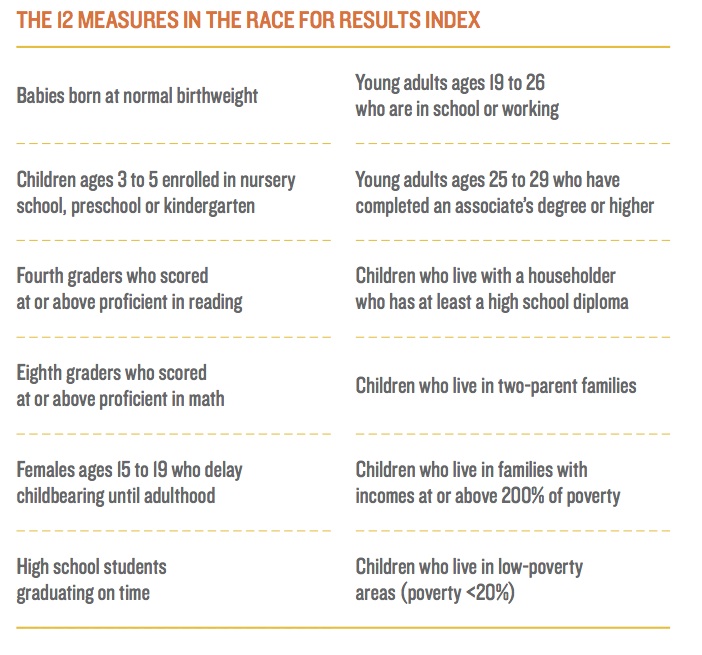
Social inequity remains grounded significantly in race and class, as measured in 12 indicators in The Race for Results Index (see p. 6):

12 indicators of The Race for Results Index

[click to enlarge]

Broadly, the report finds:

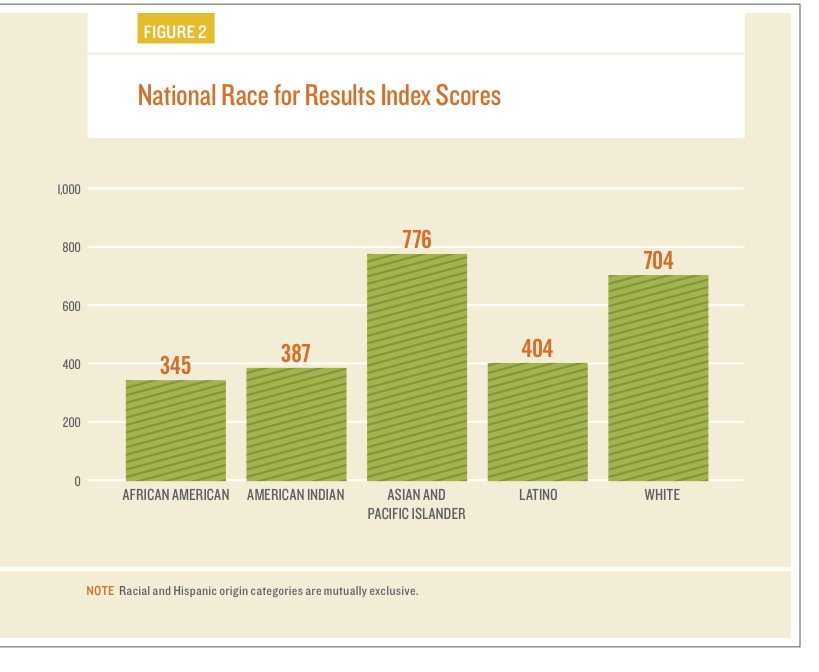
As the national data show, no one group has all children meeting all milestones. African-American, American Indian and Latino children face some of the biggest obstacles on the pathway to opportunity. As Figure 2 illustrates, Asian and Pacific Islander children have the highest index score at 776, followed by white children at 704. Scores for Latino (404), American Indian (387) and African-American (345) children are considerably lower. (p. 8)

Index scores by race

[click to enlarge]

While the overall inequity for African American and Latino/a children [1] is nation-wide, many states—often high-poverty and high-minority states (such as my home state of SC)—rank low in childhood opportunity for children of color:

state by state Afican American

[click to enlarge]

state by state Latino/a

[click to enlarge]

The report concludes with four recommendations:

RECOMMENDATION 1

Gather and analyze racial and ethnic data to inform all phases of programs, policies and decision making….

RECOMMENDATION 2

Use data and impact assessment tools to target investments to yield the greatest impact for children of color….

RECOMMENDATION 3

Develop and implement promising and evidence-based programs and practices focused on improving outcomes for children and youth of color….

RECOMMENDATION 4

Integrate economic inclusion strategies within economic and workforce development efforts….(pp. 22-28)

Ultimately, the report argues:

As profound demographic shifts, technological advances and changes in global competition race toward us, no individual can afford to ignore the fact that regardless of our own racial background or socioeconomic position, we are inextricably interconnected as a society. We must view all children in America as our own — and as key contributors to our nation’s future. (p. 28)

As I have stated about the paradox of race, the U.S. is neither a post-racial country, nor should that be our goal. Along with genuinely acting as if “they’re all our children,” we must see race as a part of an equitable society and set aside reducing life to a race to the top that must sacrifice some for the good of a few.

[1] This post focuses on the racial dynamic of white, African American, and Latino/a since my work primarily addresses SC, where that dynamic is dominant. Not addressing the remaining ethnic groups in the report is not intended to marginalize those children or the significance of any racial minority.

On Children and Childhood

children guessed(but only a few
and down they forgot as up they grew

“[anyone lived in a pretty how town],” e.e. cummings

In one of those early years of becoming and being a teacher, when I was still teaching in the exact room where I had been a student (a school building that would eventually be almost entirely destroyed by a fire set by children), it was the first day of school, and I was calling that first roll—a sort of silly but important ritual of schooling for teachers and students.

Toward the back of the room and slightly to my left sat a big young man, a white male student typical of this rural upstate South Carolina high school in my home town; like me, he would accurately be considered in that context as a Redneck.

Just about everyone knows everyone in my hometown, and we are very familiar with the common names of that town. So when I came to this young man’s name—Billy Laughter (it rhymes with “slaughter”)—I said “Billy Laughter” (rhyming the last name with “after”).

Smiling, I scanned the room and then turned my eyes back to Billy; he was red-faced and on the edge of having a very bad first day, one that was likely going to result in his being punished for my having done a very stupid thing. I raised my hand, palm facing him, and said, “Billy, my mistake. I’m sorry. I was trying to be funny but it wasn’t.” And then I said his name correctly.

Billy had suffered a life of people mangling his name, and he wasn’t in any mood for my being clever on the first day of school.

Several years later, when I was teaching a U.S. history class as part of  my usual load as a member and chair of the English department, while I was having students form small groups, two young white males bumped into each other, back to back, while moving their desks. I caught the moment out of the corner of my eye and had to rush over to deter the fight that was about to occur.

I wasn’t surprised—this was typical of my small community, along with fights starting because “he/she looked at me wrong”—but some time after this, I saw a research study that explained how people in the South and North handled personal space differently. In the South, bumping into someone or looking at someone wrong is often interpreted as challenging someone’s honor, requiring a response. People in the North, conditioned by mass transit and crowded cities (I suspect the study was as much about rural and urban, as South and North), are not as apt to find acts of close proximity anything other than that.

So setting aside the urge to examine the Redneck honor code, I want to add just one more event from my coaching life in those middle years of my teaching.

While running a drill at soccer practice, I heard a comment from a player in a group behind me. My mind heard a player with whom I had been having trouble. He was difficult in class and on the team, and worst of all, he was very disruptive at practice.

I turned and, without hesitating, I announced, “You are out of here,” pointing with my finger up the hill. Throwing him out of practice? No, I kicked him off the team.

As the young man was walking up that hill, a timid player on the team said, “Coach, that was me.”

I had just kicked a young man off the team who had, in fact, not said a thing.

A day or so ago, I received an email from Alfie Kohn about his new book, The Myth of the Spoiled Child. Alfie was apologetic about self-promotion so I replied, thanked him for the book, and noted a book I am co-editing that appears to be of a similar mind about children and childhood, Pedagogies of Kindness and Respect: On the Lives and Education of Children.

I also noted that our perspectives on children—on how parents, teachers, and society treat children—appears to be a minority view.

I have been mulling, then, or more likely stewing about this for some time: What makes adults—even the ones who choose to spend their lives with children—so damned negative and hateful about those children?

That, I must admit, is the source of my palpable anger at the “grit,” “no excuses,” and “zero tolerance” narratives and policies.

I grew up and live in the South where the default attitude toward children remains that they are to be seen and not heard, that a child’s role is to do as she/he is told. If a child crosses those lines, then, we must teach her/him a lesson, show her/him who is boss—rightfully, we are told, by hitting that child: spare the rod spoil the child.

That Christ’s love comes in the form of corporal punishment has never made any sort of sense to me, but I find that same deficit view of children is not some backwoods remnant of the ignorant South; it is the dominant perspective of children throughout the U.S.

Barbara Kingsolver explains in “Everybody’s Somebody’s Baby”:

This is not the United States.

For several months I’ve been living in Spain, and while I have struggled with the customs office, jet lag, dinner at midnight and the subjunctive tense, my only genuine culture shock has reverberated from this earthquake of a fact: People here like kids. They don’t just say so, they do. Widows in black, buttoned-down c.e.o.’s, purple-sneakered teen-agers, the butcher, the baker, all have stopped on various sidewalks to have little chats with my daughter. Yesterday, a taxi driver leaned out his window to shout ” Hola, guapa !” My daughter, who must have felt my conditioned flinch, looked up at me wide-eyed and explained patiently, “I like it that people think I’m pretty.”

With a mother’s keen myopia, I would tell you, absolutely, my daughter is beautiful enough to stop traffic. But in Santa Cruz de Tenerife, I have to confess, so is every other person under the height of one meter. Not just those who agree to be seen and not heard. When my daughter gets cranky in a restaurant (and really, what do you expect at midnight?), the waiters flirt and bring her little presents and nearby diners look on with that sweet, wistful gleam of eye that before now I have only seen aimed at the dessert tray. Children are the meringues and eclairs of this culture. Americans, it seems to me now, sometimes regard children as a sort of toxic-waste product: a necessary evil, maybe, but if it’s not their own they don’t want to see it or hear it or, God help us, smell it.

I just don’t get it.

A child is not a small adult, not a blank slate to be filled with our “adult weariness,” or a broken human that must be repaired (I won’t belabor, but the whole Original Sin idea doesn’t help and justifies the drive to use the rod).

But it is also certainly true that children are not angels, not pure creatures suited to be simply set free to find the world on their own.

Seeing children through deficit or ideal lenses does not serve them—or anyone—well.

And within the U.S. culture there is a schizophrenia—we worship young adulthood in popular media, but seem to hate children—that is multiplied exponentially by a lingering racism and classism that compounds the deficit view of childhood. Consider the research showing how people view children of color:

Asked to identify the age of a young boy that committed a felony, participants in a study routinely overestimated the age of black children far more than they did white kids. Worse: Cops did it, too….

The correlation between dehumanization and use of force becomes more significant when you consider that black boys are routinely estimated to be older than they are….

The less the black kids were seen as human, the less they were granted “the assumption that children are essentially innocent.” And those officers who were more likely to dehumanize black suspects overlapped with those who used more force against them.

In the enduring finger-pointing dominant in the U.S.—blaming the poor for their poverty, blaming racial minorities for the burdens of racism, blaming women for the weight of sexism—we maintain a gaze that blinds us to ourselves, allows us to ignore that in that gaze are reflections of the worst among us.

Why do the police sweep poor African American neighborhoods and not college campuses in search of illegal drugs? Why do we place police in the hallways of urban high schools serving mostly poor African American and Latino/a students, demanding “zero tolerance”? Why are “grit” narratives and “no excuses” policies almost exclusively targeting high-poverty, majority-minority schools (often charter schools with less public oversight)?

When I raise these questions, I can rest assured I will inspire the same sort of nasty response I often encounter when cycling. A few motorists make their anger known when we are riding our bicycles, and I am convinced that while some are genuinely frustrated with our blocking temporarily the road, the real reason they are angry is that we are enjoying ourselves as children do.

And nothing angers a bitter adult as much as the pleasures of a child.

Children are not empty vessels to be filled, blank hard drives upon which we save the data we decide they should have. Children are not flawed or wild, needing us neither to repair nor break them.

And children are not to be coddled or worshipped.

They are children, and they are all our children.

Yes, there are lessons to be taught, lessons to be learned. But those driven by deficit or idealized views are corrupted and corrupting lessons.

Each and every child—as all adults—deserves to have her/his basic dignity respected, first, and as adults charged with the care of any child, our initial question before we do anything with or to a child must be about ourselves.

In 31 years of teaching, I can still see and name the handful of students I mis-served, like Billy above. Those faces and names serve as my starting point: With any child, first do no harm.

The ends can never justify the means.

“What These Children Are Like”: Rejecting Deficit Views of Poverty and Language

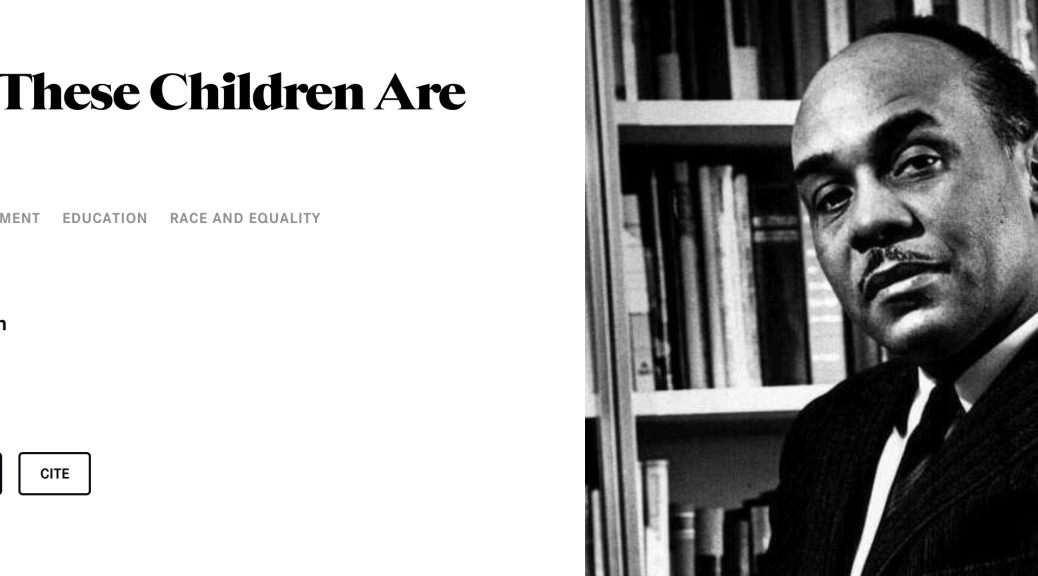
“I am an invisible man,” begins Ralph Ellison‘s enduring modern classic Invisible Man, which transforms a science fiction standard into a metaphor for the African American condition in the U.S.

Less recognized, however, is Ellison’s extensive non-fiction work, including a lecture from 1963 at a seminar for teachers—“What These Children Are Like.”

More than 50 years ago, Ellison was asked to speak about “‘these children,’ the difficult thirty percent,” the disproportionate challenges facing African American children in U.S. schools. Ellison’s discussion of language among African Americans, especially in the South, offers a powerful rejection of enduring cultural and racial stereotypes:

Some of us look at the Negro community in the South and say that these kids have no capacity to manipulate language. Well, these are not the Negroes I know. Because I know that the wordplay of Negro kids in the South would make the experimental poets, the modern poets, green with envy. I don’t mean that these kids possess broad dictionary knowledge, but within the bounds of their familiar environment and within the bounds of their rich oral culture, they possess a great virtuosity with the music and poetry of words. The question is how can you get this skill into the mainstream of the language, because it is without doubt there. And much of it finds its way into the broader language. Now I know this just as William Faulkner knew it. This does not require a lot of testing; all you have to do is to walk into a Negro church….

But how can we keep the daring and resourcefulness which we often find among the dropouts? I ask this as one whose work depends upon the freshness of language. How can we keep the discord flowing into the mainstream of the language without destroying it? One of the characteristics of a healthy society is its ability to rationalize and contain social chaos. It is the steady filtering of diverse types and cultural influences that keeps us a healthy and growing nation. The American language is a great instrument for poets and novelists precisely because it could absorb the contributions of those Negroes back there saying “dese” and “dose” and forcing the language to sound and bend under the pressure of their need to express their sense of the real. The damage done to formal grammar is frightful, but it isn’t absolutely bad, for here is one of the streams of verbal richness….

I’m fascinated by this whole question of language because when you get people who come from a Southern background, where language is manipulated with great skill and verve, and who upon coming north become inarticulate, then you know that the proper function of language is being frustrated.

The great body of Negro slang–that unorthodox language–exists precisely because Negroes need words which will communicate, which will designate the objects, processes, manners and subtleties of their urban experience with the least amount of distortion from the outside. So the problem is, once again, what do we choose and what do we reject of that which the greater society makes available? These kids with whom we’re concerned, these dropouts, are living critics of their environment, of our society and our educational system, and they are quite savage critics of some of their teachers.

What Ellison is rejecting is a deficit view of language as well as a deficit view of people living in poverty that blurs with racial prejudices. This deficit view is not some remnant of history, however; in fact, a deficit view of language and impoverished people is one of the most resilient and often repeated claims among a wide range of political and educational ideologies [1].

For example, Robert Pondiscio notes in a post for Bridging Differences:

We know that low-SES kids tend to come to school with smaller vocabularies and less ‘schema’ than affluent kids, and both of these are correlated with (and probably caused by) poverty. Low-SES kids have heard far fewer words and enjoyed few to no opportunities for enrichment.

When I posted a challenge to this deficit view, Labor Lawyer added this comment:

How about the seminal research outlined in Hart & Risley’s “Meaningful Differences”? Their research showed that there were significant differences in how low-SES parents and high-SES parents verbally interacted with their children + that the low-SES parents’ interactions were generically inferior, not just reflective of different vocabularies. The low-SES parents spoke less often to their children, used fewer words, used fewer different words, initiated fewer interactions, responded less frequently to the child’s attempt to initiate an interaction, used fewer encouraging words, and used more prohibitive words.

Two important points must be addressed about deficit views of language among impoverished people: (1) Ellison’s argument against a deficit view from 1963 is strongly supported by linguists, anthropologists, and sociologists, but (2) the flawed Hart and Risley study remains compelling, not because the research is credible (it isn’t), but because their claims match cultural assumptions about race and class, assumptions that are rooted in prejudices and stereotypes.

One powerful example of the popularity of a deficit view of language and poverty is the success of Ruby Payne’s framework of poverty books and teacher training workshops—despite a strong body of research refuting her claims and despite her entire framework lacking any credible research [2].

To understand the problems associated with deficit views of language and poverty, the Hart and Risley study from 1995 must be examined critically, as Dudley-Marling and Lucas published in 2009 [3].

Hart and Risley: Six African American Families on Welfare in Kansas City

Dudley-Marling and Lucas reject the deficit view of poverty and language, calling instead for an asset view. They note that deficit views place an accusatory gaze on impoverished parents, and thus, blaming those parents reinforces stereotypes of people in poverty and allows more credible sources of disproportionate failure by students in poverty and minority students to be ignored.

Since the political, social, and educational embracing of deficit views is commonly justified by citing Hart and Risley (1995) [4], Dudley-Marling and Lucas carefully detail what the study entails and how the claims made by Hart and Risley lack credibility.

First, Hart and Risley

studied the language interactions of parents and children in the homes of 13 upper-SES (1 Black, 12 White), 10 middle-SES (3 Black, 7 White), 13 lower-SES (7 Black, 6 White), and 6 welfare (all Black) families, all from Kansas City. Families were observed for one hour each month over a period of 2 1/2 years, beginning when children were 7–9 months old. (p. 363)

Dudley-Marling and Lucas stress:

What is particularly striking about Hart and Risley’s data analysis is their willingness to make strong, evaluative claims about the quality of the language parents directed to their children….

Many educational researchers and policy makers have generalized the findings about the language and culture of the 6 welfare families in Hart and Risley’s study to all poor families. Yet, Hart and Risley offer no compelling reason to believe that the poor families they studied have much in common with poor families in other communities, or even in Kansas City for that matter. The primary selection criterion for participation in this study was socioeconomic status; therefore, all the 6 welfare families had in common was income, a willingness to participate in the study, race (all the welfare families were Black), and geography (all lived in the Kansas City area). (pp. 363, 364)

In other words, Hart and Risley make causational claims based on a very limited sample, and those claims are widely embraced because they speak to the dominant culture’s assumptions about race and class, but not because the study’s data or claims are valid. Dudley-Marling and Lucas explain:

Conflating correlation with causation in this way illustrates the “magical thinking” that emerges when researchers separate theory from method (Bloome et al., 2005). Hart and Risley make causal claims based on the co-occurrence of linguistic and academic variables, but what’s missing is an interpretive (theoretical) framework for articulating the relationship between their data and their claims….

The discourse of “scientifically based research,” which equates the scientific method with technique, has led to a body of research that is resistant to meaningful (theoretical) critique. Hart and Risley’s conclusions about the language practices of families living in poverty, for example, are emblematic of a discourse of language deprivation that “seems impervious to counter evidence, stubbornly aligning itself with powerful negative stereotypes of poor and working-class families. It remains the dominant discourse in many arenas, both academic and popular, making it very difficult to see working-class language for what it is . . . or to be heard to be offering a different perspective.” (Miller, Cho, & Bracey, 2005b, p. 153)…

[T]hey are establishing a norm thoroughly biased in favor of middle- and upper-middle-class children. This common-sense rendering of the data pathologizes the language and culture of poor families, reflecting harmful, long-standing stereotypes that hold the poor primarily responsible for their economic and academic struggles (Nunberg, 2002). (p. 367)

The accusatory blame, then, focusing on impoverished parents is a powerful and detrimental consequence of deficit views of poverty and language, as Dudley-Marling and Lucas add:

Blaming the poor for their poverty in this way leaves no reason to consider alternative, systemic explanations for poverty or school failure. There is, for example, no reason to wonder how impoverished curricula (Gee, 2004; Kozol, 2005; Oakes, 2006), under-resourced schools (Kozol, 1992), and an insufficiency of “high-quality” teachers in high-poverty schools (Olson, 2006) limit the academic performance of many poor students. Nor is there any reason to consider how the conditions of poverty affect children’s physical, emotional, and neurological development and day-to-day performance in school (Books, 2004; Rothstein, 2004). Recent research in neuroscience, for example, indicates that the stresses of living in poverty can impair children’s brain development (Noble, McCandliss, & Farah, 2007). But most Americans do not easily embrace systemic explanations for academic failure. In our highly individualistic, meritocratic society, it is generally assumed that academic underachievement is evidence of personal failure (Mills, 1959). (p. 367)

That deficit views of language and poverty remain compelling is yet another example of a research base being discounted because cultural beliefs offer pacifying blinders:

Rolstad (2004) laments that “linguistically baseless language prejudices often underlie [even] well-designed, well-conducted studies” (p. 5). Linguistic research conducted within theoretical and anthropological linguistics and sociolinguistics that demonstrates the language strengths of children from non-dominant groups “has had virtually no impact on language-related research elsewhere” (Rolstad, 2004, p. 5). The deficit-based research of Hart and Risley, with all of its methodological and theoretical shortcomings, has been more persuasive than linguistic research that considers the language of poor families on its own terms (e.g., Labov, 1970; Heath, 1983; Michaels, 1981; Gee; 1996; see also Michaels, 2005), perhaps because Hart and Risley’s findings comport with long-standing prejudices about the language of people living in poverty (Nunberg, 2002). (pp. 367-368)

Continuing, then, to cherry-pick one significantly flawed study in order to confirm cultural stereotypes reveals far more about society and education in the U.S. than it does about children living and learning in poverty.

Despite many well-meaning educators embracing this deficit view as well as Hart and Risley’s flawed study, seeking to help students from impoverished backgrounds acquire the cultural capital associated with the dominant grammar, usage, and vocabulary is actually inhibited by that deficit view:

Finally, Hart and Risley draw attention to a real problem that teachers encounter every day in their classrooms: children enter school with more or less of the linguistic, social, and cultural capital required for school success. However, we take exception to the characterization of this situation in terms of linguistic or cultural deficiencies. Through the lens of deficit thinking, linguistic differences among poor parents and children are transformed into deficiencies that are the cause of high levels of academic failure among poor children. In this formulation, the ultimate responsibility for this failure lies with parents who pass on to their children inadequate language and flawed culture. But, in our view, the language differences Hart and Risley reported are just that—differences. All children come to school with extraordinary linguistic, cultural, and intellectual resources, just not the same resources. (p. 369)

A larger point we must confront as well is that all efforts to describe and address any social class as monolithic is flawed: Neither all affluent nor all impoverished children are easily described by what they have and don’t have. In fact, social classifications and claims about a culture of poverty are equally problematic as deficit views of poverty and language [5].

Just as Ellison confronted, U.S. society and schools remain places where minority and impoverished children too often fail. Much is left to be done to correct those inequities—both in society and in our schools—but blaming impoverished and minority parents as well as seeing impoverished and minority children (no longer invisible) as deficient stereotypes behind a false justification of research has never been and is not now the path we should take.

“I don’t know what intelligence is,” concludes Ellison in his lecture:

But this I do know, both from life and from literature: whenever you reduce human life to two plus two equals four, the human element within the human animal says, “I don’t give a damn.” You can work on that basis, but the kids cannot. If you can show me how I can cling to that which is real to me, while teaching me a way into the larger society, then I will not only drop my defenses and my hostility, but I will sing your praises and help you to make the desert bear fruit.

Continuing to embrace a deficit view of poverty and language is to embrace a desert that will never bear fruit.

[1] The source of this blog post is a comment on a post at Education Week, but deficit views of language by social class, notably the standard claim that children in poverty speak fewer words than children in middle-class and affluent homes, are common and not unique to the blog post identified here.

[2] Please see this bibliography of scholarship discrediting Payne’s framework. See also:

Thomas, P.L. (2010, July). The Payne of addressing race and poverty in public education: Utopian accountability and deficit assumptions of middle class AmericaSouls, 12(3), 262-283.

[3] See Dudley-Marling, C., & Lucas, K. (2009, May). Pathologizing the language and culture of poor childrenLanguage Arts, 86(5), 362-370.

[4] Hart, B., & Risley, T. R. (1995). Meaningful differences in the everyday experiences of young American children. Baltimore: Brookes.

[5] Please consider the following works in order to confront a wide range of problems associated with class and poverty:

Return of the Deficit, Curt Dudley-Marling

The Myth of the Culture of Poverty, Paul Gorski

Poor Teaching for Poor Children … in the Name of Reform, Alfie Kohn

The Pedagogy of Poverty Versus Good Teaching, Martin Haberman

CALL FOR PROPOSALS: Pedagogies of Kindness and Respect: On the Lives and Education of Children

CALL FOR PROPOSALS

Pedagogies of Kindness and Respect: On the Lives and Education of Children

Edited by P. L. Thomas, Paul R. Carr, Julie Gorlewski, and Brad Porfilio

Peter Lang USA

Rethinking Childhood Series, Gaile Cannella, series editor

Call and Submission Requirements

Submit a proposal of about 300 words by February 28, 2014, to paul.thomas@furman.edu.

Chapter initial drafts due July 15, 2014, should be in APA citation/style format (see citation proofing guidelines below) and 5,500-6,500 words. Authors are urged to submit clean and carefully edited drafts to enhance the editing process. Please take great care with block quotes (do not set off with returns and tabs) and hanging indents in the references list (do not create hanging indents with return/tab, but use the ruler or Menu>Format>Paragraph>Special>Hanging Indent). (Please read carefully below the background underpinning informing this volume.) Also, it is important to have complete bibliographic information with up-to-date references. (See the end of this document for more information on APA).

Topics, problems, and practices addressing the following will be included:

  • How are “no excuses” ideologies dominant in child rearing and schooling in the U.S. and elsewhere? How are these practices harmful to children?
  • Why are the Commons essential to a thriving democracy, and how does a cultural attitude toward children impact that culture’s commitment to the Commons (notably public schools)?
  • What constitutes pedagogies of kindness and respect?
  • What practices in child rearing and schooling reflect pedagogies of kindness and respect?
  • How are attitudes and practices related to children connected to democratic values?
  • How are current educational structures reflecting and perpetuating stratified opportunities for children, and what education reform alternatives address those structures?
  • How does kindness play into the conceptualization of educational curricula, pedagogy, policy and evaluation?

Submission of Chapter Proposals

To be included in the 300 words are:

  1. Name(s) and affiliation(s) of author(s)
  2. Proposed title
  3. A detailed abstract on the focus of the proposed chapter, including conceptual, theoretical and methodological frameworks as well as the central research question.
  4. A list of 8 keywords.
  5. Also attach the CV(s) for the proposed author(s).

Points of Emphasis

Because we are living in times of historical amnesia, the chapters themselves should be critical, illustrate multiplicity and nuance, and demonstrate an awareness of historical and critical constructions of childhood (and the past work done related to these areas).  The following are examples of expectations for the work:

  1. The fields of education, and especially early childhood education, have included some histories and perspectives that view/treat those who are younger with kindness and respect.  Examples include the works of Nel Noddings (1992), The Challenge to Care in Schools, and Lisa Goldstein (1998), Teaching with Love (in Peter Lang’s Rethinking Series) as well as various scholarly and educational models practiced or put forward by multiple educators and scholars.  Chapters in the work should demonstrate an informed awareness of this history and the ways that both old and new ideas can counter current conditions that are harmful to both those who are younger and older.
  2. The chapters should avoid reconstitution of the romantic, innocent child to be saved by more advanced adults; this has been addressed by many.  The issue is the context in which we are all being placed (not that we should protect the “innocent” child) that is harmful to those who are younger, as well as everyone else.
  3. The notion of two interpretations of childhood: (a) those who are poor who are also often labeled as not knowing how to raise their children so needing help, and (b) those who are privileged and know how to raise their children, has been discussed and problematized over the past 30 years.  Rather than treating this circumstance as a new revelation, the issue is “why has this circumstance continued and even worsened?”  The gap between the rich and poor has certainly increased (why?); testing and standards based education has been critiqued as problematic, but the practices are more accepted than ever (why?); why has past work been ignored and what can be done to change our current circumstances?

Timeline

  • Call, proposals due: February 28, 2014
  • Accepted chapters: March 15, 2014
  • Chapters due: July 15, 2014
  • Revised/final chapters due: September 30, 2014
  • Manuscript delivered: October 15, 2014

Background

Eliot Rosewater in Kurt Vonnegut’s God Bless You, Mr. Rosewater implores:

“Go over to her shack, I guess. Sprinkles some water on the babies, say, ‘Hello, babies. Welcome to Earth. It’s hot in the summer and cold in the winter. It’s round and wet and crowded. At the outside, babies, you’ve got about a hundred years here. There’s only one rule that I know of, babies—:

“‘God damn it, you’ve got to be kind.’” (p. 129)

In Sandra Cisneros’s short story “Eleven,” Rachel sits in class on her eleventh birthday, a day in which she is confronted by her teacher about a found red sweater that the teacher is certain belongs to Rachel:

“Of course it’s yours,” Mrs. Price says. “I remember you wearing it once.” Because she’s older and the teacher, she’s right and I’m not. (Cisneros, 2004, p. 42)

While these are fictional representations, children live in a state of powerlessness, silenced by the hierarchy of authority. The sweater in Cisneros’s story is, in fact, not Rachel’s, but as the narration reveals, facts are secondary to hierarchy.

In the U.S. and throughout the world, children tend to experience not only silencing but also a level of harshness not found in other cultures.

The twenty-first century remains a harsh place for children in their lives and their schools, even in the U.S. where childhood poverty is over 20% and the new majority of public schools involve children in poverty (A new majority, 2013).

But more than the conditions of children’s lives and schools in 2013 is worth addressing. As Barbara Kingsolver (1995) details in “Somebody’s Baby”:

What I discovered in Spain was a culture that held children to be meringues and éclairs. My own culture, it seemed to me in retrospect, tended to regard children as a sort of toxic-waste product: a necessary evil, maybe, but if it’s not our own we don’t want to see it or hear it or, God help us, smell it. (p. 100)

A sort of cultural antagonism and authoritarian control of children pervades the U.S., and during the current thirty-year cycle of accountability, children tend to face this formula[i]:

If children in the U.S. can survive the gauntlet that is the national formula for children, as young adults they can look forward to crushing debt to attend college so that they can enter a nearly non-existent workforce.

But there is a caveat to this formula: The U.S. formula for children above is for “other people’s children,” that new majority in U.S. public schools and those children living in homes of the working poor, the working class, and the dwindling middle class.

Children of the privileged are exempt.

This volume will collect a wide variety of accessible chapters from scholars and practitioners to explore pedagogies of kindness, an alternative to the “no excuses” ideology now dominating how children are raised and educated in the U.S. The genesis of this volume cane be linked to two poems by P.L. Thomas: “the archeology of white people” and “the kindness school (beyond the archeology of white people, pt. 2),” the second of which reads in full:

it simply happened one day
when the teachers decided
enough was enough

all the boys with OCD
spent the day playing drums
or riding their bicycles

and the introverts sat quietly
smiling periodically in the corners
while the extroverts laughed and laughed

and soon the pleasures became many
as varied as the children themselves
until one day a child stood to proclaim

after reading Hamlet all on her own
“I say, we will have no more tests”
to which there was thunderous cheering

yes it seemed simple and obvious enough
the founding of the kindness school
with open doors and children singing

References

Cisneros, S. (2004). Vintage Cisneros. New York, NY: Vintage Books.

Kingsolver, B. (1995). High tide in Tucson: Essays from now and never. New York, NY: Perennial.

A new majority: Low income students in the South and nation. (2013, October). Atlanta, GA: Southern Education Foundation. Retrieved from http://www.southerneducation.org/getattachment/0bc70ce1-d375-4ff6-8340-f9b3452ee088/A-New-Majority-Low-Income-Students-in-the-South-an.aspx

Vonnegut, K. (1965). God bless you, Mr. Rosewater or pearls before swine. New York, NY: Delta.

See also:

https://radicalscholarship.wordpress.com/2013/10/26/on-children-and-kindness-a-principled-rejection-of-no-excuses/

https://radicalscholarship.wordpress.com/2013/10/22/medicating-adhd-in-the-brave-new-world-of-high-stakes-accountability/

http://www.alternet.org/education/why-sending-your-child-charter-school-hurts-other-children

http://www.alternet.org/education/theyre-all-our-children

Citation Proofreading Guidelines

APA — Please copyedit submissions carefully to be sure you have cited following the APA style sheet; below are key points of emphasis that still need addressing in many chapters (also see for guidance https://owl.english.purdue.edu/owl/resource/560/01/):

Copyedit carefully references, noting APA format for titles of books and article (CAP first letter of title, first letter of subtitle and proper nouns ONLY [for example The handmaid’s tale]; journal titles use standard CAP conventions [for example: English Journal]). Essay and chapter titles do NOT require QMs, but book and journal titles remain in ITAL. Also be careful to ensure that each reference conforms to the type of work you are citing; the OWL link has a wide range of samples on the left menus, and it is crucial that you match the type of work being cited to the format. The initial information in each reference bibliography MUST match your in-text citations. For example:

in-text example

James Baldwin (1998), in “A Report from Occupied Territory” (originally published in The Nation, July 11, 1966), confronted an “arrogant autonomy, which is guaranteed the police, not only in New York, by the most powerful forces in American life” (p. 737) and the corrosive deficit view of race it is built upon.

reference

Baldwin, J. (1998). James Baldwin: Collected essays. New York, NY: The Library of America.

In-text guidelines include the following key elements:

First paraphrased reference to a source in EACH new paragraph must include either Author (year) or (Author, year). PLEASE keep Author (year) or (Author, year) in conjunction; do NOT place the year isolated from the author name. All subsequent uses in that paragraph require only either Author or (Author). Please note that parenthetical cites in the flow of your sentences require that the period come AFTER the ( ). ; for block quotes, the period comes BEFORE .( )

example

America the Beautiful created a minority class out of a race of people who are as rich, vibrant, and beautiful as any race of people. America the Beautiful has also created a criminal class out of African American men, building a new Jim Crow system (Alexander, 2012) with mass incarceration masked as a war on drugs. America the Beautiful created a dropout class and future criminal class out of African American young men, as Alexander details, building school-to-prison pipelines and schools-as-prisons as zero-tolerance schools imprisoning urban communities (Nolan, 2011).

In-text citing of print sources, required page numbers:

First quoted reference to a print source in EACH new paragraph must include either Author (year, p. #) or (Author, year, p. #). All subsequent uses require only either Author (p. #) or (Author, p. #). Note that a comma must separate Author, year, p. # and that a SPACE must be placed after the p. preceding the page number. For a quote from a single page use “p.” and for a quote spanning multiple pages, use “pp.” Please note that parenthetical cites in the flow of your sentences require that the period come AFTER the ( ). ; for block quotes, the period comes BEFORE .( )

example

In 1963, Ellison (2003) spoke to teachers:

At this point it might be useful for us to ask ourselves a few questions: what is this act, what is this scene in which the action is taking place, what is this agency and what is its purpose? The act is to discuss “these children,” the difficult thirty percent. We know this very well; it has been hammered out again and again. But the matter of scene seems to get us into trouble. (p. 546)

Ellison recognized the stigma placed on African American students, a deficit view of both an entire race and their potential intelligence (marginalized because of non-standard language skills). But Ellison rejected this deficit perspective: “Thus we must recognize that the children in question are not so much ‘culturally deprived’ as products of a different cultural complex” (p. 549). Ultimately, Ellison demanded that the human dignity of all children be honored.

Citing literary sources with APA:

APA is somewhat cumbersome for citing extended literary analysis, but you must first create an accurate bibliography of the cited works (such as novels) you will cite, and then maintain the above formatting principles when citing from and offering an extended analysis of that work. APA uses Author (year) or (Author, year) and not abbreviations of titles. If you are citing multiple works from an author published in the same year, you must alphabetize them in your bibliography by the titles, and then add sequential alphabet denotes that then MUST be used in the in-text citations.

example 

Typical of contemporary education reform, CCSS began as a political process driven by business interests—not as an educational process designed by classroom teachers or educational researchers (Ohanian, 2012a, 2012b, 2012c, 2011a, 2011b, n.d). In the 1980s during the first wave of accountability, state governors became the primary voice for educational reform. Those governors often used their educational bully pulpit to pursue economic and business goals—improving the workforce or attracting new companies.

[note that proper hanging indent does not show in blog format]

Ohanian, S. (2012a, November 19). Common Core reality check: Here’s how Common Core assessments plan to certify workers for the global economy (with pix)…Let’s make sure the children read ALL of Ovid while we’re at it! Substance News. Retrieved from http://www.substancenews.net/articles.php?page=3778

Ohanian, S. (2012b, October 28). Snookered by Bill Gates and the U.S. Department of Education. The Daily Censored. Retrieved from http://www.dailycensored.com/snookered-by-bill-gates-and-the-u-s-department-of-education/

Ohanian, S. (2012c, February 4). NCTE allegiance to the Common Core is burying us. SusanOhanian.org. Retrieved from http://susanohanian.org/outrage_fetch.php?id=1183

Ohanian, S. (2011a, December 7). We’re being steamrolled into one-size-fits-all. Learning Matters. Retrieved from http://learningmatters.tv/blog/web-series/discuss-are-common-core-standards-good-or-bad-for-education/8280/

Ohanian, S. (2011b, October 19). The crocodile in the Common Core Standards. Substance News. Retrieved from http://www.substancenews.net/articles.php?page=2716

Misreading “Grit”: On Treating Children Better than Salmon or Sea Turtles

Rob McEntarffer (@rmcenta) Tweeted a question to me about my blog post, The Poverty Trap: Slack, Not Grit, Creates Achievement, asking: “can Grit research (Duckworth, etc) be used as a humanizing/empowering tool, rather than a weapon against schools/kids?”

Rob’s question is both a good one and representative of the numerous challenges I received for rejecting “grit”—some of the push-back has been for my associating “grit” and “no excuses,” but many of the arguments (some heated) I have read simply rest on a solid trust that “grit” matters and thus should be central to what educators demand from their students, regardless of their students’ backgrounds (and possibly because many students have impoverished backgrounds).

I remain adamant that demanding “grit” is deeply misguided and harmful to children, especially children living in poverty. But I also acknowledge that a large percentage of educators who embrace “grit” are genuinely seeking ways in which we can help children in poverty succeed. In other words, many “grit” advocates share my educational goals.

So I think Rob’s question needs to be answered, and done so carefully. Let me start with a nostalgic story.

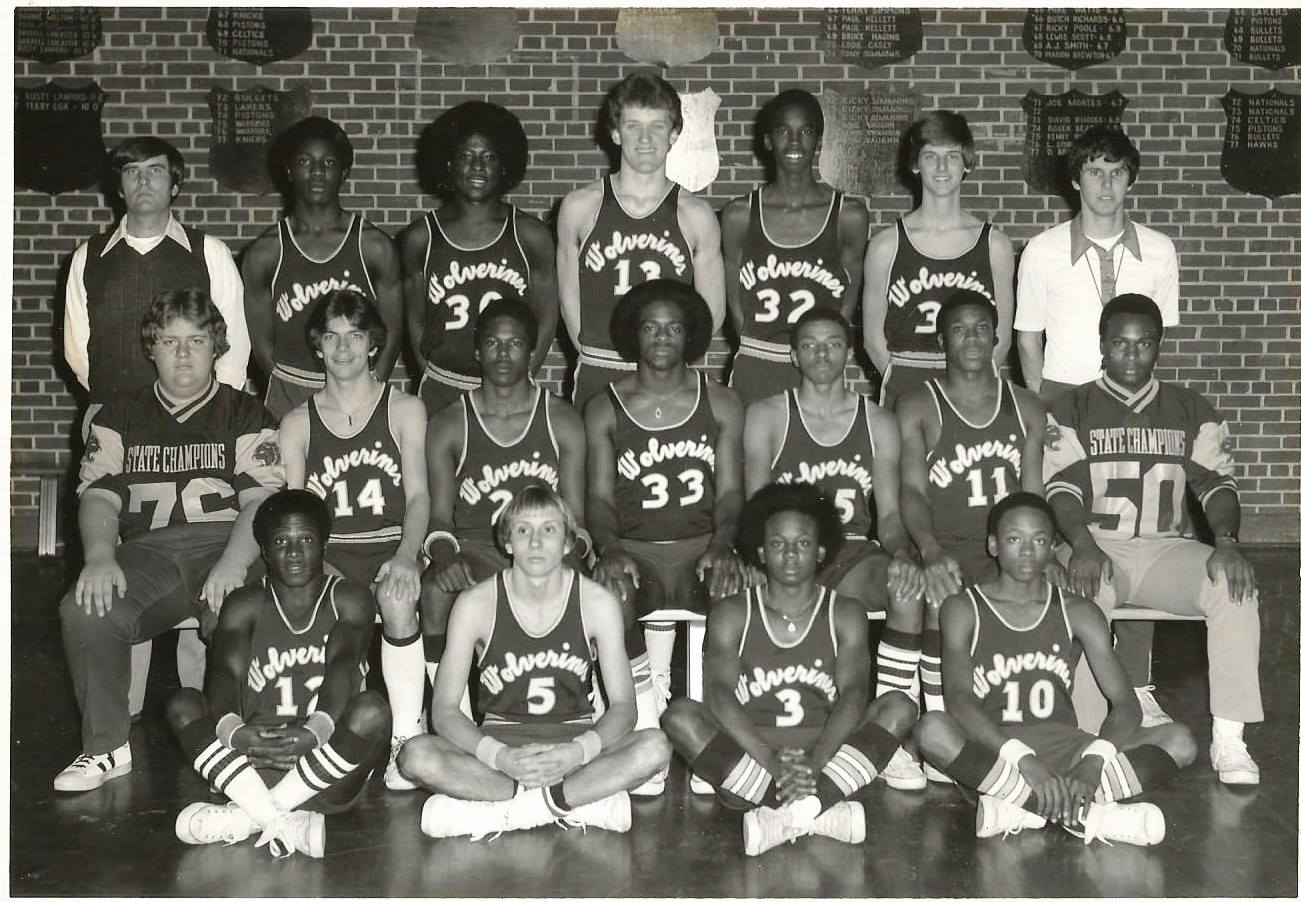
A Facebook post from a former high school friend and basketball teammate is the basis of this story—my junior year high school basketball team:

WHS basketball jr year

I am number 5, and other than wondering why I was looking away and seemingly disengaged, I am struck by my socks.

Throughout junior high and high school, I suffered the delusion I was an athlete, spending most of my free time either playing basketball or golf. My heart and soul longed for being a basketball player, and on my bedroom wall (along with the required poster of Farrah Fawcett) hung a poster of Pete Maravich who wore the same socks superstitiously every game, two pairs pushed down and tattered.

I wanted few things more than being Pistol Pete. Maravich was smart, skilled, and hard-working. Even after his career on the court, Maravich remained the personification of practice and drills: If you work hard enough, Maravich seemed to represent, you too can be a magician on the basketball court.

Soon after Maravich, I added Larry Bird to my list of role models, again latching on to his working-class ethic as an athlete. Bird prompted mythological tales—Larry Legend—about his breaking into Boston Garden to shoot in the dark when the facility was closed.

That’s right, I was a child and teenager smitten by “grit.”

After being diagnosed with scoliosis the summer before my ninth grade, I became an exercise fanatic, possibly as a response to the genetic failure of my body. I created a year-long daily calendar on poster-board each year from ninth through twelfth grades to list and monitor my workouts. For those four years, I wore ankle weights most days and jumped rope at least 300 times each night with those weights on. Every day. Four years.

My Holy Grail was dunking the basketball*—despite my being about 5’10” and around 130 pounds.

My fanaticism about practice carried over onto the driving range in good weather also. I often hit 300 range balls on the golf course practice range before setting out to play 18-27 holes.

And what did all that get me?

Look back to that junior-year photograph above. In my high school during the late 1970s, letterman jackets were the greatest treasure for want-to-be athletes like me (I often wore my father’s jacket from the 1950s to school, a jacket he earned as captain of the first state championship football team at that same high school). But the rules of receiving a letterman’s jacket revolved around lettering your junior year—no other year of lettering resulted in a jacket.

I lettered every year of high school except junior year—a year I spent almost totally on the bench. I never earned a letterman’s jacket in high school, despite lettering in two sports my senior year.

And all that golf practice resulted in a huge amount of callouses and a year on the golf team at junior college.

But I was never Pistol Pete or Larry Legend, and certainly never close to Arnold Palmer (yes, my golf fantasies had working-class heroes also).

So what is my point? I am not trying to suggest that my anecdotes of my life prove my point, but they certainly make an important case for answering Rob’s question.

You see, throughout junior high, high school, and college, I never really tried at school—I was too busy trying to be Pistol Pete and then Larry Legend. And if anyone looked at the outcomes of these two different spheres—my grades in my classes and my scrawny, blond self riding the bench of countless high school basketball games—which do you think appears to be the result of “grit,” effort?

Despite my growing up in a working class family, I thrived when I did because of a number of privileges—being white, male, and prone to math and verbal skills cherished by the school system.

And the evidence is powerful that privilege trumps effort and that human behaviors are greater reflections of the conditions of their lives (abundance or scarcity) than the content of their character.

When my junior year ended without my having earned that letterman’s jacket, I began carrying with me until this day a deep and genuine sense of failure because I wanted few things more than to hand my father back his jacket and to stand before him in the one I earned, to show him I was the man I wanted to be, which was the man he was. That was a boy’s dream, of course, because my father could not have loved me more then or now than he does.

I trust, as well, that my experiences with trying very hard at things I could never excel in and then excelling in things that required very little effort on my part do inform what I argue is a misguided commitment to “grit” in calls for education reform and in school and classroom practices, even among educators with the best of intentions. So I want to end by answering Rob with a few observations and questions I think should help us at least reconsider commitments to “grit”:

  • How do we know when one child is trying and another isn’t? And how do we know why one child works hard and another seems not to make the same effort? I recently arrived at my first year seminar class upset that so many students had failed to submit their essays on time for that class session. My assumptions were all focused on them, but once I arrived in class, I discovered they had all been having technical trouble—the campus email system wasn’t allowing attachments. The focus on “grit,” then, often maintains a singular and accusatory eye on the child, and thus ignores the context, which may be the source of the behavior.
  • How often do we misread “privilege” as “grit”? My argument is—almost always. Even when privileged people excel because of their “grit,” the distinguishing aspect of that success remains the privilege. As well, when impoverished people overcome their hurdles due to hard work and “grit,” they remain outliers, and while they should be applauded, their outlier success isn’t a credible template for everyone else struggling under the weight of poverty.
  • As I note below, “grit” may be a distorted quality among leaders because our culture is competition-based, and our leaders both feel like winners and are praised as winners. Winning is linked to effort in our society even when the effort is not the key to that success. Leaders as winners, then, tend to project their “grit” onto others—not unlike the messages found in Maravich’s basketball training videos—”Just work hard, like I did, and you can do anything!” While such messages may be inspiring, they are at least incomplete, if not mostly untrue; my efforts in high school were not failures due to my lack of effort, but due to my genetic ceiling.
  • And finally, Rob’s question directly: Can “grit” research and ideology be used as a humanizing and empowering tool, rather than a weapon against schools and children? To which I say: If we dedicate ourselves to creating the slack necessary for that “grit” to matter and for such demands to be equitable, then yes. In other words, “grit” fails when it becomes the initial and primary demand of children, superseding commitments to creating the equitable conditions that all children need in their lives and schools. My conclusion about “grit,” then, is that the ultimate concern of mine may be where we prioritize and emphasize it—and how it is used as a spotlight on children in poverty almost exclusively.

On this last point, I think, I can make my best case about why emphasizing “grit” is both misguided and harmful.

From the authoritarian extremes of “no excuses” schools such as KIPP to the more progressive embracing of “grit” that many may call “tough love,” when we honor “grit” we reduce our children to salmon and sea turtles, we create schools that perpetuate a Social Darwinism that is human-made. School, like life, for these children becomes something to survive, a mechanism for sorting.

I think we can and should do better than treating our children like salmon and sea turtles—even when we do so with love in our hearts.

* By the way, yes, I could occasionally dunk in my late teens and early twenties.

Pete Maravich: A Tribute

Aren’t All Children Equally Deserving?

A common practice for introducing students to the ethical foundation of philosophy is to pose moral dilemmas, possibly the most typical example being the life-boat dilemma that forces a person to choose who lives, and thus who dies.

Science fiction (SF) and speculative fiction often build entire other worlds in which the given circumstances create a series of moral dilemmas that are the basis of the tensions and actions of the novels and films. Writers such as Margaret Atwood (The Handmaid’s Tale, for example) and Kurt Vonnegut (Cat’s Cradle, for example) often build these worlds in the tradition of George Orwell and Aldous Huxley as a way to say, as Neil Gaiman explains about the power of fiction: “The world doesn’t have to be like this. Things can be different.”

In Cormac McCarthy’s The Road, the possible other world is one of scarcity, and by the end, the moral dilemma revolves around the fate of a child. The novel’s given, readers must accept, creates the narrow range of choices the characters face; that is part of the power of SF/speculative fiction.

Pulling back, however, from created other worlds, we are faced continually with moral dilemmas—often ones also involving children.

One such dilemma is how any society governs it schools. Confronting that dilemma in the UK, Polly Toynbee exposes dynamics that sound all too familiar in the U.S.:

Most people, right or left, would be alarmed at a trajectory of ever-worsening inequality. But few know the facts, wildly underestimating widening wealth gaps, still thinking Britain quite meritocratic. This ends the myth of modern classlessness, exposing shrinking mobility. The ladder up is so high and steep few can climb it – while those at the top exert all their power to stop their children falling down.

Citizens and institutions in both the UK and the U.S. are confronted by some troubling moral dilemmas: the rise of inequity in the wider society and the inability of public schools to overcome (as well as perpetuating) that inequity.

While debates often focus on the exact relationship between a meritocracy and its schools (a sort of “which comes first,” “chicken and egg” debate), an ethical decision about children seems to be ignored: To the question “Aren’t all children equally deserving?” the consensus in the U.S. appears to be “No.”

Education reform built on changing standards and high-stakes tests, weeding out “bad” teachers, funding the expansion of charter schools and Teach for America corp members, and retaining third graders based on their test scores is a concession to a fabricated moral dilemma. In other words, some children are more deserving (the standard among reformers is “grit,” by the way) because the reformers have conceded to a fatalistic scarcity that serves the advantages of the privileged, but leaves the middle class, the working class, the working poor, and the impoverished to fight among themselves for the scraps left behind.

Education reform in the U.S. is The Hunger Games.

Arthur H. Camins has identified the ugliest concession of them all in education reform as the Hunger Games, collateral damage:

“Whatever it takes,” is a dangerous philosophy because it tends to justify “collateral damage” in the guise of doing good things for children.  It excuses increased segregation wrought by school choice policies. It excuses flawed metrics in teacher evaluation.  It excuses the disruptions caused by open and closing of schools.  It excuses decreased instructional time for science, social studies and the arts.  It avoids exploration of meaningful debate about ideas and evidence.  It dismisses all of these consequences with the glib phrase, “Don’t let the perfect be the enemy of the good,” as if there were no alternative strategies available for improvement.  It is, I think, a calculated avoidance strategy that develops when leaders feel under siege and run out of ways to deflect valid criticism.  In the end it is a profoundly undemocratic stance.

And what given have the privileged leaders in the U.S. embraced to justify allowing all their children to remain deserving while “other people’s children” have to fight it out to show who among them are more deserving? Competition and concessions to scarcity.

However, competition and concessions to scarcity are choices, not inevitable conditions in the U.S.

As Michael B. Katz explains in The Undeserving Poor:

Poverty is deeply rooted [in the US]. Before the twentieth century, the nation lacked both the economic surplus and policy tools to eradicate it; all that could be hoped for was to ameliorate the condition of the poor by keeping them from perishing from starvation, wretched housing, and disease. The situation began to change in the twentieth century with what one historian has called the “discovery of abundance” and with increasingly sophisticated methods for transferring income, delivering services, and providing essentials of a decent life. For about a decade, this combination of abundance and method backed by popular support and political will worked spectacularly well. Since then, poverty has been allowed to grow once again, not, it must be emphasized, as the inevitable consequence of government impotence or economic scarcity, but of political will. (p. xi)

When political leaders and self-appointed education reformers point to U.S. public schools reduced to life-boats and demand that we continue to choose which children are deserving and which children are not, instead of playing the moral dilemma game they are handing us, we must begin to point back at the ship wreck they have created and concedes only this: all children are equally deserving.