
Note
Although a Vanity Fair article has framed Augusta Britt as Cormac McCarthy’s “muse,” Moira Donegan argues in The Guardian that McCarthy, in fact, groomed and took advantage of Britt.
Below, while I discuss positively McCarthy’s work and adaptations of that work, I want to acknowledge the serious concerns being raised about McCarthy as a person. He represents yet another problem with confronting deeply flawed and even abusive people against the context of what many believe are praiseworthy accomplishments.
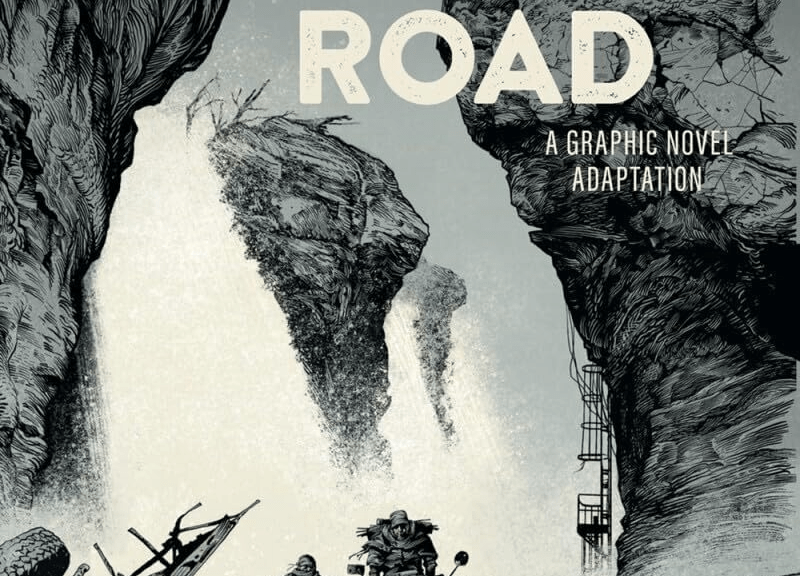
Larcenet’s Graphic Adaptation of McCarthy’s The Road
Cormac McCarthy’s novel The Road won the Pulitzer Prize in 2007. Then in 2009, it was adapted into a major film starring Viggo Mortensen and Charlize Theron.
Now, published in 2024, a third version of the novel is available, Manu Larcenet’s graphic adaptation.
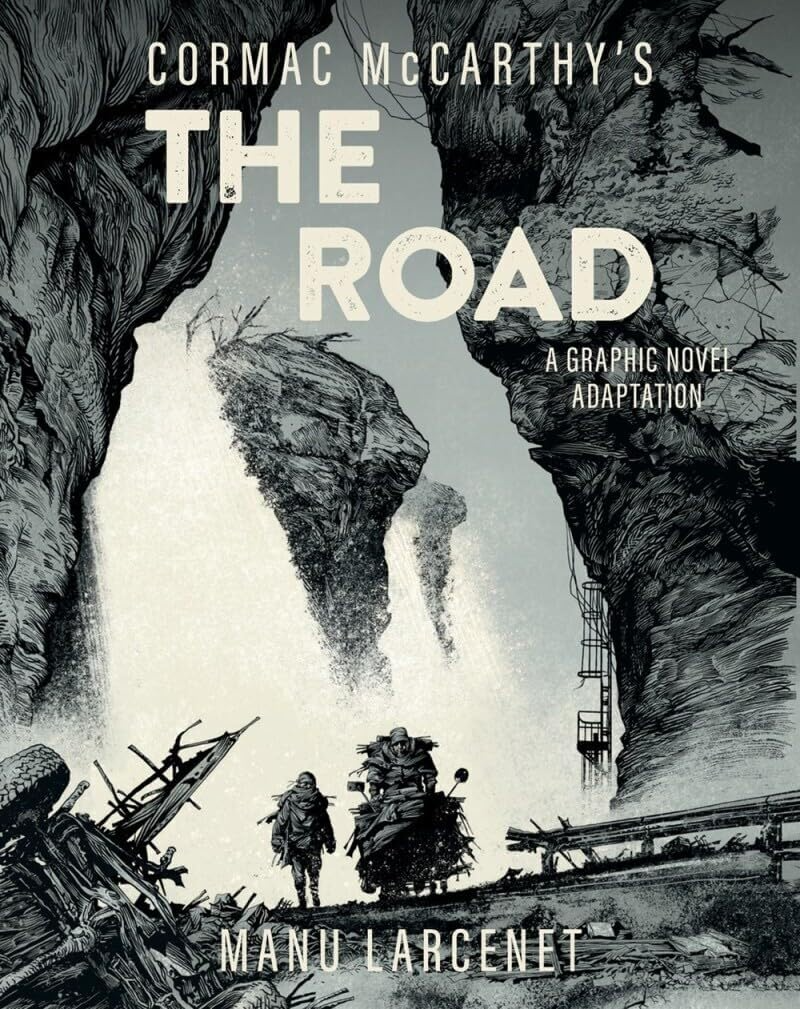
As Mike Roe notes in his review:
Larcenet made a personal appeal to McCarthy to allow him to adapt “The Road.” Praising its atmosphere, Larcenet wrote, “I enjoy drawing the snow, the chilling winds, the dark clouds, the sizzling rain, tangles and snags, rust, and the damp and the humidity. I draw violence and kindness, wild animals, dirty skin, pits and stagnant water.”
McCarthy’s novel is a stark post-apocalyptic narrative that seemed perfect for both film and now a graphic adaptation. It isn’t that McCarthy’s text isn’t enough; it is that the humanity and inhumanity of this cold barren world become even more painful for the viewer and reader through the different visual media.
Roe adds about the connection between text and graphic depiction:
“I have no other ambitions but to draw your words,” Larcenet wrote. “The magical part of being an illustrator is to find a silent line to draw with every word. These lines could support yours without distorting them. At least, that’s the goal if this project should come to fruition.”
Since The Road has already been made into a film, some may wonder why this graphic novel version is needed:
“On top of that, I’ve been racking my brain to avoid any reference to the movie adaptation,” Larcenet wrote to McCarthy. “I usually write my own comics, one of which (‘Blast’) shares common themes with your book. But I didn’t write ‘The Road’; I really wish I had! I sincerely thank you for allowing me to put my pencil down where your pen went.”
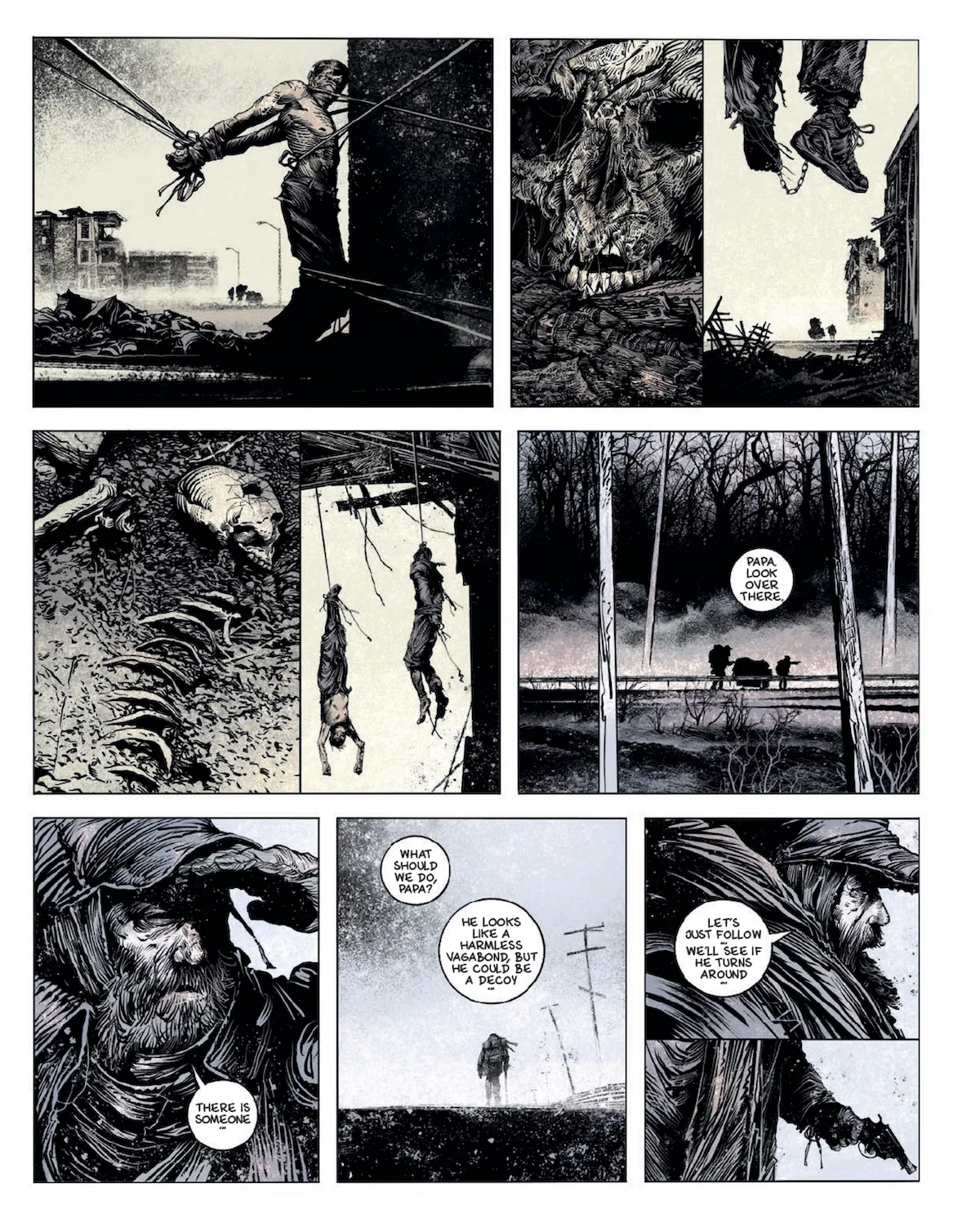
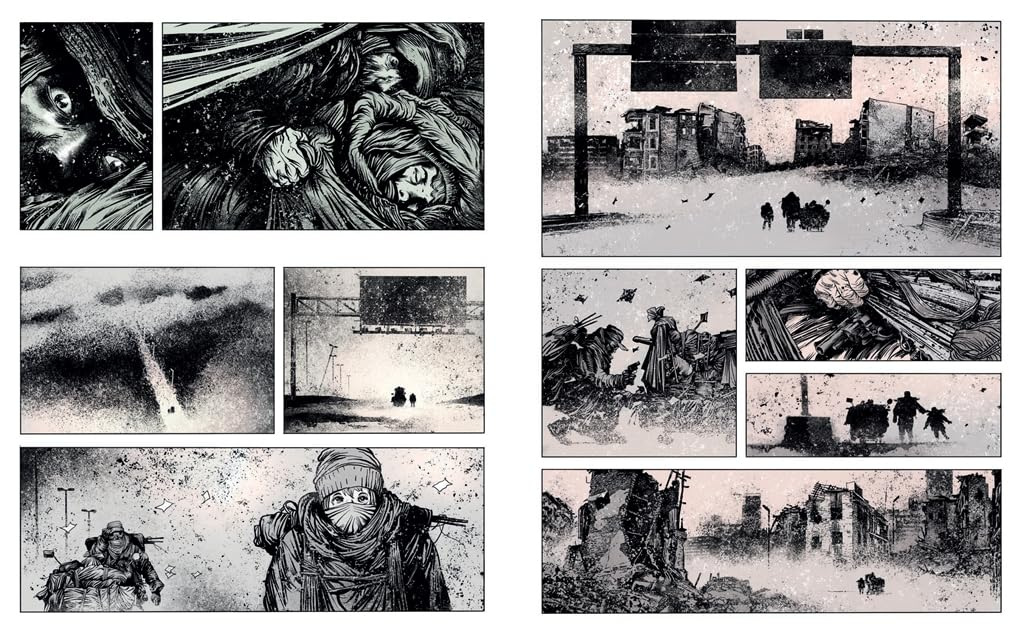
Appropriately, then, Larcenet’s adaptation is sparse in wording (many panels and pages are wordless), yet highly detailed in the mostly black-and-white artwork, augmented with subtle washes of coloring. The result is page after page that is mesmerizing and horrifying:
So why do we need yet another version of The Road?
I have read the novel and seen the film, but as a life-long comic book collector, I of course ordered Larcenet’s adaptation. But, frankly, I did so as a collector, thinking I would glance through the book because I do love sequential art.
Then, I found myself reading, lingering on pages and panels. Over a couple sittings, yes, I read the entire adaptation.
I cried. I paused because the story is often overwhelming.
This is the same and a different experience than the novel and the film.
I can’t say we need another version of McCarthy’s novel, but I do say we have been gifted by this beautiful and haunting graphic adaptation.
And since the narrative itself examines the good guys/bad guys dynamic through a child who has had his innocence ripped from him by a calloused world, we too must confront this duality in reality as we try to navigate the flawed artist and the art we love.

 dr. p.l. (paul) thomas