Tag Archives: education reform

My Open Letter to Journalists: A Critical Free Press, pt. 2

Dear Journalists (especially those who write about education):

After posting my U.S. and Education Reform Need a Critical Free Press, which represents a recurring effort in my public work to address the problems with journalism about education and education research/reports, I continued to interact with Juana Summers (NPR) and Stephen Sawchuk (Education Week) on Twitter. Those exchanges have suggested to me that I need to examine more fully what my concerns raised specifically about mainstream coverage of NCTQ’s reports mean to my wider call for a critical free press.

First, I think I need to establish the foundational context of my complaints about journalism/education journalism.

I believe journalists and teachers should be (must be) comrades in arms because a free press and universal public education are essential foundational institutions for a free people.

I am not, however, suggesting that this camaraderie is some sort of wink-wink, nod-nod collusion between the two professions in which we “cover” for each other, but that we are comrades joined by the same mission to build the free society that many claim the U.S. seeks. In fact, as comrades I expect we should be each other’s most vigilant and accurate critics to insure that we both stay the course.

And that builds on my second larger context for my concerns about journalism and my call for a critical free press. My use of the term “critical” is the source of my calls for reform of both education and journalism—two fields that reach their potential when critical, but fail when they are bound by traditional expectations of impartiality, calls that teachers and journalists avoid being “political.” Critical teachers and critical journalists are activists; they use their professions as mechanisms for change. Apolitical teachers and journalists are essentially defenders of the status quo (thus, the calls for impartiality are always loudest from those with power and wealth).

So I want to return briefly to my criticisms of mainstream media coverage of NCTQ’s latest report.

While Summers, Sawchuk, and I exchanged Tweets related to my post, Adam Bessie, whose important public work refuting the “bad” teacher meme is central to my points here, offered a Tweet that simply identified a fact about Gates funding among NPR, Education Week, and NCTQ:

@jmsummers @plthomasEdD @Stephen_Sawchuk Gates Funds NPR: http://t.co/L2YMLobtRn NCTQ: http://t.co/HCb8OrQ6ps EdWeek: http://t.co/INKq8Kp39s

— Adam Bessie (@AdamBessie) June 19, 2014

This Tweet represents the central issue to my concerns: Among the New Media (blogs, Twitter, Facebook, etc.), many critical educators have been confronting the disproportionate and inappropriate (because Gates has no credibility in the field of education, but nearly endless funds) influence of Gates on education reform—an influence that I have confronted often with a question: If Bill Gates had no money, who would listen to him about education reform? No one.

Also, Bessie’s Tweet about the ubiquity of Gates funding has finally begun to gain some traction in the mainstream press. But bloggers still carry the greatest weight for being critical about the influence of Gates on education reform. (The most common places now to find critical journalism is in the New Media, such as blogs at Education Week [see Anthony Cody and Nancy Flanagan] and The Washington Post [see Valerie Strauss] or alternative press such as Truthout and AlterNet.)

Despite Bessie’s Tweet only stating facts, Sawchuk immediately responded with this:

@AdamBessie @jmsummers @plthomasEdD As someone who works to be scrupulously fair I find that pretty offensive.

— Stephen Sawchuk (@Stephen_Sawchuk) June 19, 2014

It is at “offensive” that I think we should all pause and consider carefully.

I do not in any way think Sawchuk is a careless, “bought,” or shoddy journalist. In fact, as I stated to him, I have interacted with Sawchuk because I respect him, his work, and his profession (I do not interact with others about whom I cannot say the same).

I must add that my concern with Sawchuk’s coverage of NCTQ (as well as the other coverage I identified) is that the work fails because it conforms to the flawed traditional convention of fairness that Sawchuk mentions directly.

The traditional view of fairness in journalism has been brilliantly skewered recently by John Oliver on his HBO show: Oliver exposes that being “fair” in the climate change debate—having one person for “both sides” debate the issue—actually greatly misrepresents the current understanding within the field of science for the lay public. Mainstream journalists committed to this sort of “fair and balanced” are doomed to fail the much more important goal of accuracy. As Oliver demonstrated, the ratio of for and against climate change within the sciences is not 1 to 1 as a “fair” debate implies, but about 97 for and 3 against (and while Oliver didn’t explore this, a careful look at the against shows that even those 3% are less credible within the field).

If we extrapolate the Oliver Rule, then, to education reform, we do not find an equal 1 to 1 ratio of research on using value-added methods (VAM) to evaluate and dismiss teachers because the field overwhelmingly refutes using VAM in highs-stakes situations (even pro-VAM researchers call for “modest” uses of VAM) and mostly ideological advocates and political leaders (without expertise) endorse VAM for high-stakes education policy. However, VAM advocacy garners primary coverage in the mainstream press with little attention paid to the more credible research refuting its high-stakes and disproportionate use.

So let me be very clear here about both Sawchuk being offended and the difference between critical journalists and fair journalists.

I’m sorry, but journalists and journalism will always look bad when money speaks louder than expertise (see again Gates).

Now, imagine, journalists, if every day your field was repeatedly and inaccurately trashed for all the public: U.S. public education is a failure because our tests scores rank poorly internationally (misleading), schools with impoverished students have low test scores because of low expectations by the teachers (untrue), U.S. public education is failing because of corrupt teachers’ unions (untrue and basically opposite of the evidence), to improve public schools we need to identify “bad” teachers and fire them (untrue), public school teachers are “bad” mostly because they have tenure (untrue) [1], and the list goes on.

I genuinely regret Sawchuk being offended because he doesn’t deserve it, but I must emphasize that Sawchuk is among the media who are complicit in offending teachers, teaching, and schools everyday because journalists are quick to assume the misguided pose of “fair” and unwilling to assume the needed position of critical.

Many issues simply do not have “sides” (rape, genocide), and to be honest, most issues do not have equally credibly sides.

Does teacher education/certification need to be reformed (full disclosure: I am a teacher educator)? Absolutely.

But NCTQ has no credibility and garners its influence through the impact of money and media endorsement, and not validity (just as Gates has done).

Louann Reid, Chair of NCTE’s Conference on English Education, has identified this problem perfectly in her rebuttal of NCTQ’s recent report:

The recommendations are, however, backed by considerable funding, which helps extend NCTQ’s reach. CEE doesn’t have that kind of funding, but we do have reliable researchers and educators who can mobilize to tell the true stories of effective English teacher education. And I believe we must do so.

And herein lies the problem. While I also spurred some offense by my use of “press-release journalism,” the inordinate and uncritical coverage of NCTQ by the mainstream press proves my point that mainstream journalists respond to press releases (funding) while the experts (NCTE/CEE) remain mostly ignored.

And that’s the problem with “fairness” as the journalist’s guide instead of “critical.”

As researcher and scholar Bruce Baker added to the Twitter discussion, critical journalism would have responded to NCTQ quite differently:

@Stephen_Sawchuk @plthomasEdD To be really blunt, my point is that NCTQ report is so obviously junk, it shldn’t be covered by media at all

— Bruce Baker (@SchlFinance101) June 19, 2014

It may appear “fair” to respond to NCTQ as one perspective in the education reform debate, but it isn’t beneficial to afford an organization and a report without merit more credence (or even the same) as the contributions of those who have credibility.

And choosing to cover a topic is a political choice; coverage is never unbiased. And framing a topic is also a political choice (what perspective to present first, how to frame in the headline and lede, etc.). In truth, assuming a dispassionate pose is always dishonest since as humans we are always being political. I suggest we are all better off being openly and purposefully political instead of conforming to misleading norms of “neutrality.”

Yet, this is how the mainstream media carry on day after day—especially in the misguided assault on teachers, public schools, and now higher education.

Legions of hardworking and dedicated classroom teachers are offended daily by the mainstream media being complicit in a false story being told by those with money and an agenda—while that same mainstream media either offer secondary equal time [2] or ignore a powerful group of educators, researchers, and scholars who have the experience and expertise to reform education as it needs to be reformed.

Journalists, if you are ever offended, I would add that coincidentally you are now educators’ comrades for another reason.

As a lifelong teachers (31 years with 13 years teaching journalism to wonderful high school students), I am asking that you join us in the fight instead of taking your impartial stance that allows the well-funded but misguided reformers to keep on keeping on.

Any takers?

[1] How many mainstream journalists covering the Vergara ruling in California addressed that the judge issuing the ruling has job security himself?

[2] As “fair,” we are occasionally allowed to rebut the “reformers” somewhere in the middle or bottom third of the coverage, but even then we are framed as “critics.”

Gates Moratorium Another Scam: Beware the Roadbuilders pt. 2

The road to hell is not paved with good intentions. [1]

The road to hell in the U.S. of the 21st century is paved with the appearance of good intentions fostered by billionaires.

Billionaires are our roadbuilders, and in education reform the main roadbuilder is Bill Gates.

Gates is a billionaire education hobbyist who started a road to small schools, only to bail, but has since shifted his roadbuilding to value-added methods (VAM) for evaluating teachers and his tour de force superhighway, Common Core.

Now that Gates has issued a call for a moratorium on the intersecting roads to hell (VAM linked to next-generations high-stakes tests of the Common Core), we must return to two important points:

  1. I cannot stress or repeat often enough: If Bill Gates had no money, who would listen to him about education reform? No one–the same as who should listen to him now.
  2. Beware the roadbuilders.

To the first point, Gates has never had and does not now have any credibility as an authority on education or education reform. Zero. His commentaries linked to his huge bribes should be ignored when he advocates for policy, and his call for a moratorium should be ignored as well.

Delaying a road to hell still means we will have a road to hell.

To the second point, as Nettie and the Olinka learn in the Color Purple, the roadbuilders have an agenda to be done to those in their way and to benefit the roadbuilders. Words such as moratorium, philanthropy, and entrepreneur are thinly veiled code for not good intentions but the self-interests of the roadbuilders.

The roadbuilders are powerful because money speaks louder than words; however, the option before us is not a moratorium but a collective non-cooperation to end their roadbuilding.

[1] The best version of this cliche is in Ernest Hemingway’s The Sun Also Rises when Bill responds to Jake with the wonderfully ambiguous nod to the corrosive power of materialism: “‘Road to hell paved with unbought stuffed dogs'” (p. 78). In a capitalist society, the consumer’s hell is all the fake crap that consumer does not or cannot buy. The consumer doesn’t need the fake crap, of course, and there is never an end to the fake crap dangled before the consumer.

American Hustle: Ignoring Poverty in U.S. Needs More than 50-Year Anniversary

It is 2014, and publications such as Education Week are offering 50th-year anniversary looks at the War on Poverty.

It is 2014, and race and racism remain words that shall not be spoken, lingering scars on the American character [1] that are routinely concealed beneath a heavy foundation (something in a Caucasian, please) and a bold but not too flashy shade of red lipstick.

It is 2014, and almost everyone will say poverty, but the great irony is that this American Hustle is achieved through constantly mentioning poverty in order to ignore it.

The trick is to keep the public gaze in the U.S. transfixed on people trapped in poverty, to reinforce the myth that poverty is the result of individual weaknesses (a lack of “grit,” for example), and to perpetuate the idea that the wealthy and privileged have earned that wealth and privilege.

This American Hustle allows politicians, the media, and the public to wash their collective hands of actually doing anything except demanding that the lazy poor step up to the American Dream home plate and take their swings like everyone else.

And our literature, for example, has ample evidence that being poor in the U.S. is above all other things embarrassing—see works from The Great Gatsby to eleanor & park.

Finger pointing, ignoring systemic inequity, and embarrassment—these are the crucibles in which inequity and privilege thrive, and these are the crucibles that must be confronted in ways that rise above 50th anniversaries.

Since education, privilege, poverty, and race are inextricably interrelated, we must confront some real lessons gained during the 50 years we now associate with a War on Poverty [2]:

  • Poverty/affluence and race remain nearly indistinguishable factors at a system level driving the opportunity gaps for people in the U.S. However, poverty and race can and must be addressed both as related markers for inequity/privilege as well as separately. Gender adds another axis of complexity, and thus must be viewed in conjunction with socioeconomic status and race as well as separately.
  • Affluence is the U.S. is gained primarily through privilege and slack—not through the superior personal characteristics of those experiencing wealth. Poverty is the result primarily of scarcity [3].
  • The two evidence-based failures of K-12 public schools in the U.S. include (1) that schools often reflect the inequities found in the communities those schools serve and (2) that schools often perpetuate the inequities found in the communities those schools serve [4].
  • Calls for in-school-only education reform as the sole mechanism for overcoming social inequity have never worked and cannot work. The evidence is clear that the accountability paradigm built on standards and high-stakes testing hasn’t address inequity (closing the so-called and misleading “achievement gap”) and cannot address inequity [5].

As each of us considers this American Hustle, let me recommend a series of readings that I think help reframe how we view poverty and how we view the role education plays against poverty:

But there is another step beyond dialogue, reading, thinking, and writing about the War on Poverty as the American Hustle.

We must act, we must do something directly about inequity while naming poverty, racism, and sexism as very real and not merely as token political discourse in order to mask those realities.

As Haberman implores: “Before we can make workers, we must first make people. But people are not made—they are conserved and grown” (p. 294).

[1] Please see Denying Racism Has an Evidence Problem and The Mistrial of Jordan Davis: More Evidence Problems for Denying Racism.

[2] Please see Ending Poverty Requires Community, Not War.

[3] Please see Learning and Teaching in Scarcity: How High-Stakes ‘Accountability’ Cultivates Failure.

[4] Please see Studies Suggest Economic Inequity Is Built Into, and Worsened by, School SystemsSchools Can’t Do It Alone: Why ‘Doubly Disadvantaged’ Kids Continue to Struggle Academically, and Education Reform in the New Jim Crow Era.

[5] Please see What We Know (and Ignore) about Standards, Achievement, and Equity.

David Coleman’s Latest Khan

Maybe we need a Khan Academy video series to help the public in the U.S. understand the term “free.”

When you are driving late at night, and you are in unfamiliar rural America in need of a hotel, you see a relatively rundown hotel with a sign announcing “FREE CABLE!”

Well, of course, if you stop and pay for the room, that cable is not “free” (the honest term would be “included”); the cost of that cable is included in the hotel’s operating expenses, which are covered by the rates charged customers.

You see, nothing is free in the consumer culture of the United States—even for those people who have been demonized as “freeloaders,” those receiving welfare or disability or some other access to funds that the U.S. public has deemed unfair (oddly, that doesn’t seem to apply to the uber-wealthy and their trust funds or inheritances, hmmm). If someone acquires anything in the good ol’ USA, somebody is paying for it (and somebody is profiting), and it is often the person who is told she/he is receiving it for “free.”

So we must be quite concerned about this: College Board Enlists Khan Academy to Provide Free Online SAT Prep.

Which is the Cool Whip on the dung pie being offered by the College Board—and led by David Coleman: New SAT To Bring Back 1600-Point Scale — With Optional Essay.

In short, don’t buy it, and especially important, don’t swallow it.

The 2016 SAT reboot is all nonsense, but as disturbing is the monstrosity that is forming as Common Core (another Coleman creation), the SAT and presumably other parts of the College Board (President and CEO Coleman), Pearson, and Sal Khan join forces like a really bad Hollywood production of Marvel’s The Avengers (wait, that has already happened).

Lest we forget, below are some reminders about Khan Academy, and I can recycle from my latest post on the SAT reboot: “No, it’s all nonsense, believe me.  I had no idea how much nonsense it was, but nonsense it all is.”

Part I: [From Schools Matter, March 12, 2012]

Ever wonder how you can become an educator, education expert, or education reformer?

Well, since 60 Minutes has bought into the most recent con-du-jour, the Khan Academy, let’s consider how people become educators.

How about Secretary of Education Arne Duncan?

Peter Smagorinsky puts it best:

“Let’s trace his path to the presidential Cabinet. One of Duncan’s childhood friends, John Rogers, appointed Duncan director of the Ariel Education Initiative in Chicago. Duncan’s directorship led to Ariel’s reincarnation as a charter school, following which Duncan was advanced in the Chicago Public School system from deputy chief of staff to chief executive officer. Note that he worked exclusively at the executive level, never stooping to teach classes or learn about schools except from an operational perspective.”

Or how about Bill Gates? This one is easy, to become an education expert or education reformer, amass billions of dollars.

And Michelle Rhee? Bypass the education establishment by not receiving any degrees in education, become a leader by entering the classroom through TFA, teach three years, and then attain your credibility by firing teachers and creating an education system built on fraudulent test data.

This brings us back to Sal Khan—whose wikipedia page identifies him as an “American educator.” 

Pretty impressive considering he, like Rhee, Duncan, and Gates, has no degrees in education, and like Duncan and Gates, has no experience teaching.

But he got tired of his day job, started tutoring his relatives, made some videos, and now is a full-fledged educator. And according to CBS, he may be the future of education.

I don’t see myself grabbing billions any time soon, or having the connections Duncan and Rhee have to get on the appointment train.

So like Khan, I think I’ll just announce what I am and go from there…

I am a nuclear physicist…

[waits patiently for CBS to call]

Reconsidering the Khan Academy

The Best Posts About The Khan Academy

This Khan Academy History Video Is Just Awful

Khan Academy: It’s Different This Time

Finally, More Criticism of the Khan Academy

The Wrath Against Khan: Why Some Educators Are Questioning Khan Academy

Khan Academy: Improving school by changing nothing

Part II: Why All the Khan-troversy? [Schools Matter, July 26, 2012]

At The Answer Sheet, Valerie Strauss has spurred a debate over the definition of slope—not exactly the sort of detailed intellectual stuff we might expect in a newspaper.

The discussion of the finer points of mathematics is more akin to the nuanced conversations you may find in a university math department or a scholarly journal. But the source of this controversy is Sal Khan and his Khan Academy—which leads us to our need to pull back from the slope debate and address just why is there a controversy about Khan?

I don’t know Sal Khan, and I recognize the inherent danger in making claims about anyone’s intent. On the surface, Khan’s drive to make educational videos accessible to more people has some elements of equity and social justice that I share, but those stated goals are deeply marred by the fact that the equity gap embedded in all technology appears likely to wipe out any access advantage Khan claims his academy offers.

This leads to one very important point about the Khan Academy: The problems with the Khan Academy are primarily couched in the many distorted and corrosive messages and assumptions that the Khan Academy perpetuates as well as how political, popular, and media responses to the Khan Academy deform the education reform debate. Here are the reasons for the controversy:

• Sal Khan directly and indirectly (through media messages about him and his videos) perpetuates a popular and flawed assumption that effective teaching is a direct and singular extension of content expertise. Khan’s allure is in part built on the misguided view in the U.S. that anyone who can do, can also teach. Khan has neither the expertise nor experience as a teacher to justify the praise and claims made about him or his academy. Khan is a celebrity entrepreneur, not an educator. [If Khan had created a series of free videos showing people how to do surgery, I suspect the response would be different, although the essence of the venture is little different.]

• The videos themselves are nothing more than textbooks, static containers of fixed content. Learning, then, is reduced to the acquisition of static knowledge. The videos reinforce that content is value-neutral (it isn’t), and the videos allow teaching and learning to remain within a transmissional paradigm that is neither new nor what is best for the purposes of universal public education in a free society. Whether a video, a textbook, or a set of standards, fixed content removes the agency from the teacher and the learner about what content matters. While the videos are offered as substitutes for lectures, Khan and those who support the academy appear unaware that even lectures in classrooms are reinforced by discussions—content is presented and then negotiated among teachers and students.

• Inherent in the allure of the Khan Academy is the naive faith that technology is somehow offering teaching and learning something new, something revolutionary. The blunt truth, however, is that technology has been heralded for that quality for a century now, and it simply isn’t all it is cracked up to be. Khan’s videos are no more revolutionary than the radio, TV, VHS player, or the laser disc. Technology is often, as with the Khan Academy, a tragic waste of time and energy that misleads us away from the very human endeavors of teaching and learning. Technology at its worst is when it further isolates the learner and learning—already a central problem with traditional classroom practices.

• Sal Khan as a celebrity and self-proclaimed educator feeds into and perpetuates the cultural belief that education is somehow not a scholarly field and that education is a failure because of the entrenched nature of the “education establishment.” Khan as an outsider hasn’t thought of anything that hasn’t already been considered by the many and varied scholars and practitioners in education. Does any field benefit from ideas and practices outside that field? Yes, that is not the issue. But Khan is but one of many of the leading voices heralded as educational revolutionaries (think Gates ad Rhee) who have either no or very little experience or expertise in education. The ugly truth is that if education is failing, that failure is likely because the scholars and practitioners in education have never had the primary voice in how education should be implemented. The great irony is that education scholars and practitioners (notably critical ones) are the true outsiders of the “education establishment.” If you want to know something about math and how to teach it, talk with my high school math teacher first, and then you may be able to decide how valuable Khan’s work is.

• The Khan Academy reinforces the misguided faith we have in a silver-bullet answer to complex educational problems. Education in the U.S. is not suffering from a lack of packaged content (in fact, our commitment to textbooks is one of the major problems in public education); education is burdened by social and education inequities that are far more complex than substituting classroom lectures with videos anyone can access (if that person has internet access and the hardware to view the videos). It is easier and less painful to praise the essentially empty solution Khan is offering than to confront the serious failures of inequity remaining in U.S. society and public education.

Without the fanfare and hyperbole, Khan’s quest to make content accessible online may have some real value—if Khan is willing to bring into that plan the expertise of education scholars and practitioners. Khan’s plan would certainly benefit from a strong dose of humility; a first step to real learning is to acknowledge what one does not know.

But Khan and his academy are likely doomed because of the feeding frenzy around him. The public and media have an unquenchable thirst for rugged individualism, a thirst that is blind, deaf, and ultimately corrosive; and Khan appears to present a simplistic message about how to save a very important but complicated public institution.

The controversy about Khan isn’t about the definition of slope, but the slippery slope of believing the hype because that is easier to swallow than the truth.

Note: See the critique by Christopher Danielson and Michael Paul Goldenberg for a more detailed explanation of problems I have identified above.

“Hunting Scapegoats”: WWII Literacy Crisis and Current Education Reform

[Header Photo by Christian Chomiak on Unsplash]

“Historians often mention World War II as a time when expectations for schooling and literacy really took off,” explains Deborah Brandt [1], “when what was considered an adequate level of education moved from fourth grade to twelfth grade in a matter of a few years” (p. 485).

National concerns about literacy can be traced to literacy tests for soldiers in WWI, when 25% of recruits were deemed illiterate. While this data appear to have prompted a greater focus on literacy in U.S. public schools, WWII data on literacy again suggested far too many people in the U.S. struggled with basic literacy. As Brandt notes:

Even more profoundly, though, World War II changed the rationale for mass literacy. Literacy was irrevocably transformed from a nineteenth-century moral imperative into a twentieth-century production imperative—transformed from an attribute of a “good” individual into an individual “good,” a resource or raw material vital to national security and global competition. In the process, literacy was turned into something extractable, something measurable, some-thing rentable, and thereby something worthy of rational investment. (p. 485)

From the early to mid-twentieth century, then, a powerful dynamic was created among racial integration, military-based measurement of IQ and literacy, and changing expectations for public education.

Brandt sees those relationships in current education reform ideologies and claims:

We can find eerie parallels between the selective service system of the mid-twentieth century and the public educational system of the early twenty-first century. There is the atmosphere of high anxiety around literacy, rapidly changing standards, an imposition of those standards onto more and more people, a search (largely futile) for reliable testing, a context of quick technological development, a heightened concern for world dominance, and a linking of literacy with national security, productivity, and total quality control. This is what happens when literacy links up with competition, with the need to win the war. It is this competition that justifies the strip mining of literacy, the ranking of skill, the expendability of human potential, and the production of just-in-time literacy. It is the blueprint for the Knowledge Economy. (p. 499)

Calls of a literacy crisis during WWII are roots of similar cries of education crisis spanning from the early 1980s until today. And throughout either era, the complexities of the problems are ignored in order to force agendas that have less to do with education than with serving larger social and political goals—often ones benefitting the privileged at the expense of the impoverished and marginalized.

In 1942, Lou LaBrant confronted the misleading conclusions drawn about low literacy rates among WWII draftees:

The induction of American youth into the armed forces, and the attendant examinations and classifications have called attention to a matter long of concern to those who teach reading or who are devoted to the cause of democracy: the fact that in a land which purports to offer universal education we have a considerable number of youth who cannot read intelligently. We are disturbed now because we want these men to be able to read military directions, and they cannot. A greater tragedy is that they are and have been unable to read with sufficient understanding to be constructive peace-time citizens.

As is to be expected, immediate explanations have been forthcoming, and immediate pointing-of-fingers has begun. Most of the explanations and pointing have come from those who have had least to do with teaching reading, and who are least conversant with the real problem. Moreover, as is again to be expected, the diagnosis is frequently in terms of prejudice or pet complaint, and could be used in other situations as logically. Many are hunting scapegoats; there are scores of “I-told-you-so’s.” It is best to look at the situation critically. (p. 240)

LaBrant recognized, as a teacher and scholar of literacy, that public blame for the low literacy rates suffered from both a lack of expertise about literacy and a number of complicating factors. For example, the standard for literacy changed from generation to generation, and WWII experienced an expanded pool of recruits due to integration, which of course included African Americans and impoverished men who had been systematically denied educational opportunities.

The political and public response to low literacy rates among the military in WWII included blaming progressive education and calling for a back-to-basics focus, as LaBrant addressed:

Within the past ten years we have made great strides in the teaching of purposeful reading, reading for understanding (the kind of reading, incidentally, which the army and navy want) . Nevertheless, we hear many persons saying that the present group of near-illiterates are results of “new methods,” “progressive schools,” or any deviation from the old mechanical procedures. They say we must return to drill and formal reciting from a text book. (p. 240)

The pattern identified by LaBrant foreshadows the rise of high-quality writing instruction in the 1970s-1980s that was blunted by the accountability era’s focus on standards and high-stakes testing.

But, as LaBrant outlined, public and political blame placed on progressivism was misguided, and ultimately misleading:

Before we jump to such an absurd conclusion, let’s take a minute to think of a few things:

1. Not many men in the army now have been taught by these newer methods. Those few come for the most part from private or highly privileged schools, are among those who have completed high school or college, and have no difficulty with reading.

2. While so-called “progressive” schools may have their limitations, and certainly do allow their pupils to progress at varied rates, above the second grade their pupils consistently show superior ability in reading. Indeed, the most eager critics have complained that these children read everything they can find, and consequently do not concentrate on a few facts. Abundant data now testify to the superior results of purposeful, individualized reading programs.

3. The reading skills required by the military leaders are relatively simple, and cause no problem for normal persons who have remained in school until they are fourteen or fifteen. Unfortunately the large group of non-readers are drop-outs, who have not completed elementary school, come from poorly taught and poorly equipped schools, and actually represent the most conservative and back- ward teaching in the United States. (pp. 240-241)

Again, consider the pattern: Implement new and developing tests (literacy tests during WWII), identify a problem related to education, create a scapegoat, and then call for a return to traditional drill-based education. Does this sound familiar?

Now add what was not being addressed in 1942, as detailed by LaBrant:

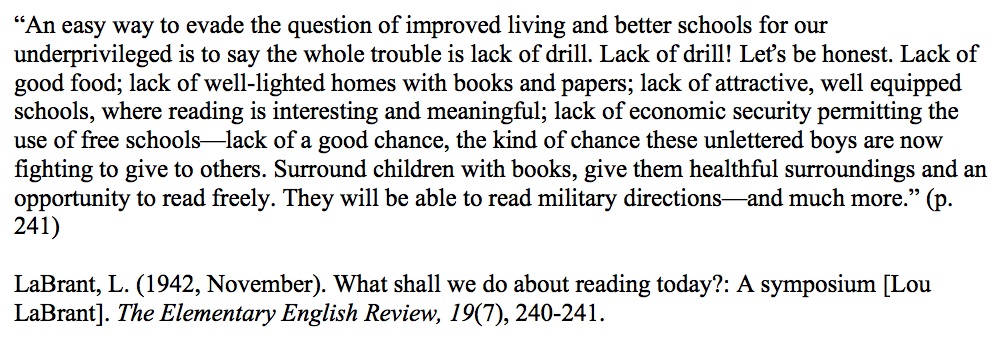
An easy way to evade the question of improved living and better schools for our underprivileged is to say the whole trouble is lack of drill. Lack of drill! Leťs be honest. Lack of good food; lack of well-lighted homes with books and papers; lack of attractive, well equipped schools, where reading is interesting and meaningful; lack of economic security permitting the use of free schools—lack of a good chance, the kind of chance these unlettered boys are now fighting to give to others. Surround children with books, give them healthful surroundings and an opportunity to read freely. They will be able to read military directions—and much more. (p. 241)

Seven-plus decades ago, public and political outrage was willing to attack a straw man, a scapegoat—progressive education—but was unwilling to confront inequity, poverty, and the linger scar of racial segregation.

Again, sound familiar?

Note

[1] Brandt, D. (2004). Drafting U.S. Literacy. College English, 66(5), 485–502. https://doi.org/10.2307/4140731 [https://www.jstor.org/stable/4140731]

Lack 1942

SOTU 2014: Orwellian Educational Change under Obama Continues

Orwellian Educational Change under Obama: Crisis Discourse, Utopian Expectations, and Accountability Failures

Paul L. Thomas

Furman University

“It is rather the same thing that is happening to the English language. . . .[T]he slovenliness of our language makes it easier for us to have foolish thoughts,” Orwell (1946) warns in “Politics and the English Language.” Few examples are better for proving Orwell right than political language addressing the education of children in the U.S. But, as Orwell adds, “If one gets rid of these habits one can think more clearly, and to think clearly is a necessary first step towards political regeneration.”

Barack Obama personifies the power of personality in politics and the value of articulating a compelling vision that resonates with many voters in the US and other global citizens. For Obama’s presidential campaign, the refrain that worked was driven by two words and concepts, “hope” and “change.” From healthcare, to war, to education reform, however, the Obama administration is proving that political discourse is more likely to mask intent—just as Orwell warned through his essays and most influential novel 1984, the source of the term “doublespeak” that characterizes well Obama’s and Secretary of Education Arne Duncan’s public comments on education reform. They mask the programs promoted and implemented by the Department of Education.

Beginning with the Reagan administration and perpetuated by Obama’s presidency are patterns of public speeches—crisis discourse and Utopian expectations—and educational policy that began with 1983’s “A Nation at Risk,” accelerated through Goals 2000, and codified without much critical concern as No Child Left Behind (NCLB) under George W. Bush and Secretary of Education Paige (Schmidt & Thomas, 2009).

Here, I will explore the neoliberal assumptions driving the language and policies related to education that came from the Obama administration and guided by Duncan. The examination will unpack Duncan’s speeches and the realities of the ideologies the administration supports through policy and public messages. The dynamic established through crisis discourse about the public education system, combined with Utopian expectations for those schools, helps mask the neoliberal assumptions embedded in what Freire (1998) calls “the bureaucratizing of the mind”: “The freedom that moves us, that makes us take risks, is being subjugated to a process of standardization of formulas, models against which we are evaluated” (p. 111).

PLEASE CONTINUE READING HERE

See also (which is being re-issued as an updated edition soon):

PhenomenonObama2011

Thomas, P.L. (2011). The educational hope ignored under Obama: The persistent failure of crisis discourse and utopian expectations. In P. R. Carr & B. J. Porfilio (Eds.), The phenomenon of Obama and the agenda for education: Can hope audaciously trump neoliberalism? (pp. 49-72). Charlotte, NC: Information Age Publishing.

Thomas, P.L. (2011). Orwellian educational change under Obama: Crisis discourse, Utopian expectations, and accountability failures. Journal of Inquiry & Action in Education, 4(1), 68-92. http://digitalcommons.buffalostate.edu/cgi/viewcontent.cgi?article=1034&context=jiae

On Leaders and Teacher Responsibility

Political leaders and candidates are rightfully concerned about asserting their credibility as leaders; however, when political leaders and candidates emphasize their leadership skills in the education reform debate, the implication appears to be that leadership replaces the value of expertise and experience in education. Let me offer two examples.

Rep. Andy Patrick, R-Hilton Head Island, SC, addressed the upcoming race for state superintendent as that intersects with plans to change teacher evaluation in SC:

“You don’t hire a surgeon to run a hospital,” he said. “What I believe we need are leaders in education not beholden to a system that’s not shown the results we need to see.”

Sen. Vincent Sheheen, D-Kershaw, SC, candidate for governor, responded to concerns about his focus on raising teacher pay as central to his education platform:

Informed of this criticism, Sheheen countered: “I think teaching environment is critical, but the biggest message we need to send for our support of public education is that we value our teachers. Sometimes academics and researchers omit the important emotional content that goes into a successful system. That’s what leaders are for.”

A key aspect of Sheheen’s response is that the criticism came from me (cited in the article)—and by taking this swipe at me, and apparently the lack of credibility found among academics and researchers, Sheheen belittles the importance of my 18 years in the public school classroom.

While I concede that leadership is important and that we can identify and foster leadership skills, I reject the implication of these comments because they suggest that leadership skills replace the need for expertise and experience. I contend that leadership grows from expertise and experience (Patrick’s background includes the military and politics; Sheheen’s background includes law and politics as well as his parents working in education).

Political leadership, historically and currently, then, has contributed directly to the marginalization of teacher professionalism, voice, and autonomy.

In fact, the conditions surrounding becoming and being a teacher in 2014 are reflected in Lou LaBrant’s “The Rights and Responsibilities of the Teacher of English” from 1961*.

LaBrant begins by identifying the conditions of teaching then that are replicated today in attacks on teachers unions and the increased accountability measures such as Common Core, new high-stakes testing, value-added methods of teacher evaluation, and merit pay:

Every teacher of English exercises some rights, no matter how dictatorial the system under which he works; and every teacher carries out some responsibilities. But today we have a considerable movement in this country to curtail certain freedom—rights—of the classroom teacher, and those rights are the matter of this discussion. (p. 379)

Reducing teaching to its mechanical parts, according to LaBrant, strips teachers of their professional “freedom,” autonomy:

Teaching, unlike the making of a car, is primarily a thought process. A man may work on an assembly line, turning a special kind of bolt day after day, and succeed as a bolt-turner. (For the moment we will forget the man and what happens to his personal life.) Having the bolts tightly turned may be all the car-in-the-making needs. But the teacher is something quite different from the man who turns a bolt, because the student is not like a car. Teaching is a matter of changing the mind of the student, of using that magic by which the thinking of one so bears on the thinking of another that new understanding and new mental activity begin. Obviously, the degree to which this is reduced to a mechanical procedure affects the results….

What I am trying to say here is that the teacher who is not thinking, testing, experimenting, and exploring the world of thought with which he deals and the very materials with which he works, that teacher is a robot himself. But we cannot expect a teacher to continue the attempt to find better means or to invent new approaches unless he knows he will have freedom to use his results. Without this freedom we must expect either a static teacher or a frustrated one. I have seen both: the dull, hopeless, discouraged teacher, and the angry, blocked, unhappy individual. (p. 380)

Predating Adam Bessie’s refuting the “bad teacher” myth, LaBrant connects the “dictatorial” educational system with the implication that since some teachers are often “bad,” all teachers need control:

Repeatedly when capable teachers ask for freedom, someone points out that we have many lazy teachers, stupid teachers unable to think and choose, ignorant teachers; in short, bad teachers who need control. We do have some, but we encourage others to be bad. Even the weak teacher does better when he has to face his own decisions, and when he supports that decision. The best way to induce teachers to think and act is to put them into situations where some thinking is essential. This less competent teacher will put more effort into the work he has himself undertaken than he will into something handed out to him. Moreover, he can, if he proves helpless, be given direction. The right to select does not force everyone to use all of his freedom, but it encourages him to use his mind. The nature of human beings precludes for either teacher or class a totally static course. The exercise of freedom is itself one means by which we become good teachers. (p. 383)

A powerful point presented by LaBrant, one too often unspoken today by teacher advocates, is the need for teachers to “earn” that freedom as they also call for their autonomy; it is in effect an argument for teacher professionalism grounded in the evidence of the field:

One reason so many of us do not have our rights is that we have not earned them. The teacher who is free to decide when and how to teach language structure has an obligation to master his grammar, to analyze the problems of writing, and to study their relations to structure….But his right to choose comes only when he has read and considered methods other than his own. He has no right to choose methods or materials which research has proved ineffective….There is little point in asking for a right without preparation for its use. (p. 390)

Finally, LaBrant challenges the pursuit of “uniformity,” today’s standardization, and ends with her strong support for teacher autonomy:

Throughout our country today we have great pressure to improve our schools. By far too much of that pressure tends toward a uniformity, a conformity, a lock-step which precludes the very excellence we claim to desire. Many are talking as though teachers with sufficient training would become good teachers. There is little consideration of the teacher as a catalyst, a changing, growing personality. Only a teacher who thinks about his work can think in class; only a thinking teacher can stimulate as they should be stimulated the minds with which he works. Freedom of any sort is a precious thing; but freedom to be our best, in the sense of our highest, is not only our right but our moral responsibility. “They”—the public, the administrators, the critics—have no right to take freedom from us, the teachers; but freedom is not some-thing one wins and then possesses; freedom is something we rewin every day, as much a quality of ourselves as it is a concession from others. Speaking and writing and exploring the books of the world are prime fields for freedom. (pp. 390-391)

In the five-plus decades since LaBrant wrote this piece, little has changed, including the lack of expertise and experience in education among political leaders.

To continue championing leadership that replaces that expertise and experience is to continue to strip teachers of the very professionalism that those leaders often give lip service to with token calls for higher pay and misleading claims that teachers are the most important element in the education of students.

Leadership grows from expertise and experience; our true leaders in education walk the halls of our schools, teach every day, and yet, remain essentially ignored by those who wish to prove that their leadership skills trump all.

* For more work by LaBrant see Lou LaBrant: An Annotated Bibliography.

Trickle-Down Administration: Education Reform in a Culture of Distracting Outrage

“One of the strange things about our politics is the disconnect between what sorts of things lead us, collectively, to express outrage and what sorts of things we don’t notice,” David Kaib begins in an examination of outrage centering on a marijuana Op-Ed by David Brooks, adding:

I’m thinking specifically of how a statement can set off outrage while the background behaviors, activities or policies that the statement expresses or seeks to justify do not….

I think this dynamic is a product of two things.  First, a great deal of our politics concerns people’s motives and character, which are largely unknowable, as opposed to assessing their actions on their own terms.  So when someone says something, potentially revealing their intentions, it seems powerful.  Second, and I suspect more importantly, it’s hard to get upset about long-standing, entrenched conditions.  We do better trying to oppose some deviation from the norm, or at least, things that are understood that way.

Kaib, I think, is confronting a socio-political and popular tendency to express outrage only at outliers and mistakenly within a cult of personality—all of which offers a powerful lens for reconsidering how teachers, scholars, academics, and public school advocates can better respond to the education reform movement.

For example, Anthony Cody shared a school memo that details how a school is instituting restroom policies “[i]n order to maximize student learning and reduce the loss of instructional time”—including justifying the policies in part by connecting the restroom guidelines to Common Core standards:

Have students fill in the “time out” and “time in” and then turn the pass in to the teacher when finished. This will help them practice the CCS of telling time with both digital and analog clocks.

First, restroom policies are a nearly universal norm of traditional schooling; thus, the likelihood that this memo will spur outrage is greatly reduced, per Kaib’s point above. However, one aspect of the policy does achieve outlier status (connecting the practices to CC) so we may anticipate outrage focusing primarily if not exclusively on that—reinforcing Kaib’s central argument that the norm of institutional and hierarchical control will remain mostly unchallenged.

Now, let me illuminate this further with an anecdote from my own career as a high school teacher. While I believe the memo above is a powerful artifact of many elements found in traditional schooling worthy of our outrage, I also think we must continue to see how policies manifest themselves in the day-to-day lives of students, teachers, and administrators.

I grew up in a small and deeply conservative (read: racism, classism, and sexism were norms and thus unexamined) Southern town in rural upstate South Carolina. After attending high school in my home town and completing college fewer than thirty minutes away, I returned to my alma mater to teach high school English for 18 years.

That school had when I was a student and continued while I was a teacher incredibly rigid and authoritarian policies for student behavior and dress. Many stereotypically strict private schools paled in comparison.

Included in those school rules (by the way, students had to pass a school handbook test at the beginning of each year) were restroom policies that mandated automatic demerits for any restroom visit during class (implicit in such rules were arguments similar to the new policies in the memo shared by Cody—protecting instructional time). The school had a demerit system connected to an in-school suspension structure governing these rules.

One year, I taught a young man who was an elite student and athlete (athletes were under a double set of extremely rigid and harsh guidelines, meaning any school infractions tended to be replicated and intensified by their coaches). During class one morning, this young man stood up quietly, walked to the trash can near the door, and then vomited (almost noiselessly) in the trash can before returning to his seat.

Once I realized what had happened, I calmly told him he needed to go to the restroom. He very politely explained he couldn’t risk the demerits.

And so let me stress here that while the new restroom policy shared by Cody and the student’s behavior in my class may appear to be outlier examples within perfectly normal and reasonable in-school policies, I must contend that they are neither outliers nor reasonable.

A comment, I believe, at Cody’s blog post helps make my case. Sarah Puglisi posted this response to the restroom policy: “Said Admin will no doubt pee as needed.”

For classroom teachers, and all workers under hierarchical structures, Puglisi’s comment is a succinct and powerful point. Let me return to my student who felt compelled to vomit in my trash can and remain in class to avoid the automatic (and I’d add “no excuses” and zero tolerance) punishment he was to receive for a situation beyond his control: The principal who sat as the personification of authority over this policy chain had his own bathroom in his office.

In the context of Kaib’s examination of distracting outrage and Cody’s exposing new restroom policies connected with CC, I want to stress several important points related to the central threads of the education reform debate:

  • We must be willing to highlight and then confront the norms of traditional schooling within which education reforms are being implemented. To continue to argue that CC is separate from high-stakes testing or simply a matter of implementation fails to acknowledge the growing evidence that adopting new standards and requiring different tests have never changed and continue not to disrupt many powerful ways in which schools function. The restroom memo is not an outlier; it is yet another artifact of how normal practices and new policies do not disrupt each other but inform and maintain the status quo.
  • Beware the hypocrisy of authoritarian and hierarchical structures, particularly as they include children. I think it is no exaggeration to compare how adults are allowed a different level of dignity in their restroom needs compared to the restrictions controlling the children under those adults’ care with the lack of accountability experienced by those imposing intensifying accountability mandates on schools, teachers, and students. The norm of accountability being inversely proportional to the hierarchical chain must be confronted in the education reform debate—not as a series of disconnected moments of outrage, but as a measured recognition that this norm is dehumanizing and incompatible with democratic ideals.
  • We must elevate the voices of teachers and students as we consider the claims and policies promoted by a social and political structure that is driven by leadership without public school teaching experience—not simply because that leadership lacks that experience but because the claims and policies are contradicted by the real world of teaching and learning.
  • We cannot afford to address social and educational issues as unrelated. Race, class, and gender inequity exists in society and is replicated in traditional schooling (for example, school discipline inequity as that mirrors the continuing era of mass incarceration). Our outrage must be at systemic policies and practices, and not diluted by targeted outrage at isolated events only, allowing an outlier mentality to suggest racism, classism, and sexism no longer exist, or can be easily overcome by in-school-only reform.

A pattern of education crisis and outrage has characterized the education reform debate for nearly 150 years. The result has been that education reform looks like the conditions of an overcrowded Emergency Room. While ERs often achieve laudable outcomes under stressful conditions, medicine is certainly better administered within a preventative care model.

The conditions of an ER are likely beyond our control to eradicate; people will continue to experience traumatic injury.

Our schools, however, need not be ERs. If we are willing to step back from crisis/outrage and then change the larger norms that tend to go unnoticed, starting with norms that are dehumanizing, as Kaib explains, we can reform our schools in ways that respect the basic dignity of children as well as honoring larger social commitments.

Civil Rights Issue of Our Time?

While the credibility of challenges leveled at the current education reform agenda—such as commitments to Common Core or the rise of “no excuses” charter schools—is often called into question throughout social and mainstream media, I see little to no questioning of political mantras of education crisis, utopian expectations for schools, and the consistent refrain of education reform being the civil rights issue of our time.

In fact, even reports coming from the USDOE show that if education reform is the civil rights issue of our time, the policies are certainly not doing what is needed to combat the demonstrable failures of the public school system.

Problem #1: Discipline in schools remains incredibly inequitable by race:

Disparate Discipline Rates and Arrests and Referrals to Law Enforcement

[click to enlarge]

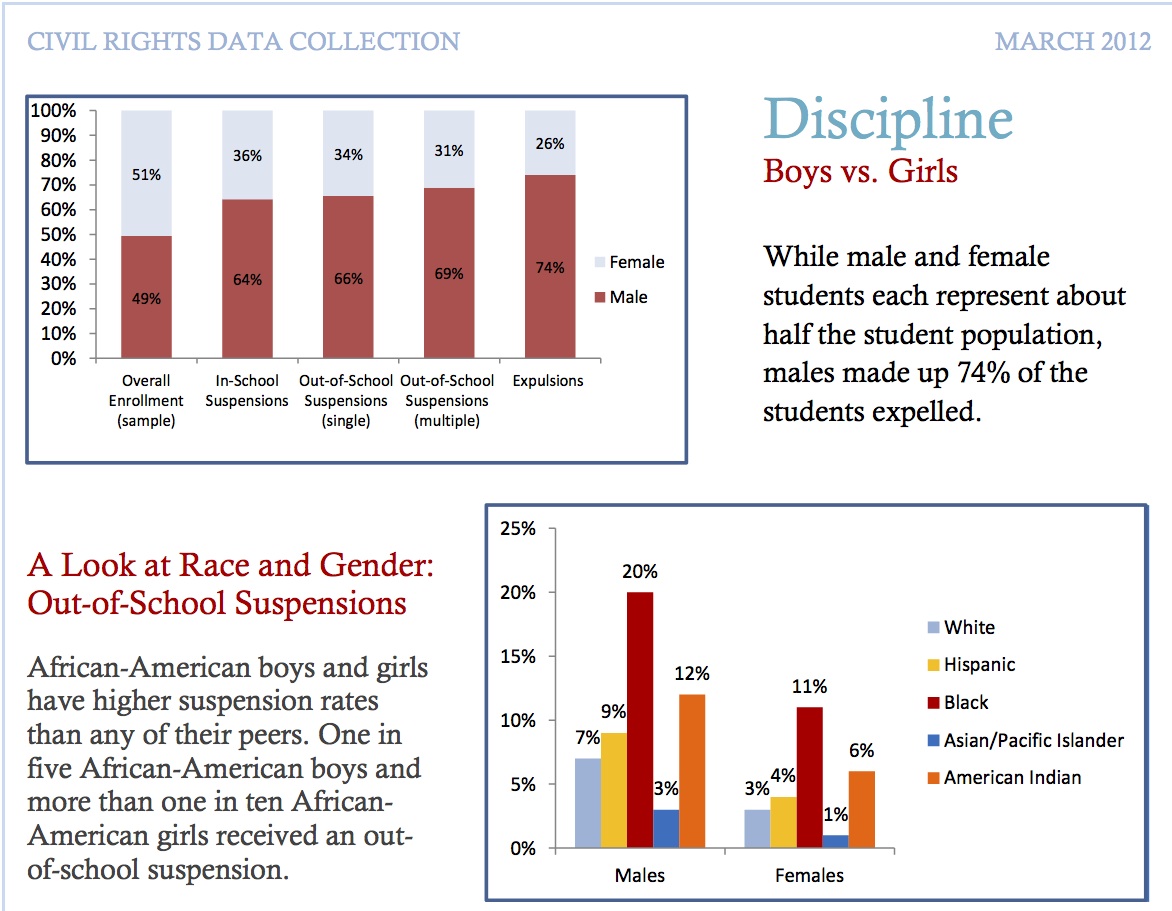
Problem #2: Discipline in schools is inequitable by gender, complicating inequity by race:

Discipline Boys vs. Girls and A Look at Race and Gender: Out-of-School Suspensions

[click to enlarge]

Problem #3: Access to advanced courses and retention rates are inequitable by race:

GandT.suspension
Access to Gifted and Talented Education (GATE) Programs and Retention Rates

[click to enlarge]

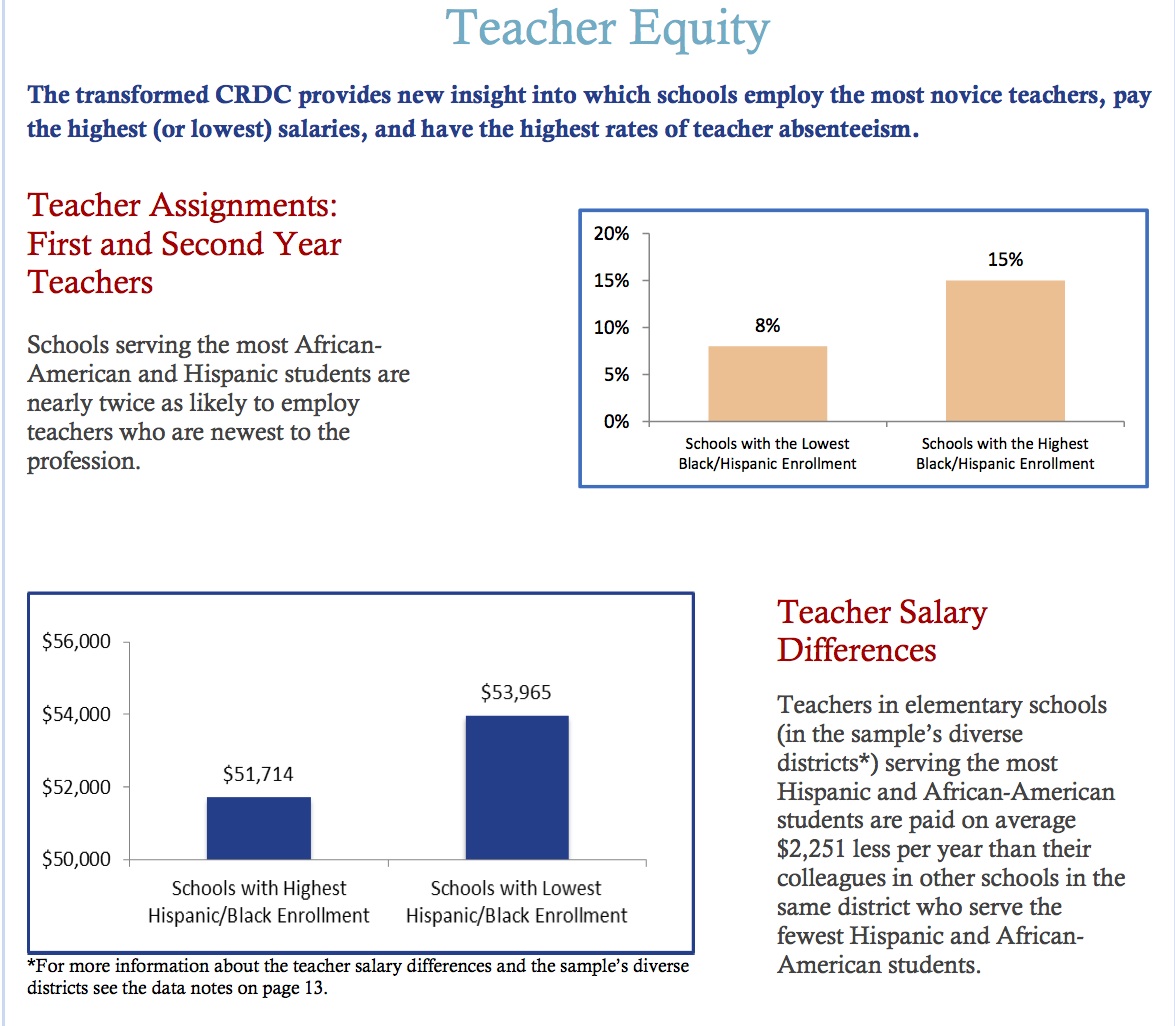
Problem #4: Teacher assignment and compensation are inequitable by race:

Teacher Assignments: First and Second Year Teachers and Teacher Salary Differences

[click to enlarge]

Problem #5: School discipline policies such as zero tolerance policies are racially inequitable and parallel to the current era of mass incarceration disproportionately impacting African American males:

There is abundant evidence that zero tolerance policies disproportionately affect youth of color. Nationally, black and Latino students are suspended and expelled at much higher rates than white students. Among middle school students, black youth are suspended nearly four times more often than white youth, and Latino youth are roughly twice as likely to be suspended or expelled than white youth. And because boys are twice as likely as girls to receive these punishments, the proportion of black and Latino boys who are suspended or expelled is especially large.  Nationally, nearly a third (31 percent) of black boys in middle school were suspended at least once during the 2009–10 school year. Part of this dynamic is that under-resourced urban schools with higher populations of black and Latino students are generally more likely to respond harshly to misbehavior. (p. 3)

As I have stated before, if education reform is the civil rights issue of our time, federal and state reform agendas would end zero tolerance policies, eradicate “no excuses” ideologies, and stop retention practices—as well as address the measurable inequities by race, class, and gender marring public schools in the U.S.

“A Question of Power”—Of Accountability and Teaching by Numbers

Almost three years ago (March 12, 2011, at OpEdNews), I posted the piece below and then adapted it as a section of Ignoring Poverty in the U.S. (IAP, 2012; see Chapter Five: The Teaching Profession as a Service Industry). Below I am posting the draft version from Ignoring (with a few added hyperlinks), and feel that the key point about the misuse of accountability—drawing on a scene from Ralph Ellison’s Invisible Man—highlights how teaching is an invisible profession. If not the whole piece, please consider my examination of the scene between the novel’s narrator and Kimbro below.

“A Question of Power”—Of Accountability and Teaching by Numbers[i] 

The speaker in Adrienne Rich’s “Diving into the Wreck” confronts the contrast between land and sea—”the sea is another story/ the sea is not a question of power”—leaving the clear message that our world is “a question of power.” Over the past thirty years, the education reform debate and the rising calls for education reform have exposed themselves as a question of power. The education reform debate is a mask for the powerful to maintain their power at the expense of marginalized groups, primarily people trapped in poverty. The first three years of the Obama administration have evolved into intense clashes about policy and commitments in the field of education, exposing that the education reform debate is about more than our schools; it is a question of power. Unless the sleeping giant—the voice of educators—is awakened, the power will remain in the hands of the inexpert.

As many ignored or marginalized the rallies in Wisconsin about teachers’ rights and the role of unions in our public education system, a role that is not nearly as unified as the public believes since many states are non-union (Larkin, 2011), the corporate and political elite continued to speak from positions of celebrity and authority that lack expertise and fly above the accountability that they champion:

“Well, it’s a dereliction of duty on behalf of the Democrat state senators in Wisconsin,” Bachmann said. “There was an election in 2010. The people spoke clearly in Wisconsin. They elected a new senator, Ron Johnson to replace Russ Feingold, a new governor, Scott Walker. And then they elected Republicans to run both the House and the Senate. This was a change election in Wisconsin. People wanted to get their fiscal house in order. That’s exactly what Gov. Walker and the House and Senate are trying to do, and now the Democrats are trying to thwart the will of the people by leaving the state? This is outrageous. And, plus, we have the president of the United States also weighing in with his campaign organization busing 25,000 protesters into Madison? It’s outrageous.” (Poor, 2011)

During the rising calls for bureaucratic education reform, revamping teacher evaluations and pay, and the Wisconsin teacher protests, former Secretary of Education Margaret Spellings (2011) weighed in about reauthorizing NCLB: “However, any new law must be a step toward stronger, more precise accountability.” And her audacity here is even bolder than what the new reformers have been perpetuating through film and popular media.

During President George W. Bush’s tenure, NCLB was a corner stone of his agenda, and when then-Secretary Spellings announced that test scores were proving NCLB a success, Gerald Bracey and Stephen Krashen(2006) exposed one of two possible problems with the data. Spellings either did not understand basic statistics or was misleading for political gain. Krashen detailed the deception or ineptitude by showing that the gain Spellings noted did occur from 1999 to 2005, a change of seven points. But he also revealed that the scores rose as follows: 1999 = 212; 2000 = 213; 2002 = 219; 2003 = 218; 2005 = 219. The jump Spellings used to promote NCLB and Reading First occurred from 2000 to 2002, before the implementation of Reading First. Krashen notes even more problems with claiming success for NCLB and Reading First, including:

Bracey (2006) also notes that it is very unlikely that many Reading First children were included in the NAEP assessments in 2004 (and even 2005). NAEP is given to nine year olds, but RF is directed at grade three and lower. Many RF programs did not begin until late in 2003; in fact, Bracey notes that the application package for RF was not available until April, 2002.

And for this, how was Spellings held accountable? Not at all, as the contradiction and misinformation were primarily ignored by the mainstream media.

And herein lies the problem with the accountability demands coming from the new reformers and not being challenged by the media or the public. The premise that our schools are failing is a distortion, especially when based on further misuse of data such as international comparisons (Riddile, 2010), but the claim that education is failing because of “bad” teachers and powerful teachers’ unions is more disturbing since no one ever offers any evidence, even manipulated evidence, to show that the most pressing education reform needed is teacher quality and disbanding unions. In fact, the entire course of the current accountability era has been destined to fail because the reforms are never couched in clearly defined problems. Instead, solutions are driven by ideology and cultural myths.

Calls for higher standards and greater accountability suggest that educational failure grows from a lack of standards and accountability—but where is the evidence those are the sources? Calls for changing teacher pay scales and implementing merit pay suggest that current pay scales and a lack of a merit pay system are somehow causing educational failures—but where is the evidence those are the sources? Charges against union influence and claimed protection of “bad” teachers also suggest that unionization of teachers has caused educational failure—but where is the evidence those are the sources?

The truth is that the new reformers are attacking teachers and unions because this is a question of power—maintaining power with the corporate and political elite at the expense of the ever-widening gap between them and the swelling workforce that is losing ground in wages and rights (Noah, 2010). De-professionalized teachers stripped of the collective bargaining are the path to a cheap and compliant workforce, paralleling the allure of Teach for America (TFA) as a cheap, recycling teacher pool—an essential element in replacing the universal public education system with a corporate charter school and privatized education system. From the perspective of the new reformers’ corporate lens for education, there is money to be made, of course, but better yet, the corporate takeover of education helps solidify the use of schools to generate compliant and minimally skilled workers.

In Ralph Ellison’s (1952) Invisible Man, the unnamed main character finds himself in a hellish nightmare after being kicked out of college and sent on a cruel quest for work in New York. He then turns to a paint manufacturing plant for employment:

KEEP AMERICA PURE

WITH

LIBERTY PAINTS. (p. 196)

The exchange between the main character and his supervisor, Kimbro, when the main character is first learning his job is important at this moment in the history of U.S. public education and the rising tide against unions:

“Now get this straight,” Kimbro said gruffily. “This is a busy department and I don’t have time to repeat things. You have to follow instructions and you’re going to do things you don’t understand, so get your orders the first time and get them right! I won’t have time to stop and explain everything. You have to catch on by doing exactly what I tell you. You got that?” (p. 199)

What follows is the main character being told by Kimbro that Liberty Paints’ prize item, white paint, requires ten drops of black. The process makes no sense on many levels to the main character, but he is chastised for questioning doing his job as told: “‘That’s it. That’s all you have to do,’ [Kimbro] said. ‘Never mind how it looks. That’s my worry. You just do what you’re told and don’t try to think about it'” (p. 200).

The scenes that follow include the main character being reprimanded for a decision although the compared paint samples look identical—the only difference being one is the result of his choice and the other is the work of the supervisor. (Later, Ellison examines the role of unions at the plant, also sections valuable to the debates today.) But here, I want to emphasize that this scene from Invisible Man is little different from the accountability dynamic begun in the early 1980s. For nearly three decades, teachers have been mandated to implement standards and to prepare students for tests that those teachers did not create and often do not endorse. Like the main character in Invisible Man, they are told daily, “’You just do what you’re told and don’t try to think about it’” (Ellison, 1952, p. 200).

And like the main character above, they are now being held accountable for the results—disregarding the power structure that mandates the standards and the tests, disregarding the weight of evidence that shows test scores are more strongly aligned with poverty than teacher or school quality. The question of power in the U.S. is that voice, thus power, comes from wealth and status. As I considered earlier, would anyone listen to Bill Gates about education if he had no money? (Thomas, 2011, March 1).

At the end of his ordeal, the main character in Invisible Man has been rendered not only silent but also invisible. He hibernates and fights a covert battle with the Monopolated Light & Power company by living surrounded by 1369 lights. His story is a question of power, a struggle to bring the truth to light. In the second decade of the twenty-first century, teachers, educators, scholars, and everyone concerned about democracy and freedom must reject the urge to hibernate and wage silent battles. Instead, voices must be raised against the powerful who have now set their sights on teachers, schools, students, and ultimately the majority of us standing on the other side of the widening gap between the haves (who have their voices amplified) and the have nots (who are silenced, invisible).

The focus on teacher quality is a political struggle over power, one that benefits the corporate and political elite as long as the public remains blind to social inequity and poverty.

References

Ellison, R. (1952). Invisible man. 30th anniversary ed. New York, NY: Vintage Books.

Krashen, S. (2006, October 2). Did Reading First work? The Pulse. Retrieved from  http://www.sdkrashen.com/content/articles/krashen_reading_first.pdf

Larkin, J. (2011, February 18). 14 Democratic senators flee Wisconsin, teachers strike for second day in a rowBallot News. Retrieved 27 June 2011 from http://ballotnews.org/2011/02/18/14-democratic-senators-flee-wisconsin-teachers-strike-for-second-day-in-a-row/

Noah, T. (2010, September 3). The United States of inequality. Slate. Retrieved from http://www.slate.com/id/2266025/entry/2266026

Poor, J. (2011, February 18). Michele Bachmann weighs in on Wisconsin teacher sick-out strike: ‘It’s a dereliction of duty.’ The Daily Caller. Retrieved 27 June 2011 from http://dailycaller.com/2011/02/18/michele-bachmann-weighs-in-on-wisconsin-teacher-sick-out-strike-its-a-dereliction-of-duty/

Riddile, M. (2010, December 15). PISA: It’s poverty not stupid. The Principal Difference [Web log]. Retrieved from http://nasspblogs.org/principaldifference/2010/12/pisa_its_poverty_not_stupid_1.html

Spellings, M. (2011, February 22). It’s an outrage. Huffington Post. Retrieved from http://www.huffingtonpost.com/margaret-spellings/its-an-outrage_b_826525.html

Thomas, P. L. (2011, March 1). Ironic lessons in education reform from Bill Gates. OpEdNews.comhttp://www.opednews.com/articles/Ironic-Lessons-in-Educatio-by-Paul-Thomas-110301-979.htm. Reposted at The Answer Sheet, March 3, 2011, The Bill Gates problem in school reform


[i] —–. (2011, March 13). “A question of power”: Of accountability and teaching by numbers. OpEdNews.comhttp://www.opednews.com/articles/A-Question-of-Power–Of-by-Paul-Thomas-110311-481.html