Tag Archives: Gwen Stacy

Eyes of the Beholder

Rain and cold at the beginning of my holiday break this late December forced me onto the bicycle trainer, something I loath doing. But to off-set that torture, I was pleased to find Eternal Sunshine of the Spotless Mind (2004), one of my short list of favorite movies that I watch over and over: Blade Runner (1982), Solaris (2002), Lost Highway (1997).

These films draw me in part because of genre—surrealism, fantasy, science fiction—and the allure of considering alternate worlds, alternate consciousness, alternate minds. But there are thematic threads pulling these films together as well.

The folding of time, or the urge and then opportunity to relive, revisit opportunities; questions about reality and what constitutes basic humanity (specifically the human mind and will/spirit); the complicated relationship/tension with each person between mind and heart—these are dramatized and personified in those films in ways that continue to help me wrestle with those realities, but also imagine beyond this temporal existence that is inevitably linear and cumulative.

As a university professor, I am each semester reminded of how perception shapes reality when I read my student feedback forms, almost always including both a few students who think I am the best professor ever and a few students who think I was pure torture and failure. In the same course, the same classroom.

As a parent, I experienced similar swings from my daughter’s own perception of me, especially in those volatile teen years.

Few things sting, hurt as much as disappointing those you love, care for, or are seeking to do nothing except the best in their interests.

I still flinch a bit each time (and it happens regularly) students inform me that I seem “mean,” that students are “afraid of me.” How, o how, could I have possibly sent such completely opposite messages?

In a recent post about the death of Gwen Stacy in The Amazing Spider-Man, I touched on superheroes’ internal struggles as those intersect with the duality motif common in superhero narratives (Peter Parker/Spider-Man, Bruce Wayne/Batman, etc.).

But another pattern found especially in the Spider-Man narrative is the contrast between what Peter Parker/Spider-Man intends and how Spider-Man is perceived. The graphic novel Death of the Stacys collects The Amazing Spider-Man #s 88-92, 121-122, combining the deaths of Captain Stacy and his daughter/Peter’s girlfriend Gwen. The stories are about the collateral damage of vigilante justice.

After Captain Stacy’s death, the public and Gwen begin to view Spider-Man as the villain, and thus, Peter’s internal struggle over great power/great responsibility is magnified by the social construction of him as evil.

Since I have just finished a semester, I am typically concerned about what students I have failed to reach as I intended, which students are apt to see the professor I never intended to be. This cycle is very powerful in teaching, and although somewhat anxiety triggering, it also helps drive me to be a better teacher next time; teaching affords us those opportunities of another chance without having to be in a dystopian future or a mind-bending David Lynch nightmare.

This winter of 2014, however, has offered me the most significant moment yet in terms of having another chance: my granddaughter, who has recently begun to look at me (and everything) quite intensely.

I have, then, begin to contemplate what she will come to think of me—who will I be in here eyes?

I still walk extremely fast—I do almost everything extremely fast—and I admit to having raced through much of my 20s, 30s, and 40s (sometimes dragging my daughter along the way).

A granddaughter’s five-month-old stare has made the world slow down, some, or at least those eyes have asked of me: Who do I think I am? Who do I want to be? (Yes, these existential questions remain throughout our lives; they are not things to be answered in youth.)

In my advancing age, I am more capable (I hope) and at least more aware that there isn’t necessarily a tension between who we are and who others think we are/want us to be but the need to negotiate those parallel realities.

I will continue to gift myself re-watching the films I love, re-reading the books that move me, but through those, I hope to live better, recognizing that today is the only today I will have, and then tomorrow—not as an act of regret but as an act of being fully human.

The Epilogue in The Amazing Spider-Man #122 is one page of nine panels. In the wake of Gwen’s death, for which he feels responsible, Peter Parker lashes out at Mary Jane, who turns to leave but in the final three wordless panels (except for the onomatopoeia “click” in the final panel) she closes the door and turns back to Peter.

Mary Jane is looking at the distraught Peter. In her eyes, he is worth it.

I think that is what we are hoping for from the ones we love. I think that is what is ours to offer.

The Power of Superhero Mythology: “The Night Gwen Stacy Died”

Risking hyperbole, I believe Spider-Man saved my life, much like Max Dillon/Electro in The Amazing Spider-Man 2except mine was metaphorical.

Watching the sequel of the 2012 reboot that had the cinematic guts to replicate possibly the most important moment in the Spider-Man Universe (and even the entire Marvel Universe)—“The Night Gwen Stacy Died”—I was powerfully forced into two minds paralleling the Peter Parker/Spider-Man duality: my 53-year-old academic mind as it interacted with my teenaged self, a traumatic period in the 1970s when I found myself strapped into a full body brace in hopes I could overcome scoliosis without major back surgery.

In the summer of 1975, I was diagnosed with scoliosis, a medical shock tossed on top of my frail self-concept wallowing in the typical throes of adolescence. I was scrawny, and I was destined not to become the strapping young male and athlete I believed my father wanted. And then, scoliosis—a curving spine and an affliction mostly common among females.

Perfect.

The body brace I wore was a torture device of straps, metal rods, and a solid plastic body mold, designed to force my spine straight so that the defective vertebrae could regain their proper shape. Wearing the brace 23 of 24 hours a day was how I spent my ninth grade, an adventure horrifying all on its own without the brace waving out to everyone, “Hey, look at the nerdy cripple kid!”

And then there was Spider-Man.

My wonderful parents not only sacrificed financially for the brace and seemingly never-ending visits to the orthopedist, but also scrambled to find anything that would help off-set what they must have recognized as a significant blow to who I was becoming, how I saw myself.

The saving choice was comic books. And to this day, I cannot set aside how hard that must have been for my very-1950s, rugged, working-class father, a four-sport athlete in high school who lost all of his teeth to sport and fights before graduation.

At first, I began buying comics mostly to stand at the long bar separating our kitchen/living room and draw (starting with tracing, and then freehand with pencil followed by teaching myself how to ink those pencil drawings as comic book artists did).

Drawing led to reading and reading, to collecting. One of our spare bedrooms became my comic book room, and I even built a chest to hold my comics in my ninth-grade wood working class at school.

Those familiar with Peter Parker/Spider-Man likely already anticipate what had to happen; I fell in love with Spider-Man comics—the Holy Grail of low self-esteem nerd superhero mythologies.

Science nerd, orphaned, painfully thin and wearing glasses, Peter Parker walked into my life both as a stark reflection of my Self and a promise that transformation was possible (although with a price). But in 1975, I was dropped into the post-Gwen Stacy world of Peter Parker/Spider-Man, but that was about to change.

“The Night Gwen Stacy Died”

As my comic book fascination grew, somehow my father was snagged in the collecting bug, taking me to the local pharmacies and quick shops in my small hometown that carried comics and even to one comic book convention in Atlanta, GA. But he also noticed comic collections being sold in the ads of the newspaper.

Over two visits spurred by the ad of a 20-something still living at home but obviously making a decision to shift into adulthood, we bought about 1000 comics, essentially a complete run of Marvel comics spanning most of the 1970s.

Sorting, cataloguing, and carefully placing each comic in the prerequisite plastic bags of true comic book nerdom—these were my solitude. I also ravenously began to piece together the Peter Parker/Spider-Man Universe, significantly the death of Gwen Stacy.

In The Power of Myth, an interview between Bill Moyers and popular comparative religion guru Joseph Campbell, I came to understand many years later the mythological patterns in superhero comics and the science fiction I would also begin to consume.

Throughout 30-plus years of teaching, I have grown more and more fascinated with genre and form; and as a reader, I can now trace my early comic book love that fed into Arthur C. Clarke to the logical path through Kurt Vonnegut and Margaret Atwood, leading then to Neil Gaiman and Haruki Murakami.

Mine is the story of the power of secular mythology—as Campbell may explain, the Truth beyond the narrative that need not be factually true (in contrast to the literalist Christianity of my Southern childhood).

That brings me back to watching The Amazing Spider-Man 2 as both teenage-Me and current-Me.

The updating of the Gwen Stacy arc (set in contemporary times, for example) hurts my soul, but I found the film ambitious for remaining true to the only conclusion possible in the Peter Parker/Spider-Man narrative, the death of Gwen Stacy.

Peter Parker/Spider-Man has always been a bit about working-class insecurity, but the current-Me feels deeply uncomfortable about the failures in the original Silver Age arcs absent sophisticated portrayals of race and gender (the latter captured in the character of Gwen Stacy, blonde, pretty, and more Ideal than person).

I want to set aside, however, a critical re-reading of Spider-Man to embrace again why I believe the myth remains enduring and ultimately important, despite the many flaws.

Peter Parker/Spider-Man is grounded in the central superhero motif of duality: the mere human and the masked superhero.

Spider-Man grew out of the seminal Marvel method—personified by Stan Lee, Steve Ditko, and Jack Kirby—of collaborative creation and genre blurring (superhero, romance, science fiction, fantasy, etc.).

As the domain of child, teen, and young adult males, comic books from Marvel in the 1960s succeeded by tapping into teenage angst and alienation, relationships, and the transition from formal school to work.

While often misquoted, however, the ethical dilemma of Peter Parker/Spider-Man endures: “WITH GREAT POWER THERE MUST ALSO COME — GREAT RESPONSIBILITY!”—anchoring the final panels of Amazing Fantasy #15, the origin of Spider-Man.

The duality motif in Spider-Man is about much more than hiding Peter behind a mask. Peter the nerd, before the spider bite, was lonely and alienated; and then, Peter Parker (Spider-Man) discovers over and over that he remains lonely and alienated because of not his super powers, but his great responsibility.

Silver Age Spider-Man, from the origin in 1962 until the death of Gwen Stacy in 1973, confronts the mythology of the individual heart in battle with that individual’s social responsibility.

Despite all the villains the Marvel bullpen could muster, Peter Parker’s greatest battle has always been with himself.

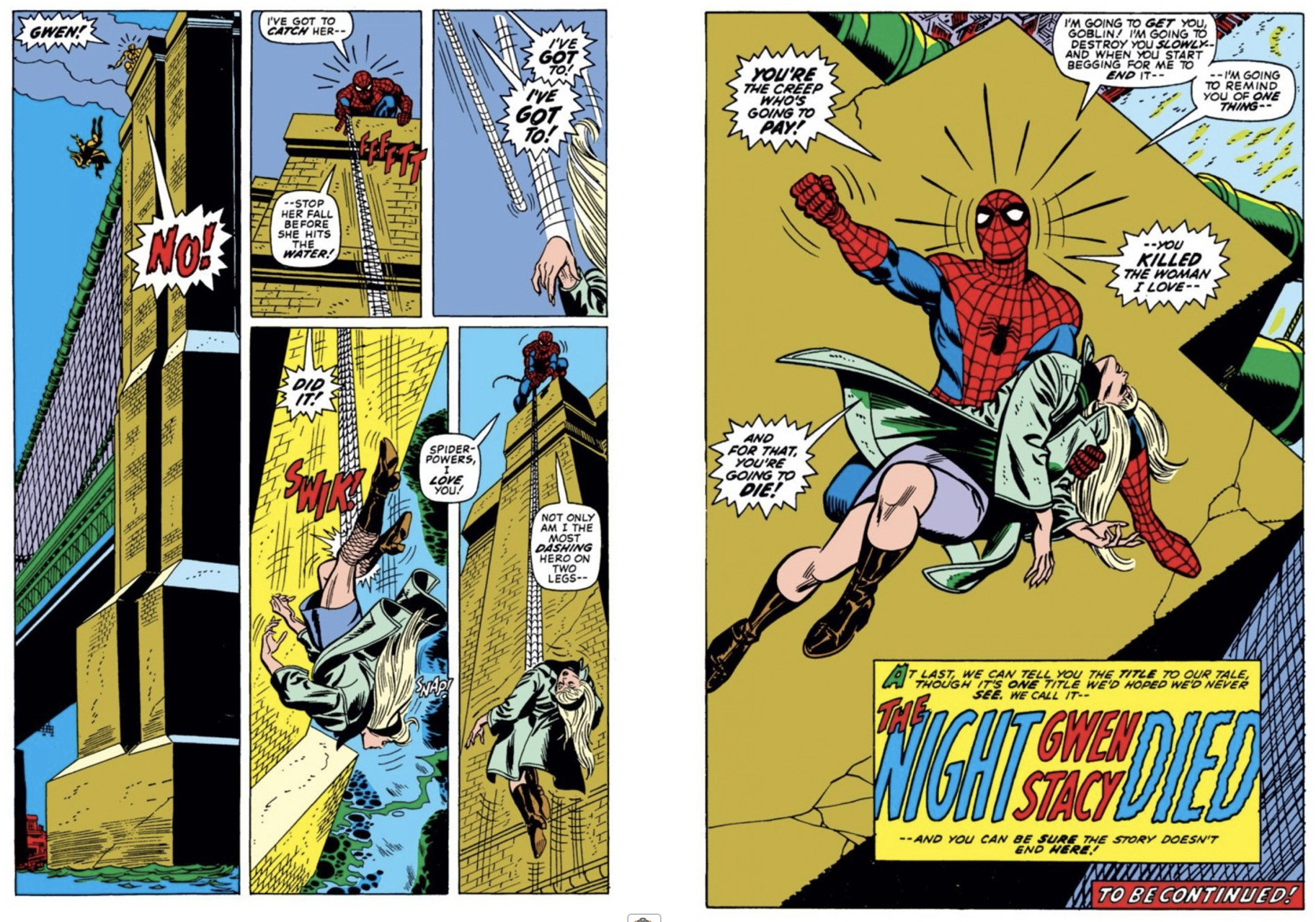
And the one moment that matters above all others is captured in a way that sequential art demands:

ASM 121 122
Gwen Stacy’s death in The Amazing Spider-Man 121-122 (June/July 1973)

The Peter Parker/Gwen Stacy storyline—for all the camp and flaws—remains in mythological terms a disturbing and fatalistic story of the sacrifice of the individual heart against our obligations, about the limitations of the human need to connect and then protect.

As a parent/grandparent and teacher, I lay on the couch and re-watched The Amazing Spider-Man 2 through layers of me and then tears because I have lived and live a very real battle with myself that is our essential humanity: how do we follow our hearts and offer those we love and world the selflessness it deserves?

Beneath the mask of superhero lies a secular myth of duality that is each one of us, a calling not for superheroes but every human. All of which we can find in classic mythology about gods and humans.

In Peter Parker’s universe, Gwen Stacy had to die, and then die again in the re-imagined universe of film.

Gwen Stacy’s neck breaking is the frailty of human limitation, ironically, at the end of a web—Gwen’s own mortality as that intersects with Peter’s humanity, even as Spider-Man.

_STH8386
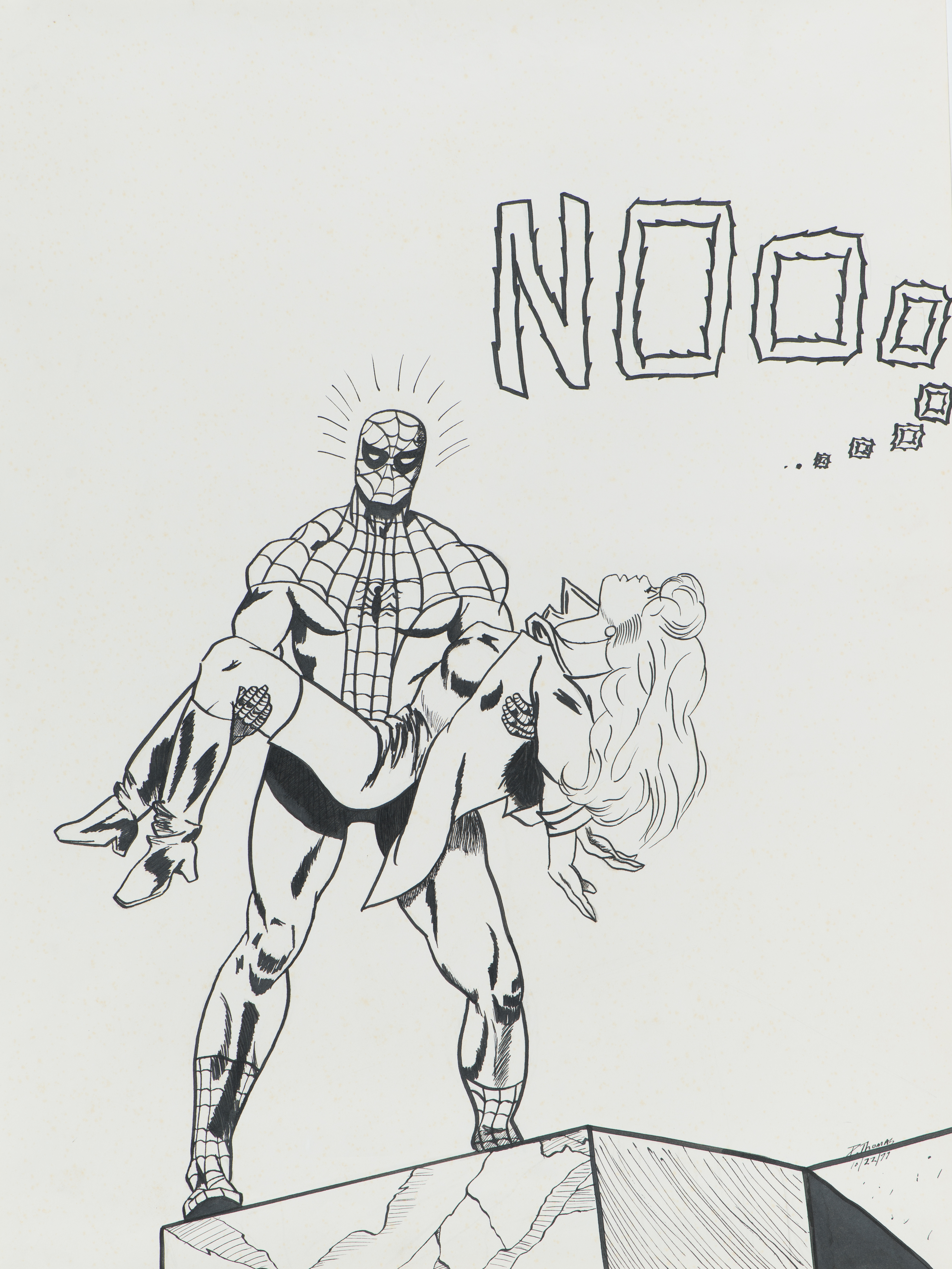
My penciled and inked drawing from my adolescence.

In existential terms, our passions are our suffering—the essential duality of being human.

As we watch Peter Parker fight himself, it is ours to recognize that to avoid our passions is to avoid living, to avoid the very humanity that should be our joy.

Max Dillon/Electro fumbles badly the gift of being saved by Spider-Man; I continue to try to find ways to serve it well (parenting, grand-parenting, teaching), although I do so in the only way a human can—I race forward, I trip, I pause on the ground, and then I stand again, committed to doing better this next time.

Each time, the spider webs are metaphorical.


For Further Reading

Challenging genres: Comic books and graphic novels

See this sample, including a brief history of comics in Chapter 1.

The Amazing Adventures of Kavalier & Clay, Michael Chabon