Tag Archives: haruki murakami

CALL: Haruki Murakami: Challenging Authors

Series: Critical Literacy Teaching Series: Challenging Authors and Genres

Sense Publishers

Volume: Haruki Murakami: Challenging Authors

Editors, Matthew Carl Strecher and P. L. Thomas

Timeline

Proposals due: June 30, 2015 [EXTENDED]

Email to paul.thomas@furman.edu 100-word chapter proposal, 50-word author(s) bio(s), contact information, and 8 key words by above due date.

Accepted chapter notified: June 30, 2015

Accepted chapters due: October 31, 2015 

Final draft submission: December 15, 2015

Overview

Japanese writer Haruki Murakami has achieved a rare status among writers—incredible popularity in his native country and world-wide as well as rising critical acclaim. Murakami, in fact, in addition to receiving most of the major literary awards in Japan, as well as many around the world, has been nominated several times for the Nobel Prize, and is likely to be Japan’s next Nobel laureate in literature.  At the same time, his relationship with the Japanese literary community proper (known as the Bundan) has not been a particularly friendly one.

Writing about Murakami’s Colorless Tsukuru Tazaki and His Years of Pilgrimage, Matthew Carl Strecher (2014) notes that one of Murakami’s central and enduring themes is a persistent warning not to suppress our fundamental desires in favor of the demands of society at large. And while Murakami’s writing over his career reveals some recurring motifs, his message has also evolved, creating a catalogue of works that reveal Murakami to be a challenging author.

Many of those challenges lie in Murakami’s blurring of genre as well as his rich blending of Japanese and Western mythologies and styles—all while continuing to offer narratives that attract and captivate a wide range of readers.  A highly challenging author, Murakami is, as Ōe Kenzaburō once contended, not a “Japanese writer” so much as a global one, and as such, he merits a central place in the classroom in order to confront readers and students, but also to be challenged as well.

This volume seeks to offer 15-20 chapters examining Murakami against the problems of genre and form, within cultural and national ideologies and mythologies, and spurred by the tensions that arise from being both popular and critically acclaimed.

Analyzing and considering teaching Murakami through the lenses of critical pedagogy and literacy offers another layer of complexity to the Murakami phenomenon and expands the scope of this series significantly, notably in the context of Freire (2005):

One of the violences perpetuated by illiteracy is the suffocation of the consciousness and the expressiveness of men and women who are forbidden from reading and writing, thus limiting their capacity to write about their reading of the world so they can rethink about their original reading of it. (p. 2)

Reading, teaching, and studying Murakami serves well the goal of rethinking this world.  It will open new lines of inquiry into what constitutes national literatures, and how some authors, in the era of blurred national and cultural boundaries, seek now to transcend those boundaries and pursue a truly global mode of expression.

References

Freire, P. (2005). Teachers as cultural workers: Letters to those who dare to teach. (D. Macedo, D. Koike, & A. Oliveira, Trans.). Boulder, CO: Westview.

Strecher, M.C. (2014). The forbidden worlds of Haruki Murakami. Minneapolis, MN: University of Minnesota Press.

Working Table of Contents

Name/contact title
Foreword
P.L. Thomas Introduction
Matthew Carl Strecher The Chronicles of Murakami Haruki and the Chamber of Secrets
P.L. Thomas Magical Murakami Nightmares: Investigating Genre through The Strange Library
Yuji Kato The Memories of Our Old “Murakami Haruki” and the Teaching Experience of “Haruki Murakami” in Classrooms in Tokyo Today
Tomoki Wakatsuki The Haruki phenomenon and everyday cosmopolitanism: belonging as a ‘citizen of the world’
Chikako Nihei Leaving Behind the Label of ‘Un-Japanese Author’: Reading ‘Mirror’ in Japanese Class
Rebecca Suter Between Self and Other: Hard-Boiled Wonderland and the End of the World As Cultural Engagement Through Fantasy
Deirdre Flynn The Trancreation of Tokyo: The Universality of Murakami’s Urban Landscape
Jonathan Dil What’s wrong with these people?: The Anatomy of Dependence in Norwegian Wood
Daisuke Kiriyama Exchanging “Far-From-Avant-garde” Jazz Records: Haruki Murakami’s “Nausea 1979” as Historiographic Metafiction
Matthew Carl Strecher Conclusion

Teaching English as “the most intimate subject in the curriculum”

On Twitter, John Warner offered a few reviews of his new book of short stories, Tough Day for the Army, followed by this Tweet:

Warner’s comment is grounded in his being a writer, but I suspect also in his being a reader and a teacher. I want to stress his #agoodthing and use this brief but insightful moment to push further against the mostly dispassionate academy where New Criticism has flourished and laid the foundation for its cousin “close reading.”

With a sort of karmic synergy, I read Warner’s Tweet above just as I was diving into a new Haruki Murakami short story, “Scheherazade,” and the companion interview with Murakami about the story.

“Scheherazade” is classic Murakami—odd, awkward, and then ultimately an unmasking of the human condition. As a writer myself (my creative, expressive writing exclusively now poetry), I was laid bare as a reader and writer toward the end of the story:

It was also possible that he would, at some point, be deprived of his freedom entirely, in which case not only Scheherazade but all women would disappear from his life. Never again would he be able to enter the warm moistness of their bodies. Never again would he feel them quiver in response. Perhaps an even more distressing prospect for Habara than the cessation of sexual activity, however, was the loss of the moments of shared intimacy. What his time spent with women offered was the opportunity to be embraced by reality, on the one hand, while negating it entirely on the other. That was something Scheherazade had provided in abundance—indeed, her gift was inexhaustible. The prospect of losing that made him saddest of all.

A recurring motif of my creative self is confronting exactly what Murakami states directly: “Perhaps an even more distressing prospect for Habara than the cessation of sexual activity, however, was the loss of the moments of shared intimacy.”

And it is this type of lucidity in stories, novels, poems, and films when I often cry because I am filled too full of feeling deeply what the author has both expressed and felt (I assume), what I know as well.

If we turn to the interview by Deborah Treisman, however, we can see Warner’s point above clearly since Murakami repeatedly deflects Treisman’s efforts to mine meaning from the story; for example, Murakami replies to two separate questions with:

Sorry, but I don’t know the exact circumstances that brought about the situation, either….Because what’s important isn’t what caused Habara’s situation but, rather, how we ourselves would act in similar circumstances….

I don’t know, but things certainly don’t look very good for Habara….

What matters to Treisman as a reader (and interviewer) appears insignificant to Murakami.

These exchanges highlight that text has both author intent and reader inference (think Rosenblatt’s reader, writer, text triangle)—but the exchanges also allow us to consider (or reconsider) that text meaning often depends on a power dynamic that involves who decides what matters and how.

Murakami’s “Scheherazade” focuses on an unnamed character (called “Scheherazade” by Habara, the other character in the story) who is a source of both sex and storytelling for Habara, who is mysteriously restricted to his house:

Habara didn’t know whether her stories were true, invented, or partly true and partly invented. He had no way of telling. Reality and supposition, observation and pure fancy seemed jumbled together in her narratives. Habara therefore enjoyed them as a child might, without questioning too much. What possible difference could it make to him, after all, if they were lies or truth, or a complicated patchwork of the two?

Whatever the case, Scheherazade had a gift for telling stories that touched the heart. No matter what sort of story it was, she made it special. Her voice, her timing, her pacing were all flawless. She captured her listener’s attention, tantalized him, drove him to ponder and speculate, and then, in the end, gave him precisely what he’d been seeking. Enthralled, Habara was able to forget the reality that surrounded him, if only for a moment. Like a blackboard wiped with a damp cloth, he was erased of worries, of unpleasant memories. Who could ask for more? At this point in his life, that kind of forgetting was what Habara desired more than anything else.

As readers, we share with Habara a brief journey through Scheherazade’s episodic tales of her own adventures, leading to the end where Murakami appears to suggest that her storytelling is more intimate for Habara, and thus more important, than the sex she shares.

Just as Murakami’s interview reveals the range of what matters in text, that Habara “enjoyed [Scheherazade’s stories] as a child might, without questioning too much” (and we might add, as Treisman does in the interview) speaks against the dispassionate ways in which formal schooling frames text and dehumanizes the reading experience for and with children and young adults (hence, New Criticism, close reading, and the enduring “evidence hunt” of reducing text to what can—or should—be mined from that text).

In her “Language Teaching in a Changing World,” Lou LaBrant (1943) warned:

Too frequently we give children books which have enough value that we call them “good,” forgetting that there are other, perhaps more important values which we are thereby missing. It is actually possible that reading will narrow rather than broaden understanding. Some children’s books, moreover, are directed toward encouraging a naive, simple acceptance of externals which we seem at times to hold as desirable for children….Let us have no more of assignments which emphasize quantity, place form above meaning, or insist on structure which is not the child’s. (p. 95)

LaBrant, then, builds to her key point: “Teachers should consider carefully what they are doing with the most intimate subject in the curriculum” (p. 97).

Teaching English as “the most intimate subject in the curriculum” is connected to, as LaBrant explains in “The Place of English in General Education” (1940), the essential element of being human: “Language is a most important factor in general education because it is a vital, intimate way of behaving. It is not a textbook, a set of rules, or a list of books” (p. 364).

Seven decades since LaBrant made these arguments, we must ask—especially in the context of Warner’s Tweet and Murakami’s story and interview—why do we persist in reducing text to the dispassionate responses demanded in the academy, whether that sits within the mechanistic processes of New Criticism or the decontextualized demands of close reading? Where in formal schooling is there room to “[enjoy] [text] as a child might, without questioning too much”?

In the answer-driven classrooms that have traditionally and currently mis-served both the text being analyzed and the students evaluated by how they analyze those texts, Murakami sends a much different message:

Habara is a man who has experienced an irrevocable turning point in his life. Was the turning point moral, or legal, or was it a metaphorical, symbolic, psychological kind of thing? Did he turn the corner voluntarily, or did someone force him? Is he satisfied with the results or not? I don’t know the answers to any of these questions. The instant he turned that corner, though, he became a “desert island.” Things can’t go back to the way they were, no matter what he does. I think that is the most important aspect of this story.

As author of this story, Murakami is interested in the questions raised, what is left unknown to him: “I don’t know. Scheherazade is a riddle to me, as well—what she is thinking, what she is looking for.”

Fiction and poetry seek the mysteries of the human condition, the unknown, the unanswerable. As LaBrant and Murakami tell us, language and teaching are about the intimacy of being human—not about the dispassionate calculation of meaning, the objective pose that is both misleading and efficient as well as manageable.

Unlike Habara, we are not in fact trapped in the house of such dispassion; we have chosen to remain there. Instead we should step outside, to enjoy text “as a child might, without questioning too much.”

Reading Out of Context: “But there was something missing,” Walter Dean Myers

ac·a·dem·icadjective \a-kə-ˈde-mik\ having no practical importance; not involving or relating to anything real or practical.

###

Currently, I have three seniors on track to certify as secondary English teachers doing extended field experiences in local schools—one is placed in an eighth-grade ELA class and another is teaching college-bound students in a high school.

While observing at the middle school, I arrived early one day while the full-time teacher was finishing a discussion of Walter Dean Myers’s Monster. The teacher had to cut the read aloud short, and one student begged for him to continue reading. The teacher asked for the books to be passed forward, prompting that same student to ask to hold on to his copy so he could keep reading (the teacher arranged for the student to retrieve a copy later, by the way).

In the high school class, the teacher-to-be has been teaching poetry by Adrienne Rich and Sylvia Plath—I observed a wonderful discussion of Plath’s “Metaphors”—but the full-time teacher has stressed that students not be offered biographical background information so students could focus on reading the texts cold—in part, as preparation for Advanced Placement Literature testing.

###

An essential element in the ELA Common Core standards is “close reading,” endorsed by David Coleman (now president of the College Board, home of AP and SAT testing):

Close reading, as it appears in the Common Core, requires readers to emphasize “what lies within the four corners of the text” and de-emphasize their own perspective, background, and biases in order to uncover the author’s meaning in the text.

Although “close reading” is a relatively new term, I have noted that its foundational elements are essentially perpetuating the dominant literary analysis focus of public education throughout the 20th and into the 21st centuries, New Criticism.

As Ferguson explains, “close reading” is only part of the literacy approach needed by students:

Critical reading, in contrast, concerns itself with those very differences between what does and does not appear in the text. Critical reading includes close reading; critical reading is close reading of both what lies within and outside of the text. For Paulo Freire, critical reading means that “reading the world always precedes reading the word, and reading the word implies continually reading the world.”…

Critical literacy argues that students’ sense of their own realities should never be treated as outside the meaning of a text. To do so is to infringe on their rights to literacy. In other words, literacy is a civil and human right; having your own experiences, knowledge, and opinions valued is a right as well. Despite praise for King’s rhetoric, Coleman promotes a system that creates outsiders of students in their own classrooms.

“Close reading,” then, is reading out of context—and ultimately, it isn’t reading at all because the reader and the world are rendered irrelevant.

###

Prompted by an analysis of people of color in children’s books (what Christopher Myers calls “[t]his apartheid of literature”), Walter Dean Myers examines his own journey as a reader and then a writer in Where Are the People of Color in Children’s Books?

Myers recalls finding books and reading in his mother’s lap, which led to comic books and eventually what many would consider classic literature:

But by then I was beginning the quest for my own identity. To an extent I found who I was in the books I read. I was a person who felt the drama of great pain and greater joys, whose emotions could soar within the five-act structure of a Shakespearean play, or find quiet comfort in the poems of Gabriela Mistral. Every book was a landscape upon which I was free to wander.

The first part of Myers’s story appears nearly idyllic, and could have served as an argument for requiring all students to read the canon, the Great Books argument. But when Myers’s family experienced “dark times,” he concludes:

But there was something missing. I needed more than the characters in the Bible to identify with, or even the characters in Arthur Miller’s plays or my beloved Balzac. As I discovered who I was, a black teenager in a white-dominated world, I saw that these characters, these lives, were not mine. I didn’t want to become the “black” representative, or some shining example of diversity. What I wanted, needed really, was to become an integral and valued part of the mosaic that I saw around me.

And although Myers struggled against his own personal “dark times”—”My post-Army days became dreadful, a drunken stumble through life, with me holding on just enough to survive”—he did discover James Baldwin:

Then I read a story by James Baldwin: “Sonny’s Blues.” I didn’t love the story, but I was lifted by it, for it took place in Harlem, and it was a story concerned with black people like those I knew. By humanizing the people who were like me, Baldwin’s story also humanized me. The story gave me a permission that I didn’t know I needed, the permission to write about my own landscape, my own map.

Ultimately, Myers’s journey is a story itself, a story about the context of reading, the humanity of reading, the inescapable web of reader, writer, text, and world:

Books transmit values. They explore our common humanity. What is the message when some children are not represented in those books? Where are the future white personnel managers going to get their ideas of people of color? Where are the future white loan officers and future white politicians going to get their knowledge of people of color? Where are black children going to get a sense of who they are and what they can be?

###

Late to the party, I finally read 1Q84 a few years ago, setting off a passionate love affair with the writing of Haruki Murakami.

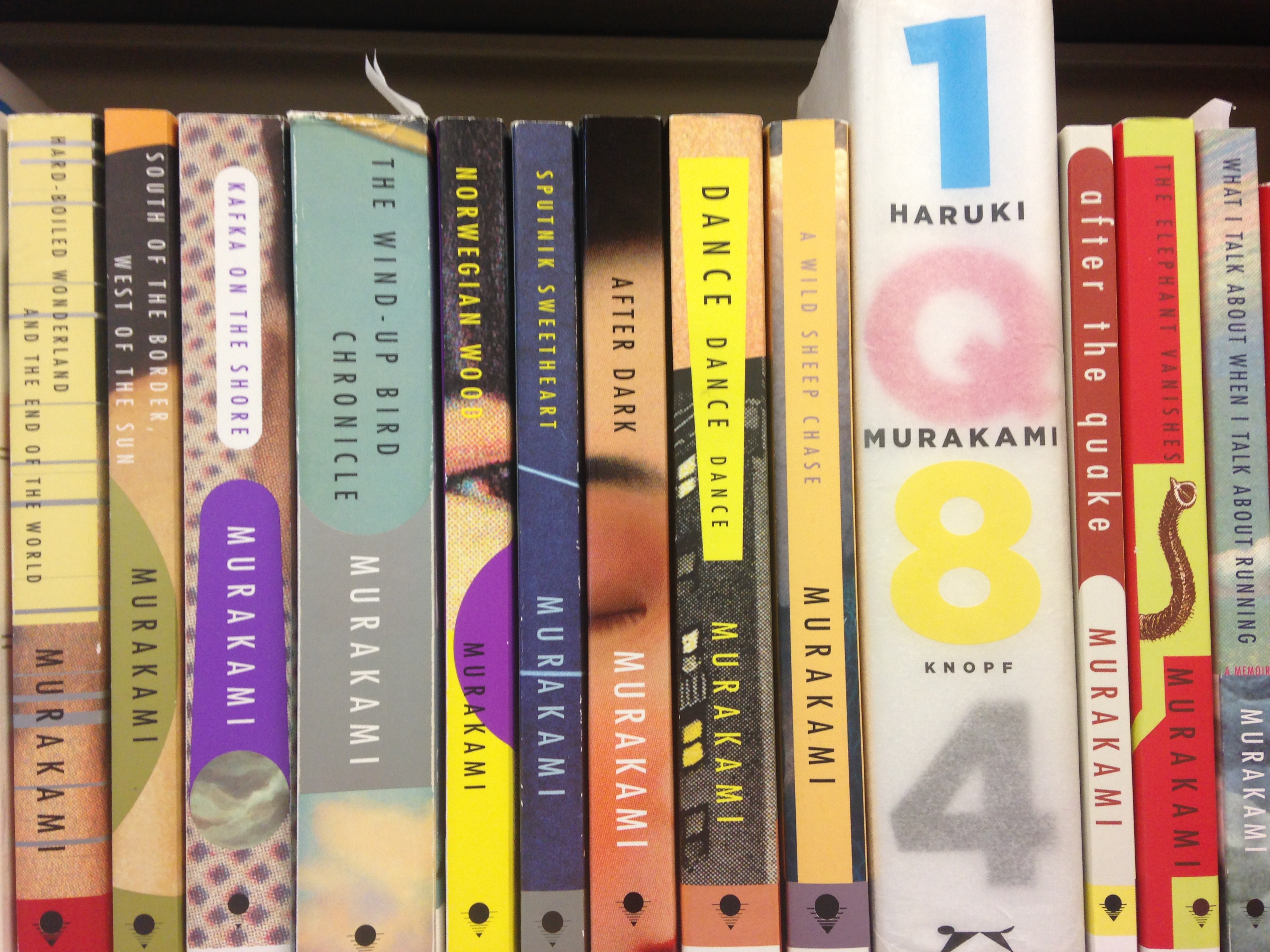
I have read all of his books and am now awaiting the English translation of Colorless Tsukuru Tazaki and His Years of Pilgrimage. As I typically do, Murakami has a bit of a shrine on my office book shelf:

Murakami books

Until I began reading What I Talk About When I Talk About Running, however, I was missing a very important element in my love of Murakami’s work. Unlike Myers’s recognition of himself in his discovery of James Baldwin, I did not think about my Self in Murakami, who is Japanese and a generation removed from me about halfway between my father and me.

Since Running is part memoir, I began to see comments by Murakami about his essential nature—claims of his true Self that speak very much to me as well as about me. Murakami, despite the details of our races and our histories, share many traits that I am convinced are at the root of my love for his fiction.

###

I was also late to the Breaking Bad party, and coincidentally, I was reading Murakami’s Running while I was just getting to Season 3 of Breaking Bad. So I was taken aback when the character Gale Boetticher shared with the main character, Walter White, how he came to cook meth—a journey of rejecting the merely academic world of science for the magic of the lab.

To fully explain his reasons, and despite his embarrassment about his being a self-proclaimed nerd, Boetticher quotes Walt Whitman:

When I Heard the Learn’d Astronomer

Walt Whitman

When I heard the learn’d astronomer,
When the proofs, the figures, were ranged in columns before me,
When I was shown the charts and diagrams, to add, divide, and measure them,
When I sitting heard the astronomer where he lectured with much applause in the lecture-room,
How soon unaccountable I became tired and sick,
Till rising and gliding out I wander’d off by myself,
In the mystical moist night-air, and from time to time,
Look’d up in perfect silence at the stars.

###

I am reading Murakami’s Running and pausing again and again as his confessions of his true Self are ones I too could make—confessions about solitude, about assuming others will not like him.

But I am also struck by Murakami’s comments about formal education:

I never disliked long-distance running. When I was at school I never much cared for gym class, and always hated Sports Day. This was because these were forced on me from above. I never could stand being forced to do something I didn’t want to do at a time I didn’t want to do it. Whenever I was able to do something I liked to do, though, when I wanted to do it, and the way I wanted to do it, I’d give it everything I had….

If you’ll allow me to take a slight detour from running, I think I can say the same thing about me and studying. From elementary school up to college I was never interested in things I was forced to study….I only began to enjoy studying after I got through the educational system and became a so-called member of society….

I always want to advise teachers not to force all junior and senior high school students to run the same course, but I doubt anybody’s going to listen to me. That’s what schools are like. The most important thing we ever learn at school is the fact that the most important things can’t be learned at school. (pp. 34-35, 45)

###

It is 1943, and English educator Lou LaBrant is deeply concerned about the teaching of language in a world combating Hitler:

Today in a world of hyperbole, it is easy to make sweeping statements and to have them accepted. We must therefore be cautious when thinking of our work. Teachers are, by the nature of their work, largely outside immediate war activities. They spend their days with children, whose greatest contribution will be made after the war….

Far too often as a people we are led astray by orators or writers whose words sound fine and smooth, but whose meanings are false, shallow, or misleading. We make their path easy when we approve essays, stories, or poems which are imitations or are full of words used for the sake of sound. (pp. 93, 95)

It is 2014, and I am deeply concerned that LaBrant’s warnings are as significant today as teachers of English face the “sweeping statements” of “orators or writers whose words sound fine and smooth” in regards to Common Core and “close reading.”

And I am certain her criticism of how books are assigned rings true today:

Too frequently we give children books which have enough value that we call them “good,” forgetting that there are other, perhaps more important values which we are thereby missing. It is actually possible that reading will narrow rather than broaden understanding. Some children’s books, moreover, are directed toward encouraging a naive, simple acceptance of externals which we seem at times to hold as desirable for children. (p. 95)

###

Close reading of books assigned to children, books in which children cannot find themselves, is reading out of context, it is merely academic, and without the magic—”I was lifted by it,” Walter Dean Myers says about Baldwin—our students will likely “bec[o]me tired and sick,/Till rising and gliding out [they will wander] off by [themselves],” concluding that teachers, schools, and books have no meaning for them.

Close reading and de-contextualizing books will, I fear, contribute to more of Christopher Myers’s denounced “apartheid of literature”; instead, he asserts:

The children I know, the ones I meet in school visits, in juvenile detention facilities like the Cheltenham Youth Facility in Maryland, in ritzy private schools in Connecticut, in cobbled-together learning centers like the Red Rose School in Kibera, Nairobi — these children are much more outward looking. They see books less as mirrors and more as maps. They are indeed searching for their place in the world, but they are also deciding where they want to go. They create, through the stories they’re given, an atlas of their world, of their relationships to others, of their possible destinations.

We adults — parents, authors, illustrators and publishers — give them in each book a world of supposedly boundless imagination that can delineate the most ornate geographies, and yet too often today’s books remain blind to the everyday reality of thousands of children. Children of color remain outside the boundaries of imagination. The cartography we create with this literature is flawed….

So now to do my part — because I can draw a map as well as anybody. I’m talking with a girl. She’s at that age where the edges of the woman she will become are just starting to press against her baby-round face, and I will make a fantastic world, a cartography of all the places a girl like her can go, and put it in a book. The rest of the work lies in the imagination of everyone else along the way, the publishers, librarians, teachers, parents, and all of us, to put that book in her hands.

Gaiman’s Mythical Folding of Childhood into Adulthood

I stumbled into the novels (invariably identified with “for adults” by reviewers and critics) of Neil Gaiman in a way that, upon looking back, the intersection now seems inevitable, not stumbling at all.

Browsing as I often do along the center aisle of Barnes and Noble, over several visits I picked up American Gods, a hefty novel labeled by the publisher as the tenth anniversary edition. I have always tended to shun enormous novels, in part as a result of my teacher self recognizing how often students struggled with big books, but I also found myself both avoiding Gaiman’s most celebrated work and always taking it into my hands each time I saw it. In the way that books can, American Gods kept calling out to me (as the author’s preferred text did more recently).

The day I acquiesced to Gaiman the novelist (I had always known him as a comic book/graphic novel creator), I  experienced a second disorientation: The publisher labels American Gods “science fiction.” Not long after slipping with glee into Gaiman’s other worlds, I had a similar experience with Haruki Murakami, whose 1Q84 is also marked “science fiction.”

Before Gaiman and Murakami, I counted myself among those dedicated to science fiction but stubbornly opposed to fantasy. No Hobbits for me! And Harry Potter? No way.

Gaiman represents my crisis of genre that would carry through into Murakami’s universe(s). I could not find a thing in American Gods I would call science fiction, but I also felt “fantasy” failed the work. The best I could ever do was think of Gaiman’s narrative as “contemporary mythology”—not Leda and the swan, but the gods right now in my time of existence.

Regardless, of course, all that mattered for me was that I loved Gaiman’s novels “for adults” and joined millions awaiting his most recent, The Ocean at the End of the Lane.

Gaiman’s Mythical Folding of Childhood into Adulthood

The best works of fiction reach into my chest, grab my heart, and squeeze until I cry because I love the characters in ways that I often fail to satisfy in this real world.

In Sandra Cisneros’s “Eleven,” I experience that feeling every time I read it aloud to my students, and the central moment when I love eleven-year-old Rachel the deepest is also the most harrowing: “Because she’s older and the teacher, she’s right and I’m not.”

“Eleven” is a sad and wonderful narrative of school and childhood crashing into adulthood. And that story, especially that passage, lept to mind as I reached the middle of Gaiman’s Ocean:

Ursula Monkton smiled, and the lightnings wreathed and writhed about her. She was power incarnate, standing in the crackling air. She was the storm, she was the lightning, she was the adult world with all its power and all its secrets and all its foolish casual cruelty….

Ursula Monkton was an adult. It did not matter, at that moment, that she was every monster, every witch, every nightmare made flesh. She was also an adult, and when adults fight children, adults always win. (pp. 86-87)

Gaiman’s slight of hand, his gift of contemporary mythology, achieves the sort of folding over into itself expressed by Kurt Vonnegut’s Tralfamadorian view of time:

The Tralfamadorians can look at all the different moments just the we way we can look at a stretch of the Rocky Mountains, for instance. They can see how permanent all the moments are, and they can look at any moment that interests them. It is just an illusion we have here on Earth that one moment follows another, like beads on a strong, and that once a moment is gone it is gone forever. (p. 34)

Ocean explores many things, but for me, Gaiman folds childhood into adulthood with a craft and care that makes the short novel speak to the collective, and far too often closed, heart of being fully human.

Ursula Monkton as adulthood’s “foolish casual cruelty” chills me to the bone in the way that the insensitivity of the teacher in Cisneros’s story leaves me angry at adults.

The magic of Gaiman’s Ocean is the seamless alchemy of turning adulthood into childhood by creating a narrative in which an adult approaching middle age recalls (and narrates for the reader like an Ancient Mariner or Marlow’s journey into the heart of darkness or Harold Crick listening to his life as narration) his own childhood confrontation with adulthood.

Ocean is often adult as only a seven-year-old can express it: His father’s adultery signalled by his lifting Ursula’s skirt from behind is both essentially innocent and stunningly graphic: “I was not sure what I was looking at….He was hugging her from behind. Her midi skirt was hiked up around her waist” (p. 79).

There are many assorted terrors in this novel, ones that remain with me in a vividness unlike any terrors I have experienced in real life. But the most disturbing message Gaiman offers is about this real world.

Ursula Monkton is a twist on the Evil Stepmother or Wicked Witch archetype, and the Hempstock family—three females like generational Muses or fairies (Russian nesting dolls, of sorts, personified)—offer a triumphant message of the possibilities of kindness and other-world guardian angels.

While Gaiman doesn’t stoop to simplistic idealizing of females, men haunt the world of childhood throughout the novel—although I think more as the embodiment of a belittling human compulsion toward harshness aimed at children than any direct indictment of men (Ursula, the father, and the opal miner share the specter of “adulthood,” not gender).

Why, I am compelled to ask, are adults so angry and unforgiving with children, with childhood?

Like the teacher in “Eleven” and the adult world in Ocean, the assistant principal  in Uncle Buck represents not only adult antagonism for children, for childhood, but how that drives the schooling of children:

While Cisneros’s math teacher’s insensitivity to Rachel, John Hughs’s warted assistant principal, and Gaiman’s Ursula Monkton speak as vivid creations of the imagination, the terrors of childhood remain quite real—and too often those terrors are connected with adults, and far too often those terrors are connected with schools.

When I set down Ocean after finishing this wonderful journey that reached into my chest, grabbed my heart, and squeezed until I cried because I love the characters in ways that I often fail to satisfy in this real world, I found myself thinking of the political, media, and public fascination with a very real-world Evil Stepmother, Wicked Witch, Assistant Principal Anita Hogarth:

No child asks to be brought into this world, and there remains no excuse for adults looming in quick and relentless judgment and anger over children.

Why must a child look to the other world for a hand held in unwavering kindness? Shouldn’t the very real home, parents, and schools where children also never choose to be offer always a hand gesturing comfort and safety?

Gaiman knows the answer and offers Lettie, an eternal eleven-year-old embodying the kindness of strangers:

I said, “I’m sorry I let go of your hand, Lettie.”

“Oh, hush,” she said. “It’s always too late for sorries, but I appreciate the sentiment. And next time, you’ll keep hold of my hand no matter what she throws at us.”

I nodded. The ice chip in my heart seemed to warm then, and melt, and I began to feel whole and safe once more. (p. 103)

Thank you, Neil Gaiman, for bringing Lettie to my world because I now love her as I do eleven-year-old Rachel and Uncle Buck. As I love childhood as the one true thing we must cling to as humans:

children guessed(but only a few/and down they forgot as up they grew

Here’s to never forgetting that we all are children—and, thus, they are all out children.