Tag Archives: James Baldwin

James Baldwin at 90: “‘I can’t believe what you say,’ the song goes, ‘because I see what you do’”

January 1, 2000, exposed a truly baffling phenomenon about most humans: A silly fascination with numbers that end in zero that completely renders those humans irrational. In the land of the arbitrary where people fear that arbitrary dates can spawn the Apocalypse, the irrational can’t even manage those arbitrary dates as January 1, 2001 (not 2000), was the turning point of the millennium.

And so we now witness a flurry of articles about James Baldwin, mostly ignored over the past few decades, because August 2, 2014, would have been Baldwin’s 90th birthday—somehow signifying he is more important now than when he would have turned 89.

As someone who has come to cherish Baldwin the essayist and Baldwin the public intellectual, I welcome this sudden burst of sunlight on one of the most daring and perceptive voices ever among writers in the U.S. I cannot stress enough in print that I find Baldwin as valuable today as ever, and often feel deeply inadequate as a writer and would-be public intellectual against the power of Baldwin.

To join in with this celebration, I want to recommend primarily that Baldwin’s voice be read and viewed/heard—that we do not allow all being said and written about him to suffice. And on August 2, 2014, we have so much of Baldwin before us, so much that we have failed to embrace, to consider carefully, to allow these words to complete their unmasking:

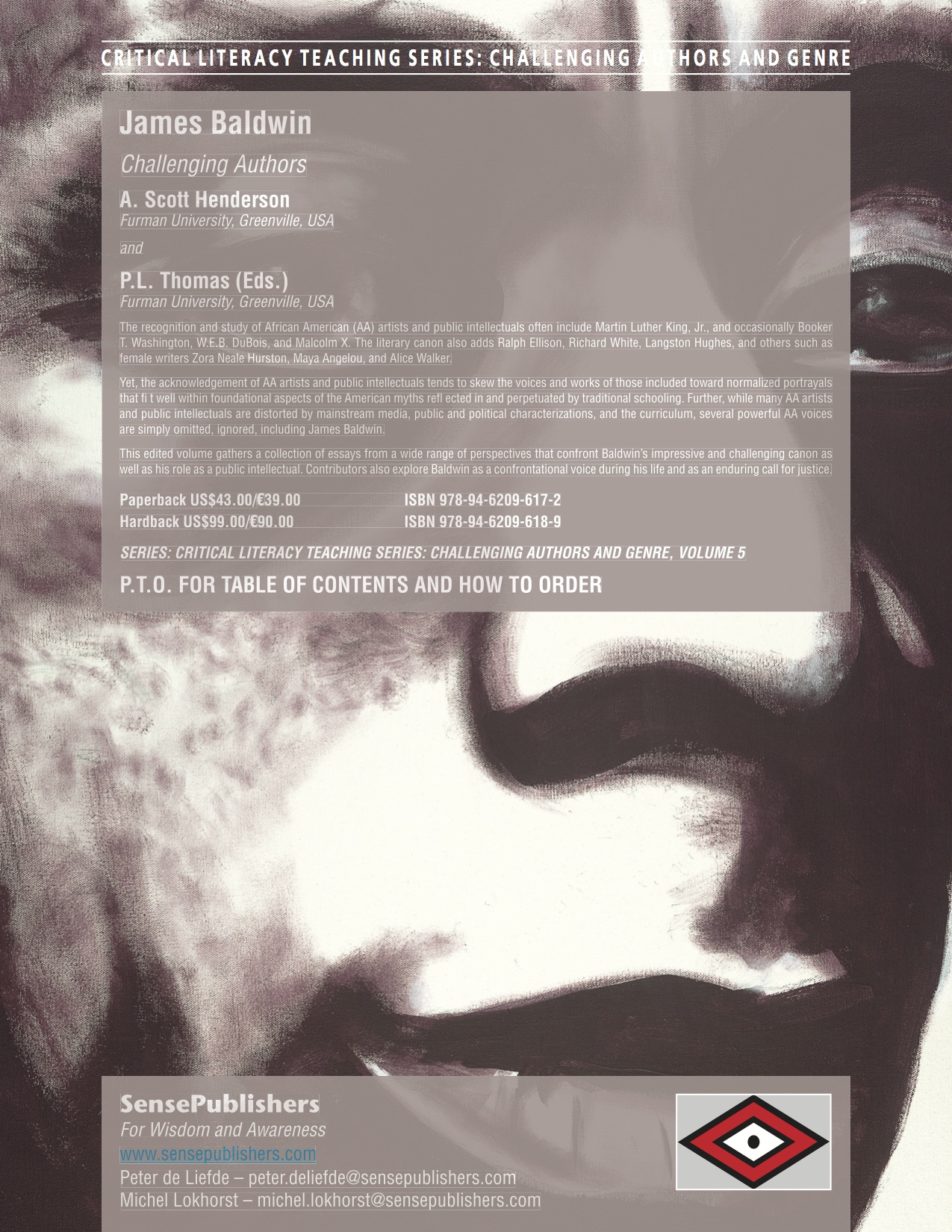
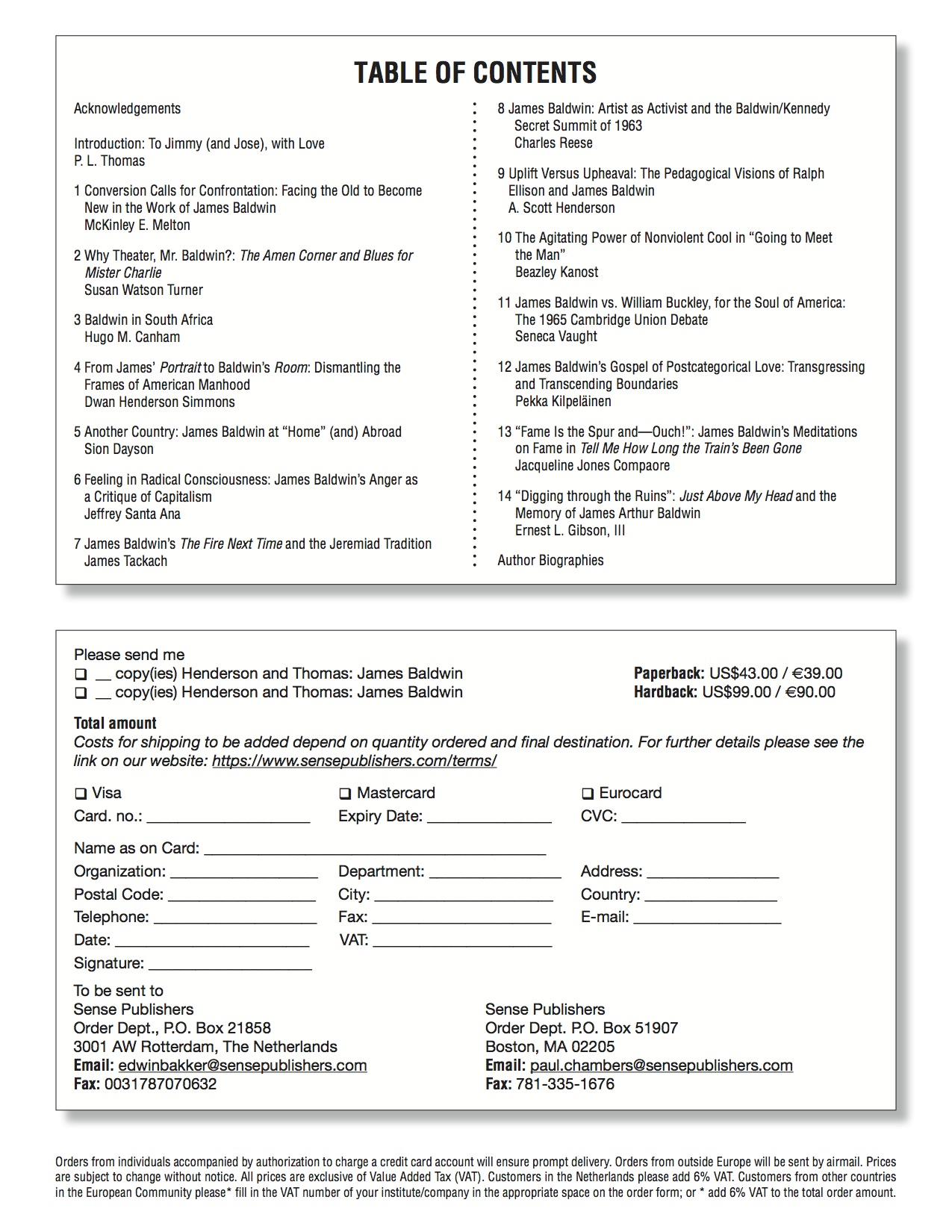
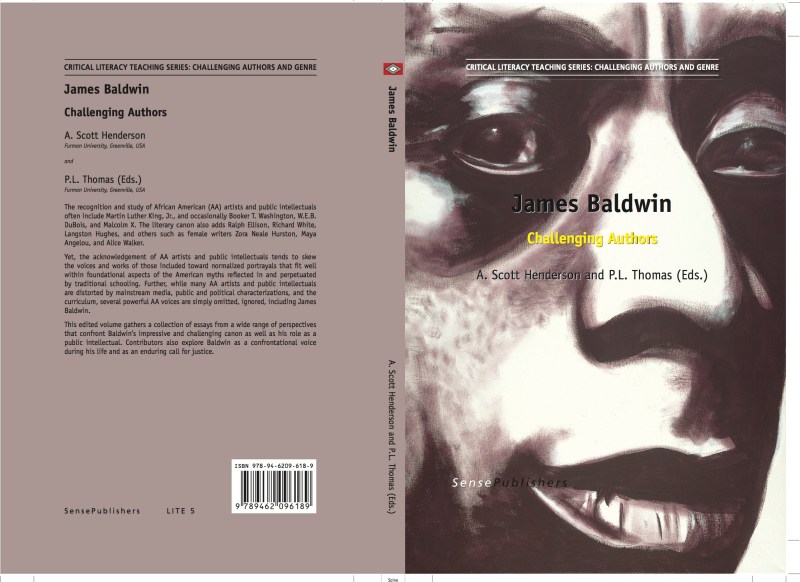
My journey with Baldwin has resulted in an edited volume (co-edited with Furman colleague Scott Henderson), James Baldwin: Challenging Authors. So here I want to share the introduction I wrote for that collection of essays.

Introduction

No rhetorical sleight of words should mask that Trayvon Martin was a son. He had parents. No rhetorical sleight of words should allow us to ignore that any child is everyone’s child.[i]

Trayvon Martin was killed February 26, 2012, in part because he was reduced to a stereotype, and after his death, Trayvon was again reduced—often by well-meaning people—to an icon, the hoodie. In his death, as well, Trayvon has been spoken about, spoken for—and I am compelled to argue that he has also been rendered voiceless. But, as Arundhati Roy (2004) has explained, “We know of course there’s really no such thing as the ‘voiceless.’ There are only the deliberately silenced, or the preferably unheard” (n.p.).

In this introduction to a volume on the work of James Baldwin, I, like Roy, am compelled to speak beyond Trayvon about “the deliberately silenced, or the preferably unheard”—about those Others: African American males.

At mid-twentieth century, as the U.S. was fighting against its racist heritage, African American males demanded to be heard—Martin Luther King Jr., Malcolm X, Ralph Ellison, James Baldwin, Richard Wright and many others took the stage as artists, public intellectuals, and civic leaders. Wright’s Black Boy and Ellison’s Invisible Man represent in fictional narrative a powerful and disturbing image of the African American male; for Ellison, the guiding metaphor of that narrative is invisibility. The killing of Trayvon and the subsequent trial may suggest that African American males no longer suffer from invisibility but from how they are seen, how they are silenced, and how they are unheard: Trayvon seen (and reduced) as black male, thus necessarily a thug, a threat, and then Trayvon, the hoodie, the icon of the disposable African American male.

The fact of being seen and reduced as African American males too often result in violent deaths and prison. And the intersection of race, class, and gender with education has paralleled the rise of mass incarceration (Thomas, 2013) over the past thirty-plus years. While Wright’s and Ellison’s novels continue to capture the African American male experience—including the entrenched conditions that contributed to Trayvon’s killing—Ellison’s and Baldwin’s concerns about the failure of education to see clearly and holistically—and humanely—the plight of African American males continue to send an ominous and powerful message today  (see Chapter 9 for a fuller discussion).

In 1963, Ellison (2003) spoke to teachers:

At this point it might be useful for us to ask ourselves a few questions: what is this act, what is this scene in which the action is taking place, what is this agency and what is its purpose? The act is to discuss “these children,” the difficult thirty percent. We know this very well; it has been hammered out again and again. But the matter of scene seems to get us into trouble. (p. 546)

Ellison recognized the stigma placed on African American students, a deficit view of both an entire race and their potential intelligence (marginalized because of non-standard language skills). But Ellison rejected this deficit perspective: “Thus we must recognize that the children in question are not so much ‘culturally deprived’ as products of a different cultural complex” (p. 549). Ultimately, Ellison demanded that the human dignity of all children be honored.

Baldwin (1998) addressed teachers in that same year, 1963:

Let’s begin by saying that we are living through a very dangerous time.  Everyone in this room is in one way or another aware of that.  We are in a revolutionary situation, no matter how unpopular that word has become in this country.  The society in which we live is desperately menaced, not by Khrushchev, but from within. (p. 678)

Then, Baldwin unmasked the cruel tension between the promise of universal public education and the inequity found in the lives of African American children. Education, for Baldwin, must be revolutionary, an act of social justice. In Baldwin’s words, I hear a refrain: No rhetorical sleight of words should mask that Trayvon Martin was a son. He had parents. No rhetorical sleight of words should allow us to ignore that any child is everyone’s child.

However, if the killing of Trayvon does not haunt us, if the killing of Trayvon slips beneath the next tragedy-of-the-moment—as the Sandy Hook school shooting (December 14, 2012) has beneath the George Zimmerman trial—then society and schools will continue to be mechanisms that shackle “the deliberately silenced, or the preferably unheard.” And I suppose that is ultimately the cruel paradox, rendering Trayvon a ghost in this American house he was never allowed to enter, invisible again as Ellison’s unnamed narrator.

To Jimmy (and Jose), with Love

When teacher and blogger Jose Vilson[ii] posts a blog, I read carefully and don’t multitask. Why? I am a privileged, white male who has lived his entire life in the South where racism clings to the region like the stench of a house razed by fire.

And as a result, I walk freely among racism because I am white. So when Vilson (2013) posted “An Open Letter From The Trenches [To Education Activists, Friends, and Haters],” I listened, and I recognized:

Anger isn’t a title we parade around like doctorates, followers, and co-signers; it’s the feeling before, during, and after we approach things with love and earnest….

However, for anyone to say that racial insults are “no big deal” speaks volumes to the sorts of work people of color and anyone who considers themselves under the umbrella have to do in order to make things right. As colleague Kenzo Shibata once said, “You can’t build a movement by making allies feel unwelcome and telling them to get over it.” I’d take it one step further and say that we can’t build coalition if we continue to think we have to build a movement under one or two people’s terms. I refuse to believe that we can’t coalesce around building a better education system for all children, regardless of background.

How can you say you care about children of color, but ostracize adults of color with the same breath?…

Adults, on the other hand, don’t get excuses. The privilege is in the hopes and dreams we have for our students, not in the ways we act towards our fellow man or woman. The privilege, to convert the anger over how our kids are treated in the system into a passion for student learning, remains at the forefront. (n.p.)

I have learned to read and listen to Jose as I do with New York Times columnist Charles Blow and writer Ta-Nehisi Coates, as I do with Martin Luther King Jr., Malcolm X, Ralph Ellison, and now more than ever, James Baldwin, who is the focus of this volume.

I have learned daily—I continue to learn today—that America the Beautiful has failed an entire race of people, specifically African American males. I have learned daily, I continue to learn today that in my half-century-plus life, the most hateful people I have encountered have been white men—yet, daily brown and black faces smile at me (even or especially when we are strangers) and speak with kindness and joy when we approach each other on the street, in restaurants, and where we all work and live. I have learned daily, I continue to learn today that in my half-century-plus life, the most beautiful humans—and the greatest reason to live on this planet—are children of every possible shade. They laugh and sing and dance and run with the beauty of life that has nothing at all to do with race or the supreme and inexcusable failures of the adults in whose care they reside.

America the Beautiful created a minority class out of a race of people who are as rich, vibrant, and beautiful as anybody else. America the Beautiful has also created a criminal class out of African American men, building a new Jim Crow system (Alexander, 2012) with mass incarceration masked as a war on drugs. America the Beautiful created a dropout class and future criminal class out of African American young men, building school-to-prison pipelines and schools-as-prisons as zero-tolerance schools imprisoning urban communities (Nolan, 2011).

These are not angry and hyperbolic claims about the soot-stained American past; these are claims about the roots that continue to thrive and bear bitter fruit. Baldwin (1998), in “A Report from Occupied Territory” (originally published in The Nation, July 11, 1966), confronted an “arrogant autonomy, which is guaranteed the police, not only in New York, by the most powerful forces in American life” (p. 737) and the corrosive deficit view of race it is built upon: “‘Bad niggers,’ in America, as elsewhere, have always been watched and have usually been killed”:

Here is the boy, Daniel Hamm, speaking—speaking of his country, which has sworn to bring peace and freedom to so many millions. “They don’t want us here. They don’t want us—period! All they want us to do is work on these penny-ante jobs for them—and that’s it. And beat our heads in whenever they feel like it. They don’t want us on the street ’cause the World’s Fair is coming. And they figure that all black people are hoodlums anyway, or bums, with no character of our own. So they put us off the streets, so their friends from Europe, Paris or Vietnam—wherever they come from—can come and see this supposed-to-be great city.”

There is a very bitter prescience in what this boy—this “bad nigger”—is saying, and he was not born knowing it. We taught it to him in seventeen years [emphasis added]. He is draft age now, and if he were not in jail, would very probably be on his way to Southeast Asia. Many of his contemporaries are there, and the American Government and the American press are extremely proud of them…. (pp. 737-738)

These realities of racism from 1966 linger today—the scar of racism cloaked, as Baldwin recognized, with claims of justice:

This is why those pious calls to “respect the law,” always to be heard from prominent citizens each time the ghetto explodes, are so obscene. The law is meant to be my servant and not my master, still less my torturer and my murderer. To respect the law, in the context in which the American Negro finds himself, is simply to surrender his self-respect. (p. 734)

And thus, Baldwin’s conclusion about the Harlem Six rings true still:

One is in the impossible position of being unable to believe a word one’s countrymen say. “I can’t believe what you say,” the song goes, “because I see what you do”—and one is also under the necessity of escaping the jungle of one’s situation into any other jungle whatever. It is the bitterest possible comment on our situation now that the suspicion is alive in so many breasts that America has at last found a way of dealing with the Negro problem. “They don’t want us—period!” The meek shall inherit the earth, it is said. This presents a very bleak image to those who live in occupied territory. The meek Southeast Asians, those who remain, shall have their free elections, and the meek American Negroes—those who survive—shall enter the Great Society. (p. 738)

Today, racism is thinly masked, and many refuse to see it.

In 1853, Frederick Douglass recognized what would 100 years later be portrayed as invisibility by Ralph Ellison:

Fellow-citizens, we have had, and still have, great wrongs of which to complain. A heavy and cruel hand has been laid upon us.

As a people, we feel ourselves to be not only deeply injured, but grossly misunderstood. Our white fellow-countrymen do not know us. They are strangers to our character, ignorant of our capacity, oblivious of our history and progress, and are misinformed as to the principles and ideas that control and guide us as a people. The great mass of American citizens estimate us as being a characterless and purposeless people; and hence we hold up our heads, if at all, against the withering influence of a nation’s scorn and contempt. (qtd. in Alexander, 2012, p. 140)

Douglass’s charges are echoed in Baldwin’s (1998) “No Name in the Street,” which points a finger at the entrenched American problem with race:

The truth is that the country does not know what to do with its black population now that the blacks are no longer a source of wealth, are no longer to be bought and sold and bred, like cattle; and they especially do not know what to do with young black men, who pose as devastating a threat to the economy as they do to the morals of young white cheerleaders. It is not at all accidental that the jails and the army and the needle claim so many, but there are still too many prancing around for the public comfort. Americans, of course, will deny, with horror, that they are dreaming of anything like “the final solution”—those Americans, that is, who are likely to be asked: what goes on in the vast, private hinterland of the American heart can only be guessed at, by observing the way the country goes these days. (pp. 432-433)

America doesn’t know what to do, but it is startlingly clear that we should know what not to do: Don’t suspend and expel young black men without just cause, don’t incarcerate young black men without just cause, don’t lure and then send young black men to war, and without a doubt, don’t allow anyone to demonize anyone else with racial slurs.

Maybe, in the end, racism remains a cancer on America the Beautiful because we will not face it or unmask it—and because we have become so cynical that the solution seems trite: As Jose stated, as King repeated, and as James (“Jimmy”) Baldwin demanded, the solution is love. Love everyone, but be vigilant about loving the least among us—children, the impoverished, the imprisoned, the hungry, the sick, the elderly—and do so color-blind.

As stated above, I offer these words because I walk freely among racism and because I, like Vilson (2013), refuse to believe “that we can’t coalesce around building a better education system for all children, regardless of background” (n.p.). Or, as Baldwin (1998) himself said: “‘I can’t believe what you say,’ the song goes, ‘because I see what you do’” (p. 738)—and we all must hear what everyone else says—especially the words they choose—never offering excuses for the racism of policy, the racism of action, or the racism of language.

James Baldwin: Challenging Authors

In 2004, poet Adrienne Rich (2009) wrote about a postage stamp bearing the face of American ex-patriot writer James Baldwin: “the stamp commemorates Baldwin’s birthday, August 2: he would have been eighty that year” (p. 49). This volume appears in 2014, the year that Baldwin would have turned ninety.
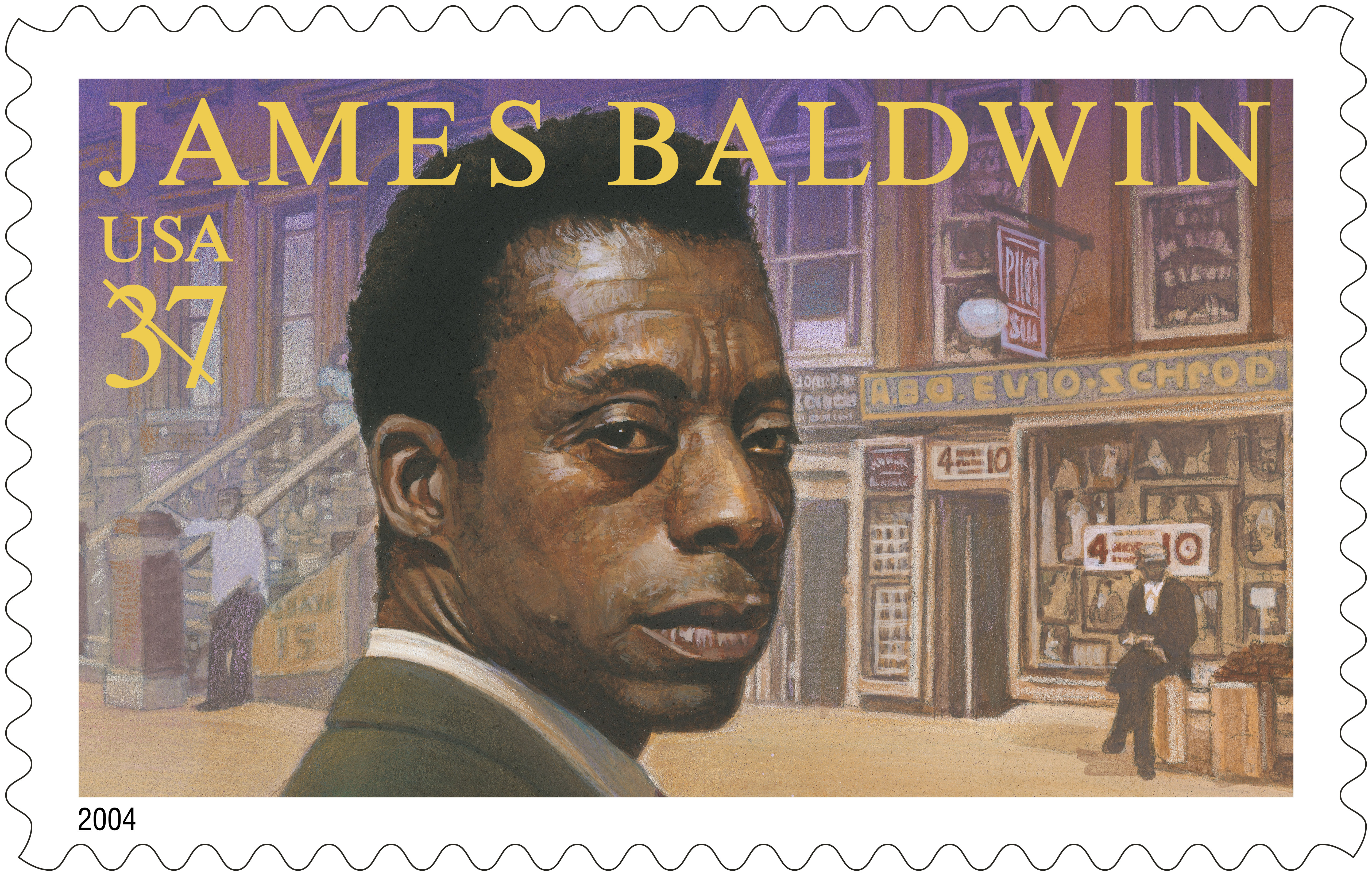
Rich’s essay reads as the journey of one writer’s experience embracing the other, but Rich also highlights what this volume seeks to address as well—the lack of attention that Baldwin receives in the twenty-first century U.S. Why, Rich asks, does a country still laboring under the same issues of race continue to ignore a powerful voice, as Americans certainly did when Baldwin spoke of racism?

Quoting from “Lockridge: ‘The American Myth,’” Rich (2009) includes the following:

The gulf between our dream and the realities that we live with is something that we do not understand and do not wish to admit. It is almost as though we were asking that others look at what we want and turn their eyes, as we do, away from what we are. I am not, as I hope is clear, speaking of civil liberties, social equality, etc., where indeed strenuous battle is yet carried on; I am speaking instead of a particular shallowness of mind, an intellectual and spiritual laxness….This rigid refusal to look at ourselves may well destroy us; particularly now since if we cannot understand ourselves we will not be able to understand anything. (p. 52; Baldwin, 1998, p. 593)

Baldwin’s challenge here should haunt us because it remains the challenge before us—“[t]his rigid refusal to look at ourselves.”

The following chapters—based on both scholarly and experiential perspectives—make significant contributions to the astonishingly slim amount of research and discussion that exists on one of the twentieth century’s most important public intellectuals. They provide key insights into Baldwin’s literary skills, his political views, and the impact his life and work had on historic, as well as ongoing, policy debates. They reveal a complicated, often tormented, and always provocative individual who confronted racism, imperialism, and homophobia as a black, gay pacifist. It should therefore come as little surprise that his work maintains its relevance as American society continues to grapple with racial, social, and political challenges.

See Also

A Raised Voice: How Nina Simone turned the movement into music.

References

Alexander, M. (2012). The new Jim Crow: Mass incarceration in the age of colorblindness (revised ed.). New York, NY: The New Press.

Baldwin, J. (1998). James Baldwin: Collected essays. New York, NY: The Library of America.

Ellison, R. (2003). The collected essays of Ralph Ellison. Ed. J.F. Callahan. New York, NY: The Modern Library.

Nolan, K. (2011). Police in the hallways: Discipline in an urban high school. Minneapolis, MN: University of Minnesota Press. [Kindle edition]

Rich, A. (2009). A human eye: Essays on art in society 1997-2008. New York, NY: W.W. Norton and Company.

Roy, A. (2004, November 8). The 2004 Sydney Peace Prize lecture. Real Voice.

Thomas, P. L. (2013, May 17). Education reform in the New Jim Crow era. Truthout.

Vilson, J. (2013, April 8). An open letter from the trenches [to education activists, friends, and haters] [Web log]. The Jose Vilson.

Woodson, C. G. (1933). The mis-education of the negro. New York, NY: Tribeca Books.

[i] Portions of this chapter are adapted from two blog posts: “The Deliberately Silenced, or the Preferably Unheard,” (2013, July 25), https://radicalscholarship.wordpress.com/2013/07/25/the-deliberately-silenced-or-the-preferably-unheard/ and To Jimmy (and Jose), with Love: I Walk Freely among Racism (2013, April 9), https://radicalscholarship.wordpress.com/2013/04/09/to-jimmy-and-jose-with-love-i-walk-freely-among-racism/

[ii] Vilson offers about himself at his blog, The Jose Vilson (http://thejosevilson.com/): “José Luis Vilson is a math educator for a middle school in the Inwood / Washington Heights neighborhood of New York, NY. He graduated with a bachelor’s degree in computer science from Syracuse University and a master’s degree in mathematics education from the City College of New York. He’s also a committed writer, activist, web designer, and father. He co-authored the book Teaching 2030: What We Must Do For Our Students and Public Schools … Now and In The Future with Dr. Barnett Berry and 11 other accomplished teachers. He currently serves as the president emeritus of the Latino Alumni Network of Syracuse University, as a board member on the Board of Directors for the Center for Teaching Quality, and has been a part of the Acentos Foundation, LATinos In Social Media (LATISM), the Capicu Poetry Group, BlogCritics, and the AfroSpear.”

Maya Angelou, RIP

With the death of Maya Angelou, I offer a few intersections between Angelou and James Baldwin.

At 80, Maya Angelou Reflects on a ‘Glorious’ Life:

Angelou says author James Baldwin, whom she considers a brother, had a covert hand in getting her to write “I Know Why the Caged Bird Sings.” Acting on Baldwin’s advice, Angelou’s editor tried a little reverse psychology and told her that writing an autobiography as literature was “almost impossible” and she shouldn’t even attempt it.

“I said, ‘Well, hmmm, maybe I’ll try it.'” Angelou recalls. “The truth is that he had talked to James Baldwin, my brother friend, and Jimmy told him that ‘if you want Maya Angelou to do something, tell her she can’t do it.'”

Angelou and Baldwin in The Price of the Ticket.

Dr. Maya Angelou: “I hear Baldwin as a part of the continuity, begun if you will for me anyway, with Frederick Douglass in 1849 in the slave narrative. I hear his voice. I hear Baldwin when I think of Jupiter Hammon, a slave in the 18th century. I hear Baldwin in the music, the lyric really, of George Moses Horton, writing about 1840, ’50. He wrote ‘Alas, and was I born for this, to wear this slavish chain–‘ I hear Baldwin.”

Recommended: Talking Back to Maya Angelou, Hilton Als

Overview of I Know Why the Caged Bird Sings from Salem Press.

Revisiting James Baldwin’s “Black English”

The first five or six years of teaching high school English have blurred in my memory, but certain days, certain events, and certain students remain vivid.

One day in those years a young woman in my tenth-grade course blurted out in utter exasperation, “When are we going to do English? All we do is read and write!”

No, she was not being sarcastic. This student had been taught in her first nine years of school that English was mostly grammar books and grammar exercises—an environment in which she had excelled, making As.

Reading and writing were much messier, and she feared her status as an A student was in jeopardy.

As an English teacher, I marvel at the power of grammar in the world outside of school. Harry Ritchie, writing about the Bad Grammar Awards in the UK, laments:

It’s a big night on Thursday at the Idler Academy, which hosts its second annual Bad Grammar awards. The founder Tom Hodgkinson promises “a thrilling X-factor for pedants”….

Everywhere, that’s where. Because the Bad Grammar prizegiving is far from a merry little jape. It’s a piece of reactionary nonsense eagerly endorsed by Michael Gove, who has gone out of his way to promote the nonsensically reactionary “grammarian” who inspired all this drivel, Nevile Gwynne, the author of Gwynne’s Grammar. The horribly right-wing and entirely wrong-headed prejudices behind the book and the prize explain why last year’s winners were some academics who’d written in protest about Gove’s education policies and why the smart money this year is on poor old Tristram Hunt and his apparently heinous semicolon.

Grammar, even a garbled understanding of the term, is not just about correctness in English class. Grammar is about values.

Both in school and society, however, grammar is misunderstood, as Jonathon Owen concludes in his call for teaching grammar:

So yes, I think we should teach grammar, not because it will help people write better, but simply because it’s interesting and worth knowing about. But we need to recognize that it doesn’t belong in the same class as writing or literature; though it certainly has connections to both, linguistics is a separate field and should be treated as such. And we need to teach grammar not as something to hate or even as something to learn as a means to an end, but as a fascinating and complex system to be discovered and explored for its own sake. In short, we need to teach grammar as something to love.

And while grammar remains entrenched in our schools and public discourse, it appears that writer James Baldwin is fading. Kathi Wolfe examines Baldwin as an often ignored voice:

Back in the day, being on the cover of Time magazine was huge. Then, everyone from salesclerks to Wall Street traders read the newsweekly, and if your face, well known or not, peered out from it on newsstands or in mailboxes, everyone would know your name.

This was especially true when James Baldwin, the iconic novelist, essayist, playwright and poet, who wrote stirringly and eloquently on the civil rights movement, race and sexuality, made the cover of Time on May 13, 1963. Time made Baldwin a celebrity after the publication earlier that year of “The Fire Next Time,” his searing essays on race and civil rights. One of my most vivid youthful memories is that of my Dad pointing to Baldwin’s visage on Time and saying, “That man is our conscience! You’d have to be made of stone not to listen to him.”

I’m remembering this because Baldwin, who died in the South of France at age 63 in 1987, was born in Harlem 90 years ago this year. Yet, the legacy of Baldwin, black and openly gay years before Stonewall, and one of the greatest writers of the 20th century, is fading in many classrooms, the New York Times reported recently. Fortunately, steps are being taken to commemorate and preserve Baldwin’s legacy.

Time Magazine May 17, 1963

James Baldwin—as novelist, public intellectual, and poet—was an important voice (although often marginalized) during his lifetime, but he remains an important voice because his concerns about race and inequity remain powerful in the U.S. today—and those inequities also remain grounded in attitudes about language.

Revisiting James Baldwin’s “Black English”

Ralph Ellison was simultaneously heralded as a Great American Novelist and shunned by the radical Left during the 1950s and 1960s. Baldwin suffered parallel experiences, although the shunning was politically inverse—Ellison, too traditional, and Baldwin, too radical.

As African American men of letters however, they shared a powerful recognition of the corrosive nature of deficit views of so-called Black English. Ellison confronted that view in a talk to teachers in 1963 addressing the high drop-out rates for Black students:

Some of us look at the Negro community in the South and say that these kids have no capacity to manipulate language. Well, these are not the Negroes I know. Because I know that the wordplay of Negro kids in the South would make the experimental poets, the modern poets, green with envy. I don’t mean that these kids possess broad dictionary knowledge, but within the bounds of their familiar environment and within the bounds of their rich oral culture, they possess a great virtuosity with the music and poetry of words. The question is how can you get this skill into the mainstream of the language, because it is without doubt there. And much of it finds its way into the broader language. Now I know this just as William Faulkner knew it. This does not require a lot of testing; all you have to do is to walk into a Negro church….

But how can we keep the daring and resourcefulness which we often find among the dropouts? I ask this as one whose work depends upon the freshness of language. How can we keep the discord flowing into the mainstream of the language without destroying it? One of the characteristics of a healthy society is its ability to rationalize and contain social chaos. It is the steady filtering of diverse types and cultural influences that keeps us a healthy and growing nation. The American language is a great instrument for poets and novelists precisely because it could absorb the contributions of those Negroes back there saying “dese” and “dose” and forcing the language to sound and bend under the pressure of their need to express their sense of the real. The damage done to formal grammar is frightful, but it isn’t absolutely bad, for here is one of the streams of verbal richness….

I’m fascinated by this whole question of language because when you get people who come from a Southern background, where language is manipulated with great skill and verve, and who upon coming north become inarticulate, then you know that the proper function of language is being frustrated.

The great body of Negro slang–that unorthodox language–exists precisely because Negroes need words which will communicate, which will designate the objects, processes, manners and subtleties of their urban experience with the least amount of distortion from the outside. So the problem is, once again, what do we choose and what do we reject of that which the greater society makes available? These kids with whom we’re concerned, these dropouts, are living critics of their environment, of our society and our educational system, and they are quite savage critics of some of their teachers.

Sara Dalmas Jonsberg, writing in English Journal nearly forty years later, recognized how the social stigma against Black English negatively impacted students’ perceptions of themselves:

When they arrived in my section of freshman comp, the course required of all entering college students, Tarsha, Shera, and Keydrya revealed themselves as bilingual. They knew how to write and speak “good English.” They were articulate and graceful in written and oral “school language.” They also knew how to speak “Black English,” and they knew when each language was appropriate. They referred to the argot they used privately as “slang” or “bad English.” I don’t know how they learned their two languages—which was first and which second, which was spoken at home and which had been acquired among friends—but I did notice this: one crucial lesson had been omitted from the language training of these alert and articulate young women. They did not respect the Black English they could speak so fluently. They did not know its history. They seemed ashamed and were apologetic if they fell to speaking it in class. Enthusiastic and thoughtful contributors to class discussions and projects, linguistically they demonstrated Theresa Perry’s comment that “Black English is the last uncontested arena of Black shame” (4).

Jonsberg’s solution? “I dragged them to the James Baldwin piece that is often included in composition readers: ‘If Black English Isn’t a Language, Then Tell Me, What Is?’

Thus, now, I do the same.

Writing from France in 1979, Baldwin opens with:

The argument concerning the use, or the status, or the reality, of black English is rooted in American history and has absolutely nothing to do with the question the argument supposes itself to be posing. The argument has nothing to do with language itself but with the role of language. Language, incontestably, reveals the speaker. Language, also, far more dubiously, is meant to define the other–and, in this case, the other is refusing to be defined by a language that has never been able to recognize him.

He had confronted the role of any person’s use of racial slurs in revealing that person in Take This Hammer, the same year as Ellison’s talk.

Immediately, Baldwin contextualizes his discussion of Black English in the language stratification he witnessed in France: “But each has paid, and is paying, a different price for this ‘common’ language, in which, as it turns out, they are not saying, and cannot be saying, the same things: They each have very different realities to articulate, or control.”

Possibly Baldwin’s central focus is the nature of language: “language is also a political instrument, means, and proof of power. It is the most vivid and crucial key to identify: It reveals the private identity, and connects one with, or divorces one from, the larger, public, or communal identity.”

If we doubt Baldwin’s relevance, let’s pause there and consider the Donald Sterling controversy and the role of his private language exposing his racism and the consequences of those revelations divorcing Sterling from the larger community.

It is not just the language we use, and the prejudices we hold about that language, but what language reveals about us.

Couched in the politics of language is Baldwin’s confrontation of how mainstream English appropriated Black English while simultaneously marginalizing it:

Now, I do not know what white Americans would sound like if there had never been any black people in the United States, but they would not sound the way they sound. Jazz, for example, is a very specific sexual term, as in jazz me, baby, but white people purified it into the Jazz Age. Sock it to me, which means, roughly, the same thing, has been adopted by Nathaniel Hawthorne’s descendants with no qualms or hesitations at all, along with let it all hang out and right on! Beat to his socks which was once the black’s most total and despairing image of poverty, was transformed into a thing called the Beat Generation, which phenomenon was, largely, composed of uptight, middle- class white people, imitating poverty, trying to get down, to get with it, doing their thing, doing their despairing best to be funky, which we, the blacks, never dreamed of doing–we were funky, baby, like funk was going out of style.

Now, no one can eat his cake, and have it, too, and it is late in the day to attempt to penalize black people for having created a language that permits the nation its only glimpse of reality, a language without which the nation would be even more whipped than it is.

Black English for Baldwin was forged out of necessity and with that comes its power—”A language comes into existence by means of brutal necessity, and the rules of the language are dictated by what the language must convey“—and power is both frightening and threatening:

There was a moment, in time, and in this place, when my brother, or my mother, or my father, or my sister, had to convey to me, for example, the danger in which I was standing from the white man standing just behind me, and to convey this with a speed, and in a language, that the white man could not possibly understand, and that, indeed, he cannot understand, until today. He cannot afford to understand it. This understanding would reveal to him too much about himself, and smash that mirror before which he has been frozen for so long.

African Americans are not language deficient, Baldwin asserts, adding,

The brutal truth is that the bulk of white people in American never had any interest in educating black people, except as this could serve white purposes. It is not the black child’s language that is in question, it is not his language that is despised: It is his experience. A child cannot be taught by anyone who despises him, and a child cannot afford to be fooled. A child cannot be taught by anyone whose demand, essentially, is that the child repudiate his experience, and all that gives him sustenance, and enter a limbo in which he will no longer be black, and in which he knows that he can never become white. Black people have lost too many black children that way.

Language is political, but so are any people’s decisions about who and how to teach both the privileged and the oppressed. So Baldwin ends:

And, after all, finally, in a country with standards so untrustworthy, a country that makes heroes of so many criminal mediocrities, a country unable to face why so many of the nonwhite are in prison, or on the needle, or standing, futureless, in the streets–it may very well be that both the child, and his elder, have concluded that they have nothing whatever to learn from the people of a country that has managed to learn so little.

As a free people, we cannot afford either our lingering deficit view of language or Baldwin to fade from our classrooms and our collective conscience.

Wolfe concludes, and I concur:

Why does Baldwin’s legacy matter? Because we still perpetuate and encounter homophobia and racism; and great writing still nourishes our hearts and minds. Happy Birthday, Mr. Baldwin! Long live your prophetic voice!

REVIEW: Jimmy’s Blues and Other Poems, James Baldwin

For many, James Baldwin is associated with novels, fiction. But my greatest affinity for Baldwin lies with his nonfiction and his role as a public intellectual.

In the volume I co-edited, James Baldwin: Challenging Authors, chapter authors examine Baldwin as a powerful voice across genre and form. Concurrent with that volume is the publication of Jimmy’s Blues and Other Poems.

Baldwin is rarely examined as a poet so this collection is significant for those new to Baldwin as well as those who have studied and treasure his complete canon.

The slim book of poetry is inviting as a paperback—the cover an electric blue to complement the rich use of “blues” in the title—color, music, mood:

Jimmy’s Blues and Other Poems, James Baldwin

“Playing by Ear, Praying for Rain: The Poetry of James Baldwin,” the introduction by Nikky Finney, opens the collection passionately and parallels Baldwin’s own challenging persona: “Baldwin was dangerous to everybody who had anything to hide,” Finney warns (p. ix).

Finney introduces readers to Baldwin as well as his poetry—his sexuality and frankness central to both:

Uninviting Baldwin was often the excuse for the whitewashing of his urgent and necessary 
brilliance from both the conservative black community and from whites who had never heard such a dark genius display such rich and sensory antagonism for them. Into the microphone of the world Baldwin leaned — never afraid to say it. (p. x)

Finney emphasizes that Baldwin always remained true to himself: “They could listen in or they could ignore him, but he was never their boy, writing something they wanted to hear” (p. xiii). Baldwin always sought Truth, compelled to speak the Truth:

In his work he remained devoted to exposing more and more the ravages of poverty and invisibility on black and poor people….

Baldwin was never afraid to say it in his novels, in his essays, and in his poetry — because Baldwin saw us long before we saw ourselves. (pp. xix, xxi)

For me, as someone drawn to Baldwin’s nonfiction and videos of his speaking, these poems fits into those contexts in ways that give his poetry a vibrancy beyond the grave.

Baldwin’s poetry is Baldwin’s voice.

“Staggerlee wonders”

A 16-page poem in four sections, this opening piece sparks, for me, Baldwin’s “Who Is the Nigger?” from Take This Hammer:

Simultaneously, “Staggerlee wonders” is deeply steeped in the U.S. of Baldwin’s lifetime and disturbingly relevant to 2014. The speaker mentions Russia, China, the Panama Canal, and Vietnam along with “Mad Charlie,” Patty Hearst, John Wayne, Ronald Reagan, and Mohammad Ali. But the historical, political, and pop culture references do not date the poem since Baldwin uses them as vehicles for his truth-telling.

The poem rarely strays too far from colors, or more accurately skin pigmentation. And Baldwin deftly blends slurs and dialects in the voice of the speaker who appears both of the situation as well as above the situation: the racial and social inequities of being Black in the U.S.:

I wonder how they think
the niggers made, make it,
how come the niggers are still here.
But, then, again, I don’t think they dare
to think of that: no:
I’m fairly certain they don’t think of that at all. (3.1-6)

As an opening poem, “Staggerlee wonders” represents Baldwin’s complexity and richness, as well as his tensions—notably his use of Biblical references bracketed with “though theology has absolutely nothing to do/ with what I am trying to say” and “But we are not talking about belief.”

This poem reveals Baldwin’s craft, his ability to be deeply personal and bound by his moments of history while speaking against and to the great questions of being human when humans fail their humanity.

David L. Ulin poses James Baldwin, poet? But of course. in his review of this new collection from Baldwin, concluding,

This new version of “Jimmy’s Blues” features six poems that until now have only been available in a limited edition chapbook published after Baldwin’s death. Not all of this material is equally resonant, but when he’s on, Baldwin has the rare ability to contain contradictions — and not only to contain them, but also to evoke them on the page.

As National Poetry Month 2014 comes to a close and as we move toward Baldwin’s 90th birthday in August, now appears to be right for exploring Baldwin the poet.

Paternalism, Old or New, Blinds

22 Wives, be subject to your own husbands, as to the Lord. 23 For the husband is the head of the wife, as Christ also is the head of the church, He Himself being the Savior of the body. 24 But as the church is subject to Christ, so also the wives ought to be to their husbands in everything.

Ephesians 5:22-24

Wives, submit yourselves to your husbands, as is fitting in the Lord.

Colossians 3:18

The Olinka do not believe that girls should be educated. When I asked a mother why  she thought this, she said: A girl is nothing to herself; only to her husband can she become something.

Nettie to Celie, The Color Purple, Alice Walker

Slaves, obey your earthly masters with respect and fear, and with sincerity of heart, just as you would obey Christ.

Ephesians 6:5

Slaves, obey your earthly masters in everything; and do it, not only when their eye is on you and to curry their favor, but with sincerity of heart and reverence for the Lord.

Colossians 3:22

The road to hell is paved with good intentions.

No one is more dangerous than he who imagines himself pure in heart: for his purity, by definition, is unassailable.
― James Baldwin, Nobody Knows My Name

I spent the last third of my career as a high school English teacher also serving as the soccer coach for the school’s boys and girls soccer programs. The reasons I took the coaching position included my own concerns about how public school coaches often behaved in ways that no one would have tolerated by teachers in the classroom—although most of those coaches were also classroom teachers.

Coaches routinely berated players, including the use of profanity, and in the South, the line between church and state simply did not exist since coaches always led players in prayer, especially just before a game or match started in full view of the fans.

For most of my life and career in my small hometown, the head football coach—who worked as athletic director and assistant principal—blared profanity over the stadium intercom during practices and even swore at students while issuing them demerits for profanity.

That coach won football games, state championships, and thus, essentially not a soul ever uttered a concern—even in those moments when the profanity was joined with racial slurs.

I did complain so when I became a coach, I set out to change the culture of my teams both in my behavior and in the messages I sent.

When I notified my team that I would not lead them in prayer—explaining why—and that before games teammates who wanted to pray needed to organize that and then join the team for a pre-game huddle, that change did prompt complaints. But that change also brought players to me in private who thanked me—players who had never spoken a word about coach-led prayers making them uncomfortable before.

So when I heard about the controversy surrounding Clemson University and whether or not head coach Dabo Swinney is coercing his players with his religious beliefs, I was certain of two things: (1) local public opinion would overwhelming support Swinney, and (2) despite Swinney’s good intentions (I do trust he has only good intentions), the situation is, in fact, inappropriate in the context of Swinney’s power as head coach and Clemson being a state university.

But the Clemson football/religion controversy is much more than the narrow situation because at its source, the controversy is about a recurring human flaw: the allure and failure of paternalism, both on grand and small scales.

Nettie and Celie are sisters who exchange letters in Alice Walker’s The Color Purple. Nettie reveals to Celie throughout the correspondence Nettie’s own awakening to the dangers of missionary zeal during her experience in Africa. Celie, who remains home in the Deep South, confronts her own awakening about the traditional view of women in the South—the subservience of women and wives occurring, however, in both sisters’ worlds.

As a work about racism and sexism, The Color Purple ultimately is a confrontation of paternalism. And paternalism is the driving force behind the justifications for misogyny and slavery: Women were to be protected because of their inherent frailties and slaves were to be taken care of by their owners because of Blacks’ inherent inadequacies.

Subjugating women to the control of men and Blacks to the control of Whites was repeatedly framed as acts of good intentions and then linked to the ultimate paternalism—the Word of God.

When the U.S. came against the bombing of Pearl Harbor, the political response was something that—looking back—seems nearly impossible to believe. Japanese-Americans were subjected to internment:

In 1942, still reeling from the attack on Pearl Harbor, the U.S. government ordered thousands of Japanese Americans to leave their homes behind and take up residence in remote detainment camps. About two thirds of them were U.S. citizens.

The most famous of the camps, located in California’s Owens Valley, was called the Manzanar War Relocation Center.

History reveals this pattern at a stunning rate: At the time, the unjustifiable appears justifiable and the acts are with good intentions, designed to protect everyone involved.

Treating women as second-class humans, U.S. slavery, the Japanese Internment—grand human errors all—are daily matched on smaller scales, however, in the pervasive paternalism that drives people in power to control those within their authority.

To suggest that Swinney and Clemson is a unique or isolated failure of paternalism, or that this crossing of the line between church and state is a lingering failure of the South is to miss the real message of the controversy.

And the controversy isn’t just about sports—although an easy scapegoat.

Consider education broadly. As Whitman notes: “In the narrowest sense, all American schools are paternalistic.” This comment, however, rests in a larger piece serving to endorse “no excuses” schools—a central justification being Whitman’s argument that a new paternalism deserves to be embraced:

Paternalistic programs survive only because they typically enforce values that “clients already believe,” Mead notes. But many paternalistic programs remain controversial because they seek to change the lifestyles of the poor, immigrants, and minorities, rather than the lifestyles of middle-class and upper-class families. The paternalistic presumption implicit in the schools is that the poor lack the family and community support, cultural capital, and personal follow-through to live according to the middle-class values that they, too, espouse.

Women must be subservient to men and wives to husbands because women lack certain qualities (that men have). The same with slaves. The same with the poor (who tend to be people of color).

And therein is the problem—a problem not unrelated to the Clemson/Swinney controversy: beware justifications of paternalism on grand and small scales, especially when the person in authority is above reproach.

Parents, teachers, and coaches all face a tremendous paradox: Those roles are by their nature prone to paternalism (and maternalism) by necessity because (unlike stereotypes of females, African Americans, and people in poverty) children in fact lack some qualities that adults (literally as parents or in locos parentis) are obligated to monitor and even control.

The paradox grows from when anyone in authority confronts her/his paternalism, the fact of that authority and the possibility of coercion must check that paternalism against some moral imperatives: (1) Is the paternalistic drive based in a deficit view of those subjected to the authority? (2) Is the paternalistic drive grounded in a moment of crisis? and (3) Is that crisis genuine or fabricated as a circular argument for justifying the acts?

Public education embracing “no excuses” ideologies and Dabo Swinney infusing his football program with Christianity (small scale paternalism) are in no way the Japanese Internment, U.S. slavery, or the historical weight of misogyny (grand scale paternalism), but they fail young people in ways that are just as hard to justify as much larger social scars facing humanity.

Our ability to see in hindsight historically grand failures of paternalism should help sharpen our ability to recognize the failure of paternalism on smaller scales.

People in authority—such as coaches—often get passes they don’t deserve, and acts grounded in assumed positive contexts—such as religion—are often above reproach.

Authority, religion, paternalism, and missionary zeal, combined, are dangerous and likely to fail us all, regardless of anyone’s good intentions. (Allow me to point back to Nettie’s experience in The Color Purple.)

Authority and its necessary paternalistic impulses must always be tempered with humility and the ability to see the world with other people’s eyes—particularly when those other people are likely intimidated and coerced by that authority.

I think it is not ours to cast stones at Swinney because he is us. Every time anyone thinks “what is right for me is right for you,” she/he is falling into the same trap of paternalism that we must recognize and avoid. And although I cannot guarantee a line has been crossed at Clemson, I am deeply suspicious it has because the responses from all involved remain righteous, and I know we all are prone to being trapped in the amber of the moment, the amber of our assumptions.

Let’s not cast stones, but let’s ask some important questions:

  1. Do we want our athletic coaches to also serve as our athletes’ spiritual leaders?
  2. How do we justify Christianity (or any religion) in the context of competitive and violent sport?
  3. If the exact same situation were occurring but Swinney was as devout about being Hindu, not Christian, would public reaction be the same?
  4. And how do we treat as sacred the wall between church and state in our public institutions so that both church and state remain honored?

And let’s be sure to answer these recognizing that paternalism on scales grand and small tends to blind us from the answers we seek.

The Paradox of Race in the U.S.

The paradox of race in the U.S.: In order to become a culture in which race does not matter, race must always matter.

Due this coming June, my first granddaughter will be born into this world a bi-racial child during the second term of the first bi-racial president of the U.S.

The symbolic power of that coincidence is, I think, significant, but the realities of the U.S.—I regret to add—far outweigh that symbolism (consider that Obama is popularly referred to as “Black,” and not bi-racial, and how that designation reflects not race, but racism).

It is 2014, and the U.S. suffers from a cultural blindness to the lingering scars of racism, sexism, and classism. U.S. mass incarceration disproportionately destroys the lives of African American males: White males outnumber African American males in the U.S. about 6 to 1, yet prisons hold African American males at a 6 to 1 ratio over White males. African Americans and Whites use recreational drugs at about the same rates, as well, but African Americans are overwhelmingly and disproportionately targeted, arrested, and imprisoned for that drug use.

The realities of inequity for women in the U.S. are disturbingly parallel.

However, Zak Cheney-Rice’s National Geographic Concludes What Americans Will Look Like in 2050, and It’s Beautiful details that the U.S. my granddaughter will experience is, in fact, increasingly multi-racial:

The Wall Street Journal reported a few years back that 15% of new marriages in 2010 were between individuals of different races. It’s unclear whether they’ve included same-sex unions in the count, but as currently stated, this number is more than double what it was 25 years ago. The proportion of intermarriages also varied by race, with “9% of whites, 17% of blacks, 26% of Hispanics and 28% of Asians [marrying] outside their ethnic or racial group.” Interracial unions now account for 8.4% of all marriages in the U.S. (please see the images and charts)

As the number of bi-racial and multi-racial children increase in the U.S., we may find that the pervasive blindness to the -isms that deform our culture is replaced by a will to confront as well as end those -isms.

But, what keeps those -isms alive, I think, is the wrong goal—a call for a post-racial U.S.

Humans will always necessarily be, individually and collectively, defined by the coincidences of race, gender, and sexuality—those qualities that we do not choose. And children (as well as adults) will always be defined by the class each is born into through no decision or action of that individual.

What we should be seeking, then, is a post-racism society, not a post-racial society; a post-sexism society, a post-classism society, a post-homophobic, post-heteronormative society.

Much of literature is the artist’s effort to remove blinders from a people.

In American literature, a recurring theme is that the American Dream is a lie (or at best, far from being realized)—even though many in the U.S. remain capable of reading, celebrating, and then completely missing that point with key works such as The Great Gatsby.

Aging and quite likely crumbling under the weight of something like Alzheimer’s, Willy Loman becomes convinced that he literally is worth more dead than alive—because he loses his ability to earn a living but holds a life insurance policy.

Arthur Miller’s Death of a Salesman is a damning work of drama and even more directly challenging the American Dream than Fitzgerald’s modern classic.

But for all the critical insight found in both Salesman and Gatsby, the two works also leave out a great deal—a great deal about the interplay among race, class, gender, and that American Dream as a lie.

However, Lorraine Hansberry returns to the American Dream in A Raisin in the Sun in order to hold up to the U.S. and the world what Salesman and Gatsby mostly ignore.

Walter Younger, like Willy Loman, faces the weight of a “dream deferred,” personifying Langston Hughes’s questions in “Harlem.”

Few if any works of literature surpass Hansberry’s masterful dramatization of race, class, gender, and the “heavy load” that is not just a “dream deferred” but a dream that is reserved for only some (white) people.

Both Willy Loman and Walter Younger are tragic figures in the modernist sense; and these two men share a burden of reaching for and believing in a dream promised that turns out to be a mirage.

But Walter suffers exponentially, not because of his race, but because of racism—how the people with power respond to his race.

In a post-racial world, Walter being African American would be erased, and with that, part of his Being would be erased. The quest for a post-racial world maintains a racialized gaze on Walter, and not the agents of racism.

Walter does not suffer oppression because of his race; he suffers oppression because of racism.

And that, I think, is one of the many nuanced messages of a surprisingly optimistic play (much like Alice Walker’s A Color Purple) that asks audiences to see and even recognize—not ignore—race, class, and gender in the context of social realities that are themselves what must be changed. Not the people who are the consequences of their race, gender, and class.

Having just co-edited a volume on James Baldwin, I cannot imagine Baldwin calling for a post-racial U.S., one in which we pretend race doesn’t exist. I can imagine Baldwin informing anyone willing to listen that the problem remaining in the U.S. is not anyone’s race, but the eye of the beholder.

In the recently published Jimmy’s Blues and Other Poems by Baldwin, the opening poem, “Staggerlee wonders,” begins:

I always wonder
what they think the niggers are doing
while they, the pink and alabaster pragmatists,
are containing
Russia
and defining and re-defining and re-aligning
China,
nobly restraining themselves, meanwhile,
from blowing up that earth
which they have already
blasphemed into dung

And I hear Baldwin, and I imagine him saying we must see each other fully in order to be no longer blinded by our -isms.

My granddaughter will be born a bi-racial child in the U.S. where the half of her which is African American will be the default for calling her “Black” and where women still earn about 3/4s what men do for the same labor.

She is likely to feel the dehumanizing realities about her own worth that send Willy to suicide. She is likely to share the frustrations Beneatha and Ruth Younger personify.

Those realities give me pause, sadden me. And I share with Walter a good deal of anger.

In another modern classic of American drama, Thornton Wilder’s Our TownEmily grows from childhood to falling in love to marriage and to her own too-early death. In the final act, Emily views her life in replay from beyond and exclaims: “I can’t look at everything hard enough.”

She then turns to the Stage Manager and asks, distraught: “Do any human beings ever realize life while they live it—every, every minute?” And the Stage Manager replies, “No—Saints and poets maybe—they do some.”

My hope lies in our ability to “look at everything hard enough.”

To pay attention—not to ignore, not to pretend in the way that calling for a post-racial U.S. is pretending.

The paradox of race in the U.S.: In order to become a culture in which race does not matter, race must always matter.

National Poetry Month: “What is the message when some children are not represented in those books?”

National Poetry Month 2014 comes not on “little cat feet,” like Carl Sandberg’s “Fog,” but in the wake of Walter Dean Myers and his son, Christopher, responding to reports of the whitewashing of books for children. Walter Dean Myers explains:

But there was something missing. I needed more than the characters in the Bible to identify with, or even the characters in Arthur Miller’s plays or my beloved Balzac. As I discovered who I was, a black teenager in a white-dominated world, I saw that these characters, these lives, were not mine. I didn’t want to become the “black” representative, or some shining example of diversity. What I wanted, needed really, was to become an integral and valued part of the mosaic that I saw around me.

Myers identifies James Baldwin as the moment he discovered what was missing, and then Myers asks:

Books transmit values. They explore our common humanity. What is the message when some children are not represented in those books? Where are the future white personnel managers going to get their ideas of people of color? Where are the future white loan officers and future white politicians going to get their knowledge of people of color? Where are black children going to get a sense of who they are and what they can be?

National Poetry Month 2014 also comes just as we have Baldwin’s Jimmy’s Blues and Other Poems, which includes a beautiful and inspired Introduction by Nikky Finney:

Jimmy’s Blues and Other Poems, James Baldwin

As we search for ways in which to insure that students, as Myers did, find what is missing in the texts students are often required to read, I recommend the poetry of Baldwin and Finney. Along with Finney’s full Introduction above, students can access Finney’s Playing by Ear, Praying for Rain: The Poetry of James Baldwin, and then their poetry (see Nikky Fnney at Poetry Foundation).

These entry points to poetry can then lead to multi-genre/mode/form considerations, such as The Most Powerful Piece of Film Criticism Ever Written—about Baldwin’s The Devil Finds Work. Noah Berlatsky’s essay includes two important links as well to another African American writer, Ta-Nehisi Coates, inspired by Baldwin (see Jose Vilson on Baldwin as well):

Along with seeking texts that have people who look like all our students, we must also consider language. A wonderful bi-lingual poetry unit can be developed from two beautiful and powerful books: Barbara Kingsolver’s Another America and Jorge Luis Borges’s Borges: Selected Poems (see Borges at Poetry Foundation), Kingsolver’s translated from English to Spanish and Borges’s translated from Spanish to English:

Another American
Borges: Selected Poems

Myers ends his essay by confronting how texts represent African Americans and how African American males, specifically, are impacted:

And what are the books that are being published about blacks? Joe Morton, the actor who starred in “The Brother From Another Planet,” has said that all but a few motion pictures being made about blacks are about blacks as victims. In them, we are always struggling to overcome either slavery or racism. Book publishing is little better. Black history is usually depicted as folklore about slavery, and then a fast-forward to the civil rights movement. Then I’m told that black children, and boys in particular, don’t read. Small wonder.

“There is work to be done,” Myers concludes, and National Poetry Month is an ideal time to start, or continue that work.

Additional Reading

Reading Out of Context: “But there was something missing,” Walter Dean Myers

From Baldwin to Coates: Denying Racism, Ignoring Evidence

remnant 20: “your absence will sadden other afternoons”

Assorted thoughts on poetry

James Baldwin: Challenging Authors

Reading, Learning, Teaching Barbara Kingsolver

From Baldwin to Coates: Denying Racism, Ignoring Evidence

I have offered two posts confronting a pattern in the U.S. of denying racism (usually arguing class instead) despite overwhelming evidence to the contrary:

As a third post, I invite you to read and view James Baldwin and Ta-Nehisi Coates*:

* If you are an educator, I recommend this as a unit for students.