
Tag Archives: James Baldwin

Beyond “Doubly Disadvantaged”: Race, Class, and Gender in U.S. Schools and Society

The U.S. Department of Housing and Urban Development (HUD) established the Moving to Opportunity (MTO) for Fair Housing program in the mid-1990:

MTO recruited more than 4,600 families with children living in severely distressed public housing projects in five cities (Baltimore, Boston, Chicago, Los Angeles, and New York City). HUD offered some MTO families the opportunity to use a housing voucher to move into private-market housing in lower poverty neighborhoods and did not make the same offer to others.

“The Long-Term Effects of Moving to Opportunity on Youth Outcomes” (2012) reveals the following from that program:

These patterns [school dropout, low test scores, and delinquency] have led to a longstanding concern that neighborhood environments may exert an independent causal effect on the life chances of young people. Because low-income individuals comprise nearly one-half of the 8.7 million people living in census tracts with poverty levels of 40 percent or higher (Kneebone, Nadeau, and Berube, 2011), poor children growing up in neighborhoods of concentrated poverty may be “doubly disadvantaged”—they face potential risks from growing up in a low-income household and in an economically poor neighborhood. (See a full discussion HERE)

The disadvantages of being born poor and then attending public schools in impoverished neighborhoods are far greater than doubled, however. The disadvantages are exponential and involve race, class, and gender.

NPR has presented two brief looks at new analyses from MTO—one directly about Study: Boys Report PTSD When Moved Out Of Poverty, and the other a related story, ‘Prep School Negro’ Shows Struggle Between Poverty And Plenty.

David Green reports on the MTO research:

Now a new study in the Journal of the American Medical Association finds that boys from these families did not thrive. They found that the move took a toll on their emotional well being, a toll not experienced by girls….

Professor at Harvard Medical School, Ronald Kessler explains about the research findings:

Well, the hope was originally that the educational opportunities for the kids would increase because of better schools, that the opportunities for the parents finding jobs would increase because they moved to places where there were higher employment rates so that in the long run the kids, as they moved out, would have better socioeconomic achievement than they would have otherwise….

Well, we found something that we hadn’t expected, which was the effect of the intervention was quite positive for girls, but boys had the opposite effect. Boys were more depressed. They were more likely to have post traumatic stress disorder. They were more likely to have conduct problems if they were in families that were offered vouchers than in the control group that wasn’t involved in any kind of move.

Although not part of the WTO experimental group, Andre Robert Lee represents that alienation felt by African American and poor males and identified by Kessler and his team:

I kind of feel like when you’re black, sometimes you have to be twice as good. I was kind of, you know, sad by it, you know. I’m a people person and to go to a school where you can’t be yourself – I was being myself, but people not to embrace you is just – it kind of sucked.

This research and personal experience must be placed in several social and educational contexts.

First, the unique and negative experiences of impoverished males, including impoverished African American males, are complicated by the research on how people view African American children:

Asked to identify the age of a young boy that committed a felony, participants in a study routinely overestimated the age of black children far more than they did white kids. Worse: Cops did it, too.

The study, published in the Journal of Personality and Social Psychology, aimed at figuring out the extent to which black children were likely to be treated differently than their white peers solely based on race. More specifically, the authors wanted to figure out the extent to which black kids were dehumanized. “Children in most societies are considered to be in a distinct group with characteristics such as innocence and the need for protection,” author Phillip Atiba Goff of UCLA told the American Psychological Association. “Our research found that black boys can be seen as responsible for their actions at an age when white boys still benefit from the assumption that children are essentially innocent.”

Second, the more specific context of how society sees and treats African American young men is captured in the controversies surrounding the shootings of Trayvon Martin and Jordan Davis as well as the controversies surrounding Richard Sherman (and the coded use of “thug”) and Marcus Smart.

Third, the Office for Civil Rights (USDOE) has detailed that in-school discipline policies and retention are disproportional by gender and race, and that access to high-quality courses and experienced teachers is also inequitable. “No excuses” practices and zero tolerance policies tend to target high-poverty and racial minority students as well:

There is abundant evidence that zero tolerance policies disproportionately affect youth of color. Nationally, black and Latino students are suspended and expelled at much higher rates than white students. Among middle school students, black youth are suspended nearly four times more often than white youth, and Latino youth are roughly twice as likely to be suspended or expelled than white youth. And because boys are twice as likely as girls to receive these punishments, the proportion of black and Latino boys who are suspended or expelled is especially large.  Nationally, nearly a third (31 percent) of black boys in middle school were suspended at least once during the 2009–10 school year. Part of this dynamic is that under-resourced urban schools with higher populations of black and Latino students are generally more likely to respond harshly to misbehavior. (p. 3)

Fourth, the race, class, and gender inequity found in school discipline is replicated and intensified in the mass incarceration of African American males in the U.S.

Finally, and possibly most importantly, the historical context must be addressed. Consider first James Baldwin speaking in 1963, Take This Hammer:

And also, consider Baldwin writing in 1966, A Report from Occupied Territory:

Here is the boy, Daniel Hamm, speaking—speaking of his country, which has sworn to bung peace and freedom to so many millions. “They don’t want us here. They don’t want us—period! All they want us to do is work on these penny-ante jobs for them—and that’s it. And beat our heads in whenever they feel like it. They don’t want us on the street ’cause the World’s Fair is coming. And they figure that all black people are hoodlums anyway, or bums, with no character of our own. So they put us off the streets, so their friends from Europe, Paris or Vietnam—wherever they come from—can come and see this supposed-to-be great city.”

There is a very bitter prescience in what this boy—this “bad nigger”—is saying, and he was not born knowing it. We taught it to him in seventeen years. He is draft age now, and if he were not in jail, would very probably be on his way to Southeast Asia. Many of his contemporaries are there, and the American Government and the American press are extremely proud of them. They are dying there like flies; they are dying in the streets of all our Harlems far more hideously than flies.

How much different, then, is our world when we listen carefully to Lee:

Yeah, it’s hard. And when a kid walks in and they’re immediately seen as a delinquent, that perception and notion is thrust upon a person immediately. Despite the fact that I’m quote-unquote successful and have a career and have a graduate degree, you know, I still have a darn hard time getting a cab, and this is even if I’m in a suit or not.

If you’re not a really strong person, it can destroy you ’cause it’s constant chipping away at your psyche, you know, and I realized this in 9th grade. I thought there’s inequity in the world and it’s not going to change. What am I going to do?

The conclusions about impoverished males drawn from the WTO experiment and Lee’s personal story suggest that Baldwin’s warnings remain disturbingly true:

This rigid refusal to look at ourselves may well destroy us; particularly now since if we cannot understand ourselves we will not be able to understand anything. (“Lockridge: ‘The American Myth’”; Baldwin, 1998, p. 593)

The truth is that the country does not know what to do with its black population now that the blacks are no longer a source of wealth, are no longer to be bought and sold and bred, like cattle; and they especially do not know what to do with young black men, who pose as devastating a threat to the economy as they do to the morals of young white cheerleaders. It is not at all accidental that the jails and the army and the needle claim so many, but there are still too many prancing around for the public comfort. Americans, of course, will deny, with horror, that they are dreaming of anything like “the final solution”—those Americans, that is, who are likely to be asked: what goes on in the vast, private hinterland of the American heart can only be guessed at, by observing the way the country goes these days. (No Name in the Street; Baldwin, 1998, pp. 432-433)

The disadvantage of being impoverished, African American, and male remains powerfully staggering, far beyond “doubly” and something we seem unable to confront much less address.
James Baldwin, The Art of Fiction No. 78

James Baldwin, The Art of Fiction No. 78

INTERVIEWER

Do you think painters would help a fledgling writer more than another writer might? Did you read a great deal?

BALDWIN

I read everything. I read my way out of the two libraries in Harlem by the time I was thirteen. One does learn a great deal about writing this way. First of all, you learn how little you know. It is true that the more one learns the less one knows. I’m still learning how to write. I don’t know what technique is. All I know is that you have to make the reader see it. This I learned from Dostoyevsky, from Balzac. I’m sure that my life in France would have been very different had I not met Balzac. Even though I hadn’t experienced it yet, I understood something about the concierge, all the French institutions and personalities. The way that country and its society works. How to find my way around in it, not get lost in it, and not feel rejected by it. The French gave me what I could not get in America, which was a sense of “If I can do it, I may do it.” I won’t generalize, but in the years I grew up in the U.S., I could not do that. I’d already been defined.

The Mistrial of Jordan Davis: More Evidence Problems for Denying Racism

In On the Killing of Jordan Davis by Michael Dunn, Ta-Nehisi Coates confronts the injustice of simply being born an African American son:

Jordan Davis had a mother and a father. It did not save him. Trayvon Martin had a mother and a father. They could not save him. My son has a father and mother. We cannot protect him from our country, which is our aegis and our assailant. We cannot protect our children because racism in America is not merely a belief system but a heritage, and the inability of black parents to protect their children is an ancient tradition.

These words—”We cannot protect him from our country, which is our aegis and our assailant”—echo James Baldwin writing in 1966:

This is why those pious calls to “respect the law,” always to be heard from prominent citizens each time the ghetto explodes, are so obscene. The law is meant to be my servant and not my master, still less my torturer and my murderer. To respect the law, in the context in which the American Negro finds himself, is simply to surrender his self-respect.

In this essay, Baldwin lays bare the scar of racism in the U.S.:

These things happen, in all our Harlems, every single day. If we ignore this fact, and our common responsibility to change this fact, we are sealing our doom. Here is the boy, Daniel Hamm, speaking—speaking of his country, which has sworn to bung peace and freedom to so many millions. “They don’t want us here. They don’t want us—period! All they want us to do is work on these penny-ante jobs for them—and that’s it. And beat our heads in whenever they feel like it. They don’t want us on the street ’cause the World’s Fair is coming. And they figure that all black people are hoodlums anyway, or bums, with no character of our own. So they put us off the streets, so their friends from Europe, Paris or Vietnam—wherever they come from—can come and see this supposed-to-be great city.”

There is a very bitter prescience in what this boy—this “bad nigger”—is saying, and he was not born knowing it. We taught it to him in seventeen years. He is draft age now, and if he were not in jail, would very probably be on his way to Southeast Asia. Many of his contemporaries are there, and the American Government and the American press are extremely proud of them. They are dying there like flies; they are dying in the streets of all our Harlems far more hideously than flies. A member of my family said to me when we learned of the bombing of the four little girls in the Birmingham Sunday school, “Well, they don’t need us for work no more. Where are they building the gas ovens?” Many Negroes feel this; there is no way not to feel it. Alas, we know our countrymen, municipalities, judges, politicians, policemen and draft boards very well. There is more than one way to skin a cat, and more than one way to get bad niggers off the streets. No one in Harlem will ever believe that The Harlem Six are guilty—God knows their guilt has certainly not been proved. Harlem knows, though, that they have been abused and possibly destroyed, and Harlem knows why—we have lived with it since our eyes opened on the world. One is in the impossible position of being unable to believe a word one’s countrymen say. “I can’t believe what you say,” the song goes, “because I see what you do”—and one is also under the necessity of escaping the jungle of one’s situation into any other jungle whatever. It is the bitterest possible comment on our situation now that the suspicion is alive in so many breasts that America has at last found a way of dealing with the Negro problem. “They don’t want us—period!” The meek shall inherit the earth, it is said. This presents a very bleak image to those who live in occupied territory. The meek Southeast Asians, those who remain, shall have their free elections, and the meek American Negroes—those who survive—shall enter the Great Society.

Post-racial discourse offers make-up, seeks a bit of cosmetic surgery for that scar, but denying racism doesn’t erase racism. The Michael Dunn verdict as partially a “mistrial” is a bitter but apt term for the lack of justice when the victim is an African American young man.

Failing to convict Dunn is more of the evidence problem facing those who seek to deny racism in the U.S.

Baldwin’s essay from 1966 simply remains a chilling echo behind Coates’s final words:

I will not respect the lie. I would rather be thought crazy.

I insist that the irrelevance of black life has been drilled into this country since its infancy, and shall not be extricated through the latest innovations in Negro Finishing School. I insist that racism is our heritage, that Thomas Jefferson’s genius is no more important than his plundering of the body of Sally Hemmings, that George Washington’s abdication is no more significant than his wild pursuit of Oney Judge, that the G.I Bill’s accolades are somehow inseparable from its racist heritage. I will not respect the lie. I insist that racism must be properly understood as an Intelligence, as a sentience, as a default setting which, likely to the end of our days, we shall unerringly return.

For young African American men in the U.S., the options appear incredibly narrow between the mass incarceration machine rightly called The New Jim Crow and victimization that can never find justice as Baldwin warned: “The law is meant to be my servant and not my master, still less my torturer and my murderer.”

Jordan Davis, like Trayvon Martin, joins a growing list of casualties for whom we cannot even sigh rest in peace.

See also:

Black Boy Interrupted, Ta-Nehisi Coates

Fight With Us Too, Damnit (Educators and Jordan Davis), Jose Vilson

C-SPAN: James Baldwin January 15, 1979

C-SPAN: James Baldwin January 15, 1979

In this 1979 speech Mr. Baldwin talked about being a black writer, about the civil rights movement, and other topics.

“They know they would not like to be black here. If they know that, they know everything they need to know. And whatever else they say is a lie….The American idea of progress, when Americans talk about progress, they mean how fast I become white. And it’s a trick bag because they know perfectly well I can never become white….

“There is a reason, there is a reason, that no one wants our children unto this day educated.”

—January 15, 1979, James Baldwin Speech

Dream Deferred, MLK Day 2014: “This rigid refusal to look at ourselves”

“What happens to a dream deferred?” asks Langston Hughes in “Harlem.”

As a poem of social consciousness, “Harlem” may often be reduced to literary analysis or an artifact of the Harlem Renaissance; as schools become more and more focused on the Common Core and raising scores on the related next-generation tests, the poem is likely to be (if at all) just one more text for close reading practice.

But on MLK Day in 2014, “Harlem” remains a powerful and necessary question—and a disturbing harbinger, as Hughes answers his opening question with more questions:

Does it dry up
like a raisin in the sun?
Or fester like a sore—
And then run?
Does it stink like rotten meat?
Or crust and sugar over—
like a syrupy sweet?

Maybe it just sags
like a heavy load.

Or does it explode?

In her “Diving into the Wreck,” Adrienne Rich explores a personal and social wreck, confronting “the wreck and not the story of the wreck/the thing itself and not the myth.” She concludes with a recognition that echoes a recurring theme found in Hughes, Ralph Ellison, and countless artists aware of otherness, invisibility:

We are, I am, you are
by cowardice or courage
the one who find our way
back to this scene
carrying a knife, a camera
a book of myths
in which
our names do not appear.

The history students have been and are currently taught remains a controlled, if not contrived, story; where once many “names [did] not appear”—names of African Americans, names of women, names of anyone from the “the deliberately silenced, or the preferably unheard”—now students are presented with a version of names that serves to keep Hughes’s question in “Harlem” relevant, not only as a dream deferred, but also as a dream ignored.

Students will certainly discuss King in these days around his birthday and holiday; and students will likely, as noted above, be lead through “I Have a Dream” as a text ripe for close reading, possibly also analyzing “Letter from Birmingham City Jail” for its technical precision but not its call for civil disobedience in the face of inequity.

Few students will be asked to look behind the official view of King as the passive radical, a masking narrative used to control whose name is allowed into the “book of myths” as well as how students are allowed to see those names—a pattern repeated in the life and death of Nelson Mandela:

Education, in this era in which the dream is ignored, you see, is about rigor, “no excuses,” and (above all else) raising test scores—as our leaders chastise us about why the U.S. pales in comparison to the rest of the world: “We talk the talk, and they walk the walk.”

Education is not about raising fists.

If education were about raising fists—a social contract with a people’s children that every person matters, that every voice has equal volume, that equity of opportunity is the essential element of human dignity—MLK Day would include the King of The Trumpet of Conscience, read for his messages and calls to action and not as a close reading activity.

If education were about raising fists, names would be added to the “book of myths,” no longer ignoring the echo of James Baldwin‘s power during the Civil Rights movement that tends to be reduced to repeatedly published images of King walking arm in arm with white men to his left and right:

But education in the U.S. is not about raising fists, and the great disturbing irony is that political leaders who are shaming the people of this country for talking the talk, but not walking the walk are themselves masters of only talking the talk.

On this MLK Day 2014, then, there remains much of King unexplored, and the days and weeks around his birthday and holiday are ideal for reading and listening to King with both reverence for his sacrifices and seeking ways in which to fulfill the dream.

But we must move beyond the ceremonial, and we must expand the “book of myths.”

And we must raise Hughes’s existential questions along with asking the truly hard questions about mass incarceration and in-school academic and discipline policies that are destroying the dreams of hundreds of thousands of young African American men week after week after week.

Where are the voices and where is the political will, we must ask, that will confront that white males outnumber African American males in the U.S. about 6 to 1, but that African American males outnumber white males about 5 to 1 in our prison system—an incarceration machine that dwarfs prison systems in countries against which political leaders use to shame the U.S. public.

In 2004, Rich called for including Baldwin in the “book of myths,” highlighting his words from “Lockridge: ‘The American Myth'”:

The gulf between our dream and the realities that we live with is something that we do not understand and do not wish to admit. It is almost as though we were asking that others look at what we want and turn their eyes, as we do, away from what we are. I am not, as I hope is clear, speaking of civil liberties, social equality, etc., where indeed strenuous battle is yet carried on; I am speaking instead of a particular shallowness of mind, an intellectual and spiritual laxness….This rigid refusal to look at ourselves may well destroy us; particularly now since if we cannot understand ourselves we will not be able to understand anything. (p. 52; Baldwin, 1998, p. 593)

Let’s place before our students, then, King metaphorically arm in arm with Baldwin—the King of The Triumph of Conscience, decrying the tragedy of Vietnam and the failure of enormous wealth turning a blind eye to inexcusable poverty, and the confrontational Baldwin, like Hughes, offering words that remain relevant today:

The truth is that the country does not know what to do with its black population now that the blacks are no longer a source of wealth, are no longer to be bought and sold and bred, like cattle; and they especially do not know what to do with young black men, who pose as devastating a threat to the economy as they do to the morals of young white cheerleaders. It is not at all accidental that the jails and the army and the needle claim so many, but there are still too many prancing around for the public comfort. Americans, of course, will deny, with horror, that they are dreaming of anything like “the final solution”—those Americans, that is, who are likely to be asked: what goes on in the vast, private hinterland of the American heart can only be guessed at, by observing the way the country goes these days. (No Name in the Street; Baldwin, 1998, pp. 432-433)

“The truth is” what will set you free.

“The truth is,” we can’t handle the truth, and “[t]his rigid refusal to look at ourselves may well destroy us.”

References

Baldwin, J. (1998). James Baldwin: Collected essays. New York, NY: The Library of America.

Rich, A. (2009). A human eye: Essays on art in society 1997-2008. New York, NY: W.W. Norton and Company.

CALL FOR PROPOSALS: Pedagogies of Kindness and Respect: On the Lives and Education of Children

CALL FOR PROPOSALS

Pedagogies of Kindness and Respect: On the Lives and Education of Children

Edited by P. L. Thomas, Paul R. Carr, Julie Gorlewski, and Brad Porfilio

Peter Lang USA

Rethinking Childhood Series, Gaile Cannella, series editor

Call and Submission Requirements

Submit a proposal of about 300 words by February 28, 2014, to paul.thomas@furman.edu.

Chapter initial drafts due July 15, 2014, should be in APA citation/style format (see citation proofing guidelines below) and 5,500-6,500 words. Authors are urged to submit clean and carefully edited drafts to enhance the editing process. Please take great care with block quotes (do not set off with returns and tabs) and hanging indents in the references list (do not create hanging indents with return/tab, but use the ruler or Menu>Format>Paragraph>Special>Hanging Indent). (Please read carefully below the background underpinning informing this volume.) Also, it is important to have complete bibliographic information with up-to-date references. (See the end of this document for more information on APA).

Topics, problems, and practices addressing the following will be included:

  • How are “no excuses” ideologies dominant in child rearing and schooling in the U.S. and elsewhere? How are these practices harmful to children?
  • Why are the Commons essential to a thriving democracy, and how does a cultural attitude toward children impact that culture’s commitment to the Commons (notably public schools)?
  • What constitutes pedagogies of kindness and respect?
  • What practices in child rearing and schooling reflect pedagogies of kindness and respect?
  • How are attitudes and practices related to children connected to democratic values?
  • How are current educational structures reflecting and perpetuating stratified opportunities for children, and what education reform alternatives address those structures?
  • How does kindness play into the conceptualization of educational curricula, pedagogy, policy and evaluation?

Submission of Chapter Proposals

To be included in the 300 words are:

  1. Name(s) and affiliation(s) of author(s)
  2. Proposed title
  3. A detailed abstract on the focus of the proposed chapter, including conceptual, theoretical and methodological frameworks as well as the central research question.
  4. A list of 8 keywords.
  5. Also attach the CV(s) for the proposed author(s).

Points of Emphasis

Because we are living in times of historical amnesia, the chapters themselves should be critical, illustrate multiplicity and nuance, and demonstrate an awareness of historical and critical constructions of childhood (and the past work done related to these areas).  The following are examples of expectations for the work:

  1. The fields of education, and especially early childhood education, have included some histories and perspectives that view/treat those who are younger with kindness and respect.  Examples include the works of Nel Noddings (1992), The Challenge to Care in Schools, and Lisa Goldstein (1998), Teaching with Love (in Peter Lang’s Rethinking Series) as well as various scholarly and educational models practiced or put forward by multiple educators and scholars.  Chapters in the work should demonstrate an informed awareness of this history and the ways that both old and new ideas can counter current conditions that are harmful to both those who are younger and older.
  2. The chapters should avoid reconstitution of the romantic, innocent child to be saved by more advanced adults; this has been addressed by many.  The issue is the context in which we are all being placed (not that we should protect the “innocent” child) that is harmful to those who are younger, as well as everyone else.
  3. The notion of two interpretations of childhood: (a) those who are poor who are also often labeled as not knowing how to raise their children so needing help, and (b) those who are privileged and know how to raise their children, has been discussed and problematized over the past 30 years.  Rather than treating this circumstance as a new revelation, the issue is “why has this circumstance continued and even worsened?”  The gap between the rich and poor has certainly increased (why?); testing and standards based education has been critiqued as problematic, but the practices are more accepted than ever (why?); why has past work been ignored and what can be done to change our current circumstances?

Timeline

  • Call, proposals due: February 28, 2014
  • Accepted chapters: March 15, 2014
  • Chapters due: July 15, 2014
  • Revised/final chapters due: September 30, 2014
  • Manuscript delivered: October 15, 2014

Background

Eliot Rosewater in Kurt Vonnegut’s God Bless You, Mr. Rosewater implores:

“Go over to her shack, I guess. Sprinkles some water on the babies, say, ‘Hello, babies. Welcome to Earth. It’s hot in the summer and cold in the winter. It’s round and wet and crowded. At the outside, babies, you’ve got about a hundred years here. There’s only one rule that I know of, babies—:

“‘God damn it, you’ve got to be kind.’” (p. 129)

In Sandra Cisneros’s short story “Eleven,” Rachel sits in class on her eleventh birthday, a day in which she is confronted by her teacher about a found red sweater that the teacher is certain belongs to Rachel:

“Of course it’s yours,” Mrs. Price says. “I remember you wearing it once.” Because she’s older and the teacher, she’s right and I’m not. (Cisneros, 2004, p. 42)

While these are fictional representations, children live in a state of powerlessness, silenced by the hierarchy of authority. The sweater in Cisneros’s story is, in fact, not Rachel’s, but as the narration reveals, facts are secondary to hierarchy.

In the U.S. and throughout the world, children tend to experience not only silencing but also a level of harshness not found in other cultures.

The twenty-first century remains a harsh place for children in their lives and their schools, even in the U.S. where childhood poverty is over 20% and the new majority of public schools involve children in poverty (A new majority, 2013).

But more than the conditions of children’s lives and schools in 2013 is worth addressing. As Barbara Kingsolver (1995) details in “Somebody’s Baby”:

What I discovered in Spain was a culture that held children to be meringues and éclairs. My own culture, it seemed to me in retrospect, tended to regard children as a sort of toxic-waste product: a necessary evil, maybe, but if it’s not our own we don’t want to see it or hear it or, God help us, smell it. (p. 100)

A sort of cultural antagonism and authoritarian control of children pervades the U.S., and during the current thirty-year cycle of accountability, children tend to face this formula[i]:

If children in the U.S. can survive the gauntlet that is the national formula for children, as young adults they can look forward to crushing debt to attend college so that they can enter a nearly non-existent workforce.

But there is a caveat to this formula: The U.S. formula for children above is for “other people’s children,” that new majority in U.S. public schools and those children living in homes of the working poor, the working class, and the dwindling middle class.

Children of the privileged are exempt.

This volume will collect a wide variety of accessible chapters from scholars and practitioners to explore pedagogies of kindness, an alternative to the “no excuses” ideology now dominating how children are raised and educated in the U.S. The genesis of this volume cane be linked to two poems by P.L. Thomas: “the archeology of white people” and “the kindness school (beyond the archeology of white people, pt. 2),” the second of which reads in full:

it simply happened one day
when the teachers decided
enough was enough

all the boys with OCD
spent the day playing drums
or riding their bicycles

and the introverts sat quietly
smiling periodically in the corners
while the extroverts laughed and laughed

and soon the pleasures became many
as varied as the children themselves
until one day a child stood to proclaim

after reading Hamlet all on her own
“I say, we will have no more tests”
to which there was thunderous cheering

yes it seemed simple and obvious enough
the founding of the kindness school
with open doors and children singing

References

Cisneros, S. (2004). Vintage Cisneros. New York, NY: Vintage Books.

Kingsolver, B. (1995). High tide in Tucson: Essays from now and never. New York, NY: Perennial.

A new majority: Low income students in the South and nation. (2013, October). Atlanta, GA: Southern Education Foundation. Retrieved from http://www.southerneducation.org/getattachment/0bc70ce1-d375-4ff6-8340-f9b3452ee088/A-New-Majority-Low-Income-Students-in-the-South-an.aspx

Vonnegut, K. (1965). God bless you, Mr. Rosewater or pearls before swine. New York, NY: Delta.

See also:

https://radicalscholarship.wordpress.com/2013/10/26/on-children-and-kindness-a-principled-rejection-of-no-excuses/

https://radicalscholarship.wordpress.com/2013/10/22/medicating-adhd-in-the-brave-new-world-of-high-stakes-accountability/

http://www.alternet.org/education/why-sending-your-child-charter-school-hurts-other-children

http://www.alternet.org/education/theyre-all-our-children

Citation Proofreading Guidelines

APA — Please copyedit submissions carefully to be sure you have cited following the APA style sheet; below are key points of emphasis that still need addressing in many chapters (also see for guidance https://owl.english.purdue.edu/owl/resource/560/01/):

Copyedit carefully references, noting APA format for titles of books and article (CAP first letter of title, first letter of subtitle and proper nouns ONLY [for example The handmaid’s tale]; journal titles use standard CAP conventions [for example: English Journal]). Essay and chapter titles do NOT require QMs, but book and journal titles remain in ITAL. Also be careful to ensure that each reference conforms to the type of work you are citing; the OWL link has a wide range of samples on the left menus, and it is crucial that you match the type of work being cited to the format. The initial information in each reference bibliography MUST match your in-text citations. For example:

in-text example

James Baldwin (1998), in “A Report from Occupied Territory” (originally published in The Nation, July 11, 1966), confronted an “arrogant autonomy, which is guaranteed the police, not only in New York, by the most powerful forces in American life” (p. 737) and the corrosive deficit view of race it is built upon.

reference

Baldwin, J. (1998). James Baldwin: Collected essays. New York, NY: The Library of America.

In-text guidelines include the following key elements:

First paraphrased reference to a source in EACH new paragraph must include either Author (year) or (Author, year). PLEASE keep Author (year) or (Author, year) in conjunction; do NOT place the year isolated from the author name. All subsequent uses in that paragraph require only either Author or (Author). Please note that parenthetical cites in the flow of your sentences require that the period come AFTER the ( ). ; for block quotes, the period comes BEFORE .( )

example

America the Beautiful created a minority class out of a race of people who are as rich, vibrant, and beautiful as any race of people. America the Beautiful has also created a criminal class out of African American men, building a new Jim Crow system (Alexander, 2012) with mass incarceration masked as a war on drugs. America the Beautiful created a dropout class and future criminal class out of African American young men, as Alexander details, building school-to-prison pipelines and schools-as-prisons as zero-tolerance schools imprisoning urban communities (Nolan, 2011).

In-text citing of print sources, required page numbers:

First quoted reference to a print source in EACH new paragraph must include either Author (year, p. #) or (Author, year, p. #). All subsequent uses require only either Author (p. #) or (Author, p. #). Note that a comma must separate Author, year, p. # and that a SPACE must be placed after the p. preceding the page number. For a quote from a single page use “p.” and for a quote spanning multiple pages, use “pp.” Please note that parenthetical cites in the flow of your sentences require that the period come AFTER the ( ). ; for block quotes, the period comes BEFORE .( )

example

In 1963, Ellison (2003) spoke to teachers:

At this point it might be useful for us to ask ourselves a few questions: what is this act, what is this scene in which the action is taking place, what is this agency and what is its purpose? The act is to discuss “these children,” the difficult thirty percent. We know this very well; it has been hammered out again and again. But the matter of scene seems to get us into trouble. (p. 546)

Ellison recognized the stigma placed on African American students, a deficit view of both an entire race and their potential intelligence (marginalized because of non-standard language skills). But Ellison rejected this deficit perspective: “Thus we must recognize that the children in question are not so much ‘culturally deprived’ as products of a different cultural complex” (p. 549). Ultimately, Ellison demanded that the human dignity of all children be honored.

Citing literary sources with APA:

APA is somewhat cumbersome for citing extended literary analysis, but you must first create an accurate bibliography of the cited works (such as novels) you will cite, and then maintain the above formatting principles when citing from and offering an extended analysis of that work. APA uses Author (year) or (Author, year) and not abbreviations of titles. If you are citing multiple works from an author published in the same year, you must alphabetize them in your bibliography by the titles, and then add sequential alphabet denotes that then MUST be used in the in-text citations.

example 

Typical of contemporary education reform, CCSS began as a political process driven by business interests—not as an educational process designed by classroom teachers or educational researchers (Ohanian, 2012a, 2012b, 2012c, 2011a, 2011b, n.d). In the 1980s during the first wave of accountability, state governors became the primary voice for educational reform. Those governors often used their educational bully pulpit to pursue economic and business goals—improving the workforce or attracting new companies.

[note that proper hanging indent does not show in blog format]

Ohanian, S. (2012a, November 19). Common Core reality check: Here’s how Common Core assessments plan to certify workers for the global economy (with pix)…Let’s make sure the children read ALL of Ovid while we’re at it! Substance News. Retrieved from http://www.substancenews.net/articles.php?page=3778

Ohanian, S. (2012b, October 28). Snookered by Bill Gates and the U.S. Department of Education. The Daily Censored. Retrieved from http://www.dailycensored.com/snookered-by-bill-gates-and-the-u-s-department-of-education/

Ohanian, S. (2012c, February 4). NCTE allegiance to the Common Core is burying us. SusanOhanian.org. Retrieved from http://susanohanian.org/outrage_fetch.php?id=1183

Ohanian, S. (2011a, December 7). We’re being steamrolled into one-size-fits-all. Learning Matters. Retrieved from http://learningmatters.tv/blog/web-series/discuss-are-common-core-standards-good-or-bad-for-education/8280/

Ohanian, S. (2011b, October 19). The crocodile in the Common Core Standards. Substance News. Retrieved from http://www.substancenews.net/articles.php?page=2716

Ali: “You must listen to me”

1972

James Baldwin declared in his No Name in the Street:

The truth is that the country does not know what to do with its black population now that the blacks are no longer a source of wealth, are no longer to be bought and sold and bred, like cattle; and they especially do not know what to do with young black men, who pose as devastating a threat to the economy as they do to the morals of young white cheerleaders. It is not at all accidental that the jails and the army and the needle claim so many, but there are still too many prancing around for the public comfort. Americans, of course, will deny, with horror, that they are dreaming of anything like “the final solution”—those Americans, that is, who are likely to be asked: what goes on in the vast, private hinterland of the American heart can only be guessed at, by observing the way the country goes these days. (Baldwin, 1998, pp. 432-433) [1]

George Carlin opened one of his best routines singing Muhammad Ali’s name as part of his album Class Clown (“Muhammad Ali – America the Beautiful”), explaining about Ali’s exile for refusing to fight in Vietnam:

He said, “No, that’s where I draw the line. I’ll beat ’em up, but I don’t want to kill ’em.” And the government said, “Well, if you won’t kill people, we won’t let you beat ’em up.”

1967-1970

From March 1967 to October 1970, Muhammad Ali lived in America the Beautiful, not as a free man, but as the embodiment of Baldwin’s declaration in 1972. Ali as African American and Black Muslim was trapped between the rule of law and his own code of ethics—which he explained as alternatives:

I have two alternatives: either go to jail or go to the army. But I would like to say that there is another alternative: and that alternative is justice.

This Ali in a suit and tie behind a microphone, glancing down to read from his prepared statement, stood in stark contrast to the Ali draped in a towel and swarmed in the boxing ring where he declared, “I shook up the world!”

1968

John Carlos and Tommy Smith stood, fists raised at the Summer Olympics.

Ali sat for an interview:

Black people actually’ve been in jail for 400 years, we’ve been here in America….They can’t believe that I’m this strong. They thought they would weaken me and put fear in me by threatening to go to jail and taking my earning power. And they won’t let me work in America…

2013

My colleague, Scott Henderson, and I are currently editing a volume on James Baldwin, and during the review of the draft chapters for the collection, I began to see ads for a film about Muhammad Ali produced by HBO, Muhammad Ali’s Greatest Fight. The ads called to me in the same way I am always moved when I hear Carlin singing Ali’s name: “Muhammad Ali, Muhammad Ali, Muhammad Ali, it’s a nice musical name, Muhammad Ali.”

So I found myself watching the HBO film, at first not yet clear if it was a documentary (my hope) or a fictional film; I was certain I wasn’t interested in watching someone portray Ali. I wanted Ali.

And there he was, Muhammad Ali, archival footage to open the film, and then, despite the film focusing on the Supreme Court and the all-white crew of young men working at the Court, Ali appears throughout the story again and again. The real Ali—each time I could not stop myself from smiling at his bravado and his ability to float like a butterfly and sting like a bee outside the boxing ring.

But there is a subtext to this film focusing on the Supreme Court dominated by old white men. There is a subtext in 2013 about why now—why now is Ali’s fight with the government about his refusal to fight in Vietnam being recognized and validated?

Ali, once again, is pushed to the background in the HBO film, a work that becomes in many ways a layered narrative of privilegewhite privilege and male privilege.

Some of those layers can be found in the book that provides the basis for HBO’s film.

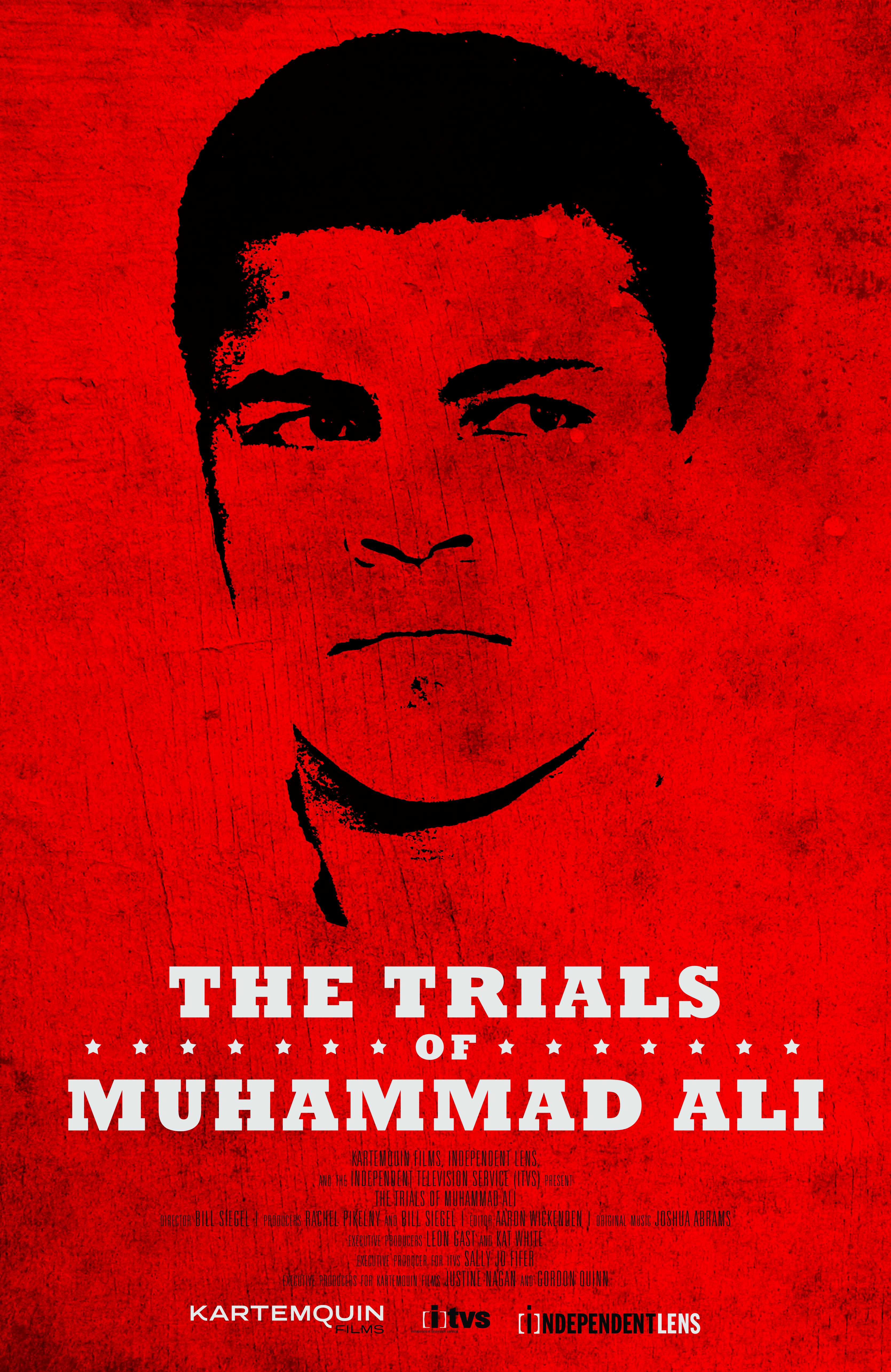
Some of those layers can be found in the documentary that doesn’t appear to share the privileged status of an HBO production: The Trials of Muhammad Ali.

ali_v01_11x17

Privilege is a closed space.

That space is behind a wall that provides the privileged their perch of authority as well as a walling out those Others.

Ali, Carlos, Smith, and Malcolm X lived outside the wall, and still remain under the gaze of privilege—to be acknowledged and explained when the time is right, when those with privilege see fit.

Ali remains mostly cartoon in America, reduced to his athletic bravado (“I am the Greatest!”) in the same way Martin Luther King, Jr. is tolerated as a passive radical, but not as the voice of protest and action that complimented Ali’s anti-war convictions:

We must move past indecision to action. We must find new ways to speak for peace in Vietnam and for justice throughout the developing world, a world that borders on our doors. If we do not act, we shall surely be dragged down the long, dark, and shameful corridors of time reserved for those who possess power without compassion, might without morality, and strength without sight.

1933

Carter Godwin Woodson confronted The Mis-education of the Negro:

[T]he educational system as it has developed both in Europe and America [is] an antiquated process which does not hit the mark even in the case of the needs of the white man himself….The so-called modern education, with all its defects, however, does others so much more good than it does the Negro, because it has been worked out in conformity to the needs of those who have enslaved and oppressed weaker people….The same educational process which inspires and stimulates the oppressor with the thought that he is everything and has accomplished everything worth while, depresses and crushes at the same time the spark of genius in the Negro by making him feel that his race does not amount to much and never will measure up to the standards of other peoples. The Negro thus educated is a hopeless liability of the race. (pp. 4-5) [2]

1963

Baldwin asked, “Who is the nigger?”:

1966

And then Baldwin wrote in The Nation:

This is why those pious calls to “respect the law,” always to be heard from prominent citizens each time the ghetto explodes, are so obscene. The law is meant to be my servant and not my master, still less my torturer and my murderer. To respect the law, in the context in which the American Negro finds himself, is simply to surrender his self-respect….

These things happen, in all our Harlems, every single day. If we ignore this fact, and our common responsibility to change this fact, we are sealing our doom. Here is the boy, Daniel Hamm, speaking—speaking of his country, which has sworn to bung peace and freedom to so many millions. “They don’t want us here. They don’t want us—period! All they want us to do is work on these penny-ante jobs for them—and that’s it. And beat our heads in whenever they feel like it. They don’t want us on the street ’cause the World’s Fair is coming. And they figure that all black people are hoodlums anyway, or bums, with no character of our own. So they put us off the streets, so their friends from Europe, Paris or Vietnam—wherever they come from—can come and see this supposed-to-be great city.”

There is a very bitter prescience in what this boy—this “bad nigger”—is saying, and he was not born knowing it. We taught it to him in seventeen years. He is draft age now, and if he were not in jail, would very probably be on his way to Southeast Asia. Many of his contemporaries are there, and the American Government and the American press are extremely proud of them. They are dying there like flies; they are dying in the streets of all our Harlems far more hideously than flies. A member of my family said to me when we learned of the bombing of the four little girls in the Birmingham Sunday school, “Well, they don’t need us for work no more. Where are they building the gas ovens?” Many Negroes feel this; there is no way not to feel it.

Privilege is a spider’s web.

Where is the space for Ali to speak for Ali? When will that space exist, and how?

I agree with Carlin that there is music in Ali’s name, but the song remains bittersweet—too hard to swallow in 2013.

I cannot disentangle the web of history that remains attached to all of us, regardless of how hard we try to pull the invisible strings from our faces, our clothes, and our skin.

That web we cannot free ourselves from is privilege—and privilege demands only two alternatives.

But as Ali explained, there is a third alternative and “that alternative is justice.”

It is time, we must listen to Ali.

[1] Baldwin, J. (1998). James Baldwin: Collected essays. New York, NY: The Library of America. Originally published in 1972, No Name in the Street.

[2] Woodson, C. G. (1933). The mis-education of the negro. New York, NY: Tribeca Books.

—–

For Further Viewing and Reading

To Jimmy (and Jose), with Love: I Walk Freely among Racism

James Baldwin (Aug. 2, 1924 – Dec. 1, 1987)

“The Deliberately Silenced, or the Preferably Unheard”

What Would James Baldwin Do (Say, Write)?

A Report from Occupied Territory, James Baldwin (1966)

Knocked the Hell Out by ‘The Trials of Muhammad Ali’, David Zirin

The Trials of Muhammad Ali 

James Baldwin on PBS

From James Baldwin: Film Excerpt: Writer, Teacher, Preacher

An encore of James Baldwin: The Price of the Ticket (original broadcast August 14, 1989) is scheduled for Friday, August 23 at 9pm on PBS in honor of the 50th anniversary of the March on Washington (8/28/1963). This broadcast also coincides with the 25th anniversary of James Baldwin’s death (12/1/1987) and the 150th anniversary of the Emancipation Proclamation (1/1/1863).

Also, James Baldwin: Film: James Baldwin: The Price of the Ticket

—–

James Baldwin (Aug. 2, 1924 – Dec. 1, 1987)

To Jimmy (and Jose), with Love: I Walk Freely Among Racism

James Baldwin (Aug. 2, 1924 – Dec. 1, 1987)

Happy birthday, Jimmy.

Let’s hope it isn’t too late to listen, listen intently, carefully, minds open, hearts full. Let’s hope…

A Report from Occupied Territory

Negroes have always held, the lowest jobs, the most menial jobs, which are now being destroyed by automation. No remote provision has yet been made to absorb this labor surplus. Furthermore, the Negro’s education, North and South, remains, almost totally, a segregated education. And, the police treat the Negro like a dog.

James Baldwin, July 11, 1966, The Nation

A Talk to Teachers

James Baldwin

(Delivered October 16, 1963, as “The Negro Child – His Self-Image”; originally published in The Saturday Review, December 21, 1963, reprinted in The Price of the Ticket, Collected Non-Fiction 1948-1985, Saint Martins 1985.)

An Open Letter to My Sister, Angela Y. Davis

James Baldwin

Collected Essays : Notes of a Native Son / Nobody Knows My Name / The Fire Next Time / No Name in the Street / The Devil Finds Work / Other Essays (Library of America), James Baldwin

James Baldwin: A BiographyDavid Adams Leeming

Baldwin’s Harlem: A Biography of James BaldwinHerb Boyd

[For over a year or so now, I have been incorporating Baldwin’s work into my public and scholarly writing addressing education, inequity, and racism. Here are a few attempts to do his words and legacy justice.]

James Baldwin, Lisbeth Salander and the Rise of the Police State in Some Children’s Schools (Truthout)

To Jimmy (and Jose), with Love: I Walk Freely Among Racism (Truthout)

What Would James Baldwin Do (Say, Write)? (Truthout)

“The Poor Are Too Free?:” Unlocking the Middle-Class Code (Truthout)

“A Separate and Unequal Education System” 2013

“What You Say about Somebody Else, Anybody Else, Reveals You”

Baldwin and Woodson: Lingering Legacy of Failing Education System

“The Deliberately Silenced, or the Preferably Unheard”

James Baldwin: Challenging Authors (Sense, under contract for late 2013/early 2014), A. Scott Henderson, P. L. Thomas, editors

What Would James Baldwin Do (Say, Write)?

My future son-in-law is black. My daughter is white. And we live in the South where, despite their (possibly naive) idealism, interracial relationships still matter, often in negative ways.

I have been deeply concerned about race, class, and literacy for my 30-year career as a teacher, writer, and scholar, but I must confess that their relationship increases the poignancy of those issues for me because on the day the Trayvon Martin murder became the focus of the media, my future son-in-law left my house in a hoodie covering his dreadlocks. It was nighttime, and I wrestled with telling him to be careful in a way that had nothing to do with the perfunctory “be careful” people often use to say good-bye.

Their relationship has also colored my watching the documentary The Loving Story, and purchasing Loving v. Virginia in a Post-Racial World: Rethinking Race, Sex, and Marriage.

Over the past couple of years, as well, I have been exploring the work of James Baldwin, notably his non-fiction, leading to my co-editing a new volume on Baldwin.

As a white child of the redneck South, I am, then, wrestling with the not guilty verdict in the shooting of Trayvon Martin on many levels—personal, scholarly, existentially. And I find myself at a loss.

One enduring rock I continue to seek—a place to stand or even hold on to—is the work of James Baldwin. In fact, What would James Baldwin do (say, write)? echoes in my mind.

I imagine Baldwin, not on the Dick Cavett Show, but on Oprah, righteous and angry:

I imagine Baldwin responding to the smug inhumanity of Rush Limbaugh:

And I envision his words, 57 years later, still titled “A Report from Occupied Territory“:

On April 17, 1964, in Harlem, New York City, a young salesman, father of two, left a customer’s apartment and went into the streets. There was a great commotion in the streets, which, especially since it was a spring day, involved many people, including running, frightened, little boys. They were running from the police. Other people, in windows, left their windows, in terror of the police because the police had their guns out, and were aiming the guns at the roofs. Then the salesman noticed that two of the policemen were beating up a kid: “So I spoke up and asked them, ‘why are you beating him like that?’ Police jump up and start swinging on me. He put the gun on me and said, ‘get over there.’ I said, ‘what for?’”

An unwise question. Three of the policemen beat up the salesman in the streets. Then they took the young salesman, whose hands had been handcuffed behind his back, along with four others, much younger than the salesman, who were handcuffed in the same way, to the police station.

Nearly two decades before Ronald Reagan initiated the mass incarceration of African American males and almost six decades before Michelle Alexander declared this The New Jim Crow (asking, for example, why drug sweeps target poor and mostly black neighborhoods but not college dorms), Baldwin declared black neighborhoods “occupied territory”:

As a result of the events of April 17, and of the police performance that day, and because Harlem is policed like occupied territory, six young Negro men, the oldest of whom is 20, are now in prison, facing life sentences for murder. Their names are Wallace Baker, Daniel Hamm, Walter Thomas, Willie Craig, Ronald Felder and Robert Rice. Perhaps their names don’t matter. They might be my brothers, they might also be yours.

Haunting this passage from Baldwin is the ugly underbelly of who we identify with, and how we create some groups of people (black males) as “others.” George Zimmerman’s jurors, all white females, appear to have identified with Zimmerman, and seem not to have viewed Trayvon Martin as someone’s son, and thus everyone’s child.

Do race and racial stereotypes over-ride our human dignity? Can we not listen to our possibilities as parents and the fact that all humans are at their core children?

Where is our empathy, the appeal to basic human dignity in Baldwin’s words?

Today, I seek Baldwin’s words, as well, because he spoke from his own life:

This means that I also know, in my own flesh, and know, which is worse, in the scars borne by many of those dearest to me, the thunder and fire of the billy club, the paralyzing shock of spittle in the face, and I know what it is to find oneself blinded, on one’s hands and knees, at the bottom of the flight of steps down which one has just been hurled. I know something else: these young men have been in jail for two years now. Even if the attempts being put forth to free them should succeed, what has happened to them in these two years? People are destroyed very easily. Where is the civilization and where, indeed, is the morality which can afford to destroy so many?

In the wake of the Civil Rights movement, blacks in the US learned lessons we continue to witness today:

Furthermore, the Negro’s education, North and South, remains, almost totally, a segregated education, which is but another way of saying that he is taught the habits of inferiority every hour of every day that he lives. He will find it very difficult to overcome these habits. Furthermore, every attempt he makes to overcome them will be painfully complicated by the fact that the ways of being, the ways of life of the despised and rejected, nevertheless, contain an incontestable vitality and authority. This is far more than can be said of the middle class which, in any case, and whether it be black or white, does not dare to cease despising him….

The children, having seen the spectacular defeat of their fathers—having seen what happens to any bad nigger and, still more, what happens to the good ones—cannot listen to their fathers and certainly will not listen to the society which is responsible for their orphaned condition.

What must children be learning now—Trayvon Martin dead, drug tested, vilified, reduced to an iconic hoodie; Zimmerman freed, exonerated, justified?

Baldwin speaks to those lessons:

This is why those pious calls to “respect the law,” always to be heard from prominent citizens each time the ghetto explodes, are so obscene. The law is meant to be my servant and not my master, still less my torturer and my murderer. To respect the law, in the context in which the American Negro finds himself, is simply to surrender his self-respect….

These things happen, in all our Harlems, every single day. If we ignore this fact, and our common responsibility to change this fact, we are sealing our doom. Here is the boy, Daniel Hamm, speaking—speaking of his country, which has sworn to bung peace and freedom to so many millions. “They don’t want us here. They don’t want us—period! All they want us to do is work on these penny-ante jobs for them—and that’s it. And beat our heads in whenever they feel like it. They don’t want us on the street ’cause the World’s Fair is coming. And they figure that all black people are hoodlums anyway, or bums, with no character of our own. So they put us off the streets, so their friends from Europe, Paris or Vietnam—wherever they come from—can come and see this supposed-to-be great city.”

There is a very bitter prescience in what this boy—this “bad nigger”—is saying, and he was not born knowing it. We taught it to him in seventeen years. He is draft age now, and if he were not in jail, would very probably be on his way to Southeast Asia. Many of his contemporaries are there, and the American Government and the American press are extremely proud of them. They are dying there like flies; they are dying in the streets of all our Harlems far more hideously than flies. A member of my family said to me when we learned of the bombing of the four little girls in the Birmingham Sunday school, “Well, they don’t need us for work no more. Where are they building the gas ovens?” Many Negroes feel this; there is no way not to feel it.

Baldwin’s last comment—”Many Negroes feel this; there is no way not to feel it”—likely remains true, but shouldn’t we by now be able to say about the death of Trayvon Martin, “Everyone recognizes the injustice; there is no way not to feel it”?