
Secretary of Education Arne Duncan has often stated that “education [is] the one true path out of poverty—the great equalizer that overcomes differences in background, culture and privilege. It’s the only way to secure our common future in a competitive global economy.” While this claim appears obvious, when Matt Bruenig asked “What’s more important: a college degree or being born rich?” and examined the data, he concluded:
So, you are 2.5x more likely to be a rich adult if you were born rich and never bothered to go to college than if you were born poor and, against all odds, went to college and graduated. The disparity in the outcomes of rich and poor kids persists, not only when you control for college attainment, but even when you compare non-degreed rich kids to degreed poor kids!
Therefore, the answer to the question in the title is that you are better off being born rich regardless of whether you go to college than being born poor and getting a college degree.
In South Carolina, for example, this sobering reality is made more troubling by the 2013 Kids Count report from the Annie E. Casey Foundation, which examines child well-being in the nation and each state.
Nationally, SC ranks 45th, down from 43rd in the foundation’s previous report. Only Louisiana, Arizona, Nevada, Mississippi, and New Mexico sit lower than SC in child well-being. The ranking consists of four broad categories that reflect significant social and educational challenges for SC:
- Economic Well-Being (2011 data): SC children in poverty, 28% (worse than 2005, 23%); children whose parents lack secure employment, 35% (worse than 2008, 30%); children living in households with a high housing cost burden, 36% (worse than 2005, 32%); teens not in school and not working, 11% (worse than 2008, 8%).
- Education: SC children not attending preschool (2009-11), 55% (better than 2005-2007, 59%); 4th graders not proficient in reading (2011), 72% (better than 2005, 74%); 8th graders not proficient in math (2011), 68% (better than 2005, 70%); high school students not graduating on time (2009/2010), 32%.
- Health: SC low-birthweight babies (2010), 9.9% (better than 2005, 10.2%); children without health insurance (2011), 8% (better than 2008, 13%); child and teen deaths per 100,000 (2010), 32% (better than 2005, 41%); teens who abuse alcohol and drugs (2012-11), 7% (better than 2005-2006, 8%).
- Family and Community: SC children in single-parent families (2011), 42% (worse than 2005, 38%); children in families where the household head lacks a high school diploma (2011), 13% (better than 2005, 15%); children living in high-poverty areas (2007-2011), 13% (worse than 2000, 6%); teen births per 1000 (2010), 43 (better than 2005, 51).
SC represents states that remain heavily burdened by the negative consequences of poverty and social inequity, complicated factors often reflected in the measurable outcomes of public schools. This report offers SC, the nation, and political leaders an opportunity to change the discourse about school reform and take bold action that addresses the wide range of social and economic challenges facing our state.
While the report data show that social and education reform should remain priorities for SC, that same data also suggest that social reform is far more pressing than expensive and historically ineffective commitments to new standards and tests being promoted for education reform.
Children in SC deserve better schools, and children in poverty remain the exact students most underserved in those schools. No one is suggesting that education reform be set aside or ignored. But many current school reform policies are simply wastes of taxpayers’ money and educators’ time that would be better spent on education reform that addresses the conditions of teaching and learning, and not just more of the same standards-and-testing mandates tried for thirty years now.
More pressing is social reform because without addressing childhood poverty, workforce stability and quality, the costs of living, single-parent homes, and concentrated high-poverty communities, most education reform measures are doomed to be fruitless.
As The Economic Mobility Project reveals, children in SC and across the US are likely to have bright futures if they are born into relative affluence, and those children, even without attending college, are apt to succeed over impoverished children who rise above the challenges of their homes and communities by graduating college. “Grit” and “no excuses” are simply slogans, hollow and cruel in the bright light of the evidence.
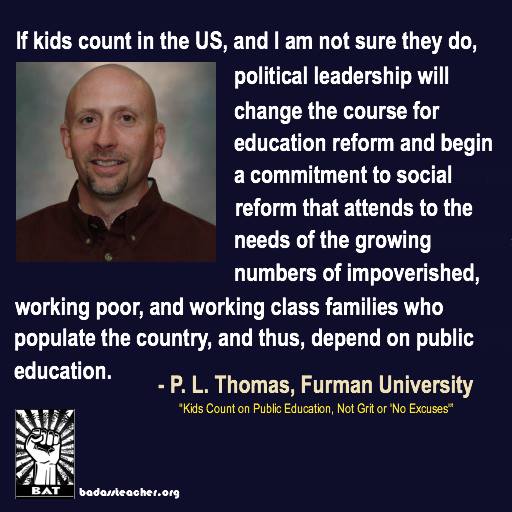
If kids count in the US, and I am not sure they do, political leadership will change the course for education reform and begin a commitment to social reform that attends to the needs of the growing numbers of impoverished, working poor, and working class families who populate the country, and thus, depend on public education.
 dr. p.l. (paul) thomas