Tag Archives: kurt vonnegut

In Defense of Poetry: “Oh My Heart”

“No, no. You’ve got something the test and machines will never be able to measure: you’re artistic. That’s one of the tragedies of our times, that no machine has ever been built that can recognize that quality, appreciate it, foster it, sympathize with it.”

Paul Proteus to his wife Anita in Kurt Vonnegut’s Player Piano

“So much depends upon a red wheel barrow glazed with rain water beside the white chickens” is, essentially, a grammatical sentence in the English language. While the syntax is somewhat out of the norm, the diction is accessible to small children—the hardest word likely being “depends.” But “The Red Wheelbarrow” by William Carlos Williams is much more than a sentence; it is a poem:

so much depends
upon

a red wheel
barrow

glazed with rain
water

beside the white
chickens.

A relatively simple English language sentence shaped into purposeful lines and stanzas becomes poetry. And like Langston Hughes’s “Harlem” and Gwendolyn Brooks’s “We Real Cool,” it sparks in me a profoundly important response each time I read these poems: [Expletive], I wish I had written that.

It is the same awe and wonder that I felt as a shy and deeply self-conscious teenager when I bought, collected, and read comic books, marveling at the artwork I wish I had drawn.

Will we soon wake one morning to find the carcasses of poems washed up on the beach by the tsunami of the Common Core?

That question, especially during National Poetry Month, now haunts me more every day, notably because of the double-impending doom augured by the Common Core: the rise of nonfiction (and the concurrent erasing of poetry and fiction) from the ELA curriculum and the mantra-of-the-moment, “close reading” (the sheep’s clothing for that familiar old wolf New Criticism):

It seems we have come to a moment in the history of the US when we no longer even pretend to care about that which is the result of the human heart: Art.

And poetry, I contend, is the most human of the arts because—although it is quite challenging often to distinguish humans from other mammals—we have two attributes that do set us apart: our too-big brains and our faculty for language.

Poetry is the very human effort to utter order out of chaos, meaning out of the meaningless: “Daddy, daddy, you bastard, I’m through” (Sylvia Plath, “Daddy”).

The course was Speech, taught by Mr. Brannon. I was a freshman at a junior college just 15-20 miles from my home, the college my parents had attended when they first fell in love and married secretly.

Despite the college’s close proximity to my home, my father insisted that I live on campus. But that class and those first two years of college were more than living on campus; they were the essential beginning of my life.

In one of the earliest classes, Mr. Brannon read aloud and gave us a copy of “[in Just-]” by e. e. cummings. I imagine that moment was, for me, what many people describe as a religious experience.

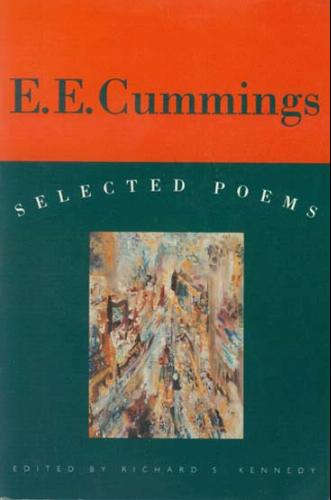
That was more than thirty years ago, but I have two precious books still that followed from that day in class: cummings’s Complete Poems and Selected Poems:

cummings1

Several years later, Emily Dickinson‘s Complete Poems would join my commitment to reading every poem by those poets who made me respond over and over: [Expletive], I wish I had written that.

But that introduction to cummings was more than a young and insecure man finding the poets he wanted to read; it was when I realized I am a poet.

Now, when the words “j was young&happy” come to me, I know there is work to do—I recognize the gift of poetry.

As a high school English teacher, I divided my academic year into quarters by genre/form: nonfiction, poetry, short fiction, and novels/ plays. The poetry quarter, when announced to students, initially received moans and even direct complaints: “I hate poetry.”

To be honest, that always broke my heart, crushed my soul. Life and school had already taken something very precious from these young people:

children guessed(but only a few
and down they forgot as up they grew (“[anyone lived in a pretty how town],” e.e. cummings)

Gradually and then always, I taught poetry in conjunction with popular songs. Although my students in rural South Carolina were overwhelmingly country music fans, I focused my nine weeks of poetry on the songs of alternative group R.E.M.

For the record, that too elicited moans from students in those early days of exploring poetry (see that unit now on the blog “There’s time to teach”).

Concurrently, throughout my high school teaching career, students always gathered in my room during our long mid-morning break and lunch (much to the chagrin of administration). And almost always, we played music.

The epitome of that unspoken norm of my classroom was two students who, after I introduced them to The Violent Femmes, would close my door in order to dance and sing along with their songs.

Many of those students are in their 30s and 40s, but it is common for them to contact me—often on Facebook—and recall fondly R.E.M. and our poetry unit. Those days and years meant something to them that lingers, that matters in ways that cannot be measured.

I can still see and hear those two students dancing, singing, and laughing. It was an oasis of happiness in their days at school, an oasis of happiness in their lives.

e.e. cummings begins “since feeling is first,” and then adds:

my blood approves,
and kisses are better fate
than wisdom
lady i swear by all flowers. Don’t cry
—the best gesture of my brain is less than
your eyelids’ flutter….

And each year when my students and I examined this poem, we would discuss that cummings—in Andrew Marvell fashion—offers an argument that is profoundly unlike what parents, teachers, preachers, and politicians claim.

So I often paired this poem with Coldplay’s “The Scientist,” focusing on:

I was just guessing at numbers and figures
Pulling your puzzles apart
Questions of science, science and progress
Do not speak as loud as my heart

Especially for teenagers, this question, this tension between heart and mind, mattered. Just as it recurs in the words of poets and musicians over decades, centuries.

Poetry, as with all art, is the expressed heart—that human quest to rise above our corporeal humanness:

               Bold Lover, never, never canst thou kiss,
Though winning near the goal yet, do not grieve;
       She cannot fade, though thou hast not thy bliss,
               For ever wilt thou love, and she be fair! (“Ode on a Grecian Urn,” John Keats)

I have loved a few people intensely. So deeply that my love, I believe, resides permanently in my bones. If you read my poetry, you will recognize that motif, I am sure.

One such love is my daughter, and she now carries the next human who will add to that ache of being fully human—loving another beyond words.

And that, I contend, is poetry.

Poetry is not identifying iambic pentameter on a poetry test or discussing the nuances of enjambment in an analysis of a Dickinson poem.

Poems are not fodder for close reading.

Poetry is the ineluctable “Oh my heart” that comes from living fully in the moment of being human, the moment that draws us to words as well as inspires us toward words.

We read a poem, we listen to a song, and our hearts rise out of our eyes as tears.

That is poetry.

And like the picture books of our childhood, poetry must be a part of our learning, essential to our school days—each poem an oasis of happiness that “machines will never be able to measure.”

Will we soon wake one morning to find the carcasses of poems washed up on the beach by the tsunami of the Common Core?

Maybe the doomsayers are wrong, and maybe, just maybe, poetry will not be erased from our classrooms.

School with less poetry is school with less heart. School with no poetry is school with no heart.

Both are tragic mistakes because if school needs anything, it is more heart. And poetry? Oh my heart.

See Also

The Dying of the Light: How Common Core Damages Poetry Instruction

No Place for Poetry on My Son’s Common Core ELA Test

NOTE: This post was drafted in the wake of driving to work while listening to Coldplay’s A Rush of Blood to the Head. Or to be perfectly honest, while singing loudly along with each song and occasionally crying. There. So keep that in mind.

Snow Blind: “Trapped in the Amber of This Moment”

What is wrong with the following claims?

  • The rich and successful are rich and successful because of their work ethic.
  • The poor are poor because they fail to take advantage of the American Dream.
  • Women are paid less than men because they choose fields/careers that pay less and choose family over career.
  • Prisons are overwhelmingly populated by African Americans because they are trapped in the cycle of poverty.
  • Work hard and be nice.
  • Education, especially college, is the main path for rising above the conditions of any person’s home or community.

Before I examine the answer, consider this enduring claim:

  • In 1492, Columbus sailed the ocean blue, and thus, Columbus discovered America. [The original poem ends “The first American?  No, not quite./ But Columbus was brave, and he was bright.”]

And how about this blast from the past:

Dewey Defeats Truman

As Lienhard explains:

Gallup brought science to that process. Richard Smith tells how, by the time Landon challenged Roosevelt, the prestigious Literary Digestmagazine was America’s leading pollster. The Digest featured a regular poll called “America Speaks.” It drew samples from phone books and auto registrations. Gallup knew that such samples were biased toward people with means….

Then, in 1948, Gallup blew the Truman-Dewey prediction. How? His mistake was to quit polling two weeks before the election with fourteen percent of the electorate still undecided. After that humiliation, Gallup went back to analyze his error. He emerged with the maxim, “Undecided voters side with the incumbent.”

By 2012, then, you’d think polling would have reached some higher and clearer process for predicting presidential outcomes, but instead, we had the Nate Silver element, yet another case about how the science of polling has flaws, human flaws.

Even, it seems, as science inspects itself—acknowledging and addressing confirmation bias, for example—we are always “trapped in the amber of this moment,” since the human condition is itself necessarily a subjective experience.

And now, in order to answer my initial question, I want to turn to history; while history as a discipline is distinct from the hard sciences, both are dependent on evidence and then the conclusions drawn from that evidence—conclusions I call narratives (more on that below). Consider Howard Zinn on Christopher Columbus:

My viewpoint, in telling the history of the United States, is different: that we must not accept the memory of states as our own. Nations are not communities and never have been, The history of any country, presented as the history of a family, conceals fierce conflicts of interest (sometimes exploding, most often repressed) between conquerors and conquered, masters and slaves, capitalists and workers, dominators and dominated in race and sex. And in such a world of conflict, a world of victims and executioners, it is the job of thinking people, as Albert Camus suggested, not to be on the side of the executioners.

Thus, in that inevitable taking of sides which comes from selection and emphasis in history, I prefer to try to tell the story of the discovery of America from the viewpoint of the Arawaks, of the Constitution from the standpoint of the slaves, of Andrew Jackson as seen by the Cherokees, of the Civil War as seen by the New York Irish, of the Mexican war as seen by the deserting soldiers of Scott’s army, of the rise of industrialism as seen by the young women in the Lowell textile mills, of the Spanish-American war as seen by the Cubans, the conquest of the Philippines as seen by black soldiers on Luzon, the Gilded Age as seen by southern farmers, the First World War as seen by socialists, the Second World War as seen by pacifists, the New Deal as seen by blacks in Harlem, the postwar American empire as seen by peons in Latin America. And so on, to the limited extent that any one person, however he or she strains, can “see” history from the standpoint of others.

In other words, shaping narratives bound by evidence does not insure that those narratives are pure and certainly does not insure that those narratives are above bias or absent the urge to mold them in order to secure someone’s agenda (likely someone in power). [1]

Snow Blind

Misleading narratives around Columbus or “I cannot tell a lie” George Washington—and the whitewashing of Steve Jobs to promote the “grit” narrative (compare the Jobs lesson to the original 1492 poem about Columbus)—are not problematic because of the evidence, but because of the lens through which the narratives are shaped and by whom those narratives are created and in whose interest.

Consider Billy Pilgrim in a telepathic conversation with a Tralfamadorian in Kurt Vonnegut’s Slaughterhouse Five:

“Welcome aboard, Mr. Pilgrim,” said the loudspeaker. “Any questions?”

Billy licked his lips, thought a while, inquired at last: “Why me?”

“That is a very Earthling question to ask, Mr. Pilgrim. Why you? Why us for that matter? Why anything? Because this moment simply is. Have you ever seen bugs trapped in amber?”

“Yes.” Billy, in fact, had a paperweight in his office which was a blob of polished amber with three ladybugs embedded in it.

“Well, here we are, Mr. Pilgrim, trapped in the amber of this moment. There is no why.”

And that brings me to the “grit” debate, one in which advocates point to scientific research and prestigious grants. From that evidence, we have three contexts of narratives: disciplinary narratives (Angela Duckworth, Carolyn Dweck), popular narratives (Paul Tough, Jay Mathews), political narratives (Arne Duncan, Michelle Rhee)—all of which are trapped like bugs in amber, or as I prefer to suggest, that “grit” narrative advocacy is snow blind.

If evidence and the narratives surrounding the evidence appear to support a privileged agenda, and since the privileged have a larger megaphone in a culture, then that evidence and narrative are disproportionately likely to gain momentum—regardless of how accurate they are in the context of the oppressed or marginalized (consider again history and the Zinn points above).

And that inability by the privileged to see beyond their privilege is, I think, a state of being snow blind.

Thus, my answer to the initial question at the beginning is that those claims as narratives built on evidence are ideological distortions of the evidence. The “grit” narrative is similar to the education = income argument that falls apart when analyzed: Education is a marker for privilege (since privilege leads to advanced education) just as “grit” qualities are markers for privilege.

Systemic Inequity v. Rugged Individualism

In Slaughterhouse Five, the work of Howard W. Campbell (previously the main character in Vonnegut’s Mother Night) is quoted:

America is the wealthiest nation on Earth, but its people are mainly poor, and poor Americans are urged to hate themselves….

Americans, like human beings everywhere, believe many things that are obviously untrue….The most destructive untruth is that it is very easy for any American to make money. They will not acknowledge how in fact hard money is to come by, and, therefore, those who have no money blame an blame and blame themselves. This inward blame has been a treasure for the rich and powerful, who have had to do less for their poor, publicly and privately, than any other ruling class since, say, Napoleonic times. (pp. 164, 165)

Snow blind and bugs trapped in amber, the privileged by their privilege and the impoverished by the blinding but misleading promise of the American Dream—the narratives become the product of those who shape them and for whose benefit, regardless of the evidence, the artifacts, the data.

Let me end, then, with a couple of points to consider, one from the 1973 satire Sleeper  [2] and the other from Vonnegut’s Cat’s Cradle.

First, a scene from the film:

And then, John and Mona in Cat’s Cradle discuss Boko-maru (a sacred foot ceremony) and their culturally-bound and conflicting perceptions of love:

“Mona?”

“Yes?”

“Is—is there anyone else in your life?”

She was puzzled. “Many,” she said at last.

“That you love?”

“I love everyone.”

“As—as much as me?”

“Yes.” She seemed to have no idea that this might bother me….

“I suppose you—you perform—you do what we just did—with other people?’

Boko-maru?”

Boko-maru.

“Of course.”

“I don’t want you to do it with anybody but me from now on,” I declared.

Tears filled her eyes. She adored her promiscuity; was angered that I should try to make her feel shame. “I make people happy. Love is good, not bad.”

“As your husband, I’ll want all your love for myself.”

She stared at me with widening eyes. “A sin-wat!”

“What was that?

“A sin-wat!” she cried. “A man who wants all of somebody’s love. That’s very bad.” (pp. 207-208)

John is trapped in the amber of the moment, his patriarchal and possessive love leaves him snow blind to Mona’s perspective. He either cannot see, or refuses to see.

So I have made a decision—one shared by Zinn, expressed by Eugene V. Debbs, and reflected in the research of Sendhil Mullainathan and Eldar Shafir—that the perspectives of the marginalized must be honored in the context of systemic inequities.

This is a position of humility and a recognition that any human arrogance—whether it be scientific or not—is likely to lead to the sort of pettiness captured in the Sleeper clip: both the satire aimed at the foolish dietary beliefs of the past and the incredulity of the scientists in the film’s present (“You mean there was no deep fat…?” exposes that despite the scientists recognizing the misguided stances of the past, they remain trapped in their own certainty).

Both the “grit” narrative and the “grit” research fail that litmus test. They both speak from and to a cultural norm that privileges individual characteristics (rugged individualism) as if they are indistinguishable from the systemic context of privilege (again, a claim refuted by Mullainathan and Shafir, but that narrative doesn’t serve the privileged, and thus, isn’t embraced as the “grit” narrative is).

Many novelties have come from America,” the cited monograph from Campbell notes, adding:

The most startling of these, a thing without precedent, is a mass of undignified poor. They do not love one another because they do not love themselves. (p. 165)

The human intellect is a wonderful thing, and thus, we must pursue our efforts to understand the world and the human condition—a thing we call science. But as humans, it is not ours to somehow remove our basic humanity from that process (the folly of objectivity), but to choose carefully just how we shape the narratives from the evidence we gather.

I am then compelled to manipulate Einstein once again. His “Science without religion is lame, religion without science is blind,” I think, is a call for the necessity of human kindness, decency, and compassion in the shaping of our narratives. The “grit” narrative does no such thing. It is a snow blind story that is also deaf to the basic human dignity shared among all people.

Your Honor, years ago I recognized my kinship with all living beings, and I made up my mind that I was not one bit better than the meanest on earth. I said then, and I say now, that while there is a lower class, I am in it, and while there is a criminal element I am of it, and while there is a soul in prison, I am not free.

Eugene V. Debs: Statement September 18, 1918

[1] See Robert Pondiscio’s citing of Kurt Vonnegut’s “Harrison Bergeron,” a misleading use of Vonnegut in the name of choice that is well outside Vonnegut’s ideological leanings; see my posted comment.

[2] While citing a Woody Allen work is problematic, I am in no way endorsing Allen or any efforts to absolve him of guilt or responsibility in the ongoing controversy surrounding him.

King’s Next Shining Novel: More “True History of the Torrance Family”

Stephen King’s career reminds me of the career of Kurt Vonnegut in three ways: (1) they suffered the negative consequences of being associated with writing genre fiction, (2) they are often devalued as being too popular to be credible “literary” authors, and (3) as many popular writers are, they are often associated with one work—King with The Shining and Vonnegut with Slaughterhouse-Five. King, as well, has been further marginalized by the stigma that being prolific means a writer can’t possibly be high quality.

Doctor Sleep, Stephen King

With Doctor Sleep, then, King takes on some monumental challenges since this 2013 novel is a sequel of possibly his most treasured work, The Shining, from 1977. King confronts the task of writing a sequel, as well as the weight of the popular film adaptation, in a concluding Author’s Note:

Did I approach the book with trepidation? You better believe it. The Shining is one of those novels people always mention…when they talk about which of my books really scared the bejeezus out of them….

I like to think I’m still pretty good at what I do, but nothing can live up to the memory of a good scare, and I mean nothing, especially if administered to one who is young and impressionable….

And people change. The man who wrote Doctor Sleep is very different from the well meaning alcoholic who wrote The Shining, but both remain interested in the same thing: telling a kick-ass story. (pp. 529-530)

Like many people, I was first drawn to King’s The Shining after seeing the 1980 film adaptation made popular by Jack Nicholson’s role. While I am certain I read the novel, I also realize I tend to recall more vividly the film version (the culturally iconic “Here’s Johnny!” and “Redrum”), which King warns about in a parenthetical comment in his Author’s Note: “If you have seen the movie but not read the novel, you should note that Doctor Sleep follows the latter, which is, in my opinion, the True History of the Torrance Family.”

I should also add that I am no fan of King’s primary genres, such as horror, and have not been an avid reader of King over the years. During a couple summers in the early 2000s when I was an instructor in a regional National Writing Project institute, we assigned King’s On Writing, solidifying my argument that King remains a writing treasure as well as a writer’s writer, one who informs what we know and understand about the craft of narrative.

In 2013, I had bought several King novels, deciding once and for all to spend more time with his work because an avid reader I trust deeply is a devoted King fan, but had yet to find one that grabbed me. Then I came across Adam Roberts’s Best science fiction books of 2013, in which he praised Doctor Sleep along with Margaret Atwood’s MaddAddam.

Although not intended as a book review, I want to offer first that Doctor Sleep delivers on King’s stated goal, “telling a kick-ass story.”

Dan Torrance is a fully developed and compelling character as a haunted adult, and his new shining companion, Abra Stone, is equally engaging as a child character replicating but also expanding some of the power found in Danny as a child in The Shining. If you are looking for a novel worthy of your commitment as a “ling-distance reader,” this is more than worthy of your time and investment.

But there are two aspects of the work I want to highlight beyond a recommendation.

First, as a regular and enthusiastic beer drinker who knows the horrors of alcoholism among men on my mother’s side of the family, the most haunting aspect of the novel is the examination of alcoholism and the personal yet not idealistic dramatization of Alcoholics Anonymous. At over 500 pages in hardback, the book took several days to read and it bore into my thoughts deeply and pervasively, making me contemplative about even raising a pint of beer with a meal.

The weight and terror associated with the life of alcoholism are rendered far more frightening in this work than the vampire-like threat of the True Knot. For readers, the damage done by alcoholism is real, and the damage done to humans in its wake, including children, haunts Dan and the reader as powerfully as the apparitions expected in a King work of horror.

Many so-called types of genre fiction—such as science fiction, fantasy, and horror—incorporate social commentary through allegory. In Doctor Sleep, King does not hide his examination of alcoholism, however, beneath a metaphorical veneer; instead he pairs the twin demons of alcoholism and the supernatural—resulting in a work that may be more disturbing in the real rather than the imagined.

The second powerful aspect of the work involves the relationship between being a child and also being vulnerable because of that mere status as well as because of nearly debilitating fears that you are alone because you are different.

Much of Doctor Sleep for me is about childhood, itself a scary thing. When Dan as a struggling adult crosses paths with Abra, their shared shining creates a compelling look at how any child and all humans must come to terms with the Self, even or especially when that Self feels or is dramatically unlike social norms or what appears to be normal: “’I’m okay,’ [Abra] said. ‘Really. I’m just glad not to be alone with this inside my head’” (p. 236). You don’t have to have the shining to understand Abra’s relief.

Even as Abra finds solace in her connection with Dan—and their shared shining—she remains a victim of her own anxieties, especially as she feels compelled to hide her differences from her parents in order to protect them.

Abra also has a terrifying connection with a murdered boy—again speaking to both the fragility of being a child in a harsh adult world and the weight of isolation and bonds that are beyond any person’s control. This connection is stunning and, like the focus on alcoholism, haunts the reader:

They cut him up and licked his blood and then they did something even worse to him [emphasis in original]. In a world where something like that could happen, mooning over a boy band seemed worse than wrong. (p. 209)

Abra’s story is more than the narrative of a paranormal girl; it is the story of the collision between childhood and adulthood, and the potential of that childhood and even children being left in the wake. Again, this very real element is somehow much more terrifying than the supernatural.

King’s noting he is a different man than the one who wrote The Shining informs the big picture about Doctor Sleep since this novel of horror has a compassionate and soothing narration to it—the gift of a master storyteller—that keeps the reader somewhere between Abra’s anxiety and the eternal drift into slumber—both the daily ritual of sleep and the inevitable exit from this mortal coil.

Yes, Doctor Sleep is “a kick-ass story,” but it also much more; it will not soon leave you once you’ve returned to, or entered for the first time, the Torrance Family Album.

The Socialist Objective: “I can see the dawn of the better day for humanity”

Under a pen-name for a newspaper in 1943, George Orwell wrote about Christmas, veering into a declaration of the Socialist objective, predating by many decades Kurt Vonnegut’s career of making similar and powerful claims about the need for human kindness:

The Socialist objective is not a society where everything comes right in the end, because kind old gentlemen give away turkeys. What are we aiming at, if not a society in which ‘charity’ would be unnecessary? We want a world where Scrooge, with his dividends, and Tiny Tim, with his tuberculous leg, would both be unthinkable. But does that mean we are aiming at some painless, effortless Utopia? At the risk of saying something which the editors of Tribune may not endorse, I suggest that the real objective of Socialism is not happiness. Happiness hitherto has been a by-product, and for all we know it may always remain so. The real objective of Socialism is human brotherhood. This is widely felt to be the case, though it is not usually said, or not said loudly enough. Men use up their lives in heart-breaking political struggles, or get themselves killed in civil wars, or tortured in the secret prisons of the Gestapo, not in order to establish some central-heated, air-conditioned, strip-lighted Paradise, but because they want a world in which human beings love one another instead of swindling and murdering one another. And they want that world as a first step. Where they go from there is not so certain, and the attempt to foresee it in detail merely confuses the issue.

Eliot Rosewater in Kurt Vonnegut’s God Bless You, Mr. Rosewater implores:

Go over to her shack, I guess. Sprinkles some water on the babies, say, “Hello, babies. Welcome to Earth. It’s hot in the summer and cold in the winter. It’s round and wet and crowded. At the outside, babies, you’ve got about a hundred years here. There’s only one rule that I know of, babies—:

“God damn it, you’ve got to be kind.” (p. 129)

With both Orwell and Vonnegut, we should hear echoing behind their words, Eugene V. Debs, from his Statement to the Court (September 18, 1918):

Your Honor, years ago I recognized my kinship with all living beings, and I made up my mind that I was not one bit better than the meanest on earth. I said then, and I say now, that while there is a lower class, I am in it, and while there is a criminal element I am of it, and while there is a soul in prison, I am not free….

I believe, Your Honor, in common with all Socialists, that this nation ought to own and control its own industries. I believe, as all Socialists do, that all things that are jointly needed and used ought to be jointly owned—that industry, the basis of our social life, instead of being the private property of a few and operated for their enrichment, ought to be the common property of all, democratically administered in the interest of all…

I am opposing a social order in which it is possible for one man who does absolutely nothing that is useful to amass a fortune of hundreds of millions of dollars, while millions of men and women who work all the days of their lives secure barely enough for a wretched existence….

I can see the dawn of the better day for humanity. The people are awakening. In due time they will and must come to their own.

When the mariner, sailing over tropic seas, looks for relief from his weary watch, he turns his eyes toward the southern cross, burning luridly above the tempest-vexed ocean. As the midnight approaches, the southern cross begins to bend, the whirling worlds change their places, and with starry finger-points the Almighty marks the passage of time upon the dial of the universe, and though no bell may beat the glad tidings, the lookout knows that the midnight is passing and that relief and rest are close at hand. Let the people everywhere take heart of hope, for the cross is bending, the midnight is passing, and joy cometh with the morning.

Kurt Vonnegut’s Children’s Crusade: Kindness

In a 2004 Paris Review interview, Haruki Murakami explained:

I liked to read Kurt Vonnegut and Richard Brautigan while I was a college student. They had a sense of humor, and at the same time what they were writing about was serious. I like those kind of books. The first time I read Vonnegut and Brautigan I was shocked to find that there were such books! It was like discovering the New World.

Murakami identified something essential in Vonnegut, a tension created by blending humor with serious themes and topics as well as Vonnegut’s ability to shuffle non-fiction and fiction in his novels like a seasoned magician.

In fact, Gregory D. Sumner catalogues the gradual emergence of Vonnegut as a thinly fictionalized character in his own novels, notably by his most celebrated work, Slaughterhouse-Five: “The opening chapter of Slaughterhouse-Five annihilates the boundary between fiction and autobiography, inviting us into Vonnegut’s uncertainty about just what he has written. It is a dance, rather than an exercise in cold objectivity” (p. 126).

From this narrative ambiguity of genre, Vonnegut is often characterized as post-modern. And while there may be some waffling about details or accuracy, Vonnegut is quite certain—uncharacteristic for actual post-modern writers—about some foundational ideals, although even then he makes his most sacred pronouncements in the most challenging ways.

Vonnegut reveled in playing the free thinker and atheist as he also referenced Jesus—a common routine in his speeches—and his persona in his speeches and non-fiction was certainly as much fabrication as Vonnegut. But the novels and their blend of memoir and fiction create and sustain the most tension.

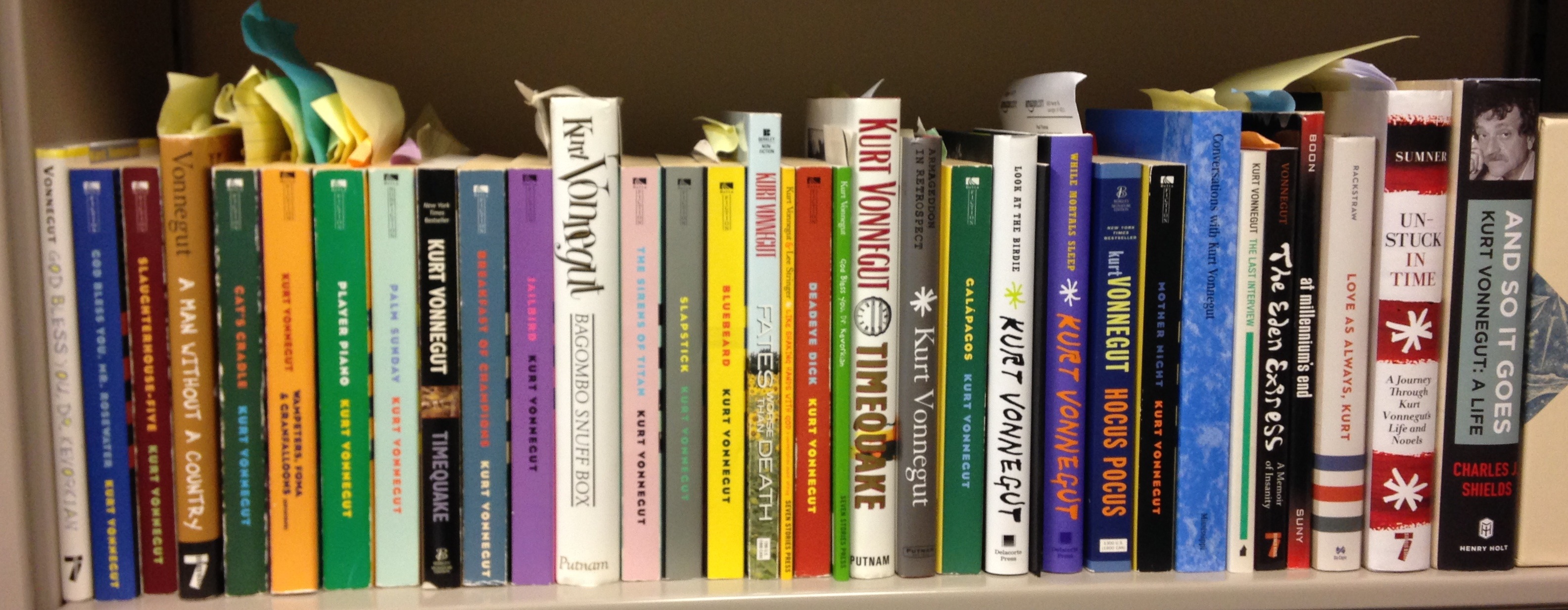
bookshelf KV

Slaughterhouse-Five presented Vonnegut a nearly insurmountable task of maintaining his joke-based writing pattern against the great human tragedy of World War II. This attempt to write a novel about being a POW during the fire bombing of Dresden, in fact, becomes the opening chapter of the novel that doesn’t genuinely start until Chapter 2. And in this first chapter while visiting a fellow veteran of WWII and his friend Bernard V. O’Hare, Vonnegut is confronted by O’Hare’s wife Mary, who is angry about Vonnegut’s considering writing a novel about his war experience:

“You were just babies then!” [Mary] said.

“What?” I said.

“You were just babies in the war—like the ones upstairs!”

I nodded that this was true. We had been foolish virgins in the war, right at the end of childhood….

So I held up my right hand and I made her a promise:…

“I tell you what,” I said, “I’ll call it ‘The Children’s Crusade.'”

She was my friend after that. (pp. 18-19)

Several years before his Dresden novel garnered him fame, Vonnegut had offered what I think is his central children’s crusade: a paean to kindness, God Bless You, Mr. Rosewater.

The titular character of the novel, Eliot Rosewater, implores:

“Go over to her shack, I guess. Sprinkles some water on the babies, say, ‘Hello, babies. Welcome to Earth. It’s hot in the summer and cold in the winter. It’s round and wet and crowded. At the outside, babies, you’ve got about a hundred years here. There’s only one rule that I know of, babies—:

“‘God damn it, you’ve got to be kind.’” (p. 129)

On November 11, 2013, the day of Vonnegut’s birth, while we who love his work raise our eyes to the heavens and hope he is in fact Resting In Peace, we might honor him by heeding those words, crafted in the glorious blasphemy that makes Vonnegut Vonnegut.

For Further Reading

My scholarship on Vonnegut

21st Century “Children’s Crusade”: A Curriculum of Peace Driven by Critical Literacy [Peace Studies Journal, 6(1), January 2103]

Zombies, “Scarcity,” and Understanding Poverty

The original comic book series The Walking Dead opens with “This is not good” in the panel depicting police officers pinned behind their patrol car by gun fire. The page ends with officer Rick Grimes being shot, followed by a full-page panel on the next page of Rick waking with a gasp in the hospital. Zombies are soon to follow.

Preceding this first story is an introduction from creator Robert Kirkman, who explains:

I’m not trying to scare anybody….

With The Walking Dead, I want to explore how people deal with the extreme situations and how these events change [emphasis in original] them. I’m in this for the long haul.

While the AMC television series is an adaptation of the comic book (and not bound to Kirkman’s graphic narrative), this central premise tends to remain true in both the comic book and the TV series, notably in the “Isolation” episode (October 27, 2013):

AMC’s The Walking Dead picked up right where it left off, exploring the mental and emotional toll Karen’s and David’s deaths has had on the group and specifically Tyreese, who experienced the loss of someone close to him for the first time in this new world….

The biggest reveal of the hour, however, came in the final moments after Rick (Andrew Lincoln) uses his sheriff skills and pieces together that it was Carol (Melissa McBride) who was the one who killed Karen and David in a bid to contain the deadly illness threatening the group’s safe haven.

When asked by Rick and with a calm matter-of-fact detachment, Carol confesses to killing, dragging outside, and then setting on fire Karen and David. While there is certainly tension and shock created by this confession, the more powerful point may be that Carol has acted in a way that she feels is justified by the shared human condition: the pervasive threat of zombies surrounding the prison along with that anybody who dies, including those living in close quarters with Carol and the others, will reanimate as a zombie.

Two of the most compelling aspects of the AMC series are that zombies are omnipresent and that every human is a walking potential for becoming a zombie. Now that the main characters have positioned themselves in a prison behind two layers of fences, viewers watch as the characters go about their reduced lives (sometimes casually hoeing the garden) with zombies always moaning and clawing at the fence.

There is only one world for these characters—a world saturated with zombies. And a world defined by zombies is a world that has redefined the nature of human free will and choice.

On Rationality and Free Will (Choice)

Western culture honors rational behavior above emotional responses, and particularly in the U.S., choice is a nearly sacred value. That prejudice for rationality tends to normalize rational behavior creating the appearance that rationality is objective. Yet, in fact, rationality is always bound by context.

Consider the hiker, Aron Ralston, who would not have been rational for amputating a limb in his day-to-day life, but once Ralston was confronted with being trapped by a boulder while hiking, amputating a limb became not only rational, but also life-saving. The context changes and so does rationality.

In The Walking Dead TV series narrative, Carol’s murderous acts raise the same sort of debate about her behavior: Considering the threat of the newly spreading flu in the prison, is Carol’s behavior rational?

Certainly in a world without zombies, Carol has no justification for murder and burning the corpses, but in the realities of The Walking Dead, context dictates behaviors—and colors our judgment of those behaviors.

While rationality is contextual and subjective, choice as a sacred value in the U.S. is popularly idealized and misrepresented.

Choice is not a foundational aspect of being human. In fact, being human is about basic behaviors about which humans have no choice: breathing, eating, seeking shelter, attending to ones health. And broadly, survival (think Ralston).

Zombie narratives are speculative stories of humans reduced to a single basic human necessity, consumption. Zombies are perpetual and relentless consumers—to the extreme that renders them simultaneously campy and terrifying.

The Western fetish for choice is an exaggeration of a great human hope or quest: The human faith in free will, the human faith that our free will lifts us above the rest of the earth’s beasts.

“So it goes” is the now-iconic phrase that provides Kurt Vonnegut’s Slaughterhouse-Five the coherence of a refrain against the staccato of Vonnegut’s time-traveling narrative.

At its essence “So it goes” is an acknowledgement of the human condition, one in which humans cling to a belief in free will that doesn’t exist. When a Tralfamadorian explains to Billy Pilgrim that Pilgrim is on the planet Tralfamadore, the conversation turns to free will:

“Where am I?” said Billy Pilgrim.

“Trapped in another blob of amber, Mr. Pilgrim….”

“How—how did I get here?”

“It would take another Earthling to explain it to you. Earthlings are the great explainers, explaining why this event is structured as it is, telling how other events may be achieved or avoided. I am a Tralfamadorian, seeing all time as you might see a stretch of the Rocky Mountains. All time is all time. It does not change. It does not lend itself to warnings or explanations. It simply is. Take it moment by moment, and you will find that we are all, as I’ve said before, bugs in amber.”

“You sound to me as though you don’t believe in free will,” said Billy Pilgrim.

•••

“If I hadn’t spent so much time studying Earthlings,” said the Tralfamadorian, “I wouldn’t have any idea what was meant by ‘free will.’ I’ve visited thirty-one inhabited planets in the universe, and I have studied reports on one hundred more. Only on Earth is there any talk of free will.”

Do the characters in The Walking Dead have the choice to live as if zombies do not exist?

Do people living in poverty have the choice to live as if they are not in poverty?

Free will and choice—like rationality—are bound by context. But neither free will nor choice is basic to being human since our basic human nature consists of those thing about which we have no real choice.

Choice, in fact, is not an essential aspect of a free people. Choice is the result of a free people collectively insuring that all people have the essentials of life protected so that the human longing to choose becomes possible and even ethical.

Simply stated, choice and being free are luxuries that exist toward the top of the triangle representing Maslow’s hierarchy of needs: choosing between a Camry and an Accord is of little importance to a person starving. If nothing else, The Walking Dead highlights how trivial our choices about materialistic lives become once the human condition is reduced to survival within an ever-present threat.

Before Free Will: Zombies and Understanding Poverty

Sendhil Mullainathan and Eldar Shafir in Scarcity: Why Having Too Little Means So Much explain:

Poverty is surely the most widespread and important example of scarcity….

One cannot take a vacation from poverty [emphasis added]. Simply deciding not to be poor—even for a bit—is never an option….Our data suggest causality runs at least as strongly in the other direction: that poverty—the scarcity mindset—causes failure.

In other words, poverty is as omnipresent for the poor as the threat of zombies is for the characters in The Walking Dead. Just as the threat of zombies and reanimation into zombies weigh on the characters’ minds and drive their actions 24 hours a day and every day of their lives, poverty too dictates who poor people are and what they do.

Living in constant vigilance against the threat of zombies, ironically, reduces all living humans to their basic compulsions, rendering even living humans more zombie-like than they would want to admit: zombies are only consumers, and humans living under the threat of zombies are primarily survivors.

Living under the weight of poverty is a very real condition that zombie narratives represent in metaphor.

Human behavior, then, is likely a window into larger social contexts and less a reflection of individual strengths and weaknesses.

Because of cultural stereotypes that marginalize and even demonize people in poverty, Mullainathan and Shafir caution against drawing conclusions from observable behaviors by people living in poverty:

Given that we hold highly negative stereotypes about the poor, essentially defined by a failure (they are poor!), it is natural to attribute personal failure to them….Accidents of birth—such as what continent you are born on—have a large effect on your chance of being poor….The failures of the poor are part and parcel of the misfortune of being poor in the first place. Under these conditions, we all would have (and have!) failed.

In The Walking Dead, Carol-as-killer is a consequence of the existence of zombies in the same way people in poverty have their mental capacities drained by the state of poverty in which they are trapped. As well, poverty may be as unavoidable as zombies for people who find themselves born into impoverished homes (considering that in the U.S., affluence and poverty are highly “sticky”—most people remain in the social class into which they are born, especially at the extreme ends of the class spectrum).

The Walking Dead‘s central relevance as it speaks to the power of poverty is that becoming a zombie in this narrative is simply the result of dying; everyone is a potential zombie (unlike the traditional need to be bitten by a zombie). Zombies in The Walking Dead and poverty, then, are unavoidable and pervasive.

Depending on evidence instead of metaphor, with unintended zombie flair, Mullainathan and Shafir argue, “Scarcity captures the mind.”

For example, Carol’s entire existence now tunnels (Mullainathan and Shafir’s term for an intense form of focus) on surviving zombies. For example before she kills Karen and David, she offers the children in the prison covert lessons on killing zombies swiftly by using knives and weapons to execute effective blows to the brain.

In a world devoid of zombies, Carol’s behavior would be warped. In her previous life, in fact, Carol has been a different person.

Zombie narratives as well as Mullainathan and Shafir’s work on scarcity help highlight an understanding of poverty that rejects stereotypes as well as what people and children living and learning in poverty need: Their state of scarcity must be alleviated.

Until we alleviate poverty, however, we must be vigilant not to increase the consequences of scarcity (such as artificially ramping up stress for teachers and students) and we can no longer ask children and their teachers to work as if poverty doesn’t exist.

Social programs addressing poverty and education reform targeting the achievement gap must begin with embracing a closing claim from Mullainathan and Shafir: “We can go some way toward ‘scarcity proofing’ our environment.”

But that goal cannot be achieved within a deforming idealism that asks impoverished people to live as if poverty doesn’t exist, that asks children living in poverty to pretend they are not impoverished during the school day. It deserves repeating: “One cannot take a vacation from poverty.”

Medicating ADHD in the Brave New World of High-Stakes Accountability

Miranda: O wonder!
How many goodly creatures are there here!
How beauteous mankind is! O brave new world,
That has such people in’t.

—William Shakespeare, The Tempest, Act V, Scene I, ll. 203–206

—–

Utopias seem much more attainable than one may have previously thought. And we are now faced with a much more frightening thought: how do we prevent their permanent fulfillment?…Utopias are attainable. The way of life points towards them. But perhaps a new century will begin, a century in which intellectuals and the educated class will find means of preventing utopias, and we will return to a non-utopian society, which may be less perfect, but will offer more freedom.

—Nicolas Berdiaeff

My love of science fiction (SF) has its roots firmly in Marvel comic books from the 1970s and the SF novels of Arthur C. Clarke and Niven/Pournelle. When I became acquainted with what teachers called “good” and “real” literature, I was immediately drawn to George Orwell and Aldous Huxley as anointed SF writers.

As an adult, I am the sort of SF reader who treasures Kurt Vonnegut and Margaret Atwood, and if I am pushed, I have to admit I value Orwell more as an essayist than novelist and always enjoyed Huxley’s Brave New World over 1984—believing both works are brilliant, but preferring BNW as a reader.

The opening passages are two foundational quotes behind the message of BNW, the Shakespeare the source of the title and the Berdiaeff a nod to Huxley’s parody of utopian fiction.

In his Foreword to the Perennial Classic edition of BNW, Huxley explains:

But Brave New World is a book about the future and, whatever its artistic or philosophical qualities, a book about the future can interest us only if its prophesies look as though they might conceivably come true….The theme of Brave New World is not the advancement of science as such; it is the advancement of science as it affects human individuals. (p. ix)

Beyond purpose, Huxley continues, speculating about “A really efficient totalitarian state”

would be one in which the all-powerful executive of political bosses and their army of managers control a population of slaves who do not have to be coerced, because they love their servitude. To make them love it is the task assigned, in present-day totalitarian states, to ministries of propaganda, newspaper editors and schoolteachers….The great triumphs of of propaganda have been accomplished, not by doing something, but by refraining from doing. Great is truth, but still greater, from a practical point of view, is silence about the truth. (p. xii)

SF, at its best, however, is not predictive, but cautionary; as Neil Gaiman has reminded us, “The world doesn’t have to be like this. Things can be different.” Thus, Huxley warns:

Round pegs in square holes tend to have dangerous thoughts about the social system and to infect others with their discontents….In conjunction with the freedom to daydream under the influence of dope and movies and the radio, it will help to reconcile his subjects to the servitude which is their fate….Indeed, unless we choose to decentralize and to use applied science [1], not as the end to which human beings are to be made the means, but as the means to producing a race of free individuals, we have only two alternatives to choose from: either a number of national, militarized totalitarianisms…or else one supra-national totalitarian. (pp. xiii, xiv)

And then, Huxley conclude: “You pays your money and you takes you choice” (p. xiv).

The speculative and cautionary possibilities found in SF rarely come to fruition in the real world in the dramatic ways of novels or films (or in the somewhat looney ways political factions rant and rave in public discourse). So it seems likely that we are apt never to listen or to act in ways that we should and could.

Huxley, I think, was in many ways speaking to this—“The Not-So-Hidden Cause Behind the A.D.H.D. Epidemic”:

Between the fall of 2011 and the spring of 2012, people across the United States suddenly found themselves unable to get their hands on A.D.H.D. medication. Low-dose generics were particularly in short supply. There were several factors contributing to the shortage, but the main cause was that supply was suddenly being outpaced by demand.

The number of diagnoses of Attention Deficit Hyperactivity Disorder has ballooned over the past few decades. Before the early 1990s, fewer than 5 percent of school-age kids were thought to have A.D.H.D. Earlier this year, data from the Centers for Disease Control and Prevention showed that 11 percent of children ages 4 to 17 had at some point received the diagnosis — and that doesn’t even include first-time diagnoses in adults. (Full disclosure: I’m one of them.)

That amounts to millions of extra people receiving regular doses of stimulant drugs to keep neurological symptoms in check. For a lot of us, the diagnosis and subsequent treatments — both behavioral and pharmaceutical — have proved helpful. But still: Where did we all come from? Were that many Americans always pathologically hyperactive and unable to focus, and only now are getting the treatment they need?

Probably not. Of the 6.4 million kids who have been given diagnoses of A.D.H.D., a large percentage are unlikely to have any kind of physiological difference that would make them more distractible than the average non-A.D.H.D. kid. It’s also doubtful that biological or environmental changes are making physiological differences more prevalent. Instead, the rapid increase in people with A.D.H.D. probably has more to do with sociological factors — changes in the way we school our children, in the way we interact with doctors and in what we expect from our kids.

As disturbing as this is, the final paragraph of this article may be the most significant:

Today many sociologists and neuroscientists believe that regardless of A.D.H.D.’s biological basis, the explosion in rates of diagnosis is caused by sociological factors — especially ones related to education and the changing expectations we have for kids. During the same 30 years when A.D.H.D. diagnoses increased, American childhood drastically changed. Even at the grade-school level, kids now have more homework, less recess and a lot less unstructured free time to relax and play [emphasis added]. It’s easy to look at that situation and speculate how “A.D.H.D.” might have become a convenient societal catchall for what happens when kids are expected to be miniature adults. High-stakes standardized testing, increased competition for slots in top colleges [emphasis added], a less-and-less accommodating economy for those who don’t get into colleges but can no longer depend on the existence of blue-collar jobs — all of these are expressed through policy changes and cultural expectations, but they may also manifest themselves in more troubling ways — in the rising number of kids whose behavior has become pathologized.

The rise of ADHD diagnoses and medications has run concurrent to the accountability era in education, sharing the same thirty-year history. O brave new world of high-stakes accountability and the ADHD medication needed to make the students love their servitude to the tests…

[1] Paul Boyle, “A U.K. View on the U.S. Attack on Social Sciences,” Science, 341 (August 16, 2013), p. 719.

Aren’t All Children Equally Deserving?

A common practice for introducing students to the ethical foundation of philosophy is to pose moral dilemmas, possibly the most typical example being the life-boat dilemma that forces a person to choose who lives, and thus who dies.

Science fiction (SF) and speculative fiction often build entire other worlds in which the given circumstances create a series of moral dilemmas that are the basis of the tensions and actions of the novels and films. Writers such as Margaret Atwood (The Handmaid’s Tale, for example) and Kurt Vonnegut (Cat’s Cradle, for example) often build these worlds in the tradition of George Orwell and Aldous Huxley as a way to say, as Neil Gaiman explains about the power of fiction: “The world doesn’t have to be like this. Things can be different.”

In Cormac McCarthy’s The Road, the possible other world is one of scarcity, and by the end, the moral dilemma revolves around the fate of a child. The novel’s given, readers must accept, creates the narrow range of choices the characters face; that is part of the power of SF/speculative fiction.

Pulling back, however, from created other worlds, we are faced continually with moral dilemmas—often ones also involving children.

One such dilemma is how any society governs it schools. Confronting that dilemma in the UK, Polly Toynbee exposes dynamics that sound all too familiar in the U.S.:

Most people, right or left, would be alarmed at a trajectory of ever-worsening inequality. But few know the facts, wildly underestimating widening wealth gaps, still thinking Britain quite meritocratic. This ends the myth of modern classlessness, exposing shrinking mobility. The ladder up is so high and steep few can climb it – while those at the top exert all their power to stop their children falling down.

Citizens and institutions in both the UK and the U.S. are confronted by some troubling moral dilemmas: the rise of inequity in the wider society and the inability of public schools to overcome (as well as perpetuating) that inequity.

While debates often focus on the exact relationship between a meritocracy and its schools (a sort of “which comes first,” “chicken and egg” debate), an ethical decision about children seems to be ignored: To the question “Aren’t all children equally deserving?” the consensus in the U.S. appears to be “No.”

Education reform built on changing standards and high-stakes tests, weeding out “bad” teachers, funding the expansion of charter schools and Teach for America corp members, and retaining third graders based on their test scores is a concession to a fabricated moral dilemma. In other words, some children are more deserving (the standard among reformers is “grit,” by the way) because the reformers have conceded to a fatalistic scarcity that serves the advantages of the privileged, but leaves the middle class, the working class, the working poor, and the impoverished to fight among themselves for the scraps left behind.

Education reform in the U.S. is The Hunger Games.

Arthur H. Camins has identified the ugliest concession of them all in education reform as the Hunger Games, collateral damage:

“Whatever it takes,” is a dangerous philosophy because it tends to justify “collateral damage” in the guise of doing good things for children.  It excuses increased segregation wrought by school choice policies. It excuses flawed metrics in teacher evaluation.  It excuses the disruptions caused by open and closing of schools.  It excuses decreased instructional time for science, social studies and the arts.  It avoids exploration of meaningful debate about ideas and evidence.  It dismisses all of these consequences with the glib phrase, “Don’t let the perfect be the enemy of the good,” as if there were no alternative strategies available for improvement.  It is, I think, a calculated avoidance strategy that develops when leaders feel under siege and run out of ways to deflect valid criticism.  In the end it is a profoundly undemocratic stance.

And what given have the privileged leaders in the U.S. embraced to justify allowing all their children to remain deserving while “other people’s children” have to fight it out to show who among them are more deserving? Competition and concessions to scarcity.

However, competition and concessions to scarcity are choices, not inevitable conditions in the U.S.

As Michael B. Katz explains in The Undeserving Poor:

Poverty is deeply rooted [in the US]. Before the twentieth century, the nation lacked both the economic surplus and policy tools to eradicate it; all that could be hoped for was to ameliorate the condition of the poor by keeping them from perishing from starvation, wretched housing, and disease. The situation began to change in the twentieth century with what one historian has called the “discovery of abundance” and with increasingly sophisticated methods for transferring income, delivering services, and providing essentials of a decent life. For about a decade, this combination of abundance and method backed by popular support and political will worked spectacularly well. Since then, poverty has been allowed to grow once again, not, it must be emphasized, as the inevitable consequence of government impotence or economic scarcity, but of political will. (p. xi)

When political leaders and self-appointed education reformers point to U.S. public schools reduced to life-boats and demand that we continue to choose which children are deserving and which children are not, instead of playing the moral dilemma game they are handing us, we must begin to point back at the ship wreck they have created and concedes only this: all children are equally deserving.

9/11: Essays and Film

How could we best honor the tragedy of 9/11?

Become a nation and people of peace.

Art is our path to that too often ignored goal.

I recommend Small Wonder by Barbara Kingsolver, a collection of essays spawned by 9/11. From the wonderful essay “And Our Flag was Still There”:

In one stunning statement uttered by a fundamentalist religious leader, this brand of patriotism specifically blamed homosexuals, feminists, and the American Civil Liberties Union for the horrors of September 11. In other words, these hoodlum-Americans were asking me to believe that their flag stood for intimidation, censorship, violence, bigotry, sexism, homophobia, and shoving the Constitution through a paper shredder? Well, our flag does not, and I’m determined that it never will. Outsiders can destroy airplanes and buildings, but only we the people have the power to demolish our own ideals. (p. 238)

Also Kurt Vonnegut’s A Man without a Country. From “Do unto others”:

So the America I loved still exists, if not in the White House, the Supreme Court, the Senate, the House of Representatives, or the media. The America I loved still exists at the front desks of our public libraries. (p. 103)

And a film—Remember Me.

Peace?


The MLK Imperative in an Era of “No Excuses”

My father was a hard-ass, €”a Southern version of the Red Forman-type made popular in That 70’s Show. I grew up, then, in a “no excuses” environment rooted in the 1950s work ethic my father personified. [1]*

Mine was a working-class background: My paternal grandfather (for whom I was named) ran the small-town gas station where I grew up, and my maternal grandfather worked in the yarn mills in the hills of North Carolina.

Way before the “no excuses” ideology consumed the education reform movement of the 21st century, “no excuses” ruled my childhood and teen years. My behavior at home and school? No excuses. My academic achievement? No excuses.

Two important realizations, however, stem from that childhood and young adulthood of mine.

First, most of my academic, scholarly, and personal success occurred in spite of (not because of) that “no excuses” upbringing.

And second, in retrospect I recognize that the central element in that success, feeding my working-class roots, was enormous privilege driven by the coincidences of my being male, white, and possessing the academic acumen preferred by social and educational norms.

Privilege, Humility, and Community

Nestled somewhat silently and invisibly beneath the “no excuses” atmosphere of my childhood was two wonderfully loving parents €”and a culture of literacy that can clearly be identified as the source of my academic success.

The line from Dr. Seuss to Kurt Vonnegut is being necessarily oversimplified here, but from my earliest recollections, I loved reading and books. And by my late adolescence and young adulthood, I became an avid reader of Kurt Vonnegut, through whom I came to know alternative views of history (Sacco and Vanzetti by way of Jailbird, for example).

The most powerful lesson I have drawn from Vonnegut, however, has been the words, life, and actions of Eugene V. Debs:

Your Honor, years ago I recognized my kinship with all living beings, and I made up my mind that I was not one bit better than the meanest on earth. I said then, and I say now, that while there is a lower class, I am in it, and while there is a criminal element I am of it, and while there is a soul in prison, I am not free.

From Debs I have come to understand that anyone’s privilege is the foundation for humility, not arrogance (no “I deserve this unlike others” attitude), and that all people bestowed with privilege should feel compelled to work diligently for the equity of others, with Debs’ works and life serving as models.

The key to that understanding of and praxis drawn from privilege is my embracing critical pedagogy:

Thus, proponents of critical pedagogy understand that every dimension of schooling and every form of educational practice are politically contested spaces. Shaped by history and challenged by a wide range of interest groups, educational practice is a fuzzy concept as it takes place in numerous settings, is shaped by a plethora of often-invisible forces, and can operate even in the name of democracy and justice to be totalitarian and oppressive. (Kincheloe, 2005, p. 2)

My critical commitment, then, to equity is grounded in my work as an educator and scholar as well as my foundational focus on democracy, equity, and agency.

And it is there that I now turn to examining the Martin Luther King Jr. imperative in an era of “no excuses.”

Claim One: Poverty and Privilege Are Destiny

“No excuses” has a specific meaning and context in 2012, one associated with corporate education reform endorsed by Secretary of Education Arne Duncan, Bill Gates, Michelle Rhee, and a long list of self-proclaimed reformers who have little or no experience as educators or scholars. Nonetheless, these reformers drive their agendas with slogans such as “poverty is not destiny.”

While this and other slogans are culturally compelling, factually in the U.S., poverty is destiny, and that reality is often as much linked to socioeconomic status as race.

Some acknowledgement exists for the school-to-prison pipeline that plagues poor and minority students; for example, the Justice Department in Mississippi has concluded, as Ferriss reports:

The suit alleges that the state, county and city “help to operate a school-to-prison pipeline in which the rights of children in Meridian are repeatedly and routinely violated,” said a Department of Justice press release.  “As a result, children in Meridian have been systematically incarcerated for allegedly committing minor offenses, including school disciplinary infractions, and are punished disproportionately without due process of law.”

The school-to-prison pipeline, I fear, is ultimately an inadequate metaphor for the current “no excuses” policies in many high-poverty and high-minority public and charter schools that are better described with schools-as-prisons.To understand the need to change the metaphor, we must first acknowledge that in the U.S. white males outnumber Latino and African American males about 3 to 1, but in U.S. prisons, Latino and African American males outnumber white males about 10 to 1.

The race and class implications of the causes behind these data are captured, I think, in James Baldwin’s assessment in “No Name in the Street” (1972):

The truth is that the country does not know what to do with its black population now that the blacks are no longer a source of wealth, are no longer to be bought and sold and bred, like cattle; and they especially do not know what to do with young black men….It is not at all accidental that the jails and the army and the needle claim so many….€

The blurring of public institutions used for control instead of their democratic purposes has been questioned by Michel Foucault:

The practice of placing individuals under ‘observation’ is a natural extension of a justice imbued with disciplinary methods and examination procedures. Is it surprising that the cellular prison, with its regular chronologies, forced labour, its authorities of surveillance and registration, its experts in normality, who continue and multiply the functions of the judge, should have become the modern instrument of penality? Is it surprising that prisons resemble factories, schools, barracks, hospitals, which all resemble prisons? (Discipline & Punish, 1975)

The evidence that poverty is destiny is disturbingly reflected in our schools. Pre-kindergarten expulsions—€”overwhelmingly male and then disproportionately African American males—€”foreshadow our imprisonment inequities; and our “no excuses” school discipline policies, such as zero tolerance, have directly transformed the school-to-prison pipelines into schools-as-prisons:

These findings show that urban youth get subjected to levels of surveillance and repression that are not the same as long-term incarceration, but nonetheless, as the school merges with an ideology of street policing, the courts, and even the prison, a particular culture of penal control becomes an aspect of everyday life at school and beyond….

Despite the trouble it caused students, there was an important ideological dimension to their refusal to comply with law enforcement. Their contestations during interactions with police and agents contained within them a decisive critique of disciplinary practices. Policing practices, especially the demand to see ID, conflicted with students’ sense of justice and fairness and their imagined ideal of schooling. Kathleen Nolan, Police in the Hallways

While “No Excuses” Reformers (NER) issued a manifesto claiming that a child’s ZIP code does not determine access to educational quality, several recent studies show that ZIP code determines a child’s school [2], and then that school’s policies and quality further entrench that child’s future. For many African American males, ZIP code determines school quality and then that school experience is both like prison and a precursor to prison.These damning facts associated with schools, however, are but microcosms of larger social inequities. The U.S. is no longer a model of social mobility (Sawhill & MortonNorton & Ariely), and the U.S. ranks near the bottom when compared with other industrialized countries in the percentage of childhood poverty, well over 20%.

Public schools in the U.S. fail in two ways that are masked by claims that “poverty is not destiny” and school reform alone will allow schools to reform society: (1) Schools reflect the inequities of the wider society, and (2) schools perpetuate social inequities.

One of the most powerful examples of how schools reflect society is that student achievement is correlated between 60% and over 80% with out-of school factors (BerlinerJoseph Rowntree Foundation, ETS 2007 and 2009).

Yet, the current agenda coming from the NER remains blind to social realities and the inadequacy of their reform agenda, as Berliner explains:

Because of our tendency to expect individuals to overcome their own handicaps, and teachers to save the poor from stressful lives, we design social policies that are sure to fail since they are not based on reality. Our patently false ideas about the origins of success have become drivers of national educational policies. This ensures that our nation spends time and money on improvement programs that do not work consistently enough for most children and their families, while simultaneously wasting the good will of the public (Timar & Maxwell-Jolly, 2012). In the current policy environment we often end up alienating the youth and families we most want to help, while simultaneously burdening teachers with demands for success that are beyond their capabilities.

Claim Two: “No Excuses” Reform Entrenches Status Quo of Inequity

The discourse of NER has successfully framed a “failed public schools” narrative that receives the shorthand “status quo.” A central part of that narrative is built on the argument that school reform alone can change society, but these claims, in fact, create a logic problem for NER: For schools to change society (and for which there is no evidence this has ever happened), those schools must be unlike the society, yet both public schools and NER mirror and perpetuate social inequities:

Public School Problem
“No Excuses”€ Reform
Poor, Latino/Black, special needs, and ELL students assigned disproportionately inexperienced and un-under-certified teachers
Assign poor, Latino/Black, special needs, and ELL students Teach for America recruits (inexperienced and uncertified)
Public schools increasingly segregated by race and socioeconomic status
Charter schools, segregated by race and socioeconomic status
Three decades of standards-based testing and accountability to close the test-based achievement gap
Common Core State Standards linked to new tests to create a standards-based testing and accountability system
Inequitable school funding that rewards affluent and middle-class schools in affluent and middle-class neighborhoods and ignores or punishes schools in impoverished schools/neighborhood
Drain public school funding for parental choice policies that reinforce stratification found in those parental choices
State government top-down and bureaucratic reform policies that ignore teacher professionalism
Federal government top-down and bureaucratic reform policies that ignore teacher professionalism
Rename high-poverty schools “academy”€ or “€œmagnet”€ schools
Close high-poverty public schools and open “€œno excuses” charters named “€œhope”€ or “€œpromise”€ [see above]
Ignore and trivialize teacher professionalism and autonomy
Erase experienced teachers and replace with inexperienced and uncertified TFA recruits [see above]
Poor, Latino/Black, special needs, and ELL students assigned disproportionately to overcrowded classrooms
Poor, Latino/Black, special needs, and ELL students assigned to teachers rewarded for teaching 40-1 student-teacher ratio classrooms
Poor, Latino/Black, special needs, and ELL students tracked into test-prep classrooms
Poor and Latino/Black students segregated into test-prep charter schools; special needs and ELL students disregarded [left for public schools to address; €”see column to the left]
Teacher preparation buried under bureaucracy at the expense of content and pedagogy
Teacher preparation rejected at the expense of content and pedagogy
Presidents, secretaries of education, governors, and state superintendents of education misinform and mishandle education
Presidents, secretaries of education, governors, and state superintendents of education [most of whom have no experience as educators] misinform and mishandle education
Fail to acknowledge the status quo of public education [see above]: Public schools reflect and perpetuate the inequities of U.S. society
Fail to acknowledge the status quo of public education [see above and the column to the left]: NER reflect and perpetuate the inequities of U.S. society

For example, the opting out of NCLB policy under the Obama administration successfully combines the failures of traditional public schooling with the failures of “no excuses” ideology, notably the senseless consequences of the NCLB waiver in New Jersey:

Demographic Composition of New Jersey’s Priority, Focus and Reward Schools

Classification
# of Schools
Black/Latino
Free/Reduced Lunch
ELL
Student Mobility Rate
Priority
75
97%
81%
7%
24%
Focus
183
72%
63%
10%
15%
Reward
112
20%
15%
2%
5%

NER advocates depend on a narrative maintaining a focus on a fabricated status quo of failed public education in order to continue the same failures of that status quo under the mask of NER.

Claim Three: Social Context Reform Seeks Equity

While often discredited by NER narratives as embracing the status quo or, most inaccurately, suggesting children in poverty cannot learn, Social Context Reformers (SCR) are primarily educators and education scholars who call for a combination of social and education reforms committed to addressing equity: Poverty is destiny, in society and schools, but poverty should not be destiny, argues SCR.

SCR is committed to the Martin Luther King Jr. imperative from 1967:

“As a consequence, fragmentary and spasmodic reforms have failed to reach down to the profoundest needs of the poor….In addition to the absence of coordination and sufficiency, the programs of the past all have another common failing — they are indirect. Each seeks to solve poverty by first solving something else….We are likely to find that the problems of housing and education, instead of preceding the elimination of poverty, will themselves be affected if poverty is first abolished.

Instead of calling again for indirectly addressing inequity and poverty (NER), SCR seeks to reform directly both society and education:

Social Context Reform
Social Commitments to Equity
School-based Commitments to Equity
Universal healthcare (including eye care, dental care) for children and families with children
End high-stakes testing and accountability; implement teacher/school autonomy and transparency (what schools offer and how v. student outcomes)
Childhood family food security
End labeling and sorting students
Stable and well-paying work for families (reform healthcare so jobs and healthcare are not linked); increase worker’s right and empowerment
Insure equitable teacher assignments
Re-commit to fully funding and supporting universal public education
Confront inequitable discipline policies and outcomes related to race, gender, and class
Insure universal public college access for all students
Reject the traditional deficit perspectivedriving public schooling and reflecting cultural deficit view of poverty
Honor and support school, teacher, and student AUTONOMY (current accountability culture is about complianceanti-democratic)

The King imperative, address poverty and inequity directly, must be acknowledged and embraced; the first step to direct action is to unmask the paradoxes of NER.

Ellison and Baldwin Speak to the King Imperative

Ralph Ellison’s address to teachers in 1963 exposes that social and educational failures have been historically intertwined, as he confronted “‘these children,’ the difficult thirty percent. We know this very well; it has been hammered out again and again.”

Ellison asserted, “There is no such thing as a culturally deprived kid,” concluding:

I don’t know what intelligence is. But this I do know, both from life and from literature: whenever you reduce human life to two plus two equals four, the human element within the human animal says, ‘I don’t give a damn.’ You can work on that basis, but the kids cannot. If you can show me how I can cling to that which is real to me, while teaching me a way into the larger society, then I will not only drop my defenses and my hostility, but I will sing your praises and help you to make the desert bear fruit.

Embedded in the narratives of Ellison, and James Baldwin (see blow), are the threads that show education is not experiencing a crisis, but a systemic reality of the inequity in the culture and institutions of the U.S. We have no “achievement gap,” but we do have an equity gap that metrics such as the “achievement gap” reflect. Ursula K. LeGuin’s “The Ones Who Walk Away from Omelas,” an allegory of privilege, exposes that privilege exists upon the back of oppression:

They all know it is there, all the people of Omelas. Some of them have come to see it, others are content merely to know it is there. They all know that it has to be there. Some of them understand why, and some do not, but they all understand that their happiness, the beauty of their city, the tenderness of their friendships, the health of their children, the wisdom of their scholars, the skill of their makers, even the abundance of their harvest and the kindly weathers of their skies, depend wholly on this child’s abominable misery. (Le Guin, 1975, p. 282)

This SF allegory is the story of the U.S., the story of ignoring the oppressed child that our privilege depends on by acknowledging “it,” or simply walking away.

As James Baldwin states in “Lockridge: ‘The American Myth'” (1948): “The gulf between our dream and the realities that we live with is something that we do not understand and do not wish to admit. It is almost as though we were asking that others look at what we want and turn their eyes, as we do, away from what we are….”

NER in education maintains the idealism that privilege can somehow be separated from inequity. SCR, however, seeks to pull aside the rugged individualism myth in order to pursue the King imperative that we seek equity in society and schools in the U.S.—by genuine social reform that is then wedded to educational reform.

We must no longer justify inequity with our privilege, and taking an objective, apolitical pose is a “walking away” we can no longer afford.

Direct action is the only solution to the problem of inequity.

* This is a reposting from October 27, 2012, in honor of the 50th Anniversary March on Washington.

[1] This blog is a narrative/expository version of a talk I delivered at the University of Arkansas on 18 October 2012; you can view the presentation PP here.

[2] See (a) “A Rotting Apple: Education Redlining in New York City” from the Schott Foundation for Public Education; (b) The Brookings report, “Housing Costs, Zoning and Access to High-Scoring Schools”; and (c) “Is Demography Still Destiny?” from the Annenberg Institute for School Reform.