Tag Archives: learning

The Science of Ideology: What Is Really Wrong with Education?

[Header Photo by Ivan Aleksic on Unsplash]

Responding to the symposium question “What Shall We Do about Reading Today?” Emmett A. Betts, professor of Education at Pennsylvania State College, opened the first article in a professional journal for elementary education with a broad claim:

In a democracy, the people get the kind of schools they want. One of the many functions of an educator is to point the way to ever better schools. If the people want many public and private institutions for the preparation of teachers regardless of the quality of the work or the teacher supply and demand, the people get them. If the people want better schools plants and instruction, they make their will known at the polls and they get what they want. In a democracy, the quantity and quality of educational opportunity is the product of what people want, and what they want is to no small degree conditioned by the educational leadership they have elected to follow. (p. 226)

This may read a bit idealistic or naive, but Betts, I think, offers an accurate characterization of the very complex public education system in the US—a system bound necessarily to the political system itself.

Betts then warns:

Very soon strong pressure will be felt by elementary school teachers to intensify instruction in certain areas, such as reading. This pressure will be brought to bear by non-educators who have found a deficiency but who may may offer no other solution than a “stronger prescription.” Years of fruitful research on learning many be cast aside in order to “do something about reading instruction….” To prevent this wastage, educators must be prepared to bring to bear a considerable accumulation of information that permits an adequate resolving of this problem. (p. 226)

Later in that issue, William S. Gray, University of Chicago, expands on Betts’s warning:

[R]ecent editorials…maintain that current deficiencies in reading are the product of “pseudo-scientific bungling and the innovation of so-called progressive methods of teaching. The solution advocated by one editor was the elimination of “impractical non-essentials,” which were not defined, and of “undisciplined dabbling with practical essentials. The implication of these vague criticisms is that recent innovations in teaching reading have been adopted without due consideration of essentials and of methods of achieving desired ends. Such assumptions are as unsound and merit no more consideration than a purely defensive attitude. (p. 235)

In forty-plus pages, eleven literacy scholars confront the same problems with a reading crisis that may sound familiar to people in 2025.

However, this is from 1942

And in a mere two decades, guess what the state of reading the US entailed?

“After half a century of [progressive reform and expanding public education],” wrote Jacques Barzun in Tomorrow’s Illiterates: The State of Reading Instruction Today (1961), “we who run businesses, carry on professions, work for the government, or engage in teaching itself are forced to admit that illiteracy is still with us” (xii-xiii).

Barzun adds, “the citizen who is interested (and who has managed to learn to read) [may have their] hair [stand] on end at hearing what folly has been condoned as educational theory during the past thirty years” (p. xiv).

Editor of this volume and author of chapters 1 and 7, Charles Child Walcutt argues: “One way to describe the reading problem is to say that it is a teacher problem and—even more—that it is a problem of the teaching of teachers” (p. 18).

And of course: “The assertion that the reading experts do not understand the theory of their system can be demonstrated if we point out the false assumptions, the faulty extrapolations from scientific research, and the absolute contradictions that appear in its central propositions and procedures” (pp. 19-20).

Over sixty years ago, a reading crisis was declared (twenty years after on just before it), teachers were blamed, and reading experts were accused of not understanding the science behind their own field.

Déjà vu all over again.

There is a recurring story—one that is profitable and easy to sell—that education in the US is a failure, notably reading and math education.

The problem with this story is that it has existed since the mid-1800s in some fashion; but as I share above, an intense era of education (reading and math) crisis is at least 80 years and running.

And then, the last 40 years has been characterized by perpetual education reform, several cycles of new standards, new tests, and constant high-stakes accountability.

At no point in the US has the public, the media, or political leaders declared education (reading or math) effective.

But since the 1980s, after the hyper-crisis panic of A Nation at Risk, the US has doubled and tripled down on in-school only reform—”pressure will be brought to bear by non-educators,” as Betts noted in 1942.

The story that isn’t compelling and is hard to sell is this: The history of education crisis and reform has been grounded in misdiagnosing educational problems, casting misguided blame, and mandating solutions that are destined to fail—and even cause harm.

However, here is a story told in research that the US will not accept:

Almost 63% of the variance in test performance was explained by social capital family income variables that influence the development of background knowledge. Background knowledge is a known predictor of standardized test results. Family income variables are immutable by schools. Only public policies, outside the control of school personnel, can influence family income….

Policy makers and education leaders should rethink the current reliance on standardized test results as the deciding factor to make decisions about student achievement, teacher quality, school effectiveness, and school leader quality. In effect, policies that use standardized test results to evaluate, reward, and sanction students and school personnel are doing nothing more than rewarding schools that serve advantaged students and punishing schools that serve disadvantaged students. (Maroun and Tienken, 2024)

In other words, the ways we measure school and teacher effectiveness as well as student achievement are in fact mostly measuring out-of-school factors.

So, what is really wrong with education?

Ideology/politics and market forces.

The disconnect between public, political, and media beliefs about education and decades of research reinforced by Maroun and Tienken is entirely ideological/political.

Many people in the US are bound to rugged individualism and the meritocracy myth, both of which feed into another belief that education transforms society.

So we are now at the story the US hates, refuses to acknowledges, and thus, does not sell: Schools reflect our society, but do not (cannot) transform it (reread the opening quote from Betts above).

There is a core libertarian belief in the US rejecting the dominance of systemic forces that drives crisis rhetoric about education as well as the politics and policy mandating how we implement our schools.

US public education has never been a singular process. There has never been one program or learning/teaching theory driving schools.

However, the ideological attacks on schools, teachers, and students have always reduced claims of crisis to simplistic problems and blame (reading the entire journal issue from 1942 or the book from 1961 is eerie and frustrating).

But possibly as powerful and problematic as ideology/politics is the impact of market forces on educational practices.

To be blunt, the education market benefits from perpetual education crisis, not from successful education reform. (See also: The healthcare market benefits from perpetual illness, not curing diseases and healthy people.)

Education crisis and reform, then, have been almost entirely ideological/political and market driven.

Ironically, perpetual crisis/reform benefits both ideology/politics and the market.

Regretfully, perpetual crisis/reform does not benefit schools, teachers, or students.

This also is a story that doesn’t sell: The current “science of” movement (science of reading, science of math, science of learning) is nothing new; in fact, this is simply the science of ideology (again).

Because of the outsized impact of ideology/politics and the market on how we talk about, judge, and implement schooling in the US, we do not have a crisis, but an entrench set of failures we lack the political will to address: perpetual opportunity and achievement gaps between affluent, white students and minoritized/marginalized students (Black and brown students, impoverished students, multilingual learners, and special needs students).

Yet those gaps have been about the same for many decades and across all areas of learning (there is no gap in reading, for example) that isn’t also in math or science, or even civics).

But as Maroun and Tienken show, those measured gaps are more about social inequity than education—even though those measures also show in-school inequity as well that magnifies systemic inequities.

The ideology/politics driving how we view and implement our schools is corrupted by a fatalism about needed social reform.

It isn’t that we cannot build a better society; it isn’t that we cannot build better schools.

It is that we simply have chosen that neither matters more than our sacred—and misguided—beliefs and market.


Recommended

Enough with the doom and gloom. American education isn’t failing. Perry Bacon Jr.

The overwhelming majority of American students are reaching “baseline proficiency,” in math, reading and science, according to PISA. That’s almost certainly because of our public school systems, where about 87 percent of students in grades K-12 get their education. U.S. politicians for a while were pushing the aspirational idea that most students should score proficient or above on the NAEP tests. That is a very high and probably unrealistic standard. Most of America’s students are reaching the NAEP “basic” level, mirroring the PISA results.

Court Rejects Reading Lawsuit, Media Accountability Must Follow

[Header Photo by Tingey Injury Law Firm on Unsplash]

While many fear the irrevocable decline of the US from Presidential executive orders, there appears to be some hope that courts may save us—and recently specifically save public education.

The Supreme Court allowed the Oklahoma Supreme Court’s rejecting religious charter schools to stand, and a federal judge “blocked President Donald Trump’s executive order to dismantle the Education Department and ordered the agency to reinstate employees who were fired in mass layoffs.”

Although likely not as prominent on the national radar, more good news:

While parents, the media, and political leaders have uncritically supported false claims about reading for about a decade now, this ruling supports what scholars have noted about the “science of reading” (SOR) movement.

For example, Elena Aydarova explains:

Now moving to the reading instruction, there’s a narrative that has been sold to the American public and policymakers. There’s a literacy crisis because teachers do not teach the science of reading because they were not taught the science of reading in colleges of education. I have tried to identify the evidence that was used to construct this claim, and I actually have not found this evidence yet.

And Reinking, Hruby, and Risko directly assert:

A perceived crisis demands attention and creates an impetus for urgently needed solutions. The Course takes that tack, arguing that there is a national crisis in reading and then promoting phonics as the cause (there is not enough of it) and the solution (more of it is needed). As we argue here, there is no indisputable evidence of a national crisis in reading, and even if there were a crisis, there is no evidence that the amount of phonics in classrooms is necessarily the cause or the solution.

To be blunt, the mainstream argument that the US has a reading crisis caused by a few balanced-literacy based reading programs lacks scientific research—a disturbing fact considering that claim is the basis for the SOR movement.

This court decision also comes on the heals of Snopes confronting Secretary of Education McMahon’s claim on social media, “When 70% of 8th graders in the U.S. can’t read proficiently, it’s not the students who are failing—it’s the education system that’s failing them”:

National Assessment of Educational Progress scores are not representative of grade-level performance, per the Department of Education’s website. According to 2022 data, most state reading standards are closer to the NAEP Basic level, and 67% of eighth-graders in 2024 met that standard.

You can add to the fact-free claims of the SOR movement, then, that 2/3 of students are not “proficient” (used incorrectly to mean not on “grade level”) readers based on misrepresenting or misunderstanding NAEP data.

As a country, we have never been happy with the reading achievement of our students. But decades of education reform and the current reading crisis based in misinformation and hyperbole are not serving our students, teachers, or schools well.

All of this reinforces a garbled truism: “A lie can travel halfway around the world while the truth is still putting on its shoes” (a quote misattributed to Mark Twain, somewhat ironically).

Maybe the truth about reading is finally putting on its shoes and will finds its legs.

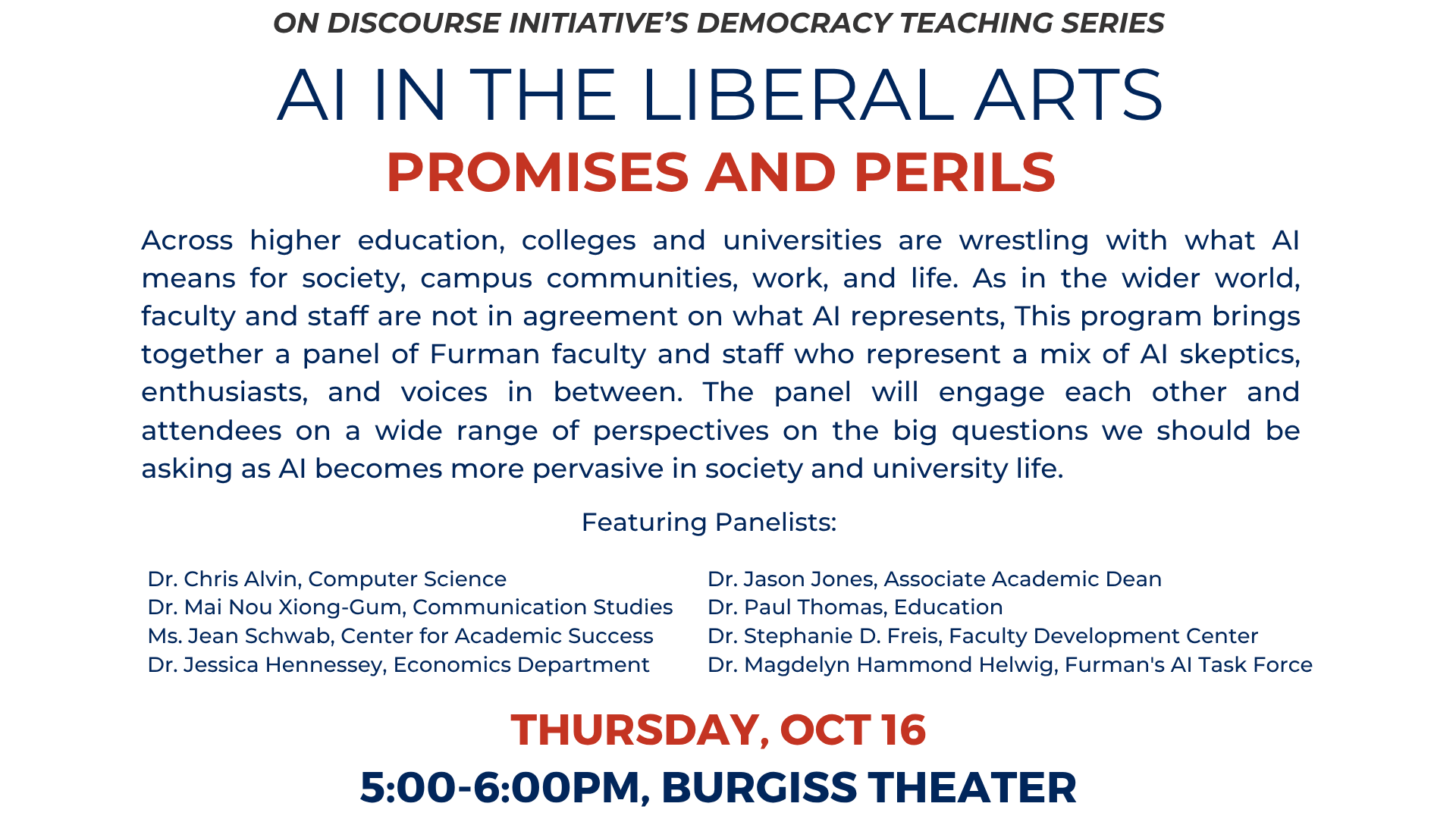
Schedule: Fall/ Winter/ Spring 2025-2026

AI in the Liberal Arts: Promises and Perils

October 16 @ 5:00 pm – 6:00 pm


NCTE Annual Conference 2025 – Denver CO

Panel: Balanced Learning Approaches: From Texts to Literacy Enriched Classrooms

11/20/2025 – 1:00 – 2:15, Mile High Ballroom 2C

Presentation

Dream Texts by Nightmare Authors: To Teach or Not to Teach 

Access PDF of presentation HERE           

Many beloved authors have been exposed as abusive people or advocates for offensive beliefs. From the revelations about Neil Gaiman to the anti-trans stance by JK Rowling, whether to teach their works despite those failures or controversies confronts teachers throughout K-16 literacy classrooms. This session examines if and why teachers should or should not teach dream texts by nightmare authors.

Roundtable: Literacy, a Dream Deferred?: How to (Actually) Serve the Literacy Needs of All Students

11/21/2025 – 9:30 – 10:45, Room 108/110

Roundtable Presentation

Literacy and Literature as Casualties of Reading Wars

Access a PDF of the presentation HERE [Updated 11/21/25]

Reading Wars often have two overlapping components, debates about how reading should be taught and what texts students should (and should not) read. Both of these elements tend to promote ideological agendas at the expense of authentic approaches to literacy and literature.

Individual Presentation: Recovering Our Reading Dream from a Long Crisis Nightmare

11/21/2025 – 2:45 – 3:15, Mile High Ballroom 1A/1B

Access a PDF of presentation HERE

In 1961, Jacques Barzun in Tomorrow’s Illiterates declared “illiteracy is still with us.” Charles Child Walcutt added: “[N]o further ‘research’ into methods of reading instruction is necessary.” This session examines reading crisis/reform cycles to reconsider the stories told about reading and offer a new approach for reform that serves the needs of students and supports teacher professionalism.

Roundtable: How Can Literacy Teachers Reclaim the Right to Teach in Ways that are Responsive to Our Kids, Our Setting, and Our Beliefs?  

11/23/2025 – 9:00 – 10:15, Room 107/109/111

Talk

Fact Checking “The reading wars are ending. Phonics won.” (Washington Post Editorial Board)

Access a PDF of the presentation HERE [Updated]

The Editorial Board at The Washington Post published a bold claim: The reading wars are ending. Phonics won. Here, that claim is fact checked focusing on the false claim that California adopted Mississippi-style “science of reading” legislation. A brief examination of the misleading comparison of CA and MS shows that the WaPo Editorial Board has declared a false end to the reading war as well as mischaracterizing the role of phonics.

Roundtable Presentation

Education Journalism Fails Education (Again)

Access a PDF of the presentation HERE

This roundtable will share with teachers four “red flags” (Chris Ferguson) to critically engage with media coverage of educational issues and research (highlighting the “science of” coverage): RED FLAG 1: Claims that all the evidence is on one side of a controversial issue; RED FLAG 2: Reversed burden of proof. “Can you prove it’s not the smartphones?”; RED FLAG 3: Failing to inform readers that effect sizes from studies are tiny, or near zero, only mentioning they are “statistically significant.”; RED FLAG 4: Comparisons to other well-known causal effects.


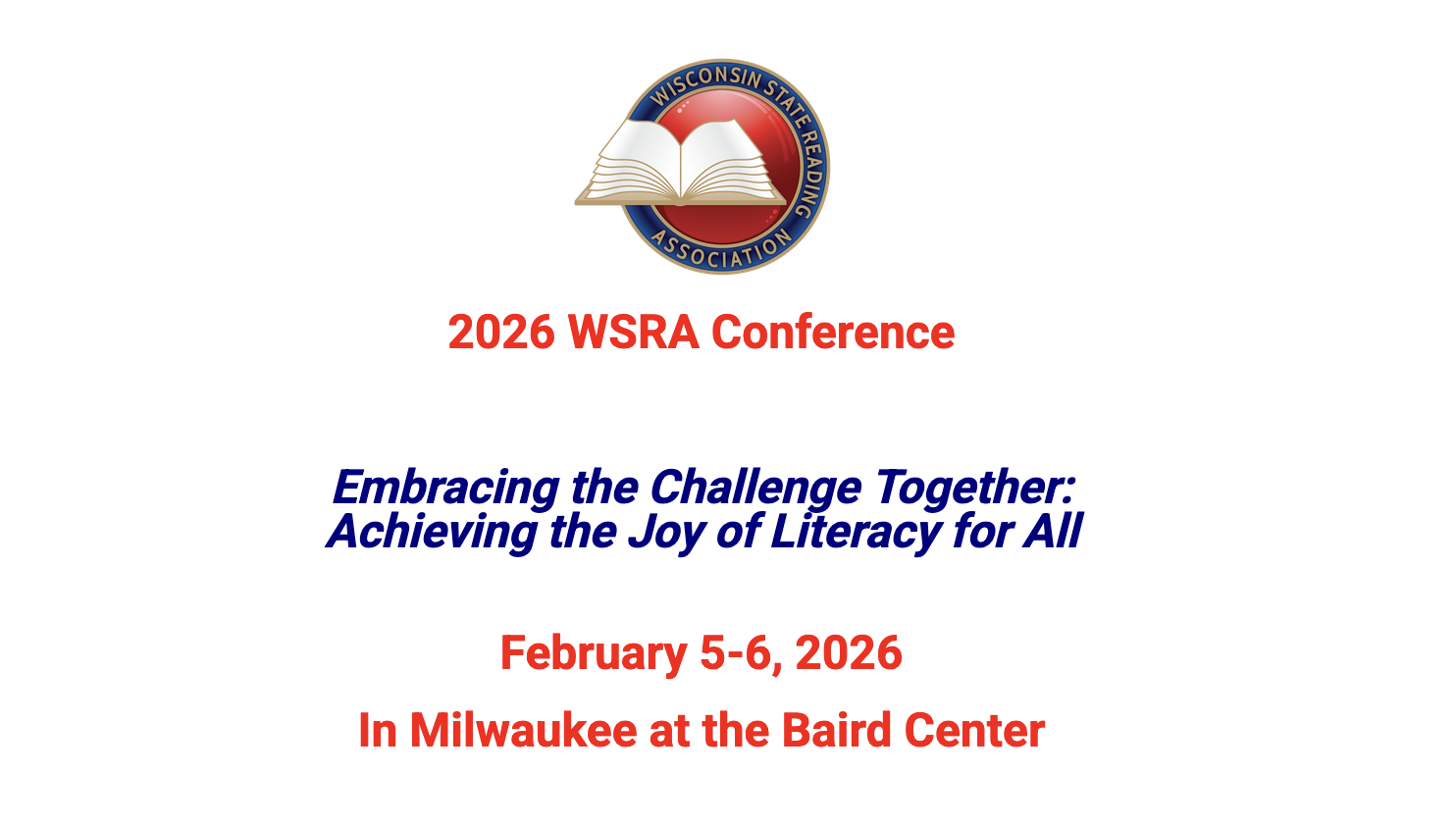
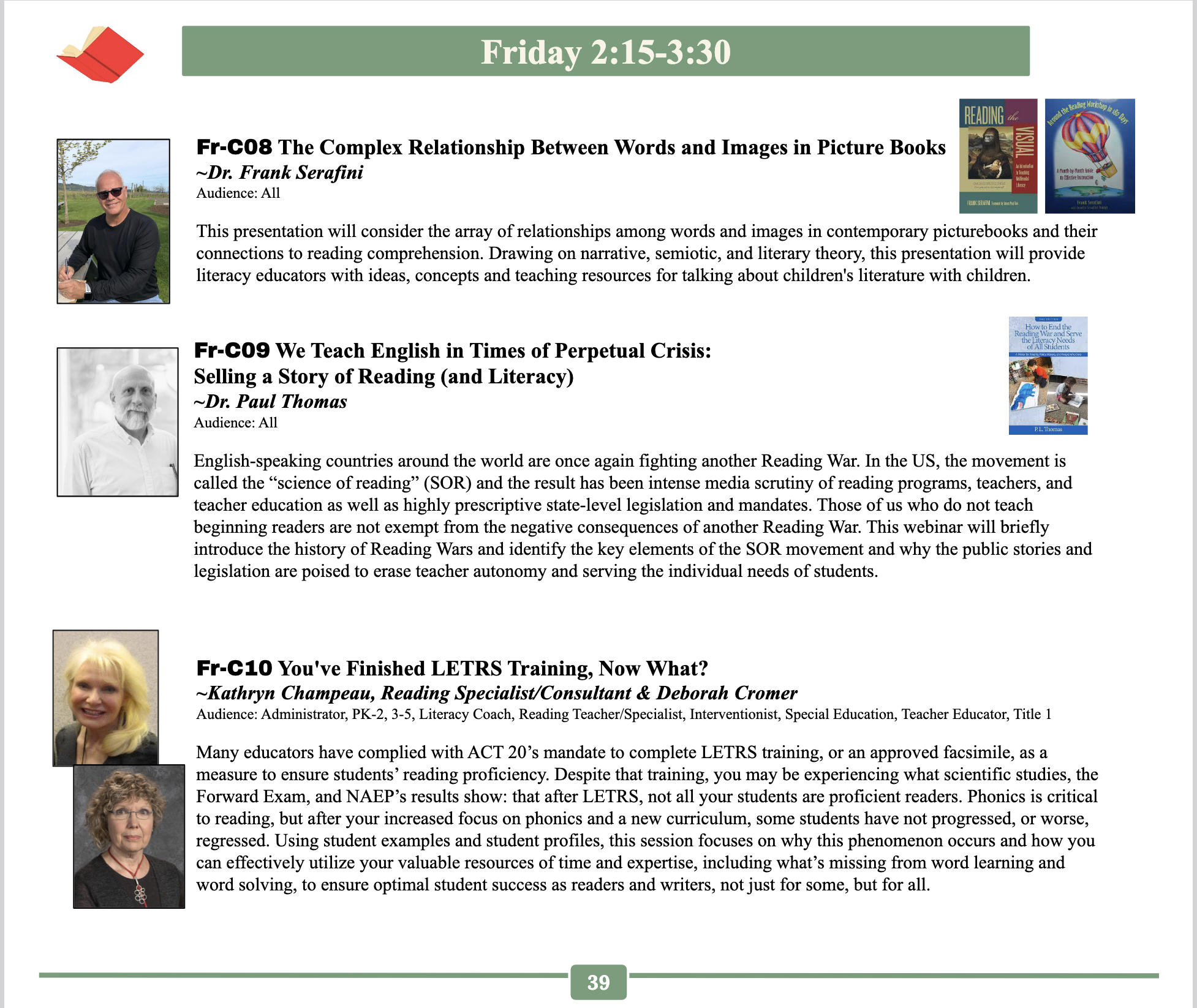
WSRA 2026 Annual Conference

February 6, 2025

Conference Program

Session: Fri. Feb 6 from 11:15 to 12:30

Big Lies of Education: “Science of” Era Edition [Access PP PDF Here]

Education practices and policy are often directly and indirectly driven by the stories told in the media, among the public, and by political leaders. This session will explore the Big Lies in the compelling but misleading narratives, including A Nation at Risk/education “crisis,” reading proficiency/NAEP, National Reading Panel, poverty as an excuse, international test rankings and economic competitiveness, grade retention, growth mindset/grit, and the word gap.

Session: Fri. Feb 6 from 2:15 to 3:30

We Teach English in Times of Perpetual Crisis: Selling a Story of Reading (and Literacy) [Companion Post]

See the presentation HERE.

English-speaking countries around the world are once again fighting another Reading War. In the US, the movement is called the “science of reading” (SOR) and the result has been intense media scrutiny of reading programs, teachers, and teacher education as well as highly prescriptive state-level legislation and mandates. Those of us who do not teach beginning readers are not exempt from the negative consequences of another Reading War. This presentation will briefly introduce the history of Reading Wars and identify the key elements of the SOR movement and why the public stories and legislation are poised to erase teacher autonomy and serving the individual needs of students.


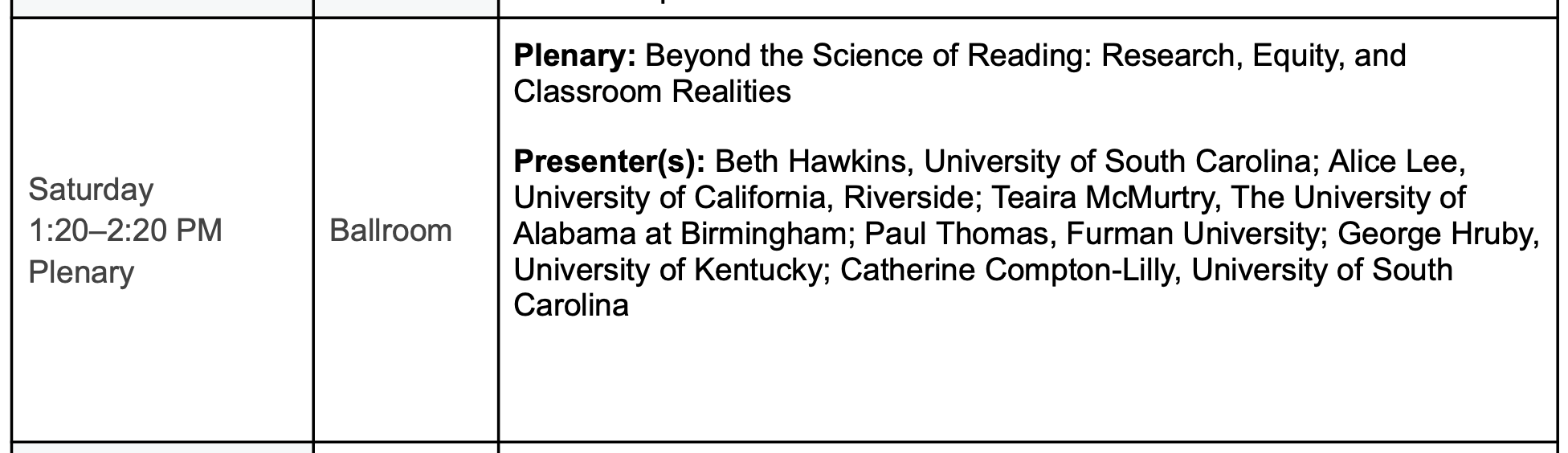
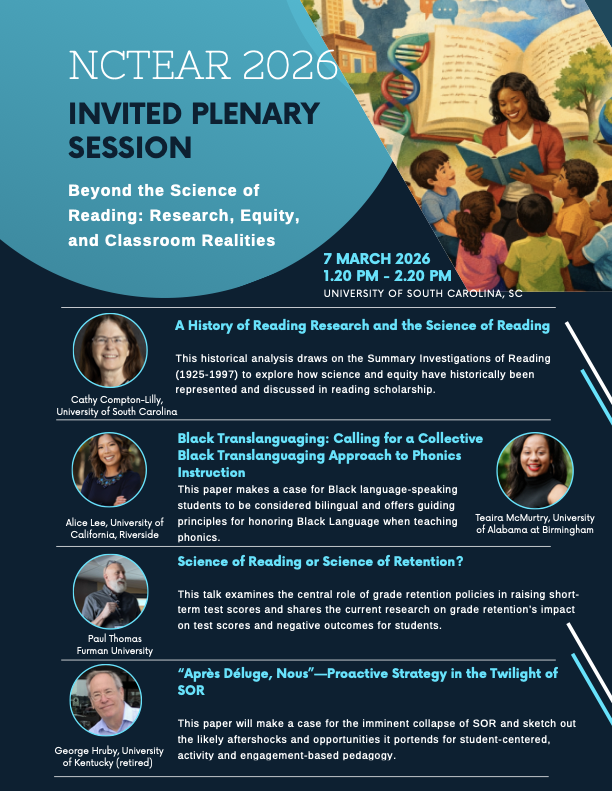
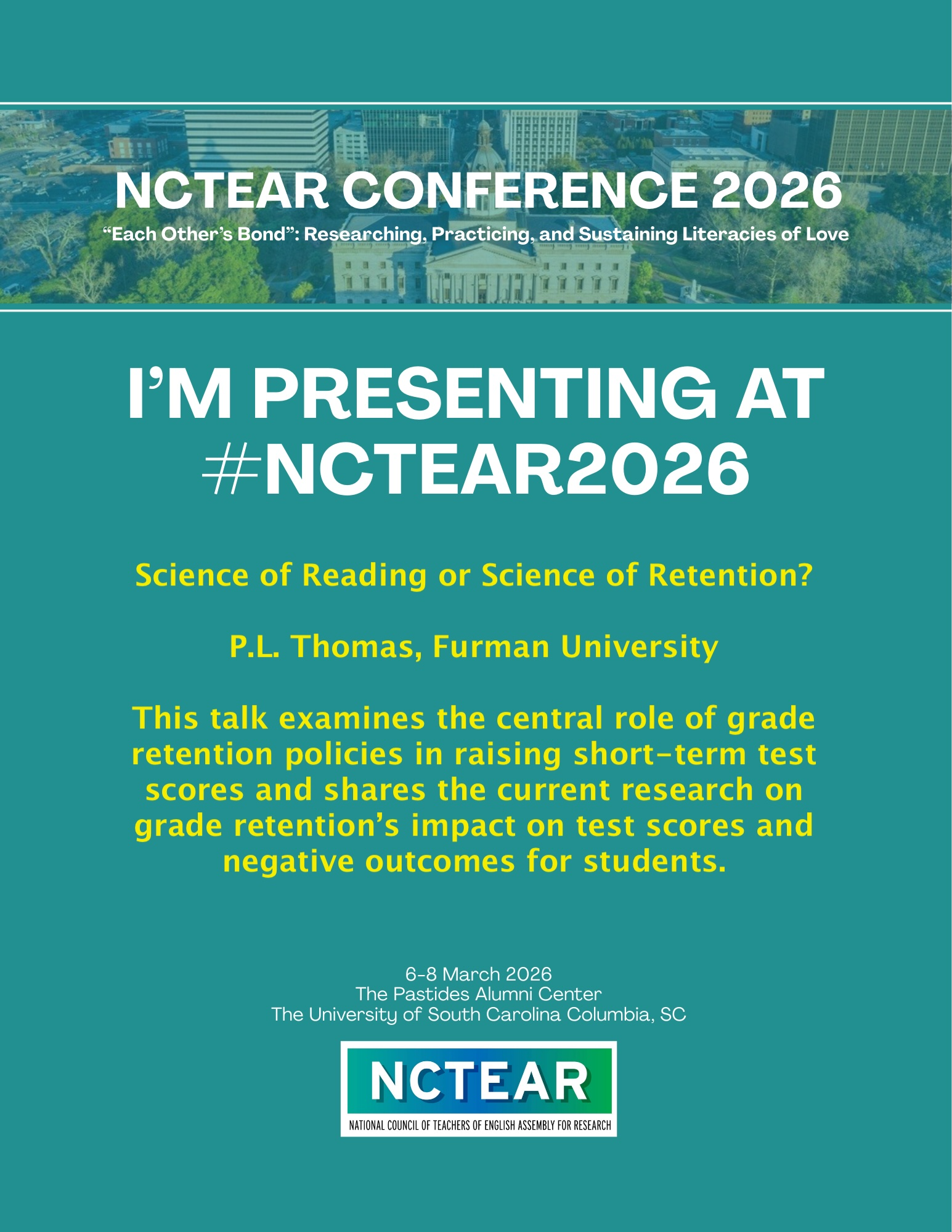
NCTEAR 2026

Pastides Alumni Center, Columbia, SC

Pleanary Session on the Science of Reading

Saturday 3/7/2026, 1:20 – 2:30

Science of Reading or Science of Retention? [follow link for PDF of PP]

P.L. Thomas, Furman University

This talk examines the central role of grade retention policies in raising short-term test scores and shares the current research on grade retention’s impact on test scores and negative outcomes for students.

NAEP: A Modest Proposal

[Header Photo by Nguyen Dang Hoang Nhu on Unsplash]

Likely the most influential standardized test in the US is the National Assessment of Educational Progress (NAEP), under the purview of the beleaguered US Department of Education.

Also without question, NAEP is one of the most misunderstood and misrepresented standardized tests since the mainstream media, political leaders, pundits, and the public routinely shout “Crisis!” with each release of NAEP data.

NAEP’s achievement levels are misleading at best, but at worst, those achievement levels were designed to create the appearance of perpetuate educational failure, and yes, crisis.

“Proficient” is almost always conflated with “grade level” resulting in false claims, for example, that 2/3 of fourth graders are reading below grade level. NAEP’s “basic” is approximately what most states identify as “proficient”—suggesting on grade level (see an extensive analysis here).

What most people misunderstand as well about NAEP is its purpose: NAEP was born in the fertile soil of high-stakes accountability education reform spurred by the Reagan administration’s propaganda A Nation at Risk. Reagan sought to reintroduce forced prayer in schools and wanted to close the Department of Education, labeled an “abomination.”

However, what Reagan spawned was over four decades of ever-changing standards and tests to hold schools, teachers, and students accountable. In short, NAEP was created as a test of random samples of students to hold states accountable for their educational standards and outcomes (historically, public education has been the responsibility of the states, and NCLB in 2001 was a departure toward more federal oversight).

Frankly, NAEP was designed as an accountability mechanism, not a way to provide feedback on individual student achievement. (Note that state-level accountability testing was designed to provide individual student assessment that should provide evidence for instruction.)

In 2025, on the heels of recent shouts of “Crisis!” (again) because almost everyone has misunderstood and misrepresented NAEP scores across math, reading, and even civics, Reagan’s dream may be coming true since the Trump administration has promised to end the USDOE, and that move imperils the future of NAEP.

As Peter Greene has confronted, some have taken this uncertainty about NAEP to propose turning NAEP into (you should pause here to prepare yourself for the inanity) the failed Common Core experiment that sought to replace the state-based public education accountability process with national standards and testing.

Into the nonsense that is NAEP historically and the current doubling-down on Common Core Redux, I want to make a modest proposal about the future of NAEP.

Actually I want to make two modest proposals, acknowledging that the first is never going to happen (although it is the one more strongly supported by empirical data; you know, the “science” that so many education reformers claim to worship).

I strongly reject standardized testing as well as traditional classroom testing and grades. That has been at the core of my 40-plus-year career, and again, this is informed not just by my experiences as an educator but by a very robust body of research.

Therefore, my first modest (and completely unrealistic in the US) proposal is the conclusions reached by Maron and Tienken:

Almost 63% of the variance in test performance was explained by social capital family income variables that influence the development of background knowledge. Background knowledge is a known predictor of standardized test results. Family income variables are immutable by schools. Only public policies, outside the control of school personnel, can influence family income.

The United States has one of the highest levels of childhood poverty among Organisation of Economic Co-operation and Development (OECD) countries. It is well known that the social safety net in the United States is not as strong as some nations in Europe and other parts of the world [20]. Neoliberal policies have greatly reduced government support for families in the United States. Important social policy frameworks that reduce poverty, such as monetary, labor, fiscal, and health policies, have been weakened over the last 40 years, causing increases in childhood poverty in the United States compared to other democratic countries [41].

Although some education policy makers in the United States claim that standardized test results are an important component of a comprehensive system of educational quality control, the results from decades of research on the topic suggest otherwise [42]. The influence of family social capital variables manifests itself in standardized test results. Policy makers and education leaders should rethink the current reliance on standardized test results as the deciding factor to make decisions about student achievement, teacher quality, school effectiveness, and school leader quality. In effect, policies that use standardized test results to evaluate, reward, and sanction students and school personnel are doing nothing more than rewarding schools that serve advantaged students and punishing schools that serve disadvantaged students.
Alas, the US will never follow this last point because we refuse to acknowledge systemic forces and remain a people fatally committed to rugged individualism and bootstrap mythologies.

And thus, here is my compromise, a modest proposal that can and should be explored for the future of NAEP:

  • Rename achievement levels in standardized testing that share a national standard metric for the levels (all states and NAEP would share the same achievement levels and metric).
  • Achievement levels must be age-level and not grade-level (currently, using “grade level” allows states to game scores through grade retention, for example). A clear system of “below age level,” “age level,” and “above age level” would simplify reporting and allow for more accurate political, media, and public responses to data.

This proposal would be a first step, I hope. The problem at first is that this doesn’t address the excessive testing culture the US has embraced without positive outcomes for over forty years.

This first step, I think, can create a new basis for evaluating and viewing our public schools, and then, we may be primed to begin dismantling the standardized testing machine—or at least become more acclimated to reducing it dramatically.

The great irony of the power of high-stakes testing in the education accountability era is that it has proven only one thing: Weighing a pig does not make it fatter.

Testing, testing, and testing has not improved schools, teachers, or students, but it has created a perpetuate state of educational crisis.

Perpetual educational crisis serves only political agendas and the unquenchable education marketplace.

If we can entertain for a moment of idealism that the Trump disaster doesn’t destroy both the USDOE and public education, let’s consider how to more forward in ways that better serve the promise of public education and our fragile democracy.

If not an end to NAEP, at least a better NAEP that serves the interest of students and not political or market agendas?


See Also

Big Lies of Education: Reading Proficiency and NAEP

Beware Grade-Level Reading and the Cult of Proficiency

Rethinking Reading Proficiency

Big Lies of Education: Word Gap

The story is simple and may sound obvious: Poor children suffer from a significant “word gap” (WG) when compared to middle-class and affluent children.

Miller, Sperry, and Sperry explain in A deficit story in motion: How marginalized youngsters are defined out of the educational game before they enter school:

To re-cap, the WG Story runs as follows: Parents from lower-class backgrounds do not talk enough to their children in the early years of life, in contrast to affluent European American parents who talk a great deal. This relative deficit impedes children’s vocabulary development, which, in turn, leads them to under achieve in school. It is a small step from this narrative to a rationale for intervention: If these parents could be taught to behave more like their privileged counterparts, marginalized children would develop larger vocabularies, which would boost their success in school.

As is typical in the Big Lies of Education, compelling and enduring stories do not necessarily prove to be accurate. And the resilience of Big Lies often rests on a complex matrix of causes, detailed by Miller, Sperry, and Sperry:

In sum, nearly 20 years after its inception, the WG Story had gone from academic obscurity to celebrity status. Biases of class, race, and method paved the way for this juggernaut, which gathered force with the convergence of two events, NCLB and LENA, in its Life History. The WG Story flourished by traveling back and forth between academic, policy, and public spheres, illustrating the permeability of discourses (Bakhtin,1981), and inadvertently reproducing the educational inequality it was intended to reduce.

The WG Story and its impact are driven by deficit ideologies (what most people believe regardless of empirical evidence) despite flawed methodology in the foundational research, which, according to Miller, Sperry and Sperry, “did not arise from virgin ground but rather from soil already cultivated with the language deprivation story” that began in the 1960s.

They also acknowledge the role of the media and advocacy:

But the WG Story did not remain sealed off in the academy (Bakhtin, 1981, 1986). It was widely covered in the popular press, and high-profile foundations amplified the Story by funding initiatives to close the Gap.

Again, uncritically embracing the WG Story reflects core deficit beliefs: “The most fundamental historical through-line between the WG Story and its backstory is the fixation on the language defects of marginalized families.”

There is an enduring and false set of beliefs that link deficit ideologies about social class and language: So-called nonstandard or underdeveloped literacy reflects moral and intelligence deficits in not just individual people but entire classifications of people.

In short, any person’s functional vocabulary is not a measure of that person’s character or intelligence, particularly when framed against a norm or standard based on cultural and ideological beliefs instead of valid empirical evidence.

Here, then, is the credible counter-story:


Big Lies of Education: Growth Mindset and Grit

Currently, US education is under one of the most intense eras of criticism—although there has never been a moment over the past century and a half absent cries of education “crisis.”

Notably during the accountability era begun in the early 1980s, permanent (and manufactured) education crisis has been further eroded by the education marketplace and fads promising to end that crisis.

One enduring tension in the field of education as well is between calls for high-quality and narrowly “scientific” evidence for educational practices [1] and the pervasive embracing of education fads that promise more than research supports.

Two of the current examples of this “gap” [2] between research and practice are growth mindset and grit theories and interventions.

I am now revising a chapter on the current research on growth mindset and grit, and offer here an overview of what educators should know before embracing or continuing to embrace advocacy for both theories and interventions that promise to address student achievement.

In short, the research does not support claims by advocates for growth mindset and grit. Here is a list of what we currently do know about both:

  • Advocates for growth mindset and grit significantly overstate the casual relationship between these theories/interventions and student achievement.
  • Research published and cited by advocates is often plagued by flawed research design and/or population concerns, expectancy bias, and reporting errors (including financial conflicts) (Macnamara & Burgoyne, 2023).
  • Advocates tend to acknowledge that implementation of both growth mindset and grit is often suffers from oversimplification, misunderstanding, and reducing the theories and interventions to slogans and isolated lessons.
  • Meta-analyses and high-quality independent studies tend to have mixed results with weak effectiveness measures that may not be significant. Increasingly, research on both is negative, in fact (see chart below).
  • Despite the lack of evidence to support either growth mindset or grit, both continue to be implemented in many schools; some scholars raise concerns that this support is driven by ideology (deficit ideology, bootstrapping/ rugged individualism/ meritocracy) and racism/classism.
  • Scholars also warn that overemphasizing growth mindset and grit allows educators and policy to ignore the more significant impact of out-of-school factors [3], and as a result, often messaging and interventions manifest as “blaming the victims.”

Below, I include a chart of recent public commentary and a research overview of growth mindset and grit. I also provide the references after the chart with a few key quotes in some of the more powerful studies.

 Growth MindsetGrit
Popular sourcesNegative
Study finds, 2018
Tait, 2020
Young, 2021
Negative
Barshay, 2019
Denby, 2016
Selingo, 2016
Tampio, 2016  
research validity and robustnessPositive
Dweck, et al.  
Dweck & Yeager, 2019  
Hecht et al., 2021  

Mixed  
Haimovitz & Dweck, 2017
Miller, 2019
Sisk et al., 2018
Tipton et al., 2023
Yeager et al., 2022
Yeager & Dweck, 2020  

Negative  
Brez et al., 2020 (Burnette et al., 2018; Dixson et al., 2017; Sisk et al., 2018; Schmidt et al., 2017)
Burgoyne et al., 2020
Ganimian, 2020
Li & Bates, 2019
Macnamara & Burgoyne, 2023  
Positive  
Duckworth  

Mixed  
Allen, Kannangara, & Carson, 2021
Palisoc et al., 2017
Ris, 2015  

Negative  
Bazelais, Lemay, & Doleck, 2016
Barcza-Renner, Shipherd, & Basevitch, 2024 (burnout)
Crede, 2018
Credé, Tynan, & Harms, 2017
Goodman, 2018
Gorski, 2016
Kohn, 2014
Locks, Mendoza, & Carter, 2024
Stahl, 2024  
evidence-based or ideologically basedDeficit ideology
Dudley-Marling, 2007
Gorski, 2000
Tewell, 2020
Thomas, 2023
Wormeli, n.d., Grit and growth mindset  

Bootstrapping/ rugged individualism/ meritocracy  
Petrik, Vega, & Vindas-Meléndez, 2022
Tewell, 2020
Deficit ideology   Cushing, 2021
Dudley-Marling, 2007
Gorski, 2000, 2016
Locks, Mendoza, & Carter, 2024
Stahl, 2024
Tewell, 2020
Thomas, 2023
Wormeli, n.d., Grit and growth mindset  

Bootstrapping/ rugged individualism/ meritocracy  
Kohn, 2014
Kindu, 2014
Locks, Mendoza, & Carter, 2024
Tewell, 2020
racism and classismRacism  
Thomas, 2023
Young, 2012b  

Classism/ poverty Coles, 2019
Mullainathan & Shafir, 2014
Thomas, 2023
Thomas, et al., 2014
Racism  
Thomas, 2023   [Popular]  
Love, 2019
Perry, 2016
Locks, Mendoza, & Carter, 2024  

Classism/ poverty Coles, 2019
Mullainathan & Shafir, 2014
Stahl, 2024
Thomas, 2023
Thomas, et al., 2014

Growth Mindset and Grit/ Deficit

Cushing, I. (2021), Language, discipline and ‘teaching like a champion.’ British Educational Research Journal, 47(1), 23-41. https://doi.org/10.1002/berj.3696

Dudley-Marling, C. (2007). Return of the deficit. Journal of Educational Controversy, 2(1), 1–13.

Freire, P. (2000). Pedagogy of freedom: ethics, democracy, and civic courage. Rowman & Littlefield Publishers.

Mizerny, C. (2019, November 23). Misconceptions about mindset, rigor, and grit. MiddleWeb. https://www.middleweb.com/21699/our-misconceptions-about-mindset-rigor-and-grit 

Thomas, P.L. (2023). The “Science of Reading,” education faddism, and the failure to honor the intellectual lives of all children: On deficit lenses and ignoring class and race stereotyping. Voices in the Middle, 30(3), 17-21. https://publicationsncte.org/content/journals/10.58680/vm202332439

Wormeli, R. (n.d.). Grit and growth mindset: Deficit thinking? AMLE. https://www.amle.org/grit-and-growth-mindset-deficit-thinking/

Growth Mindset and Grit/ Poverty

Coles, G. (2019, Summer). Cryonics phonics: Inequality’s little helper. New Politics, 18(3). https://newpol.org/issue_post/cryonics-phonics-inequalitys-little-helper/.

Gorski, P. C. (2000). Good intentions are not enough: A decolonizing intercultural education. Intercultural Education, 19(6), pp. 515-525.

Mullainathan, S. & Shafir, E. (2014). Scarcity: The new science of having less and how it defines our lives. Macmillan.

Thomas, P. L., Porfilio, B.J., Gorlewski, J., & Carr, P.R. (eds.). (2014). Social context reform: A pedagogy of equity and opportunity. Routledge.

Growth mindset

Popular Sources

Study finds popular ‘growth mindset’ educational interventions aren’t very effective. (2018, May 22). Science Daily. https://www.sciencedaily.com/releases/2018/05/180522114523.htm.

Tait, V. (2020, October 17). Is there still a case for teaching fixed vs. growth mindset? Psychology Today. https://www.psychologytoday.com/us/blog/pulling-through/202010/is-there-still-case-teaching-fixed-vs-growth-mindset

Young, G. (2021). Why growth mindset theory fails children. Psychology Today. https://www.psychologytoday.com/us/blog/shrink-mindset/202106/why-growth-mindset-theory-fails-children

Research

Brez, C., Hampton, E. M., Behrendt, L., Brown, L., & Powers, J. (2020). Failure to replicate: Testing a growth mindset intervention for college student success. Basic and Applied Social Psychology, 42(6), 460–468. https://doi.org/10.1080/01973533.2020.1806845

“The pattern of findings is clear that the intervention had little impact on students’ academic success even among sub-samples of students who are traditionally assumed to benefit from this type of intervention (e.g., minority, low income, and first-generation students)” (p. 464)

Burgoyne, A. P., Hambrick, D.Z., & Macnamara, B.N. (2020). How firm are the foundations of mind-set theory? The claims appear stronger than the evidence. Psychological Science, 31(3). https://doi.org/10.1177/0956797619897588.

Burnette, J. L., Russell, M. V., Hoyt, C. L., Orvidas, K., & Widman, L. (2018). An online growth mindset intervention in a sample of rural adolescent girls. British Journal of Educational Psychology, 88(3), 428–445. https://doi.org/10.1111/bjep.12192

Dixson, D. D., Roberson, C. C. B., & Worrell, F. C. (2017). Psychosocial keys to African American achievement? Examining the relationship between achievement and psychosocial variables in high achieving African Americans. Journal of Advanced Academics, 28(2), 120–140. https://doi.org/10.1177/1932202X17701734

Ganimian, A. J. (2020). Growth-mindset interventions at scale: Experimental evidence from Argentina. Educational Evaluation and Policy Analysis, 42(3), 417–438. https://doi.org/10.3102/0162373720938041  

Haimovitz K., & Dweck, C.S. (2017). The origins of children’s growth and fixed mindsets: New research and a new proposal. Child Development, 88(6), 1849–1859. https://doi.org/10.1111/cdev.12955

Hecht, C. A., Yeager, D. S., Dweck, C. S., & Murphy, M. C. (2021). Beliefs, affordances, and adolescent development: Lessons from a decade of growth mindset interventions. In J. J. Lockman (Ed.), Advances in child development and behavior (Vol. 61, pp. 169–197). JAI. https://doi.org/10.1016/bs.acdb.2021.04.004

Li, Y., & Bates, T. C. (2019). You can’t change your basic ability, but you work at things, and that’s how we get hard things done: Testing the role of growth mindset on response to setbacks, educational attainment, and cognitive ability. Journal of Experimental Psychology: General, 148(9), 1640–1655. https://doi.org/10.1037/xge0000669

Macnamara, B. N., & Burgoyne, A. P. (2023). Do growth mindset interventions impact students’ academic achievement? A systematic review and meta-analysis with recommendations for best practices. Psychological Bulletin, 149(3–4), 133–173. https://doi.org/10.1037/bul0000352

“Taken together, our findings indicate that studies adhering to best practices are unlikely to demonstrate that growth mindset interventions bene t students’ academic achievement. Instead, significant meta-analytic results only occurred when quality control was lacking,  and these results were no longer significant after adjusting for publication bias. This pattern suggests that apparent effects of growth mindset interventions on academic achievement are likely spurious and due to inadequate study design, awed reporting, and bias” (p. 163)

Miller, D. I. (2019). When do growth mindset interventions work? Trends in Cognitive Sciences, 23(11), 910–912. https://doi.org/10.1016/j.tics.2019.08.005

Petrik, R. L., Vega, J., & Vindas-Meléndez, A. R. (2022). A reflection on growth mindset and meritocracy. Journal of Humanistic Mathematics, 12(1), 408–421. DOI: 10.5642/jhummath.202201.3

Schmidt, J.A., Shumow, L., & Kackar-Cam, H.Z. (2017). Does mindset intervention predict students’ daily experience in classrooms? A comparison of seventh and ninth graders’ trajectories. Journal of Youth and Adolescence, 46(3), 582–602. https://doi.org/10.1007/s10964-016-0489-z

Sisk, V. F., Burgoyne, A. P., Sun, J., Butler, J. L., & Macnamara, B. N. (2018). To what extent and under which circumstances are growth mind-sets important to academic achievement? Two meta-analyses. Psychological Science, 29(4), 549-571. https://doi.org/10.1177/0956797617739704

Tipton, E., Bryan C., Murray J., McDaniel M., Schneider B., & Yeager D.S. (2023, March/April). Why meta-analyses of growth mindset and other interventions should follow best practices for examining heterogeneity: Commentary on Macnamara and Burgoyne (2023) and Burnette et al. (2023). Psychological Bulletin, 149(3-4), 229-241. doi: 10.1037/bul0000384

Yeager, D. S., Carroll, J. M., Buontempo, J., Cimpian, A., Woody, S., Crosnoe, R., Muller, C., Murray, J., Mhatre, P., Kersting, N., Hulleman, C., Kudym, M., Murphy, M., Duckworth, A. L., Walton, G. M., & Dweck, C. S. (2022). Teacher mindsets help explain where a growth-mindset intervention does and doesn’t work. Psychological Science, 33(1), 18-32. https://doi.org/10.1177/09567976211028984

Yeager D. S., & Dweck C. S. (2020). What can be learned from growth mindset controversies? American Psychologist, 75(9), 1269–1284. https://doi.org/10.1037/amp0000794

Grit

Popular Sources

Barshay, J. (2019, March 11). Research scholars to air problems with using ‘grit’ at school. The Hechinger Report. https://hechingerreport.org/research-scholars-to-air-problems-with-using-grit-at-school/

Bayraktar, B. (2020). Tip: Grit & growth mindset. Tips for Teaching Professors. https://higheredpraxis.substack.com/p/tip-grit-and-growth-mindset

Denby, D. (2016, June 21). The limits of ‘grit.’ The New Yorker. https://www.newyorker.com/culture/culture-desk/the-limits-of-grit.

Love, B.L. (2019). ‘Grit is in our DNA’: Why teaching grit is inherently anti-Black. Education Week. https://www.edweek.org/leadership/opinion-grit-is-in-our-dna-why-teaching-grit-is-inherently-anti-black/2019/02

Perry, A. (2016). Black and Brown boys don’t need to learn ‘grit,’ they need schools to stop being racist. The Hechinger Report. https://hechingerreport.org/black-brown-boys-dont-need-learn-grit-need-schools-stop-racist/

Selingo, J.J. (2016, May 25). Is ‘grit’ overrated in explaining student success? Harvard researchers have a new theory. The Washington Post. https://www.washingtonpost.com/news/grade-point/wp/2016/05/25/is-grit-overrated-in-explaining-student-success-harvard-researchers-have-a-new-theory-and-its-not-comforting-at-all/.

Tampio, N. (2016, June 2). Teaching ‘grit’ is bad for children, and bad for democracy. Aeon. https://aeon.co/ideas/teaching-grit-is-bad-for-children-and-bad-for-democracy.

Research

Allen, R.E., Kannangara, C., & Carson, J. (2021). True grit: How important is the concept of grit for education? A narrative literature review. International Journal of Educational Psychology, 10(1), 73-87. https://doi.org/10.17583/ijep.2021.4578

Barcza-Renner, K., Shipherd, A. M., & Basevitch, I. (2024). An examination of the relationship between burnout and grit in college athletes. Asian Journal of Sport & Exercise Psychology, 4(3), 138–143. https://doi.org/10.1016/j.ajsep.2024.10.007

“This study was one of the first to examine the relationship between burnout and grit in student-athletes. The results indicated that student-athletes who were high in grit, also self-reported symptoms of burnout and that this relationship was strongest during the first two years of college. It is plausible athletes who are grittier are also more likely to persevere through stress and challenges, including burnout symptoms. Athletes higher in grit may also be investing more effort into their sport, which could be increasing symptoms of burnout, as well.” (p. 142)

Credé, M. (2018). What shall we do about grit? A critical review of what we know and what we don’t know. Educational Researcher, 47(9), 606-611. https://doi.org/10.3102/0013189X18801322

“For all its intuitive appeal, the grit literature is currently characterized by a number of serious theoretical and empirical challenges ranging from a lack of construct validity, discriminant validity, and predictive validity. At present there is no empirical support for the idea that grit is the combination of perseverance and passion or for the claim that grit adds to our understanding of success and performance. Indeed, the best available evidence strongly suggests that grit is largely a repackaging of conscientiousness—a widely studied personality trait” (p. 610)

Credé, M., Tynan, M.C., & Harms, P.D. (2017). Much ado about grit: A meta-analytic synthesis of the grit literature. Journal of Personality and Social Psychology, 113(3), 492–511. https://doi.org/10.1037/pspp0000102

Cushing, I. (2021), Language, discipline and ‘teaching like a champion.’ British Educational Research Journal, 47(1), 23-41. https://doi.org/10.1002/berj.3696

Goodman, S. (2018). It’s not about grit: Trauma, inequity, and the power of transformative teaching. Teachers College Press.

Gorski, P.C. (2016). Poverty and the ideological imperative: A call to unhook from deficit and grit ideology and to strive for structural ideology in teacher education. Journal of Education for Teaching, 42(4), 378-386. DOI: 10.1080/02607476.2016.1215546

Kohn, A. (2014). Grit? A skeptical look at the latest educational fad. Educational Leadership, 74, 104–108.

“Make no mistake: Duckworth is selling grit, not dispassionately investigating its effects” (para. 6).

Kundu, A. (2014). Backtalk: Grit, overemphasized; agency, overlooked. Phi Delta Kappan, 96(1), 80.

Locks, A.M., Mendoza, R., & Carter, D.F. (2024). Debunking the grit narrative in higher education. Routledge.

Ris, E.W. (2015). Grit: A short history of a useful concept. Journal of Educational Controversy, 10(1). https://cedar.wwu.edu/jec/vol10/iss1/3/.

Stahl, G. (2024). “Pedagogies of the poor” to “pedagogies on the poor”: Compliance, grit, and the corporeal. In P.P. Trifonas & S. Jagger (eds) Handbook of curriculum theory, research, and practice. Springer International Handbooks of Education. Springer. https://doi.org/10.1007/978-3-031-21155-3_39

Tewell, E. (2020). The problem with grit: dismantling deficit thinking in library instruction. Libraries and the Academy 20(1), 137-159. https://dx.doi.org/10.1353/pla.2020.0007.

“The ideal of meritocracy, much like grit and growth mind-set, assumes that the best and brightest rise to the top based on their hard work and determination, without regard for the historical and present-day subordination of many groups….Deficit models view students as perpetual lacking and at fault. This belief is neither healthy nor accurate. Instead, we need to remain open to broader ways of engaging students and of thinking about their lives, consider what power they really have to effect change, and where we share some responsibility. It is essential to examine how issues of access and equity shape our students’ experiences and to question how success is defined and attained” (p. 150)


Notes

[1] Wormeli, R. (n.d). The problem with, “show me the research” thinking. AMLE. https://www.amle.org/the-problem-with-show-me-the-research-thinking/

[2] LaBrant, L. (1947, January). Research in language. Elementary English, 24(1), 86-94. http://www.jstor.org/stable/41383425

[3] Maroun, J., & Tienken, C.H. (2024). The pernicious predictability of state-mandated tests of academic achievement in the United States. Education Sciences, 14(2), 129-142. https://doi.org/10.3390/educsci14020129


The Zombie Politics of Misinformation about Students Reading at Grade Level

[Header Photo by Daniel Lloyd Blunk-Fernández on Unsplash]

Yesterday, we had our last class session in my upper-level writing and research course that is grounded in students analyzing and evaluating how media covers a chosen education topic.

In that last class, we debriefed about what students concluded about media coverage of education. While some found the coverage valid and informative, much of the discussion focused on why media perpetuates misinformation more often than not—notably about student reading proficiency in the US.

Right on cue, then, I saw this posted on social media, Teaching reading is rocket science, with these two recurring claims that are, in fact, misleading at best and false at worst (see “Recommended” links below):

Eli’s story, and the stories of all my students, are not the exception. They represent the shared reality for two-thirds of our children, here in California and across the country since the 1990s. My students are not at risk because they cannot yet read — they are at risk because not knowing how to read limits their access to opportunities, both academically and beyond.

Research shows when we teach students to read by directly guiding them to break the code of how sounds in letters work, about 95% of them can become strong readers — including multilingual learners and those with dyslexia. So why have only one-third of our fourth graders been reading at grade level for the past three decades? This gap persists because students haven’t had access to evidence-based literacy instruction drawn from decades of vast interdisciplinary research in areas such as cognitive psychology, linguistics, communication sciences and education.

The “2/3 of students are not reading a grade level” claim is one of the most powerful recurring claims in the media. Note these high-profile examples:

Emily Hanford in APM Reports:

The stakes were high. Research shows that children who don’t learn to read by the end of third grade are likely to remain poor readers for the rest of their lives, and they’re likely to fall behind in other academic areas, too. People who struggle with reading are more likely to drop out of high school, to end up in the criminal justice system, and to live in poverty. But as a nation, we’ve come to accept a high percentage of kids not reading well. More than 60 percent of American fourth-graders are not proficient readers, according to the National Assessment of Educational Progress, and it’s been that way since testing began in the 1990s.

Nicholas Kristof in the New York Times:

One of the most bearish statistics for the future of the United States is this: Two-thirds of fourth graders in the United States are not proficient in reading.

And even a college-based literacy professor in The Conversation:

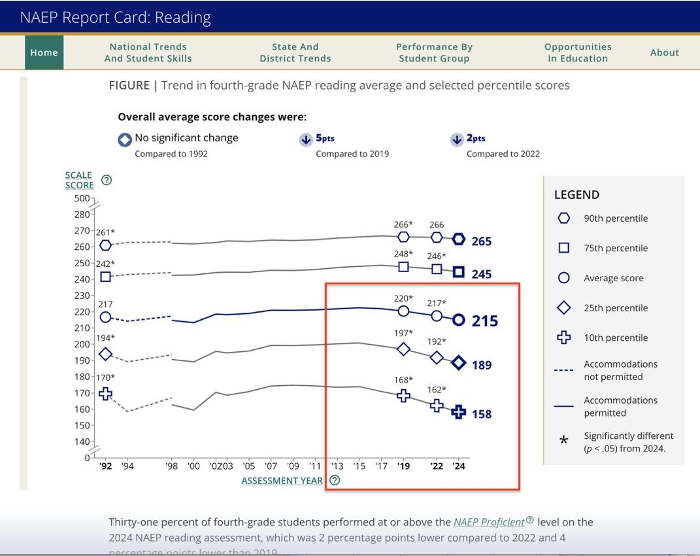
Five years after the pandemic forced children into remote instruction, two-thirds of U.S. fourth graders still cannot read at grade level. Reading scores lag 2 percentage points below 2022 levels and 4 percentage points below 2019 levels.

Despite ample evidence to the contrary and repeated clarifications from many educators and scholars (See “Big Lie” link in “Recommended” below), media characterizations of student reading proficiency continues to be misrepresented, primarily by misunderstanding NAEP achievement levels, because the public has always believed that “kids today can’t read”—despite there being little evidence of a reading “crisis” over the recurring claims of “crisis” reaching back into at least the 1940s.

Two points are important to clarify:

  1. NAEP achievement levels are confusing because “basic” is approximately what most states consider “proficient” and by implication “grade level.” NAEP “proficient” is well above grade level, set at an “aspirational” [1] level that is misleading and creates a perpetual appearance of failure for students, teachers, and schools.
  2. Most states—notably Mississippi and Louisiana—set their “proficient” level just above the mid-point of NAEP “basic” (MS) or just below (LA):
Mapping State Proficiency Standards Onto NAEP Scales, 2007–22

In short, if we consider NAEP and state assessments of reading valid, about 1/3 of students have over the last couple of decades performed below “basic” (NAEP) and thus seem to be below grade level in grade 4.

NAEP Grade 4 Reading National Trends

While the NAEP misinformation and misunderstanding is grounded in the “aspirational” use of “proficient,” the “95% of students can be on grade level” claim is just wildly overstated, and ironically, not based on scientific evidence (despite this being a refrain by the “science of” movement).

I recommend reading Can 95% of Children Learn to Read? to see some of how this claim gained its zombie status.

Historically and currently, many in the US have been and are concerned about student reading acquisition; this, of course, is a valid concern, notably that marginalized and vulnerable populations of students are disproportionately struggling to meet whatever standard we set for “proficient” or “grade level” (see HERE that explores how MS has not closed the race or socioeconomic achievement gaps, for example).

There is an insidious zombie politics to claims about 2/3 of students not reading at grade level, but that if we just did the right thing, 95% of students would read at grade level.

Since neither claim is empirically true, we must confront that basing education claims and reform on misunderstanding and misinformation have not yet worked and are unlikely to work moving forward.


Note

[1] Rosenberg, B. (2004, May). What’s proficient? The No Child Left Behind Act and the many meanings of proficiency. Washington, DC: American Federation of Teachers. https://files.eric.ed.gov/fulltext/ED497886.pdf

Recommended

“Science of Reading” Playing Numbers Games Not Supported by Science

Big Lies of Education: Reading Proficiency and NAEP

Education: How the Market and Fads Poison a Robust Field

[Header Photo by Thomas Kolnowski on Unsplash]

My high school English teacher and eventual mentor, Lynn Harrill, told me in my junior year that I should be a teacher.

I laughed, and certainly as teens are apt to do, hurt his feelings.

Almost fifty years later, and I have been a career educator since 1984.

I realized I wanted to be a teacher and a writer during my junior college years—the former because I had a job as a tutor and the latter because my speech teacher, Steven Brannon, introduced my to e.e. cummings.

I declared my secondary English education major when I transferred the fall of my junior year. And then, almost immediately, I learned a harsh lesson about becoming an education major: It was a “lesser” degree.

I took as many English courses as I could as an undergrad, and in ever class, I had to out myself as an education major, not an English major (almost most of my close friends were English majors).

Over the next five decades, I have had to navigate that “lesser” status when I tried to enter an MFA program while teaching high school full-time (nope), tried to apply for a PhD in English while teaching high school full time (nope), and then completed an EdD (yet another “lesser” degree to go with with my BA in English Education and MEd).

And since 2002, I have had to correct people who assume I am in the English department; nope, I am in Education.

In the good ol’ U.S. of A., as well, the standard beliefs are that education is failing, teachers are people who can’t do (and were mostly weak students themselves), and the discipline of education is a joke.

Just as a recent example, see this on social media:

I have recently submitted a book chapter, in fact, on two “pernicious” fads in education—grit and growth mindset.

However, I believe the standard attacks on education, teachers, and then the discipline of education are gross oversimplifications that miss almost entirely the real problems (what Vainker is addressing above and what I am confronting in my chapter on grit and growth mindset).

There are layers to the problem.

First, education as a discipline is robust and valid. My own recognition of that, however, did not fully develop until my EdD program where I was engaged with the scholarship, philosophy, and theory of the field of education—and not distracted by issues of certification and bureaucracy.

Now, that means when people are attacking “education” and the “pernicious fads” they are in fact not criticizing the discipline.

Here are the layers of problems that dilute a valid field:

  • Certification and accreditation bureaucracy. Regretfully, education is a profession that feels compelled to mimic more respected fields like medicine and law, where credentials are required. However, that layer has more often than not been reductive for the discipline because of the inherent flaws with credentialing and bureaucracy.
  • The education market place. The current “science of reading” (SOR) movement is repeating what happened during the Common Core era—the education market place using branding (SOR, CC) to spur purchasing cycles in education. To be blunt, the single most powerful and corrupting aspect of education as a field is the market. Any credible or valid education research is necessarily reduced when it is packaged and sold; this is exactly what happened with multiple intelligences, learning styles, grit, growth mindset, etc., creating the perception that the research isn’t credible instead of acknowledging that the marketing is the problem (although in some cases, the market is perpetuating flawed research as well). In short, education reform is an industry, not a process for improving teaching and learning in the US.
  • Education celebrities. A parallel problem with education market forces is the education celebrity who corrupts the field of education by selling programs, fads, or themselves as “experts” (and sometimes, all of these at once). This is a problematic concern since many of us who work in education, of course, are paid as professionals. Simply being paid as a professional is not something to criticize in a capitalistic society, of course, but money can and does corrupt. One of the best (worst?) examples of how an education celebrity can distort significantly credible and valid research is Ruby Payne, who cashed in (literally) on NCLB mandates and funding. Payne peddled stereotypes about poverty and teaching children in poverty—even though a robust body of research on poverty refuted nearly everything she packaged, promoted, and sold. Part of the problem here is that education celebrities and the market can easily prey on education and educators because the US has been politically negligent in providing schools, teachers, and students the sort of conditions in which all children can learn.
  • Sexism. Here is a fact at the core of many problems in education: More than 7 out of 10 K-12 teachers and most teacher educators/scholars are women. I leave this as the last point for emphasis because I believe sexism is the foundation of why education remains disrespected as a field and why there is so little political and public support for teachers as professionals (note the current rush to support scripted curriculum as one example). The current focus on “science,” as well, is another sexist movement (repeating the same sort of claims during NCLB) since the quantitative/qualitative divide in what research matters is highly gendered (men do “hard” science, but women do “soft” science).

Bashing student achievement, school and teacher quality, and teaching as a profession as well as education as a field are all a sort of lazy and unexamined national past time in the US.

These sorts of attacks and criticisms are shrugged off as common knowledge and even jokes; again, I believe, primarily because we still see teaching as just something women do with children.

While there is some validity to criticizing educational research that is packaged and sold, this is not something unique to education as a field.

Consider as just one example the perversion of the 10,000 rule in psychology, and the power of Malcolm Gladwell as “celebrity” to do just that.

Psychology and economics, in fact, have experienced crises of replication that should tarnish those fields at least as much as how we marginalize education.

Yet, psychology and economics are seen as men’s professions, and thus, professions, and receive a huge pass when they simply do not deserve that.

We should stop bashing education as a field, but we should also be far more vigilant about protecting educational research and practice from the corrosive impact of bureaucracy, the market, celebrities, and sexism.

Recommended: Why We Cannot Go Back to Basics (Rethinking Schools)

[Header Photo by Element5 Digital on Unsplash]

Note

The article below appears in Rethinking Schools and brings together several problems with and connections between the “science of reading” and book banning/censorship movements that I have been address since 2018.


Why We Cannot Go Back to Basics: Reclaiming The Right to Teach Literacy, Daniel Ferguson, Laurie Rabinowitz, and Amy Tondreau

Although the “culture war” and “reading war” have been described as separate causes promoted by disparate organizations, their stories are more connected than they appear. Both book banning and SoR dogmatism limit what teachers can teach and what students can read, narrowing the ability of public schools to address children’s diverse needs. We see this most explicitly in conservative parent groups, including Moms for Liberty, who have made it clear they endorse both. This should be a wake-up call to critically examine the potential impact of phonics-based policies on public school students and teachers. 


Recommended

SOR Movement Maintains Conservative Assault on Teachers and Public Schools [Updated]

Beware Scripted Curriculum: More Trojan Horse Education Reform

Big Lies of Education: National Reading Panel (NRP)

We Teach English in Times of Perpetual Crisis: Selling a Story of Reading (and Literacy) [Webinar Companion Post]

Recommended: The Balancing Act by Dominic Wyse and Charlotte Hacking

Thomas, P.L. (2024, March). We teach English in times of perpetual crisis: The long (and tedious) history of reading crisis. English Journal, 113(4), 21-26. https://publicationsncte.org/content/journals/10.58680/ej2024113421

Thomas, P.L. (2024, May). Teaching English in the “science of reading” era: We teach English in times of perpetual crisis: Selling a story of reading. English Journal, 113(5), 16-22. https://publicationsncte.org/content/journals/10.58680/ej2024113516 [Access HERE until open access at EJ]

Thomas, P.L. (2024, September). We teach English in times of perpetual crisis: The media continue to misread teaching reading and literacy. English Journal, 114(1), 14-19. https://publicationsncte.org/content/journals/10.58680/ej2024114114 [Access HERE until open access at EJ]

Thomas, P.L. (2024, November). We teach English in times of perpetual crisis: For all ELA teachers, “the time is always now.” English Journal, 114(2), 21-26. https://publicationsncte.org/content/journals/10.58680/ej2024114221 [Access HERE until open access at EJ]

Thomas, P.L. (2023). The “science of reading,” education faddism, and the failure to honor the intellectual lives of all children: On deficit lenses and ignoring class and race stereotyping. Voices in the Middle, 30(3), 17-21. https://publicationsncte.org/content/journals/10.58680/vm202332439

The Science of Reading Movement: The Never-Ending Debate and the Need for a Different Approach to Reading Instruction (policy brief) – NEPC


Misreading Reading Scores (Again) [Unpublished OpEd Submission]

[This piece has been submitted to national newspapers with no responses.]

[Header Photo by Kelly Sikkema on Unsplash]

Every two years reading scores make headlines. And this year, as has been the case since COVID, the news is not good. Scores are down (again), and the causes being pointed to for the drop are also wrong (again).

National Assessment of Educational Progress (NAEP) is the national program mandated with tracking student achievement. The 2024 results reveal that reading scores have hit their lowest point in 32 years. This decline is notable because in recent years many states have passed aggressive reading legislation, often labeled as the “science of reading” (SOR).

The SOR movement makes a few key claims: the US has a reading crisis, teachers fail to use “scientific” evidence for instruction, and educators and policymakers are making excuses by acknowledging poverty when addressing low reading proficiency.

When 2019 NAEP reading scores were released, Mississippi was proclaimed a “miracle” state for improving grade 4 reading scores despite being a high-poverty state, implying (without evidence) that those increases were caused by Mississippi implementing SOR policy. In the years that followed, the Mississippi “miracle” became the poster child for other states following the SOR legislative formula; to date 40 states and the District of Columbia have passed SOR legislation.

However, the Mississippi “miracle” story was an incomplete misreading of reading proficiency and policy.

With the average 2024 NAEP reading scores in further decline, the SOR era in reading reform appears to be failing. This is especially true for vulnerable students whose scores have dropped the most. Interpreting these scores correctly is key to forging a better path forward.

Thus, we must seek a more credible story about 2024 NAEP reading scores.

Let’s consider three sets of data from the Department of Defense schools (DoDEA), Florida, and Mississippi. These student populations include significant racial and socioeconomic diversity as well as multilingual learners and other vulnerable populations of students.

Florida and Mississippi have long been applauded for aggressive education and reading reform, and in 2024, their grade 4 reading scores remained in the top 25% of states, seemingly defying the odds. But Florida and Mississippi scored again well below top-scoring DoDEA schools.

Although many rush to ascribe this success to SOR policies, we should really be looking at a different (ultimately harmful) policy: third-grade retention based on state testing.

As education analysts John Westall and Amy Cummings concluded in a report on reading policy: “[S]tates whose policies mandate third-grade retention see significant and persistent increases in high-stakes reading scores in all cohorts…. [T]here is no consistent evidence that high-stakes reading scores increase in states without a retention component.”

In other words, by holding back the lowest performing students in third grade, grade 4 scores appear higher. Florida and Mississippi retain thousands of K-3 students annually.

Inflated scores are not learning; by eighth grade NAEP reading scores for Florida and Mississippi drop into the bottom 25% of states. The widely applauded “gains” in grade 4 are, in fact, a mirage.

Here is a different story: DoDEA schools are the top-scoring schools on NAEP tests and tell a story we’ve resisted admitting in the US. Maroun and Tieken found in 2024, replicating decades of similar research, that 60+% of student test scores are not linked to teacher quality, instruction, or programs but to out-of-school factors like socioeconomic background, home environment, and parental involvement to name a few.

While DoDEA schools have significant populations from poor and working-class backgrounds and serve diverse as well as vulnerable populations of children, these students have healthcare, food security, stable housing, and parents with stable work—and consistently high reading scores.

NAEP reading scores, again, are not a story about teacher and reading program failure or even student reading proficiency. These scores tell a complex story about a long history in the US of negligence, the lack of political will to address not only the education of all our children, but also their lives outside of school.