Tag Archives: literacy

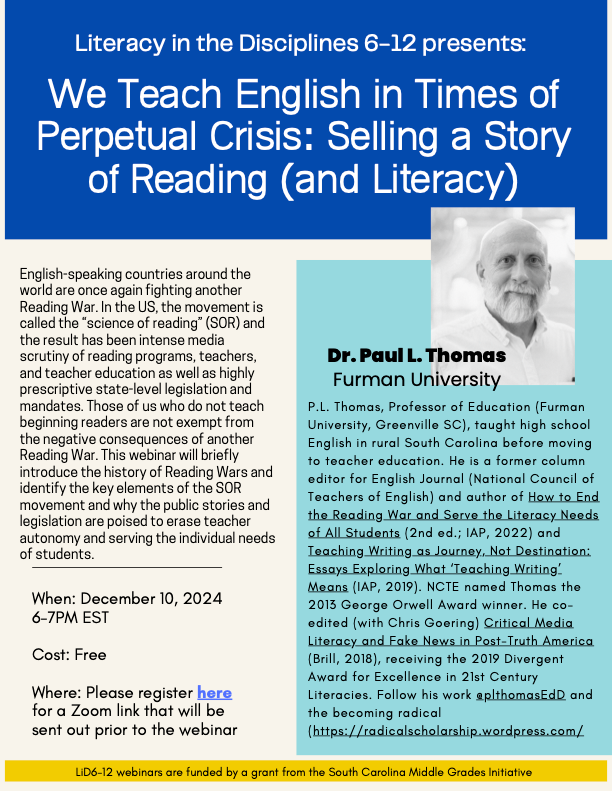
We Teach English in Times of Perpetual Crisis: Selling a Story of Reading (and Literacy) [Webinar Companion Post]

Click here to register: https://forms.gle/mvvs7etQAg7RESxs8

See the webinar presentation HERE.

Webinar recording:

In 1947, writing in NCTE’s Elementary English (which became Language Arts), Lou LaBrant announced, “This is not the time for the teacher of any language to follow the line of least resistance, to teach without the fullest possible knowledge of the implications of his medium” (p. 94).

The 2020s have made this call even more important for teachers of language K-12 in the US because of the rise of censorship and curriculum gag orders along with legislative mandates including scripted curriculum as part of the “science of reading” (SOR) movement.

Here, I want to focus on the SOR movement as another cycle of the Reading War, one that threatens the professionalism and autonomy of all teachers at every level.

Those Reading War cycles have included:

Teachers must recognize that Reading War cycles tend to be about ideology, market concerns (reading programs), and political agendas, but not grounded in credible evidence or well focused on the needs of students or the professionalism of teachers.

Also when I address the SOR movement, I am not contesting reading science or valid concerns about reading instruction or reading proficiency by students. I am challenging the media story being sold:
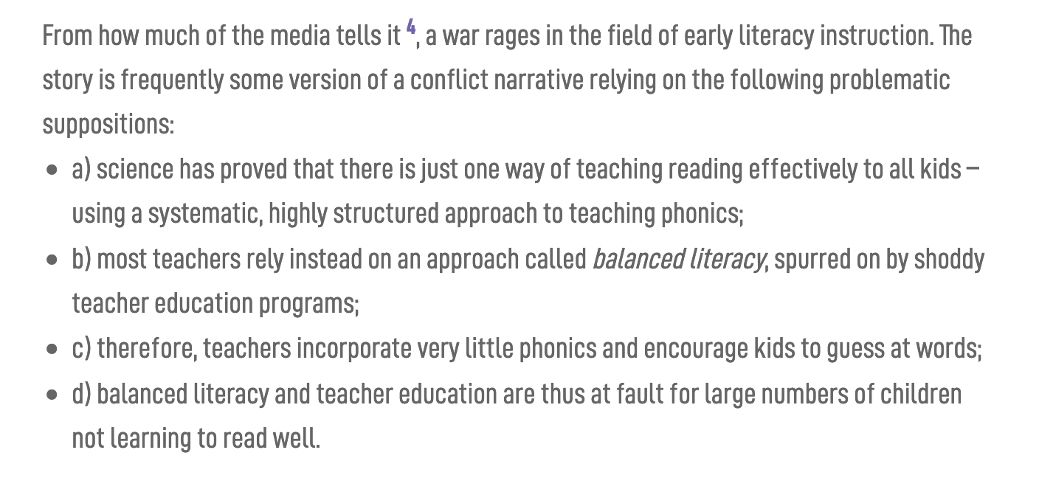
Aukerman, M. (2022, November 23). The science of reading and the media: Is reporting biased? Literacy Research Association. https://literacyresearchassociation.org/stories/the-science-of- reading-and-the-media-is-reporting-biased/ 

Further, teachers at all levels must be familiar with the key issues for misleading and even inaccurate claims within the SOR movement (again distinct from reading science and a broad base of research over a century):

Despite many of the claims made in this media story being misleading or false, the story is very compelling for the public, especially parents. For example, a poll, Reading Education Messaging: Findings and Recommendations from an Online Poll of K-5 Parents in America, shows a disturbing pattern:
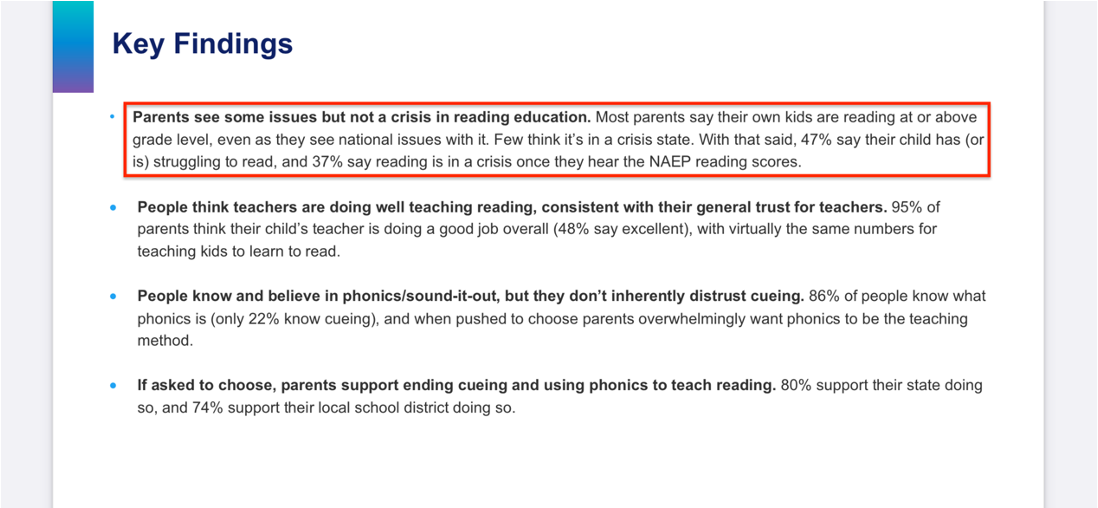
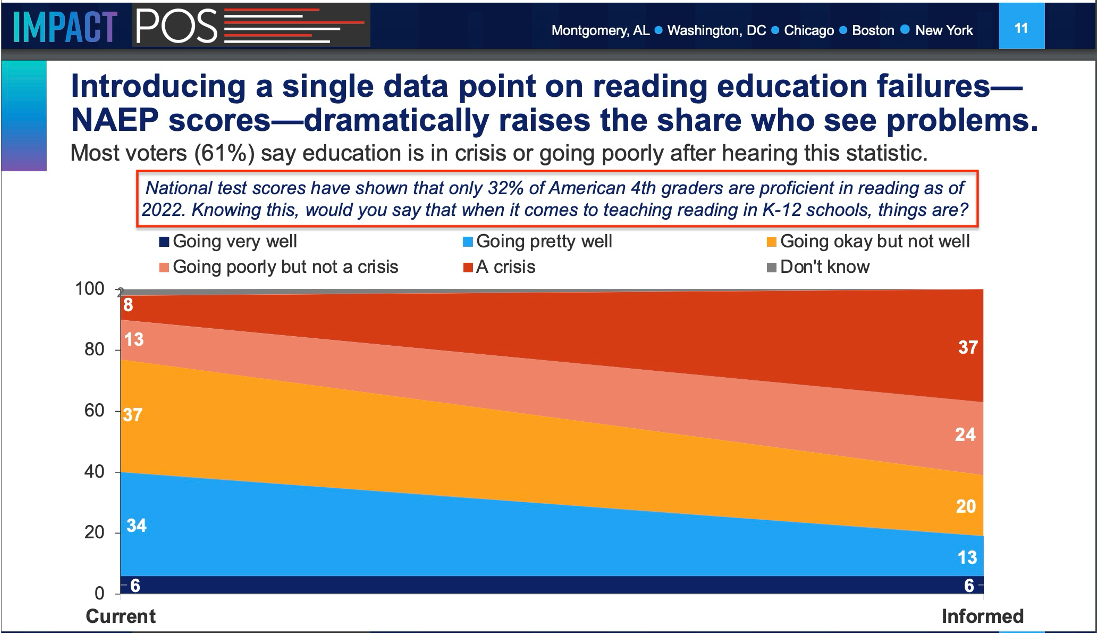
The media claim about reading proficiency (which is false because of the confusing categories in NAEP testing) actually changes parental opinion from positive to negative.

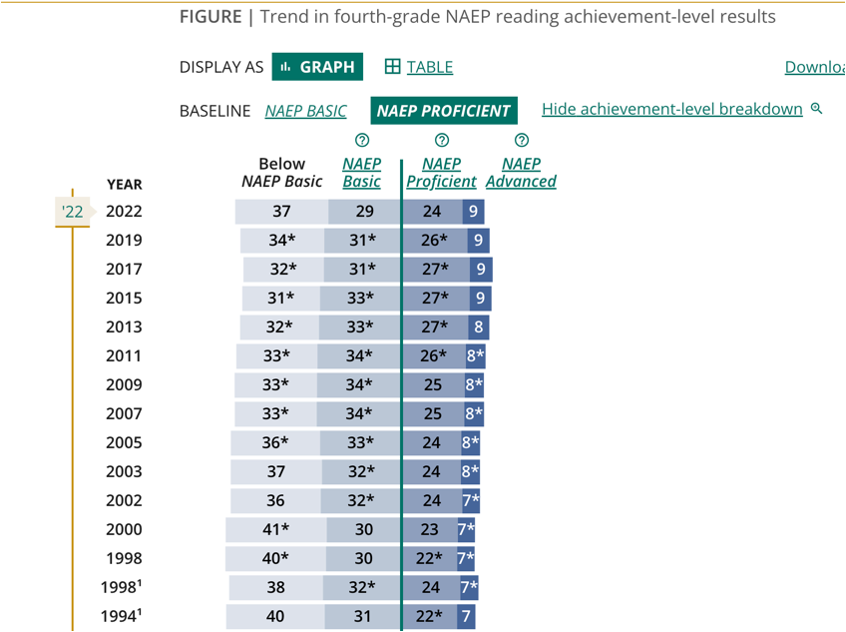
“Basic,” not “proficient,” in NAEP is at grade level; therefore, instead of about 2/3 of students struggling to read, the closer statistic is about 1/3 (and this has been a flat data point for 30+ years, which suggests a norm of reading proficiency and not some recent crisis):
More broadly, the phonics agenda in the Reading War is driven by the same conservative ideology as book bans.

One example is the advocacy of the Gablers in the 1980s, featured in a article in Texas Monthly:

But the Gablers also feel that even those students who learn to read through intensive phonics, memorize their ‘times tables,’ diagram sentences perfectly, and win spelling bees and math contests must still cope with an educational system that is geared to undermining their morals, their individuality, their pride in America, and their faith in God and the free enterprise system. Much of this corrosive work is accomplished through textbooks in history, social sciences, health, and homemaking.

The Gablers also targeted textbooks in their crusade similar to the book bans and misguided attacks on some reading programs:

Norma and Mel Gabler entered the field of textbook reform twenty years ago, after their son Jim came home from school disturbed at discrepancies between the 1954 American history text his eleventh-grade class was using and what his parents had taught him. The Gablers compared his text to history books printed in 1885 and 1921 and discovered differences. “Where can you go to get the truth?” Jim asked.

Since states have been moving toward reading legislation and programs labeled as SOR since around 2012, the evidence is mounting that these misleading and ideological claims of a reading crisis have not (and cannot) deliver on their promises. [1]

But possibly more troubling than the failure to improve student reading proficiency is that these legislative commitments are wasting taxpayers’ money on another baseless Reading War that serves the interests of the education marketplace: “In the first year of implementation, $100 million was allocated for the reform, with $60 million coming from CO VID-19 relief funds. Most of these resources, however, went toward covering the products and services provided by nonprofit and private-sector organizations” (Aydarova, 2023, p. 570).

The market motives behind SOR, in fact, were openly expressed a decade ago in a post by IDA, Structured Literacy: A New Term to Unify Us and Sell What We Do:

At its July 1st meeting, the IDA Board of Directors made a landmark decision designed to help market our approach to reading instruction.  The board chose a name that would encompass all approaches to reading instruction that conform to IDA’s Knowledge and Practice Standards. That name is ‘Structured Literacy.’…

If we want school districts to adopt our approach, we need a name that brings together our successes. We need one name that refers to the many programs that teach reading in the same way. A name is the first and essential step to building a brand….

The term “Structured Literacy” is not designed to replace Orton Gillingham, Multi-Sensory, or other terms in common use. It is an umbrella term designed to describe all of the programs that teach reading in essentially the same way. In our marketing, this term will help us simplify our message and connect our successes. “Structured Literacy” will help us sell what we do so well.

Structured literacy is more a marketing term than a proven way to address the manufactured reading crisis; further, structured literacy accomplishes two outcomes that are counter-educational—de-professionalizing teachers and whitewashing the reading curriculum. [2]

The SOR movement grounded in structured literacy driven by efforts to curb teacher autonomy is being admitted also by the Evidence Advocacy Center, as reported in New Initiative Is Creating Evidence-Based Guidelines for Educators:

In the EAC’s plan for the transformation of the profession into an evidence-based system, educators will relinquish certain freedoms — notably the leeway to employ ineffective practices — but will gain guidance that empowers them to fulfill their original purpose by profoundly impacting the future of students, families and communities. The alternative is to continue rearranging the deck chairs under the guise of education reform.

Since over 75% of public school teachers are women (Report on the Condition of Education 2024), all educators, regardless of content area or grade level, must recognize the threat of “relinquish certain freedoms,” eeriely similar to arguments posed to Handmaid’s in Atwood’s The Handmaid’s Tale:

There is more than one kind of freedom, said Aunt Lydia. Freedom to and freedom from. in the days of anarchy, it was freedom to. Now you are being given freedom from. Don’t underrate it….

We were a society dying, said Aunt Lydia, of too much choice. (pp. 24, 25)

While these efforts are about power and control, the SOR movement includes a harmful pattern of journalists taking on the role of “watchdogs,” as Hanford claims for the Education Writers Association.

Finally, then, the SOR movement is not just another Reading War, and the SOR movement is far more than an immediate concern for beginning reading teachers and teacher educators.

This movement is another threat to teaching as a profession, an organized agenda that seeks ways to de-professionalize teachers while serving market and political goals at the expense of teaching and learning.

Recommended

Betts, E. A., Dolch, E. W., Gates, A. I., Gray, W. S., Horn, E., LaBrant, L., Roberts, H., Smith, D. V., Smith, N. B., & Witty, P. (1942). What shall we do about reading today? A symposium. The Elementary English Review, 19(7), 225–­ 256. https://www.jstor.org/stable/41382636

Thomas, P.L. (2024, March). We teach English in times of perpetual crisis: The long (and tedious) history of reading crisis. English Journal, 113(4), 21-26. https://publicationsncte.org/content/journals/10.58680/ej2024113421

Thomas, P.L. (2024, May). Teaching English in the “science of reading” era: We teach English in times of perpetual crisis: Selling a story of reading. English Journal, 113(5), 16-22. https://publicationsncte.org/content/journals/10.58680/ej2024113516 [Access HERE until open access at EJ]

Thomas, P.L. (2024, September). We teach English in times of perpetual crisis: The media continue to misread teaching reading and literacy. English Journal, 114(1), 14-19. https://publicationsncte.org/content/journals/10.58680/ej2024114114 [Access HERE until open access at EJ]

Thomas, P.L. (2024, November). We teach English in times of perpetual crisis: For all ELA teachers, “the time is always now.” English Journal, 114(2), 21-26. TBD

Thomas, P.L. (2022). The Science of Reading movement: The never-ending debate and the need for a different approach to reading instruction. Boulder, CO: National Education Policy Center. Retrieved [date] from http://nepc.colorado.edu/publication/science-of-reading

Thomas, P.L. (2016). Miracle schools or political scam? In W.J. Mathis & T.M. Trujillo, Learning from the Federal Market-Based Reforms: Lessons for ESSA. Charlotte, NC: IAP.

Lou LaBrant: An Annotated Bibliography

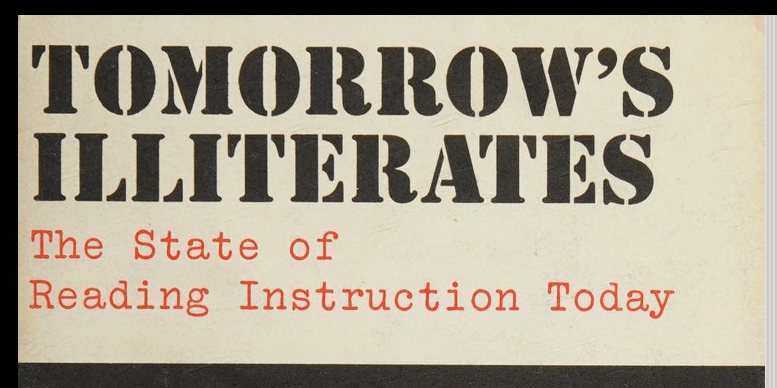
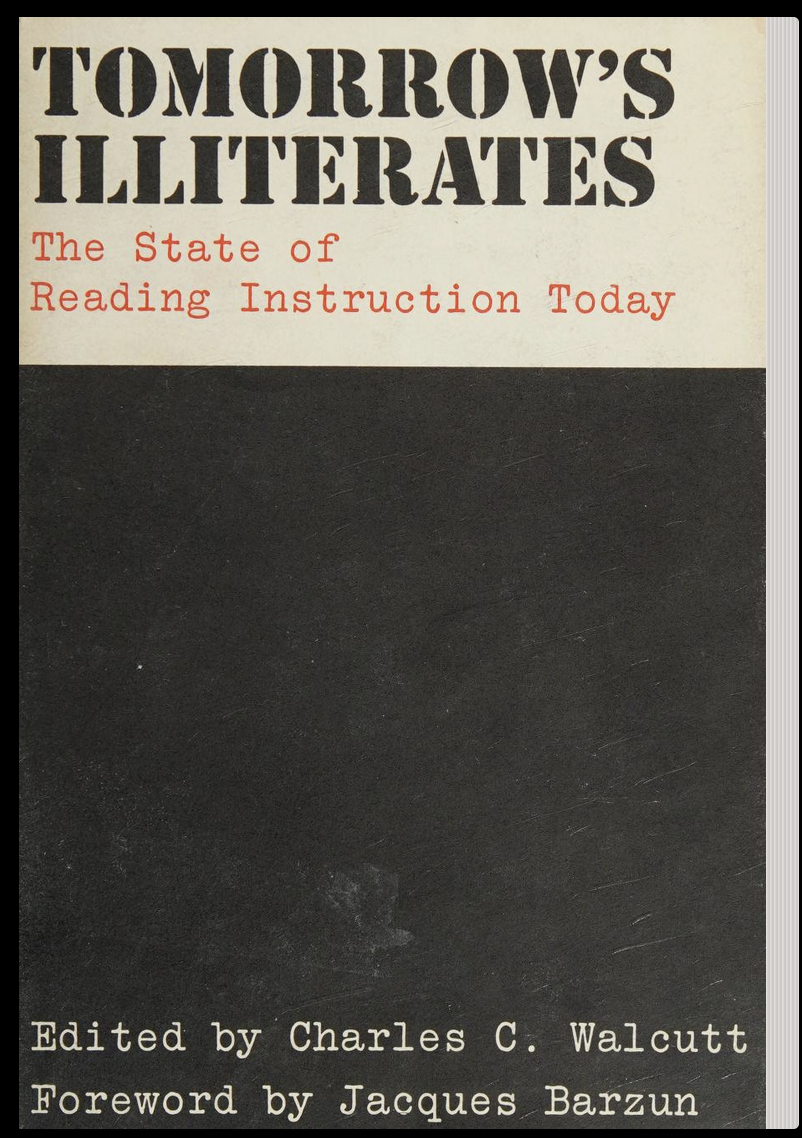
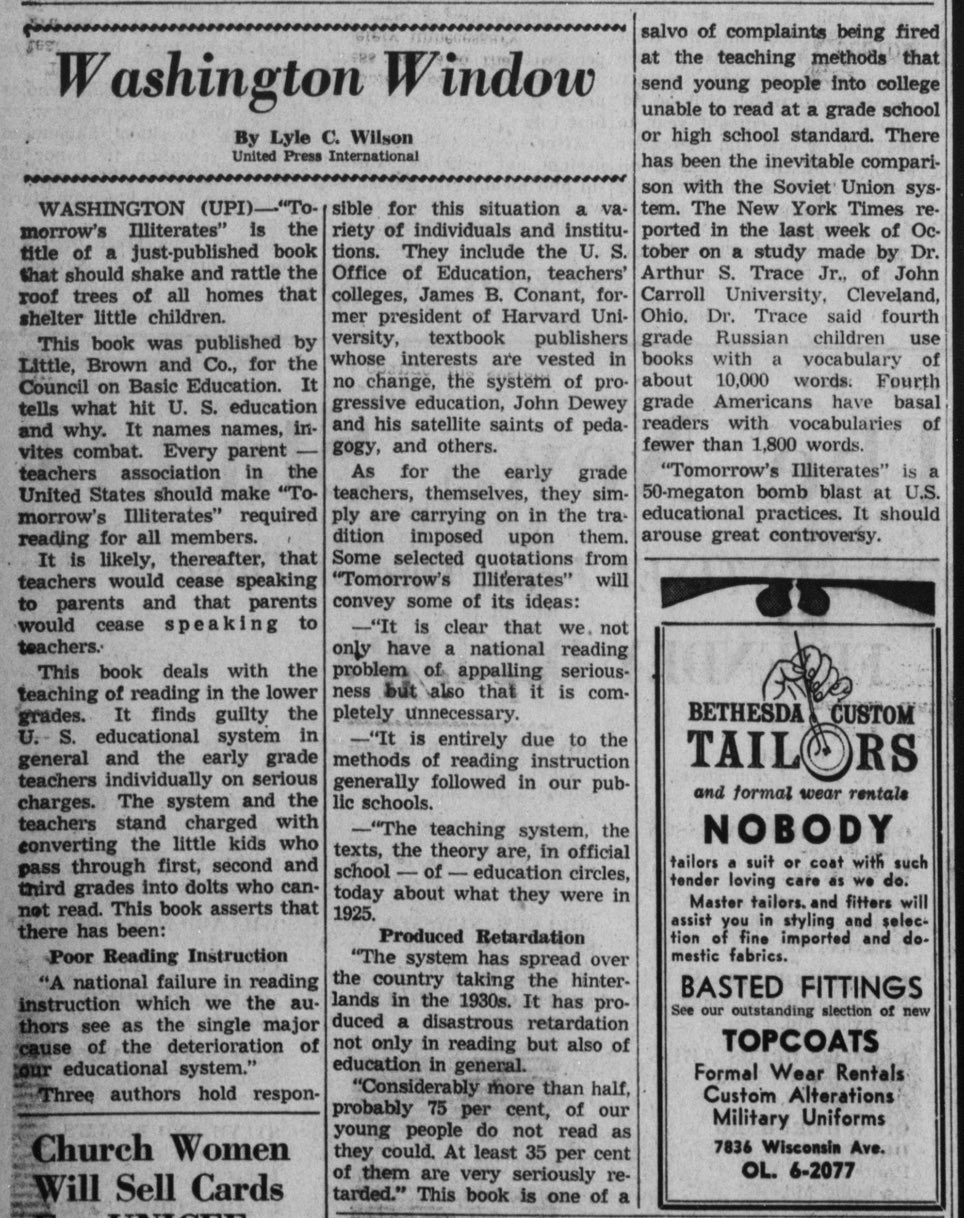
Tomorrow’s Illiterates: The State of Reading Instruction Today, by Walcutt, Charles Child


Notes

[1] See for example:

  • Aydarova, E. (2023). ‘Whatever you want to call it”: Science of reading mythologies in the education reform movement. Harvard Educational Review, 93(4), 556–581, https://doi.org10.17763/1943-5045-93.4.556
  • Chaffin, M., Riesco, H.S., Hacket-Hill, K., Collet, V., Grizzle, M.Y., Y Warren, J. (2023). “Phonics monkeys” and “real life reading”: Heteroglossic views of a state reading initiative. Literacy Research and Instruction, 1–22. https://doi.org10.1080/19388071.2023.2271085
  • Reinking, D., Hruby, G.G., & Risko, V.J. (2023). Legislating phonics: Settle science of political polemic? Teachers College Record. https://doi.org/10.1177/01614681231155688
  • Thomas, P.L. (2022). The Science of Reading movement: The never-ending debate and the need for a different approach to reading instruction. Boulder, CO: National Education Policy Center. http://nepc.colorado.edu/publication/science-of-reading 

[2] See for example:

Reading Crisis 1961: “[N]o Further ‘Research’ into Methods of Reading Is Necessary”

“After half a century of [progressive reform and expanding public education],” wrote Jacques Barzun in Tomorrow’s Illiterates: The State of Reading Instruction Today, “we who run businesses, carry on professions, work for the government, or engage in teaching itself are forced to admit that illiteracy is still with us” (xii-xiii).

This was published in 1961, and the cause of illiteracy Barzun confronts may sound familiar to those of us in the 2020s: “the loss of the proper pedagogy in the lower schools…, the goal of seeing whole words instead of letters” (p. xiii).

Barzun pleads, “the citizen who is interested (and who has managed to learn to read) [may have their] hair [stand] on end at hearing what folly has been condoned as educational theory during the past thirty years” (p. xiv).

Along with Barzuns dismay about how reading was taught and what passed for “reading theory,” he mused at the end of his Introduction: “Shall we need another book like the present one, fifty years hence, about the misdeeds of the new simplifiers?” (p. xvi).

Considering Barzun lived to be 102, dying in 2012, he may have had what little hair remained stand on end to watch the reading crisis return in the 1990s (the national meltdown over whole language) and 2000s (the National Reading Panel era). And if he could have just held on a bit longer, the current “science of reading” (SOR) onslaught that takes its playbook from the very volume that includes Barzun’s hand wringing now some 60-plus years ago.

Despite the authors’ lamentations in this volume (along with others in the 1950s and 1960s that held forth again progressive education and whole word reading instruction), neither the US nor the world collapsed due to misguided reading instruction or theory.

Shouting “reading crisis!” has proven to be more hobby that credible pronouncement, and ironically, if folks would find the time to read a bit (I recommend this book, b the way), it doesn’t take long to see the arguments as mostly nonsense and wild overreactions grounded in ideologies.

Let me show you a few examples beyond Barzun’s smug and sensationalistic Introduction.

Chapter I: The Reading Problem in America, Charles Child Walcutt [click for a selection of screen shots]

Walcutt, editor of the volume and also author of Chapter VII, offers and opening chapter that takes a full swing at announcing a reading crisis as well as casting plenty of blame. Much of the chapter should sound eerie similar to those familiar with Emily Hanford’s journalism and podcast, patterns that pervade the entire volume.

Walcutt starts by showing evidence of claims of a reading crisis (somehow avoiding credible evidence of a reading crisis). This is particularly interesting because of the strong connections made about low literacy, special needs, and what children are suited for higher education and what children should move from high school into the workforce. Of note, Walcutt mentions Samuel Orton (of Orton-Gillingham), but provides no citation, when discussing disability (p. 8)

If nothing else, the certainty exhibited by Walcutt framed against how much of that certainty comes off as deeply misguided, and by today’s standards, offensive and dehumanizing should give all of us pause about our own certainty and blanket claims.

However, note that immediately follow Walcutt’s arguments about low literacy, he immediately shares a single example of a school that excels at teaching reading! Yes, even in the 1960s, there were claims of miracle schools: “In a school of 700 pupils, there are only 20 with reading problems….We cannot stress too positively that fact that in this school every child learns to read independently in the first grade, unless he is mentally retarded [sic] or disabled”—a percentage oddly close to SOR claims that 90, 95, or 96% of students can be proficient readers (pp. 10-11). [Nowhere is terminology such as “independently” defined or linked to how these claims are verified beyond the claims of the school. We also have no demographics on students or how those students compare to a generalized populations of students.]

We should note that these extraordinary claims have no proof, no scientific research—just claims and anecdotes.

Walcutt does launch into a few pages of “facts,” including data mostly grounded in IQ testing. One example is a reference to the 1940s reading crisis based on the draft for WWII; note that this reading crisis was strongly discredited by literacy scholars as a false attack on progressive education.

Walcutt’s facts also criticize popular commercial reading programs (Macmillan) and associate low literacy with delinquency and low IQ.

Then comes the direct blame, which, again, will sound familiar: “One way to describe the reading problem is to say that it is a teacher problem and —even more—that it is a problem of the teaching of teachers” (p. 18).

And of course: “The assertion that the reading experts do not understand the theory of their system can be demonstrated if we point out the false assumptions, the faulty extrapolations from scientific research, and the absolute contradictions that appear in its central propositions and procedures” (pp. 19-20).

Walcutt then discredits the look-and-say method that he claims dominates reading instruction—although we are left simply to trust that the characterization is both fair and as universally applied as he claims.

Walcutt also traces look-and-say back to Horace Mann, although, again, we must trust this analysis is credible.

Embedded here is a big picture characterization-as-criticism:

This says that reading for meaning has supplanted reading for pronunciation, or even word-recognition, and that some teachers teach only reading for meaning (presumably by whole sentences), ignoring phonics completely on the theory that the child who can read for meaning will pick up his phonics incidentally and without special instruction or effort, but he will read for meaning before he can sound out a word” (p. 31).

In the 1990s, this is the same argument leveled against whole language; today, this is the same argument leveled at balanced literacy.

After Walcutt spends a great deal of time metaphorically discrediting the look-and-say method (an extended bird analogy), he ends melodramatically (but not scientifically): “With this rickety equipment the look-and-say bird has flown for more than thirty years, casting a huge shadow over the lives of our children” (p. 43).

Chapter II: The Nature of Reading Skill, John C. Daniels and Hunter Diack [click for a selection of screen shots]

Daniels and Diack start with exploring different definitions for reading, using another analogy (driving a car). Much of the discussion focuses on concerns about reading through whole word methods, leading to the authors noting their own research on reading errors.

Again, they criticisms seem mostly grounded in disagreements with Dewey and Gestalt psychology. This leads to a discussion of new reading primers, which they criticize as lacking and boring because of efforts to identify and use a necessarily limited number of sight words.

As an artifact of the recurring patterns of the Reading War, this chapter highlights the problems with reading programs and primers grounded in narrow theories and philosophies of reading, but it also demonstrates the complexity of the debates in their final paragraph: “But having said this, we must add that, though the unit of accomplished reading is the word, the phrase, or even the sentence, the unit of learning to read is the letter. These are not two contradictory, conflicting aspects of reading; the one agrees with the other. However, present anxieties about the teaching of reading stem from failures to distinguish between, and indeed actually confusing, these two aspects of the reading process” (p. 67).

Ch. III: Reading Readiness in Theory and Practice, Glenn McCracken [click for a selection of screen shots]

McCracken explains that the New Castle Reading Experiment was published in the book, The Right to Learn, and thus, “Its most important contribution to reading is its proof that the ‘reading readiness’ program is both meaningless and harmful” (p. 71).

This chapter includes a claim that seems common across decades: “Today reading specialists have a long list of reasons why about one third of the public school children can’t read” (p. 80). [Note that despite claims by SOR advocates, NAEP reading scores have been fairly flat with about 30% of students below basic, which is below grade level approximately.]

McCracken represents as well the “poverty is an excuse” faction in the Reading War, arguing: “It is folly to blame poor reading on distracting home influences….Children will learn to read if they are taught to read….If they don’t learn to read it is the fault of the teaching, not the taught” (p. 82).

If fact, McCracken continues, “The reading readiness fad as we have described it here was invented to excuse poor reading instruction by shifting the entire blame to the child….Almost every five-year-old child is ready to learn to read the day he enters school if the reading program is ready for him” (pp. 82, 83).

But, alas, “Reading instructional method in this country is abysmally poor, and blaming the matter on the child is never going to provide any improvement” (p. 84).

Ch. IV: The Whole-Word and Word-Guessing Fallacy, Helen R Lowe [click for a selection of screen shots]

Lowe shares an anecdote about a 28-year-old who holds a high school diploma designated with “Honors”; yet, Arthur cannot read.

Of course, such stories have been highlighted throughout the twentieth and into the twenty-first centuries; they are tragic but are none the less anecdotes, proving nothing that can be generalized about how children are taught to read.

Lowe, like the other authors in this volume, has an agenda so as is common in all the eras of the Reading War, their are bait-and-switch tactics, never grounded in valid evidence or claims.

Notable, Lowe recognizes that standardized testing of reading can and was gamed to meet the ways students were taught to read; she accuses reading tests focusing on predicting means that “the best predicters are rated the best readers” (p. 103)

The agenda is to attack, you may be surprised, teaching children to guess at words by using pictures: “How can he learn to read words when he is taught to look and think about pictures?” she ponders (p. 104).

Lowe also mentions Orton (in this volume paired with Gallagher, not Gillingham), again without citation.

Ch. V: Reading: A Therapeutic Tool, Hildred Rawson [click for a selection of screen shots]

Rawson’s chapter demonstrates a few key patterns found in today’s Reading War. First is the tension between teaching reading and how to identify students with special needs such as dyslexia.

Rawson argues that “children with reading disorders are not usually referred to us for examination and treatment until they reach the third grade” because of the look-and-say curriculum.

However, “Children…who have been taught for the first grade…to sound out words—that is, by the phonetic method—approach reading differently. They do not need picture clues” (p. 132).

She calls for phonics-first instruction, and no guessing using pictures, to prevent dyslexia, in fact.

[Ch. VI deals with the claimed link between reading “retardation [sic]” and delinquency.]

Ch. VII: Phonics Systems—Proved and Available, Charles Child Walcutt [click for a selection of screen shots]

Walcutt returns and offers the anchor chapter with the stunning opening line: “We have said that no further ‘research’ into methods of reading instruction is necessary” (p. 141).

The chapter is dedicated to an overview of phonics-based reading programs that, he claims, show that reading research is settled—in 1961.


So here you have essentially the exact same arguments made in 1961 that are being used in the SOR movement.

This is basically a silly book, filled with anecdotes and overstatements. But the SOR movement is no less silly, no less bombastic, and no less futile.

We persist with the same arguments getting us nowhere.

Maybe the problem is the arguments, the silly adult bickering.

Actually, there is no “maybe.”


Tomorrow’s Illiterates: The State of Reading Instruction Today, by Walcutt, Charles Child [click title for access through Internet Archive]

You can access screenshots HERE.


NCTE 2025 Individual Presentation: Recovering Our Reading Dream from a Long Crisis Nightmare

11/21/2025 – 2:45 – 3:15, Mile High Ballroom 1A/1B

Access a PDF of presentation HERE

In 1961, Jacques Barzun in Tomorrow’s Illiterates declared “illiteracy is still with us.” Charles Child Walcutt added: “[N]o further ‘research’ into methods of reading instruction is necessary.” This session examines reading crisis/reform cycles to reconsider the stories told about reading and offer a new approach for reform that serves the needs of students and supports teacher professionalism.

“Hunting Scapegoats”: WWII Literacy Crisis and Current Education Reform

[Header Photo by Christian Chomiak on Unsplash]

“Historians often mention World War II as a time when expectations for schooling and literacy really took off,” explains Deborah Brandt [1], “when what was considered an adequate level of education moved from fourth grade to twelfth grade in a matter of a few years” (p. 485).

National concerns about literacy can be traced to literacy tests for soldiers in WWI, when 25% of recruits were deemed illiterate. While this data appear to have prompted a greater focus on literacy in U.S. public schools, WWII data on literacy again suggested far too many people in the U.S. struggled with basic literacy. As Brandt notes:

Even more profoundly, though, World War II changed the rationale for mass literacy. Literacy was irrevocably transformed from a nineteenth-century moral imperative into a twentieth-century production imperative—transformed from an attribute of a “good” individual into an individual “good,” a resource or raw material vital to national security and global competition. In the process, literacy was turned into something extractable, something measurable, some-thing rentable, and thereby something worthy of rational investment. (p. 485)

From the early to mid-twentieth century, then, a powerful dynamic was created among racial integration, military-based measurement of IQ and literacy, and changing expectations for public education.

Brandt sees those relationships in current education reform ideologies and claims:

We can find eerie parallels between the selective service system of the mid-twentieth century and the public educational system of the early twenty-first century. There is the atmosphere of high anxiety around literacy, rapidly changing standards, an imposition of those standards onto more and more people, a search (largely futile) for reliable testing, a context of quick technological development, a heightened concern for world dominance, and a linking of literacy with national security, productivity, and total quality control. This is what happens when literacy links up with competition, with the need to win the war. It is this competition that justifies the strip mining of literacy, the ranking of skill, the expendability of human potential, and the production of just-in-time literacy. It is the blueprint for the Knowledge Economy. (p. 499)

Calls of a literacy crisis during WWII are roots of similar cries of education crisis spanning from the early 1980s until today. And throughout either era, the complexities of the problems are ignored in order to force agendas that have less to do with education than with serving larger social and political goals—often ones benefitting the privileged at the expense of the impoverished and marginalized.

In 1942, Lou LaBrant confronted the misleading conclusions drawn about low literacy rates among WWII draftees:

The induction of American youth into the armed forces, and the attendant examinations and classifications have called attention to a matter long of concern to those who teach reading or who are devoted to the cause of democracy: the fact that in a land which purports to offer universal education we have a considerable number of youth who cannot read intelligently. We are disturbed now because we want these men to be able to read military directions, and they cannot. A greater tragedy is that they are and have been unable to read with sufficient understanding to be constructive peace-time citizens.

As is to be expected, immediate explanations have been forthcoming, and immediate pointing-of-fingers has begun. Most of the explanations and pointing have come from those who have had least to do with teaching reading, and who are least conversant with the real problem. Moreover, as is again to be expected, the diagnosis is frequently in terms of prejudice or pet complaint, and could be used in other situations as logically. Many are hunting scapegoats; there are scores of “I-told-you-so’s.” It is best to look at the situation critically. (p. 240)

LaBrant recognized, as a teacher and scholar of literacy, that public blame for the low literacy rates suffered from both a lack of expertise about literacy and a number of complicating factors. For example, the standard for literacy changed from generation to generation, and WWII experienced an expanded pool of recruits due to integration, which of course included African Americans and impoverished men who had been systematically denied educational opportunities.

The political and public response to low literacy rates among the military in WWII included blaming progressive education and calling for a back-to-basics focus, as LaBrant addressed:

Within the past ten years we have made great strides in the teaching of purposeful reading, reading for understanding (the kind of reading, incidentally, which the army and navy want) . Nevertheless, we hear many persons saying that the present group of near-illiterates are results of “new methods,” “progressive schools,” or any deviation from the old mechanical procedures. They say we must return to drill and formal reciting from a text book. (p. 240)

The pattern identified by LaBrant foreshadows the rise of high-quality writing instruction in the 1970s-1980s that was blunted by the accountability era’s focus on standards and high-stakes testing.

But, as LaBrant outlined, public and political blame placed on progressivism was misguided, and ultimately misleading:

Before we jump to such an absurd conclusion, let’s take a minute to think of a few things:

1. Not many men in the army now have been taught by these newer methods. Those few come for the most part from private or highly privileged schools, are among those who have completed high school or college, and have no difficulty with reading.

2. While so-called “progressive” schools may have their limitations, and certainly do allow their pupils to progress at varied rates, above the second grade their pupils consistently show superior ability in reading. Indeed, the most eager critics have complained that these children read everything they can find, and consequently do not concentrate on a few facts. Abundant data now testify to the superior results of purposeful, individualized reading programs.

3. The reading skills required by the military leaders are relatively simple, and cause no problem for normal persons who have remained in school until they are fourteen or fifteen. Unfortunately the large group of non-readers are drop-outs, who have not completed elementary school, come from poorly taught and poorly equipped schools, and actually represent the most conservative and back- ward teaching in the United States. (pp. 240-241)

Again, consider the pattern: Implement new and developing tests (literacy tests during WWII), identify a problem related to education, create a scapegoat, and then call for a return to traditional drill-based education. Does this sound familiar?

Now add what was not being addressed in 1942, as detailed by LaBrant:

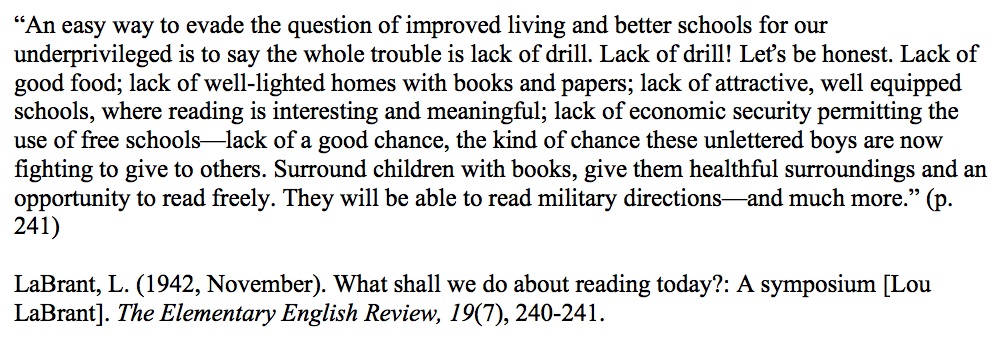
An easy way to evade the question of improved living and better schools for our underprivileged is to say the whole trouble is lack of drill. Lack of drill! Leťs be honest. Lack of good food; lack of well-lighted homes with books and papers; lack of attractive, well equipped schools, where reading is interesting and meaningful; lack of economic security permitting the use of free schools—lack of a good chance, the kind of chance these unlettered boys are now fighting to give to others. Surround children with books, give them healthful surroundings and an opportunity to read freely. They will be able to read military directions—and much more. (p. 241)

Seven-plus decades ago, public and political outrage was willing to attack a straw man, a scapegoat—progressive education—but was unwilling to confront inequity, poverty, and the linger scar of racial segregation.

Again, sound familiar?

Note

[1] Brandt, D. (2004). Drafting U.S. Literacy. College English, 66(5), 485–502. https://doi.org/10.2307/4140731 [https://www.jstor.org/stable/4140731]

Lack 1942

Recommended: Whose Knowledge Counts in Government Literacy Policies?

Especially in the context of President Barack Obama’s education agenda—one that builds on the failed No Child Left Behind template begun under President George W. Bush—and against claims that teachers must earn their place at the education reform agenda,  Whose Knowledge Counts in Government Literacy Policies? (Routledge, 2014)—edited by Kenneth S. Goodman, Robert C. Calfee, and Yetta M. Goodman—is both a powerful and needed collection that confronts “the political determination of school knowledge in the field of literacy instruction” (p. xv).

Calfee’s introduction subtitle gets right to the issue: “How the Federal Government Used Science to Take Over Public Schools.” But the entire collection offers a solid case for rejecting thirty-plus years of inexpert accountability and seeking instead the voices and expertise of the field of literacy to drive education policy.

I highly recommend reading and sharing this volume widely.

Table of Contents

Foreword: Joel Spring

Acknowledgments

Chapter 1: Introduction: Knowledge, Evidence, and Faith: How the Federal Government Used Science to Take Over Public Schools, Robert Calfee

Part 1: The Political Realties

Chapter 2: Whose Knowledge Counts? The Pedagogy of the Absurd, Kenneth S. Goodman

Chapter 3: Re-reading Poverty; Reorienting Educational Policy, Patrick Shannon

Chapter 4: Neoliberal and Neoconservative Literacy Education Policies in Contemporary France, Jacques Fijalkow

Chapter 5: Flying Blind: Government Policy on the Teaching of Reading in England and Research on Effective Literacy Education, Henrietta Dombey

Chapter 6: Whose Knowledge Counts, For Whom, In What Circumstances?: The Ethical Constraints on Who Decides, Sue Ellis

Chapter 7: About the Dubious Role of Phonological Awareness in the Discussion of Literacy Policies, Renate Valtin

Part 2: Aspects of Literacy: The Knowledge Base

Chapter 8: The Role of Story and Literature in a World of Tests and Standards, Kathy G. Short

Chapter 9: The Staircase Curriculum: Whole-School Collaboration to Improve Literacy Achievement, Kathryn H. Au and Taffy E. Raphael

Chapter 10: Diversity in Children’s Literature: What Does It Matter in Today’s Educational Climate? Rudine Sims Bishop

Chapter 11: Examining Three Assumptions about Text Complexity: Standard 10 of the Common Core State Standards, Elfrieda H. Hiebert and Katie Van Sluys

Chapter 12: The Role of Literature and Literary Reasoning in English Language Arts and English Classrooms, Judith A. Langer

Chapter 13: Writing Teachers: The Roles Exploration, Evaluation, and Time Play in Their Lives, Jane Hansen

Chapter 14: What Do Children Need to Succeed in Early Literacy—And Beyond? William H. Teale, Jessica L. Hoffman, and Kathleen A. Paciga

Chapter 15: The Impact of Changing Conceptions of Language on Curriculum and Instruction of Literacy and the Language Arts, David Bloome and Melissa Wilson,

Comments: Nu!…. So!… Where do We Go from Here? Yetta M. Goodman

List of Contributors