
“No, no. You’ve got something the test and machines will never be able to measure: you’re artistic. That’s one of the tragedies of our times, that no machine has ever been built that can recognize that quality, appreciate it, foster it, sympathize with it.”
Paul Proteus to his wife Anita in Kurt Vonnegut’s Player Piano
“So much depends upon a red wheel barrow glazed with rain water beside the white chickens” is, essentially, a grammatical sentence in the English language. While the syntax is somewhat out of the norm, the diction is accessible to small children—the hardest word likely being “depends.” But “The Red Wheelbarrow” by William Carlos Williams is much more than a sentence; it is a poem:
so much depends
upona red wheel
barrowglazed with rain
waterbeside the white
chickens.
A relatively simple English language sentence shaped into purposeful lines and stanzas becomes poetry. And like Langston Hughes’s “Harlem” and Gwendolyn Brooks’s “We Real Cool,” it sparks in me a profoundly important response each time I read these poems: [Expletive], I wish I had written that.
It is the same awe and wonder that I felt as a shy and deeply self-conscious teenager when I bought, collected, and read comic books, marveling at the artwork I wish I had drawn.
•
Will we soon wake one morning to find the carcasses of poems washed up on the beach by the tsunami of the Common Core?
That question, especially during National Poetry Month, now haunts me more every day, notably because of the double-impending doom augured by the Common Core: the rise of nonfiction (and the concurrent erasing of poetry and fiction) from the ELA curriculum and the mantra-of-the-moment, “close reading” (the sheep’s clothing for that familiar old wolf New Criticism):
It seems we have come to a moment in the history of the US when we no longer even pretend to care about that which is the result of the human heart: Art.
And poetry, I contend, is the most human of the arts because—although it is quite challenging often to distinguish humans from other mammals—we have two attributes that do set us apart: our too-big brains and our faculty for language.
Poetry is the very human effort to utter order out of chaos, meaning out of the meaningless: “Daddy, daddy, you bastard, I’m through” (Sylvia Plath, “Daddy”).
•
The course was Speech, taught by Mr. Brannon. I was a freshman at a junior college just 15-20 miles from my home, the college my parents had attended when they first fell in love and married secretly.
Despite the college’s close proximity to my home, my father insisted that I live on campus. But that class and those first two years of college were more than living on campus; they were the essential beginning of my life.
In one of the earliest classes, Mr. Brannon read aloud and gave us a copy of “[in Just-]” by e. e. cummings. I imagine that moment was, for me, what many people describe as a religious experience.
That was more than thirty years ago, but I have two precious books still that followed from that day in class: cummings’s Complete Poems and Selected Poems:
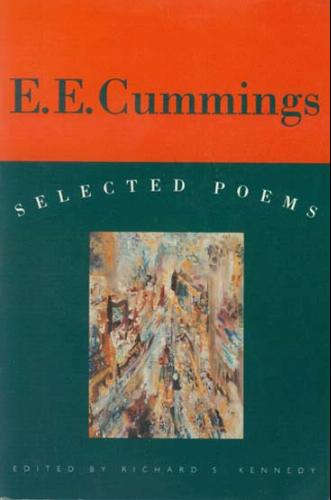
Several years later, Emily Dickinson‘s Complete Poems would join my commitment to reading every poem by those poets who made me respond over and over: [Expletive], I wish I had written that.
But that introduction to cummings was more than a young and insecure man finding the poets he wanted to read; it was when I realized I am a poet.
Now, when the words “j was young&happy” come to me, I know there is work to do—I recognize the gift of poetry.
•
As a high school English teacher, I divided my academic year into quarters by genre/form: nonfiction, poetry, short fiction, and novels/ plays. The poetry quarter, when announced to students, initially received moans and even direct complaints: “I hate poetry.”
To be honest, that always broke my heart, crushed my soul. Life and school had already taken something very precious from these young people:
children guessed(but only a fewand down they forgot as up they grew (“[anyone lived in a pretty how town],” e.e. cummings)
Gradually and then always, I taught poetry in conjunction with popular songs. Although my students in rural South Carolina were overwhelmingly country music fans, I focused my nine weeks of poetry on the songs of alternative group R.E.M.
For the record, that too elicited moans from students in those early days of exploring poetry (see that unit now on the blog “There’s time to teach”).
Concurrently, throughout my high school teaching career, students always gathered in my room during our long mid-morning break and lunch (much to the chagrin of administration). And almost always, we played music.
The epitome of that unspoken norm of my classroom was two students who, after I introduced them to The Violent Femmes, would close my door in order to dance and sing along with their songs.
Many of those students are in their 30s and 40s, but it is common for them to contact me—often on Facebook—and recall fondly R.E.M. and our poetry unit. Those days and years meant something to them that lingers, that matters in ways that cannot be measured.
I can still see and hear those two students dancing, singing, and laughing. It was an oasis of happiness in their days at school, an oasis of happiness in their lives.
•
e.e. cummings begins “since feeling is first,” and then adds:
my blood approves,
and kisses are better fate
than wisdom
lady i swear by all flowers. Don’t cry
—the best gesture of my brain is less than
your eyelids’ flutter….
And each year when my students and I examined this poem, we would discuss that cummings—in Andrew Marvell fashion—offers an argument that is profoundly unlike what parents, teachers, preachers, and politicians claim.
So I often paired this poem with Coldplay’s “The Scientist,” focusing on:
I was just guessing at numbers and figures
Pulling your puzzles apart
Questions of science, science and progress
Do not speak as loud as my heart
Especially for teenagers, this question, this tension between heart and mind, mattered. Just as it recurs in the words of poets and musicians over decades, centuries.
Poetry, as with all art, is the expressed heart—that human quest to rise above our corporeal humanness:
•
I have loved a few people intensely. So deeply that my love, I believe, resides permanently in my bones. If you read my poetry, you will recognize that motif, I am sure.
One such love is my daughter, and she now carries the next human who will add to that ache of being fully human—loving another beyond words.
And that, I contend, is poetry.
Poetry is not identifying iambic pentameter on a poetry test or discussing the nuances of enjambment in an analysis of a Dickinson poem.
Poems are not fodder for close reading.
Poetry is the ineluctable “Oh my heart” that comes from living fully in the moment of being human, the moment that draws us to words as well as inspires us toward words.
We read a poem, we listen to a song, and our hearts rise out of our eyes as tears.
That is poetry.
And like the picture books of our childhood, poetry must be a part of our learning, essential to our school days—each poem an oasis of happiness that “machines will never be able to measure.”
•
Will we soon wake one morning to find the carcasses of poems washed up on the beach by the tsunami of the Common Core?
Maybe the doomsayers are wrong, and maybe, just maybe, poetry will not be erased from our classrooms.
School with less poetry is school with less heart. School with no poetry is school with no heart.
Both are tragic mistakes because if school needs anything, it is more heart. And poetry? Oh my heart.
—
See Also
The Dying of the Light: How Common Core Damages Poetry Instruction
No Place for Poetry on My Son’s Common Core ELA Test
NOTE: This post was drafted in the wake of driving to work while listening to Coldplay’s A Rush of Blood to the Head. Or to be perfectly honest, while singing loudly along with each song and occasionally crying. There. So keep that in mind.


 dr. p.l. (paul) thomas