
Tag Archives: Nikki Haley

Twitter Truth (and The Onion Gets It Again)

As I have catalogued on this blog and elsewhere, when it comes to education policy, my home state of South Carolina is A Heaping Stumbling-Bumbling Mess of Ineptitude.

And while we have garnered a sort of unwanted but fully warranted 15 minutes of fame by being the repeated source of ridicule for The Daily Show, SC has now achieved what I am calling Twitter Truth through the actions of Governor Nikki Haley, as reported at The Huffington Post:

South Carolina Gov. Nikki Haley (R) wanted to tout her state’s education reform plan Monday — but it all went horribly wrong.

Here’s what Haley tweeted about the plan:

nikki haley tweet

Haley, or whichever member of her staff posted the tweet, was the victim of Twitter’s 140 character limit. An Instagram photo caption longer than 140 characters in length is cut off mid-sentence, followed by a link to the original post. The full caption makes much more sense than the above tweet:

nikki haley instagram post

The tweet was deleted a few hours after it was posted.

If we put Tweet 1 (clipped by Twitter Truth) together with Tweet 2, we find that Tweet 1 actually makes an accurate commentary on how SC continues to plow the wrong road in our claimed quest for educating the children of SC, a large percentage of whom are living in poverty and suffering the burdens of their racial and language minority statuses.

For the record, “reading coaches” masks that SC has adopted 3rd-grade retention policy based on high-stakes testing, “technology investments” ignores SC’s high poverty rate and that the state needs to invest in hundreds of areas other than making technology vendors wealthy, and “charter schools” fails to note that SC charter schools, as is the case across the U.S., perform about the same and worse than public schools while contributing to the rise in re-segregation.

And with charter schools in mind, let’s be sure to give The Onion its due, once again; this time for New Charter School Lottery System Gives Each Applicant White Pill, Enrolls Whoever Left Standing:

NEW YORK—Introducing key changes to the lottery system that governs the admissions process, the New York City Charter School Center notified potential students this week that openings will now be filled by randomly distributing white pills to applicants and enrolling those left standing.

In place of the existing electronic lottery system conducted in the spring, education officials explained that applicants would receive identical white pills, among them a small number of innocuous placebos corresponding to the amount of open spots, and then wait approximately 30 minutes to determine the survivors and new charter school enrollees.

“With so many deserving students competing for so few spots in the city’s network of high-performing, tuition-free charter schools, our new lottery system ensures that each student is provided with an equal opportunity,” said Eva Moskowitz, the head of the Success Academy chain of 22 charter schools, while mixing up a tub of 118 sugar pills and 2,376 pentobarbital capsules to be blindly administered in an upcoming lottery. “Between small class sizes, longer school days, individualized instruction, and superior college admission rates, charters provide amazing opportunities for students who don’t enter a convulsive state, fall into a coma, stop breathing, and cease all bodily functions during the admissions process.” (emphasis added)

“Of course it’s heartbreaking for the families of children who aren’t accepted,” Moskowitz continued, “But seeing the look on parents’ faces when their child is still standing in a room littered with rejected applicants is priceless. They know their child is going to get the best possible education.” [1]

Administrators told reporters that the new quick and relatively painless lottery system is a welcome alternative to the notoriously long and emotional computerized drawings of past years, where all applicants received a random number and were subjected to waiting for many hours before learning whether they would attend a charter school or return to an inferior public school.

Officials confirmed that the innovative selection process has already proved a success, though not without its minor setbacks, in areas of the country where it has already been implemented.

“This year we’re making the pills a little stronger because not all the candidates were weeded out right away,” said Tim Bernard of Thrive Academy in Washington, D.C., a public charter that had 200 elementary school students apply for eight open spots last year. “Some kids would seem fine, we’d extend them an official offer of admission, and then a few days later they’d start hallucinating or slurring their speech. Meanwhile parents are scared sick we’re going to rescind their kids’ offers because too many applicants survived.”

“Luckily, we worked out all the kinks for this year,” Bernard added. “The body removal crews are already assembled outside the auditoriums and ready to go.”

Though charter school officials maintained that the new admissions process is designed fairly, critics claimed many affluent parents have already found ways to exploit the system. For example, after a lottery in Los Angeles ended with a high number of living students, officials discovered that parents had been building up their children’s immunity to the pills by giving them small doses of poison each day, or had hired tutors to help them train their bodies to overcome the effects of the pills. (emphasis added) [2]

Despite these flaws, many parents said they have no doubts about trying to get their child into a charter.

“I went through charter school admissions with my oldest son last year, but after he died I wondered whether it was even worth it to try again with my other kids,” Hoboken, NJ mother Jane Schaal told reporters. “But then my younger daughter got into Achievement First and I knew we made the right decision. There was no way she was going to succeed in public school.”

“Next year we’ll try to get my youngest son into a good elementary school,” Schaal added. “He’s not in kindergarten yet, but even if he’s not accepted to a top-notch charter, it’s a relief knowing that his future will be set.”

This should be really funny, but as with many of their other satires, this piece comes disturbingly close to everything that is wrong with charter schools driven by market forces—a commitment done to children and their families, a process that sacrifices children in very real ways.

[1] Why Sending Your Child to a Charter School Hurts Other Children

[2] Endgame: Disaster Capitalism, New Orleans, and the Charter Scam:

And even in Layton’s own article, we discover the dark truth beneath the polished sheen of charter school advocacy:

“White students disproportionately attend the best charter schools, while the worst are almost exclusively populated by African American students. Activists in New Orleans joined with others in Detroit and Newark last month to file a federal civil rights complaint, alleging that the city’s best-performing schools have admissions policies that exclude African American children. Those schools are overseen by the separate Orleans Parish School Board, and they don’t participate in OneApp, the city’s centralized school enrollment lottery.”
Unions? We Don’t Need No Stinking Unions

I have lived and worked always in the state of South Carolina.

SC is a high-poverty state (see here and here) with a racially diverse population (ranked 12th highest). And, like many comparable states across the Deep South, SC is a right to work state.

Combined, these characteristics of my home state confirm, I think, my claim about the self-defeating South. However, when it comes to the Great American Worker, the entire U.S. shares that self-defeating nature.

Often that self-defeating quality is represented by political and public attitudes—antagonistic and aggressive—toward workers’ unions.

Current SC governor, Nikki Haley, who is now running for re-election, has taken a seemingly unnecessary stand against unions:

South Carolina Gov. Nikki Haley didn’t mince words when she spoke about unions at an automotive conference in Greenville this week. The state loves its manufacturing jobs from BMW, Michelin and Boeing and welcomes more, she explained, but not if they’re bringing a unionized workforce with them.

“It’s not something we want to see happen,” she told The Greenville News.“ We discourage any companies that have unions from wanting to come to South Carolina because we don’t want to taint the water.”…

She also warned auto industry executives at the conference to keep their guards up. “They’re coming into South Carolina. They’re trying,” Haley said. “We’re hearing it. The good news is it’s not working.”

“You’ve heard me say many times I wear heels. It’s not for a fashion statement,” she continued. “It’s because we’re kicking them every day, and we’ll continue to kick them.”

And a reader’s letter in The Greenville News represents how the public in SC feels about unions as well as Haley’s stance, arguing in part:

What would happen if unions made an inroad into the Upstate? They would start organizing like mad to try to increase their strength. As more and more employers started having to deal with union demands by raising wages and adding costly benefits, they would need to increase the costs of their products and services. The cost of living would go up for everybody.

I think Gov. Nikki Haley has the right idea.

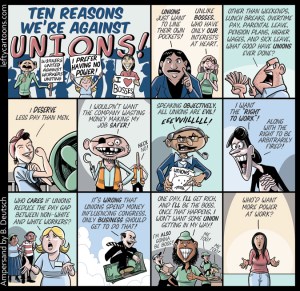
This reader’s letter as well as the apparent lack of awareness about its self-defeating perspective is perfectly satirized in this cartoon:

Ten Reasons We’re Against Unions! by Barry Deutsch
Ten Reasons We’re Against Unions! by Barry Deutsch [click to enlarge original link]
While SC political leaders and the public are drawing a line in the sand about unions intruding in the state, Northwestern college football athletes, led by quarterback Kain Colter, have taken unprecedented action to unionize, as Strauss and Eder detail:

A regional director of the National Labor Relations Board ruled Wednesday that a group of Northwestern football players were employees of the university and have the right to form a union and bargain collectively.

For decades, the major college sports have functioned on the bedrock principle of the student-athlete, with players receiving scholarships to pay for their education in exchange for their hours of practicing and competing for their university. But Peter Ohr, the regional N.L.R.B. director, tore down that familiar construct in a 24-page decision.

He ruled that Northwestern’s scholarship football players should be eligible to form a union based on a number of factors, including the time they devote to football (as many as 50 hours some weeks), the control exerted by coaches and their scholarships, which Mr. Ohr deemed a contract for compensation.

“It cannot be said that the employer’s scholarship players are ‘primarily students,’ ” the decision said.

How the public responds across the U.S. to college athletes unionizing must be framed against patterns over the last decade that include a disturbing cultural attitude toward workers, notably against teachers’ unions, tenure, and striking (see the 2012 Chicago strike for example).

Examining how workers are portrayed in the media, how workers are valued (or not) in the U.S., and the prospect of becoming a worker for graduate students, I have framed being a worker within the rise of disaster capitalism and concluded:

Finally, in the wake of disaster capitalism in New Orleans and Oregon, pop culture, specifically The Big Bang Theory, is a crucible of not only the role of workers in the U.S. but also the attitudes about the worker that series highlights. Penny, the stereotypical “girl next door,” is the object of an on-going, clichéd joke of a waitress who longs to be an actress. The larger and central jokes of the series, however, are the four academics living across the hall from Penny. It seems in this TV world, all work is funny.

What a TV sit-com never addresses, however, is that in the real world, the gap between Penny as waitress and college professors is shrinking, or better phrased, merging. The state of the American worker is beginning to share with waitressing some disturbing characteristics that cheapen all workers. As Greider (2013) details about the restaurant industry, workers of all types are becoming less often protected by unions, receiving fewer or no benefits (paid sick days, vacation days, health insurance, retirement) with their positions, being paid less than previous generations, and generally suffering under a dynamic whereby the businesses have more or all of the power in the business-worker relationship.

In the real world, Penny and one of the academics, Leonard, would not be wrestling over the education gap between them, but would be sharing the consequences of part-time work in a hostile economy toward workers regardless of those workers’ qualifications since Leonard would be an adjunct (like Professor Beth) while Penny would remain a waitress—and both would be unsatisfied as workers because their situations do not live up to their ideals.

Yet, most Americans will always be workers, and to be a worker should be an honorable thing worthy of poetic speeches and artistic black-and-white film tributes. Being an American worker doesn’t need to be a condition tolerated on the way to something better, and it shouldn’t be twenty-first century wage-slavery that is a reality echoed in the allegory of SF: “one fine day, a purely predatory world shall consume itself.” As the last paragraphs of Cloud Atlas express, however, the wage-slavery of workers in the context of assembly-line and disaster capitalism is a condition Americans have chosen (or at least been conditioned to choose), but it is also a condition workers can change—if workers believe it is wrong, “such a world will come to pass.” (Academia and the American Worker: Right to Work in an Era of Disaster Capitalism?, pp. 21-22)

A question that remained with me as I drafted the piece above is just why the majority state of people in the U.S.—being a worker—does not inform the pervasive antagonistic attitude toward workers. The public in the U.S. appears just as self-defeating as the South when we are confronted with workers’ rights and collective workers’ voices.

The opportunity before us with the possibility that college athletes may unionize and transform not only their circumstances but also all of college athletics has a less appealing parallel for me, however: The tension between the NFL players’ union and NFL owners in 2011 and how the public responded to that unionization when compared to the rising calls to end teachers’ unions and tenure.

American disdain for unions is grounded in a traditional faith in rugged individualism, but it also seems linked to a good degree of self-loathing informed by a cultural worshipping of the wealthy and famous.

Stated directly and without the political baggage of the term “union,” what are the problems with due process and academic freedom (the central elements of tenure for teachers secured by unionization)? Who prospers from workers without full benefits, strong wages, and safe working conditions? Who maintains control when workers do not have equitable voices in their work and compensation?

Writing about the term “totalitarian,” Ta-Nehisi Coates confronts the power of words (to which I would add “union”):

Words exist within the realm of politics. In politics, words are sometimes perverted by the speaker. It’s worth considering which words come under attack for perversion (“racist,” “homophobe,” “bigot”) and which do not (“democratic,” “bipartisan,” “anti-American”). I am always skeptical of people who seek to curtail their use, instead of interrogating their specific usage. Some people really are racists, and other people really are misogynists, and others still actually are homophobes. Instead of prohibiting words, I’d rather better understand their meaning.

Some people demonizing unions and unionization really are being self-serving, really are seeking ways that workers can be treated as interchangeable widgets (not unlike college athletes) while the owners reap a disproportionate profit on their backs, sweat, and labor (consider how Walmart has sought to bust unions and reduce their workforce to part-time without benefits, resulting in those workers often being on welfare).

Ultimately, Coates comes to workers in the totalitarian state:

But the central idea—that the communist party, and thus the central committee, and thus the politburo was the sole representative of workers—has a chilling moral closure. Who could be against the workers? And if the party is the true representative of the workers, why do we need other parties?

I must echo: Who could be against the workers?

That haunts me, baffles me, leaves me cynical because of all the qualities that divide people in the U.S.—race, class, religion, sexuality, gender—that almost all of us are and always will be workers—a state that should be something of honor and dignity—is the one quality that should unite us.

College athletics stand before the entire U.S. as the crucible of a few benefitting on the backs of many—many without a voice. And that crucible also reveals to us the potential power of a collective voice, an acknowledged voice among the majority who do the labor that generates the profits.

As Coates warns, “words are sometimes perverted by the speaker.”

“Union” is one such word, and when it is spoken by those in power, be certain the motivation is not in the best interests of the workers.

There would be no billionaires today without workers. In fact, powerless workers are nearly essential for maintaining the inequitable state of the U.S. in which billionaires thrive while more and more workers become trapped in multiple part-time jobs, absent benefits or job security.

The Northwestern college football players have my solidarity, but I also wonder why we all are not seeking that same solidarity among every worker in the U.S., a solidarity that could attain the American Dream that has been perverted into an American Winter:

In case it’s not clear, “American Winter” comes from a specifc, biased and unapologetic viewpoint, but it’s also the kind of argument that’s needed right now. Watching the 50 year old John, 3 years unemployed and father to a young son with Down’s Syndrome, weep on camera because he had to borrow money from his parents to pay the electric bill, it’s bracing and raw. When Paula goes to the food bank for the first time, and is overwhelmed by the fact that her situation has forced her to take such measures or when single mom Jeanette tries make a promise to her young son Gunner that they will find a place to live, it puts a new perspective on those who are traditionally associated/stereotyped as being on social services. Everyone in “American Winter” has been working, are raising families, and doing everything they can (Dierdre gives blood and goes scrapping on weekends just for extra money) to make ends meet. They are not the vultures of the system that certain political segments like to paint as living on taxpayer money. (Review: ‘American Winter’ A Devastating Portrait Of The Erosion Of The Middle Class)

That recovered American Dream could be built on workers unionized for the right to work—the right to work for wages that dignify their work and their lives, the right to work as a part of their right to live fully and freely, the right to work in a physically and psychologically safe environment, the “right to work” not perverted by a political elite bragging about using high-heeled shoes as the boot on the throat of the Great American Worker.

See Related

Remembering Howard Zinn by Meditating on Teacher Unions and Tenure?

[NOTE: The title is an allusion to a line from Blazing Saddles.]

Should SC Ditch Common Core?

Reporting at Education Week, Andrew Ujifusa notes:

In a clear signal that the Common Core State Standards are in hot water in South Carolina, Gov. Nikki Haley told a meeting of a local Republican Party women’s club that she was determined to ditch the standards this year because, she said, “We don’t ever want to educate South Carolina children like they educate California children.”

In response to the article and one comment, I posted (with edits and additions):

SC is a high-poverty state (bottom quarter, around 10th most impoverished), and thus, historically and currently, people incorrectly use metrics that reflect that poverty to bash the state as having “bad” education. [SC has a poverty problem, reflected in our schools.]

Should SC dump CC? Of course, as all states should.

But as is typical, political leaders have all the wrong reasons (Haley playing to her rightwing, Tea Party base in the state).

In a high-poverty state such as SC—that will now be on our 4th iteration of standards and testing (none of which have “worked” apparently)—the incredible COST of implementing CC and the new tests is unpardonable.

Dump CC, SC, but do so as a commitment to being better stewards of public funds and as a shift to addressing the poverty scar that plagues the state, the children, and the schools.

Haley is in candidate mode, and she has chosen education as a key focus of her reelection campaign, possibly as a pre-emptive strike against her democratic opponent. This stand against CC is mis-guided in the reasons, but remains the right action in SC.

The irony of Haley’s comments lies in her swipe at California: “‘We don’t ever want to educate South Carolina children like they educate California children.'” While Haley is triggering the conservative caricature of the “left coast,” within her populist bating is a kernel of truth.

California has dedicated at least 1.2 billion dollars of public funds to implementing CC (more funding will be required). This pattern of millions and billions of tax payers’ dollars dedicated to new standards and new tests is being replicated, almost silently, across the U.S.

Thus, SC does not, in fact, want to educate our children as California does—spending millions on an accountability system that has already failed the state for thirty years.

Valerie Strauss reports, for example, that Maryland needs $100 million in funding for online testing related to CC.

Education reform built on an accountability system driven by (perpetually new) standards and (perpetually new) tests has never worked; it is the wrong approach to reform.

SC should drop CC and the new tests; SC should end similar investments in charter schools, teacher evaluation and merit pay, and a wide array of policies already tried time and again without success.

Haley’s motivation (reelection) and her reasons (Tea Party misinformation about CC) are both deeply misguided, but the best first step SC could make for a new era of genuine school reform is ditch CC.

And then, start anew by admitting SC has a poverty problem, and having the political will to design social and educational policy that addresses directly that real problem.