On the first day of spring classes, I mentioned to one of my first-year writing seminar classes that I now live just a few minutes from my first college, Spartanburg Methodist College (SMC).
I currently live in a converted mill, one among many empty mills or mills transformed into apartments in the area around SMC, which began as a mill college.
It was in the beautiful rock building, the first-year dorm for young men, on the third floor where I recall vividly writing my first real poem; it was prompted by a combination of having read e.e. cummings in my speech class with Mr. Brannon and watching students throw a Frisbee on the lawn in front of my dorm.
That was spring of 1980, some 46 years ago. I have been a poet and writer since.
At SMC, also, I was invited by a literature professor, Dean Carter, to tutor for the course, and so, there I also discovered that I am a teacher.
Teacher and writer have been wonderful twin avocations for a redneck who grew up in the South, lived through the 1960s and 1970s as a child and teen.
College saved my life, or more specifically, saved my soul.
It is in college where I started becoming a better person. Shedding the racism and other bigotries I was raised in, both my home and my community.
I have not ventured very far physically, but I have traveled a great distance in my mind and my heart.
In the pages of English Journal, we look to publish well-crafted poems that connect our readers to topics central to English education: the impact of reading and writing on young people, words and language, classroom stories, and reflections on teaching and learning. Poetry reminds us, as educators, how to live in this world. Submit your work by emailing a Word doc attachment to paul.thomas@furman.edu. Use the subject line “Poetry Submission for Review.” The first page of the attached document should be a cover sheet that includes your name, address, and email, as well as a two-sentence biographical sketch. In your bio, include how long you have been a member of NCTE, if applicable, and a publishable contact email. Following the cover sheet, include one to five original poems in the same document. Finally, please fill out and attach this form granting English Journal permission to publish your poem: https://ncte.org/app/uploads/2018/10/NCTE-Consent-to-Publish-No-Assignment-EJ-poems-Collective-Work-4845-4342-1491-1.pdf
Though we welcome work of any length, shorter pieces (30 lines and under) often work best for the journal. Poems must be original and not previously published. Simultaneous submissions are welcome, though writers must immediately withdraw from consideration any poems that are to be published elsewhere by contacting the editors via email.
Poets whose work is published will receive two complimentary copies of the issue in which their work appears. Additional inquiries about poetry submissions may be directed to the editor at paul.thomas@furman.edu. We look forward to reading and celebrating your work.
Poets
Please submit poem(s) as a Word doc only.
Use this form to grant English Journal permission to publish your poem: Poet CTP
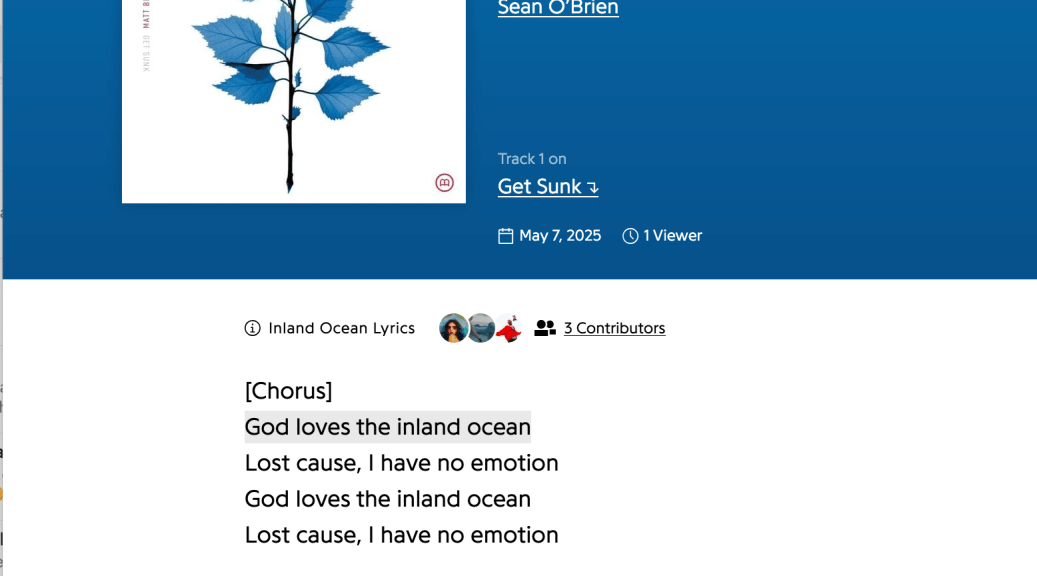
[Header image via Genuis, lyrics by Matt Berninger]
As I have noted often, over my forty-plus years teaching students to write, a few patterns remain constant, one of which is students lacking genre awareness.
On the first day of class, I often ask students what novels they read in high school English, and invariably, students include The Crucible or simply say “Shakespeare.”
They read these plays in book form, and have conflated anything in book form with “novel.”
Also, they mostly are experienced in being students who write, not writers.
So I spend a great deal of time and effort in my writing courses helping students become engaged with authentic writing practices, specifically fostering stronger writing purposes (and understanding writing forms/genres) and processes.
As a fan of The National and lead singer/lyricist Matt Berninger, I was particularly struck by this new interview [1] as Berninger begins promoting his second solo album, Get Sunk:
I think this interview is a really wonderful and brief entry point to discussing writer purpose and process (note that Berninger does use some profanity and references pot smoking).
Berninger is an endearing and quirky as his lyrics. And while he may seem flippant at first (“I’ll start fucking around with stuff”), he makes some very sophisticated and accessible observations about purposeful writing and the importance of the writing process (he has begun scribbling lyrics on baseballs instead of his standard journal, for example).
When the interviewer mentions his favorite lyric from Boxer (The National), Berninger offers a brief window into the importance of being a reader as well as the recursive nature of texts: “I stole that from Jonathan Ames.”
Berninger’s lyrics often pull from books, authors, and other song lyrics. Here is an ideal place to discuss with students the conventions of allusion and references as that creates tension with plagiarism (a great opportunity to tie in so-called canonized writers such as Marianne Moore and T.S. Eliot).
But the core comments I think students need to hear and then practice in the writing are about understanding different writing purposes/forms:
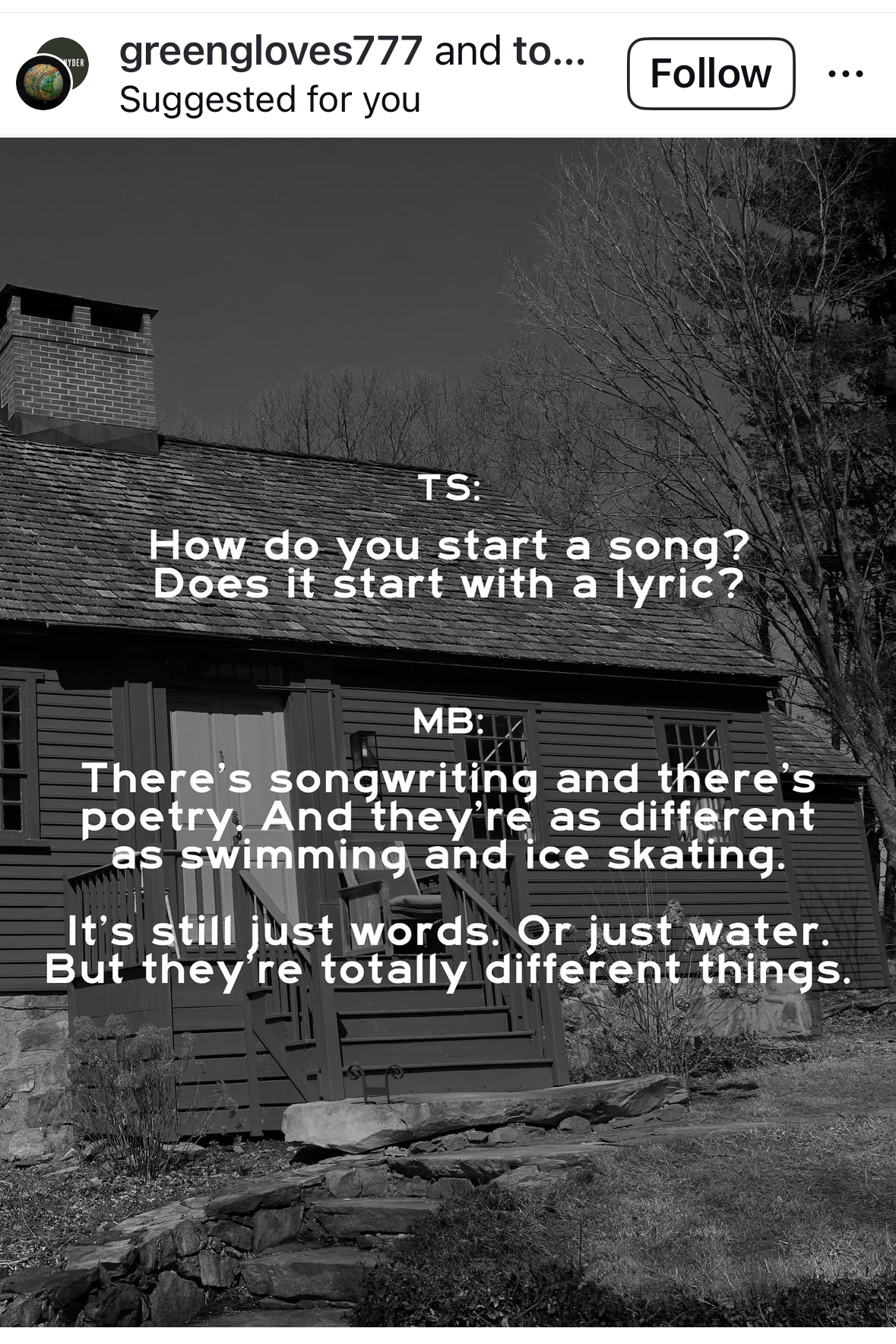
I do think songwriting is a very specific kind of thing…. It’s not—there’s poetry and there’s songwriting…. And I think they’re as different as like swimming and ice skating…. It’s like it’s still just words or just water but they’re totally different things.
This distinction and metaphor are powerful because they acknowledge the complexity of choosing and writing in different ways, for different purposes, and for different audiences.
Berninger also talks about his use of scribbling on baseballs for writing ideas. While quirky, this really captures the writing process in an authentic way (not the scripted way often taught in school).
As a teacher of writing and a writer (as well as avid reader), I want students to be fully engaged as writers—not as students performing a stilted essay for the teacher/professor.
We want for our students a sense of purpose, a demonstration of intent, an awareness of form and audience, and ultimately, a writing product of their choosing and for their purposes.
And in the era of intensified AI, I want to stress that AI has no place in these goals because students need and deserve opportunities to experience all of these aspects of brainstorming, drafting, and presenting a final product.
It may seem crude, careless, and flippant, but if we listen carefully, Berninger’s “fucking around” demonstrates the power and complexity of being a writer—and thus, being a teacher of writing.
[1] I highly recommend this blog post on Bon Iver/Justin Vernon as a companion to the Berninger interview.
“No, no. You’ve got something the test and machines will never be able to measure: you’re artistic. That’s one of the tragedies of our times, that no machine has ever been built that can recognize that quality, appreciate it, foster it, sympathize with it.”
Paul Proteus to his wife Anita in Kurt Vonnegut’s Player Piano
“So much depends upon a red wheel barrow glazed with rain water beside the white chickens” is, essentially, a grammatical sentence in the English language. While the syntax is somewhat out of the norm, the diction is accessible to small children—the hardest word likely being “depends.” But “The Red Wheelbarrow” by William Carlos Williams is much more than a sentence; it is a poem:
so much depends
upon
a red wheel
barrow
glazed with rain
water
beside the white
chickens.
A relatively simple English language sentence shaped into purposeful lines and stanzas becomes poetry. And like Langston Hughes’s “Harlem” and Gwendolyn Brooks’s “We Real Cool,” it sparks in me a profoundly important response each time I read these poems: [Expletive], I wish I had written that.
It is the same awe and wonder that I felt as a shy and deeply self-conscious teenager when I bought, collected, and read comic books, marveling at the artwork I wish I had drawn.
•
Will we soon wake one morning to find the carcasses of poems washed up on the beach by the tsunami of the Common Core?
That question, especially during National Poetry Month, now haunts me more every day, notably because of the double-impending doom augured by the Common Core: the rise of nonfiction (and the concurrent erasing of poetry and fiction) from the ELA curriculum and the mantra-of-the-moment, “close reading” (the sheep’s clothing for that familiar old wolf New Criticism):
It seems we have come to a moment in the history of the US when we no longer even pretend to care about that which is the result of the human heart: Art.
And poetry, I contend, is the most human of the arts because—although it is quite challenging often to distinguish humans from other mammals—we have two attributes that do set us apart: our too-big brains and our faculty for language.
Poetry is the very human effort to utter order out of chaos, meaning out of the meaningless: “Daddy, daddy, you bastard, I’m through” (Sylvia Plath, “Daddy”).
•
The course was Speech, taught by Mr. Brannon. I was a freshman at a junior college just 15-20 miles from my home, the college my parents had attended when they first fell in love and married secretly.
Despite the college’s close proximity to my home, my father insisted that I live on campus. But that class and those first two years of college were more than living on campus; they were the essential beginning of my life.
In one of the earliest classes, Mr. Brannon read aloud and gave us a copy of “[in Just-]” by e. e. cummings. I imagine that moment was, for me, what many people describe as a religious experience.
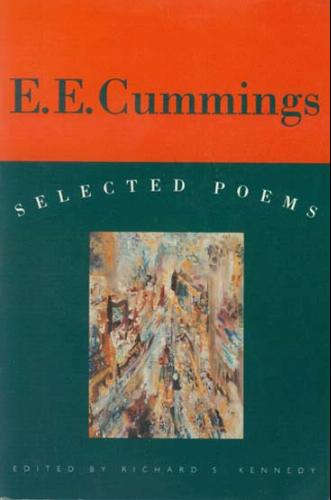
That was more than thirty years ago, but I have two precious books still that followed from that day in class: cummings’s Complete Poems and Selected Poems:
Several years later, Emily Dickinson‘s Complete Poemswould join my commitment to reading every poem by those poets who made me respond over and over: [Expletive], I wish I had written that.
But that introduction to cummings was more than a young and insecure man finding the poets he wanted to read; it was when I realized I am a poet.
Now, when the words “j was young&happy” come to me, I know there is work to do—I recognize the gift of poetry.
•
As a high school English teacher, I divided my academic year into quarters by genre/form: nonfiction, poetry, short fiction, and novels/ plays. The poetry quarter, when announced to students, initially received moans and even direct complaints: “I hate poetry.”
To be honest, that always broke my heart, crushed my soul. Life and school had already taken something very precious from these young people:
Gradually and then always, I taught poetry in conjunction with popular songs. Although my students in rural South Carolina were overwhelmingly country music fans, I focused my nine weeks of poetry on the songs of alternative group R.E.M.
For the record, that too elicited moans from students in those early days of exploring poetry (see that unit now on the blog “There’s time to teach”).
Concurrently, throughout my high school teaching career, students always gathered in my room during our long mid-morning break and lunch (much to the chagrin of administration). And almost always, we played music.
The epitome of that unspoken norm of my classroom was two students who, after I introduced them to The Violent Femmes, would close my door in order to dance and sing along with their songs.
Many of those students are in their 30s and 40s, but it is common for them to contact me—often on Facebook—and recall fondly R.E.M. and our poetry unit. Those days and years meant something to them that lingers, that matters in ways that cannot be measured.
I can still see and hear those two students dancing, singing, and laughing. It was an oasis of happiness in their days at school, an oasis of happiness in their lives.
my blood approves, and kisses are better fate than wisdom lady i swear by all flowers. Don’t cry —the best gesture of my brain is less than your eyelids’ flutter….
And each year when my students and I examined this poem, we would discuss that cummings—in Andrew Marvell fashion—offers an argument that is profoundly unlike what parents, teachers, preachers, and politicians claim.
So I often paired this poem with Coldplay’s “The Scientist,” focusing on:
I was just guessing at numbers and figures
Pulling your puzzles apart Questions of science, science and progress
Do not speak as loud as my heart
Especially for teenagers, this question, this tension between heart and mind, mattered. Just as it recurs in the words of poets and musicians over decades, centuries.
Poetry, as with all art, is the expressed heart—that human quest to rise above our corporeal humanness:
I have loved a few people intensely. So deeply that my love, I believe, resides permanently in my bones. If you read my poetry, you will recognize that motif, I am sure.
One such love is my daughter, and she now carries the next human who will add to that ache of being fully human—loving another beyond words.
And that, I contend, is poetry.
Poetry is not identifying iambic pentameter on a poetry test or discussing the nuances of enjambment in an analysis of a Dickinson poem.
Poems are not fodder for close reading.
Poetry is the ineluctable “Oh my heart” that comes from living fully in the moment of being human, the moment that draws us to words as well as inspires us toward words.
We read a poem, we listen to a song, and our hearts rise out of our eyes as tears.
That is poetry.
And like the picture books of our childhood, poetry must be a part of our learning, essential to our school days—each poem an oasis of happiness that “machines will never be able to measure.”
•
Will we soon wake one morning to find the carcasses of poems washed up on the beach by the tsunami of the Common Core?
Maybe the doomsayers are wrong, and maybe, just maybe, poetry will not be erased from our classrooms.
School with less poetry is school with less heart. School with no poetry is school with no heart.
Both are tragic mistakes because if school needs anything, it is more heart. And poetry? Oh my heart.
NOTE: This post was drafted in the wake of driving to work while listening to Coldplay’s A Rush of Blood to the Head. Or to be perfectly honest, while singing loudly along with each song and occasionally crying. There. So keep that in mind.
educator, public scholar, poet&writer – academic freedom isn't free



 dr. p.l. (paul) thomas