Some predictions aren’t that bold, and this is one of them:
I predict there will be much shouting and gnashing of teeth over the newest CREDO charter schools study and that the Kids Count 2013 report will dissipate into thin air like smoke from an abandoned camp fire.
Ultimately, the charter school debate continues to be much ado about nothing because charter schools produce about the same range of quality as public and private schools. Charter schools are school-choice-lite so they appease the beefy middle ground of conservatives and progressives who want to appear reasonable, but charter schools are not credible solutions to our pressing social and educational problems that remain primarily issues of equity and opportunity.
Schooling in the US continues to be a reflection and perpetuation of the inequities of our society; they don’t transform society, and they never have—primarily because education remains a tool of the political and economic elite who simply do not want social reform since that reform would challenge their perches atop the masses.
And the Kids Count report will remain ignored because it proves exactly that—social reform is needed in the US.
But most disturbing of all, beyond how debates about the CREDO study and charter schools will overshadow substantive examinations of social inequity, is that the CREDO study helps perpetuate the mindless and also distracting focus on data that ignores the ugly underbelly of many charter schools—segregating children by race and class, perpetuating “no excuses” and zero tolerance policies for African American and Latino/a children (but not white children), demonizing and de-professionalizing teachers and teaching, and reducing education for “other people’s children” to test-prep factories beholden to textbook publishers and high-stakes testing regimes (such as the ACT).
Count of this; my prediction will be proven true.
And we all lose in the process.
Addendum
And almost no one is paying attention to the Pew report on economic mobility—except for Matt Bruenig and The Atlantic. Why? Because just as the Kids Count data refute the big political lies, so does the Pew report in terms of the American Dream; for example:
Americans raised at the bottom and top of the family income ladder are likely to remain there as adults, a phenomenon known as “stickiness at the ends.”
While a majority of Americans exceed their parents’ family incomes, the extent of that increase is not always enough to move them to a different rung of the family income ladder.
Forty-three percent of Americans raised in the bottom quintile remain stuck in the bottom as adults, and 70 percent remain below the middle.
Forty percent raised in the top quintile remain at the top as adults, and 63 percent remain above the middle.
Only 4 percent of those raised in the bottom quintile make it all the way to the top as adults, confirming that the “rags-to-riches” story is more often found in Hollywood than in reality. Similarly, just 8 percent of those raised in the top quintile fall all the way to the bottom….
There is stickiness at the ends of the wealth ladder.
Sixty-six percent of those raised in the bottom of the wealth ladder remain on the bottom two rungs themselves, and 66 percent of those raised in the top of the wealth ladder remain on the top two rungs.
Blacks have a harder time exceeding the family income and wealth of their parents than do whites.
Sixty-six percent of blacks raised in the second quintile surpass their parents’ family income compared with 89 percent of whites.
Only 23 percent of blacks raised in the middle surpass their parents’ family wealth compared with over half (56 percent) of whites.
Blacks are more likely to be stuck in the bottom and fall from the middle than are whites.
Over half of blacks (53 percent) raised in the bottom of the family income ladder remain stuck in the bottom as adults, compared with only a third (33 percent) of whites. Half of blacks (56 percent) raised in the middle of the family income ladder fall to the bottom two rungs as adults compared with just under a third of whites (32 percent).
Half of blacks (50 percent) raised in the bottom of the family wealth ladder remain stuck in the bottom as adults, compared with only a third (33 percent) of whites. More than two-thirds of blacks (68 percent) raised in the middle fall to the bottom two rungs of the ladder as adults compared with just under a third of whites (30 percent).
New Orleans may be the extreme test case, but reforms like these are reshaping public education across the country. The movement is rooted in the notion that “fixing” schools is the strongest lever for lifting communities out of poverty. The criminal justice and health care systems may be broken, living-wage jobs in short supply, and families forced to live in unstable or unsafe conditions. But the buck supposedly stops in the classroom. Thus teachers can find themselves charged with remedying an impossibly broad set of challenges that go far beyond reading at grade level.
Post-Katrina New Orleans represents a crucible for both disaster capitalism and the neoliberal (privatization) agenda driving education reform. After the hurricane devastated New Orleans, the city was swept clean of its teacher workforce (overwhelmingly African Americans constituting a significant percentage of the black middle class), its public schools, and its teachers union so that Paul Vallas could rebuild the school system with charter schools and Teach for American recruits, inexperienced and uncertified teachers who are often white, affluent, and transplants to New Orleans from all across the US. Carr highlights the tensions in this human-made flood of the city:
But most explanations have focused on the radical overhaul of the city’s education system: the expansion of independent charter schools (which more than 80 percent of New Orleans public school children now attend); a greater reliance on alternative teacher training programs like Teach for America; and the increased use of test scores to determine whether educators should keep their jobs and schools should stay open….
This mentality has attracted ambitious, talented young teachers from across the country. But it has also risked turning teaching into a missionary pursuit. At a few of the charter schools I have reported on over the last six years, less than 10 percent of the teachers came from New Orleans or were older than 35. “I think a lot of people who come to New Orleans want to change New Orleanians,” said Mary Laurie, a veteran school administrator and principal of O. Perry Walker High School….
This disconnect can manifest itself in ways both small (as when a teacher fails to recognize a popular New Orleans term, like “beaucoup” for “a lot”) and large (as when a teacher can’t grasp what students are going through at home).
Yet, while New Orleans has become a feast for disaster capitalism (see Archer and Bessie’s graphic journalism here, here, and here), political and public concern for the city and for the greater assault on public education, children and families living in poverty, and teachers remains essentially absent.
In her critical analysis of education reform in New Orleans, Kristen Buras concludes: “Critical research and ongoing activism in multiple spaces are crucial. What is currently happening in New Orleans is not socially conscious capitalism. It is simply unconscionable” (p. 324).
That New Orleans, public schools across the US, teachers, teachers unions, and families in poverty remain under assault while political leadership, advocacy representatives, and the public remain focused on baseless calls for Common Core and next generation testing as well as equally baseless attacks of teacher education exposes some harsh realities about the US: profit and the privilege of wealth matter, but workers, children, and the impoverished do not.
There is simply no other lesson one can draw from New Orleans today.
Pussy Riot: A Punk Prayer (HBO Documentaries, 2013) offers a window into the intersections of music, religion, and politics in the context of Vladimir Putin’s Russia:
On Feb. 21, 2012, members of the feminist art collective Pussy Riot, donning their colorful trademark balaclavas, or ski masks, participated in a 40-second “punk prayer protest” on the altar of Moscow’s Christ the Savior Cathedral before being detained. Arrested and tried for trespassing, wearing “inappropriate” sleeveless dresses and disrupting social order, Nadia, Masha and Katia were accused of religious hatred in a trial that reverberated around the world and transformed the face of Russian society.
The film ends with two of the three band members still in prison, their unwavering ethical statements expressed in court haunting viewers along with the sometimes shocking and always confrontational performance art detailed in the backgrounds of these young women.
It was 10 years ago this week — as the country was barreling toward war with Iraq — that Natalie Maines, lead singer of the Dixie Chicks, stood in front of a packed house in London and said:
“Just so you know, we’re on the good side with y’all. We do not want this war, this violence. And we’re ashamed the president of the United States is from Texas.”
Especially since the politically charged counter-culture 1960s when US popular music merged with making social and political commentary, musicians and musical groups have capitalized on and suffered under their choices about being political or not. Athens alternative group R.E.M. and California-based CAKE are but two groups who have often worn their politics on their sleeves, both garnering and alienating their fans.
For musicians, the argument runs toward a purist view of entertainment: Just entertain, detractors exclaim. This purist view, ironically, is a political statement, one that determines for all musicians, all artists the singular role of art, a sort of art for art’s sake. A long tradition supports this view, one confronted by John Keats in “Ode on a Grecian Urn”: “‘Beauty is truth, truth beauty,—that is all/Ye know on earth, and all ye need to know.'”
The British Romantics argued for the immutability of art in its pursuit of beauty, even over this life. But other poets have seen quite a different world, and quite a different view of poetry. Andrew Marvell urges his coy mistress: “The grave’s a fine and private place,/But none, I think, do there embrace.”
From Keats to Marvell there is a sexual politics at play, underneath competing views of the roles and purposes of art. A parallel debate exists about the rightful place of politics in the classroom.
Stanley Fish and the Politics of “Academicizing”
Stanley Fish plays the same note over and over in Save the World on Your Own Time, a purist view of being academic: “That’s what intellectual work is all about, the evaluation, not the celebration, of interests, beliefs, and identities” (p. 11). Fish’s view of academics is “simple” (his word) as it entails only bodies of knowledge and analysis of those bodies of knowledge.
Fish also claims his argument that educators must be apolitical in the classroom is a minority view, an assertion that has some credibility at the university level (although not much), but is completely off-base when applied to K-12 teachers. Traditional and current expectations for teachers remain inside a belief that teaching can and should be objective—the teacher persona entirely divested from the politics of the person assuming that role.
In essence, Fish is embracing and even celebrating the phrase “merely academic” as he sees academic pursuits in their purest sense disassociated from the real world.
While I do not want to revisit Fish’s discounting the argument that everything is political (which he deals with multiple times and in a somewhat uneven way), I want to confront two problems I see with continuing to argue that teachers should avoid being political in the classroom.
My first concern lies with Fish’s framing of the purposes of education. His definition of academics is certainly compelling and shared by many, but equally credible educators embrace a different view of education, one couched squarely in and of the world. The social reconstructionists of the early 20th century embraced education as a lever for changing the world. Social justice and critical educators also start with the premise that education is historically bound and inherently political, as Kincheloe (2005) explains:
Thus, proponents of critical pedagogy understand that every dimension of schooling and every form of educational practice are politically contested spaces. Shaped by history and challenged by a wide range of interest groups, educational practice is a fuzzy concept as it takes place in numerous settings, is shaped by a plethora of often-invisible forces, and can operate even in the name of democracy and justice to be totalitarian and oppressive. (p. 2)
To take Fish’s apolitical academic pose in the classroom becomes a political act of maintaining the status quo, the norms, regardless of any instances of injustice. Within Fish’s parameters of fields of knowledge and analysis, the politics of who decides is left unchecked, unacknowledged.
For critical educators, there is a moral imperative to move beyond fixed bodies of knowledge and technical analysis, thus moving toward raising student awareness that some agent(s) of power drive(s) a consensus within a field as an initial step to providing that student opportunities to develop her agency either within that consensus or against it.
In its simplest form, Fish appears comfortable with the disassociated academic environment in which acquisition of content (Freire’s “banking” concept) and analysis are all that a teacher should approach. This appears valid only if Fish’s definition of what academics should be is also embraced.
Thus, my first concern is that Fish has every right to his definition of academics and the role of the teacher within that, but he doesn’t have the right to define academics for me or anyone else.
My argument about the role of the teacher is also couched in a tradition that embraces education as social reconstruction and critical pedagogy, seeking social justice; thus, the role of the teacher is necessarily political.
That brings me to my second concern—Fish’s extended discusion of postmodernism and his dualistic, and distorted, representation of social justice, critical educators.
Fish uses Mark Bracher to represent educators who embrace “everything is political,” and builds to a powerful and somewhat appropriate comment: “In [Bracher’s] view teaching is indoctrination and the only question is, will it be our indoctrination or theirs?” (p. 176).
And it is here I both agree with Fish and have to take exception to him. If his characterization of Bracher is accurate (I’m not going to argue about that), then I agree with Fish and share his concern about anyone who sees teaching as necessarily indoctrination. To conflate “all teaching is political” with “all teaching is indoctrination,” however, is falling into a false and misleading dualistic trap.
I also agree with Fish that the classroom should never be partisan. I have made this argument before, but calling for political teaching is not calling for partisan politics in the classroom:
I will concede and even argue that classrooms, teachers, and education in general should avoid being partisan—in that teachers and their classrooms should not be reduced to mere campaigning for a specific political party or candidate. And this, in fact, is what I believe most people mean (especially teachers) when they argue for education not to be political.
But, especially now, we must stop conflating partisan and political, and come to terms with both the inherent political and oppressive call for teachers not to be political and the inevitable fact that being human and being a teacher are by their nature political.
That said, critical educators reject Fish’s “academicizing” and education as indoctrination; as Kincheloe (2005) clarifies:
Recognition of these educational politics suggests that teachers take a position and make it understandable to their students. They do not, however, have the right to impose these positions on their students [emphasis in original]….
In this context it is not the advocates of critical pedagogy who are most often guilty of impositional teaching but many of the mainstream critics themselves. When mainstream opponents of critical pedagogy promote the notion that all language and political behavior that oppose the dominant ideology are forms of indoctrination, they forget how experience is shaped by unequal forms of power. To refuse to name the forces that produce human suffering and exploitation is to take a position that supports oppression and powers that perpetuate it. The argument that any position opposing the actions of dominant power wielders is problematic. It is tantamount to saying that one who admits her oppositional political sentiments and makes them known to students is guilty of indoctrination, while one who hides her consent to dominant power and the status quo it has produced from her students is operating in an objective and neutral manner. Critical pedagogy wants to know who’s indoctrinating whom. (p. 11)
Embracing political transparency as an educator is rejecting both apolitical posturing and indoctrination.
Ultimately, I do support Fish’s right to his view of education and the role of the teacher, just as I support those musicians and artists who seek entertainment and art for the sake of entertainment and art.
But I remain in solidarity with the Pussy Riots, R.E.M.s, CAKEs, and critical educators who see education as integral to not just life, but a better life—as complicated an endeavor as that is fraught with the possibility that we make in our sincere efforts mistakes.
Being fully human is embracing our essential political nature, and as a teacher, I must be fully human.
In the June 2013 newsletter for the American Association of Colleges for Teacher Education (AACTE), Board of Directors Chair Fayneese Miller makes this case about Common Core States Standards (CCSS):
What should be our message? What do we stand for?
For starters, we need to stand resolved in supporting the implementation of the Common Core and its concomitant assessments. Unless we can demonstrate that what is about to occur in most states by 2014 will harm students, we need to stand back from criticizing and look for ways to show that we can be a real partner in improving student learning and outcomes….
We can be a powerful voice on education if we align our messages and speak with one voice. The time to do this is not tomorrow, but now.
This message of “speak[ing] with one voice” in support of CCSS comes on the heels of Randi Weingarten, president of the American Federation of Teachers, calling for a moratorium on high-stakes testing of CCSS while the new standards are implemented.
However, Alice Johnson Cain, vice president for policy at Teach Plus, has rejected the moratorium, endorsing both CCSS and high-stakes testing through a commentary at Education Week:
But a moratorium would be a mistake.
The common core is not just another reform; it is truly a revolutionary development. But it is also a package deal in which next-generation assessments will inform and improve instruction in ways that make far more sense to teachers than the current “bubble tests” that are often disconnected from what they teach and what their students need.
What these arguments all have in common is that CCSS are now inevitable; that we debate only how to implement CCSS, how and when to test CCSS, and to what degree CCSS are “revolutionary” all seal the fate of educators and students. As Miller seems to be suggesting, challenging implementation of CCSS is now off the table.
“There wasn’t a lot of choice, but there was some”
For over a decade of my nearly two decades as a public high school English teacher in the rural and deeply conservative South, one of the most powerful and enduring units in my Advanced Placement Literature and Composition course centered around Margaret Atwood’s The Handmaid’s Tale.
The discussion surrounding Chapter 16, when the main character Offred (June) contemplates The Ceremony, proved each year to be one of the best days for me as a teacher and my students. In the dystopian future imagined by Atwood, the U.S. stands fractured and the Caucasian race finds itself disappearing.
The Republic of Gilead, basing its structure and laws on the Christian bible, seeks to repopulate the white race by identifying potentially fertile young women, Handmaids, and assigning them to Commanders, who have wives but also carry out the duty of impregnating Handmaids, a process labeled The Ceremony. In Chapter 16, Offred (June) describes the act by exploring what term best captures her circumstance:
I do not say making love, because this is not what he’s doing. Copulating too would be inaccurate, because it would imply two people and only one is involved. Nor does rape cover it: nothing is going on here that I haven’t signed up for. There wasn’t a lot of choice but there was some, and this is what I chose. (p. 94)
A central motif running through Atwood’s speculative narrative is the existence and consequences of reduced circumstances. The Handmaids are but one example of many throughout the novel representing the stratification of women as a mechanism for controlling women. Just as the history of slavery in the U.S. revealed how slave owners pitted slave against slave—those allowed in the “house” and those relegated to the “field”—the reduced circumstances of women in the novel exposes the use of carefully managed choices to maintain control, to maintain the status quo of hierarchies of power.
Just as Offred (June) has had her circumstances reduced to the point that she relinquishes her humanity to “some” choice, educators now find ourselves in a state of perpetual reform under the weight of crisis:
The administrations in charge never cease announcing supposedly necessary reforms: to reform schools, to reform industries, hospitals, the armed forces, prisons….In the disciplinary societies one was always starting again (from school to the barracks, from the barracks to the factory), while in the societies of control one is never finished with anything—the corporation, the educational system, the armed services being metastable states coexisting in one and the same modulation, like a universal system of deformation. (Deleuze, 1992)
The message is clear for teachers: Be quiet and just reform. And that message endures within both the moratorium stance and “next-generation assessments” advocacy.
The reduced circumstances of teaching and learning are currently imprisoned in a state of fatalism—CCSS are inevitable so everyone must shut up, lie back, and make the best of it. As Freire warns:
There is a lot of fatalism around us. An immobilizing ideology of fatalism, with its flighty postmodern pragmatism, which insists that we can do nothing to change the march of socio-historical and culture reality because that is how the world is anyway. The most dominant contemporary version of such fatalism is neoliberalism. With it, we are led to believe that mass unemployment on a global scale is an end-of-the-century inevitability. From the standpoint of such an ideology, only one road is open as far as educative practice is concerned: adapt the student to what is inevitable, to what cannot be changed. In this view, what is essential is technical training, so that the student can adapt and, therefore, survive. (pp. 26-27)
The fatalism of reform in the guise of CCSS and “next-generation assessments” creates silent compliance, and ultimately the sort of guilt by association captured in World War Z:
Brilliance….Conventional executions might have reinforced discipline, might have restored order from the top down, but by making us all accomplices, they held us together not just by fear, but by guilt as well. We could have said no, could have refused and been shot ourselves, but we didn’t. We went right along with it….We relinquished our freedom that day, and we were more than happy to see it go. From that moment on we lived in true freedom, the freedom to point to someone else and say “They told me to do it! It’s their fault, not mine.” The freedom, God help us, to say “I was only following orders.” (p. 81-83)
“Only one road is open” in the fatalism of advocacy for CCSS, whether there is a moratorium on testing or not, but that road is yet more dystopian fiction, Cormac McCarthy’s The Road.
It is, then, necessary for educators to build and then follow another road, one that confronts a fact of recent accountability history: what is tested is what is taught. The promises of CCSS and “next-generation assessments” ignore that inevitability.
The new road includes a message that we do not need “new” standards, we do not need “new” tests, but we do need to end the high-stakes accountability culture/paradigm.
I teach a May Experience course, The Reel World: The Depiction of Schools on Film. A colleague of mine in the education department and I designed the course before Waiting for “Superman,” but the course is intended as a way to examine how political and public discourse shapes perceptions about public schools as well as policy. The course was revised to include Poverty Studies credit so many of the films explore how education intersects class and race.
The focus of the discussion, however, remains on the eight documentaries below with some annotations about what aspects of education each film highlights. I do recommend all of these films, although each has some limitations as most documentaries do.
This documentary focuses on a court case in South Carolina initiated by high-poverty school districts surrounding primarily the I-95 corridor of the state, paralleling the east coast and stretching from the NE to the SE region. The documentary suffers from melodramatic production values (music, slow-motion panning of sad children’s faces), but the essential claim of the film is important for confronting the social inequity that is reflected in educational inequity, particularly in the South. Issues included in the film are school funding, community-based schools, access to high-quality educational opportunities and facilities, teacher assignments related to student characteristics, and state education accountability mechanisms. Some related resources (SC school report cards, poverty indices, related blog posts) to the documentary can be found HERE.
Ron Stone stands at the center of this film about an urban high school in New Jersey. The film is solid and interesting—while also creating a good deal of tension and presenting a surprise ending. Many important issues are raised, notably the controversial stance of Stone as principal toward gangs and gang leaders attending the high school. This is an ideal companion to Police in the Hallways and it confronts several important issues about education and education reform—urban schools, high-poverty/majority-minority schools, zero tolerance policies, deficit views of minorities and impoverished children, gang presence and violence, leadership styles, police in schools.
The controversy, teaching evolution in public schools, that will not die—although it has evolved, ironically—is explored by this film that is engagingly personal and often humorous. The Intelligent Design (ID) movement is the approach of the moment for creating debates about if and how evolution should be taught in schools. While the filmmaker is upfront with his allegiances to science, the documentary is fair, almost to a fault as it allows the scientists to show why their expertise is often lost in their arrogance. The film successfully helps viewers navigate the definitions of science, evolution, ID, and creationism; it also confronts the roles of religion, ideology, and politics (specifically the power of school boards) in the “teach the controversy” assertions found among ID advocates. An interesting connection to this documentary is the news coverage of a creationist test given to students in a SC private school.
These documentaries often soar because of the people allowed to speak for themselves. This excellent HBO film opens with Minnijean Brown Trickey returning to Little Rock Central High, and then it never fails to deliver throughout. I would rate this a must-see among the selections in this course. The film confronts Brown v. Board, separate and unequal, schools within schools, the return of segregation (especially in the South), and the lingering tensions between the ideal and reality of racial harmony. Related pieces on the rise of the segregated South and education reform in the New Jim Crow Era are recommended. Alexander’s The New Jim Crow is also an excellent connection.
When Waiting for “Superman” was released and disproportionately praised in the media, I wrote a piece on this documentary to suggest it is far superior and to ask viewers what these administration and teachers at Douglass High were supposed to do. The focus of this film is No Child Left Behind (NCLB) in the context of a high-poverty, majority minority urban high school. Some of the most significant moments of the documentary are disturbing scenes of violence in the hallways and one female student recounting a fight with an adult male relative. Teachers struggling with the students, including one TFA recruit, are included, and this is also a strength of the film. The film addresses accountability, administrator/faculty relationships, the roles of teachers (especially young teachers), the influence and struggles of parents, the voices of students, the significance of extracurricular activities, and the limitations of school-only reform and accountability under the weight of poverty and racial inequity.
Who controls the money, controls everything—or at least who controls the money wants to control everything. This documentary examines the clash between a family funding scholarships and the science curriculum in a logging community. This is a powerful pairing with Flock of Dodos since both documentaries dramatize the debate over who should determine the curriculum in public schools serving a free society. Clearcut and Flock of Dodos also highlight the culture war that simmers beneath almost all educational controversies. The issues raised in this documentary can be linked to the influence of entrepreneurs in the current reform movement, such as Bill Gates, and the role of school boards is also a central issue, again as in Flock of Dodos.
Morgan Freeman challenges his childhood hometown to integrate the prom, and he’ll foot the bill; this is the focus of an engaging and powerful documentary on the persistence of segregated proms in the twenty-first century. The voices of students, parents, and administrators drive this film, and the intersection of racism and public education takes center stage through those voices. A potential pairing (non-education related) is the documentary The Loving Story about the 1967 Supreme Court case addressing interracial marriage. The 2013 prom integration in Georgia also is a suitable companion to this film.
Neoliberalism driving education reform in Mexico is confronted in this documentary, which provides a strong conclusion to the May experience addressing education. Corporations (Walmart, Coca-Cola, Ford), corrupt unions, and President Fox provide a matrix of influential forces shaping and even dismantling public education in Mexico, paralleling the same neoliberal agenda highlighted under George W. Bush and increased under Obama. A combative and disturbing documentary, Grain of Sand forces viewers to consider the value of the Commons and the dangers of privatization. Like Hard Times at Douglass High, this film suggests that accountability reform based on high-stakes testing poses much greater harm than good for schools and students.
Recently, I was at the window of my allergist, paying for my allergy shots. The receptionist asked me something about enjoying my break, but I noted I was currently teaching a May course. Her response was something like “Sorry.”
I said that I enjoyed my May class and ended with “I love my students.” The receptionist stopped typing my information into the computer and looked up at me, her brow furrowed.
“Are you being serious?” she asked.
“Yes,” I explained, “I love my students, I love teaching.”
She explained to me that another professor came to the same office and only said that sarcastically so she assumed I was also.
This moment came back to me as I watched CNN’s coverage of the tornado destroying a school in Moore, OK. Anderson Cooper, echoing comments made by the media during the Sandy Hook Elementary shootings, interviewed a teacher who had gathered all of her students under their desks during the storm—and no children from her class were injured—and stated that teachers do amazing things every day, heroic things every day, but this women had gone above her duty.
I have now grown tired of this token and blatantly superficial (and insincere) praise of teachers.
Token praise cannot, or at least should not, mask the disdain expressed about not only teachers but also workers in general in the U.S. The reposted blog below, then, remains a valid concern.
The first decade of the 21st century has been an ominous harbinger for the American worker.
Children and adults in poverty, the working poor, and the working class are increasing; the middle-class is eroding; and the pooling of capital among the 1% is expanding, forming the anchor stalling the progress of the USS Democracy.
In The State of Working America (12th ed), Mishel, Bivens, Gould, and Shierholz identify the disturbing trends that signal the approaching death of the American worker:
America’s vast middle class has suffered a ‘lost decade’ and faces the threat of another (p. 5)….
Income and wage inequality have risen sharply over the last 30 years (p. 6)….
Rising inequality is the major cause of wage stagnation for workers and of the failure of low- and middle-income families to appropriately benefit from growth (p. 6)….
Economic policies caused increased inequality of wages and incomes (p. 7)….
Claims that growing inequality has not hurt middle-income families are flawed (p. 8)….
Growing income inequality has not been offset by increased mobility (p. 9)….
Inequalities persist by race and gender. (p. 9)
Currently, the American worker—like those trapped in poverty and the working poor—have no political party because, ironically, the democratic process in the U.S. has been bought by Corporate America and democracy has been left in that wake.
Public school teachers also have no political party, and since the Chicago teachers’ strike, teachers now more than ever represent the political and public failure to appreciate and recognize the importance of the American worker.
Teachers as Workers
Early and mid-twentieth century America may have been a turning point for unionization in a country that lives more by ideology than evidence, but even that assessment may be tinted by the rose-colored glasses of hindsight.
The truth is likely that Americans’ embracing of rugged individualism has always been an impenetrable wall between the American character and the community and solidarity at the core of unions.
Nonetheless, the American public school teacher has over the past decade—during the demonstrable decline of the working and middle class as well as the rise of poverty in the U.S.—gradually become the target of the popular corporate agenda to end tenure and break unions, despite the essential democratic nature of both.
Politicians, corporate advocates, and the media have fed a willing public a steady diet of false but robust narratives that characterize teachers as the sole force behind misleading claims of failed public schools. Any evidence- and experience-based rebuttal to the “bad” teacher claim or the corrupt union mantra has been met with a “no excuses” ideology that chants “poverty is not destiny.”
This corporate agenda has no basis in fact, but the abundant commentaries and scholarship refuting this drum beat have failed to pierce the American public’s self-defeating faith in America the meritocracy.
The political and corporate elite know this, and they have little motivation to set aside their lies since they work, and since they benefit in the end.
And during the teachers’ strike in Chicago, the media and political leaders mischaracterized unions and teachers in Chicago and across the U.S.—more laziness and greediness heaped on teachers, and more evidence that the Democratic party is indistinguishable from the Republican party in terms of education and labor policy.
What is most disturbing ultimately about the demonizing of teachers and in effect all American workers is that most Americans are and will always be those exact workers who are being stripped of their rights, dignity, and access to the American Dream that the political and corporate elite along with the public claim to be protecting.
The Chicago teachers’ strike was yet another referendum on the failing education reform agenda that is destined to strip teachers of their professionalism and to further stratify the education system of the U.S. so that affluent children (mostly white) gain even more advantage in their schooling than they have in their lives over children living in working class, working poor, and impoverished homes (disproportionately people of color).
It was a political lie to claim that the Chicago teachers’ strike was the fault of lazy and greedy teachers supported by their corrupt union. It was a political lie to ignore the central demand of those teachers—a stand against test-based teacher accountability.
But neither the political elite nor the corporate elite will eventually lose in this debate because a public embracing of the corporate agenda and rejection of the striking teachers is a self-defeating commitment that will guarantee what appears inevitable now—the death of the American worker.
Teachers are not alone in this, but public school teachers are great American workers. I cannot fathom how we have come to a day when Americans no longer value something that cannot be more American than workers in solidarity.
Let me try once again to clarify both that these claims are true and necessary to name in order to change.
“Poverty is destiny” is a normative [1] fact of the United States. For most children, the social class they are born into predicts the trajectory of their lives, independent of their self-worth, effort, and all sorts of other factors we are more likely to associate with the individual child.
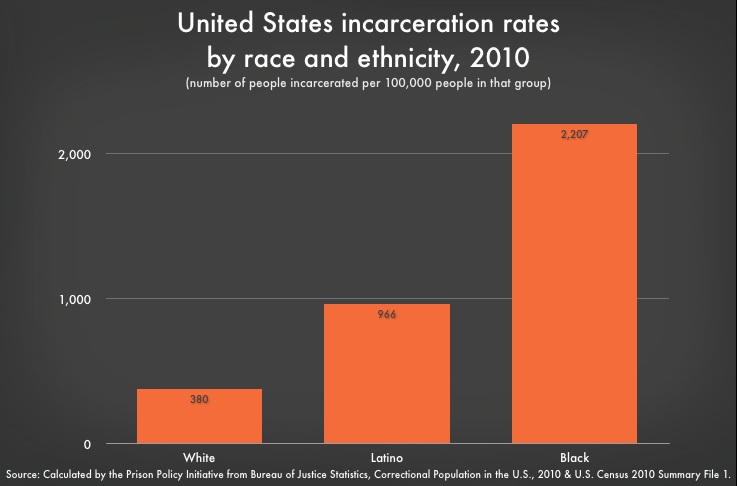
That this is a normative statement includes a concession that outliers exist (some people fall out of and rise above the social class of their births), but outliers do not discredit a normative statement just as we must caution against making an outlier status the rubric for normalized behavior. In other words, that African American men have scaled to the presidency and supreme court stands as outliers against the disproportionate number of AA men incarcerated in our country:
Michelle Alexander has embodied the need to name in order to change by confronting the normative facts of mass incarceration as well as the indisputable fact that mass incarceration is the New Jim Crow, thus racist.
Here’s a fact that may not surprise you: the children of the rich perform better in school, on average, than children from middle-class or poor families. Students growing up in richer families have better grades and higher standardized test scores, on average, than poorer students; they also have higher rates of participation in extracurricular activities and school leadership positions, higher graduation rates and higher rates of college enrollment and completion….
In the 1980s, on an 800-point SAT-type test scale, the average difference in test scores between two such children would have been about 90 points; today it is 125 points. This is almost twice as large as the 70-point test score gap between white and black children. Family income is now a better predictor of children’s success in school than race….
We are still talking about this despite decades of clucking about the crisis in American education and wave after wave of school reform.Whatever we’ve been doing in our schools, it hasn’t reduced educational inequality between children from upper- and lower-income families….
The income gap in academic achievement is not growing because the test scores of poor students are dropping or because our schools are in decline….
It may seem counterintuitive, but schools don’t seem to produce much of the disparity in test scores between high- and low-income students. We know this because children from rich and poor families score very differently on school readiness tests when they enter kindergarten, and this gap grows by less than 10 percent between kindergarten and high school. There is some evidence that achievement gaps between high- and low-income students actually narrow during the nine-month school year, but they widen again in the summer months….
The more we do to ensure that all children have similar cognitively stimulating early childhood experiences, the less we will have to worry about failing schools. This in turn will enable us to let our schools focus on teaching the skills — how to solve complex problems, how to think critically and how to collaborate — essential to a growing economy and a lively democracy.
Alexander and Reardon are naming normative facts—ones that many all along the ideological spectrum not only refuse to do themselves, but rush to silence others who do name in order to change.
If the patterns of mass incarceration and “no excuses”/”zero tolerance” schools and policies even impacted privileged white males proportionately in the U.S., the outcry would be deafening.
The current and historical racially disproportionate and negative patterns of the U.S. penal and judicial systems and the rise of highly segregated “no excuses” charter schools and “zero tolerance” urban public schools must be named and then we must act t change that which is racist, that which is classist, that which is sexist.
Refusing to name, refusing to act guarantees poverty will remain destiny and the current education reform movement will continue to mirror the New Jim Crow of mass incarceration.
If you are uncertain about the messages our culture sends about race, view the video below:
America is the embodiment of might-makes-right. When another country (USSR) invades Afghanistan, America is filled with righteous indignation, but when America invades Afghanistan, well, all is right with the world.
To mask the bully culture of the U.S., bullying is confronted as a school-based problem among children (note the distraction of the R rating in the documentary on bullying addressed by Nancy Flanagan and Douglas Storm). Yet, the exact ruling class who denounces bullying among children are themselves bullies.
So there is no surprise that the current education reform movement is characterized by bully politics.
NCTQ: Teaching Teachers a Lesson
In the mid-1800s, public education was called a “’dragon. . .devouring the hope of the country as well as religion. [It dispenses] ‘Socialism, Red Republicanism, Universalism, Infidelity, Deism, Atheism, and Pantheism—anything, everything, except religion and patriotism,’” explains Jacoby (2004, pp. 257-258). Bullying public education, then, has long roots, at least stretching back to the threat of universal public schooling detracting from the Catholic church’s control of education in the nineteenth century.
From there, the bullying of public schools continued, judging the quality of our public schools based on drop-out rates (Get adjusted, 1947). We must recognize that the demonizing of public schools and the condemnation of school quality are the way we talk about and view schools in the U. S. as popular discourse and understanding, but this historical badgering of schools has evolved recently into a more direct and personal attack on teachers.
While it appears we cringe when children bully each other, we have no qualms about inexpert, inexperienced, and self-proclaimed education reformers bullying an entire profession.
While the bullying can be witnessed in the discourse coming from Secretary of Education Arne Duncan, former-chancellor Michelle Rhee, and billionaire-reformer Bill Gates, one of the most corrosive and powerful dynamics embracing bully politics is the rise of self-appointed think-tank entities claiming to evaluate and rank teacher education programs. A key player in bully politics is the National Council on Teacher Quality (NCTQ).
Think tanks have adopted the format and pose of scholarship, producing well crafted documents filled with citations and language that frame ideology as “fair and balanced” conclusions drawn from the evidence.
In short, NCTQ is not an unbiased and scholarly enterprise to evaluate and reform teacher education. NCTQ is a right-wing, agenda-driven think tank entity determined to marginalize and discredit teacher education in order to promote a wide range of market-based ideologies related specifically to public education.
Further, and powerfully connected to the bully politics of NCTQ, is the association between NCTQ and U.S. News & World Report. In other words, NCTQ lacks educational and scholarly credentials and credibility, but gains its influence and power through direct and indirect endorsements from government, the media, and entrepreneurs (re: Gates foundation and funding).
In both reports, NCTQ contacts departments and colleges of education with a simple but blunt request: Cooperate with us or we’ll evaluate you however we can, and publish our report regardless. These requests demand extensive data from the departments and colleges, and then subject these programs to standards and expectations designed by NCTQ completely decontextualized from the departments and colleges being “evaluated” against those standards. In other words, the basis for NCTQ’s evaluations have not been vetted by anyone for being credible. A department or college could very well be rated high or low and that rating mean little since the department or college may or may not consider the criteria of any value.
In fact, the first report by NCTQ has been reviewed (most think tank reports receive tremendous and uncritical coverage without review, and when reviewed, those reviews tend to receive almost no media coverage), confirming that NCTQ produces biased and careless work. Benner’s review concludes, in part:
The NCTQ review of student teaching is based upon the assumption that it is not only possible, but also worthwhile and informative to isolate student teaching from the totality of a teacher preparation program. This notion is in direct conflict with the perspective that effective teacher education programs avoid the isolation of pedagogy and classroom management content, offering such knowledge and skills within a learning environment centered upon a clinical experience.
The sample of programs cannot be characterized as representative based on any statistical standard or recognized sampling technique. The problems include disproportionate samples, artificial restrictions, selection bias toward the weakest programs within universities, lack of clarity regarding sample size, and unsound selection procedures for the sample-within-sample. The problems with data collection include how the ratings were derived, how site visit destinations were selected and how the site visits were used in the data analysis, and how principals were surveyed and/or interviewed.
Limitations in the development and interpretation of the standards, sampling techniques, methodology, and data analysis unfortunately negate any guidance the work could have offered the field and policy makers. However, the fact that this particular review is ill-conceived and poorly executed does not mean that all is well in teacher education. The education of future teachers can be greatly improved by increased selectivity of the students admitted into teacher preparation programs, strengthened clinical experiences woven into the study of teaching and learning, increased demand for teachers to have strong content knowledge and understanding of content-specific instructional strategies, and stricter enforcement of program approval standards.
NCTQ, espcially in its relationship with the media, appears more concerned about creating an appearance of failure within tecaher education than with genuinely addressing in a scholarly way what works, what doesn’t work, and how to reform teacher education.
The bully depends on status—the weight of appointment, designation—and the threat of wielding that power regardless of credibility. The bully depends on repetition and volume of claims over the confirmation of evidence or logic.
The current education reform movement is in the hands of bullies and in the vortex of bully politics. Left unchecked, bullying is incredibly effective for the benefit of the bullies and detrimental to everyone else.
Calling out the bullies, however, is possible and even relatively simple since the bully has nothing genuine to stand on.
In the long run, truth trumps bullying, but truth cannot win in the cloak of silence and inaction.
The States: More Bully Politics of Education Reform
From South Carolina to New Jersey to Wisconsin—and all across the U.S.—universal public education is under assault by the bully politics of education reform.
In my home state of South Carolina, Governor Haley and Superintendent Zais, neither of whom have experience or expertise in education, are seeking to attack unions (although SC is a non-union, right-to-work state), increase education testing through adopting Common Core State Standards (CCSS), deprofessionalize teachers through new accountability and merit-pay schemes, and cripple public schools by endorsing expanded choice initiatives.
Gov. Chris Christie wastes no opportunity to trash Newark’s public schools. His assaults continued recently at a national school choice conference, where he and odd-couple partner Mayor Cory Booker were featured speakers.
Aside from Christie’s well-known penchant for confrontation, there are two big problems with his attacks.
First, he insists on citing “facts” that are either flat-out wrong or cherry-picked to emphasize the worst in Newark’s schools. An education expert recently questioned why those promoting school choice often use the best charter schools to characterize all charter schools and the worst regular public schools to characterize all those schools.
Walker is the archetypical bully. He has plenty of insecurities as a possible suspect in a John Doe case and as a college dropout–which necessitates his attacks on the ‘liberal’ academics. Self-esteem issues explain his need to repeatedly remind us how ‘courageous’ he has been and how he is like Ronald Reagan. Walker, like most bullies, yearns for status—which explains his national speaking tour. Most blatantly bullying is Walker’s ‘divide and conquer’ management style (openly advertised to one of his billionaire campaign donors).
No group is better skilled at handling bullies, like Walker, than public educators. Teachers have much experience managing bullies in schools. We are trained in anti-bullying tactics. We have intervened in bullying situations and we advise our students on how to counter bullying. It is now time for Wisconsin’s teachers to embrace what we teach our students.
Steve Strieker, then, calls for a response in Wisconsin that every educator should heed: “Public educators must not be bystanders to Walker’s bullying.” Part of the action educators must take is to identify the hypocrisy and lack of credibility coming from the current leaders in the call to reform schools along “no excuses” and corporate ideologies.
Bully Bravado Masks Inexperience, No Expertise, and Hypocrisy
Presidents, Secretaries of Education, Governors, and State Superintendents of Education historically and currently have used their bully pulpits to speak to and directly influence public education in the U.S. and in each state. In the twenty-first century, billionaires, millionaires, athletes, and celebrities have increasingly joined those political leaders by adopting education as their hobby. Among all of these elites, several patterns expose their combined failure to understand the problems facing and solutions needed for education—despite their elitist status that allows them power and prestige in the education debate. Those patterns expose these leaders’ hypocrisy and lack of credibility and include the following:
• Most of these leaders experienced educational advantages unlike the schools they hope to create by dismantling public schools. Bill Gates, Arne Duncan, and Mitt Romney, for example, enjoyed the luxury of low student-teacher ratios, but claim class size doesn’t matter (although class size does matter). The hypocrisy of the “no excuses” reformers reveals that these people living in privilege have a different standard for other people’s children.
• Most of these leaders have never taught a day in their lives, and have no background in education other than their appointments and self-proclamations as educators. Sal Khan—like Duncan, Gates, and the governors across the nation—for example, has been anointed “educator” and “innovator” without having ever taught, without holding any degrees in education.
• Most of these leaders have either a weak or nonexistent grasp on the current knowledge and research-base for teaching and learning. Further, like Christie, when these reformers call on evidence, they either cherry-pick, distort, or misrepresent the data. Recently, Superintendent Zais (SC) discounted paying teachers for years of experience or advanced degrees since, as he claimed, those two characteristic do not correlate positively with higher student test scores. But Zais does endorse merit pay, value-added methods of teacher evaluation, charter schools, and vouchers/tuition tax credits—all of which have the same correlation with higher student test scores as his claim about experience and advanced degrees.
With these patterns in mind, educators must consider directly the situation in Wisconsin, where a recall highlights the power of action, and possibly highlights yet again the negative influence of passive educators.
Wisconsin, along with SC and New Jersey, is not just one state in the union, but a very real crucible of democracy. Educators and citizens across the U.S. must not ignore that an attack on public schools, public school teachers, and public school students is an attack on democracy.
Democracy is not just an ideal, it is an act of the individual fully committed to the community.
In his Washington Post Op-Ed (28 February 2011), Bill Gates builds to this solution to education reform*:
“What should policymakers do? One approach is to get more students in front of top teachers by identifying the top 25 percent of teachers and asking them to take on four or five more students. Part of the savings could then be used to give the top teachers a raise. (In a 2008 survey funded by the Gates Foundation, 83 percent of teachers said they would be happy to teach more students for more pay.) The rest of the savings could go toward improving teacher support and evaluation systems, to help more teachers become great.”
Wealth and celebrity do not equal expertise. The United States is a celebrity culture, and we revere wealth because we aspire to wealth. Why do we listen to Dr. Phil and Dr. Oz? Because Oprah endorsed them—not because they offered the public credible expertise in their fields. The current education reform debate is being driven by wealth, celebrity, and life-long bureaucrats—not by the expertise and experience of millions of teachers, scholars, and researchers who have credible evidence about the problems that face our public education system and the likely solutions that would move us closer to the promise of that system in our democracy.
Calls for accountability tend to come from those outside and above that accountability. As I will discuss later, the role of evidence is interesting and disturbing in the claims made by the new reformers, including Gates. A central part of the push to hold teachers accountable is tying teacher pay to evidence, but when these claims are made, Gates and others are never required to show any evidence themselves about their claims. As well, billionaires, millionaires, celebrities, and politicians all exist in lives in which they are less often held accountable for their actions when compared to the vast majority of Americans.
Teaching and learning are not the simple transmission of a set body of knowledge from an authoritarian teacher and to a passive classroom of students. The smoldering charges that our schools are overburdened by “bad” teachers, and thus we need to improve our teaching core, has distracted us from considering first exactly what the teaching/learning process should look like in universal public education system built to support a free people and a democracy.
The new reformers have framed teaching as both the most important element in educational outcomes (although evidence refutes that simplistic claim) and a simple act of transmitting knowledge to a large group of students to raise test scores linked to national standards.
If we need the best and the brightest and if teachers alone can overcome the weight of poverty, then reducing teaching to a service industry contradicts internally an argument that is also easily disproved since both initial claims are false. Teaching and learning are messy, idiosyncratic, and nearly impossible to measure or trace to single points of causation.
The political and corporate elite as well as the general U.S. public simply do not respect teachers and do not value education. The United States, as the wealthiest and most powerful country in the history of humanity, has and can make anything happen we want. We move forward with wars when we decide we should, we bail out failing banks when we feel we should, we make a whole host of celebrities wealthy when we want (and we never hold them accountable for their egregious lack of respect for anything), and we could eradicate childhood poverty and support fully a vibrant and world-class education system–if we wanted to. But we don’t.
Evidence doesn’t matter, but it should. As the first point above suggests, the public seems content with celebrity and wealth, but skeptical of evidence. I have had dozens of experiences offering public commentary on education, citing extensively why I hold the positions I do, but one of the most common replies I receive is, “Anybody can make research say whatever they want.” While I empathize with the sentiment, this belief is flawed because it oversimplifies the research debate in the same way that the new reformers oversimplify the education reform debate. The truth about research is that one study is interesting, but that one study proves little.
Once research has been peer-reviewed, while no guarantee, that study gains credibility. Then, as research builds to a body of peer-reviewed research with clear patterns, we reach safe ground for public claims and policy (see this about charter schools, for example). Neither cherry-picking studies to advance an agenda nor being cavalier and cynical about research is conducive to advancing humanity through our greatest gifts as human — our minds.
Poverty is the unspoken and ignored weight on education outcomes, and while U.S. public education needs significant reforms, education reform will never succeed without the support of social reforms addressing childhood poverty and income equity.
This final ironic lesson from a billionaire holding forth repeatedly on education reveals its problem by the obvious complexity of the statement itself. The sentence is too much for our sound-bite culture that politicians feel compelled to appease. While we revel in making international comparisons to demonize our schools (falsely), we fail to acknowledge international evidence of how to address school reform.
Let me suggest two international approaches we should be considering, both from the Joseph Rowntree Foundation (UK)—a compilation of evidence on the impact of poverty on educational success and adetailed consideration of wide-scale social and education reform.
In 2013, again, U.S. political leaders and the public appear disgusted with a public education system, but this sentiment has been with us since the Committee of Ten declared education inadequate in the 1890s. We must, then, come to terms with two facts: (1) We must drop Utopian claims about education because education is not the sole key to overcoming social failures, but a single element in the larger working of our society, (2) claims of crisis in education are misleading since the problems we are considering (student outcomes and drop-out rates, for example) are patterns that have existed for over a century.
Many are arguing that the new reformers must be valued since they are creating a debate about education and rattling the cage of an entrenched status quo that is failing. I find this argument weak since we have no evidence that inexpert celebrity claims are resulting in a close consideration of what is truly wrong with our schools and what should be pursued to create the world-class schools we claim we want.
In fact, this current round of school bashing and calls for accountability and reform are an intensifying of the exact same failed solutions we have tried for three decades–all the while ignoring the genuine problems and the weight of evidence for what reforms would work
And this leads to a question I have: If Bill Gates had no money, who would listen to him about education reform? No one–the same as who should listen to him now.
This starts with caveats and clarifications so please be patient.
I am white, male, and heterosexual—by the coincidences of my birth, many of my defining characteristics place me in the norm of my culture and combine to bestow upon me through no merit on my part a great deal of privilege.
Below, then, I am making no claim that the closets I have suffered and that others suffer share some sort of ultimate equivalence even though they share the crippling power of fear. I remain deeply angered at the scars of racism, sexism, and homophobia that linger in my country that claims to be a beacon of life, liberty, and the pursuit of happiness. I remain deeply angered at the scar of poverty that flourishes in that same country wrapping its crass consumerism and capitalism in the flag in order to continue to ignore inequity.
But as a privileged person, I too understand the weight of the closet and the paralysis of fear so I am venturing into this not as a pity party, not as navel gazing, and not to make some grand claim that I know what it is like to be the daily victim of racism, sexism, or homophobia, what it is like to be homeless or hungry.
I don’t.
This, however, is a place to offer a few words about the intersections that may at first not seem like intersections at all: Jason Collins coming out of the closet, the Boston Marathon bombing, Common Core State Standards (CCSS), Knowledge Is Power Program (KIPP) and other “no excuses” schools.
•
“Stones can make people docile and knowable,” writes Foucault [1]. “The old simple schema of confinement and enclosure—thick walls, a heavy gate that prevent entering or leaving—began to be replaced by the calculation of openings, of filled and empty spaces, passages and transparencies” (p. 190).
Here, Foucault is being literal, confronting the culture of control that is housed in social institutions such as hospitals, prisons, and schools. But I want to consider the enclosure of the metaphorical closet before coming back to the role of the brick-and-mortar school below.
My privilege built on gender, race, and sexuality (all elements of my being I have not chosen, but essentials of whom I am) has contributed to my existential angst of coming to recognize throughout my life the equally important aspects of my Self that are distinctly outside cultural norms.
In my late 30s, I began to experience panic attacks, notably ones not directly associated with an event but attacks that were, as best as I can describe them, the manifestation of a war with myself. The attacks came upon me any time I tried to sleep, relax, and this was when my Normal Self let down the guard enough for the real and true me to begin to fight for the surface.
Again, I don’t want to belabor my personal struggles, but I do want to emphasize that the human condition is fraught with closets of many kinds that are joined by fear.
My closeting has always been an existential one: I have never felt the sort of normal response to religion that others appear to embrace (a powerful closeting condition in the South), but even more profoundly, I recognize my worldview as completely out of kilter with almost all other humans. It has created for me an often overwhelming sense of alienation.
What often is left unspoken is that it is in the moments of conflict between who we truly are and who we are expected to be that we feel self-conscious, we imagine that all eyes are on us, judging us, recognizing us for who we truly are in order to banish us from the community. For me, it is the never-ending ritual of “Let us pray…” or that split second when someone says something and everyone else nods in agreement while I calculate the damage that would be done if I said my piece. Both of these seem trivial to me in the text I just typed, but the cumulative effect of this daily, I think, must not be discounted—particularly as it occurred in my childhood and youth.
Closets exist because humans come to recognize two forces—who we truly are and who the World around us demands that we be. If who we truly are doesn’t match the demand, we often gather the stones to build our closets because above all else we are afraid of not being accepted, not being loved, not being cherished for who we truly are.
Even in our moments of such recognitions, we reach out for someone to join us:
I’m Nobody! Who are you?
Are you – Nobody – too?
Then there’s a pair of us!
Don’t tell! they’d advertise – you know!
How dreary – to be – Somebody!
How public – like a Frog –
To tell one’s name – the livelong June –
To an admiring Bog!
•
The closet, then, is a place to hide, how not to be seen. However, the human condition involves a drive not only to be seen, but also to be accepted, embraced. This has been profoundly demonstrated in Jason Collin’s own words about his motivation for confronting his sexuality within the exponentially judgmental worlds of social and athletic homophobia and normative expectations for being fully a man.
This tension between being seen and not being seen is at the center of Foucault’s culture of control: “This infinitely scrupulous concern with surveillance is expressed in the architecture by innumerable mechanisms….The perfect disciplinary apparatus would make it possible for a single gaze to see everything constantly” (p. 191).
Constant surveillance, then, achieves two ends: The power and coercion of normalizing (control, obedience), and the creation of anxiety, fear, where neither are warranted: “The perpetual penality that traverses all points and supervises every instant in the disciplinary institutions compares, differentiates, hierarchizes, homogenizes, excludes. In short, it normalizes” (p. 195).
The existential angst within the human condition, made more pronounced from within our many closets, confronts the concrete structures recognized by Foucault—hospitals, schools, prisons—but also now confronts a pervasive surveillance that was identified and then normalized itself because of the Boston Marathon bombing—the Brave New World of constant surveillance through smart phones, ubiquitous surveillance cameras, and the interconnectivity afforded through the Internet.
The normalizing came in the form of repeated comments from political leaders, law enforcement, and the media that the constant surveillance has now shown itself as essential for our safety—from the (criminal) Other, our mechanisms for the middle-class cocoon.
•
“Similarly,” Foucault explains, “the school building was to be a mechanism for training” (p. 190).
Building on Foucault’s recognition of the structures within a culture of control, DeLeuze details:
We are in a generalized crisis in relation to all the environments of enclosure—prison, hospital, factory, school, family….The administrations in charge never cease announcing supposedly necessary reforms: to reform schools….But everyone knows that these institutions are finished….These are the societies of control, which are in the process of replacing the disciplinary societies….In the disciplinary societies one was always starting again (from school to the barracks, from the barracks to the factory), while in the societies of control one is never finished with anything [emphasis added]. (pp. 3, 5)
And now the intersections among closeted existences, fear, constant surveillance and the Boston Marathon bombing, and the “age of infinite examination” that is education reform built on accountability, standards, and high-stakes testing.
First let’s zoom in to the life of the student, specifically the student marginalized in her/his home and community and then marginalized in her/his school: “a pupil’s ‘offense’ is not only a minor infraction, but also an inability to carry out his tasks,” Foucault explains (p. 194), predating significantly the new norm of “no excuses” school cultures as captured by Sarah Carr’s look at post-Katrina New Orleans and the rise of KIPP and similar charter schools:
The reformers approach students they perceive as disadvantaged in much the same way they do struggling teachers….[L]ow income children must be taught, explicitly and step-by-step, how to be good students. Staff at a growing number of “no-excuses” charter schools…are prescriptive about where new students look (they must “track” the speaker with their eyes), how they sit (upright, with both feet planted on the ground, hands folded in front of them), how they walk (silently and in a straight line, which is sometimes marked out for them by tape on the floor), how they express agreement (usually through snaps or “silent clapping” because it’s less disruptive to the flow of class), and, most important, what they aspire to (college, college, college). This conditioning (or “calibration” or “acculturation”…) starts with the youngest of students. (pp. 42-43) [2]
“The disciplinary mechanisms,” Foucault explains, “secreted a ‘penalty of the norm,’ which is irreductible in its principles and functioning to the traditional penalty of the law” (p. 196). Carr and Nolan, in her ethnography of zero tolerance policies in urban high schools [3], shine a light on how schools and the penal system have merged in the U.S. for “other people’s children”—creating both a school-to-prison pipeline and schools as prisons.
CCSS and the high-stakes tests designed to enforce those standards, then, are yet a logical extension of the broader purposes of school to control, an institution that “compares, differentiates, hierarchizes, homogenizes, excludes[,]…normalizes” through the mechanism of tests:
The order that the disciplinary punishments must enforce is of a mixed nature: it is an “artificial” order, explicitly laid down by a law, a program, a set of regulations. But it is also an order defined by natural and observable processes: the duration of apprenticeship, the time taken to perform an exercise, the level of aptitude refer to a regularity that is also a rule. (Foucault, pp. 194-195)
As well, Deleuze recognizes education is in a contant state of crisis, reform, and standardization, within which schools, teachers, and students can never finish. Our Brave New World of standardization and “infinite examination” is one of international rankings, school rankings, teacher rankings, and student rankings—all of which assure that virtually everyone cannot possibly measure up; number two is perpetually the first loser.
“The power of the Norm appears throughout the disciplines,” adds Foucault:
The Normal is established as a principle of coercion in teaching with the introduction of a standardized education and the establishment of the ecoles normales (teachers’ training college)….Like surveillance and with it, normalization becomes one of the great instruments of power at the end of the classical age. (p. 196)
•
A culture of control is the antithesis of a community.
A culture of control uses the normative gaze to breed conformity and to excise the Different from the herd.
A community reaches out, lends a hand, opens arms. A community is an invitation to the recognition of the humanity that joins all people despite the diversity among us individually.
Many closets, one fear—this should speak to our hearts in a way that moves us beyond cultures and societies of control and toward a community.
We should also come to see that our culture of control is built upon and perpetuated by a dehumanizing education mechanism grounded in surveillance and fear.
Just as fear is the wrong motivation for embracing the perpetual surveillance created by smart phones, cameras on every street corner, and the Internet, fear is the wrong motivation for how we build our schools.
Ultimately, KIPP and other “no excuses” charter schools, CCSS, and the perpetual churn of education reform are the consequences of fear.
Ceaseless school reform is irrational and heartless; it is building closets from the stones of test scores.
Ceaseless school reform creates schools and a society in which we all must find ways not to be seen, fearful if we take the risk to stand as our true selves in that open field we too will be shot down like a punch line in a comedy sketch.
[1] Foucault, M. (1984). The Foucault reader. Ed. P. Rabinow. New York: Pantheon Books. See “The means of correct training” from Discipline and punish.

 dr. p.l. (paul) thomas