Tag Archives: reading

Schedule: Fall/ Winter/ Spring 2025-2026

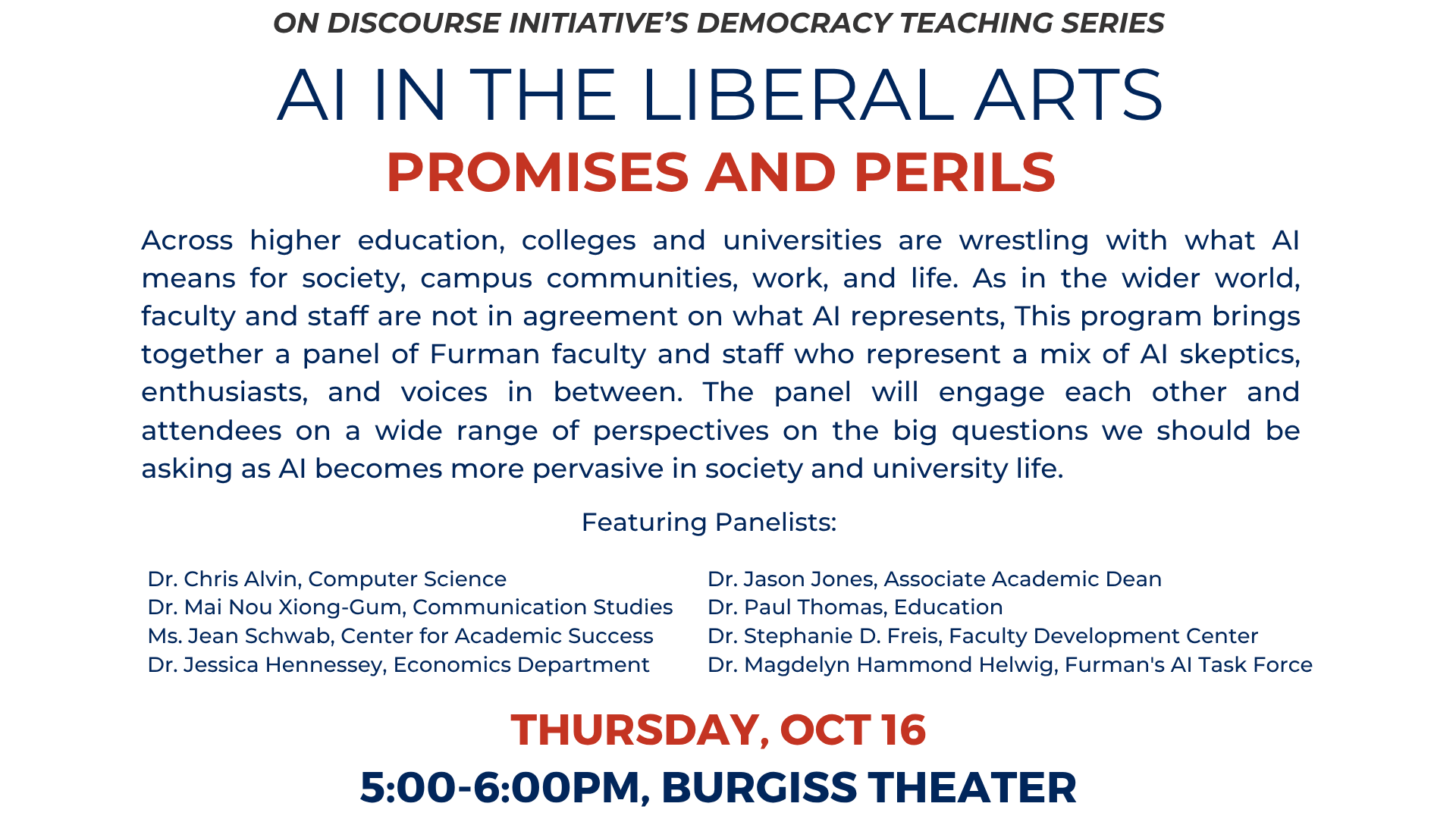
AI in the Liberal Arts: Promises and Perils

October 16 @ 5:00 pm – 6:00 pm

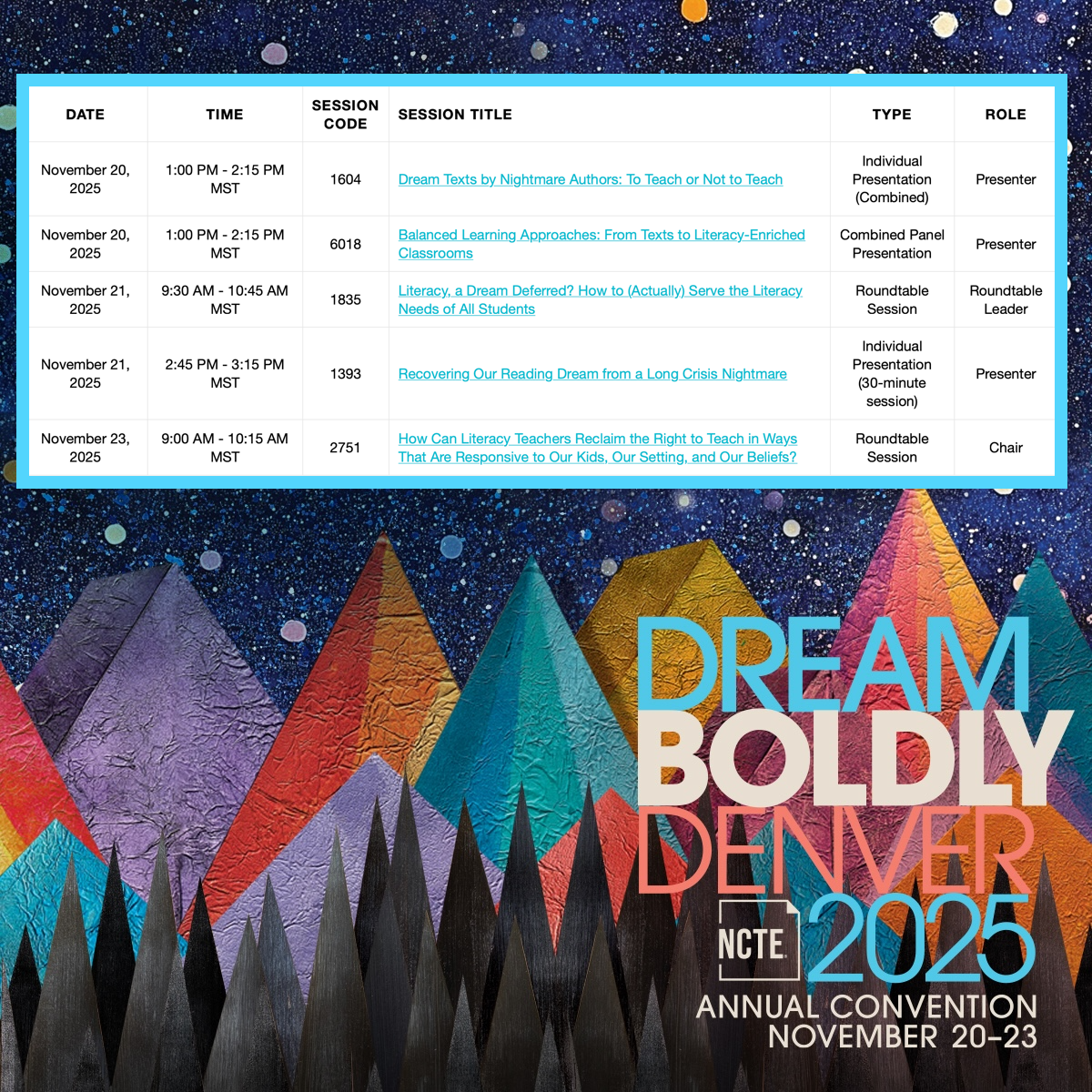
NCTE Annual Conference 2025 – Denver CO

Panel: Balanced Learning Approaches: From Texts to Literacy Enriched Classrooms

11/20/2025 – 1:00 – 2:15, Mile High Ballroom 2C

Presentation

Dream Texts by Nightmare Authors: To Teach or Not to Teach 

Access PDF of presentation HERE           

Many beloved authors have been exposed as abusive people or advocates for offensive beliefs. From the revelations about Neil Gaiman to the anti-trans stance by JK Rowling, whether to teach their works despite those failures or controversies confronts teachers throughout K-16 literacy classrooms. This session examines if and why teachers should or should not teach dream texts by nightmare authors.

Roundtable: Literacy, a Dream Deferred?: How to (Actually) Serve the Literacy Needs of All Students

11/21/2025 – 9:30 – 10:45, Room 108/110

Roundtable Presentation

Literacy and Literature as Casualties of Reading Wars

Access a PDF of the presentation HERE [Updated 11/21/25]

Reading Wars often have two overlapping components, debates about how reading should be taught and what texts students should (and should not) read. Both of these elements tend to promote ideological agendas at the expense of authentic approaches to literacy and literature.

Individual Presentation: Recovering Our Reading Dream from a Long Crisis Nightmare

11/21/2025 – 2:45 – 3:15, Mile High Ballroom 1A/1B

Access a PDF of presentation HERE

In 1961, Jacques Barzun in Tomorrow’s Illiterates declared “illiteracy is still with us.” Charles Child Walcutt added: “[N]o further ‘research’ into methods of reading instruction is necessary.” This session examines reading crisis/reform cycles to reconsider the stories told about reading and offer a new approach for reform that serves the needs of students and supports teacher professionalism.

Roundtable: How Can Literacy Teachers Reclaim the Right to Teach in Ways that are Responsive to Our Kids, Our Setting, and Our Beliefs?  

11/23/2025 – 9:00 – 10:15, Room 107/109/111

Talk

Fact Checking “The reading wars are ending. Phonics won.” (Washington Post Editorial Board)

Access a PDF of the presentation HERE [Updated]

The Editorial Board at The Washington Post published a bold claim: The reading wars are ending. Phonics won. Here, that claim is fact checked focusing on the false claim that California adopted Mississippi-style “science of reading” legislation. A brief examination of the misleading comparison of CA and MS shows that the WaPo Editorial Board has declared a false end to the reading war as well as mischaracterizing the role of phonics.

Roundtable Presentation

Education Journalism Fails Education (Again)

Access a PDF of the presentation HERE

This roundtable will share with teachers four “red flags” (Chris Ferguson) to critically engage with media coverage of educational issues and research (highlighting the “science of” coverage): RED FLAG 1: Claims that all the evidence is on one side of a controversial issue; RED FLAG 2: Reversed burden of proof. “Can you prove it’s not the smartphones?”; RED FLAG 3: Failing to inform readers that effect sizes from studies are tiny, or near zero, only mentioning they are “statistically significant.”; RED FLAG 4: Comparisons to other well-known causal effects.


WSRA 2026 Annual Conference
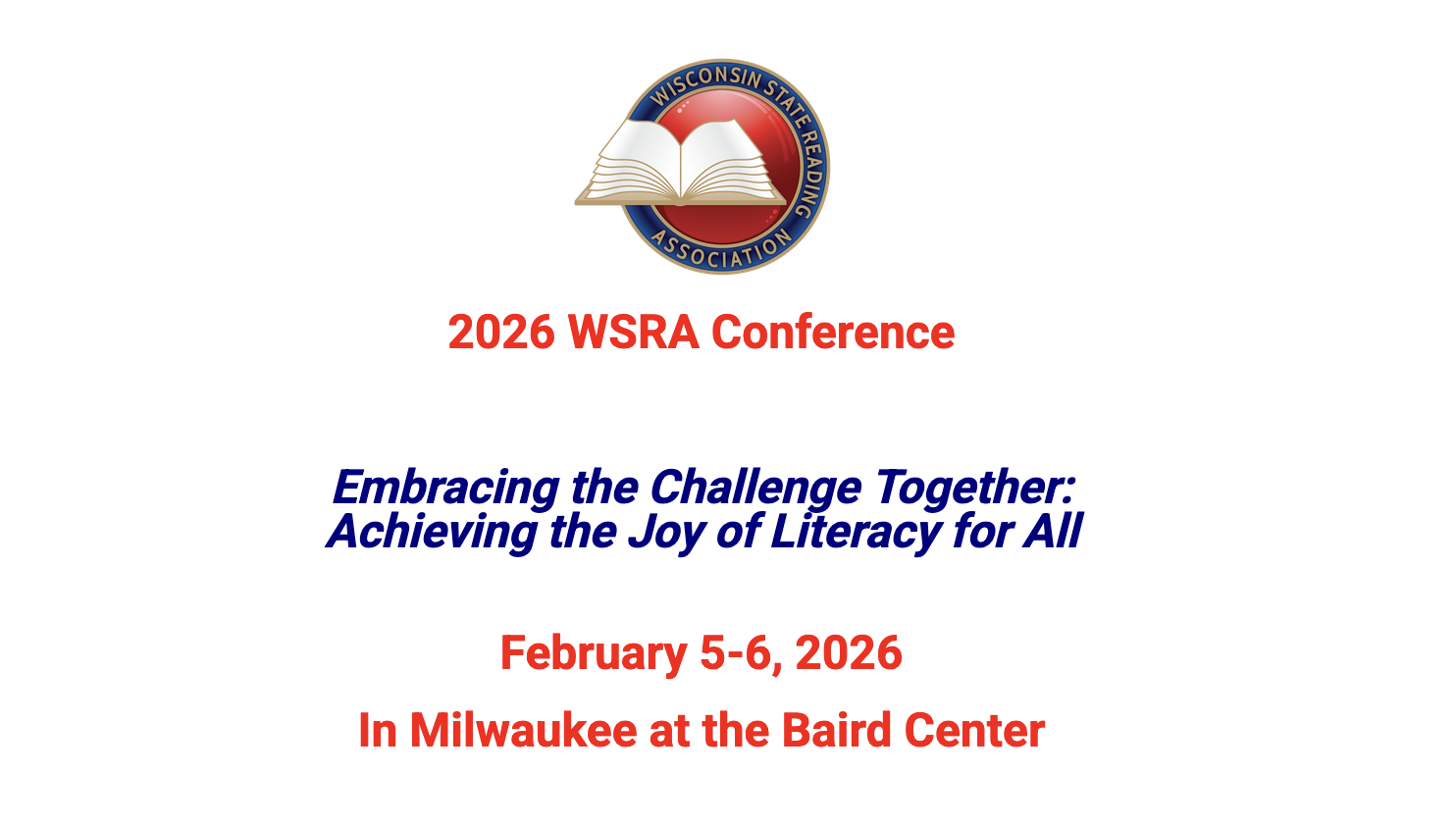
February 6, 2025

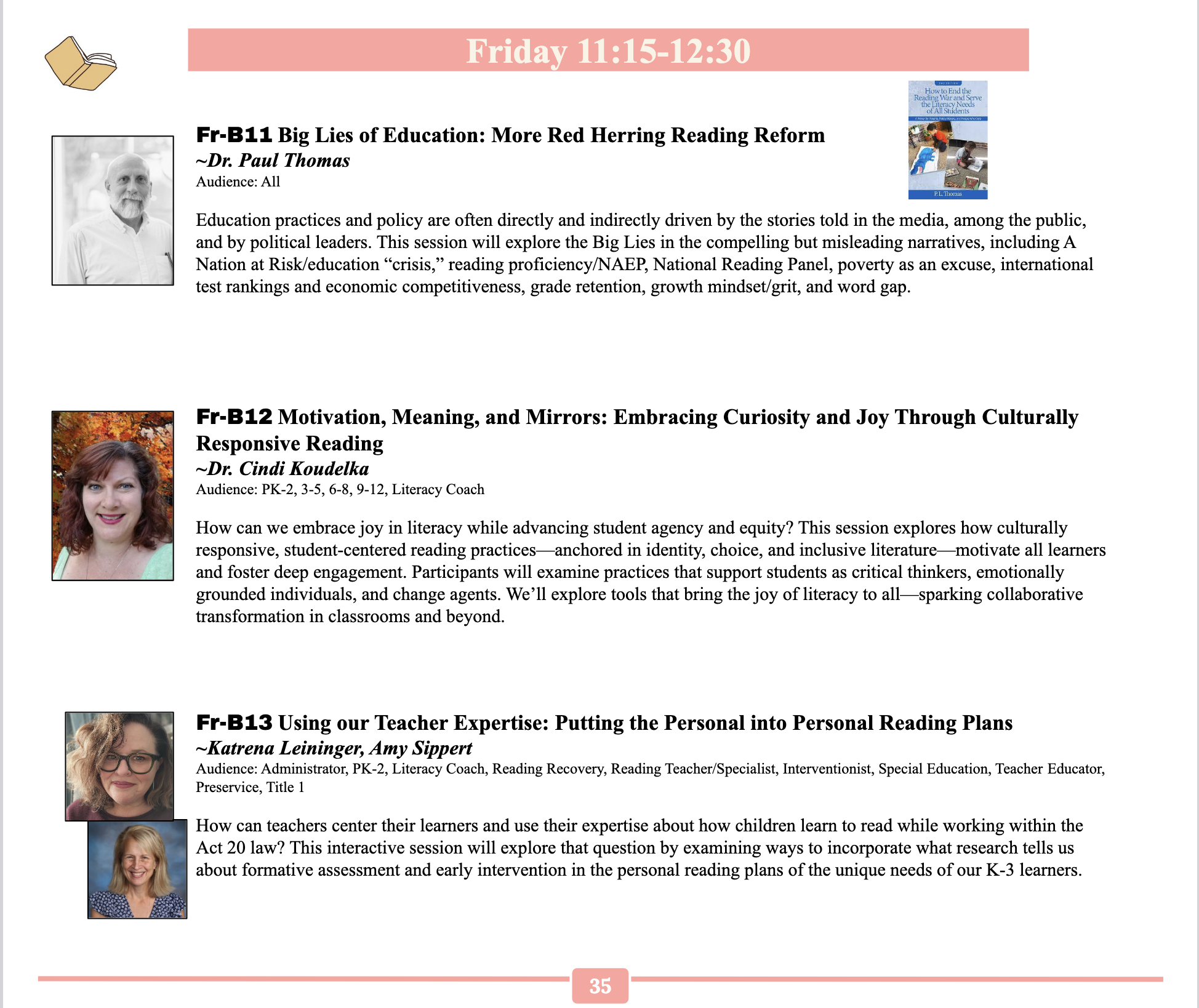
Conference Program

Session: Fri. Feb 6 from 11:15 to 12:30

Big Lies of Education: “Science of” Era Edition [Access PP PDF Here]

Education practices and policy are often directly and indirectly driven by the stories told in the media, among the public, and by political leaders. This session will explore the Big Lies in the compelling but misleading narratives, including A Nation at Risk/education “crisis,” reading proficiency/NAEP, National Reading Panel, poverty as an excuse, international test rankings and economic competitiveness, grade retention, growth mindset/grit, and the word gap.

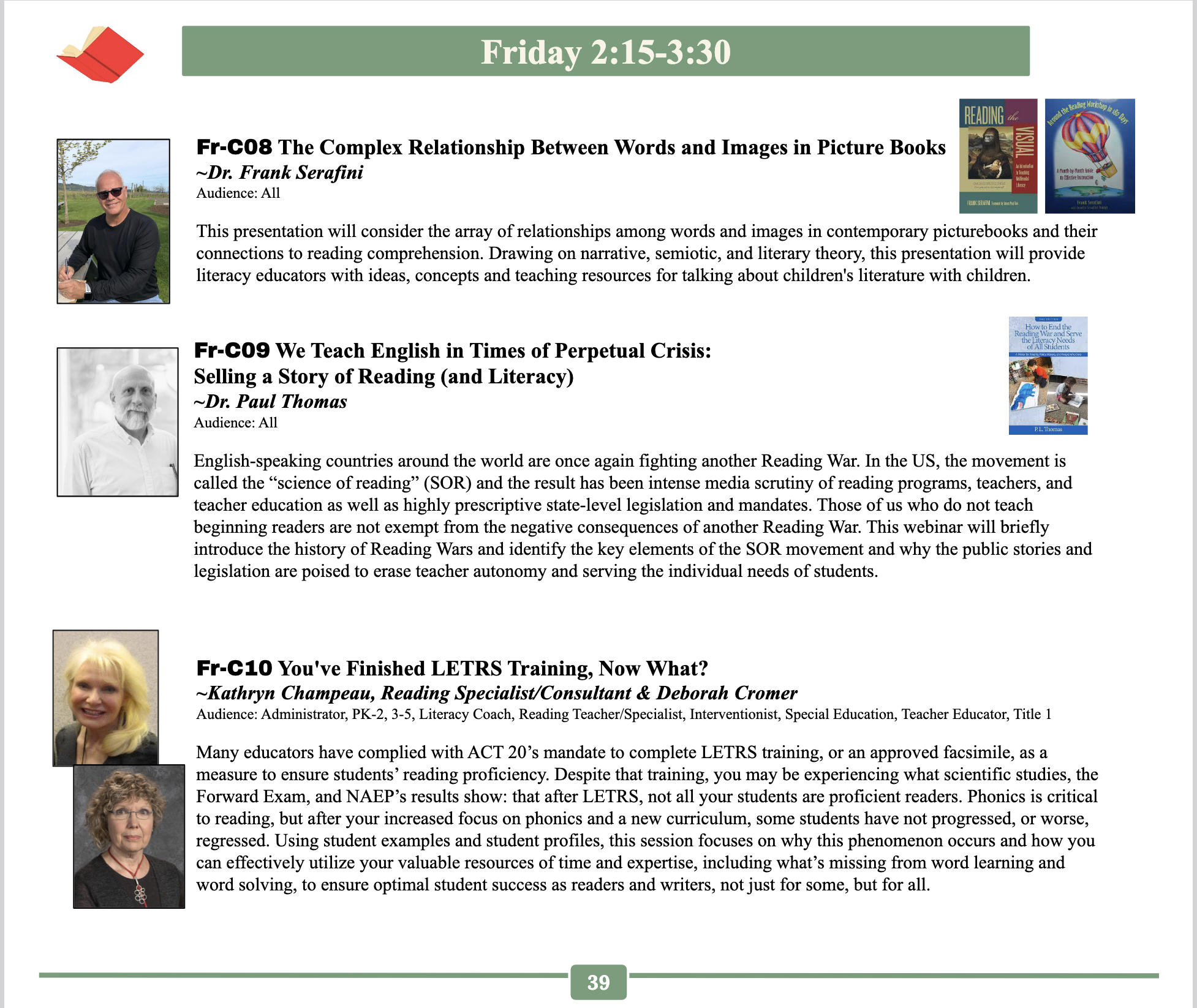
Session: Fri. Feb 6 from 2:15 to 3:30

We Teach English in Times of Perpetual Crisis: Selling a Story of Reading (and Literacy) [Companion Post]

See the presentation HERE.

English-speaking countries around the world are once again fighting another Reading War. In the US, the movement is called the “science of reading” (SOR) and the result has been intense media scrutiny of reading programs, teachers, and teacher education as well as highly prescriptive state-level legislation and mandates. Those of us who do not teach beginning readers are not exempt from the negative consequences of another Reading War. This presentation will briefly introduce the history of Reading Wars and identify the key elements of the SOR movement and why the public stories and legislation are poised to erase teacher autonomy and serving the individual needs of students.


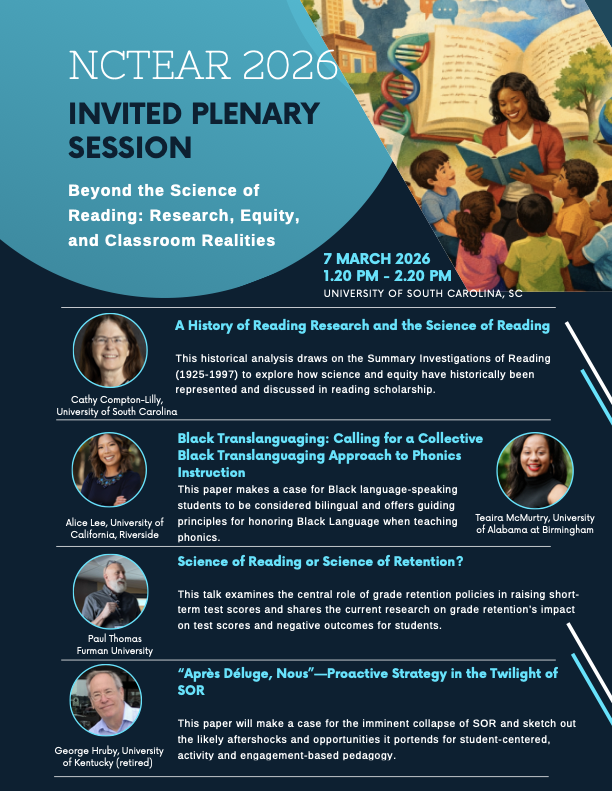
NCTEAR 2026

Pastides Alumni Center, Columbia, SC

Pleanary Session on the Science of Reading

Saturday 3/7/2026, 1:20 – 2:30
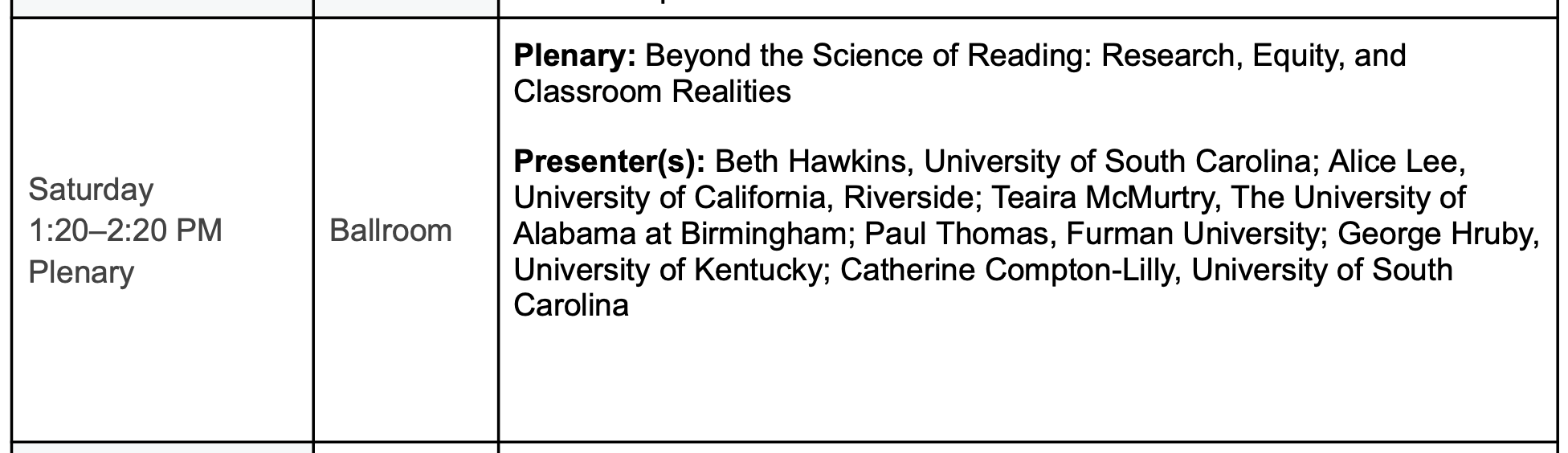
Science of Reading or Science of Retention? [follow link for PDF of PP]

P.L. Thomas, Furman University

This talk examines the central role of grade retention policies in raising short-term test scores and shares the current research on grade retention’s impact on test scores and negative outcomes for students.
Big Lies of Education: Word Gap

The story is simple and may sound obvious: Poor children suffer from a significant “word gap” (WG) when compared to middle-class and affluent children.

Miller, Sperry, and Sperry explain in A deficit story in motion: How marginalized youngsters are defined out of the educational game before they enter school:

To re-cap, the WG Story runs as follows: Parents from lower-class backgrounds do not talk enough to their children in the early years of life, in contrast to affluent European American parents who talk a great deal. This relative deficit impedes children’s vocabulary development, which, in turn, leads them to under achieve in school. It is a small step from this narrative to a rationale for intervention: If these parents could be taught to behave more like their privileged counterparts, marginalized children would develop larger vocabularies, which would boost their success in school.

As is typical in the Big Lies of Education, compelling and enduring stories do not necessarily prove to be accurate. And the resilience of Big Lies often rests on a complex matrix of causes, detailed by Miller, Sperry, and Sperry:

In sum, nearly 20 years after its inception, the WG Story had gone from academic obscurity to celebrity status. Biases of class, race, and method paved the way for this juggernaut, which gathered force with the convergence of two events, NCLB and LENA, in its Life History. The WG Story flourished by traveling back and forth between academic, policy, and public spheres, illustrating the permeability of discourses (Bakhtin,1981), and inadvertently reproducing the educational inequality it was intended to reduce.

The WG Story and its impact are driven by deficit ideologies (what most people believe regardless of empirical evidence) despite flawed methodology in the foundational research, which, according to Miller, Sperry and Sperry, “did not arise from virgin ground but rather from soil already cultivated with the language deprivation story” that began in the 1960s.

They also acknowledge the role of the media and advocacy:

But the WG Story did not remain sealed off in the academy (Bakhtin, 1981, 1986). It was widely covered in the popular press, and high-profile foundations amplified the Story by funding initiatives to close the Gap.

Again, uncritically embracing the WG Story reflects core deficit beliefs: “The most fundamental historical through-line between the WG Story and its backstory is the fixation on the language defects of marginalized families.”

There is an enduring and false set of beliefs that link deficit ideologies about social class and language: So-called nonstandard or underdeveloped literacy reflects moral and intelligence deficits in not just individual people but entire classifications of people.

In short, any person’s functional vocabulary is not a measure of that person’s character or intelligence, particularly when framed against a norm or standard based on cultural and ideological beliefs instead of valid empirical evidence.

Here, then, is the credible counter-story:


The Zombie Politics of Misinformation about Students Reading at Grade Level

[Header Photo by Daniel Lloyd Blunk-Fernández on Unsplash]

Yesterday, we had our last class session in my upper-level writing and research course that is grounded in students analyzing and evaluating how media covers a chosen education topic.

In that last class, we debriefed about what students concluded about media coverage of education. While some found the coverage valid and informative, much of the discussion focused on why media perpetuates misinformation more often than not—notably about student reading proficiency in the US.

Right on cue, then, I saw this posted on social media, Teaching reading is rocket science, with these two recurring claims that are, in fact, misleading at best and false at worst (see “Recommended” links below):

Eli’s story, and the stories of all my students, are not the exception. They represent the shared reality for two-thirds of our children, here in California and across the country since the 1990s. My students are not at risk because they cannot yet read — they are at risk because not knowing how to read limits their access to opportunities, both academically and beyond.

Research shows when we teach students to read by directly guiding them to break the code of how sounds in letters work, about 95% of them can become strong readers — including multilingual learners and those with dyslexia. So why have only one-third of our fourth graders been reading at grade level for the past three decades? This gap persists because students haven’t had access to evidence-based literacy instruction drawn from decades of vast interdisciplinary research in areas such as cognitive psychology, linguistics, communication sciences and education.

The “2/3 of students are not reading a grade level” claim is one of the most powerful recurring claims in the media. Note these high-profile examples:

Emily Hanford in APM Reports:

The stakes were high. Research shows that children who don’t learn to read by the end of third grade are likely to remain poor readers for the rest of their lives, and they’re likely to fall behind in other academic areas, too. People who struggle with reading are more likely to drop out of high school, to end up in the criminal justice system, and to live in poverty. But as a nation, we’ve come to accept a high percentage of kids not reading well. More than 60 percent of American fourth-graders are not proficient readers, according to the National Assessment of Educational Progress, and it’s been that way since testing began in the 1990s.

Nicholas Kristof in the New York Times:

One of the most bearish statistics for the future of the United States is this: Two-thirds of fourth graders in the United States are not proficient in reading.

And even a college-based literacy professor in The Conversation:

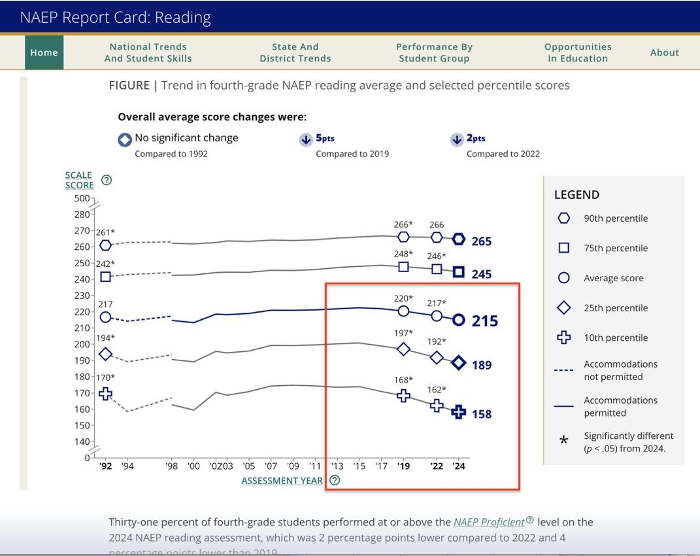
Five years after the pandemic forced children into remote instruction, two-thirds of U.S. fourth graders still cannot read at grade level. Reading scores lag 2 percentage points below 2022 levels and 4 percentage points below 2019 levels.

Despite ample evidence to the contrary and repeated clarifications from many educators and scholars (See “Big Lie” link in “Recommended” below), media characterizations of student reading proficiency continues to be misrepresented, primarily by misunderstanding NAEP achievement levels, because the public has always believed that “kids today can’t read”—despite there being little evidence of a reading “crisis” over the recurring claims of “crisis” reaching back into at least the 1940s.

Two points are important to clarify:

  1. NAEP achievement levels are confusing because “basic” is approximately what most states consider “proficient” and by implication “grade level.” NAEP “proficient” is well above grade level, set at an “aspirational” [1] level that is misleading and creates a perpetual appearance of failure for students, teachers, and schools.
  2. Most states—notably Mississippi and Louisiana—set their “proficient” level just above the mid-point of NAEP “basic” (MS) or just below (LA):
Mapping State Proficiency Standards Onto NAEP Scales, 2007–22

In short, if we consider NAEP and state assessments of reading valid, about 1/3 of students have over the last couple of decades performed below “basic” (NAEP) and thus seem to be below grade level in grade 4.

NAEP Grade 4 Reading National Trends

While the NAEP misinformation and misunderstanding is grounded in the “aspirational” use of “proficient,” the “95% of students can be on grade level” claim is just wildly overstated, and ironically, not based on scientific evidence (despite this being a refrain by the “science of” movement).

I recommend reading Can 95% of Children Learn to Read? to see some of how this claim gained its zombie status.

Historically and currently, many in the US have been and are concerned about student reading acquisition; this, of course, is a valid concern, notably that marginalized and vulnerable populations of students are disproportionately struggling to meet whatever standard we set for “proficient” or “grade level” (see HERE that explores how MS has not closed the race or socioeconomic achievement gaps, for example).

There is an insidious zombie politics to claims about 2/3 of students not reading at grade level, but that if we just did the right thing, 95% of students would read at grade level.

Since neither claim is empirically true, we must confront that basing education claims and reform on misunderstanding and misinformation have not yet worked and are unlikely to work moving forward.


Note

[1] Rosenberg, B. (2004, May). What’s proficient? The No Child Left Behind Act and the many meanings of proficiency. Washington, DC: American Federation of Teachers. https://files.eric.ed.gov/fulltext/ED497886.pdf

Recommended

“Science of Reading” Playing Numbers Games Not Supported by Science

Big Lies of Education: Reading Proficiency and NAEP

The Great Gatsby at 100: Failing Students and America

Teaching high school English has a Groundhog Day dynamic that people who have not taught may never consider.

Over my 18-year career as a teacher of high school English, I taught some works of literature more times than I’d like to admit. But let me also note that I often taught some works of literature several times a day and then year after year.

One of those works—that I in some ways loathe—is F. Scott Fitzgerald’s The Great Gatsby, which turned 100 this week in 2025.

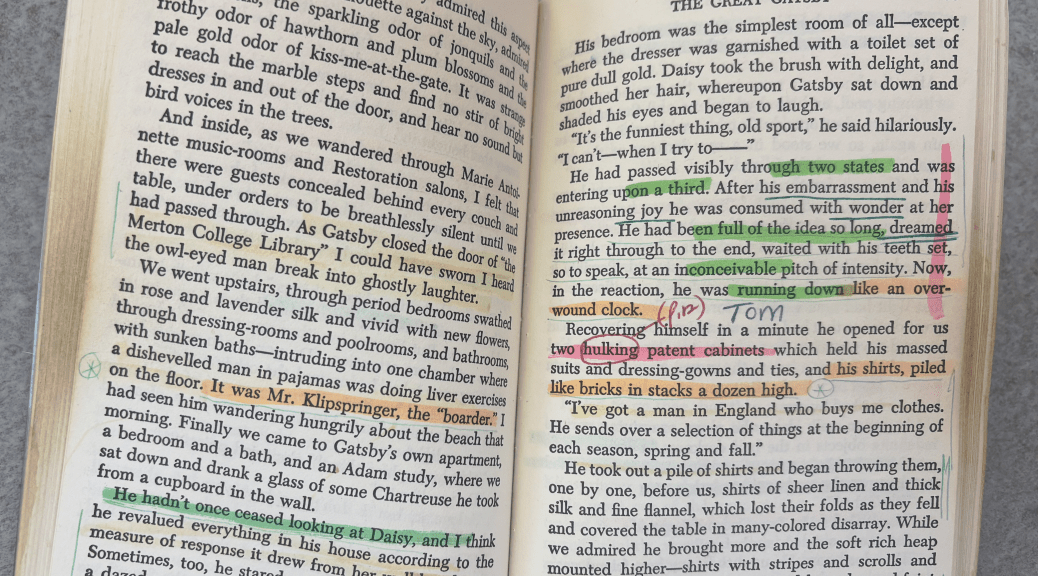
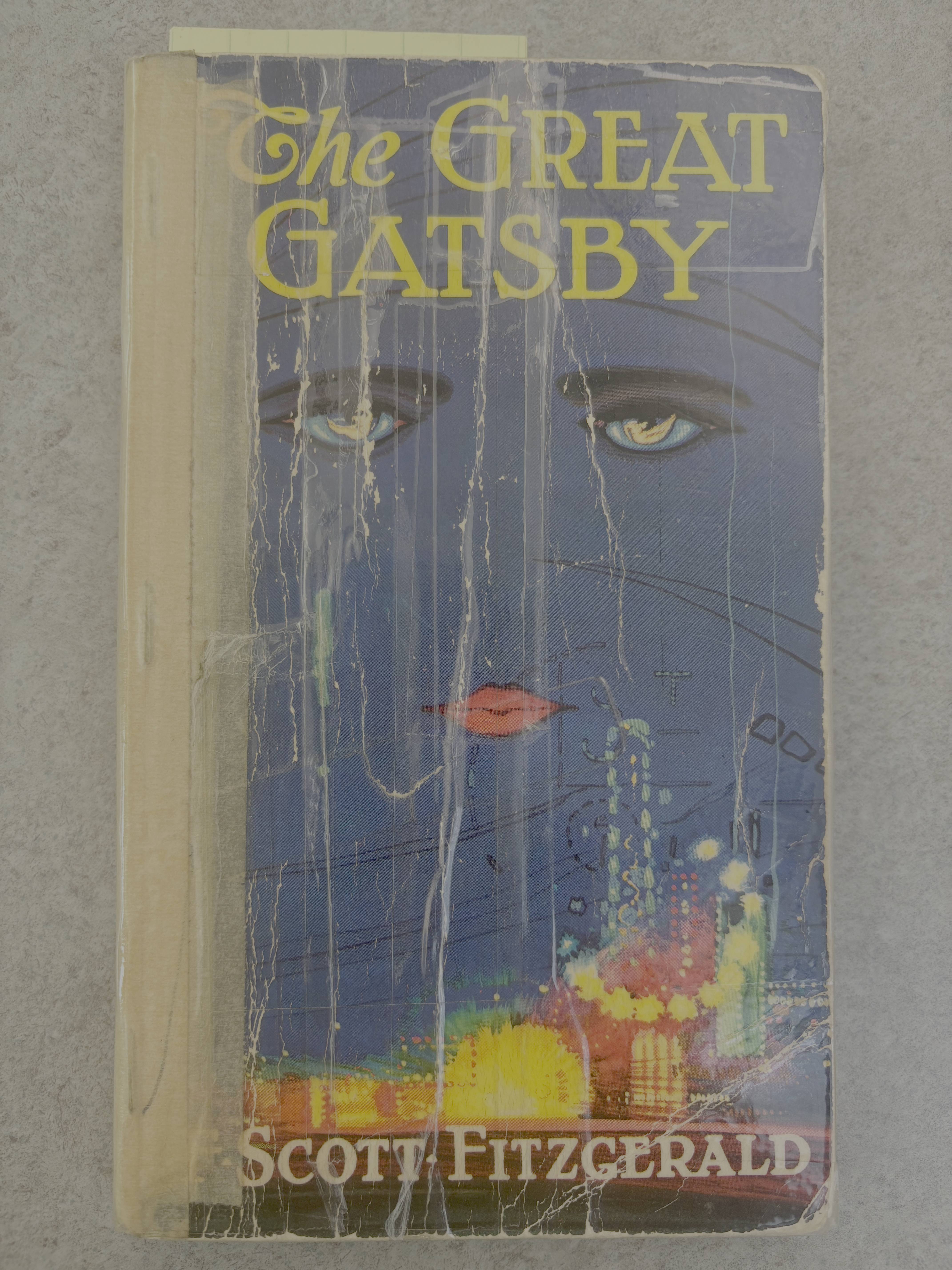
My well-worn teaching copy of The Great Gatsby used to teach high school English from 1984 until 2002.

Setting aside my own skepticism about the canon and requiring all students to read certain so-called “classics,” among the American literature works I was required to teach year after year after year—The Great Gatsby, The Scarlet Letter, The Crucible, and The Sun Also Rises at the core of those required lists—I must admit that Gatsby was often the most accessible for students (easy to read and the Robert Redford film was a great supplement to the unit).

I prefer Hemingway as a writer to Fitzgerald, but I prefer student choice and more diverse and contemporary works as well.

However, a century on and many students in the US still read and study Gatsby in high school along with a fairly conservative list of works from the slightly expanding canon of American literature.

My point here is not to crucify Gatsby or Fitzgerald or modernist literature (lots there that is worth interrogating), but to confront that how secondary (and college) teachers teach along with how students read and learn from Gatsby in traditional and reductive ways that cheat the novel, cheat students, and ultimately cheat the democratic purposes of public education in a (for now) free country.

“Gatsby Believed in the Green Light”

In a bit of ironic symbolism, if you want to see (literally) my concern about the cultural failure of Gatsby, click here: The Empire State Building is turning into a green light for The Great Gatsby’s centennial (See also It’s Gatsby’s World, We Just Live in It).

This act, of course, is a nod to the color imagery running through Gatsby, culminating in the penultimate paragraph of the novel:

Gatsby believed in the green light, the orgiastic future that year by year recedes before us. It eluded us then, but that’s no matter—tomorrow we will run faster, stretch out our arms farther … And one fine morning—

This reductive and figurative language approach to what this novel shows the reader is about more than the often mechanical way students are required and taught to analyze text (more on that next); while teachers, students, and then the public often “get” that Gatsby is about the American Dream, too often that becomes completely disconnected from the novel itself.

Partly, that happens because that next-to-the-last paragraph can become a sort of idealistic doubling-down on the American Dream that Fitzgerald pretty clearly dismantles over fewer than 200 pages.

When I taught Gatsby, in fact, I required students to read John Gardner’s bi-centennial essay, “Amber (Get) Waves (Your) of (Plastic) Grain (Uncle Sam),” where he makes a distinction that is often missed when studying Gatsby:

That idea—humankind’s inalienable right to life, liberty, and the pursuit of happiness—coupled with a system for protecting human rights—was and is the quintessential American Dream. The rest is greed and pompous foolishness—at worst, a cruel and sentimental myth, at best, cheap streamers in the rain. (p. 96)

Taking Gardner’s figurative language, then, Gatsby’s American Dream (a sort of singular obsession with wealth and Daisy) is just “cheap streamers in the rain,” what has for the most part replaced the essential American Dream—life, liberty, and the pursuit of happiness.

Fitzgerald’s own life being sold to the capitalism of Jazz Age America, both in his relentless production of short stories for income and his alcoholism and partying, sits behind the fictional dramatization of what America had become, what America kept becoming, and how America now has nearly fully erased “life, liberty, and the pursuit of happiness” for “filthy lucre” (as D.H. Lawrence warned just a year after Gatsby was published).

Two dynamics are at play here, I think.

The first is most students like Gatsby because it is short and easy to read (notably more so than reading Edgar Allan Poe or Nathaniel Hawthorne, for example); students also enjoy the melodramatic plot of the novel centered on partying, violence, and adultery.

The second is my larger concern—how we traditionally teach literature in high school through a narrow and distorted New Criticism lens.

Not to wander to deep into the weeds of literary criticism and classroom pedagogy, but most of us can recognize how often high school English classes become “guess what the English teacher wants you to say about this text”—and that guess often includes some literary technique, what I call the “literary technique hunt.”

For high school teachers and students, then, Gatsby become likes most texts being studied—a vehicle for identifying techniques.

Students begin what amounts to an Easter egg hunt; there’s lots of green and yellow (gold) throughout the novel (hint: money), and the job students have is to find the color and identify the symbolism. (It’s how we ruin poetry, for example.)

About mid-way through the novel, Daisy encounters Gatsby’s “‘beautiful shirts'” (her own Easter egg hunt), and readers encounter the green light:

“If it wasn’t for the mist we could see your home across the bay,” said Gatsby. “You always have a green light that burns all night at the end of your dock.”…

Now it was again a green light on a dock. His count of enchanted objects had diminished by one.

I want to emphasize here, I am not blaming high school English teachers necessarily because the “literary technique hunt” is a consequence of how formal public education has been reduced to testing (easier to test students finding and identifying literary terms than having them do complex analysis of texts) and teachers and schools are expected to be non-political.

The reductive New Criticism of high school English classes seems objective, then, and offers what appears to be a fixed way to assess students.

It is frustrating, however, that Gatsby is reduced to color imagery and symbolism while most of the racism and bigotry are skirted over or ignored entirely.

“They Were Careless People, Tom and Daisy”

Not that I want to “save” Gatsby on its centennial anniversary, but I am particularly invested in literature and how we teach it (and how we often ruin it for students)—and I am also deeply committed to the role of literature/literacy in our democracy, which is currently in Hospice.

But if we could set aside our reductive New Criticism approaches, and then shift our focus away from Nick and Gatsby and toward Tom and Daisy, we could make Gatsby work for our students and for this country that we seem uninterested in saving.

In the last pages, Nick explicates Tom, and Daisy:

I couldn’t forgive him or like him, but I saw that what he had done was, to him, entirely justified. It was all very careless and confused. They were careless people, Tom and Daisy—they smashed up things and creatures and then retreated back into their money or their vast carelessness, or whatever it was that kept them together, and let other people clean up the mess they made … .

Fitzgerald showed us 100 years ago that America was a wasteland, a product of “vast carelessness.”

Because of our idealism, “our rigid refusal to look at ourselves,” we have chosen to walk to the precipice of America no more.

We seem eager and even gleeful to have chosen “cheap streamers in the rain.”

This is not who we have become, this is who we always were.


Recommended

‘No one had the slightest idea what the book was about’: Why The Great Gatsby is the world’s most misunderstood novel

Gatsby’s Secret

Recommended: Why We Cannot Go Back to Basics (Rethinking Schools)

[Header Photo by Element5 Digital on Unsplash]

Note

The article below appears in Rethinking Schools and brings together several problems with and connections between the “science of reading” and book banning/censorship movements that I have been address since 2018.


Why We Cannot Go Back to Basics: Reclaiming The Right to Teach Literacy, Daniel Ferguson, Laurie Rabinowitz, and Amy Tondreau

Although the “culture war” and “reading war” have been described as separate causes promoted by disparate organizations, their stories are more connected than they appear. Both book banning and SoR dogmatism limit what teachers can teach and what students can read, narrowing the ability of public schools to address children’s diverse needs. We see this most explicitly in conservative parent groups, including Moms for Liberty, who have made it clear they endorse both. This should be a wake-up call to critically examine the potential impact of phonics-based policies on public school students and teachers. 


Recommended

SOR Movement Maintains Conservative Assault on Teachers and Public Schools [Updated]

Beware Scripted Curriculum: More Trojan Horse Education Reform

Big Lies of Education: National Reading Panel (NRP)

We Teach English in Times of Perpetual Crisis: Selling a Story of Reading (and Literacy) [Webinar Companion Post]

Recommended: The Balancing Act by Dominic Wyse and Charlotte Hacking

Thomas, P.L. (2024, March). We teach English in times of perpetual crisis: The long (and tedious) history of reading crisis. English Journal, 113(4), 21-26. https://publicationsncte.org/content/journals/10.58680/ej2024113421

Thomas, P.L. (2024, May). Teaching English in the “science of reading” era: We teach English in times of perpetual crisis: Selling a story of reading. English Journal, 113(5), 16-22. https://publicationsncte.org/content/journals/10.58680/ej2024113516 [Access HERE until open access at EJ]

Thomas, P.L. (2024, September). We teach English in times of perpetual crisis: The media continue to misread teaching reading and literacy. English Journal, 114(1), 14-19. https://publicationsncte.org/content/journals/10.58680/ej2024114114 [Access HERE until open access at EJ]

Thomas, P.L. (2024, November). We teach English in times of perpetual crisis: For all ELA teachers, “the time is always now.” English Journal, 114(2), 21-26. https://publicationsncte.org/content/journals/10.58680/ej2024114221 [Access HERE until open access at EJ]

Thomas, P.L. (2023). The “science of reading,” education faddism, and the failure to honor the intellectual lives of all children: On deficit lenses and ignoring class and race stereotyping. Voices in the Middle, 30(3), 17-21. https://publicationsncte.org/content/journals/10.58680/vm202332439

The Science of Reading Movement: The Never-Ending Debate and the Need for a Different Approach to Reading Instruction (policy brief) – NEPC


Misreading Reading Scores (Again) [Unpublished OpEd Submission]

[This piece has been submitted to national newspapers with no responses.]

[Header Photo by Kelly Sikkema on Unsplash]

Every two years reading scores make headlines. And this year, as has been the case since COVID, the news is not good. Scores are down (again), and the causes being pointed to for the drop are also wrong (again).

National Assessment of Educational Progress (NAEP) is the national program mandated with tracking student achievement. The 2024 results reveal that reading scores have hit their lowest point in 32 years. This decline is notable because in recent years many states have passed aggressive reading legislation, often labeled as the “science of reading” (SOR).

The SOR movement makes a few key claims: the US has a reading crisis, teachers fail to use “scientific” evidence for instruction, and educators and policymakers are making excuses by acknowledging poverty when addressing low reading proficiency.

When 2019 NAEP reading scores were released, Mississippi was proclaimed a “miracle” state for improving grade 4 reading scores despite being a high-poverty state, implying (without evidence) that those increases were caused by Mississippi implementing SOR policy. In the years that followed, the Mississippi “miracle” became the poster child for other states following the SOR legislative formula; to date 40 states and the District of Columbia have passed SOR legislation.

However, the Mississippi “miracle” story was an incomplete misreading of reading proficiency and policy.

With the average 2024 NAEP reading scores in further decline, the SOR era in reading reform appears to be failing. This is especially true for vulnerable students whose scores have dropped the most. Interpreting these scores correctly is key to forging a better path forward.

Thus, we must seek a more credible story about 2024 NAEP reading scores.

Let’s consider three sets of data from the Department of Defense schools (DoDEA), Florida, and Mississippi. These student populations include significant racial and socioeconomic diversity as well as multilingual learners and other vulnerable populations of students.

Florida and Mississippi have long been applauded for aggressive education and reading reform, and in 2024, their grade 4 reading scores remained in the top 25% of states, seemingly defying the odds. But Florida and Mississippi scored again well below top-scoring DoDEA schools.

Although many rush to ascribe this success to SOR policies, we should really be looking at a different (ultimately harmful) policy: third-grade retention based on state testing.

As education analysts John Westall and Amy Cummings concluded in a report on reading policy: “[S]tates whose policies mandate third-grade retention see significant and persistent increases in high-stakes reading scores in all cohorts…. [T]here is no consistent evidence that high-stakes reading scores increase in states without a retention component.”

In other words, by holding back the lowest performing students in third grade, grade 4 scores appear higher. Florida and Mississippi retain thousands of K-3 students annually.

Inflated scores are not learning; by eighth grade NAEP reading scores for Florida and Mississippi drop into the bottom 25% of states. The widely applauded “gains” in grade 4 are, in fact, a mirage.

Here is a different story: DoDEA schools are the top-scoring schools on NAEP tests and tell a story we’ve resisted admitting in the US. Maroun and Tieken found in 2024, replicating decades of similar research, that 60+% of student test scores are not linked to teacher quality, instruction, or programs but to out-of-school factors like socioeconomic background, home environment, and parental involvement to name a few.

While DoDEA schools have significant populations from poor and working-class backgrounds and serve diverse as well as vulnerable populations of children, these students have healthcare, food security, stable housing, and parents with stable work—and consistently high reading scores.

NAEP reading scores, again, are not a story about teacher and reading program failure or even student reading proficiency. These scores tell a complex story about a long history in the US of negligence, the lack of political will to address not only the education of all our children, but also their lives outside of school.

Misreading the Outlier Distraction: Illiteracy Edition Redux

[Header Photo by Adam Winger on Unsplash]

Arthur Young graduated from high school with honors. However, as an adult, he was illiterate.

Literacy expert Helen Lowe featured Young and concluded:

Arthur could not read, even at a primer level. He could not drive a car, because he could not pass the test for a driver’s license; he could not read the street signs or traffic directions. He was unable to order from the menu in a restaurant. He could not read letters from his family and he could not write to them. He could not read the mixing directions on a can of paint or the label on a shipment of sheet rock. He had been cheated.

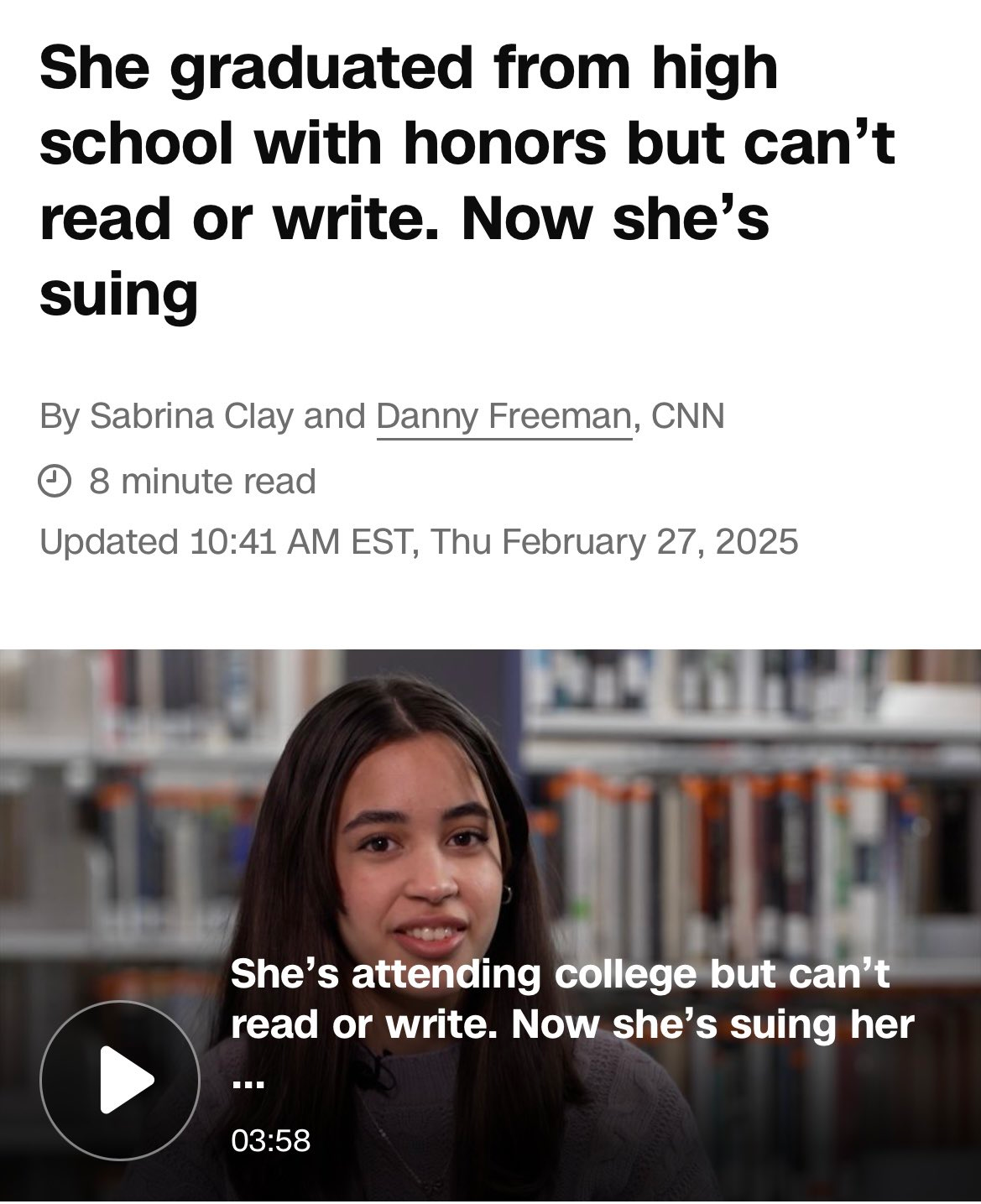
This story may be shocking but also sounds disturbingly familiar to a recent story on CNN:

This young woman, of course, has also been “cheated.”

But here is something important to acknowledge: The dramatic story of Young is from 1961 as part of a book on the illiteracy crisis in the US, Tomorrow’s Illiterates: The State of Reading Instruction Today.

Both problematic stories seven decades apart are outlier narratives that are both inexcusable failures but are not evidence of any generalizations about education, teaching, or literacy.

Stated bluntly, outliers can never lead to any sort of generalizations.

One of the great failures of public discourse and policy around reading and literacy in the US has been perpetual crisis rhetoric used to drive ideological agendas about what counts as literacy and how best to teach children and young adults to read and write.

If you had a time machine, you could visit any year over the past century in the US and discover that “kids today” can’t and don’t read because the education system is failing them.

These histrionic stories are compelling because they often include real children and adults whose lives have been reduced because of their illiteracy or inadequate literacy.

Ideally, of course, no person in the richest and most powerful country in the world should ever be cheated like that.

But here is the paradox: These outlier stories are distractions from doing the reform and work needed to approach all children and adults being literate.

Once again, reading test data for decades has shown exactly the same reality as all other forms of tests of student learning (math, science, civics, etc.): Over 60% of test scores are causally linked to factors beyond the walls of schools—access to healthcare, food security, housing security, access to books in the homes and communities, and thousands of factors impacting the lives and learning of children.

At best, teacher impact on measurable student literacy is only about 1-14%.

Yet, year after year, decade after decade, the US focuses on teacher quality, curriculum and standards, reading programs, and reading test scores without acknowledging or addressing the overwhelming impact of out-of-school factors on people acquiring the literacy they need and deserve to live their full humanity.

The two stories seven decades apart from above are likely far more complicated than any coverage could detail; the are both compelling and upsetting human stories that deserve our attention, in order to address their individual tragedies as well as taking greater care that others do not suffer the same fate.

However, misreading outlier distractions is not the way to honor that these people have been cheated.

Two things can be true at once: Outlier stories are heartbreaking and inexcusable; however, they prove nothing beyond the experiences they detail.

CNN uses outlier stories for traffic and profit.

Literacy ideologues use outlier stories to drive their agendas as well as to feed the education market.

We are all cheated, once again, when we play the outlier distraction game and refuse to acknowledge and address the crushing realities of inequity in the lives and learning of children.

Each child matters, and all children matter.

Yet, only the adults have the political and economic power to make that a reality.

The “Science of Reading” Ushers in NAEP Reading Decline: Time for a New Story

With the release of the 2024 NAEP reading results, a disturbing new story is developing:

The media has long been obsessed with reading in the US, crying “crisis” every decade over the past century. The most recent media-based reading crisis has prompted aggressive and new reading legislation reaching back over a decade, policy and programs identified as the “science of reading” (SOR).

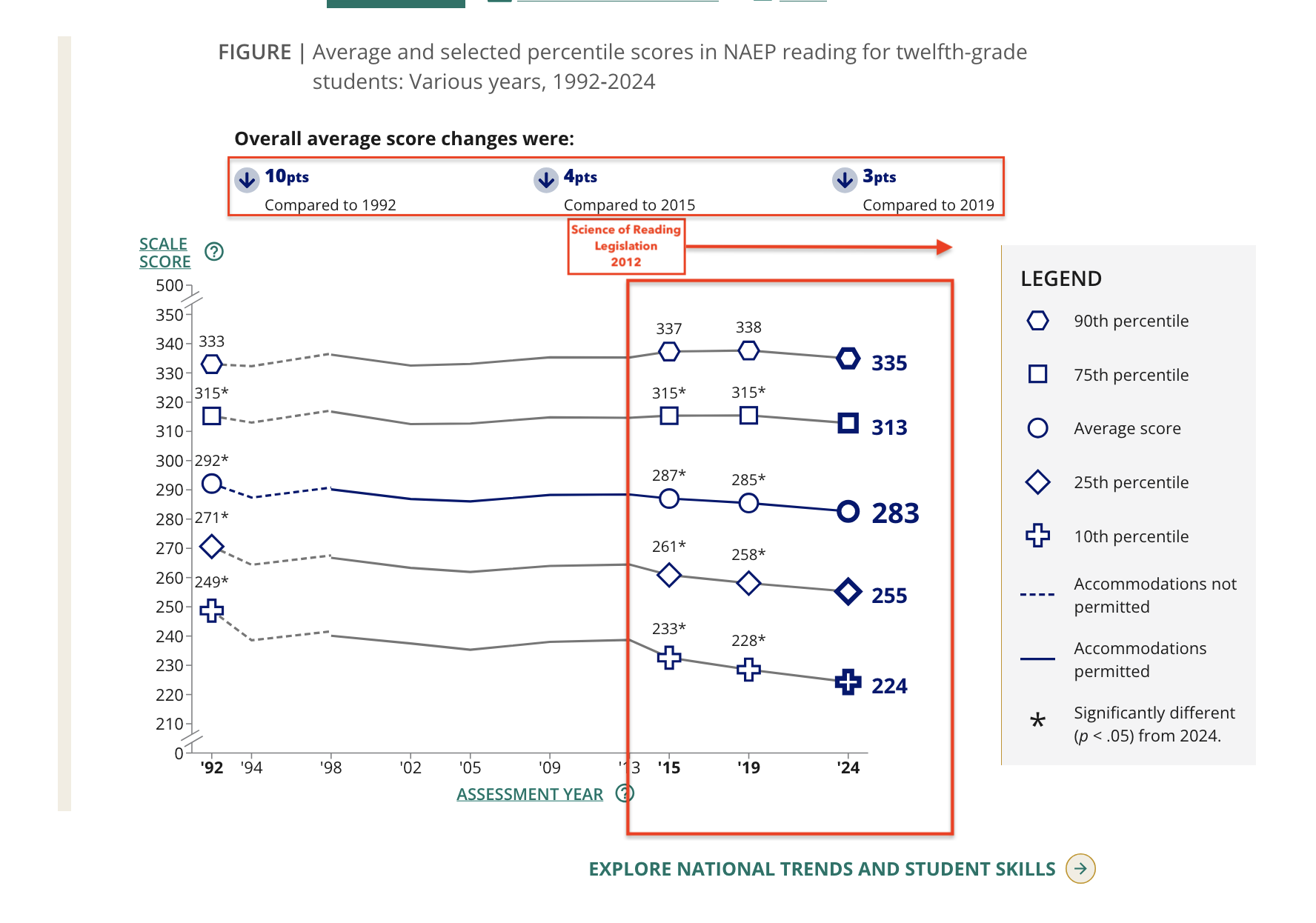
The hand wringing over the 2024 NAEP reading results, however, seems to focus on learning loss and post-Covid consequences—not that reading achievement on NAEP was flat during the balanced literacy era and now has dropped steadily during the SOR era:

The senior cohort in the 2024 NAEP reading scores represent the SOR era begun in 2012.

Suddenly, media appears to forget that the SOR movement was built on a series of baseless claims: the US has a reading crisis (despite NAEP score being flat for decades) because teachers do not know how to teach reading and rely on failed reading programs and balanced literacy.

The foundational claim of the SOR movement has been firmly discredited: “[T]here is no indisputable evidence of a national crisis in reading, and even if there were a crisis, there is no evidence that the amount of phonics in classrooms is necessarily the cause or the solution.”

But a key element of the SOR story is often overlooked: “One of the excuses educators have long offered to explain America’s poor reading performance is poverty.”

In other words, the SOR story argues that the US has a reading crisis that is entirely the result of in-school policies and practices, that SOR-based reading instruction guarantees 95%+ of students will achieve reading proficiency.

How then is the recent 5-year decline in NAEP scores being blamed on out-of-school factors, Covid learning loss? The story being sold is such blame is merely an excuse.

The problem here is that the entire SOR story is a series of misrepresentations and ideological claims not grounded (ironically) is research or evidence.

As I have noted, NAEP achievement levels are confusing since “proficient” is well above grade level and “basic” tends to correlate with most state metrics for “proficient” (see here for a full explanation and state/NAEP correlations).

However, journalists persists is misrepresenting NAEP scores in order to feed their manufactured “crisis” story: Two-Thirds of Kids Struggle to Read, and We Know How to Fix It.

With the release of 2024 NAEP scores on reading, we have an opportunity to embrace a different story, a credible story, by examining scores from Department of Defense (DoDEA) schools as well as Mississippi and Florida.

First, note that DoDEA schools again are the top scoring schools in grade 4 reading, but MS and FL rank in the top 25% of states despite challenging populations of students being served (both states appear to be outliers defying the odds):

Both MS and FL have been praised for their reading and education reform; however, there are two parts to this “miracle” story that are often left out, that show there is a mirage, not a miracle.

First, MS and FL join many states that have enacted SOR reading reform over the past decade-plus, yet the research on that reading reform highlights something other than reading instruction or programs.

Westall and Cummings concluded in a report on reading policy: “[S]tates whose policies mandate third-grade retention see significant and persistent increases in high-stakes reading scores in all cohorts…. [T]here is no consistent evidence that high-stakes reading scores increase in states without a retention component [emphasis added].”

States implementing K-3 grade retention are gaming the system by pulling out the lowest performing students and then re-inserting them into the testing population when older.

In fact, MS has been retaining about 9000-10,000 K-3 students a year since 2014, and FL retains about 17,000 students annually. [1]

Beyond the impact of grade retention on test scores, we should also ask: If SOR “works,” why do states continue to retain about the same number of students per year?

But NAEP also tells a story about SOR that has been ignored for years. Both MS and FL rank in the top 25% of grade 4 but the bottom 25% by grade 8 while DoDEA remains the top scoring schools in both grades:

Grade retention creates a mirage of achievement in grade 4 that disappears by grade 8, further evidence that SOR is not working at either grade.

Reading achievement as measured on testing has never been about reading instruction, teacher quality, or reading programs.

DoDEA school reading achievement is a testament to what research has shown for decades about student achievement:

Almost 63% of the variance in test performance was explained by social capital family income variables….The influence of family social capital variables manifests itself in standardized test results. Policy makers and education leaders should rethink the current reliance on standardized test results as the deciding factor to make decisions about student achievement, teacher quality, school effectiveness, and school leader quality. In effect, policies that use standardized test results to evaluate, reward, and sanction students and school personnel are doing nothing more than rewarding schools that serve advantaged students and punishing schools that serve disadvantaged students.

DoDEA student populations are diverse, often coming from impoverished and working class backgrounds; these schools also serve vulnerable and challenging populations of students.

However, teacher pay is high, and those students have healthcare, food and housing security, and parents with stable work.

DoDEA students almost all have the advantages mostly afforded children living in privilege so that how and what they are taught can matter.

If reading and literacy matter—and they do—and education matters in the US, we are well past blaming teachers, declaring false “miracles,” and jumping on the reading program merry-go-round once again.

Students must have their lives addressed so that their education can serve them well.

NAEP scores tell us little about reading (or math), but confirms again and again that the US is a country determined to ignore the corrosive impact of inequity on the lives and education of children.


Update

Media has only one story—a false one—about outliers in NAEP scores. Compare the coverage of MS in 2019 with LA 2024:

[1] Note that in the early 2000s, FL was the “miracle” state and established the Florida Model that essentially became the MS “miracle.”

Next up is Louisiana, and most of the coverage is claiming LA’s success is because the state has copied MS.

And a part of the lineage is more grade retention. Here are the currently available data on LA grade retention:

Big Lies of Education: Grade Retention

Update [November 2025]

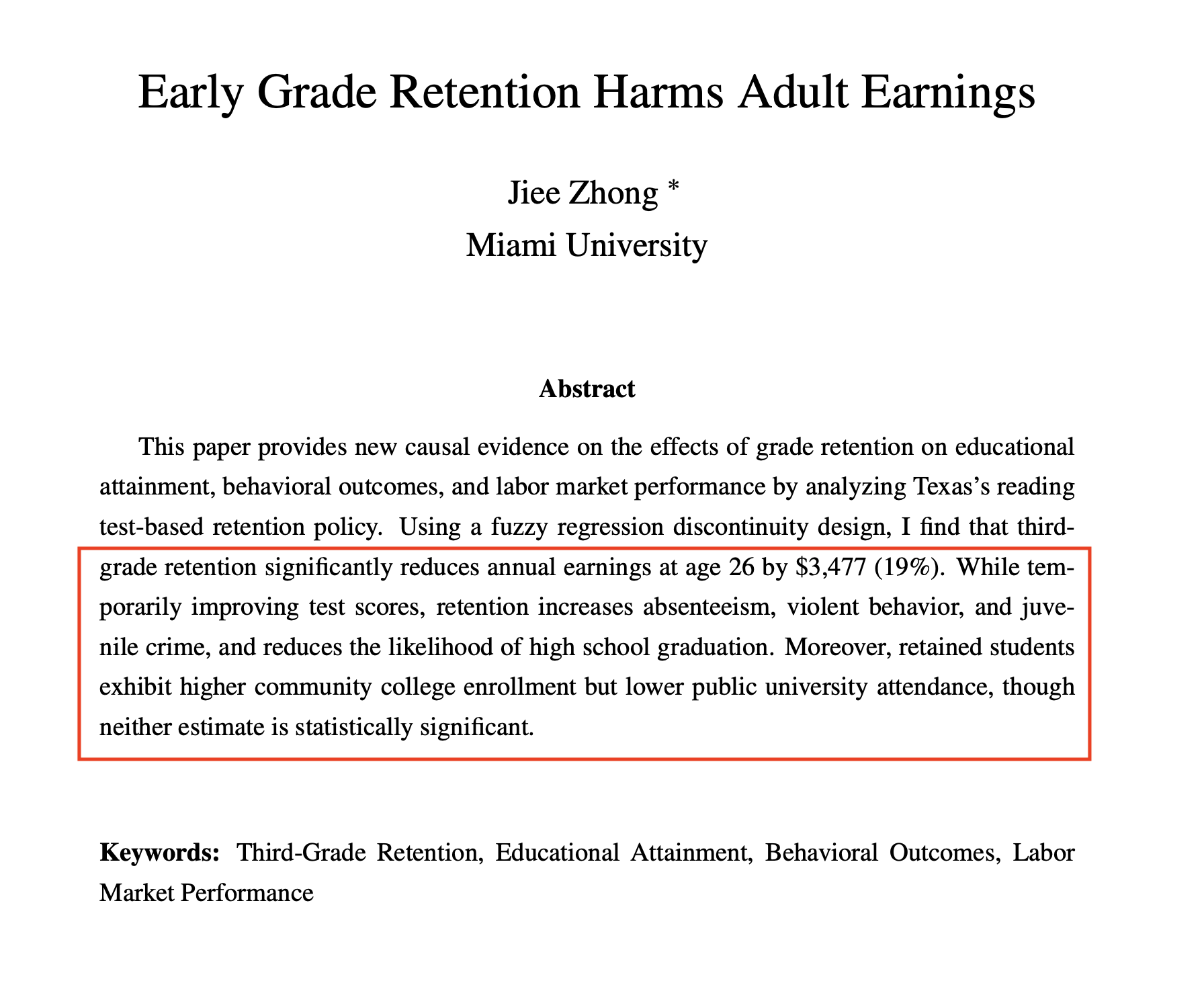
Early Grade Retention Harms Adult Earnings, Jiee Zhong [access PDF HERE]

See also: American Economic Journal: Applied Economics (Forthcoming)


The Big Lie of grade retention in the US is that it is often hidden within larger reading legislation and policy, notably since the 2010s:

The Effects of Early Literacy Policies on Student Achievement, John Westall and Amy Cummings

Westall and Cummings, in fact, have recently found:

  • Third grade retention (required by 22 states) significantly contributes to increases in early grade high-stakes assessment scores as part of comprehensive early literacy policy.
  • Retention does not appear to drive similar increases in low-stakes assessments.
  • No direct causal claim is made about the impact of retention since other policy and practices linked to retention may drive the increases.

However, their analysis concludes about grade retention as reading reform :

Similar to the results for states with comprehensive early literacy policies, states whose policies mandate third-grade retention see significant and persistent increases in high-stakes reading scores in all cohorts. The magnitude of these estimates is similar to that of the “any early literacy policy” estimates described in Section 4.1.1 above, suggesting that states with retention components essentially explain all the average effects of early literacy policies on high-stakes reading scores. By contrast, there is no consistent evidence that high-stakes reading scores increase in states without a retention component.

Therefore, one Big Lie about grade retention is that it allows misinformation and false advocacy for the recent “science of reading” reform across most states in the US.

To be blunt, grade retention is punitive, impacts disproportionately minoritized and marginalized students, and simply is not “reading” reform [1]:

Since grade retention in the early grades removes the lowest scoring students from populations being tested and reintroduces them biologically older when tested, the increased scores may likely be from these population manipulations and not from more effective instruction or increased student learning.

Evidence from the UK, for example, suggests that skills-based reading testing (phonics checks) that count as “reading” assessment strongly correlate with biological age (again suggesting that test scores may be about age and not instruction or learning):

Another Big Lie about grade retention is that reading reform advocates fail to acknowledge decades of evidence that grade retention mostly drives students dropping out of school and numerous negative emotional consequences for those students retained.

Consequently, NCTE has a resolution rejecting test-based grade retention:

Resolved, that the National Council of Teachers of English strongly oppose legislation mandating that children, in any grade level, who do not meet criteria in reading be retained.

And be it further resolved that NCTE strongly oppose the use of high-stakes test performance in reading as the criterion for student retention.

Grade retention, then, is an effective Big Lie of Education because it allows misinformation based in test-score increases to promote policy and practices that fail to increase test scores in sustained ways (see the dramatic drop in “success” for “high-flying” states such as Mississippi and Florida, both of which taut strong grade 4 reading scores, inflated by grade retention, but do not sustain those mirage gains by grade 8).

Grade retention is a Big Lie of education reform that punishes minoritized and marginalized students, inflates test scores, and fuels politicized education reform.

In short, don’t buy it.

Recommended


Note [Updated]

[1] Consider that states retaining thousands of students each year, such as Mississippi, have not seen those retention numbers drop, suggesting that the “science of reading” reforms are simply not working but the retention continues to inflate scores.

The following data from Mississippi on reading proficiency and grade retention exposes that these claims are misleading or possibly false:

2014-2015 – 3064 (grade 3) – 12,224 K-3 retained/ 32.2% proficiency

2015-2016 – 2307 (grade 3) – 11,310 K-3 retained/ 32.3% proficiency

2016-2017 – 1505 (grade 3) – 9834 K-3 retained / 36.1 % proficiency

2017-2018 – 1285 (grade 3) – 8902 K-3 retained / 44.7% proficiency

2018-2019 – 3379 (grade 3) – 11,034 K-3 retained / 48.3% proficiency

2021-2022 – 2958 (grade 3) – 10,388 K-3 retained / 46.4% proficiency

2022-2023 – 2287 (grade 3) – 9,525 K-3 retained/ 51.6% proficiency

2023-2024 – 2033 (grade 3) – 9,121 K-3 retained/ 57.7% proficiency

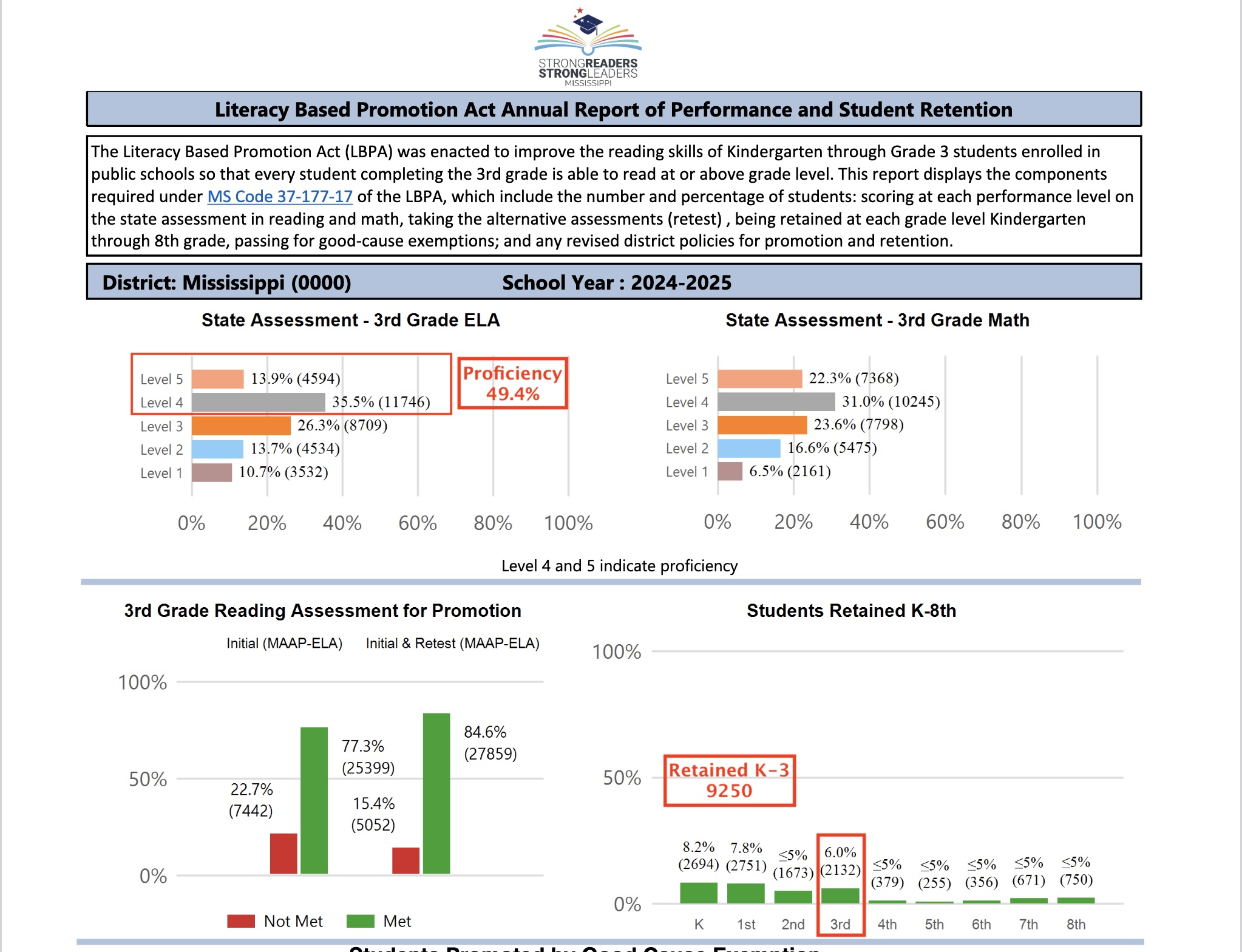
2024-2025 – 2132 (grade 3) – 9250 K-3 retained/ 49.4% proficiency

Update [January 2026]

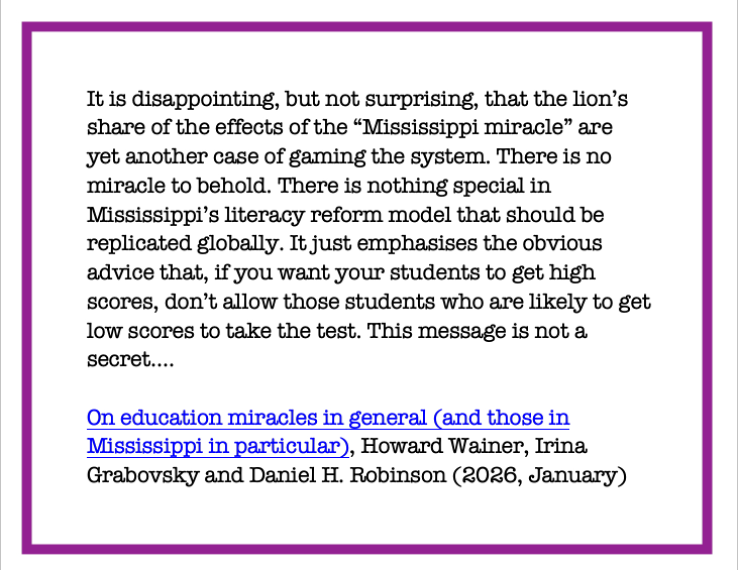
On education miracles in general (and those in Mississippi in particular), Howard Wainer, Irina Grabovsky and Daniel H. Robinson


Education Journalism Fails Education (Again): “News media often cater to panics”

[Header Photo by Markus Spiske on Unsplash]

“The available research does not ratify the case for school cellphone bans,” writes Chris Fergusonprofessor of psychology at Stetson University, adding, “no matter what you may have heard or seen or been [told].”

What Ferguson then offers is incredibly important, but also, it exposes a serious lack of awareness by Kappan considering their coverage of education:

And the media treatment has played a part in amplifying what can only be described as a moral panic about phones in schools.
 
One recent New York Times article begins with the sentence, “Cellphones have become a school scourge.” 
 
Can we expect objective coverage to follow?
 
News media often cater to panics, neglecting inconvenient science and stoking unreasonable fears. And this is what I see happening with the issue of cellphones in schools.

First, Ferguson’s characterizations of media coverage of education—”News media often cater to panics”—is not only accurate but matches a warning many scholars and educators have been offering for decades, especially during five decades of high-stakes accountability education reform uncritically endorsed by media.

The only story education journalists seem to know how to write is shouting crisis and stoking panic.

Just a couple days ago in The Hechinger Report, this headline, “6 observations from a devastating international math test,” is followed by this lede: “An abysmal showing by U.S. students on a recent international math test flabbergasted typically restrained education researchers. ‘It looks like student achievement just fell off a cliff,’ said Dan Goldhaber, an economist at the American Institutes for Research.”

And for a century, in fact, education journalism has been persistently fostering a “moral panic” about reading proficiency by students.

Here is Nicholas Kristof in the New York Times: “One of the most bearish statistics for the future of the United States is this: Two-thirds of fourth graders in the United States are not proficient in reading.”

Kristof is but one among dozens in the media repeating what constitutes at best an inexcusable mischaracterization and at worst a lie about what exactly NAEP testing data show about reading achievement in the US.

Nearly every media story about reading in the US since Emily Hanford launched in 2018 (and then repackaged as a podcast) the popular mischaracterization/lie has dutifully “amplif[ied] what can only be described as a moral panic” about reading achievement and instruction:

The stakes were high. Research shows that children who don’t learn to read by the end of third grade are likely to remain poor readers for the rest of their lives, and they’re likely to fall behind in other academic areas, too. People who struggle with reading are more likely to drop out of high school, to end up in the criminal justice system, and to live in poverty. But as a nation, we’ve come to accept a high percentage of kids not reading well. More than 60 percent of American fourth-graders are not proficient readers, according to the National Assessment of Educational Progress, and it’s been that way since testing began in the 1990s.

Ferguson’s warning about the misguided panic over cell phones in schools and the resulting rush to legislate based on that misguided panic is but a microcosm of the much larger and much more dangerous media misinformation about reading and the rise of “science of reading” (SOR) legislation.

We should heed Ferguson’s message not just about cell phones in schools but about the vast majority of media coverage of education and then how the public and political leaders overreact to the constant but baseless moral panics.

Yes, I am glad Kappan included Ferguson’s article, but I wish Kappan‘s The Grade and all education journalists would pause, take a look in the mirror, and recognize that his concern about media coverage of cell phones easily applies to virtually every media story on education.

In fact, I encourage The Grade and other education journalists to implement Ferguson’s “Red Flags” when considering education research, specifically the SOR story being sold:

RED FLAG 1: Claims that all the evidence is on one side of a controversial issue….

RED FLAG 2: Reversed burden of proof. “Can you prove it’s not the smartphones?”…

RED FLAG 3: Failing to inform readers that effect sizes from studies are tiny, or near zero, only mentioning they are “statistically significant.”…

RED FLAG 4: Comparisons to other well-known causal effects.

As I and others have repeatedly shown, the SOR stories fails all of these Red Flags.

Let’s look at just one example of Red Flag 1. Hanford quoting Louisa Moates (who has a market interest in selling SOR stories to promote her teacher training, LETRS, which, ironically, fails the scientific evidence test itself) asserts SOR is “settled science”:

There is no debate at this point among scientists that reading is a skill that needs to be explicitly taught by showing children the ways that sounds and letters correspond.

“It’s so accepted in the scientific world that if you just write another paper about these fundamental facts and submit it to a journal they won’t accept it because it’s considered settled science,” Moats said.

And this refrain is at the center of SOR advocacy, media coverage, and the work of education journalists: “Hanford pushed reporters to understand the research on how students learn to read is settled.”

However, not only is there no scientific evidence of a reading crisis caused by balanced literacy and a few targeted reading programs, the field of reading science is both complex and contested—the dominant theory, the simple view of reading, being revised by evidence supporting the active view of reading.

Ultimately, the moral panics around education have far more to do with media begging for readers/viewers, education vendors creating market churn for profit, and politicians grandstanding for votes.

In the wake of education journalists repeatedly choosing to “cater to panics,” students, teachers, and education all, once again, are the losers.