necrophilia [nek-ruh-fil-ee-uh] – noun, Psychiatry.
1. an erotic attraction to corpses.
There is a perverse irony to this I cling to: My homeland, The South, is best represented by William Faulkner’s “A Rose from Emily”—a story that builds to a Town discovering that dear old Emily has been sleeping with the corpse of a lover, who everyone assumed had left her just before marriage.
To this day in 2015, as I post this, Emily remains the fictional personification of The South.
Proposed Georgia legislation would prohibit the removal of monuments despite any future objections to them.
Rep. Tommy Benton introduced House Bill 50 to avoid changing fashions from sweeping away memories, he said. It was approved by a Georgia House committee on Wednesday.
“I think history is history,” said Benton, R-Jefferson.
Having been born and then lived my entire life in The South, I am deeply skeptical of the first two words of Rep. Benton’s quote—thinking is not something common among the wink-wink-nod-nod populist politics in The South, but pandering is—and that pandering is often to the lowest possible denominator, I fear.
I imagine that some political leaders in Georgia have heard the rising voices at nearby Clemson University in South Carolina, where students and faculty have called for the renaming of Tillman Hall; see two posts addressing that debate:
Ultimately, The South’s contemporary and historical Selves are almost indistinguishable; we never let go.
Segregation, corporal punishment, self-defeating political allegiances, racism, sexism, inadequate commitments to public institutions (notably education), “right to work” anti-unionism, a contradictory reputation for great literature and “deficient” literacy, a fundamentalist religious fervor—these are The South, and I invite you to read further:
Hartsville, South Carolina sits just north of I-20 and north-west of I-95 about a 30-minute drive from Florence.
Geography matters in SC when discussing education because the state has a long and tarnished history of pockets of poverty and educational inequity now commonly known as the Corridor of Shame[1], a name coined in a documentary addressing that inequity as it correlates with the I-95 corridor running mostly north and south paralleling the SC coast.
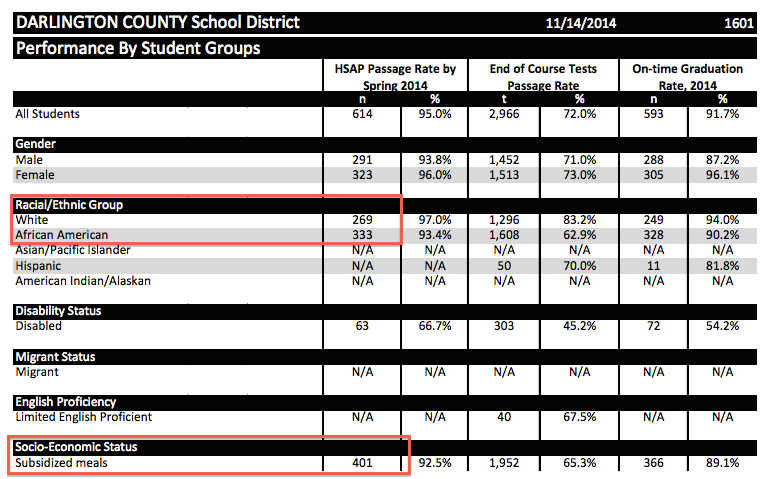
The town’s schools are part of Darlington County School District that serves approximately equal numbers of white and black students, although significantly skewed by poverty as reflected in the district’s 2014 report card detailing tested students:
Take Hartsville. Until recently, no one there had ever asked Thompson or her colleagues what they noticed about their child passengers on the bus, or thought to connect their observations to the behavior teachers might witness in the classroom. Moreover, while Hartsville’s teachers were expected to be knowledgeable about their students’ academic standing, they were not expected to be attuned to their psychological states.
That began to change in 2011, when the community announced a five-year plan to transform its elementary schools. It partnered with Yale University’s School Development Program, which helps schools identify and meet the developmental needs of children. It began to evaluate its schools by a broader set of measurements – including the number of disciplinary referrals a bus driver had to write each morning. And it started to coordinate its social services to ensure a more equitable set of support structures for Hartsville’s poorest families.
This focus on Hartsville specifically and SC more broadly is important for understanding the entire education reform movement in the U.S. for several reasons.
The standards/testing issues in SC are complex (the anti-Common Core movement in SC is mostly ill-informed and falls along libertarian lines, for example) and represent well patterns found across the country during the mostly state-based accountability era (see below).
SC was one of the first accountability states, and we have had about 5-6 sets of standards and new tests over 30-plus years (see below). Throughout those years, almost no one in political leadership has acknowledged SC being in the bottom quartile of poverty in the U.S.—huge pockets of poverty and affluence—is the real educational crisis.
Like New Orleans, I think, SC is a perfect model of all that is wrong with the education reform debate.
I recommend viewing the 180 Days focus on Hartsville through the complicated and often jumbled politics and education reform over the past three decades in SC, much of which I have addressed in the reader offered below, organized by major accountability issues and policies:
[1] This documentary focuses on a court case in South Carolina initiated by high-poverty school districts surrounding primarily the I-95 corridor of the state, paralleling the east coast and stretching from the NE to the SE region. The documentary suffers from melodramatic production values (music, slow-motion panning of sad children’s faces), but the essential claim of the film is important for confronting the social inequity that is reflected in educational inequity, particularly in the South. Issues included in the film are school funding, community-based schools, access to high-quality educational opportunities and facilities, teacher assignments related to student characteristics, and state education accountability mechanisms. Some related resources (SC school report cards, poverty indices, related blog posts) to the documentary support examining the film in my educational documentaryMay experience course.
If anyone is wondering why the “bad” teacher crisis remains central to what political leaders want the public to hear, South Carolina offers a heaping dose of why: Political leaders are enormously incompetent and need us all to remain distracted from that fact.
Case in point: SC has now been officially vamboozled, passing a new teacher evaluation system that includes the new sham word “growth” nearly 50 times in a little over 30 pages—notably (in part):
The changes described in this document will result in a support and evaluation system that is valid, reliable, and fair and that will
…use multiple valid measures (including but not limited to observations, professional practice, and student growth) in determining performance levels, with data on student growth for all students (including English Language Learners and students with disabilities) being a significant factor in the calculation of the overall effectiveness score (growth measure for teachers of tested grades and subjects include growth based on statewide assessments as a component)….
Of course, the most important point here is that VAM (teacher evaluations based on student test scores, or now euphemistically “student growth”) has been proven again and again to fail against the measures of “valid, reliable, and fair.”
SC political leadership has emphasized that their hands are tied because of federal mandates linked to opting out of NCLB and the lure of “filthy lucre” promised therein—a baffling stance taken by a state infamous for taking the most preposterous stances just to shun the federal government.
It is well past time to stop listening to political leaders who have no credibility (hint: If you hear a politician or read a politician, you are in the presence of one who has no clue) and to turn our gazes away from the distractions (hint: “bad” teachers are not the problem).
It is time to invoke the Oliver Rule about claims about and policies including VAM; thus, here is the enormous body of evidence so far refuting VAM (see related research cited within the following):
Combined, these characteristics of my home state confirm, I think, my claim about the self-defeating South. However, when it comes to the Great American Worker, the entire U.S. shares that self-defeating nature.
Often that self-defeating quality is represented by political and public attitudes—antagonistic and aggressive—toward workers’ unions.
South Carolina Gov. Nikki Haley didn’t mince words when she spoke about unions at an automotive conference in Greenville this week. The state loves its manufacturing jobs from BMW, Michelin and Boeing and welcomes more, she explained, but not if they’re bringing a unionized workforce with them.
“It’s not something we want to see happen,” she told The Greenville News.“ We discourage any companies that have unions from wanting to come to South Carolina because we don’t want to taint the water.”…
She also warned auto industry executives at the conference to keep their guards up. “They’re coming into South Carolina. They’re trying,” Haley said. “We’re hearing it. The good news is it’s not working.”
“You’ve heard me say many times I wear heels. It’s not for a fashion statement,” she continued. “It’s because we’re kicking them every day, and we’ll continue to kick them.”
What would happen if unions made an inroad into the Upstate? They would start organizing like mad to try to increase their strength. As more and more employers started having to deal with union demands by raising wages and adding costly benefits, they would need to increase the costs of their products and services. The cost of living would go up for everybody.
I think Gov. Nikki Haley has the right idea.
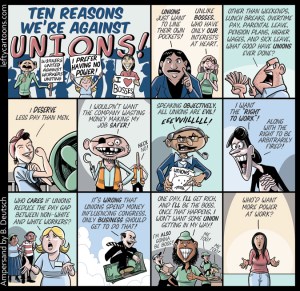
This reader’s letter as well as the apparent lack of awareness about its self-defeating perspective is perfectly satirized in this cartoon:
A regional director of the National Labor Relations Board ruled Wednesday that a group of Northwestern football players were employees of the university and have the right to form a union and bargain collectively.
For decades, the major college sports have functioned on the bedrock principle of the student-athlete, with players receiving scholarships to pay for their education in exchange for their hours of practicing and competing for their university. But Peter Ohr, the regional N.L.R.B. director, tore down that familiar construct in a 24-page decision.
He ruled that Northwestern’s scholarship football players should be eligible to form a union based on a number of factors, including the time they devote to football (as many as 50 hours some weeks), the control exerted by coaches and their scholarships, which Mr. Ohr deemed a contract for compensation.
“It cannot be said that the employer’s scholarship players are ‘primarily students,’ ” the decision said.
How the public responds across the U.S. to college athletes unionizing must be framed against patterns over the last decade that include a disturbing cultural attitude toward workers, notably against teachers’ unions, tenure, and striking (see the 2012 Chicago strike for example).
Examining how workers are portrayed in the media, how workers are valued (or not) in the U.S., and the prospect of becoming a worker for graduate students, I have framed being a worker within the rise of disaster capitalism and concluded:
Finally, in the wake of disaster capitalism in New Orleans and Oregon, pop culture, specifically The Big Bang Theory, is a crucible of not only the role of workers in the U.S. but also the attitudes about the worker that series highlights. Penny, the stereotypical “girl next door,” is the object of an on-going, clichéd joke of a waitress who longs to be an actress. The larger and central jokes of the series, however, are the four academics living across the hall from Penny. It seems in this TV world, all work is funny.
What a TV sit-com never addresses, however, is that in the real world, the gap between Penny as waitress and college professors is shrinking, or better phrased, merging. The state of the American worker is beginning to share with waitressing some disturbing characteristics that cheapen all workers. As Greider (2013) details about the restaurant industry, workers of all types are becoming less often protected by unions, receiving fewer or no benefits (paid sick days, vacation days, health insurance, retirement) with their positions, being paid less than previous generations, and generally suffering under a dynamic whereby the businesses have more or all of the power in the business-worker relationship.
In the real world, Penny and one of the academics, Leonard, would not be wrestling over the education gap between them, but would be sharing the consequences of part-time work in a hostile economy toward workers regardless of those workers’ qualifications since Leonard would be an adjunct (like Professor Beth) while Penny would remain a waitress—and both would be unsatisfied as workers because their situations do not live up to their ideals.
Yet, most Americans will always be workers, and to be a worker should be an honorable thing worthy of poetic speeches and artistic black-and-white film tributes. Being an American worker doesn’t need to be a condition tolerated on the way to something better, and it shouldn’t be twenty-first century wage-slavery that is a reality echoed in the allegory of SF: “one fine day, a purely predatory world shall consume itself.” As the last paragraphs of Cloud Atlas express, however, the wage-slavery of workers in the context of assembly-line and disaster capitalism is a condition Americans have chosen (or at least been conditioned to choose), but it is also a condition workers can change—if workers believe it is wrong, “such a world will come to pass.” (Academia and the American Worker: Right to Work in an Era of Disaster Capitalism?, pp. 21-22)
A question that remained with me as I drafted the piece above is just why the majority state of people in the U.S.—being a worker—does not inform the pervasive antagonistic attitude toward workers. The public in the U.S. appears just as self-defeating as the South when we are confronted with workers’ rights and collective workers’ voices.
American disdain for unions is grounded in a traditional faith in rugged individualism, but it also seems linked to a good degree of self-loathing informed by a cultural worshipping of the wealthy and famous.
Stated directly and without the political baggage of the term “union,” what are the problems with due process and academic freedom (the central elements of tenure for teachers secured by unionization)? Who prospers from workers without full benefits, strong wages, and safe working conditions? Who maintains control when workers do not have equitable voices in their work and compensation?
Words exist within the realm of politics. In politics, words are sometimes perverted by the speaker. It’s worth considering which words come under attack for perversion (“racist,” “homophobe,” “bigot”) and which do not (“democratic,” “bipartisan,” “anti-American”). I am always skeptical of people who seek to curtail their use, instead of interrogating their specific usage. Some people really are racists, and other people really are misogynists, and others still actually are homophobes. Instead of prohibiting words, I’d rather better understand their meaning.
Ultimately, Coates comes to workers in the totalitarian state:
But the central idea—that the communist party, and thus the central committee, and thus the politburo was the sole representative of workers—has a chilling moral closure. Who could be against the workers? And if the party is the true representative of the workers, why do we need other parties?
I must echo: Who could be against the workers?
That haunts me, baffles me, leaves me cynical because of all the qualities that divide people in the U.S.—race, class, religion, sexuality, gender—that almost all of us are and always will be workers—a state that should be something of honor and dignity—is the one quality that should unite us.
College athletics stand before the entire U.S. as the crucible of a few benefitting on the backs of many—many without a voice. And that crucible also reveals to us the potential power of a collective voice, an acknowledged voice among the majority who do the labor that generates the profits.
As Coates warns, “words are sometimes perverted by the speaker.”
“Union” is one such word, and when it is spoken by those in power, be certain the motivation is not in the best interests of the workers.
There would be no billionaires today without workers. In fact, powerless workers are nearly essential for maintaining the inequitable state of the U.S. in which billionaires thrive while more and more workers become trapped in multiple part-time jobs, absent benefits or job security.
The Northwestern college football players have my solidarity, but I also wonder why we all are not seeking that same solidarity among every worker in the U.S., a solidarity that could attain the American Dream that has been perverted into an American Winter:
In case it’s not clear, “American Winter” comes from a specifc, biased and unapologetic viewpoint, but it’s also the kind of argument that’s needed right now. Watching the 50 year old John, 3 years unemployed and father to a young son with Down’s Syndrome, weep on camera because he had to borrow money from his parents to pay the electric bill, it’s bracing and raw. When Paula goes to the food bank for the first time, and is overwhelmed by the fact that her situation has forced her to take such measures or when single mom Jeanette tries make a promise to her young son Gunner that they will find a place to live, it puts a new perspective on those who are traditionally associated/stereotyped as being on social services. Everyone in “American Winter” has been working, are raising families, and doing everything they can (Dierdre gives blood and goes scrapping on weekends just for extra money) to make ends meet. They are not the vultures of the system that certain political segments like to paint as living on taxpayer money. (Review: ‘American Winter’ A Devastating Portrait Of The Erosion Of The Middle Class)
That recovered American Dream could be built on workers unionized for the right to work—the right to work for wages that dignify their work and their lives, the right to work as a part of their right to live fully and freely, the right to work in a physically and psychologically safe environment, the “right to work” not perverted by a political elite bragging about using high-heeled shoes as the boot on the throat of the Great American Worker.
Appointed and elected officials related to education have some important characteristics in common. Consider U.S. Secretary of Education Arne Duncan and South Carolina Superintendent of Education Mick Zais.
Neither have experience or education in the field of K-12 education, despite their primary responsibilities being related to K-12 education.
And because of their appointed (Duncan) or elected (Zais) position, they have a primary and nearly unchallenged voice in both the narratives about education and the policies implemented in public schools.
As well, since they have that access, Duncan and Zais often conduct tours and speeches promoted as informational or celebratory, but always use those masks to achieve something quite different: driving a set of ideologies and narratives that are mostly misinformation.
I am writing to set the record straight about public education in South Carolina.
The opening points made by Zais focus on his claim that funding and poverty levels are not the key determining factors in how successful schools are. To make that case he identifies two schools directly:
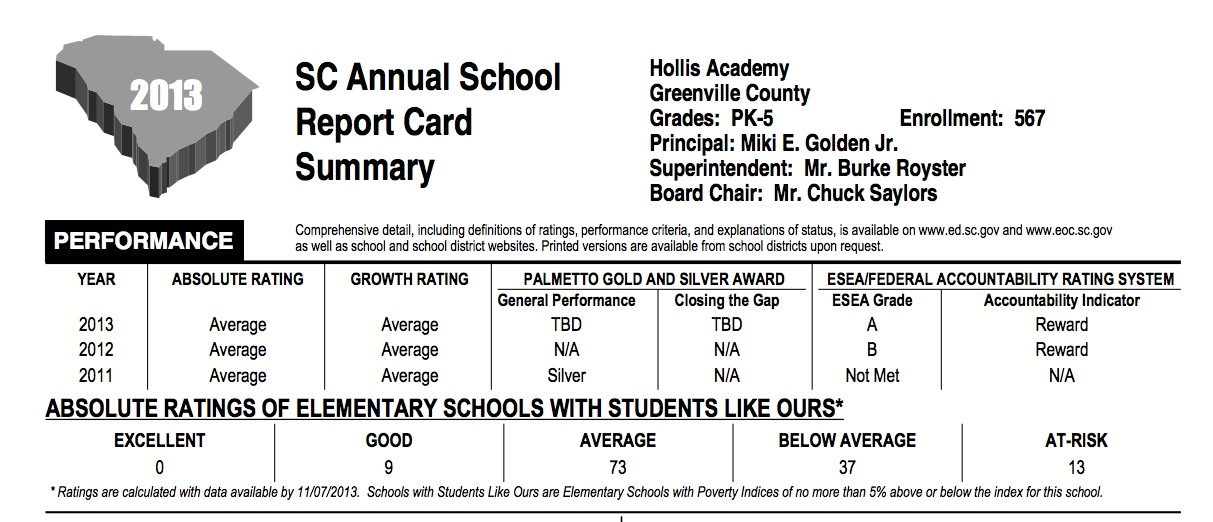
In Greenville County School District, Hollis Academy Elementary School has a poverty rating of 99 percent and received a grade of 97 percent, an A, on their federal report card. It’s one of the highest performing elementary schools in South Carolina. Welcome Elementary School is also in Greenville County. It has virtually identical demographics and received a grade of 47 percent, an F, on their report card.
Hollis Academy Elementary School (99.48 PI) and Welcome Elementary School (98.32) as high-poverty schools in the same school district (Greenville County) do appear to make Zais’s case, except he fails to identify the SC school report card data—ones that provide an important metric, “schools like us.”
On the 2013 school report cards (issued by the SC Department of Eduction which Zais heads), Hollis Academy Elementary School receives an absolute rating of “Average,” which is essentially typical of “schools like us” (Excellent, 0; Good, 9; Average, 73; Below Average, 37; At-Risk, 13):
On the same report card, Welcome Elementary School receives an absolute rating of “Average,” which is essentially typical of “schools like us” (Excellent, 0; Good, 10; Average, 85; Below Average, 43; At-Risk, 15):
Two points must be highlighted, if we seek to set the record straight: Hollis and Welcome are relatively similar in their composition and their outcomes; however, as the data above suggests (the numbers are different, note, in the range of “schools like us”), Hollis and Welcome are not identical in populations served.
Thus, the only way Zais can make his case is to cherry-pick data, conveniently omit data, and then make a really mean-spirited claim for which he offers no data:
The difference between high poverty schools that are excelling and those that are failing is neither funding, the education level of the parents, nor demographics. It’s the competence of the adults in the system. Where schools have capable principals and effective teachers, poor kids will learn.
The sweeping claims made by Zais, however, are not supported by the research base—and not once does Zais offer any evidence from research showing that “competence of the adults in the system” is a determining factor in student outcomes. Not once (notably because such evidence doesn’t exist).
Teacher quality (and VAM advocacy), “more with less,” funding doesn’t matter, and X practices and/or teacher quality can add “days of learning” or “years of learning”—all of these claims have been debunked:
Just as Duncan has continued a legacy among recent USDOE Secretaries of Education (Paige, Spellings), Zais represents the politics of misinformation in education reform that exposes our appointed and elected education officials as either incompetent or dishonest—neither quality suggesting that they should be driving our education narratives or policies.
In a clear signal that the Common Core State Standards are in hot water in South Carolina, Gov. Nikki Haley told a meeting of a local Republican Party women’s club that she was determined to ditch the standards this year because, she said, “We don’t ever want to educate South Carolina children like they educate California children.”
In response to the article and one comment, I posted (with edits and additions):
SC is a high-poverty state (bottom quarter, around 10th most impoverished), and thus, historically and currently, people incorrectly use metrics that reflect that poverty to bash the state as having “bad” education. [SC has a poverty problem, reflected in our schools.]
Should SC dump CC? Of course, as all states should.
But as is typical, political leaders have all the wrong reasons (Haley playing to her rightwing, Tea Party base in the state).
In a high-poverty state such as SC—that will now be on our 4th iteration of standards and testing (none of which have “worked” apparently)—the incredible COST of implementing CC and the new tests is unpardonable.
Dump CC, SC, but do so as a commitment to being better stewards of public funds and as a shift to addressing the poverty scar that plagues the state, the children, and the schools.
The irony of Haley’s comments lies in her swipe at California: “‘We don’t ever want to educate South Carolina children like they educate California children.'” While Haley is triggering the conservative caricature of the “left coast,” within her populist bating is a kernel of truth.
California has dedicated at least 1.2 billion dollars of public funds to implementing CC (more funding will be required). This pattern of millions and billions of tax payers’ dollars dedicated to new standards and new tests is being replicated, almost silently, across the U.S.
Thus, SC does not, in fact, want to educate our children as California does—spending millions on an accountability system that has already failed the state for thirty years.
Valerie Strauss reports, for example, that Maryland needs $100 million in funding for online testing related to CC.
Education reform built on an accountability system driven by (perpetually new) standards and (perpetually new) tests has never worked; it is the wrong approach to reform.
SC should drop CC and the new tests; SC should end similar investments in charter schools, teacher evaluation and merit pay, and a wide array of policies already tried time and again without success.
Haley’s motivation (reelection) and her reasons (Tea Party misinformation about CC) are both deeply misguided, but the best first step SC could make for a new era of genuine school reform is ditch CC.
And then, start anew by admitting SC has a poverty problem, and having the political will to design social and educational policy that addresses directly that real problem.
educator, public scholar, poet&writer – academic freedom isn't free


 dr. p.l. (paul) thomas