Tag Archives: Teacher quality

Teacher Motivation: Context and Culture

Catherine Joynson and Ottoline Leyser’s The culture of scientific research identifies the motivation of scientists, which:

provide[s] additional insights into how they view research, and the majority of the survey respondents clearly chose a career in science in order to find out more about the world around them. When respondents were asked to rank phrases to describe what they believe motivates them in their work, the top three were:

  1. Improving my knowledge and understanding
  2. Making scientific discoveries for the benefit of society
  3. Satisfying my curiosity

And then, they confront the impact of competition:

High levels of competition in scientific research emerged as a strong theme running through all the project activities. Applying for funding is thought to be very competitive by the majority of the survey respondents (94 per cent), as is applying for jobs and promotions (77 per cent). Around nine in ten think making discoveries and gaining peer recognition is quite or very competitive.

High levels of competition for jobs and funding in scientific research are believed by survey respondents both to bring out the best in people and to create incentives for poor quality research practices, less collaboration, and headline chasing [emphasis added]. For example, behaviours such as rushing to finish and publish research, employing less rigorous research methods and increased corner-cutting in research were raised by 29 per cent of survey respondents who commented on the effects of competition on scientists.

Immediately this analysis reminded me of the increasing political calls for weeding out “bad” teachers and concurrently rewarding good teachers, notably from the right but also from the left, including support for value-added methods (VAM) for teacher evaluation and retention as well as merit pay.

While simplistic calls for rewarding good teachers are politically popular, they fail to confront the inherent negative consequences and to acknowledge the research base on what exactly motivates teachers.

Teaching and learning are highly sensitive to the same problems noted above about science: VAM and merit pay create competitive cultures in schools, discouraging collaboration and incentivizing teachers to view their students as tools of success (and thus, creating winners and loser when we claim a goal of everyone winning).

Research shows that merit pay for teachers is harmful:

Some researchers have warned, however, that merit pay may change the relationships between teachers and students: poor students may pose threats to the teacher’s rating and rewards [emphasis added] (Johnson 1986). Another concern is that merit pay plans may encourage teachers to adjust their teaching down to the program goals, setting their sights no higher than the standards (Coltham 1972).

Odden and Kelley reviewed recent research and experience and concluded that individual merit and incentive pay programs do not work and, in fact, are often detrimental (1997). A number of studies have suggested that merit pay plans often divide faculties, set teachers against their administrators, are plagued by inadequate evaluation methods, and may be inappropriate for organizations such as schools that require cooperative, collaborative work [emphasis added] (Lawler 1983).

Evidence on VAM reveals similar warnings:

High-stakes uses of teacher VAM scores could easily have additional negative consequences for children’s education. These include increased pressure to teach to the test, more competition and less cooperation among the teachers within a school, and resentment or avoidance of students who do not score well. In the most successful schools, teachers work together effectively (Atteberry & Bryk, 2010). If teachers are placed in competition with one another for bonuses or even future employment, their collaborative arrangements for the benefit of individual students as well as the supportive peer and mentoring relationships that help beginning teachers learn to teach better may suffer. (p. 24)

So what does motivate teachers?:

Frase identified two sets of factors that affect teachers’ ability to perform effectively: work context factors (the teaching environment, and work content factors (teaching)….

Work context factors are those that meet baseline needs. They include working conditions such as class size, discipline conditions, and availability of teaching materials; the quality of the principal’s supervision; and basic psychological needs such as money, status, and security.

In general, context factors clear the road of the debris that block effective teaching. In adequate supply, these factors prevent dissatisfaction. Even the most intrinsically motivated teacher will become discouraged if the salary doesn’t pay the mortgage….

Work content factors are intrinsic to the work itself. They include opportunities for professional development, recognition, challenging and varied work, increased responsibility, achievement, empowerment, and authority. Some researchers argue that teachers who do not feel supported in these states are less motivated to do their best work in the classroom (NCES 1997).

Data from the National Center for Education Statistics (1997) confirm that staff recognition, parental support, teacher participation in school decision making, influence over school policy, and control in the classroom are the factors most strongly associated with teacher satisfaction [emphasis added]. Other research concurs that most teachers need to have a sense of accomplishment in these sectors if they are to persevere and excel in the difficult work of teaching.

VAM, merit pay, accountability built on standards and high-stakes testing, “no excuses” ideologies, zero tolerance policies—these remain essential elements of education reform although they are likely to creates the worst possible contexts and cultures necessary for teaching and learning.

Top-down and technocratic approaches to school policy, which de-professionalize teaching and teachers, are creating harmful cultures in public schools, proving further that the partisan political control of education remains tone-deaf to evidence and educators.

Teachers, like scientists above, are already quite likely to have chosen the profession in order to serve others. VAM and merit pay destroy those initial reasons for teaching.

Political commitments to harmful policies suggest the real problem in education is the motivation of those political leaders, not teachers.
Unpacking Education and Teacher Impact

Among media, political, and public claims driving calls for education reform, two beliefs are dominant: (i) education is the single most important lever for lifting anyone above the circumstances of her/his birth, and (ii) teacher quality is the single greatest factor in whether that educational experience accomplishes the first belief.

As I have increased my contribution to public debates about education reform, I have witnessed that media, political, and public comments are often knee-jerk and simplistic either/or responses to complex research.

For example, when I note that 40 years of research reject grade retention, responses tend to discount that research with “So you want us just to pass them on?”—suggesting that social promotion is the only alternative to grade retention (which, of course, it isn’t). Similarly, when I share that 60 years of research on corporal punishment also refute spanking—that, in fact, there is no debate on its use—responses immediately include, “So we are just supposed to let children do whatever they want?”

But I have also discovered that in my education courses, students challenge many research-based conclusions, although the students are more thoughtful—particularly when I share the evidence on the impact of education and teachers [1].

Consider the follow body of evidence below; and then, in the context of this evidence, I want to unpack what education and teacher impact actually entails.

Is teacher quality actually the single greatest factor in student achievement? Di Carlo details what research shows:

But in the big picture, roughly 60 percent of achievement outcomes is explained by student and family background characteristics (most are unobserved, but likely pertain to income/poverty). Observable and unobservable schooling factors explain roughly 20 percent, most of this (10-15 percent) being teacher effects. The rest of the variation (about 20 percent) is unexplained (error). In other words, though precise estimates vary, the preponderance of evidence shows that achievement differences between students are overwhelmingly attributable to factors outside of schools and classrooms (see Hanushek et al. 1998; Rockoff 2003; Goldhaber et al. 1999; Rowan et al. 2002; Nye et al. 2004).

Also consider Donald Hirsch’s research on the UK for the Joseph Rowntree Foundation: “Just 14 per cent of variation in individuals’ performance is accounted for by school quality [emphasis added]. Most variation is explained by other factors, underlining the need to look at the range of children’s experiences, inside and outside school, when seeking to raise achievement.”

We see here two important points: (i) out-of-school factors dwarf measurable influences of teacher quality, and (ii) teacher quality is a subset of school quality. Thus, school and teacher quality is not even close to the most important measurable factor in student achievement.

Now, what is the evidence on social mobility in the U.S., notably in terms of how educational attainment influences the relationship between social class or race and that mobility?

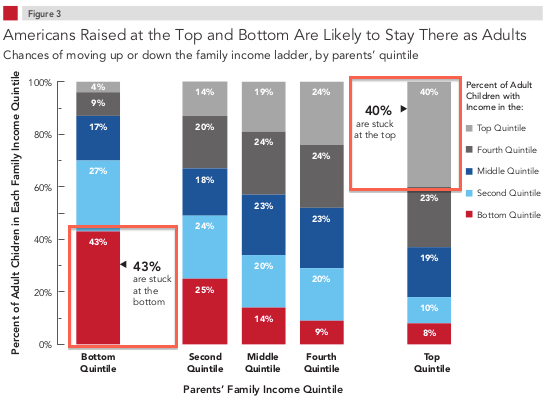
Social mobility appears fairly sticky in the bottom and top quintiles:

mobility
From Pew’s Economic Mobility Project data; analysis by Bruenig, 2013, June 13: “As far as income mobility goes, you are 10x more likely to wind up in the richest fifth as an adult if you were born there than if you were born in the poorest fifth.”
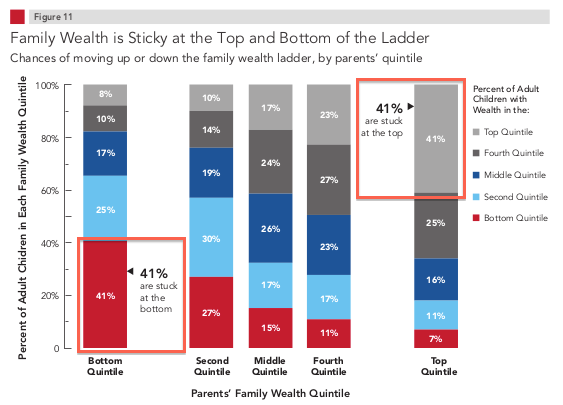
Fig 11
From Pew’s Economic Mobility Project data; analysis by Bruenig, 2013, June 13: “As far as wealth mobility goes, you are more than 5x more likely to wind up in the wealthiest fifth as an adult if you were born there than if you were born in the least wealthiest fifth.”

Next, Bruenig (2013, June 13) concludes:

One convenient way to describe what’s going on is that rich kids are more likely to get a better education, which translates into being richer and wealthier as adults. It is certainly the case that richer kids are more likely to get a college degree, and it is certainly the case that getting a college degree leaves you much better off on average than not getting one. But this does not explain the full picture of social immobility [emphasis added].

And thus, social mobility appears more strongly connected to the social class of a person’s family than to education (a function of combined school and teacher quality):

educationandmobility
From Pew’s Economic Mobility Project data; analysis by Bruenig, 2013, June 13: “[Y]ou are 2.5x more likely to be a rich adult if you were born rich and never bothered to go to college than if you were born poor and, against all odds, went to college and graduated.”
The consequences of the dynamic between social class and education are, as Matt O’Brien explains, as follows:

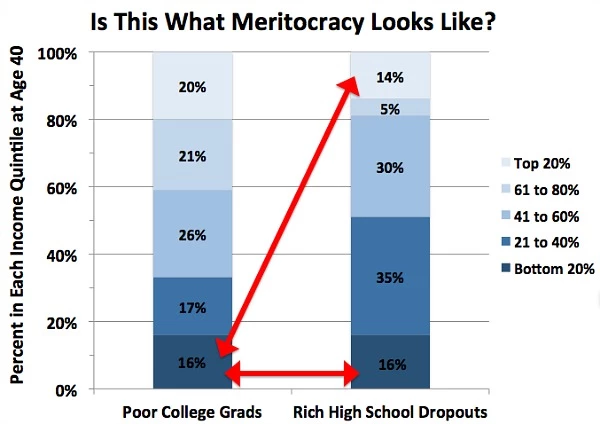
meritocracy
Data from Richard Reeves and Isabel Sawhill. O’Brien concludes: “Even poor kids who do everything right don’t do much better than rich kids who do everything wrong.”

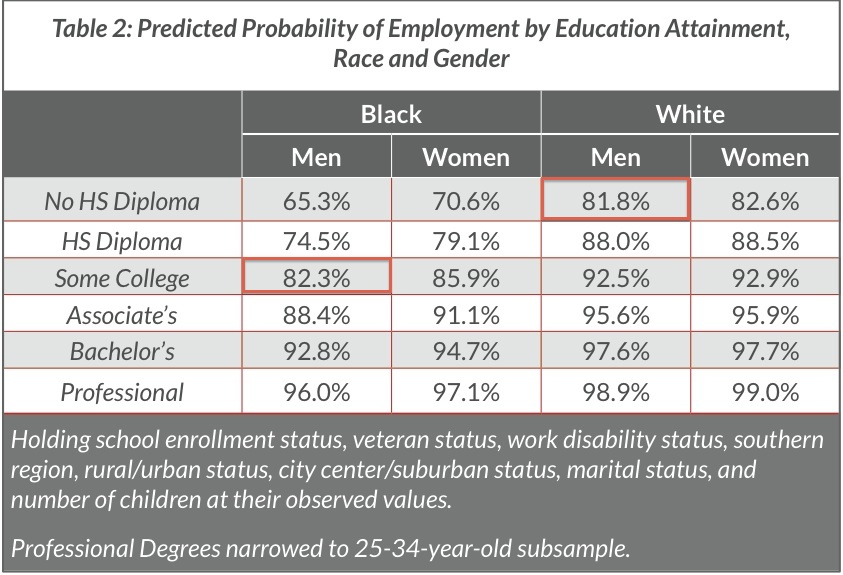
Now, consider the relationship between educational attainment and race. First, in Closing the Race Gap, O’Sullivan, Mugglestone, and Allison (2014) detail that blacks with some college earn about the same as whites with no high school diploma:

Table 2 copy
O’Sullivan, Mugglestone, and Allison (2014)

From this report as well, Susan Adams explains: “African-American college students are about as likely to get hired as whites who have dropped out of high school.”

Significant income disparities exist along racial lines despite educational attainment, as Bruenig (2014, October 24) shows:

fig_2
Bruenig (2014, October 24): “First, understand that blacks and Hispanics have lower incomes than whites up and down the educational spectrum. On average, black families at a given level of educational attainment receive incomes that are just 66% of what white families at the same level of educational attainment receive. For Hispanic families, that figure is 79%. Naturally, when education-controlled income disparities like this exist, education-controlled wealth disparities will exist.”

The impact of education (school and teacher quality), then, when placed in the context of both social class and race refutes the opening claims: (i) education is the single most important lever for lifting anyone above the circumstances of her/his birth, and (ii) teacher quality is the single greatest factor in whether that educational experience accomplishes the first belief.

When I offer these measurable facts to either the public or my students, often I hear: “So you are saying that education and teachers do not matter?”

Here is the hard part.

First, making claims that measurable education and teacher impact exists is problematic. Thus, I absolutely support that both education and teachers matter, but I also caution that this impact is not singular, direct, or easily quantified.

Part of that problem is that the impact of any person’s education or the influence of any teacher or teachers tends to occur over long periods of time, and we are hard pressed to tease out and measure specific teachers or practices since that impact is cumulative, interrelated, and multi-faceted (consider that a student can learn a valuable lesson from a flawed lesson or a weak teacher).

Our first conclusion, then, is that making claims about education being the single or sole factor in success or that the teacher is the single most important factor in achievement is misleading, overly simplistic.

But, there are fair and accurate claims we can make about the importance of education, leading to our second conclusion.

Our second conclusion is that within social class and race, educational attainment has significant influence, but that education alone appears less effective in overcoming large social inequities such as classism and racism.

From this, I think we have several important lessons:

  • Media, public, and political hyperbole about education and teacher impact does a disservice to public education, teachers, students, and the public. Overstating the impact of education and teachers assures that we will continue to fail our students and the promise of universal public education.
  • In our endless quest for education reform, we would be better served if we moved away from mostly measurable data points for making claims about and policies in education. Education is messy and complicated; quantified data are in fact simplistic and misleading.
  • Until we confront the corrosive influence of class and race in the U.S. and until we admit that education alone is not enough to overcome classism and racism, we are perpetuating social inequity.

Let’s be clear: Education and teachers matter. But, regretfully, they simply do not matter in the ways most people claim or believe, and certainly not in ways that are easy to identify.

The good news, however, is that there is much we can do to change this, if we have the resolve to confront the evidence, accept the ugly truths, and then to do something different.

See Related: If social mobility is the problem, grammar schools are not the solution, Gaby Hinsliff


[1] This post is in debt to my current, fall 2014 EDU 111 course at Furman University, a group of students fully committed to engaging with the topics, challenging claims, and seeking to understand the complexity of education. They are proof that teaching is an act of learning, if the teacher is there to listen as well as talk.

What We Tolerate (and for Whom) v. What the Rich Demand: On Teacher Quality

Two of the best teachers and education advocates I respect and listen to carefully, Nancy Flanagan and Susan Ohanian, had an important exchange on Twitter recently:

Prompted by the Vergara court case in California and a related article in The Atlantic, Flanagan and Ohanian share a concern about the political, popular, and media claim that “bad” teachers work in “bad” schools with “bad” students (all of which is the result of a flawed misreading of the conditions common in high-poverty schools that serve high-poverty communities).

Before examining the issue of teacher quality raised above, please take note of a Big Picture problem at the heart of the Vergara ruling: All professions, including teaching, have elite, solid, and weak practitioners, but to suggest that teacher quality is the or one of the primary causes of educational problems is simply false, a manufactured scapegoat to keep the public view off the real problems facing us—mostly social and educational inequity.

Let’s look carefully, now, at how the complex issue of teacher quality is further complicated by high-poverty schools:

  • Teacher quality represents only about 10-15% of measurable student outcomes (test scores); thus, since high-poverty students are disproportionately likely to produce low test scores, it is a mistake to read raw tests scores as a reflection of teacher quality (or even student learning) since those test scores are primarily a reflection of out-of-school influences. (Also note that outliers to that dynamic do not disprove a generalization and do not suggest what the norm should be; as well, all claims of such “miracle” schools have been discredited.)
  • High-poverty schools and high-poverty students are staffed and taught by teachers who are disproportionately new, early career, and/or under-/un-certified. That dynamic does contribute to “teacher quality,” but not in ways popular claims mean (for example, a new teacher is not “bad,” but experience certainly contributes to greater teacher effectiveness—although that is not necessarily reflected in measurable student outcomes).
  • High-poverty students and their parents value education as much as more affluent students and parents, but living in poverty is existing in a state of scarcity that taxes adults and children physically, psychologically, and mentally—often leaving them less capable of advocating for education and benefitting for learning opportunities. Conversely, students and parents from relative affluence are afforded the slack necessary to advocate for education and fully engage with learning experiences. The important point here is that teaching, parenting, and learning in conditions influenced by poverty negatively impact nearly everyone involved, but by changing those conditions (and not the people), those same people would perform differently. (This contradicts claims that we need to rid schools of “bad” teachers and instill poor students with “grit”—both of which focus the problems in the people and not the system.)

Flanagan and Ohanian, then, are right that high-poverty schools are not overburdened by “bad” teachers; many wonderful teachers work in high-poverty schools (but some genuinely weak teachers are protected by the mask of affluent students, affluent schools, and affluent communities)—and high-poverty students are potentially as capable of learning as their more affluent peers (impoverished students don’t need to be “fixed” and don’t need to be taught “grit”).

But those facts are harshly clouded by the knee-jerk conclusions drawn from raw test scores—just as most people erroneously believe private schools are superior to public schools simply because the outward evidence appears to suggest so.

What do the data show, then, when we look at teacher characteristics (interpreted as “quality”) in high-poverty schools along with student test scores as that contrasts with teacher characteristics and student test scores in affluent public and private schools?

As a society, we tolerate the worst possible conditions for the students with the most need (teacher characteristics, school conditions and funding, and high percentage of children living in poverty are the failure of adequate public response and policy) while students living in relative affluence have the advocacy of their parents demanding that they do not suffer the same conditions experienced by children in poverty (disproportionately children of color): high student-teacher ratios, inexperienced and un-/under-certified teachers, underfunded schools, facilities in disrepair, and worksheet and rote instructional practices aimed at test-prep.

The cruel reality is that high-poverty and high-minority schools are not staffed by “bad” teachers forced to teach “bad” students, but that those teachers and students have the most challenging conditions in their lives and schools to overcome while affluent students have slack in their lives and the best conditions in their schools.

Instead of misguided commitments to value-added methods (VAM) for finding the best teachers (which do not work), policies that address equity would serve us much better:

  • No child should be taught by un-/under-certified teachers.
  • No child should have new or early career teachers for several years in a row.
  • Teacher quality must be re-imagined as an effective matching of teachers with students and not reduced to measurable outcomes.
  • Student achievement must no longer be reduced to measurable outcomes.

As with much of the flawed education reform agenda, the teacher quality issue reflects the overuse and misuse of test scores.

Until we address the scarcity in children’s lives and schools, addressing teacher quality is a futile distraction, just as continuing to change standards and tests is a futile distraction.

Instead of labeling, ranking, and then firing teachers, our first best step would be to end the cult of high-stakes testing because the problems of education are mostly systemic (social and educational) and not the adults who choose to teach or the children we seek to serve.

Teacher Quality: On Hyperbole and Anecdotes

In 2011, 3,764,698,318 retail prescriptions were filled in the U.S. If 0.01% of those prescriptions were filled incorrectly (and thus jeopardizing the health or even lives of patients, including children), 376,469 events could have constituted the danger of tolerating “bad” pharmacists.

Every day, patients are also served by doctors and surgeons who completed their degrees at the bottom of their classes.

Just how many “bad” doctors and “bad” surgeons are we willing to tolerate?

But in the scope of political and media scrutiny, it appears the greatest danger facing our children and society is the ever-present “bad” teacher. When Cindi Scoppe, Associate Editor for The State (Columbia, SC), explored her own experiences as a student, she concluded:

It only takes one lousy teacher, out of 50 really good ones, to leave indelible scars on a child’s education — and on a parent’s political perspective. It only takes one lousy teacher who returns to the classroom year after year to convince a parent that the public schools care more about preserving jobs for incompetents than providing every child with a good education. It only takes one lousy teacher to make a parent susceptible to the siren song of private school “choice” and “scholarships.”

Scoppe’s impassioned claim drawn from anecdote is both compelling and deeply misleading—both in the hyperbole (“one lousy teacher” and “indelible scar”) and the implication that anecdotes are generalizable and valid (some are, and some are not).

I have been a teacher for 31 years, and if we asked one student to pen a similar piece about me, it is possible she/he would draw the same conclusion because I have on occasion been the one “bad” teacher for a few handfuls of students—at least that would be their perception. And some who think I was “lousy” are entirely justified because I was (despite my best intentions), some who think I was “lousy” are, frankly, wrong, and some who think I was “lousy” are examples of how a teacher can be perfect for one student and lousy for another (and this is often the case on my student evaluations which include several students identifying me as the best teacher they have ever had and then one student saying I was the worst).

But the hyperbole grounded in anecdotes about “bad” teachers (and the related handwringing about the urgent need to be able to fire all those “bad” teachers) is more than a public and media failure; the hyperbole is driven by a political agenda as well, notably the recent announcement under the Obama administration that colleges of education are next on the reform agenda (including another round of accountability based on the test scores of students taught by their candidates).

So since the early 1980s, the education reform agenda has tried the following:

  • Link student promotion/retention and graduation to high-stakes tests.
  • Create school report cards based on high-stakes tests.
  • Base teacher promotion, pay, and retention on high-stakes tests.
  • Label and rank teacher education programs based on high-stakes tests.

There is a fatally flawed motif here (high-stakes tests), but even more troubling is that all efforts to reform education through accountability based on those tests have failed as well as increasing the exact problems the accountability advocates claim to be addressing. Exit exams increased drop outs and non-completers, school report cards stigmatized schools and reduced funding for schools most in need, teachers have been dismissed falsely and teacher attrition has increased under merit-based systems, and soon teacher education will suffer negative consequences as well.

So let’s return to the teacher quality problem in education.

On one important level, it is perfectly reasonable to argue that no child should have a “bad” teacher. But those who make that political and public claim appear insincere or misguided when we consider a few important foundational questions and contradictions:

  1. Where is the evidence that teacher quality is a fundamental or primary aspect of the causes of educational failures or weaknesses? And even if we have such evidence, teacher quality constitutes only about 10-15% of those factors impacting student achievement. Teacher quality, although important, is a minor issue in the context of what reform needs to be address.
  2. In the one area of teacher quality that has a large research base—poor, African American, and Latino/a students disproportionately are assigned inexperienced and un-/under-certified teachers—the same political advocates of increasing teacher quality also endorse Teach For America, which is designed to assign inexperienced and uncertified teachers to poor, African American, and Latino/a students.
  3. By labeling and ranking teachers (and teacher education programs), we are insuring that we will always have “bad” teachers by the very nature of ranking and since we can never achieve the Lake Wobegon ideal of everyone being above the average.

It seems likely that education must always be in a state of reform. All children in fact do deserve excellent teachers and excellent schools—and thus we must always be working to that end, regardless of it not being possible to achieve it..

There also appears to be a need to maintain the perception of the “bad” teacher and the inability of schools to fire those “bad” teachers—regardless of the accuracy of the perception or how that contributes (or not) to better schools for all children.

Thus we must confront the corrosive nature of using anecdotes and hyperbole in the context of actual policy.

“Bad” teachers, the inability to fire those “bad” teachers, and the quality of teacher education programs—to be blunt—are calculated distractions in the big picture of What Is Wrong with Our Schools.

Political capital, however, can be built on and perpetuated by attacking these exaggerations in the ways that we have experienced for three decades now.

I have had “bad” teachers, and I have been perceived as a “bad” teacher. I have suffered a teacher certification process that I think was lacking, and I have participated in aspects of teacher certification I know are stymied by bureaucracy.

I strongly advocate for reform. I have no patience for “bad” teachers and for the status quo of teacher certification.

But I cannot tolerate education reform grounded in misleading anecdote and hyperbole, and I cannot support policies that, in fact, reinforce the exact problems we are facing.

And we must stop creating policy that seeks ideals beyond the scope of human control. Like 100% student proficiency in No Child Left Behind, having a school system with no “bad” teachers (or all excellent teachers) is unattainable. The goal itself insures failure. (“You know, my firend’s daughter had a bad teacher last year…”)

Again, where is the public, media, and political call for no “bad” pharmacists—a goal that seems far more pressing and necessary?

There is no political capital is bashing pharmacists, however, and that is the ugly secret about the “bad” teacher mantra: Bashing teaching is bashing a “woman’s” field, and pretending educational failure is mostly the fault of those teachers masks the racial and socioeconomic realities driving those failures.

No abusive teachers? I’m on board.

No predatory teachers? Absolutely.

No hungry child? No child without healthcare? No children living transient lives because their parents cannot find stable employment? Let’s move these to the front of the line, please.

But no “bad” teachers? Mostly hyperbole and disingenuousness so I call “calculated distraction” and demand no more “bad” politicians.

Anyone? Anyone?

Teacher Quality Mania: Backward by Design

Let’s return to the allegory of the river.

Throughout the Land, people discovered babies floating in the river. A few were chosen to save those babies. While many survived, too many babies perished.

Technocrats, Economists, and Statisticians gathered all the Data that they could and discovered that at least 60% of the reason the babies survived or perished in the river was due to babies being tossed in the river; about 10-15% of the reason babies survived or perished was due to the quality of those trying to save babies in the river.

So the Leaders of the Land decided to focus exclusively on increasing the quality of those trying to save the babies floating in the river, saying, “There is nothing we can do about babies being tossed in the river, and there are no excuses for not saving these babies!”

And so it goes…

While this altered tale above reads like a dystopian allegory, it is a fair and accurate portrayal of the current mania to address teacher quality—a mania that simply has the entire reform process backward.

First, the body of research shows a clear statistical pattern about the array of factors influencing measurable student outcomes, as summarized by Di Carlo:

But in the big picture, roughly 60 percent of achievement outcomes is explained by student and family background characteristics (most are unobserved, but likely pertain to income/poverty). Observable and unobservable schooling factors explain roughly 20 percent, most of this (10-15 percent) being teacher effects. The rest of the variation (about 20 percent) is unexplained (error). In other words, though precise estimates vary, the preponderance of evidence shows that achievement differences between students are overwhelmingly attributable to factors outside of schools and classrooms (see Hanushek et al. 1998Rockoff 2003Goldhaber et al. 1999Rowan et al. 2002Nye et al. 2004).

When educators and education researchers note that teacher quality is dwarfed by other factors, primarily out-of-school factors associated with affluence and poverty, Corporate and “No Excuses” Reformers respond with straw man arguments that quoting statistical facts is somehow saying teachers cannot have an impact on students or that quoting those facts is simply an excuse for not trying to educate all students (see Larry Ferlazzo and Anthony Cody for examples of this phenomenon in the debate over teacher quality).

To be clear, however, the problem is not that teacher quality doesn’t matter or that teachers do not want to be evaluated or held accountable. The problem is that addressing in a single-minded way teacher quality is self-defeating since (as the altered allegory above shows) it has the priorities of reform backward.

Teacher quality reform should occur, but it must come after the primary factors impacting learning and teaching conditions are addressed, thus making it possible to make valid and reliable evaluations of teacher quality. That process should be:

(1) Address first and directly the inequity of opportunity in the lives of children to create the conditions within which schools/teachers can succeed and thus school and teacher quality can be better evaluated and supported. As stated in a recent review of misleading “no excuses” and “miracle” school claims: “Addressing out-of-school factors is primary and fundamental to resolving education inequality” (Paige, 2013, January).

(2) Address next equity and opportunity within schools. Teaching conditions must be equitable in all school and for all students. Currently, affluent and successful students have the most experienced certified teachers and also sit in AP and IB classes with low student/teacher ratios while poor and struggling students have new and un-/under-certified teachers, sitting in high student/teacher ratios classes that are primarily test-prep. Inequitable teaching/learning conditions actually mask our ability to identify quality teachers.

(3) And then, once out-of-school equity is addressed and then in-school equity is addressed focusing on teaching and learning conditions, teachers must be afforded autonomy; and finally, we can gather credible evidence to begin identifying valid teacher quality metrics to inform evaluating, supporting, and retaining teachers.

The first and second priorities can be implemented simultaneously and immediately, with the third priority delayed until conditions are equitable enough to make authentic assessments of teacher impact on student learning. [And regardless, everyone involved in teaching and learning can and must continue to teach as well as possible; that is a given.]

Current arguments that only teacher quality matters are neither statistically accurate nor an effective reform priority.

Current arguments that only teacher quality matters are a frantic effort to save the babies floating in the river while ignoring the real crisis of babies being thrown in the river in the first place.