Education reform, however, was never about improving learning or teaching, but about ideological agendas, conservative agendas.
The crisis/miracle cycles started with that Texas “miracle,” but included the Chicago “miracle” (to bolster Arne Duncan), the DC “miracle” (to promote Michelle Rhee’s grift), and the Harlem “miracle” (that solidly merged education reform as bi-partisan under Obama with the help of grifter Duncan).
What may prove to be the most successful (and harmful) “miracle,” however, is the media manufactured Mississippi “miracle,” grounded in 2019 NAEP scores.
Six years later, the real end game of these manufactured and false “miracles” are merging with an initial effort by W. Bush—de-professionalizing teachers with scripted curriculum. Note the connection in a recent misleading but recurring endorsement by Patrinos (from the Department of Education Reform, funded by Walton money in Arkansas) of that Mississippi “miracle”:
After taking a swipe at NCTE, Korbey makes the same but false connection as Patrinos above:
Nearly all the states that have seen reading scores improve recently – including Mississippi, Louisiana, Tennessee and Alabama – have changed state law to encourage districts to choose from approved lists of HQIM.
Conveniently omitted in public advocacy and endorsements of scripted curriculum, is that this is a correlation; however, research has shown that curriculum, instruction, and teacher training are not the keys to increased test scores. Grade retention is:
[S]tates whose policies mandate third-grade retention see significant and persistent increases in high-stakes reading scores in all cohorts…. [T]here is no consistent evidence that high-stakes reading scores increase in states without a retention component.
And another omission is that research has shown scripted reading programs de-professionalize teachers, fail to serve the individual needs of students, and have “whitewashed” the curriculum, alienating the most under-served students in our schools [see Recommended below].
And thus, the end game:
Musk: If you have a classroom of 25 or 30 kids, it is literally impossible to spend time with every kid individually or you can spend to little time.. But what you can do is set them up with ai.. pic.twitter.com/tAcySW2zTE
Education reform is dedicated to perpetual education crisis for market and political goal.
Scripted curriculum, then, is not designed to improve reading proficiency, but to create one more step toward AI replacing teachers the same way self-checkout replaced cashiers in our grocery stores.
Mainstream media loves a compelling story. And, regretfully, media tends to care very little how accurate or complete that story is.
Media coverage of education is almost entirely a series of misleading stories grounded in either crisis or miracle rhetoric.
One of the darlings of the media is the charter school, the one aspect of the school choice movement that has garnered bipartisan support.
However, as a type of school choice, charter schools must market themselves and recruit. So when media and school marketing combine, I urge “Buyer Beware”:
Here, The State (Columbia, SC) has platformed the principal of a charter school, who makes a couple important (but misleading) claims: the charter school is exceptional and that is because the school practices separating boys and girls for instruction.
“Exemplary High Performing School” is causally connected by Wooten to the boy/girl instructional segregation; however, rarely can a school conduct the sort of scientific research in-house to determine causation, and more importantly, student achievement (test scores) remain overwhelmingly a reflection of the students’ socioeconomic status (60+%), not the school, instruction, or teacher quality.
Here is the missing parts to this story:
Note that Langston Charter Middle has the third lowest poverty index (PI) in the state (12.9), and for comparison, in the same district, the Washington Center has one of the highest PI (96) in the state. [Note that Greenville has a incredibly wide range of low and high poverty schools because the district is large and covers an area of the state with significant pockets of poverty and affluence; and thus, neighborhood schools tend to reflect that socioeconomic reality.]
Further, if we look at Langston Charter Middle’s state report card, the “exceptional” seems to be missing:
Yes, the academic achievement is “excellent,” but again, this data point reflects mostly the very low PI for the students being served.
Note that when Langston Charter Middle is compared to schools with similar student demographics (Daniel Island School, 8.2PI, and Gold Hill Middle, 11.5 PI), the “exceptional” appears to be typical among similar schools:
Media and marketing do more harm than good for public education. When the media is fixated on incomplete and misleading stories and schools feel compelled to market themselves for customers, we all lose.
The OpEd run by The State is not about an exceptional school or the success of separating girls and boys for instruction (although that does speak into a current political ideology that wants this to be true).
The story, as usual, is incomplete, and the marketing is at best misleading.
Once again, many in the US do not want to hear or see the full story: Our schools and student achievement mostly reflect the socioeconomic status of the students’ parents, homes, and communities.
When it comes to media coverage of our schools, I must emphasize: Don’t buy the story being sold.
I almost feel sorry for Louisiana. (See Update 2 below)
When the 2024 reading scores for NAEP were released, LA seemed poised to be the education “miracle” of the moment for the media and political leaders.
Since mainstream media seems to know only a few stories when covering education—outliers, crises, and miracles—the outlier gains by LA compared to the rest of the nation, reportedly still trapped in the post-Covid “learning loss,” was ripe for yet another round of manufacturing educational “miracles.”
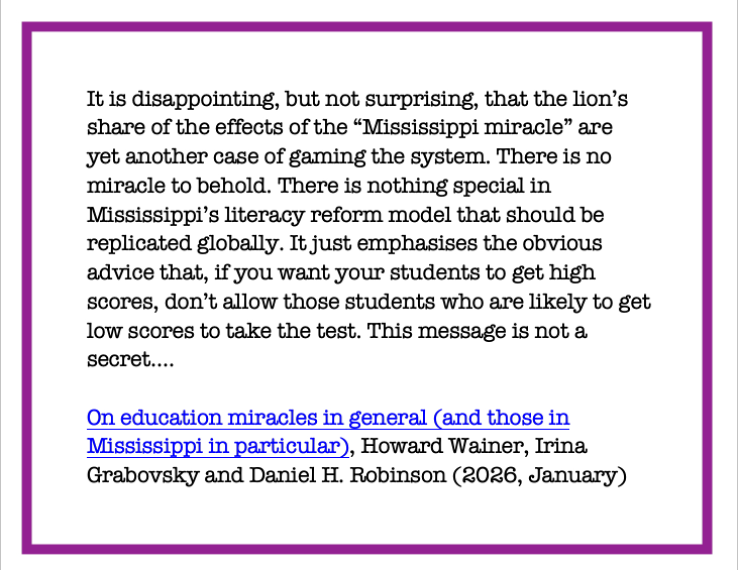
To maintain the MS “miracle” message, journalists must work incredibly hard to report selectively, and badly.
For example, Aldeman celebrates, again, MS as a outlier for for the achievement of the bottom 10% of students (carelessly disregarding that outlier data is statistically meaningless when making broad general claims):
But one state is bucking this trend: Mississippi. Indeed, there’s been a fair amount of coverage of Mississippi’s reading progress in recent years, but its gains are so impressive that they merit another look.
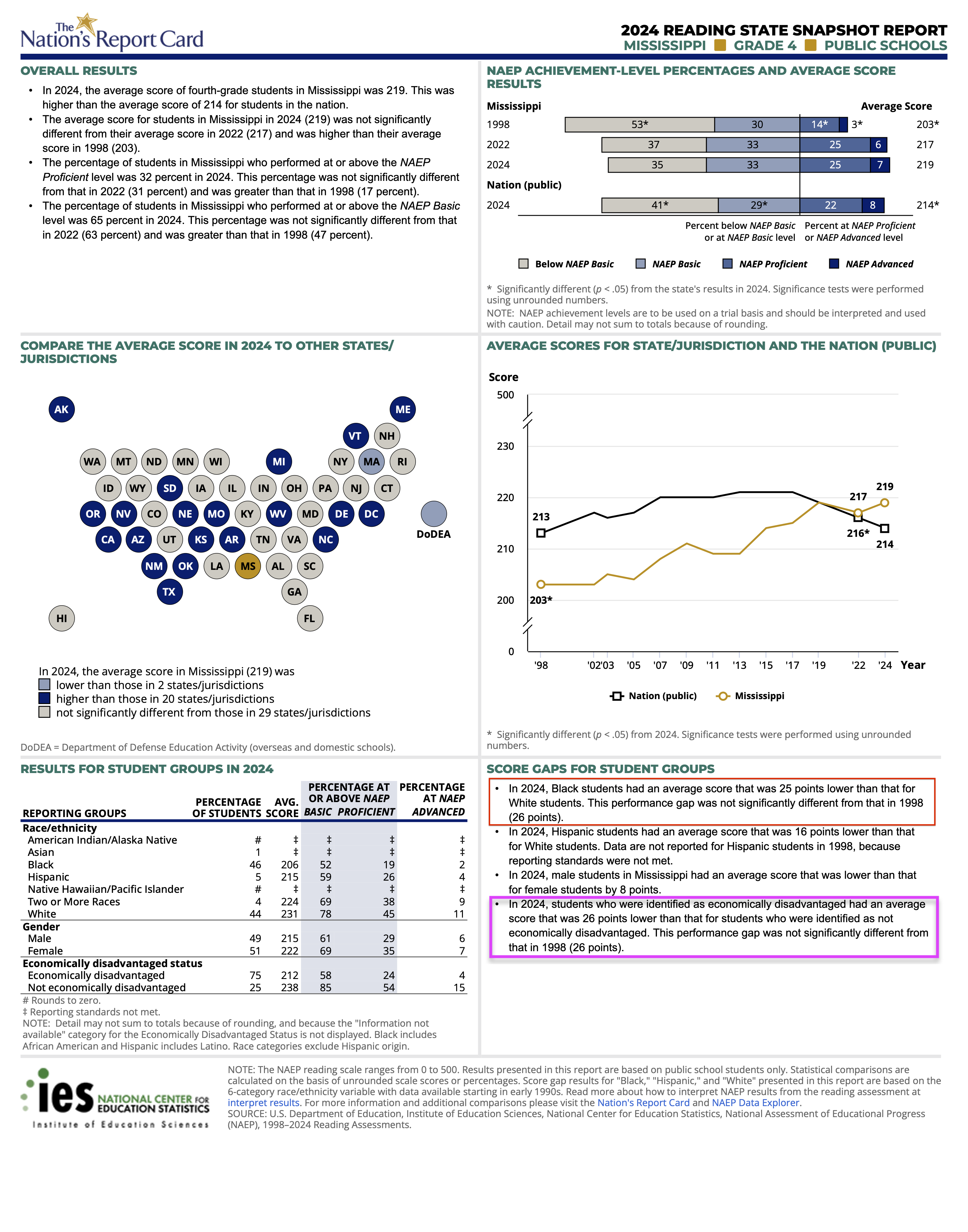
Next, Aldeman highlights reading gains by Black students in MS, omitting a damning fact about the achievement of Black (and poor) students in MS (which mirrors the entire nation):
That’s right, MS has the same racial and socio-economic achievement gaps since 1998, discrediting anything like a “miracle.”
But the likely most egregious misrepresentation of MS as a reading “miracle” is Aldeman “debunking” claims that MS gains are primarily grounded in grade retention, not the “science of reading.”
Notably, Aldeman seems to think linking to the Fordham Institute constitutes credible evidence; it isn’t.
So let’s look at the full picture about grade retention and MS’s reading scores on NAEP.
First, the research on increased reading achievement has found that only states with retention have seen score increases. Westall and Cummings concluded in a report on reading policy: “[S]tates whose policies mandate third-grade retention see significant and persistent increases in high-stakes reading scores in all cohorts…. [T]here is no consistent evidence that high-stakes reading scores increase in states without a retention component [emphasis added].” [Note that Aldeman selective refers to this study late in the article, but omits this conclusion.]
The positive impact of retention on test scores has not been debunked, but confirmed. What hasn’t been confirmed is that test score gains are actual achievement gains in reading acquisition.
Next, MS (like FL and SC, for example) has risen into the top 25% of states in grade 4 reading on NAEP, but then plummets into the bottom 25% of states by grade 8 (despite their reading reform having been implemented for over a decade), suggesting those grade 4 scores are a mirage and not a miracle:
A final point is that media always omits the most important story, what research has shown for decades about student achievement:
Almost 63% of the variance in test performance was explained by social capital family income variables…. The influence of family social capital variables manifests itself in standardized test results. Policy makers and education leaders should rethink the current reliance on standardized test results as the deciding factor to make decisions about student achievement, teacher quality, school effectiveness, and school leader quality. In effect, policies that use standardized test results to evaluate, reward, and sanction students and school personnel are doing nothing more than rewarding schools that serve advantaged students and punishing schools that serve disadvantaged students.
High-poverty states and states with high percentages of so-called racial minorities are not, in fact, beating the odds—again, note that states have not closed the racial achievement gap or the socio-economic achievement gap.
Yes, too often our schools are failing our most vulnerable students. But the greater failures are the lack of political will to address the inequity in the lives of children and the lazy and misleading journalism of the mainstream media covering education.
The goal is de-professionalizing teachers and teaching, not improving student reading proficiency.
Updated 2
The political, market, and media hype over both MS and LA are harmful because that misrepresentation and exaggeration drive the fruitless crisis/reform cycles in education and distracts reform from the larger and more impactful causes of student achievement.
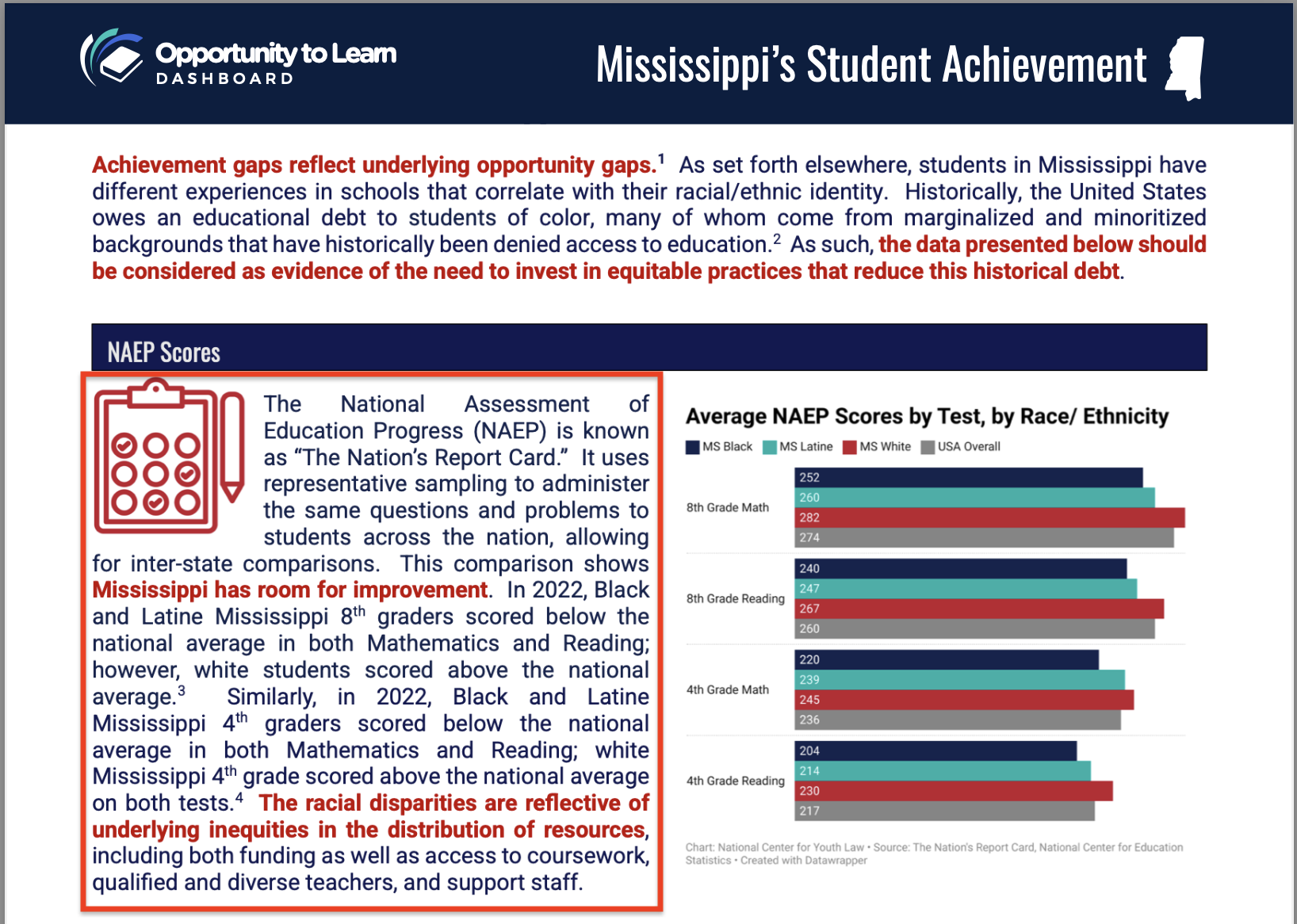
Funded and maintained by the National Center for Youth Law (NCYL) and The Schott Foundation for Public Education, the Opportunity to Learn Dashboard tracks 18 indicators across 16 states. The project seeks to provide information about factors impacting the degree to which children of different ethnicities and races are exposed to environments conducive to learning.
However, indicators directly related to schools explain only a minority of the variation in achievement-related outcomes. Therefore, the dashboard includes out-of-school factors such as access to health insurance and affordable housing, as well as within-school factors such as exposure to challenging curricula and special education spending.
For both MS and LA, we must acknowledge the significant and robust systemic (out-of-school) disadvantages minoritized and impoverished students continue to face in both states:
Note here my points raised about lingering opportunity/achievement gaps exposed by NAEP scores in both states:
To emphasize again, NAEP scores do not reveal education “miracles” in either MS or LA. In fact, NAEP scores continue to show that education reform as usual is a failure.
Children who can’t read have been cheated by their teachers, who fail to teach reading skills such as phonics.
And our national reading crisis is a threat to our very nation, especially our international economic competitiveness.
However, there are a few problems with this story.
If you were to find a Time Machine, you could travel to any year over the past century and hear the exact same story.
As well, this crisis rhetoric has been used historically and currently with math—and every other content area tested in the US.
Here is a story about reading you probably are not familiar with: There is no reading crisis, and there is no evidence that reading test scores are driven by reading instruction or programs.
Further, again, there is nothing unique or catastrophic about reading test scores or reading achievement by US students.
Historically and currently, reading test scores and achievement reflect a fact that has been replicated for decades:
Almost 63% of the variance in test performance was explained by social capital family income variables….The influence of family social capital variables manifests itself in standardized test results. Policy makers and education leaders should rethink the current reliance on standardized test results as the deciding factor to make decisions about student achievement, teacher quality, school effectiveness, and school leader quality. In effect, policies that use standardized test results to evaluate, reward, and sanction students and school personnel are doing nothing more than rewarding schools that serve advantaged students and punishing schools that serve disadvantaged students.
Now, consider a newer story: Post-Covid students are suffering a historic learning loss:
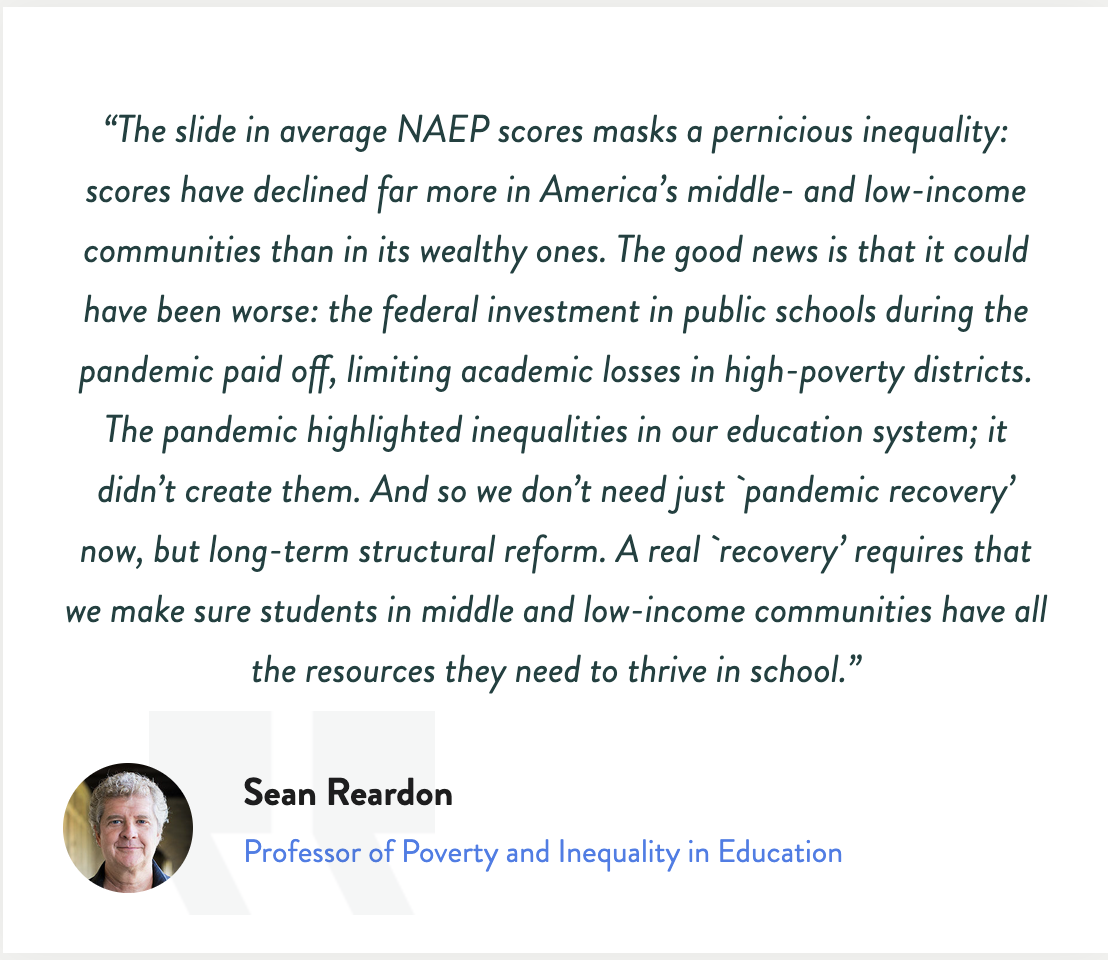
Reardon’s call for “long-term structural reform” must follow a new story about reading and a different approach to reading reform.
First, since the vast majority of causal factors reflected in reading standardized test scores are out-of-school conditions, the new reading story and different reform must address universal healthcare, food security and eliminating food deserts, home and housing stability, and stable well-paying job for parents.
Another out-of-school reform needed for reading is guaranteeing students have access to books and texts in their homes, communities (public libraries), and then in their schools (school and classroom libraries).
A simple program that gives every child from birth to high school graduation 20 books a year (10 chosen by the child/parents and 10 common texts) would build a library and ensure access to texts, one of the strongest research-based elements of reading acquisition.
Without social reform, reading scores will likely remain flat and inadequate.
The most important different aspects of a new story and reading reform is confronting traditional approaches to in-school reform in the US common since the 1980s. A different approach to reading reform must include the following:
De-couple reading reform and instruction from universal or prescribed reading programs and center teaching children to read (not implementing reading programs with fidelity). Admit there is no one way to teach all students to read, and provide the contexts that allow teachers to serve individual student needs.
Reform the national- and state-level testing of reading. The US needs a standard metric for “proficient” and “age level” (instead of”grade level”) shared on NAEP and state tests in grades 3 and 8; and that achievement level needs to be achievable and not “aspirational” (such as is the case with NAEP currently). National and state testing must be age-based and not grade-based to better provide stable data on achievement.
End grade retention based on standardized testing. Retention is punitive, and it harms children while also distorting test data.
Monitor and guarantee vulnerable populations of students who are below “proficient” to insure they are provided experienced and certified teachers and assigned to classes with low student/teach ratios.
Address teaching and learning conditions of schools, including teacher pay and autonomy.
Honor and serve students with special needs and multi-lingual learners.
While we have no unique or catastrophic reading crisis in the US—and even hand wringing over learning loss seems unfounded—we have allowed a century (or more) of political negligence to ignore the negative impact of children’s lives on their learning.
We have remained trapped in a manufactured story of reading crisis and that poverty is an excuse.
All the available evidence suggests otherwise.
Crisis, miracles, blame, and punishment have been at the center of the story everyone is familiar with. That story has never served the interests of students, teachers, or public education.
In an era of intense political hatred and fearmongering, this is a tenuous call, but if we really care about students learning to read, and if we truly believe literacy is the key to the economic and democratic survival of our country, reading deserves a new story, an accurate story, and a different approach to reform grounded in the evidence and not our cultural mythologies and conservative ideologies.
The first two decades of my career as a literacy educator were spent as a high school English teacher in rural Upstate South Carolina, the high school I had graduated from and my home town.
This began in 1984 when SC had passed sweeping education legislation that would become the standard legislative approach across the US—accountability policy grounded in state standards, high-stakes testing (grades 3 and 8 with exit exams in high school starting in grade 10), and school report cards.
SC was an early and eager adopter of the “crisis” rhetoric fueled by A Nation at Risk report released under the Reagan administration.
That high school and town were populated mostly by working-class and poor people; the town and smaller towns served by the high school were dead or dying mill towns.
Schools had far more poverty than the data showed because rural Southerners often refused to accept free and reduced meals (the primary data point for measuring poverty in schools).
However, for many years the high school ranked number 1 in the entire state for student exit exam scores in math, reading, and writing. Because of our student demographics (and notably because these students had relatively low or typical scores in grade 8 testing), we were what many people would refer to as a “high flying” or “miracle” school.
In more accurate statistical terms, we were an “outlier” data point in the state.
I have been in SC education for an ongoing five decades, and the overwhelming body of data related to student achievement in the state has matched what all data show across the US—measurable student learning is most strongly causally related to the socioeconomic status and educational levels of those students’ parents.
Further, the full story about how we achieved outlier status includes two aspects.
One is that from grade 8 to grade 10 testing, the population of students changed because of students dropping out of school (and these were among the lowest scoring students in grade 8). In fact, students were often encouraged to drop out and enroll in adult education (a two-fer win for the school because they would not be tested and enrolling in adult ed removed them from the drop-out data).
A second part of the story is that students scoring low in grade 8 were enrolled in two math and two ELA courses in grade 10. The “extra” courses were specifically designed as test-prep for state testing. We rigorously adopted a teach-to-the-test culture.
For the state writing exam, for example, we discovered that the minimum text a student could produce was an “essay” with a three-sentence introduction, a five-sentence body, and a three-sentence conclusion. Students in the “extra” ELA course wrote dozens of 3-5-3 essays in grade 10 with the teacher focusing on helping students avoid the “errors” that would flag the text as a below standard.
Many of us found the 3-5-3 approach to writing became a huge problem when students were required to write in other courses; even as students “passed” the state writing exam, they were not performing well as writers in other courses, and even refusing at times to write more than 3-5-3 essays.
For the high-stakes accountability era, we did do a great deal of good because many students across the US passed all their courses but could not receive a diploma because of exam exams. Most of our students graduated, and not because we did anything underhanded.
Yet, I must stress that how we accomplished our outlier status was likely not scalable, but more importantly, our approach should not be replicated by other schools.
Fast-forward 40 years, and education journalism has written hundreds and hundreds of stories not only in pursuit of “outlier” schools, but carelessly framing them as both proof of the on-going (permanent) education crisis and that “status quo” education refuses to implement what we know “works.”
The newest iteration of this misleading story in education is the “science of” movement grounded in the “science of reading” story first popularized by Emily Hanford, who wrote about a “miracle” school in Pennsylvania. This compelling but false story has been parlayed into an even more successful podcast as well as spawning dozens of copy-cat articles by education journalists across the country.
Media, however, never covered Gerald Coles’s careful debunking of the “miracle” school Hanford featured. Similar to my story above about the beginning of my teaching career, the full story of that school was quite different than what was covered in the media.
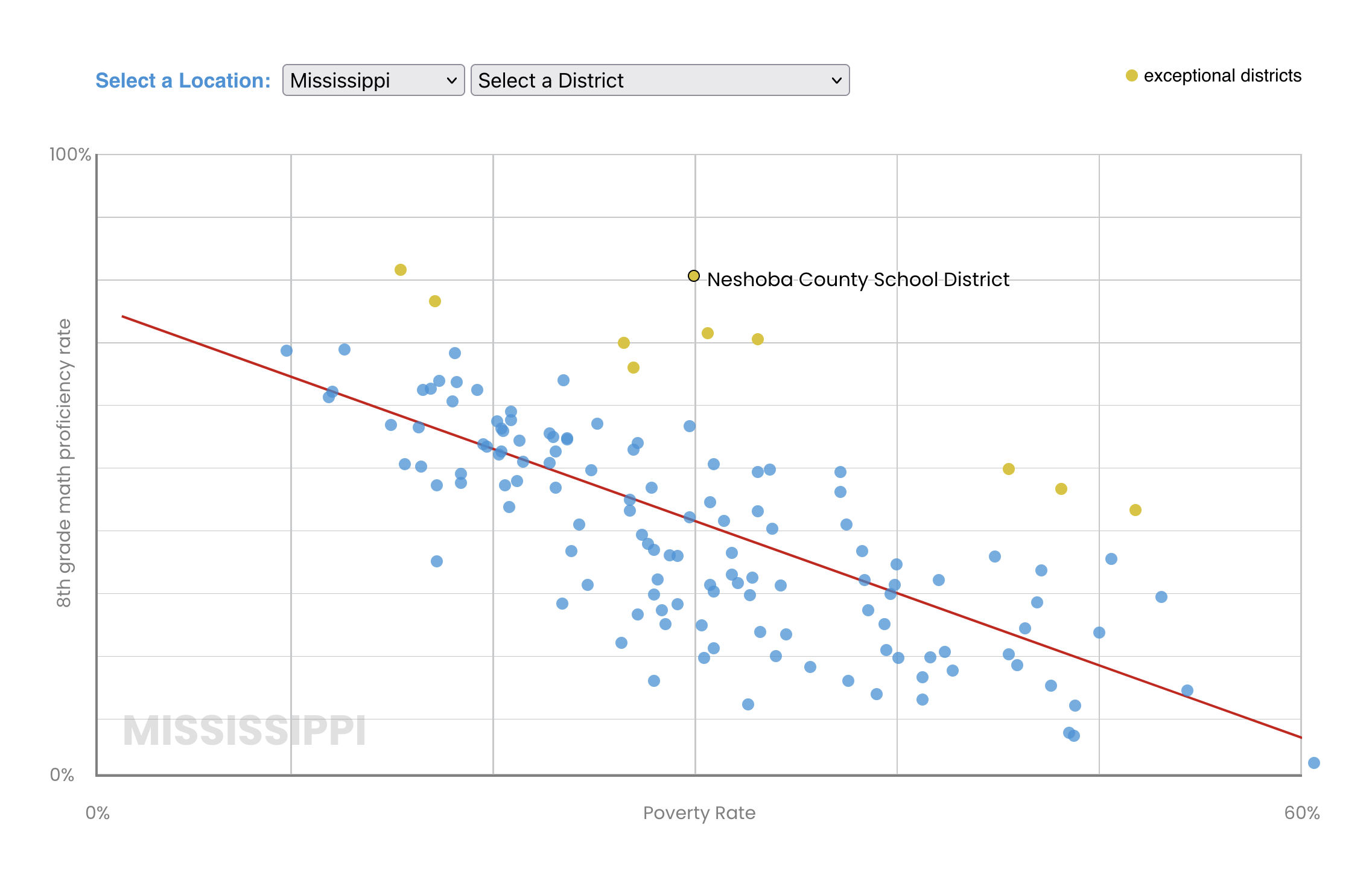
To be blunt, education journalists are mistakenly compelled to focus on the “exceptional” districts (outliers) while ignoring the more compelling red line that, again, shows what, in fact, is normal and what can and should be addressed in terms of educational reform—the negative impact of poverty on educational attainment.
So here is a story you likely will not read: Education journalism is failing public education, and has been doing so for decades.
Education journalists are blindly committed to the “crisis” and “outlier” stories because they know people will read and listen to them.
The “outlier” story makes for a kind of “good” journalism, I suppose, but the problem is that these stories become popular beliefs and then actual legislation and policy.
The current”science of” movement is riding a high wave because of the “science of reading” tsunami. But like all the misguided reforms since the original false education story, A Nation at Risk, this too will crash and reveal itself as a great harm to students, teachers, and our public school system.
This is boring, I know, but most outlier stories are ultimately false or they simply are not replicable or scalable, as I explained in my opening story.
If we genuinely care about student learning, teaching, and the power of public education, we need education journalists more dedicated to the full story and the not the outliers that help drive their viewing numbers.
Third grade retention (required by 22 states) significantly contributes to increases in early grade high-stakes assessment scores as part of comprehensive early literacy policy.
Retention does not appear to drive similar increases in low-stakes assessments.
No direct causal claim is made about the impact of retention since other policy and practices linked to retention may drive the increases.
However, their analysis concludes about grade retention as reading reform :
Similar to the results for states with comprehensive early literacy policies, states whose policies mandate third-grade retention see significant and persistent increases in high-stakes reading scores in all cohorts. The magnitude of these estimates is similar to that of the “any early literacy policy” estimates described in Section 4.1.1 above, suggesting that states with retention components essentially explain all the average effects of early literacy policies on high-stakes reading scores. By contrast, there is no consistent evidence that high-stakes reading scores increase in states without a retention component.
Therefore, one Big Lie about grade retention is that it allows misinformation and false advocacy for the recent “science of reading” reform across most states in the US.
Since grade retention in the early grades removes the lowest scoring students from populations being tested and reintroduces them biologically older when tested, the increased scores may likely be from these population manipulations and not from more effective instruction or increased student learning.
Evidence from the UK, for example, suggests that skills-based reading testing (phonics checks) that count as “reading” assessment strongly correlate with biological age (again suggesting that test scores may be about age and not instruction or learning):
Another Big Lie about grade retention is that reading reform advocates fail to acknowledge decades of evidence that grade retention mostly drives students dropping out of school and numerous negative emotional consequences for those students retained.
Resolved, that the National Council of Teachers of English strongly oppose legislation mandating that children, in any grade level, who do not meet criteria in reading be retained.
And be it further resolved that NCTE strongly oppose the use of high-stakes test performance in reading as the criterion for student retention.
Grade retention, then, is an effective Big Lie of Education because it allows misinformation based in test-score increases to promote policy and practices that fail to increase test scores in sustained ways (see the dramatic drop in “success” for “high-flying” states such as Mississippi and Florida, both of which taut strong grade 4 reading scores, inflated by grade retention, but do not sustain those mirage gains by grade 8).
Grade retention is a Big Lie of education reform that punishes minoritized and marginalized students, inflates test scores, and fuels politicized education reform.
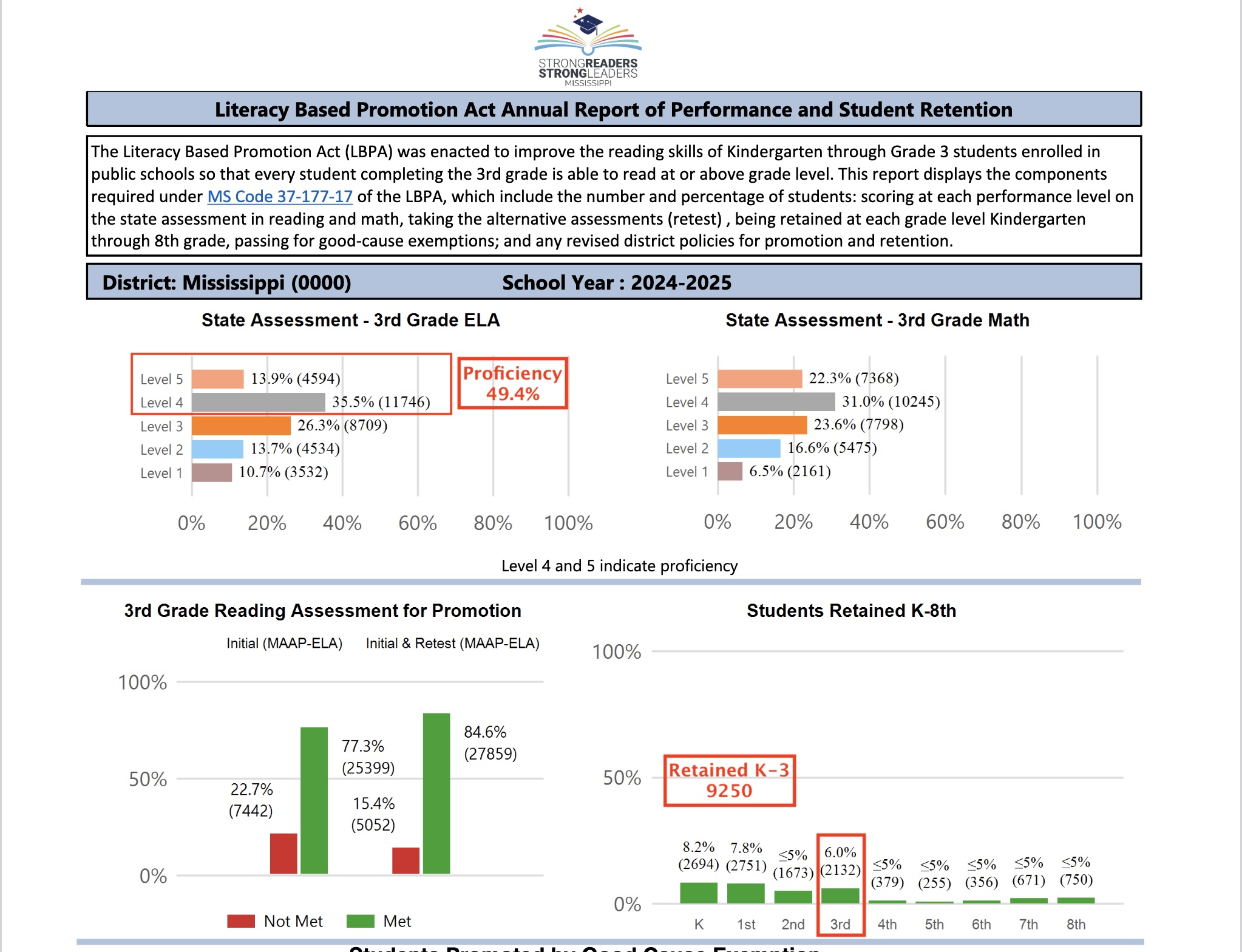
[1] Consider that states retaining thousands of students each year, such as Mississippi, have not seen those retention numbers drop, suggesting that the “science of reading” reforms are simply not working but the retention continues to inflate scores.
The following data from Mississippi on reading proficiency and grade retention exposes that these claims are misleading or possibly false:
“The available research does not ratify the case for school cellphone bans,” writes Chris Ferguson, professor of psychology at Stetson University, adding, “no matter what you may have heard or seen or been [told].”
What Ferguson then offers is incredibly important, but also, it exposes a serious lack of awareness by Kappan considering their coverage of education:
And the media treatment has played a part in amplifying what can only be described as a moral panic about phones in schools.
News media often cater to panics, neglecting inconvenient science and stoking unreasonable fears. And this is what I see happening with the issue of cellphones in schools.
First, Ferguson’s characterizations of media coverage of education—”News media often cater to panics”—is not only accurate but matches a warning many scholars and educators have been offering for decades, especially during five decades of high-stakes accountability education reform uncritically endorsed by media.
The only story education journalists seem to know how to write is shouting crisis and stoking panic.
Just a couple days ago in The Hechinger Report, this headline, “6 observations from a devastating international math test,” is followed by this lede: “An abysmal showing by U.S. students on a recent international math test flabbergasted typically restrained education researchers. ‘It looks like student achievement just fell off a cliff,’ said Dan Goldhaber, an economist at the American Institutes for Research.”
And for a century, in fact, education journalism has been persistently fostering a “moral panic” about reading proficiency by students.
Here is Nicholas Kristof in the New York Times: “One of the most bearish statistics for the future of the United States is this: Two-thirds of fourth graders in the United States are not proficient in reading.”
Kristof is but one among dozens in the media repeating what constitutes at best an inexcusable mischaracterization and at worst a lie about what exactly NAEP testing data show about reading achievement in the US.
Nearly every media story about reading in the US since Emily Hanford launched in 2018 (and then repackaged as a podcast) the popular mischaracterization/lie has dutifully “amplif[ied] what can only be described as a moral panic” about reading achievement and instruction:
The stakes were high. Research shows that children who don’t learn to read by the end of third grade are likely to remain poor readers for the rest of their lives, and they’re likely to fall behind in other academic areas, too. People who struggle with reading are more likely to drop out of high school, to end up in the criminal justice system, and to live in poverty. But as a nation, we’ve come to accept a high percentage of kids not reading well. More than 60 percent of American fourth-graders are not proficient readers, according to the National Assessment of Educational Progress, and it’s been that way since testing began in the 1990s.
Ferguson’s warning about the misguided panic over cell phones in schools and the resulting rush to legislate based on that misguided panic is but a microcosm of the much larger and much more dangerous media misinformation about reading and the rise of “science of reading” (SOR) legislation.
We should heed Ferguson’s message not just about cell phones in schools but about the vast majority of media coverage of education and then how the public and political leaders overreact to the constant but baseless moral panics.
Yes, I am glad Kappan included Ferguson’s article, but I wish Kappan‘s The Grade and all education journalists would pause, take a look in the mirror, and recognize that his concern about media coverage of cell phones easily applies to virtually every media story on education.
In fact, I encourage The Grade and other education journalists to implement Ferguson’s “Red Flags” when considering education research, specifically the SOR story being sold:
RED FLAG 1: Claims that all the evidence is on one side of a controversial issue….
RED FLAG 2: Reversed burden of proof. “Can you prove it’s not the smartphones?”…
RED FLAG 3: Failing to inform readers that effect sizes from studies are tiny, or near zero, only mentioning they are “statistically significant.”…
RED FLAG 4: Comparisons to other well-known causal effects.
As I and others have repeatedly shown, the SOR stories fails all of these Red Flags.
There is no debate at this point among scientists that reading is a skill that needs to be explicitly taught by showing children the ways that sounds and letters correspond.
“It’s so accepted in the scientific world that if you just write another paper about these fundamental facts and submit it to a journal they won’t accept it because it’s considered settled science,” Moats said.
And this refrain is at the center of SOR advocacy, media coverage, and the work of education journalists: “Hanford pushed reporters to understand the research on how students learn to read is settled.”
Ultimately, the moral panics around education have far more to do with media begging for readers/viewers, education vendors creating market churn for profit, and politicians grandstanding for votes.
In the wake of education journalists repeatedly choosing to “cater to panics,” students, teachers, and education all, once again, are the losers.
Recently, I was at the window of my allergist, paying for my allergy shots. The receptionist asked me something about enjoying my break, but I noted I was currently teaching a May course. Her response was something like “Sorry.”
I said that I enjoyed my May class and ended with “I love my students.” The receptionist stopped typing my information into the computer and looked up at me, her brow furrowed.
“Are you being serious?” she asked.
“Yes,” I explained, “I love my students, I love teaching.”
She explained to me that another professor came to the same office and only said that sarcastically so she assumed I was also.
This moment came back to me as I watched CNN’s coverage of the tornado destroying a school in Moore, OK. Anderson Cooper, echoing comments made by the media during the Sandy Hook Elementary shootings, interviewed a teacher who had gathered all of her students under their desks during the storm—and no children from her class were injured—and stated that teachers do amazing things every day, heroic things every day, but this women had gone above her duty.
I have now grown tired of this token and blatantly superficial (and insincere) praise of teachers.
Token praise cannot, or at least should not, mask the disdain expressed about not only teachers but also workers in general in the U.S. The reposted blog below, then, remains a valid concern.
The first decade of the 21st century has been an ominous harbinger for the American worker.
Children and adults in poverty, the working poor, and the working class are increasing; the middle-class is eroding; and the pooling of capital among the 1% is expanding, forming the anchor stalling the progress of the USS Democracy.
In The State of Working America (12th ed), Mishel, Bivens, Gould, and Shierholz identify the disturbing trends that signal the approaching death of the American worker:
America’s vast middle class has suffered a ‘lost decade’ and faces the threat of another (p. 5)….
Income and wage inequality have risen sharply over the last 30 years (p. 6)….
Rising inequality is the major cause of wage stagnation for workers and of the failure of low- and middle-income families to appropriately benefit from growth (p. 6)….
Economic policies caused increased inequality of wages and incomes (p. 7)….
Claims that growing inequality has not hurt middle-income families are flawed (p. 8)….
Growing income inequality has not been offset by increased mobility (p. 9)….
Inequalities persist by race and gender. (p. 9)
Currently, the American worker—like those trapped in poverty and the working poor—have no political party because, ironically, the democratic process in the U.S. has been bought by Corporate America and democracy has been left in that wake.
Public school teachers also have no political party, and since the Chicago teachers’ strike, teachers now more than ever represent the political and public failure to appreciate and recognize the importance of the American worker.
Teachers as Workers
Early and mid-twentieth century America may have been a turning point for unionization in a country that lives more by ideology than evidence, but even that assessment may be tinted by the rose-colored glasses of hindsight.
The truth is likely that Americans’ embracing of rugged individualism has always been an impenetrable wall between the American character and the community and solidarity at the core of unions.
Nonetheless, the American public school teacher has over the past decade—during the demonstrable decline of the working and middle class as well as the rise of poverty in the U.S.—gradually become the target of the popular corporate agenda to end tenure and break unions, despite the essential democratic nature of both.
Politicians, corporate advocates, and the media have fed a willing public a steady diet of false but robust narratives that characterize teachers as the sole force behind misleading claims of failed public schools. Any evidence- and experience-based rebuttal to the “bad” teacher claim or the corrupt union mantra has been met with a “no excuses” ideology that chants “poverty is not destiny.”
This corporate agenda has no basis in fact, but the abundant commentaries and scholarship refuting this drum beat have failed to pierce the American public’s self-defeating faith in America the meritocracy.
The political and corporate elite know this, and they have little motivation to set aside their lies since they work, and since they benefit in the end.
And during the teachers’ strike in Chicago, the media and political leaders mischaracterized unions and teachers in Chicago and across the U.S.—more laziness and greediness heaped on teachers, and more evidence that the Democratic party is indistinguishable from the Republican party in terms of education and labor policy.
What is most disturbing ultimately about the demonizing of teachers and in effect all American workers is that most Americans are and will always be those exact workers who are being stripped of their rights, dignity, and access to the American Dream that the political and corporate elite along with the public claim to be protecting.
The Chicago teachers’ strike was yet another referendum on the failing education reform agenda that is destined to strip teachers of their professionalism and to further stratify the education system of the U.S. so that affluent children (mostly white) gain even more advantage in their schooling than they have in their lives over children living in working class, working poor, and impoverished homes (disproportionately people of color).
It was a political lie to claim that the Chicago teachers’ strike was the fault of lazy and greedy teachers supported by their corrupt union. It was a political lie to ignore the central demand of those teachers—a stand against test-based teacher accountability.
But neither the political elite nor the corporate elite will eventually lose in this debate because a public embracing of the corporate agenda and rejection of the striking teachers is a self-defeating commitment that will guarantee what appears inevitable now—the death of the American worker.
Teachers are not alone in this, but public school teachers are great American workers. I cannot fathom how we have come to a day when Americans no longer value something that cannot be more American than workers in solidarity.
















 dr. p.l. (paul) thomas