necrophilia [nek-ruh-fil-ee-uh] – noun, Psychiatry.
1. an erotic attraction to corpses.
There is a perverse irony to this I cling to: My homeland, The South, is best represented by William Faulkner’s “A Rose from Emily”—a story that builds to a Town discovering that dear old Emily has been sleeping with the corpse of a lover, who everyone assumed had left her just before marriage.
To this day in 2015, as I post this, Emily remains the fictional personification of The South.
Proposed Georgia legislation would prohibit the removal of monuments despite any future objections to them.
Rep. Tommy Benton introduced House Bill 50 to avoid changing fashions from sweeping away memories, he said. It was approved by a Georgia House committee on Wednesday.
“I think history is history,” said Benton, R-Jefferson.
Having been born and then lived my entire life in The South, I am deeply skeptical of the first two words of Rep. Benton’s quote—thinking is not something common among the wink-wink-nod-nod populist politics in The South, but pandering is—and that pandering is often to the lowest possible denominator, I fear.
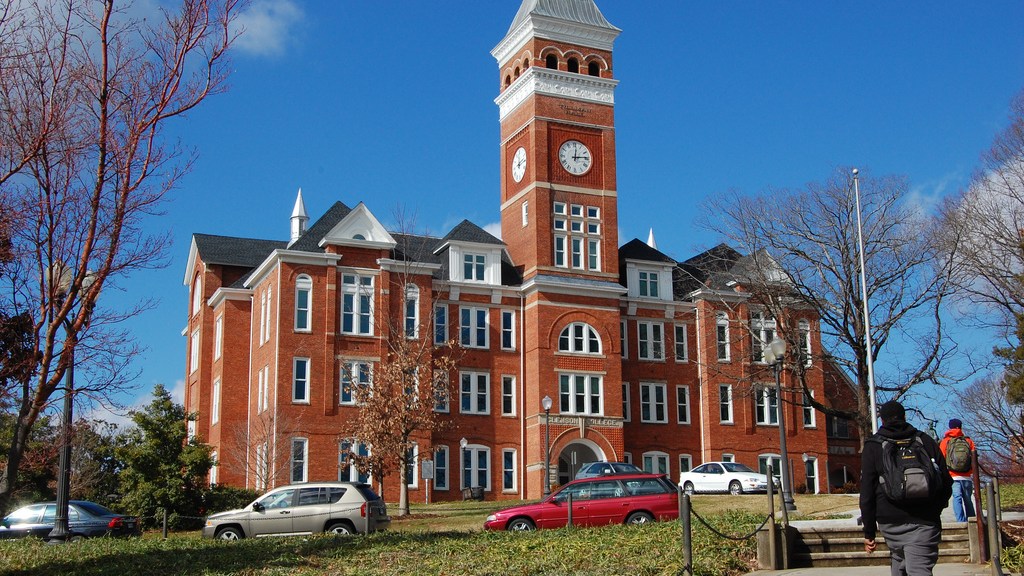
I imagine that some political leaders in Georgia have heard the rising voices at nearby Clemson University in South Carolina, where students and faculty have called for the renaming of Tillman Hall; see two posts addressing that debate:
Ultimately, The South’s contemporary and historical Selves are almost indistinguishable; we never let go.
Segregation, corporal punishment, self-defeating political allegiances, racism, sexism, inadequate commitments to public institutions (notably education), “right to work” anti-unionism, a contradictory reputation for great literature and “deficient” literacy, a fundamentalist religious fervor—these are The South, and I invite you to read further:
John Proctor: Because it is my name! Because I cannot have another in my life! Because I lie and sign myself to lies! Because I am not worth the dust on the feet of them you have hanged! How may I live without my name? I have given you my soul; leave me my name!
While Proctor speaks to the association between a name and honor, names also carry the burdens of gender and heritage. “I have guarded my name as people/ in other times kept their own clipped hair,” begins the speaker in Barbara Kingsolver’s “Naming Myself” from Another America. Later, she explains:
I could shed my name in the middle of life, the ordinary thing, and it would flee along with childhood and dead grandmothers to that Limbo for discontinued maiden names.
But it would grow restless there. I know this. It would ride over leaf smoke mountains and steal horses.
Names also represent race and the lingering weight of the heaviest shackles of history. To that, Malcolm X explains his name:
“It’s true, South Carolinians would do well to remember Tillman’s legacy,” argues Paul Bowers, addressing directly the naming of Tillman Hall:
But we shouldn’t honor it, which is exactly what we’re doing by keeping his name on a building at a public university….
It’s another thing entirely for it to be named after Tillman, a progenitor and perpetuator of American apartheid who led lynch mobs during Reconstruction and boasted about it until his dying day.
Remembering history, the worst scars of history, is different than honoring those scars of history. And naming—whether it be a person’s name or a building’s—treads a thin line between remembering (as not to make the same mistake again) and honoring.
This is the field where the battle did not happen,… where no monument stands,…
No people killed—or were killed—on this ground hallowed by neglect and an air so tame that people celebrate it by forgetting its name.
The South presents a history that must not be forgotten, but includes much that should not be honored—including the person, ideologies, acts, and name of Benjamin Tillman.
And somewhere between John Proctor’s impassioned but fictionalized plea and Malcolm X’s steadfast and reasonable refusal to accept the name given him lies my recognition that what we name anyone or anything, and why, is powerful evidence of what we remember and why—and ultimately what we honor beneath claims otherwise.
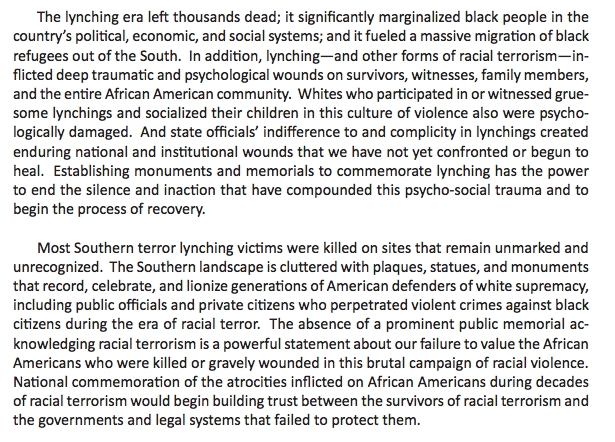
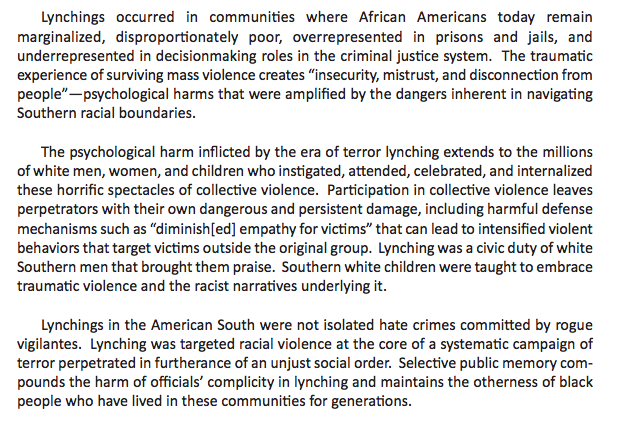
Most Southern terror lynching victims were killed on sites that remain unmarked and unrecognized. The Southern landscape is cluttered with plaques, statues, and monuments that record, celebrate, and lionize generations of American defenders of white supremacy, including public officials and private citizens who perpetrated violent crimes against black citizens during the era of racial terror [emphasis added]. The absence of a prominent public memorial acknowledging racial terrorism is a powerful statement about our failure to value the African Americans who were killed or gravely wounded in this brutal campaign of racial violence. National commemoration of the atrocities inflicted on African Americans during decades of racial terrorism would begin building trust between the survivors of racial terrorism and the governments and legal systems that failed to protect them. (p. 22)
Sandra Cisneros’s The House on Mango Street has a chapter “My Name” that begins, “In English my name means hope,” adding, “It was my great-grandmother’s name and now it is mine”:
She looked out the window her whole life, the way so many women sit their sadness on an elbow. I wonder if she made the best with what she got or was she sorry because she couldn’t be all things she wanted to be. Esperanza. I have inherited her name, but I don’t want to inherit her place by the window. (pp. 4-5)
Tradition is static, like “forgotten.” A name given, a name chiseled in granite, a name uttered each time someone gives directions.
Remembering in order to remain steadfast against the mistakes of the past does not require the echo of names, and renaming becomes an act of defiance and recognition, as Esperanza proclaims: “I would like to baptize myself under a new name, a name more like the real me, the one nobody sees” (p. 5).
The call to rename Tillman Hall, then, is not about erasing or forgetting, but about the baptism of re-naming as an act of courage, a claiming of honor too often denied and too often ignored. The refusal to rename Tillman Hall proves James Baldwin right, although he made these observations sixty years ago:
[The South] clings to the myth of its past but it is being inexorably changed, meanwhile, by an entirely un-mythical present: its habits and its self-interest are at war. Everyone in the South feels this and this is why there is such panic on the bottom and such impotence at the top. …
[I]t is, admittedly, a difficult task to try to tell people the truth and it is clear that most Southern politicians have no intention of attempting it….
This failure to look reality in the face diminishes a nation as it diminishes a person. (“Nobody Knows My Name: A Letter from the South”)
Renaming is a baptism long overdue in the Bible Belt.
Any real change implies the breakup of the world as one has always known it, the loss of all that gave one an identity, the end of safety. And at such a moment, unable to see and not daring to imagine what the future will now bring forth, one clings to what one knew, or thought one knew; to what one possessed or dreamed that one possessed. Yet, it is only when a man is able , without bitterness or self-pity, to surrender a dream he has long cherished or a privilege he has long possessed that he is set free—he has set himself free—for higher dreams, for greater privileges.
Whether you are from the South—as I am, approaching my 54th year in the area where I was born—or not, here is how you can come to understand the South: Read William Faulkner’s “A Rose for Emily,” James Baldwin’s “Faulkner and Desegregation,” and M.E. Bradford’s “Faulkner, James Baldwin, and the South.”
In the shocking ending to “A Rose for Emily,” the town (that community and place so sacred to Faulkner, as Bradford emphasizes) and the reader discover that Emily has spent much of her life sleeping with the corpse of her mysteriously vanished lover. Not to be overly simplistic, but in that scene, Emily is the South and her act is the cancerous core of what best captures that region’s ideological commitment—cling to the corpse of tradition no matter what.
It is the steadfast clinging that matters, not the thing itself.
Baldwin’s response to Faulkner’s call for Southern blacks to be patient about integration at mid-twentieth century deftly dismantles the inherent contradictions, the incessant paternalism, and the disturbing lack of awareness embodied by Faulkner himself. While Faulkner seems oblivious to the message in his own work, Baldwin, a black man from Harlem, the North, echoes the warning of “A Rose for Emily”:
[S]o far from trying to correct it, Southerners, who seem to be characterized by a species of defiance most perverse when it is most despairing, have clung to it [emphasis added], at incalculable cost to themselves, as the only conceivable and as an absolutely sacrosanct way of life. They have never seriously conceded that their social structure was mad. They have insisted, on the contrary, that everyone who criticized it was mad.
Further, Baldwin’s understanding of the South remains as perceptive now as when he originally confronted Faulkner:
It is apparently very difficult to be at once a Southerner and an American….It is only the American Southerner who seems to be fighting, in his own entrails, a peculiar, ghastly, and perpetual war with all the rest of the country….
The difficulty, perhaps, is that the Southerner clings to two entirely antithetical doctrines, two legends, two histories….
The Southern tradition, which is, after all, all that Faulkner is talking about, is not a tradition at all: when Faulkner evokes it, he is simply evoking a legend which contains an accusation. And that accusation, stated far more simply than it should be, is that the North, in winning the war, left the South only one means of asserting its identity and that means was the Negro.
And finally to grasp fully the South, Bradford’s apologist reading of Faulkner (punctuated with “We in the South”) as well as a distinct misreading of Baldwin offers the full shape that characterizes the South: Faulkner as embodiment, Emily as metaphor, Baldwin as moral witness, and Bradford as contorted intellectual justification.
However, in the South, this is never merely academic or something past.
Clemson’s Tillman Hall and the Tragedy of Southern Tradition
It is currently being recreated in the Tillman Hall debate at Clemson University—not as a unique case, but a representative one, Clemson University in its founding, its physical plant, and the myriad names with which it is associated
Tillman Hall at Clemson University bears the name of a former South Carolina governor, Benjamin Tillman, who “established an agricultural school that would become Clemson College, as well as Winthrop College.”
Those not from the South likely find these recurring tensions unfathomable, notably the never-ending battles about the Confederate flag that remains on the capitol grounds after decades flying atop the Statehouse.
Apologists for tradition in the South, like Bradford for Faulkner, expose the contradictory mindset confronted by Baldwin. Those who rush to add “yes, but…” in defense of Tillman, for example, are likely to interject the “yes, but…” strategy to refute Martin Luther King Jr.
“Yes, but” Tillman was governor and if not for him, no Clemson!
“Yes, but” King was a socialist and adulterer.
As a life-long Southerner, I have witnessed these patterns regularly throughout my life. It is the logic of the South.
Again, as Baldwin recognized, the South clings like Emily not to tradition but to the fabricated legend. And it is there that the hypocrisy of “yes, but…” is fully exposed.
Apologists for Tillman cling to Tillman’s ill-gotten status during his life, a status reflecting the most dehumanizing qualities of the South during Reconstruction and the early twentieth century.
Critics of Tillman, however, recognize that his racism outweighs any so-called accomplishments.
Tillman went to the U.S. Senate in 1895, where he remained until his death in 1918. He used the Senate floor and the Chatauqua circuit to become the nation’s loudest and most famous proponent of white supremacy, or in his own words, “preaching to those people the gospel of white supremacy according to Tillman.”
“It’s true, South Carolinians would do well to remember Tillman’s legacy,” argues Paul Bowers, addressing directly the naming of Tillman Hall:
But we shouldn’t honor it, which is exactly what we’re doing by keeping his name on a building at a public university….
It’s another thing entirely for it to be named after Tillman, a progenitor and perpetuator of American apartheid who led lynch mobs during Reconstruction and boasted about it until his dying day.
To honor Tillman as well as many others like him is to make Emily’s mistake—clinging to a corpse that should be buried beneath a marker, not to honor but to remind us of all that we must not embrace again.
Apologists for tradition are emboldened by those calling for patience, like Faulkner, who prompted Baldwin to punctuate his essay with urgency:
But the time Faulkner asks for does not exist— and he is not the only Southerner who knows it. There is never time in the future in which we will work out our salvation. The challenge is in the moment, the time is always now.




 dr. p.l. (paul) thomas