
Tag Archives: Twitter

Twitter Truth (and The Onion Gets It Again)

As I have catalogued on this blog and elsewhere, when it comes to education policy, my home state of South Carolina is A Heaping Stumbling-Bumbling Mess of Ineptitude.

And while we have garnered a sort of unwanted but fully warranted 15 minutes of fame by being the repeated source of ridicule for The Daily Show, SC has now achieved what I am calling Twitter Truth through the actions of Governor Nikki Haley, as reported at The Huffington Post:

South Carolina Gov. Nikki Haley (R) wanted to tout her state’s education reform plan Monday — but it all went horribly wrong.

Here’s what Haley tweeted about the plan:

nikki haley tweet

Haley, or whichever member of her staff posted the tweet, was the victim of Twitter’s 140 character limit. An Instagram photo caption longer than 140 characters in length is cut off mid-sentence, followed by a link to the original post. The full caption makes much more sense than the above tweet:

nikki haley instagram post

The tweet was deleted a few hours after it was posted.

If we put Tweet 1 (clipped by Twitter Truth) together with Tweet 2, we find that Tweet 1 actually makes an accurate commentary on how SC continues to plow the wrong road in our claimed quest for educating the children of SC, a large percentage of whom are living in poverty and suffering the burdens of their racial and language minority statuses.

For the record, “reading coaches” masks that SC has adopted 3rd-grade retention policy based on high-stakes testing, “technology investments” ignores SC’s high poverty rate and that the state needs to invest in hundreds of areas other than making technology vendors wealthy, and “charter schools” fails to note that SC charter schools, as is the case across the U.S., perform about the same and worse than public schools while contributing to the rise in re-segregation.

And with charter schools in mind, let’s be sure to give The Onion its due, once again; this time for New Charter School Lottery System Gives Each Applicant White Pill, Enrolls Whoever Left Standing:

NEW YORK—Introducing key changes to the lottery system that governs the admissions process, the New York City Charter School Center notified potential students this week that openings will now be filled by randomly distributing white pills to applicants and enrolling those left standing.

In place of the existing electronic lottery system conducted in the spring, education officials explained that applicants would receive identical white pills, among them a small number of innocuous placebos corresponding to the amount of open spots, and then wait approximately 30 minutes to determine the survivors and new charter school enrollees.

“With so many deserving students competing for so few spots in the city’s network of high-performing, tuition-free charter schools, our new lottery system ensures that each student is provided with an equal opportunity,” said Eva Moskowitz, the head of the Success Academy chain of 22 charter schools, while mixing up a tub of 118 sugar pills and 2,376 pentobarbital capsules to be blindly administered in an upcoming lottery. “Between small class sizes, longer school days, individualized instruction, and superior college admission rates, charters provide amazing opportunities for students who don’t enter a convulsive state, fall into a coma, stop breathing, and cease all bodily functions during the admissions process.” (emphasis added)

“Of course it’s heartbreaking for the families of children who aren’t accepted,” Moskowitz continued, “But seeing the look on parents’ faces when their child is still standing in a room littered with rejected applicants is priceless. They know their child is going to get the best possible education.” [1]

Administrators told reporters that the new quick and relatively painless lottery system is a welcome alternative to the notoriously long and emotional computerized drawings of past years, where all applicants received a random number and were subjected to waiting for many hours before learning whether they would attend a charter school or return to an inferior public school.

Officials confirmed that the innovative selection process has already proved a success, though not without its minor setbacks, in areas of the country where it has already been implemented.

“This year we’re making the pills a little stronger because not all the candidates were weeded out right away,” said Tim Bernard of Thrive Academy in Washington, D.C., a public charter that had 200 elementary school students apply for eight open spots last year. “Some kids would seem fine, we’d extend them an official offer of admission, and then a few days later they’d start hallucinating or slurring their speech. Meanwhile parents are scared sick we’re going to rescind their kids’ offers because too many applicants survived.”

“Luckily, we worked out all the kinks for this year,” Bernard added. “The body removal crews are already assembled outside the auditoriums and ready to go.”

Though charter school officials maintained that the new admissions process is designed fairly, critics claimed many affluent parents have already found ways to exploit the system. For example, after a lottery in Los Angeles ended with a high number of living students, officials discovered that parents had been building up their children’s immunity to the pills by giving them small doses of poison each day, or had hired tutors to help them train their bodies to overcome the effects of the pills. (emphasis added) [2]

Despite these flaws, many parents said they have no doubts about trying to get their child into a charter.

“I went through charter school admissions with my oldest son last year, but after he died I wondered whether it was even worth it to try again with my other kids,” Hoboken, NJ mother Jane Schaal told reporters. “But then my younger daughter got into Achievement First and I knew we made the right decision. There was no way she was going to succeed in public school.”

“Next year we’ll try to get my youngest son into a good elementary school,” Schaal added. “He’s not in kindergarten yet, but even if he’s not accepted to a top-notch charter, it’s a relief knowing that his future will be set.”

This should be really funny, but as with many of their other satires, this piece comes disturbingly close to everything that is wrong with charter schools driven by market forces—a commitment done to children and their families, a process that sacrifices children in very real ways.

[1] Why Sending Your Child to a Charter School Hurts Other Children

[2] Endgame: Disaster Capitalism, New Orleans, and the Charter Scam:

And even in Layton’s own article, we discover the dark truth beneath the polished sheen of charter school advocacy:

“White students disproportionately attend the best charter schools, while the worst are almost exclusively populated by African American students. Activists in New Orleans joined with others in Detroit and Newark last month to file a federal civil rights complaint, alleging that the city’s best-performing schools have admissions policies that exclude African American children. Those schools are overseen by the separate Orleans Parish School Board, and they don’t participate in OneApp, the city’s centralized school enrollment lottery.”
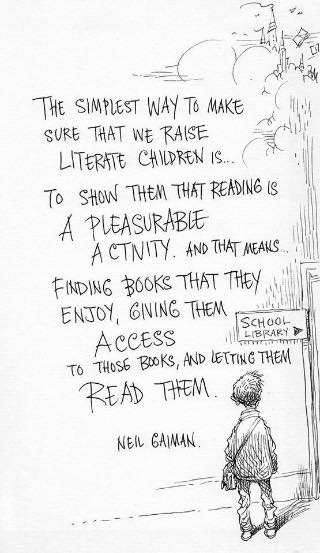
Gaiman, Prisons, Literacy, and the Problems with Satire

Regarding my recent blog about Neil Gaiman for Secretary of Education (and the edited version at The Answer Sheet), Ken Libby took me to task on Twitter for, among other things, Gaiman’s comment about prisons and literacy:

I was once in New York, and I listened to a talk about the building of private prisons – a huge growth industry in America. The prison industry needs to plan its future growth – how many cells are they going to need? How many prisoners are there going to be, 15 years from now? And they found they could predict it very easily, using a pretty simple algorithm, based on asking what percentage of 10 and 11-year-olds couldn’t read. And certainly couldn’t read for pleasure.

It’s not one to one: you can’t say that a literate society has no criminality. But there are very real correlations.

My immediate point after quoting Gaiman was: “Gaiman even understands the difference between causation and correlation—a dramatic advantage over Secretaries of Education in the past two administrations.”

I have also received a friendly and much appreciated email from Chris Boynick addressing the same issue, noting that it is an urban legend that prisons use child literacy to predict prison needs. See “Prisons don’t use reading scores to predict future inmate populations” and “Kathleen Ford says private prisons use third-grade data to plan for prison beds.”

Boynick sent that same information to Neil Gaiman who responded on Twitter with: “@CBoynick Interesting. The person who told me that was head of education for New York city.”

So let me make a few clarifications addressing all this:

  1. My Gaiman piece is satire (and to be honest, that should put all this to rest). I don’t really endorse or want Gaiman as Secretary of Education, although I think Gaiman is brilliant (as one Gaiman fan noted, we don’t want to detract from his life as a writer!). My real point is the calamity that is those who have served at Secretaries of Education—especially in the George W. Bush and Barack Obama administrations.
  2. Nonetheless, Gaiman only relays a fact: He did hear this stated as a truth. So maybe we can level some blame at his believing this, but apparently a person with some authority who should have known the truth did state this in front of Gaiman.
  3. Has Gaiman, then, been a victim (like many of us) of an urban legend? It appears so.
  4. But, does Gaiman then make some outlandish or flawed claim based on misinformation? Not at all. In fact, I highlighted that Gaiman immediately made a nuanced claim: “It’s not one to one: you can’t say that a literate society has no criminality. But there are very real correlations.” And that claim helps him move into a series of powerful and valid points. I should emphasize that most politicians and political appointees start with misinformation and then make ridiculous and flawed proposals. On that comparison, Gaiman wins.

And for good measure, I suggest “Do prisons use third grade reading scores to predict the number of prison beds they’ll need?” by Joe Ventura, which addresses the urban legend, concluding with an important point relevant to this non-issue about Gaiman’s speech and my blog:

Perhaps it’s best to call this a distortion of the truth. While there isn’t evidence of State Departments of Corrections using third- (or second- or fourth-) grade reading scores to predict the number of prison beds they’ll need in the next decade (one spokesperson called the claim “crap”), there is an undeniable connection between literacy skills and incarceration rates.

You see, a student not reading at his or her grade level by the end of the third grade is four times less likely to graduate high school on time–six times less likely for students from low-income families. Take that and add to it a 2009 study by researchers at Northwestern University that found that high school dropouts were 63 times (!) more likely to be incarcerated than high school grads and you can start to see how many arrive at this conclusion.

But once incarcerated, not all hope is lost. In fact, literacy instruction can help on both ends of the correctional system; studies have shown that inmates enrolled in literacy and other education programs can substantially reduce recidivism rates. One study of 3,000 inmates in Virginia found that 20% of those receiving support in an education program were reincarcerated, while 49% not receiving additional support returned to prison after being released.

So, while prison planners do not use third grade reading scores to determine the number of prison beds they’ll need in the decade to come, there is a connection between literacy rates, high school dropout rates, and crime. While we should file this claim as an urban legend, let’s recognize why it resonates with us: it speaks to the important ways that poor reading skills are connected with unfavorable life outcomes [his emphasis].

With that, I rest my case: Gaiman’s speech is overwhelming on target, moving, and brilliant, and he deserves a bit of space for a small error of fact, and the current Secretary of Education is incompetent.

This leads me to wonder why so much concern about one detail in an author’s speech and my satirical blog, but so little concern for the incompetence of the Secretary of Education and the entire education agenda at the USDOE.

What, Me Blog?

Venturing into the virtual world of blogging (and Twitter) as a scholar, academic, or teacher/professor requires you to address a few foundational questions. Here are some of those decisions with examples from a variety of blogs addressing my field of education:

  • Blogging allows the blogger to create a public persona. What persona do you want to present to the public? Some in education highlight their roles as teachers while others highlight their scholarship—some, of course, blend those roles. Katie Osgood, @KatieOsgood_, maintains a passionate blog, emphasizing her persona as a teacher. Nancy Flanagan, @nancyflanagan, blogging at Teacher/Education Week, speaks as a veteran teacher in her blogs. Julian Vasquez Heilig’s popular and high-quality blog is primarily scholarly work made accessible and strongly political (@ProfessorJVH). Examples of administrators blogging include Carol Burris, @carolburris, and Peter DeWitt, @PeterMDeWitt.
  • Part of that persona creation includes an important blogging decision: Will you blog under your name or a pseudonym? Two bloggers who have debated this issue on Twitter are Jersey Jazzman, @jerseyjazzman, (pro-pseudonym and primarily a blogger addressing statistics and research while also being strongly political) and Jose Vilson, @TheJLV (an advocate for blogging under his name and speaking from the classroom as a teacher). Also see this excellent self-revealing piece from EduSchyster (@EduShyster) addressing her move from a pseudonym to posting under her real name.
  • Blogging (and Twitter) are also platforms for extending the role of teacher into your work as a public intellectual. If the goal of blogging is to teach a wider public, then another important decision is, What level of discourse will drive your blogging? Many academic disciplines and fields include complex ideas and field-specific language. Translating those complexities in public blogs is a daunting task. However, blogging allows you to include hyperlinks, which in turn provide readers extensions to your discussion that provide context and richer examinations of issues than the typical blog can address (when a blog remains in the range of about 750-1250 words). Hyperlinking is a craft in itself that includes a scholar’s ethic of highlighting representative evidence, thus never cherry picking.
  • Running through many of these decisions is a debate about tone: What tone and what level of civility will you honor in your blog? Two outstanding scholarly blogs represent fairly distinct answers to that question. Matthew DiCarlo, @shankerinst, represents some of the best scholarship online that is both meticulous and accessible; the blogs are highly instructive, but DiCarlo is all-business (his one attempt at satire blew up in his face and he lamented the shift in tone on Twitter). Bruce Baker, @SchlFinance101, offers a very similar blog in terms of content, providing the public highly detailed statistical analyses as well as reviews of high-profile education research. But Baker is often satirical and sarcastic, even in his headlines. While DiCarlo is balanced to a fault, Baker wears his agendas on his sleeve.
  • A final point: Will you blog at your own platform (such as WordPress or blogger) or do you want to associate yourself with an online blogging publication such as Daily Kos or Daily Censored? The tensions between these options include how much traffic you want and can generate as well as how independent you want your persona to be.

NOTE: See a companion piece by my colleague Bryan Bibb, Getting Started in Online Communication; and two great posts from Peter Smagorinsky:

Carpe Diem in the Public Sphere, Part I

Carpe Diem in the Public Sphere, Part II