Tag Archives: Walter Dean Myers

#NCTE14 MOH: The Possible?: “You must consider what happens to a life which finds no mirror”

A Moment in NCTE History – NCTE Annual Convention

Washington DC, 2014

Paul Thomas, Council Historian

Delivered at the Board of Directors Meeting, 2014 Annual Convention

The Possible?: “You must consider what happens to a life which finds no mirror”

In late November of 2003, I sat on the floor in a crowded luncheon just a few feet and slightly behind Adrienne Rich, speaking and reading her poetry at the annual convention of the National Council of Teachers of English, held that year in San Francisco. Appropriately, Rich was reading from her then-upcoming collection, The School among the Ruins, and talking about teaching, teachers, and education. I was struck by many things that day, but one of Rich’s most enduring messages from her Arts of the Possible confronts our choices about education in the U.S.:

Universal public education has two possible—and contradictory—missions. One is the development of a literate, articulate, and well-informed citizenry so that the democratic process can continue to evolve and the promise of radical equality can be brought closer to realization. The other is the perpetuation of a class system dividing an elite, nominally “gifted” few, tracked from an early age, from a very large underclass essentially to be written off as alienated from language and science, from poetry and politics, from history and hope—toward low-wage temporary jobs. The second is the direction our society has taken. The results are devastating in terms of the betrayal of a generation of youth. The loss to the whole of society is incalculable. (162)

If anything, history is a tapestry of choices—the story of human commitments, choices that shape us. Universal public education in the U.S. is such a tapestry of choices, choices about the possible as well as the possible ignored.

Writing in the November 1985 English Journal, novelist Walter Dean Myers reflected on his journey to loving literature:

I would read a library book under my desk with the assigned text on the desk itself. It happened that I had no library book one day, but I had discovered a store which sold used paperbacks for ten cents a piece. The cover of the book I had selected featured a young woman, sword in hand, blouse carelessly pulled down from her shoulder, standing before a billowing mainsail….

Now, I’d like to think that I read today because I enjoy the finer things in literature. I’m sure that’s the case. I remember, years later, icebound on a cargo ship on Baffin Bay, I actually experienced Coleridge’s “wondrous cold” and the “dismal sheen” of Arctic fog. But sometimes…sometimes I wonder if I wasn’t reading for at least a few years, at just the right time in my life, in hopes that I would find another really juicy line the likes of “he silently padded over her.” (93-94)

And then in 2014, the year he passed away on July 1 just a month and one day before James Baldwin would have turned 90, Myers returned to why he loved literature, why he wrote in“Where Are the People of Color in Children’s Books?”:

But by then I was beginning the quest for my own identity. To an extent I found who I was in the books I read….

But there was something missing. I needed more than the characters in the Bible to identify with, or even the characters in Arthur Miller’s plays or my beloved Balzac. As I discovered who I was, a black teenager in a white-dominated world, I saw that these characters, these lives, were not mine. I didn’t want to become the “black” representative, or some shining example of diversity. What I wanted, needed really, was to become an integral and valued part of the mosaic that I saw around me….

Then I read a story by James Baldwin: “Sonny’s Blues.” I didn’t love the story, but I was lifted by it, for it took place in Harlem, and it was a story concerned with black people like those I knew. By humanizing the people who were like me, Baldwin’s story also humanized me. The story gave me a permission that I didn’t know I needed, the permission to write about my own landscape, my own map.

And thus, Myers in the January 2005 English Journal explained: “As a writer I especially want to reach the uninspired reader. I believe it is vital for the country and important for social order, and I relish my shared experiences with inner-city youths” (37).

Like Myers, Rich wrote in 2004 about Baldwin in her “The Baldwin Stamp.” Rich had encountered Baldwin’s work when she was 19, and then met him personally in 1980, explaining, “I did not need to introduce myself to Baldwin nor raise my hand in a question. His work was what I needed” (51). Later, Rich adds,

Baldwin was a moralist, a role which many writer today are apparently uncomfortable, since morality has become hostage of various fundamentalisms, or Hollywood/TV “good guys and “bad guys,” or relegated to the critical trash heap of “post-” discards. But there was no self-righteous or simplistic moral scenario for him. (52)

In the U.S. where our streets and schools are increasingly hostile to young black males—the threat of being shot and killed by the exact police meant to protect them or destined to be suspended, expelled, or failed by the exact schools meant to teach them—we teachers of English, among all teachers, have become hostage to yet another era of accountability, standards, and tests that keep us from our central calling—one identified by Rich and Myers, one voiced by Baldwin at the Non Violent Action Committee Los Angeles (December 18, 1964): “you must consider what happens to a life which finds no mirror.”

With each passing moment, we are contributing to the ever-growing tapestry of history, too often adding the possible ignored. Instead, let’s create the possible; let’s offer our students those mirrors for their quests for their own identities.

In her “Language Teaching in a Changing World,” Lou LaBrant (1943) warned: “Teachers should consider carefully what they are doing with the most intimate subject in the curriculum” (97). The possible, then, resides in the words of Rich, Myers, and Baldwin and the faces of our students who come to our classes seeking themselves.

Works Cited

LaBrant, Lou. “Language Teaching in a Changing World.” The Elementary English Review 20.3 (1943, March): 93–97. Print.

Myers, Walter Dean. “How I Came to Love English Literature.” English Journal (1985, November): 93-94. Print.

Myers, Walter Dean. “Where Are the People of Color in Children’s Books?” The New York Times (2014, March 15). Web.

Myers, Walter Dean. “Writing for the Uninspired Reader.” English Journal 94.3 (2005, January): 36-38. Print.

Rich, Adrienne. A Human Eye: Essays on Art in Society, 1997-2008. New York: Norton, 2010. Print.

Rich, Adrienne. Arts of the Possible: Essays and Conversations. New York: Norton, 2001. Print.

National Poetry Month: “What is the message when some children are not represented in those books?”

National Poetry Month 2014 comes not on “little cat feet,” like Carl Sandberg’s “Fog,” but in the wake of Walter Dean Myers and his son, Christopher, responding to reports of the whitewashing of books for children. Walter Dean Myers explains:

But there was something missing. I needed more than the characters in the Bible to identify with, or even the characters in Arthur Miller’s plays or my beloved Balzac. As I discovered who I was, a black teenager in a white-dominated world, I saw that these characters, these lives, were not mine. I didn’t want to become the “black” representative, or some shining example of diversity. What I wanted, needed really, was to become an integral and valued part of the mosaic that I saw around me.

Myers identifies James Baldwin as the moment he discovered what was missing, and then Myers asks:

Books transmit values. They explore our common humanity. What is the message when some children are not represented in those books? Where are the future white personnel managers going to get their ideas of people of color? Where are the future white loan officers and future white politicians going to get their knowledge of people of color? Where are black children going to get a sense of who they are and what they can be?

National Poetry Month 2014 also comes just as we have Baldwin’s Jimmy’s Blues and Other Poems, which includes a beautiful and inspired Introduction by Nikky Finney:

Jimmy’s Blues and Other Poems, James Baldwin

As we search for ways in which to insure that students, as Myers did, find what is missing in the texts students are often required to read, I recommend the poetry of Baldwin and Finney. Along with Finney’s full Introduction above, students can access Finney’s Playing by Ear, Praying for Rain: The Poetry of James Baldwin, and then their poetry (see Nikky Fnney at Poetry Foundation).

These entry points to poetry can then lead to multi-genre/mode/form considerations, such as The Most Powerful Piece of Film Criticism Ever Written—about Baldwin’s The Devil Finds Work. Noah Berlatsky’s essay includes two important links as well to another African American writer, Ta-Nehisi Coates, inspired by Baldwin (see Jose Vilson on Baldwin as well):

Along with seeking texts that have people who look like all our students, we must also consider language. A wonderful bi-lingual poetry unit can be developed from two beautiful and powerful books: Barbara Kingsolver’s Another America and Jorge Luis Borges’s Borges: Selected Poems (see Borges at Poetry Foundation), Kingsolver’s translated from English to Spanish and Borges’s translated from Spanish to English:

Another American
Borges: Selected Poems

Myers ends his essay by confronting how texts represent African Americans and how African American males, specifically, are impacted:

And what are the books that are being published about blacks? Joe Morton, the actor who starred in “The Brother From Another Planet,” has said that all but a few motion pictures being made about blacks are about blacks as victims. In them, we are always struggling to overcome either slavery or racism. Book publishing is little better. Black history is usually depicted as folklore about slavery, and then a fast-forward to the civil rights movement. Then I’m told that black children, and boys in particular, don’t read. Small wonder.

“There is work to be done,” Myers concludes, and National Poetry Month is an ideal time to start, or continue that work.

Additional Reading

Reading Out of Context: “But there was something missing,” Walter Dean Myers

From Baldwin to Coates: Denying Racism, Ignoring Evidence

remnant 20: “your absence will sadden other afternoons”

Assorted thoughts on poetry

James Baldwin: Challenging Authors

Reading, Learning, Teaching Barbara Kingsolver

Reading Out of Context: “But there was something missing,” Walter Dean Myers

ac·a·dem·icadjective \a-kə-ˈde-mik\ having no practical importance; not involving or relating to anything real or practical.

###

Currently, I have three seniors on track to certify as secondary English teachers doing extended field experiences in local schools—one is placed in an eighth-grade ELA class and another is teaching college-bound students in a high school.

While observing at the middle school, I arrived early one day while the full-time teacher was finishing a discussion of Walter Dean Myers’s Monster. The teacher had to cut the read aloud short, and one student begged for him to continue reading. The teacher asked for the books to be passed forward, prompting that same student to ask to hold on to his copy so he could keep reading (the teacher arranged for the student to retrieve a copy later, by the way).

In the high school class, the teacher-to-be has been teaching poetry by Adrienne Rich and Sylvia Plath—I observed a wonderful discussion of Plath’s “Metaphors”—but the full-time teacher has stressed that students not be offered biographical background information so students could focus on reading the texts cold—in part, as preparation for Advanced Placement Literature testing.

###

An essential element in the ELA Common Core standards is “close reading,” endorsed by David Coleman (now president of the College Board, home of AP and SAT testing):

Close reading, as it appears in the Common Core, requires readers to emphasize “what lies within the four corners of the text” and de-emphasize their own perspective, background, and biases in order to uncover the author’s meaning in the text.

Although “close reading” is a relatively new term, I have noted that its foundational elements are essentially perpetuating the dominant literary analysis focus of public education throughout the 20th and into the 21st centuries, New Criticism.

As Ferguson explains, “close reading” is only part of the literacy approach needed by students:

Critical reading, in contrast, concerns itself with those very differences between what does and does not appear in the text. Critical reading includes close reading; critical reading is close reading of both what lies within and outside of the text. For Paulo Freire, critical reading means that “reading the world always precedes reading the word, and reading the word implies continually reading the world.”…

Critical literacy argues that students’ sense of their own realities should never be treated as outside the meaning of a text. To do so is to infringe on their rights to literacy. In other words, literacy is a civil and human right; having your own experiences, knowledge, and opinions valued is a right as well. Despite praise for King’s rhetoric, Coleman promotes a system that creates outsiders of students in their own classrooms.

“Close reading,” then, is reading out of context—and ultimately, it isn’t reading at all because the reader and the world are rendered irrelevant.

###

Prompted by an analysis of people of color in children’s books (what Christopher Myers calls “[t]his apartheid of literature”), Walter Dean Myers examines his own journey as a reader and then a writer in Where Are the People of Color in Children’s Books?

Myers recalls finding books and reading in his mother’s lap, which led to comic books and eventually what many would consider classic literature:

But by then I was beginning the quest for my own identity. To an extent I found who I was in the books I read. I was a person who felt the drama of great pain and greater joys, whose emotions could soar within the five-act structure of a Shakespearean play, or find quiet comfort in the poems of Gabriela Mistral. Every book was a landscape upon which I was free to wander.

The first part of Myers’s story appears nearly idyllic, and could have served as an argument for requiring all students to read the canon, the Great Books argument. But when Myers’s family experienced “dark times,” he concludes:

But there was something missing. I needed more than the characters in the Bible to identify with, or even the characters in Arthur Miller’s plays or my beloved Balzac. As I discovered who I was, a black teenager in a white-dominated world, I saw that these characters, these lives, were not mine. I didn’t want to become the “black” representative, or some shining example of diversity. What I wanted, needed really, was to become an integral and valued part of the mosaic that I saw around me.

And although Myers struggled against his own personal “dark times”—”My post-Army days became dreadful, a drunken stumble through life, with me holding on just enough to survive”—he did discover James Baldwin:

Then I read a story by James Baldwin: “Sonny’s Blues.” I didn’t love the story, but I was lifted by it, for it took place in Harlem, and it was a story concerned with black people like those I knew. By humanizing the people who were like me, Baldwin’s story also humanized me. The story gave me a permission that I didn’t know I needed, the permission to write about my own landscape, my own map.

Ultimately, Myers’s journey is a story itself, a story about the context of reading, the humanity of reading, the inescapable web of reader, writer, text, and world:

Books transmit values. They explore our common humanity. What is the message when some children are not represented in those books? Where are the future white personnel managers going to get their ideas of people of color? Where are the future white loan officers and future white politicians going to get their knowledge of people of color? Where are black children going to get a sense of who they are and what they can be?

###

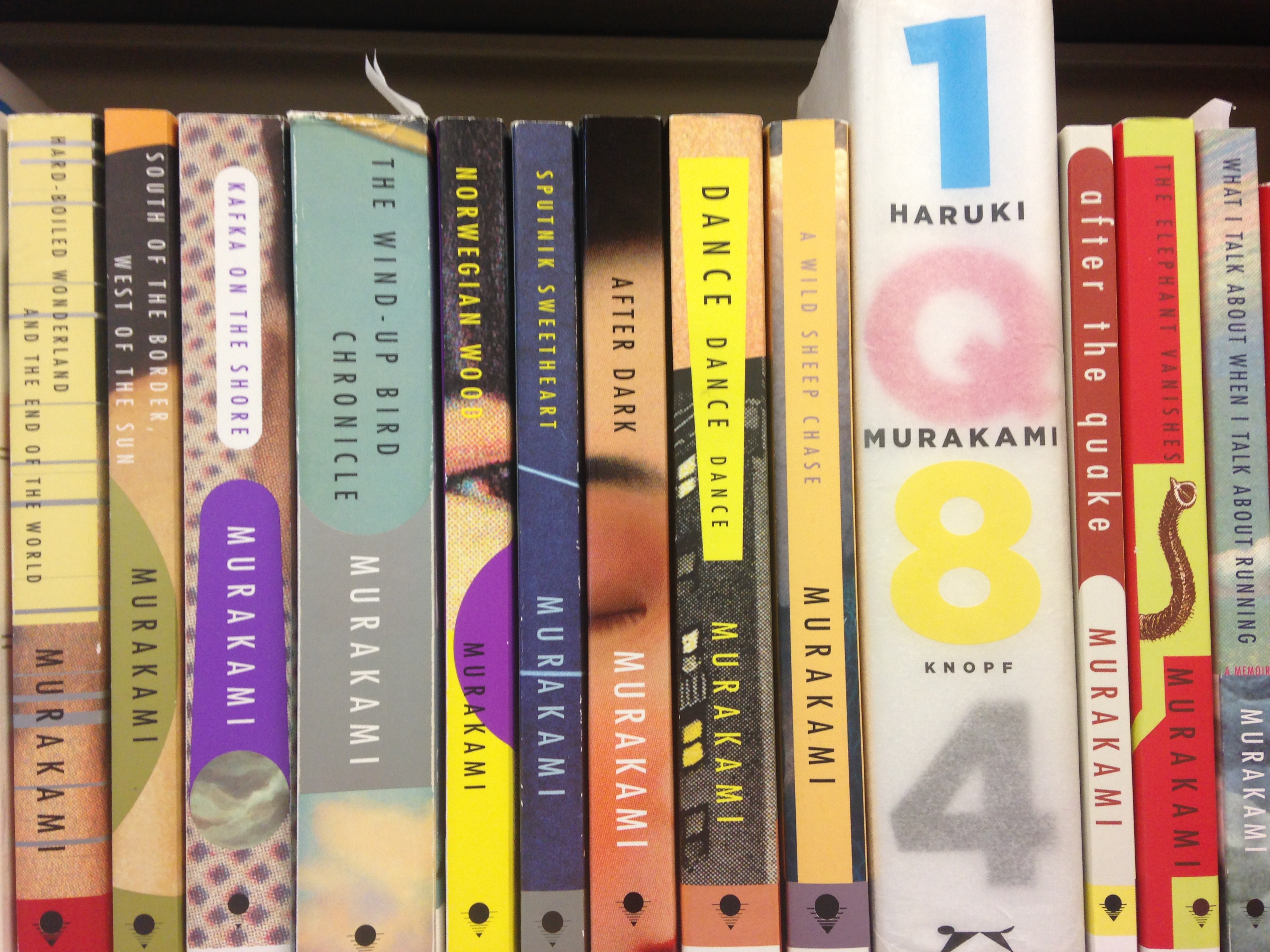
Late to the party, I finally read 1Q84 a few years ago, setting off a passionate love affair with the writing of Haruki Murakami.

I have read all of his books and am now awaiting the English translation of Colorless Tsukuru Tazaki and His Years of Pilgrimage. As I typically do, Murakami has a bit of a shrine on my office book shelf:

Murakami books

Until I began reading What I Talk About When I Talk About Running, however, I was missing a very important element in my love of Murakami’s work. Unlike Myers’s recognition of himself in his discovery of James Baldwin, I did not think about my Self in Murakami, who is Japanese and a generation removed from me about halfway between my father and me.

Since Running is part memoir, I began to see comments by Murakami about his essential nature—claims of his true Self that speak very much to me as well as about me. Murakami, despite the details of our races and our histories, share many traits that I am convinced are at the root of my love for his fiction.

###

I was also late to the Breaking Bad party, and coincidentally, I was reading Murakami’s Running while I was just getting to Season 3 of Breaking Bad. So I was taken aback when the character Gale Boetticher shared with the main character, Walter White, how he came to cook meth—a journey of rejecting the merely academic world of science for the magic of the lab.

To fully explain his reasons, and despite his embarrassment about his being a self-proclaimed nerd, Boetticher quotes Walt Whitman:

When I Heard the Learn’d Astronomer

Walt Whitman

When I heard the learn’d astronomer,
When the proofs, the figures, were ranged in columns before me,
When I was shown the charts and diagrams, to add, divide, and measure them,
When I sitting heard the astronomer where he lectured with much applause in the lecture-room,
How soon unaccountable I became tired and sick,
Till rising and gliding out I wander’d off by myself,
In the mystical moist night-air, and from time to time,
Look’d up in perfect silence at the stars.

###

I am reading Murakami’s Running and pausing again and again as his confessions of his true Self are ones I too could make—confessions about solitude, about assuming others will not like him.

But I am also struck by Murakami’s comments about formal education:

I never disliked long-distance running. When I was at school I never much cared for gym class, and always hated Sports Day. This was because these were forced on me from above. I never could stand being forced to do something I didn’t want to do at a time I didn’t want to do it. Whenever I was able to do something I liked to do, though, when I wanted to do it, and the way I wanted to do it, I’d give it everything I had….

If you’ll allow me to take a slight detour from running, I think I can say the same thing about me and studying. From elementary school up to college I was never interested in things I was forced to study….I only began to enjoy studying after I got through the educational system and became a so-called member of society….

I always want to advise teachers not to force all junior and senior high school students to run the same course, but I doubt anybody’s going to listen to me. That’s what schools are like. The most important thing we ever learn at school is the fact that the most important things can’t be learned at school. (pp. 34-35, 45)

###

It is 1943, and English educator Lou LaBrant is deeply concerned about the teaching of language in a world combating Hitler:

Today in a world of hyperbole, it is easy to make sweeping statements and to have them accepted. We must therefore be cautious when thinking of our work. Teachers are, by the nature of their work, largely outside immediate war activities. They spend their days with children, whose greatest contribution will be made after the war….

Far too often as a people we are led astray by orators or writers whose words sound fine and smooth, but whose meanings are false, shallow, or misleading. We make their path easy when we approve essays, stories, or poems which are imitations or are full of words used for the sake of sound. (pp. 93, 95)

It is 2014, and I am deeply concerned that LaBrant’s warnings are as significant today as teachers of English face the “sweeping statements” of “orators or writers whose words sound fine and smooth” in regards to Common Core and “close reading.”

And I am certain her criticism of how books are assigned rings true today:

Too frequently we give children books which have enough value that we call them “good,” forgetting that there are other, perhaps more important values which we are thereby missing. It is actually possible that reading will narrow rather than broaden understanding. Some children’s books, moreover, are directed toward encouraging a naive, simple acceptance of externals which we seem at times to hold as desirable for children. (p. 95)

###

Close reading of books assigned to children, books in which children cannot find themselves, is reading out of context, it is merely academic, and without the magic—”I was lifted by it,” Walter Dean Myers says about Baldwin—our students will likely “bec[o]me tired and sick,/Till rising and gliding out [they will wander] off by [themselves],” concluding that teachers, schools, and books have no meaning for them.

Close reading and de-contextualizing books will, I fear, contribute to more of Christopher Myers’s denounced “apartheid of literature”; instead, he asserts:

The children I know, the ones I meet in school visits, in juvenile detention facilities like the Cheltenham Youth Facility in Maryland, in ritzy private schools in Connecticut, in cobbled-together learning centers like the Red Rose School in Kibera, Nairobi — these children are much more outward looking. They see books less as mirrors and more as maps. They are indeed searching for their place in the world, but they are also deciding where they want to go. They create, through the stories they’re given, an atlas of their world, of their relationships to others, of their possible destinations.

We adults — parents, authors, illustrators and publishers — give them in each book a world of supposedly boundless imagination that can delineate the most ornate geographies, and yet too often today’s books remain blind to the everyday reality of thousands of children. Children of color remain outside the boundaries of imagination. The cartography we create with this literature is flawed….

So now to do my part — because I can draw a map as well as anybody. I’m talking with a girl. She’s at that age where the edges of the woman she will become are just starting to press against her baby-round face, and I will make a fantastic world, a cartography of all the places a girl like her can go, and put it in a book. The rest of the work lies in the imagination of everyone else along the way, the publishers, librarians, teachers, parents, and all of us, to put that book in her hands.