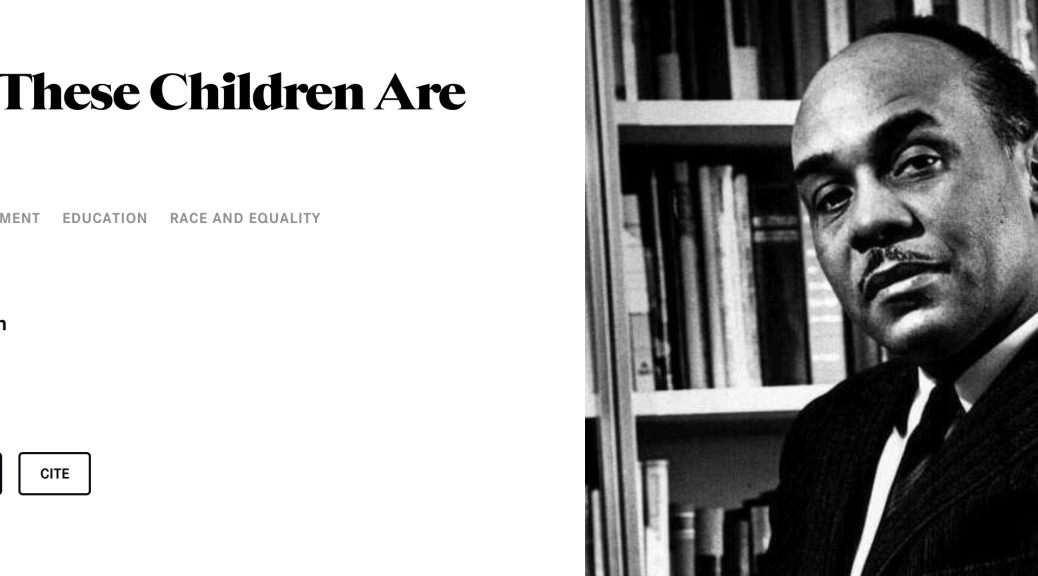
“I am an invisible man,” begins Ralph Ellison‘s enduring modern classic Invisible Man, which transforms a science fiction standard into a metaphor for the African American condition in the U.S.
Less recognized, however, is Ellison’s extensive non-fiction work, including a lecture from 1963 at a seminar for teachers—“What These Children Are Like.”
More than 50 years ago, Ellison was asked to speak about “‘these children,’ the difficult thirty percent,” the disproportionate challenges facing African American children in U.S. schools. Ellison’s discussion of language among African Americans, especially in the South, offers a powerful rejection of enduring cultural and racial stereotypes:
Some of us look at the Negro community in the South and say that these kids have no capacity to manipulate language. Well, these are not the Negroes I know. Because I know that the wordplay of Negro kids in the South would make the experimental poets, the modern poets, green with envy. I don’t mean that these kids possess broad dictionary knowledge, but within the bounds of their familiar environment and within the bounds of their rich oral culture, they possess a great virtuosity with the music and poetry of words. The question is how can you get this skill into the mainstream of the language, because it is without doubt there. And much of it finds its way into the broader language. Now I know this just as William Faulkner knew it. This does not require a lot of testing; all you have to do is to walk into a Negro church….
But how can we keep the daring and resourcefulness which we often find among the dropouts? I ask this as one whose work depends upon the freshness of language. How can we keep the discord flowing into the mainstream of the language without destroying it? One of the characteristics of a healthy society is its ability to rationalize and contain social chaos. It is the steady filtering of diverse types and cultural influences that keeps us a healthy and growing nation. The American language is a great instrument for poets and novelists precisely because it could absorb the contributions of those Negroes back there saying “dese” and “dose” and forcing the language to sound and bend under the pressure of their need to express their sense of the real. The damage done to formal grammar is frightful, but it isn’t absolutely bad, for here is one of the streams of verbal richness….
I’m fascinated by this whole question of language because when you get people who come from a Southern background, where language is manipulated with great skill and verve, and who upon coming north become inarticulate, then you know that the proper function of language is being frustrated.
The great body of Negro slang–that unorthodox language–exists precisely because Negroes need words which will communicate, which will designate the objects, processes, manners and subtleties of their urban experience with the least amount of distortion from the outside. So the problem is, once again, what do we choose and what do we reject of that which the greater society makes available? These kids with whom we’re concerned, these dropouts, are living critics of their environment, of our society and our educational system, and they are quite savage critics of some of their teachers.
What Ellison is rejecting is a deficit view of language as well as a deficit view of people living in poverty that blurs with racial prejudices. This deficit view is not some remnant of history, however; in fact, a deficit view of language and impoverished people is one of the most resilient and often repeated claims among a wide range of political and educational ideologies [1].
For example, Robert Pondiscio notes in a post for Bridging Differences:
We know that low-SES kids tend to come to school with smaller vocabularies and less ‘schema’ than affluent kids, and both of these are correlated with (and probably caused by) poverty. Low-SES kids have heard far fewer words and enjoyed few to no opportunities for enrichment.
When I posted a challenge to this deficit view, Labor Lawyer added this comment:
How about the seminal research outlined in Hart & Risley’s “Meaningful Differences”? Their research showed that there were significant differences in how low-SES parents and high-SES parents verbally interacted with their children + that the low-SES parents’ interactions were generically inferior, not just reflective of different vocabularies. The low-SES parents spoke less often to their children, used fewer words, used fewer different words, initiated fewer interactions, responded less frequently to the child’s attempt to initiate an interaction, used fewer encouraging words, and used more prohibitive words.
Two important points must be addressed about deficit views of language among impoverished people: (1) Ellison’s argument against a deficit view from 1963 is strongly supported by linguists, anthropologists, and sociologists, but (2) the flawed Hart and Risley study remains compelling, not because the research is credible (it isn’t), but because their claims match cultural assumptions about race and class, assumptions that are rooted in prejudices and stereotypes.
One powerful example of the popularity of a deficit view of language and poverty is the success of Ruby Payne’s framework of poverty books and teacher training workshops—despite a strong body of research refuting her claims and despite her entire framework lacking any credible research [2].
To understand the problems associated with deficit views of language and poverty, the Hart and Risley study from 1995 must be examined critically, as Dudley-Marling and Lucas published in 2009 [3].
Hart and Risley: Six African American Families on Welfare in Kansas City
Dudley-Marling and Lucas reject the deficit view of poverty and language, calling instead for an asset view. They note that deficit views place an accusatory gaze on impoverished parents, and thus, blaming those parents reinforces stereotypes of people in poverty and allows more credible sources of disproportionate failure by students in poverty and minority students to be ignored.
Since the political, social, and educational embracing of deficit views is commonly justified by citing Hart and Risley (1995) [4], Dudley-Marling and Lucas carefully detail what the study entails and how the claims made by Hart and Risley lack credibility.
First, Hart and Risley
studied the language interactions of parents and children in the homes of 13 upper-SES (1 Black, 12 White), 10 middle-SES (3 Black, 7 White), 13 lower-SES (7 Black, 6 White), and 6 welfare (all Black) families, all from Kansas City. Families were observed for one hour each month over a period of 2 1/2 years, beginning when children were 7–9 months old. (p. 363)
Dudley-Marling and Lucas stress:
What is particularly striking about Hart and Risley’s data analysis is their willingness to make strong, evaluative claims about the quality of the language parents directed to their children….
Many educational researchers and policy makers have generalized the findings about the language and culture of the 6 welfare families in Hart and Risley’s study to all poor families. Yet, Hart and Risley offer no compelling reason to believe that the poor families they studied have much in common with poor families in other communities, or even in Kansas City for that matter. The primary selection criterion for participation in this study was socioeconomic status; therefore, all the 6 welfare families had in common was income, a willingness to participate in the study, race (all the welfare families were Black), and geography (all lived in the Kansas City area). (pp. 363, 364)
In other words, Hart and Risley make causational claims based on a very limited sample, and those claims are widely embraced because they speak to the dominant culture’s assumptions about race and class, but not because the study’s data or claims are valid. Dudley-Marling and Lucas explain:
Conflating correlation with causation in this way illustrates the “magical thinking” that emerges when researchers separate theory from method (Bloome et al., 2005). Hart and Risley make causal claims based on the co-occurrence of linguistic and academic variables, but what’s missing is an interpretive (theoretical) framework for articulating the relationship between their data and their claims….
The discourse of “scientifically based research,” which equates the scientific method with technique, has led to a body of research that is resistant to meaningful (theoretical) critique. Hart and Risley’s conclusions about the language practices of families living in poverty, for example, are emblematic of a discourse of language deprivation that “seems impervious to counter evidence, stubbornly aligning itself with powerful negative stereotypes of poor and working-class families. It remains the dominant discourse in many arenas, both academic and popular, making it very difficult to see working-class language for what it is . . . or to be heard to be offering a different perspective.” (Miller, Cho, & Bracey, 2005b, p. 153)…
[T]hey are establishing a norm thoroughly biased in favor of middle- and upper-middle-class children. This common-sense rendering of the data pathologizes the language and culture of poor families, reflecting harmful, long-standing stereotypes that hold the poor primarily responsible for their economic and academic struggles (Nunberg, 2002). (p. 367)
The accusatory blame, then, focusing on impoverished parents is a powerful and detrimental consequence of deficit views of poverty and language, as Dudley-Marling and Lucas add:
Blaming the poor for their poverty in this way leaves no reason to consider alternative, systemic explanations for poverty or school failure. There is, for example, no reason to wonder how impoverished curricula (Gee, 2004; Kozol, 2005; Oakes, 2006), under-resourced schools (Kozol, 1992), and an insufficiency of “high-quality” teachers in high-poverty schools (Olson, 2006) limit the academic performance of many poor students. Nor is there any reason to consider how the conditions of poverty affect children’s physical, emotional, and neurological development and day-to-day performance in school (Books, 2004; Rothstein, 2004). Recent research in neuroscience, for example, indicates that the stresses of living in poverty can impair children’s brain development (Noble, McCandliss, & Farah, 2007). But most Americans do not easily embrace systemic explanations for academic failure. In our highly individualistic, meritocratic society, it is generally assumed that academic underachievement is evidence of personal failure (Mills, 1959). (p. 367)
That deficit views of language and poverty remain compelling is yet another example of a research base being discounted because cultural beliefs offer pacifying blinders:
Rolstad (2004) laments that “linguistically baseless language prejudices often underlie [even] well-designed, well-conducted studies” (p. 5). Linguistic research conducted within theoretical and anthropological linguistics and sociolinguistics that demonstrates the language strengths of children from non-dominant groups “has had virtually no impact on language-related research elsewhere” (Rolstad, 2004, p. 5). The deficit-based research of Hart and Risley, with all of its methodological and theoretical shortcomings, has been more persuasive than linguistic research that considers the language of poor families on its own terms (e.g., Labov, 1970; Heath, 1983; Michaels, 1981; Gee; 1996; see also Michaels, 2005), perhaps because Hart and Risley’s findings comport with long-standing prejudices about the language of people living in poverty (Nunberg, 2002). (pp. 367-368)
Continuing, then, to cherry-pick one significantly flawed study in order to confirm cultural stereotypes reveals far more about society and education in the U.S. than it does about children living and learning in poverty.
Despite many well-meaning educators embracing this deficit view as well as Hart and Risley’s flawed study, seeking to help students from impoverished backgrounds acquire the cultural capital associated with the dominant grammar, usage, and vocabulary is actually inhibited by that deficit view:
Finally, Hart and Risley draw attention to a real problem that teachers encounter every day in their classrooms: children enter school with more or less of the linguistic, social, and cultural capital required for school success. However, we take exception to the characterization of this situation in terms of linguistic or cultural deficiencies. Through the lens of deficit thinking, linguistic differences among poor parents and children are transformed into deficiencies that are the cause of high levels of academic failure among poor children. In this formulation, the ultimate responsibility for this failure lies with parents who pass on to their children inadequate language and flawed culture. But, in our view, the language differences Hart and Risley reported are just that—differences. All children come to school with extraordinary linguistic, cultural, and intellectual resources, just not the same resources. (p. 369)
A larger point we must confront as well is that all efforts to describe and address any social class as monolithic is flawed: Neither all affluent nor all impoverished children are easily described by what they have and don’t have. In fact, social classifications and claims about a culture of poverty are equally problematic as deficit views of poverty and language [5].
Just as Ellison confronted, U.S. society and schools remain places where minority and impoverished children too often fail. Much is left to be done to correct those inequities—both in society and in our schools—but blaming impoverished and minority parents as well as seeing impoverished and minority children (no longer invisible) as deficient stereotypes behind a false justification of research has never been and is not now the path we should take.
“I don’t know what intelligence is,” concludes Ellison in his lecture:
But this I do know, both from life and from literature: whenever you reduce human life to two plus two equals four, the human element within the human animal says, “I don’t give a damn.” You can work on that basis, but the kids cannot. If you can show me how I can cling to that which is real to me, while teaching me a way into the larger society, then I will not only drop my defenses and my hostility, but I will sing your praises and help you to make the desert bear fruit.
Continuing to embrace a deficit view of poverty and language is to embrace a desert that will never bear fruit.
[1] The source of this blog post is a comment on a post at Education Week, but deficit views of language by social class, notably the standard claim that children in poverty speak fewer words than children in middle-class and affluent homes, are common and not unique to the blog post identified here.
[2] Please see this bibliography of scholarship discrediting Payne’s framework. See also:
Thomas, P.L. (2010, July). The Payne of addressing race and poverty in public education: Utopian accountability and deficit assumptions of middle class America. Souls, 12(3), 262-283.
[3] See Dudley-Marling, C., & Lucas, K. (2009, May). Pathologizing the language and culture of poor children. Language Arts, 86(5), 362-370.
[4] Hart, B., & Risley, T. R. (1995). Meaningful differences in the everyday experiences of young American children. Baltimore: Brookes.
[5] Please consider the following works in order to confront a wide range of problems associated with class and poverty:
Return of the Deficit, Curt Dudley-Marling
The Myth of the Culture of Poverty, Paul Gorski
Poor Teaching for Poor Children … in the Name of Reform, Alfie Kohn
The Pedagogy of Poverty Versus Good Teaching, Martin Haberman




 dr. p.l. (paul) thomas