
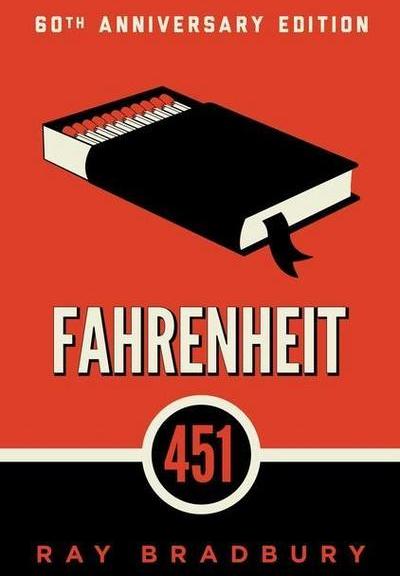
“Sometimes writers write about a world that does not yet exist,” Neil Gaiman begins his Introduction to the 60th Anniversary Edition of Ray Bradbury’s Fahrenheit 451:
This is a book of warning. It is a reminder that what we have is valuable, and that sometimes we take what we value for granted….
People think—wrongly—that speculative fiction is about predicting the future, but it isn’t; or if it is, it tends to do a rotten job of it….
What speculative fiction is really good at is not the future but the present—taking an aspect of it that troubles or is dangerous, and extending and extrapolating that aspect into something that allows the people of that time to see what they are doing from a different angle and from a different place. It’s cautionary.
Fahrenheit 451 is speculative fiction. It’s an “If this goes on…” story. Ray Bradbury was writing about his present, which is our past.
Like Margaret Atwood’s In Other Worlds, Gaiman’s clarification about the purposes of science fiction/speculative fiction builds a foundation for reading (or re-reading) Fahrenheit 451 as well as for considering why Bradbury’s novel on book burning endures.
Sixty years ago in October 1953, Fahrenheit 451 was published. In the fall of 2013, the novel reads as an eerie crystal ball—despite Gaiman’s caution: the pervasive Seashells like iPod earbuds, wall-sized monitors and reality TV.
Yet, upon re-reading this anniversary edition, I am less interested in Bradbury’s prescience about technology and its role in isolating humans from each other, and reminded—as Gaiman suggests—of what matters.

The enduring flame of Fahrenheit 451 is perfectly stoked by Gaiman, in fact:
A young reader finding this book today, or the day after tomorrow, is going to have to imagine first a past, and then a future that belongs to that past.
But still, the heart of the book remains untouched, and the questions Bradbury raises remain as valid and important.
Why do we need the things in books?…Why should we read them? Why should we care?…
Ideas—written ideas—are special….
This is a book about caring for things. It’s a love letter to books, but I think, just as much, it’s a love letter to people….
Yes, Gaiman is a writer’s writer so he is naturally suited to understand Bradbury as well as marvel at the magic of Fahrenheit 451. But there is more.
This anniversary edition includes not only Gaiman’s new Introduction but also a concluding section—History, Context, and Criticism. The opening piece by Jonathan R. Eller explains, “Bradbury virtually lived in the public libraries of his time.” And later in a transcript of an audio-introduction, Bradbury adds:
When I left high school, I began to go to the library every day of my life for five, ten, fifteen years. So the library was my nesting place, it was my birthing place, it was my growing place. And my books are full of libraries and librarians and book people, and booksellers. So my love of books is so intense that I finally have done—what? I have written a book about a man falling in love with books.
Here, I think, another important connection between Gaiman and Bradbury highlights why Fahrenheit 451 endures: Both men are readers, the type of readers who love the idea of books, love specific books, and recognize the human dignity represented by the free access to books.
Like Bradbury, then, Gaiman has a life-long love affair with libraries:
Another way to destroy a child’s love of reading, of course, is to make sure there are no books of any kind around. And to give them nowhere to read those books.
I was lucky. I had an excellent local library growing up. I had the kind of parents who could be persuaded to drop me off in the library on their way to work in summer holidays, and the kind of librarians who did not mind a small, unaccompanied boy heading back into the children’s library every morning and working his way through the card catalogue, looking for books with ghosts or magic or rockets in them, looking for vampires or detectives or witches or wonders. And when I had finished reading the children’s’ library I began on the adult books.
They were good librarians. They liked books and they liked the books being read. They taught me how to order books from other libraries on inter-library loans. They had no snobbery about anything I read. They just seemed to like that there was this wide-eyed little boy who loved to read, and would talk to me about the books I was reading, they would find me other books in a series, they would help. They treated me as another reader – nothing less and more – which meant they treated me with respect. I was not used to being treated with respect as an eight year old.
But libraries are about Freedom. Freedom to read, freedom of ideas, freedom of communication. They are about education (which is not a process that finishes the day we leave school or university), about entertainment, about making safe spaces, and about access to information.
I worry that here in the 21st Century people misunderstand what libraries are and the purpose of them.
For those of us who share this love of books and the “[f]reedom to read, freedom of ideas, freedom of communication,” then, that Fahrenheit 451 endures is both wonderful and chilling.
If the novel had been published October 2013, I suspect it could have just as easily been applauded as a stark mirror of our present disguised as a futuristic dystopia:
“Jesus God,” said Montag….Why doesn’t someone want to talk about it! We’ve started and won two atomic wars since 2022! Is it because we’re having so much fun at home we’ve forgotten the world? Is it because we’re so rich and the rest of the world’s so poor and we just don’t care if they are? I’ve heard rumors; the world is starving, but we’re well fed. Is it true, the world works hard and we play? Is that why we’re hated so much?
And then Montag recalls a brief encounter with an old man:
The old man admitted to being a retired English professor who had been thrown out upon the world forty years ago when the last liberal arts college shut for lack of students and patronage.
Fahrenheit 451 ends with Montag as a criminal on the run who finds himself on the outskirts of the town among refugees, mostly outcast professors.
If a reader picks up Bradbury’s novel today, and then turns to her iPad to read the online blog The Answer Sheet at The Washington Post, she may read this:
The discussion of why the humanities matter has picked up steam since The New York Times published a piece last week suggesting that even some top institutions are increasingly anxious about the proliferation of STEM (science, technology, engineering and math) majors.
Meanwhile, they report a declining interest in topics like French literature.
Only eight percent of students now major in the humanities, according to the American Academy of Arts & Sciences, down from a peak of more than 17 percent in 1967. The trend is worrisome, and plenty of college presidents have come to the defense of the humanities; views of all kinds have since been published….
Tolstoy endured. Will the liberal arts?
From Aldous Huxley to Ray Bradbury to Neil Gaiman—and countless authors and readers alike along the way—Fahrenheit 451 should leave us all with Shakespeare ringing in our ears:
Miranda: O wonder!
How many goodly creatures are there here!
How beauteous mankind is! O brave new world,
That has such people in’t. (William Shakespeare, The Tempest, Act V, Scene I, ll. 203–206)
Fahrenheit 451 remains a warning we need to heed, but likely won’t—once again: Be careful what brave new world we allow to happen when we aren’t paying attention.
 dr. p.l. (paul) thomas