“The Role of the Intellectual – An Analysis,” Lawrence Davidson, Truthout, Speakout
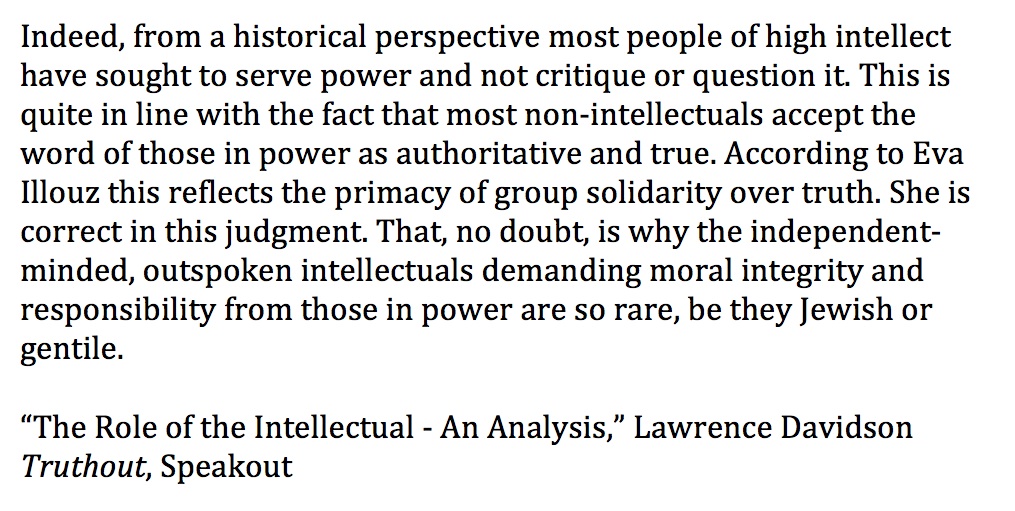

“The Role of the Intellectual – An Analysis,” Lawrence Davidson, Truthout, Speakout
Toward the final pages of Roxane Gay‘s An Untamed State, the primary narrator, Mireille, admits about her response to the earthquake in Haiti in the wake of her own personal horror of being kidnapped and repeatedly raped and tortured over thirteen days of captivity: “We sent money instead and it was then I felt like a true American” (p. 345).

When Margaret Atwood writes about Canada, she is also writing about the U.S. When Atwood writes about women, she is also writing about men. And in both dualities, Atwood writes about the intersections, Canada/U.S. and woman/man—as Classen and Howes explain:
From Atwood’s perspective, Canada has traditionally occupied, and internalized, the position of the female in relation to the dominant, male land to the south (Atwood 1982: 389), and so the figure of the female is well suited to represent the Canadian character. As Rosemary Sullivan writes in her biography of Atwood, within Canada “national identity and gender were both predicated on second-class status” (Sullivan 1998: 128).
In fact, in many of Atwood’s poems and stories, the context for the exploration of dualism and borders subtly shifts back and forth from the personal or the interpersonal to the national (Hutcheon 1988).
In Gay’s novel, readers find a parallel to Atwood’s dualities as Gay confronts both Haiti and the U.S. through a personal hell experienced by Mireille who personifies some deeply ugly Truths: when poverty and privilege intersect, violence occurs; when males and females intersect, violence occurs; in both dynamics, as Mireille concludes, “Girl children are not safe in a world where there are men” (p. 344).
An Untamed State: Of Mind, Body, and Nation
My entry point to Gay’s writing was “There is No ‘E’ in Zombi Which Means There Can Be No You Or We.” The story reached out from the computer screen and demanded that I find more by Gay to read so I ordered An Untamed State the same day after exploring Gay’s web site.
That first story struck me with Gay’s use of voice, genre manipulation, and tone; I was lost much of the story until the end, which pays off brilliantly.
My experience with the novel confirms my initial attraction to Gay’s gifts, but the novel presents a paradox: The story is so brutal, it is nearly unreadable, unbearable, and the story is so brutal, I never wanted to put the book down until I reached the last word.
I am prone to placing books on my bookshelves in ways that honor how I feel about those books. I will slip An Untamed State beside Atwood’s The Handmaid’s Tale and Stieg Larsson’s Millennium trilogy because at their cores these works are about what Mireille (again at the end of the novel and after the 2010 earthquake in Haiti) proclaims:
There was an earthquake….It was a new sorrow, a fresh break in an already broken place. The tents are still there, providing no shelter. Women are in even more danger. There is no water. There is no hope. My parents survived and for that I was grateful, in spite of myself. My father’s buildings stood strong while the rest of the country fell. I imagine he is proud of his work, these standing monuments of his resolve. (p. 344)
The most powerful motifs of the novel are weaved into the passage above, exhibiting a simplicity that masks the weight the novel carries from the very title itself. “An Untamed State” speaks to Haiti as country, especially as that contrasts with the U.S. and as privilege and poverty are dramatized in Mireille’s parents (their gated estate in Haiti) and Mireille’s captivity once kidnapped, and to the fragility of Mireille’s mental and physical states.
“Forgive me for my father’s sins”
Gay’s narration mixes time and perspectives with both a suddenness and grace that left me as conflicted about the style, structure, and point of view as I was about the content, Mireille’s kidnapping, the repeated scenes of rape and torture, and the tension Gay creates with her characters and her themes. For example, what am I to do when the kidnappers and rapists express valid confrontations about the violence of inequity?
Within the first few pages, the dominant motif is established, as Mireille offers the first flashback embedded in her coming to consciousness in captivity:
We sat on our lanai, illuminated by paper lanterns and candles, all of us drunk on the happiness of too much money and too much food and too much freedom. (p. 10)
This passage echoes for me the opening of Chapter III in F. Scott Fitzgerald’s The Great Gatsby:
There was music from my neighbor’s house through the summer nights. In his blue gardens men and girls came and went like moths among the whisperings and the champaign and the stars. (p. 39)
But in Gay’s novel, the opulence and decadence are framed against Mireille’s story of being grotequely tamed, her nightmare of awareness germinated in her native Haiti: “There are three Haitis—the country Americans know and the country Haitians know and the country I thought I knew” (p. 11).
Also in those first few chapters, I came to recognize that the chapter numbering was tallying—I, II, III, IIII, IIII …—a subtle technique that reveals the fact of Mireille’s many states of captivity: captive to her father’s privilege and arrogance; captive to her native Haiti; captive to her existence as a woman; captive to her life as a Haitian married to a pale American; captive for 13 days to kidnapping, rape, and torture; and then captive to her history for the entirety of her life.
An Untamed State is a compelling novel and deserves your time if you love to read well crafted stories and characters, but the work is also a brave and piercing spotlight on the violence of this world bred by socioeconomic and gender inequity. Gay focuses those messages, in part, on Mireille’s father:
My father does not understand obstacles, doesn’t believe they exist. He cannot even see obstacles. Failure was never going to be an option. He often says, “There is nothing a man cannot get through if he tries hard enough.”
He built skyscrapers….My father said, “There’s no telling how high a man can reach if he’s willing to look up into the sky and straight into the sun.” (p. 32)
The father’s discourse is steeped in the sort of rugged individualism mythology at the core of the U.S., is paternalistic and chauvinistic, and is ironic in its embracing of a concluding image of self-induced blindness.
As a Haitian embodying the Great American Myths, Mireille’s father embodies the “no excuses” and “grit” ideologies found in current education reform discourse and policies in the U.S.:
Growing up, my father told my siblings and me two things—I demand excellence and never forget you are Haitian first; your ancestors were free because they took control of their fate.. When he came home from work each night, he’d find us in our corners of the house and ask, “How we you excellent today?”…If he disapproved, he’d remove his glasses and rub his forehead, so wearied by our small failures. He would say, “You can be better. You control your fate.”…
It was easy for my father to overlook the country’s painful truths because they did not apply to him, to us. He left the island with nothing and returned with everything—a wife, children, wealth. (pp. 35, 36-37)
In the wake of her father’s arrogant idealism, however, is the living death of Mireille—reduced to a shell of herself, sated only by hunger like a Kafkan nightmare, and left always a captive, mostly of her being a woman and the unfortunate child of privilege in a violently untamed state.
Readers are not left only with these tragedies, although the counterweight to the consequences of the sins of the father don’t quite equal out despite the novel’s final word being “hope.”
Mireille and her mother-in-law form over the course of the novel a compact built on basic human kindness; in fact, the word “kindness” rises to the level of refrain throughout the last third of the novel.
But it is a kindness shared by battered women risen from the ashes of a man’s razed world.
The reader learns of Mireille’s last moments with the Commander, the lead kidnapper who brutalizes her, in the final chapter of the novel when Mireille utters to him, “‘Forgive me for my father’s sins'” (p. 363).
Heavy with this novel, I put it down recognizing that like Tom and Daisy in The Great Gatsby, Mireille’s father, a man of privilege, and Mireille’s captor, a man of poverty, walk away from their carnage, but I fear Mireille’s plea rings louder in my ears than in the ears of either of these men, these sinners.
For several years, I have been showing Little Rock Central: 50 Years Later in both my introductory education course and an interim educational documentaries course at the selective private university where I teach.
Two scenes address the contemporary realities of lingering segregation within the walls of historic Central High in Little Rock, Arkansas: the school principal announcing mix-up day over the intercom and Minnijean Brown Trickey, one of the Little Rock Nine, speaking to a class of students and asking them to identify why the room upsets her.
These moments from the documentary lead to my students discussing the segregated dynamics of our university, attended disproportionately by affluent and white students (also overwhelmingly female). The dining hall is the most stark example of the segregation on campus with tables of mostly African American athletes and then an assortment of less overt self-segregation by a number of characteristics easily identified by the students themselves.
Race, social class, and the inherent overlap of race with social class all still shuffle the university into distinct and separate groups that are the result of far more than simple shared interests or the seemingly natural human habit of forming cliques.
Throughout May of 2014, numerous media events and publications have been exploring where we stand as a people in the U.S. 60 years after the court-ordered end to racial segregation in public schools. The messages have consisted of somewhat idealized celebrations of the 1954 Brown vs the Board of Education Supreme Court judgement and confrontations of the current state of segregation in schools and communities throughout the U.S.—notably that segregation is not only a lingering scar in the South, but a reality of the entire country.
When I published Racial segregation returns to US schools, 60 years after the Supreme Court banned it at The Conversation (UK) and then AlterNet reposted the piece, I noticed several trends in the responses that warrant some clarification.
First, it appears that many who are confronted with the facts of segregation misunderstand that large phenomenon in ways similar to how we misread poverty.
Segregation and poverty are, in fact, manageable terms for extremely complex and unwieldy conditions—terms that comprise a number of interrelated but smaller conditions that may exist in an unpredictable array of combinations.
Segregation presents several complicating factors for understanding the phenomenon. One is that racial segregation is overt, relatively easy to identify. Social class segregation is less overt, but racial and class segregation are so closely interrelated that confronting one often allows the other to be ignored or marginalized.
This first trend—misreading and misunderstanding the condition of segregation—leads to a second: Many who acknowledge the fact of segregation immediately express something between skepticism and cynicism about the ability of a people or the government to do anything about it.
Since segregation is a complex condition and an abstraction of many shifting but related conditions, the sheer enormity of doing something about segregation does appear overwhelming. But fatalism seems to spring from both a blindness to how laws, policies, and grassroots activism have created change and a lack of individual and community agency among the public in the U.S.
A third and important trend is almost as enormous to confront as eradicating segregation itself: the profound misunderstanding of just why we continue to seek integration.
A typical misunderstanding of acknowledging a need to end segregation is couched in this comment from the AlterNet posting: “Will a black child develop better reading skills or be more proficient at math because he sat next to a white child.”
If we focus for a moment on racial segregation among schools or within schools, this comment provides a powerful entrance into addressing all three trends noted above.
To answer the question, then, is to begin to see how we might address segregation in ways that can eradicate the root causes of segregation.
The answer involves recognizing that race is a marker in the U.S. for access to equity and the coincidences of poverty and privilege. Thus, African American children may in fact learn better if sitting beside a white child, but not because of the proximity of one child to another but because that African American child would then likely be afforded proximity to the opportunity that white child enjoys as a result of that child’s privilege.
In other words, segregation is the result of racism, the momentum of poverty and privilege, sexism, classism, and public policy. If we were to begin to build the U.S.—in both policy and public behavior—around goals of equity for all, then segregation would either be eliminated or reduced to a dynamic that is no longer a marker of injustice but the consequence of mostly harmless human socialization.
To put a sharp point on what we are supposed to do about segregation, let’s focus on just education.
Segregation among schools and within schools represents a measurable inequity of opportunity by race and class among students.
Currently, African American, Latino/a, and impoverished students experience both segregation in the schools they attend as well as within schools that are racially balanced (schools-within-schools created by selective tracks such as Advanced Placement [AP] and International Baccalaureate [IB]; again, see Little Rock Central: 50 Years Later for students confronting that reality). These examples of segregation are markers for seminal problems: Inequitable school funding, inequitable teacher assignments, school facilities in disrepair, lower access to technology and materials, teacher churn, higher rates of suspension and expulsion, etc.
So we are now faced in 2014 with the opportunity to reconsider how we have exposed and then addressed segregation for 60 years.
Yes, some policies and practices have proven futile—especially those that created tensions, bussing to force integration, and ultimately targeted the consequences without addressing root causes.
It seems that we need now to make a better case that seeking integration is a commitment to equity for all. The problem is not segregation itself because segregation is the large phenomenon that serves as a marker for the facts of systemic and institutional inequity correlated with race, class, gender, sexual orientation, and native language (for examples).
Sixty years from now if we look up to see our communities and schools are still often segregated by race, we may be able to declare success if we can also show the conditions among those segregated communities and schools are no longer inequitable in terms of anyone’s or any child’s access to opportunities.
Ending segregation, then, is not about forcing African American children to sit beside white children, is not about forcing African American families to live beside white families—as if racial proximity is what ultimately matters.
Ending segregation is about African American children enjoying the same opportunities white children have, about African American adults enjoying the same opportunities white adults have.
Doing something about segregation—whether we mean public policy or public activism—must be doing something about equity, and not continuing the mistake of reading segregation as a problem of simple proximity.
For Further Reading
“So That’s Just One Of My Losses,” Ta-Nehisi Coates
Last year, I went to visit the home of Clyde Ross in North Lawndale. I was there to research an argument for reparations. Clyde Ross had just turned 90. I asked Mr. Ross why he’d come from Mississippi to Chicago. He told me he came because he was seeking “the protection of the law.” I didn’t understand what he meant. He told me there were no black judges, no black police, no black prosecutors in his hometown of Clarksdale. For a black man living in that town it effectively meant that there was “no law.”
This was a particularly illustrative example of why it is always important to report. Talking to Ross clarified something I’d been thinking about–specifically that being black was not a matter of white people thinking you had cooties. It was something deeper and more mature. It was the branding of black people as outside of American society, outside of American law, and outside of the American social contract. And this branding was done even as black people pledged fealty to the state, paid taxes to the state, and died for the state. This was high tech robbery, plunder at the systemic level. White Supremacy was not about getting black and white people to sit at the same lunch table, it was about getting white people to stop stealing shit from black people–labor, bodies, children, taxes, lives.
Small and unexpected resurrections of a kind help lighten the weight of the inevitable consequence of aging, those losses of people and things that you know must happen but you regret nonetheless.
One such loss for me was when the group R.E.M. called it a day. So it is fitting that I sit writing these recommendations while listening to Unplugged 1991 2001, a beautiful and bittersweet resurrection of everything I love about R.E.M. and everything I miss, mostly that there will never be a new R.E.M. album.
When Kurt Vonnegut died 11 April 2007, I cried on and off for several days, unable to hold inside that I was filled with Vonnegut’s art. I found myself crying as I came to the end of the first official biography of Vonnegut as well, prompting a poem.
Since Vonnegut’s death, we have been gifted small and unexpected resurrections, including two new books.
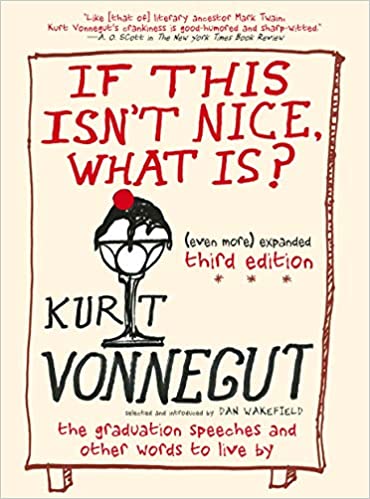
If This Isn’t Nice, What Is?: Advice to the Young is a collection of Vonnegut’s graduation speeches, a form that suited Vonnegut perfectly since he worked on a basic framework found among comedians: The Joke. And jokes are perfect for graduations where people invited to give speeches often take themselves and the ceremony far too seriously (see my own tongue-in-cheek graduation speech written mostly as a homage to Vonnegut).

If this collection isn’t perfect for a graduation gift, what is?
In “How I Learned from a Teacher What Artists Do,” Vonnegut employs his standard speech format, exhibiting his mainstay of seeming simplicity and dark bitterness masking crystal clear Truth and genuine kindness, or better phrased, a genuine call to kindness among all humans and for all things of this only world we know:
There are three things that I very much want to say in this brief hail and farewell. They are things which haven’t been said enough to you freshly minted graduates nor to your parents or guardians, nor to me, nor to your teachers. I will say these in the body of my speech, I’m just setting you up for this.
First, I will say thank you. Second, I will say I am truly sorry—now that is the striking novelty among the three. We live in a time when nobody ever seems to apologize for anything; they just weep and raise hell on the Oprah Winfrey Show. The third thing I want to say to you at some point— probably close to the end—is, “We love you.” Now if I fail to say any of those three things in the body of this great speech, hold up your hands, and I will remedy the deficiency.
I probably fell in love hard with the work of Vonnegut with Breakfast of Champions, although Vonnegut himself offered only an average grade for the work. Part of the attraction, I know, are the crude drawings, Vonnegut’s artwork that blends his calling to capture the world simply—I feel Thoreau in the background—and to remain true to his primary love, words.
I probably came to understand fully the work for Vonnegut with Cat’s Cradle, which Vonnegut graded highly also, and I return to it often to help me navigate the world too complex for a humankind unkind.
However, like his A Man without a Country, the collected graduation speeches are punctuated with his drawings, something that remains possibly the most endearing quality of published Vonnegut, which leads me to the other new Vonnegut resurrection—Kurt Vonnegut Drawings.

There is an apt and warm touch to this collection of Vonnegut’s visual art, the “drawings” in the title. Vonnegut, if anything, is an artist that embodies childhood as well as a glorious faith in childhood. When he is most serious and most angry, he appears to be his most playful and childlike, but never childish (preview some of the pieces in this review).
In my most recent poem, Vonnegut’s Bluebeard came rushing back to me, unbidden. I preface the poem with a line from the novel and then include an allusion to the novel’s ending. Bluebeard is one of Vonnegut’s many faux autobiographies that exist in a netherworld between fiction and nonfiction that forces the reader to consider everything she/he knows about genre while also setting all of those assumptions aside.
There is a good deal of Vonnegut to find in Bluebeard and Rabo Karabekian (who confesses [for Vonnegut?], “I may have been a lousy painter, but what a collector I turned out to be!”); just as there is much in both that tells us almost nothing about Vonnegut.
Having spent a year or so of my life as a biographer, and then having read dozens of biographies, I am under no delusion Vonnegut was some saint of a human as he walked the earth daily. Who is?
But—despite Vonnegut being mostly a man of letters—I find his drawings help me come to terms with the complete Vonnegut, the human Vonnegut wanted to be, the humans Vonnegut wanted all of us to be.
Vonnegut shall not pass for me until I too pass because he remains in that thing that a small group of humans reach for, frantically I think as a very human thing to do—our shared frailty and mortality coming up against our longing for immortality: Art.
Buy these books.
Hold the hardback copies in your hands to feel the weight, and then flip each over for the two photos of Vonnegut.
On the back cover of the speeches, Vonnegut is striking a Tom Wolfe pose and look, foregrounded by a pigeon just slightly out of focus.
But save the back cover of the drawings for last: Vonnegut sitting, weathered face balanced beautifully by weathered sneakers and then ceramic Laurel and Hardy on the table beside him.
Please, buy these books, but buy extra copies.
Hand them out to strangers as you walk down the street.
Click for Further Reading
The mass of men lead lives of quiet desperation.
Since October 1999, when I experienced several weeks of unrelenting panic attacks, I have been negotiating my lifelong struggle with anxiety—many of those years spent completely unaware of the problem and then coming to recognize and even understand a condition that to most people seems completely irrational (even silly).
Not to slip into being simplistic, one of the foundational ways in which I have come to understand better anxiety is that my body responds to the civilized world in ways that prehistory demanded.
In other words, when human existence depended on a constant state of vigilance, anxiety, that quality was passed on from human to human since those humans most vigilant—most aware of the world around them—lived long enough to procreate.
Now, although no mountain lion lies in wait to pounce upon me and make me its lunch, I live in a constant state as if that were true—hyperaware of both the world and every possibility about that world.
And that is the seemingly irrational part for those who do not experience incessant anxiety. Of course, I know better, but anxiety of the type I experience is beyond rationality.
Thus, for me (and possibly my fellow sufferers of anxiety), The Walking Dead (both the graphic series and the TV series) serves as a powerful allegory for our condition because surviving humans in that imagined post-apocalyptic world actually must exist always aware of the omnipresent possibility of zombie attack.
Post-apocalyptic Mindset in a Civilized World
But there is something here far beyond my personal wrestling with anxiety: The cultural and educational post-apocalyptic mindset in a civilized world.
To survive and thrive as a human has always been, is currently, and likely will be in the context of finite resources for survival and thriving.
For much of human history (and in our imagined post-apocalyptic worlds), those finite resources were necessarily the focus of human competition.
In the 21st century, humanity has not yet eradicated existence-as-survival among large numbers of people (disproportionately children, with no political power) born into and living in extreme poverty. However, in so-called developed countries, we do have pockets of organized societies that have built resources that, although still finite, are adequate to eradicate existence-as-survival if those people had the political will to address the distribution of those resources.
The U.S. is one such country that does not suffer under a scarcity of resources, but under an inequitable distribution of resources, one that allows (and even perpetuates) scarcity for some and abundance for others (primarily determined by anyone’s accident of birth).
I want to pose two claims now:
Not only are U.S. commitments to #2 counter to achieving #1, but also those commitments serve only to support the minority elite class that benefits from those ideologies despite having rarely exhibited those qualities.
In other words, the ruling elite have been born into abundance and haven’t experienced the anxiety of scarcity, but they demand that those born into and living in scarcity rise through a manufactured culture of competition—even though we have an abundance of resources to make such social Darwinism unnecessary.
As just one example, researchers and advocates of “grit” actually recommend placing impoverished and minority students in fabricated situations of scarcity to teach them the “grit” those researchers and advocates claim is the source of achievement among the affluent (a claim that, in fact, is at best misleading, and at worst, simply false).
And to add insult to injury, those outliers who have risen through scarcity to thrive have been co-opted into the post-apocalyptic mindset maintaining that since some have fought to survive, others must fight to survive.
The alternative of a society in which such base struggles do not have to occur is either ignored or trivialized as a soft option beneath our ruggedly individualistic culture. We boast, in fact, when we make other people suffer: “I taught him a lesson.”
•
As someone trapped in an irrational existence governed by anxiety—an existence dramatized in the fabricated world beyond the zombie apocalypse—I treasure the possibility of rejecting the post-apocalyptic mindset in a civilized world.
We know that scarcity creates anxiety and that any person suffers under the weight of scarcity, notably if that scarcity is avoidable. We also know that everyone benefits from a condition of abundance (see Scarcity).
And thus, I remain offended by the incessant refrain offered by those with the loudest voices in our society, voices that demand the least among us must work twice as hard as everyone else to earn the basic dignity of human existence the privileged have handed to them.
It is, ultimately, a shallow call against the world we could create, a world unlike our prehistoric past and unlike our fabricated post-apocalyptic future.
It is world where we no longer foster competition, but make competition unnecessary—as it already could be if we recognized we are no longer slaves to scarcity but to the inequitable distribution of resources that erases our humanity in very real ways that have nothing to do with zombies.
Many people throughout the world and in the U.S.—many children—lead lives of quiet desperation, desperation about food, shelter, health, and happiness.
One new fact of the human condition, however, is that those people do not have to lead lives of desperation. For those living in abundance, the choice to end scarcity is ours.
That we appear unwilling (not unable) to do so causes me great, and for once, justifiable anxiety.
Please read and consider carefully:
The Master’s House Is Burning: bell hooks, Cornel West and the Tyranny of Neoliberalism

A book must be the axe for the frozen sea within us.
Franz Kafka, Letter to Oskar Pollak 1904
Paul Horton at Anthony Cody’s blog has offered a third installment of his defense of reading, recommending:
David Mikics, a Professor of English at the University of Houston, has recently written a very good book on this issue, Slow Reading in a Hurried Age (2013).
As reading and English teachers grapple with teaching literacy to prepare students for PARCC tests across the country, they should read this book very slowly to attempt to maintain a semblance of sanity: Slow Reading in a Hurried Age describes what you know you should be doing and want to do in your classes: reading to open minds rather than prescribed literacy drills that closes them.
Horton’s defense speaks to two important points I want to add here.
First, over 31 years as a teacher primarily concerned with literacy, I can attest that one of the most powerful forces that stands between students and a life-long love of reading is formal schooling.
For example, virtually all children (who are healthy, safe, and well fed) are eager and excited about both learning to read and reading. By 9th or 10th grade, however, a solid majority of students respond to reading somewhere between ambivalence and dread.
What do all those students have in common? Years of formal schooling in which their reading has overwhelmingly been assigned and then the purpose of text has almost exclusively been reduced to mining those assigned texts for the information teachers or test creators want those students to identify (up next, the hell that will be “close reading”—or “how to destroy the love of reading in one easy step”).
Teaching at the university level and working closely with English majors have presented me with another powerful phenomenon: College students who lament that their formal education keeps them from pleasure reading and who feel relief and excitement at the possibility of returning to reading by choice once they graduate.
Second, Horton’s series on reading speaks to the work of Lou LaBrant, who spent most of her 65 years as a formal educator calling for free reading—including her foundational “The Content of a Free Reading Program” (1937).
And thus, to the term “free reading.”
Directly, advocacy for free reading is an evidence-based argument that reading is essential for human agency and empowerment, but the quest for reading among the young must be couched in recognizing the tension between the ability to read (so-called reading skills such as decoding, comprehension, etc.) and the proclivity to read (appreciating the value of reading as well as simply wanting to read).
If teaching children to read makes them non-readers, what’s is the point?
That leads to the secondary implication of the term “free reading”—we must find ways in which to free reading from the historical and current policies and practices that destroy the love of reading all children need and deserve.
And here is what we know (from the earliest years of LaBrant’s work to the continued scholarship and advocacy of Stephen Krashen):
The ways in which many of us come to love reading have been identified and confirmed again and again by teachers and researchers, but also among writers. Read Neil Gaiman on libraries and books, or Ray Bradbury, or Walter Dean Myers.
That list, in fact, is nearly endless, but we fail to listen to teachers, researchers, writers, and worst of all, students.
There is a wonderful and powerfully subtle remembrance in Lousie DeSalvo’s Vertigo in which she shares a moment from her high school experience. DeSalvo’s physics teacher confronts the young Louise about her ignoring his lectures by reading novels not-so-covertly in the back of room (otherwise, Louise notes that she is a good student in that class).
Mr. Horton, the teacher, does not respond in the way we expect. He takes her book, Fyodor Dostoevsky’s The Possessed, in his hand and then offers her a deal: He wants her to stop ignoring his lectures, but he offers to read the books she is reading and then talking with her about them (pp. 168-169).
For me, this teacher asks that DeSalvo respect the course by acknowledging his respect for those things that matter to her. It is an elegant and gracious compromise found all too rarely in schools.
If we are to take seriously the value in reading, as Horton does, we must come to terms with the paradox: Free reading is the path to free reading from the failures of demanding and teaching reading in our schools.
In 1937, LaBrant reached a conclusion that holds true today:
The theory that in a free or extensive reading program designed to utilize interest and to serve individual needs there will be fruitless reading of light fiction gains no evidence from this study. The report does, however, point to the possibility that the adolescent has much greater power to read and to think intelligently about reading than the results of our conventional program have led us to believe. (p. 34)
DeSalvo’s physics teacher ends his deal offer by noting that Louise has the key quality needed for a teacher: “‘A passionate interest in your subject'” (p. 169).
Moments such as this must become the norm of schooling, not the rare recollection found in a memoir—a memoir, by the way, that is a beautiful and incisive read, an “axe for the frozen sea within us.”
For Further Reading
How an economics professor taught me a life-changing lesson — in literature
Nearly 2.5 years ago, I wrote directly about the essential flaw with the thirty-plus-years accountability movement in K-12 U.S. public education. That essential flaw is that accountability built on standards and high-stakes testing is a corruption of the concept of accountability—which may be better understood as “responsibility.”
The corrupted “accountability” imposed on students, teachers, and schools in this model fails to establish first some key conditions in which accountability proper can be valid, ethical, and effective:
As a teacher, and if I am allowed my professional autonomy, I cannot control the outcomes of my students since those outcomes are impacted significantly by many different cause agents outside my control, but I can (or should be able to) control the opportunities to learn that I provide students each day.
And thus, as we dig deeper the corrupted accountability hole with the shiny new Common Core shovel, it is with great sadness that I must assert that the reposting below remains the ugly reality of today as we near mid-2014 (in handy-dandy bumper sticker format):
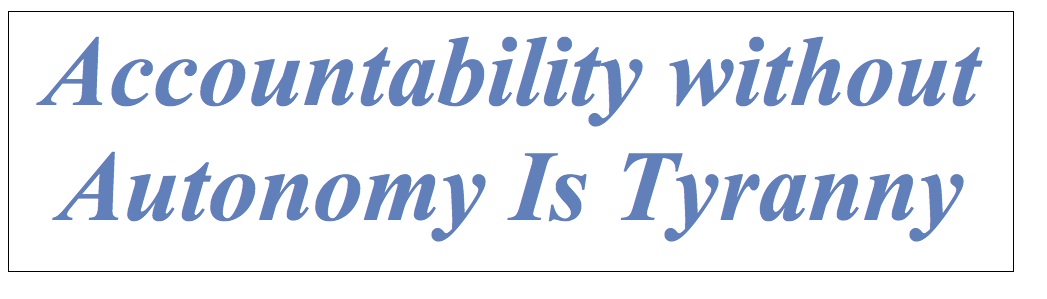 Accountability without Autonomy Is Tyranny
When educational research reaches the public through the corporate media, the consequences are often dire. Chetty, Friedman, and Rockoff released “The Long-Term Impacts of Teachers: Teacher Value-Added and Student Outcomes in Adulthood” and immediately The New York Times pronounced in “Big Study Links Good Teachers to Lasting Gains”:
Elementary- and middle-school teachers who help raise their students’ standardized-test scores seem to have a wide-ranging, lasting positive effect on those students’ lives beyond academics, including lower teenage-pregnancy rates and greater college matriculation and adult earnings, according to a new study that tracked 2.5 million students over 20 years.
The simplistic and idealistic headline reflects the central failure of the media in the education reform debate, highlighted by careless reporting such as including this quote from one of the study’s researchers:
“The message is to fire people sooner rather than later,” Professor Friedman said.
This newest attempt to justify value-added methods for identifying, rewarding, and retaining high-quality teachers (as well as firing so-called weak teachers) was yet to be peer-reviewed, but two close initial examinations of the study—by Matthew Di Carlo and Bruce Baker—have praised the data but urged caution about conclusions drawn by the researchers and in media responses:
This appropriately cautious conclusion stands in stark contrast with the fact that most states have already decided to do so. It also indicates that those using the results of this paper to argue forcefully for specific policies are drawing unsupported conclusions from otherwise very important empirical findings. (Di Carlo)
These are interesting findings. It’s a really cool academic study. It’s a freakin’ amazing data set! But these findings cannot be immediately translated into what the headlines have suggested – that immediate use of value-added metrics to reshape the teacher workforce can lift the economy, and increase wages across the board! The headlines and media spin have been dreadfully overstated and deceptive. Other headlines and editorial commentary has been simply ignorant and irresponsible. (No Mr. Moran, this one study did not, does not, cannot negate the vast array of concerns that have been raised about using value-added estimates as blunt, heavily weighted instruments in personnel policy in school systems.) (Baker)
Despite these strong and careful cautions, Dana Goldstein followed up with a praising piece in The Nation that links to Di Carlo’s work, but on balance accepts Chetty, Friedman, and Rockoff’s claims and suggests:
Given the widespread, non-ideological worries about the reliability of standardized test scores when they are used in high-stakes ways, it makes good sense for reform-minded teachers’ unions to embrace value-added as one measure of teacher effectiveness, while simultaneously pushing for teachers’ rights to a fair-minded appeals process. What’s more, just because we know that teachers with high value-added ratings are better for children, it doesn’t necessarily follow that we should pay such teachers more for good evaluation scores alone. Why not use value-added to help identify the most effective teachers, but then require these professionals to mentor their peers in order to earn higher pay?
Journalists, politicians, bureaucrats, and researchers are nearly uniform in failing to identify the central flaw in pursuing data as the holy grail of identifying and rewarding high-quality teachers, and the persistent positive response to Chetty, Friedman, and Rockoff’s study doesn’t prove VAM works but does reveal that there is little hope we’ll make any good decisions about teachers and schools any time soon.
Teaching in a Time of Tyranny
Ten-plus years into the federalized accountability era designated as No Child Left Behind, one fact of education is rarely mentioned (except by people who do spend and have spent their lives actually teaching children day in and day out): Since 1983’s A Nation at Risk, and intensified under NCLB, teachers have systematically been de-professionalized, forced by the weight of policy and bureaucracy to implement standards they did not create, to prepare students for tests they did not create (and cannot see, and likely do not support), and to be held accountable for policies and outcomes that are not within their control.
And this is the fact of the accountability era that has evolved from holding students accountable for test scores in the beginning to the more recent call to hold teachers accountable because, as media pundits claim, teachers and their protective unions are all that is wrong with the U.S.—at least according to Mort Zuckerman on CNN:
I think there are huge problems in this country and a lot of it, in my judgment, stems not from capitalism [emphasis added] but from the government….
Because the education is a government function. If there ever was a public function in this country from the days it started, it’s public education and we’ve done a lousy job. Part of it is frankly because we have lousy teachers.
Part of the reason we have lousy teachers is we have teachers union that say won’t deal with those issues. So there are lots of reasons why education is not being properly handled in this country.
If U.S. public education is failing (and that is at least complicated, if not mostly misleading) and if teachers are the source of that failure (and that is demonstrably untrue since out-of-school factors represent at least two-thirds of the influence on measurable student outcomes), let’s consider where the accountability should lie.
For the past ten years, teachers have been reduced to mere conduits of policy, curriculum, and tests that have nothing in common with what educators and researchers know to be best practice. Teacher have had little or no autonomy in these decisions and practices. To hold people accountable for implementing behaviors they do not control or support is, simply put, tyranny—not accountability.
The teacher quality debate is failing among political leaders, corporate elites, and the media because none of them are teachers, and as a consequence, they are controlling a debate about reform that they do not allow to start where it should—not at how to measure teacher quality, but at creating teaching and learning environments that honor the autonomy of children and teachers as professionals.
The ugly truth is that the leading elite do not truly respect children (especially children of color, children living in poverty, and children speaking home languages other than English), and they genuinely do not want professional teachers.
If children were treated with dignity in our schools and provided the environment they deserve to look critically at the world and if teachers were allowed their professional autonomy and held accountable for only that over which they have control, those children and teachers would likely notice and confront the tremendous inequity being controlled and perpetuated by the corporate leaders, corporate politicians, and corporate media—threatening the privilege that is being protected by calls for more testing, more data, and more accountability.
Hasty and misleading reactions to research that confirms the corporate narrative and even moderate pleas for compromise, such as Goldstein’s, are equally inexcusable because they all fail to confront that accountability without autonomy is tyranny.
We are a people tragically enamored with data to the exclusion of humanity, dignity, and the very ideals we claim to be at center of our country—individual autonomy.
And we have sold our souls to capitalism, blind to the reality that the only thing free about the market is that our consumer culture is free of any ethics, free of any commitment to social justice.
Of course teacher quality matters, of course every child deserves a quality teacher. But neither is something we can measure and force to happen as if students and teachers are cogs in a machine.
So ultimately every second spent crunching data about VAM is wasted time; every moment and penny spent on more standards and testing, also wasted time.
Teaching, learning, and human autonomy are complicated and beyond metrics, but they must become the ideals we put into practice. All else is tyranny
 dr. p.l. (paul) thomas