I have lived some thirty years on this planet, and I have yet to hear the first syllable of valuable or even earnest advice from my seniors. They have told me nothing, and probably cannot tell me anything to the purpose. Here is life, an experiment to a great extent untried by me; but it does not avail me that they have tried it. If I have any experience which I think valuable, I am sure to reflect that this my Mentors said nothing about.
No institution has invited me to be the speaker at graduation, and none is ever likely to do so.
But I feel compelled to offer this speech to gradates. So in the spirit of Kurt Vonnegut—great American novelist who knew how to give a graduation speech—I’ll start by telling you exactly what I want you to learn from this speech: Don’t listen to graduation speakers.
Now that I have the main point out of the way, I want to share why I feel compelled to offer this speech to graduates, a speech I will never give, and I have two reasons:
So my mother volunteered at my school — helping out every day in the front office, making sure our teachers were doing their jobs, holding their feet to the fire if she thought they were falling short. I’d walk by the office and there she’d be. (Laughter.) I’d leave class to go to the bathroom, there she’d be again, roaming the halls, looking in the classrooms. And of course, as a kid, I have to say, that was a bit mortifying, having your mother at school all the time.
But looking back, I have no doubt that my classmates and I got a better education because she was looking over those teachers’ shoulders. (Applause.) You see, my mom was not a teacher or a principal or a school board member. But when it came to education, she had that hunger. So she believed that our education was very much her business.
Next is the part I opened by asking you to ignore—the part where I offer what I learned from my parents and how that differs greatly from the image Michelle Obama created about teachers who needed their feet held to the fire when they were falling short.
I want to focus on two lessons from my parents.
First, my father lived by a creed he repeated often to me: Do as I say and not as I do.
And this lesson is not what my father intended, but it taught me that adults often are hypocritical, especially in their interactions with children and young people (the same adults who implore children to work hard and be nice, do neither themselves). So the lesson I learned—don’t be a hypocrite—is one basis for my speech’s main thesis: Don’t listen to graduation speakers.
They are apt, I have found, to offer my father’s advice (Do as I say and not as I do), thinly veiled behind a number of rhetorical strategies that the speakers themselves likely did not write.
Second, like Michelle Obama, I learned powerful lessons about teachers and education from my parents. But my parents impressed upon me that teachers deserved my unwavering respect and that teaching was a noble thing for any person to do.
If my parents had concerns about a teacher, that was never uttered in my presence, and if I ever crossed any lines of improper behavior or shoddy work as a student, my parents assured my teachers that would change and that the teachers had my parents’ full support in seeing that I never stumbled again.
The result of this second lesson—one quite distinct from the picture Michelle Obama painted about teachers? I have been a teacher for 31 years.
My parents are very proud of me for having dedicated my life to a noble profession.
They do not see me as someone who needs my feet held to the fire, as someone who must be watched because I am likely to fall short.
I am also proud to call myself a teacher.
Now, here toward the end, I want to include what all graduation speakers are expected to offer, advice.
I could have spent my career so far making more money than I have as a teacher, but my profession is a profession of service and the benefits of dedicating myself to that service is more than enough to counterbalance the money I have not earned.
So I am telling you without an ounce of hypocrisy or without the usual lip-service that accompanies this advice in the U.S.: Dedicate your life to something that matters to you because you have but one life and the pursuit of money and things will always prove hollow in the long run if those pursuits keep you from the things that matter.
In the off chance that you didn’t take the paradoxical advice of this speech, I must end in the only way I can in full sincerity, leading you again to the world of Kurt Vonnegurt.
Go over to her shack, I guess. Sprinkles some water on the babies, say, “Hello, babies. Welcome to Earth. It’s hot in the summer and cold in the winter. It’s round and wet and crowded. At the outside, babies, you’ve got about a hundred years here. There’s only one rule that I know of, babies—:
“God damn it, you’ve got to be kind.” (p. 129)
The adult world is filled with abundant mean-spirited hypocrisy, and you can certainly do better.
Kurt Vonnegut’s Cat’s Cradle and Tennessee Williams’s Cat on a Hot Tin Roof may seem at first blush to share only the use of “cat” in their titles, but both works are masterful examinations of something central to the human condition: the lie.
Mendacity is the darkest of lies because it corrupts and ultimately destroys relationships and even lives. For Big Daddy, mendacity is inevitable, central to the human condition: “I’ve lived with mendacity!—Why can’t you live with it? Hell, you got to live with it, there’s nothing else to live with except mendacity, is there?”
While Vonnegut’s novel is also dark—and typically satirical—foma is offered as harmless lies, as Julian Castle explains to the narrator:
“Well, when it became evident that no governmental or economic reform was going to make the people much less miserable, the religion became the one real instrument of hope. Truth was the enemy of the people, because the truth was so terrible, so Bokonon made it his business to provide the people with better and better lies.” (p. 172)
Although different consequences result from the mendacity of Cat on a Hot Tin Roof and the foma of Cat’s Cradle, all lies share one important characteristic: They are almost impossible to confront, and once confronted, they create a great deal of pain.
As a parent, I came face to face with letting the cat out of the bag when my daughter first unmasked the foma of the Tooth Fairy, and then connected that realization with Santa Claus. After I confessed to the truth—trying as I did to make a case about “harmless lies”—my daughter cut right to the heart of the matter, asking, “Why did y’all lie to me?”
The thinnest margins between mendacity and foma, I think, are found in our cultural myths—the fatal flaw of confusing the ideals we aspire to as a people with conditions already achieved. Many of those aspirations have tipped into mendacity, poisoning the possibility of those ideals—especially in the foundational promises of public institutions.
Here, then, are those ideals that could have served us well as aspiration, but now work as mendacity and thus against our best intensions:
Capitalism and choice. The realization is now becoming hard to ignore, that capitalism (the free market) is incompatible with equity (see, for example, Thomas Piketty). As well, choice as a concept central to freedom is far more complicated than expressed in our public discourse. Both capitalism and choice have worked against cultural aspirations for equity, but those failures may be better explained by the reason they have failed: idealizing capitalism and choice while failing to commit fully to the power of the Commons to establish the context within which capitalism and choice could serve equity well.
Education as Key to Equity. As misleading as claims about the U.S. being a meritocracy (or that we are a post-racial country) are assertions that education is the one true way to overcome social ills and how any individual can lift her/himself out of poverty. However, education has not and does not, in fact, change society, rarely lifts people out of the circumstances of their births, and serves as a marker for privilege (thus creates the illusion that education is a force for change)—as Reardon explains:
Here’s a fact that may not surprise you: the children of the rich perform better in school, on average, than children from middle-class or poor families. Students growing up in richer families have better grades and higher standardized test scores, on average, than poorer students; they also have higher rates of participation in extracurricular activities and school leadership positions, higher graduation rates and higher rates of college enrollment and completion.
Whether you think it deeply unjust, lamentable but inevitable, or obvious and unproblematic, this is hardly news. It is true in most societies and has been true in the United States for at least as long as we have thought to ask the question and had sufficient data to verify the answer.
What is news is that in the United States over the last few decades these differences in educational success between high- and lower-income students have grown substantially….
Meanwhile, not only are the children of the rich doing better in school than even the children of the middle class, but the changing economy means that school success is increasingly necessary to future economic success, a worrisome mutual reinforcement of trends that is making our society more socially and economically immobile.
Education Must Be Reformed. One key to seeing the mendacity of cultural claims is recognizing how often those claims are contradictory. Many who champion the idealized and misleading belief that education is central to social and personal achievement also have historically and currently declared education a failure, concluding that education must be reformed. That reform is monolithic: Greater and greater accountability built on new standards and new testing. The concept of “having high standards,” however, proves to be as misleading as claims of the U.S. being a meritocracy because thirty years of standards-based education reform have revealed there is no correlation between the existence or quality of standards and student achievement. As well, throughout more than 60 years of lamenting international test score rankings of the U.S., we also have no evidence of a correlation between those international rankings and any country’s economic robustness or competitiveness.
When my daughter allowed the evidence to lead her to a conclusion that made her at least uncomfortable if not disillusioned, she had to begin to re-evaluating her perception of the world, a perception that included the nature of truth and the role of her parents in her navigating that world.
That may sound dramatic about a conversation including the Tooth Fairy, but for a child, the intentions of foma have the same stinging consequences as the cynicism of mendacity. For adults, it seems, burying ourselves in the opiate of foma (Aldous Huxley’s soma) allows us to ignore the bitter pill of mendacity.
As aspirations, the bulleted concepts above remain important for a free people, but as mendacity, they have and will continue to insure that inequity cannot be achieved.
Many readers miss the powerful theme of optimism that runs through Vonnegut’s works; he maintains a genuine and compelling hope among the ruins for the capacity of humans to be kind. The bitterness and fatalism of Big Daddy, however, seem for now a more accurate assessment of the human condition in 2014.
More difficult to confront than either mendacity or foma, it appears, is the hard truth that the human pursuit of equity must come before merit can matter and that in order to achieve that possibility, the human condition must commit to a spirit of community and collaboration, not competition.
Regretfully, most in power are apt to continue to not let that cat out of the bag.
—
[1] The film adaptation of the play has some shifts in the wording and transposing of character’s lines, but the film is iconic as pop culture so I include a clip from that although I use lines from the play in the quotes.
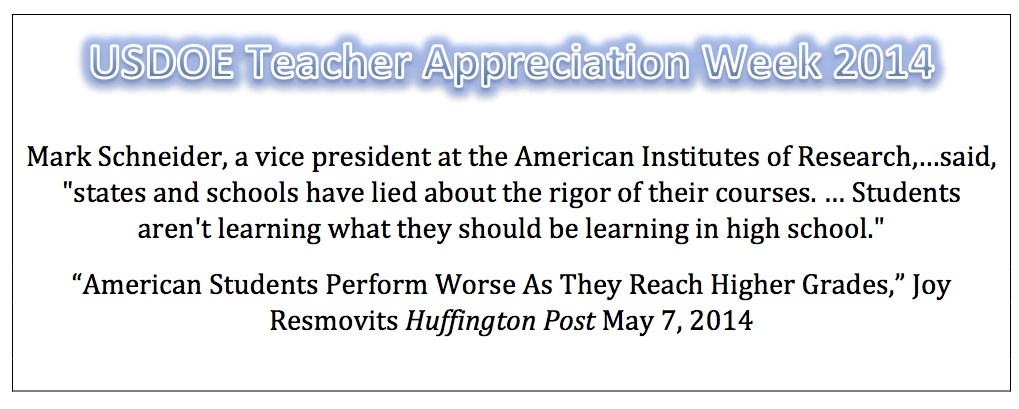
In fact, the U.S. Department of Education has just released a hot-off-the-press bumper sticker that celebrates Teacher Appreciation Week 2014 by acknowledging recent NAEP data:
Well, the claim made above by Schneider (“a vice president at the American Institutes of Research who previously led the government arm that administered NAEP”)—a truly ugly claim about education and teachers that appears to have been accepted without any request for evidence (Evidence? Secretary Duncan, You Can’t Handle the Evidence).
U.S. Secretary of Education Arne Duncan said in a statement about the results, “We project that our nation’s public schools will become majority-minority this fall—making it even more urgent to put renewed attention into the academic rigor and equity of course offerings and into efforts to redesign high schools. We must reject educational stagnation in our high schools, and as [a] nation, we must do better for all students, especially for African-American and Latino students.”
Amongst the ugliness and baseless pontificating by political leaders are absent some key points that the media will fail (again) to uncover:
NAEP data are released and pronouncements made, but no one really knows the cause of the data concerns. Why scores appear stagnant and why racial/socioeconomic gaps persist are often complex (although a huge and evidence-based source of both is likely inequity and poverty). The initial reactions to NAEP this time in EdWeek and HuffPo are overwhelmingly speculation by people with political agendas. If we are genuinely interested in people who are likely telling lies, it appears we may want to look at the people cited in these articles.
“Achievement gap” is a misnomer for “opportunity gaps,” and using standardized tests to measure and examine that gap is inherently flawed since standardized testing remains biased by race, class, and gender; and thus, the tests themselves not only measure but create the gaps. Furthermore, for any gap to close, identified populations of students would need to be treated differently, but the current policy is a common core of what students experience in schools. And another dirty little secret is that the current era of accountability has damned high-poverty and minority students to test-prep course work that in fact asks less of them (thus, it is not “states and schools” that are telling lies, but politicians who shape accountability policy who are in fact telling lies).
Throughout the 20th and into the 21st centuries, we have found no correlation between how U.S. students do on test comparisons (among states or internationally) and claimed goals such as international competitiveness or the robustness of the U.S economy. None. And while we are at it, over the last three decades of accountability, we have found no correlation between the existence or quality of standards and measurable student outcomes. None. Again, it is a political lie to continue to cry “crisis” over test scores. A lie.
While I remain certain that accountability built on standards and high-stakes testing is a fundamental flaw in education reform, political leadership and the media are not doing us any favors either. This latest “high school achievement crisis” based on a rush to misread NAEP data is but more of the same—lamentably so as we certainly could do a better job even within the flawed test-based culture of U.S. education, as Matthew Di Carlo has outlined.
Childhood is steeped in a series of lies—what Kurt Vonnegut has labeled “foma,” although many of these lies are not so harmless: the Easter bunny, Santa Claus, work hard and be nice.
But one truism from our youths must be accepted as fact: Action speaks louder than words.
If we apply that to the USDOE, then we are likely to recognize just who is telling lies and about what:
Lie: U.S. schools, teachers, and students are failing because of low standards and expectations.
Lie: New standards and new tests will save public schools.
Lie: State X is worse than State Y because NAEP (or SAT) scores say so; the U.S. is falling behind Country X because PISA scores say so.
Lie: Poverty is not destiny.
Lie: Arne Duncan (or Bill Gates or Michelle Rhee) knows what he is talking about.
Lie: Education reform is the Civil Rights issue of our time.
Lie: U.S. education is struggling because of “bad” teachers who are too hard to fire.
When Mary Catherine Bradshaw, a teacher since 1984 in Nashville, TN, announced her retirement from public schools, Bradshaw pointed her finger at one major reason, standardized testing:
[S]he says standardized testing is the reason….
Testing, she said, has taken away from instructional time and taken the joy out of learning.
Much has changed, she said, since she took her first job as a teacher at Hillsboro in 1984 when she said she was attracted to its diversity and commitment to academic reputation.
“There was more of a focus on the whole student, the joy of learning, building a community and finding one’s own passion in the midst of the K-12 experience,” she said.
“Now, with the focus on testing, data collection and closing a too narrowly defined gap among learners, I have found myself ready to retire from public education.”
Now nearly 100 leading educational figures from around the world have issued an unprecedented challenge to Pisa – and what they call “the negative consequences” of its rankings – in a letter to its director, Andreas Schleicher….
“Education policy across the world is being driven by the single aim of pushing up national performance levels on Pisa,” says one signatory, Stephen Ball, professor at London university’s Institute of Education. “It’s having a tremendously distorting effect, right down to the level of classroom teaching.” Another signatory, Sally Tomlinson, research fellow at Oxford university’s education department, says that, though the Pisa league tables appear to be scientifically based, “you really can’t compare a country the size of Liechtenstein with one the size of China and nor can you compare education systems that developed over the years in different political, social and cultural contexts”.
The signatories are particularly concerned about the UK, the US and other countries imitating schools in Asian countries that come high in the Pisa rankings. They are suspicious of Shanghai’s success. “Shanghai’s approach is an incredibly strategic one,” says Ball. “Their students practise the tests. It’s difficult to see what their maths teachers can say to ours except ‘teach to the test’.”
While international rankings based on test scores have influenced public perception of U.S. public education for at least 60+ years (see Hyman Rickover’s books lamenting U.S. rankings, for example), state rankings based on NAEP and SAT/ACT scores have also been central to perception as well as policy, especially since the early 1980s.
As I have addressed often about the SAT (see HERE and HERE), even when a comparison of states appears fair and accurate—South Carolina with Mississippi, for example, since the states share a similar high-poverty demographics of students—the reality is far more complex: MS has a higher SAT average score than SC because the test-taking populations of students are significantly different despite the overall student populations being similar:
Two Southern states, Mississippi and South Carolina, share both a long history of high poverty rates (Mississippi at over 30% and SC at over 25%) and reputations for poor schools systems. Yet, when we compare the SAT scores (pdf) from Mississippi in 2010 (CR 566, M 548, W 552 for a 1,666 total) to SAT scores in SC (CR 484, 495, 468 for a 1,447 total), we may be compelled to charge that Mississippi has overcome a higher poverty rate than South Carolina to achieve, on average, a score 219 points higher.
This conclusion, based on a “few data points”, is factually accurate, but ultimately misleading once we add just one more data point: the percentage of students taking the exam. Just 3% of Mississippi seniors took the exam, compared to 66% in South Carolina. A fact of statistics tells us that SC’s larger percentage taking the exam is much closer to the normal distribution of the all seniors in that state, thus the average must be lower than a uniquely elite population, such as in Mississippi. Here, the statistics determined by the populations taking the exam trump the raw data of test averages, even when placed in the context of poverty. (The truth about failure in US schools)
Even if the open letter about PISA prompts reform by the OECD, we have evidence that the problem will persist. For example, The College Board struggles with both the statistical complexity of SAT data (see here about the recentering) and the misleading use of SAT data to rank states:
Educators, the media and others should:
8.1 Not rank or rate teachers, educational institutions, districts or states solely on aggregate scores derived from tests that are intended primarily as a measure of individual students. Do not use aggregate scores as the single measure to rank or rate teachers, educational institutions, districts, or states.
The open letter about PISA implores, “Slow down the testing juggernaut,” adding:
OECD’s narrow focus on standardised testing risks turning learning into drudgery and killing the joy of learning. As Pisa has led many governments into an international competition for higher test scores, OECD has assumed the power to shape education policy around the world, with no debate about the necessity or limitations of OECD’s goals. We are deeply concerned that measuring a great diversity of educational traditions and cultures using a single, narrow, biased yardstick could, in the end, do irreparable harm to our schools and our students.
Once we apply the brakes, we must then take a close look at the fundamental policy errors—high-stakes standardized testing, labeling, sorting, and ranking—and then abandon those practices for alternatives that address inequity both outside and inside schools and that honor the essential dignity and humanity of students and their teachers.
This is not the time for the teacher of any language to follow the line of least resistance, to teach without the fullest possible knowledge of the implications of his medium.
LaBrant, L. (1947, January). Research in language. Elementary English, 24(1), 86-94.
The first full week in May 2014 is a swift punch in the gut of teachers across the U.S. since the week is both Teacher Appreciation Week and National Charter School Week.
Not since Waiting for “Superman” have teacher bashing and “miracle school” mania had such a distorted coexistence.
Here in my home state of South Carolina, we are witnessing a steady stream of Op-Eds written by teachers calling for VAM and an end to seniority in the dismissal of teachers. Yes, written by teachers. We also have a steady dose of Op-Eds about the plight upon our schools that threatens the very existence of humanity: “bad” teachers. [1]
So as I watch teaching and teachers being bashed, I am glad Teacher Appreciation Week lasts only a week; teachers and our profession have had enough in this time of devaluing teachers in the era of value-added.
The ugly truth is that all across the U.S. people genuinely do not appreciate teachers, and more broadly, people do not appreciate workers.
This makes no sense, of course, because almost all of us in this country are workers, but what are you going to do?
The piece focuses on two teachers: my high school English teacher, Lynn Harrill, and the focus of my doctoral dissertation, Lou LaBrant. In the piece I conclude:
Each act I do as a person, as a teacher, as a writer is with Lynn Harrill and Lou LaBrant in mind. Everything I have learned about being an English teacher reminds me that each child, each student, is the reason we teach English. I write this not to complain, not to lament, but to call all of us to action. And I make this call in the names of Lynn Harrill and Lou LaBrant—the educator’s educators, who know and knew that this job we do is the most personal of endeavors because language is the essence of us as humans, and it is the only road to human dignity and individual voice.
So I say, teachers, we are mostly not appreciated; in fact, we are scorned. But we share a paradox as members of the scorned workers of the U.S. and as some of the most important people in the lives of our students (who often do appreciate us as individual people even as they express a lack of appreciation for “teachers” or “teaching”).
And here in 2014 as the education reform movement continues down the wrong path at warp speed, I remain convinced that we as teachers must take action. We must be the brakes that stop the momentum and then offer everyone the opportunity to step off and seek a better way.
Keep in mind that many of our students did not appreciate us at first because confronting what we don’t know and what we misunderstand is hard and uncomfortable. But over time, those initially resistant students came to a place where they could make that discomfort their own—and then they were able to appreciate us.
It is well past time for us to take our patience, our poise, our expertise, and our voices out of the classroom and into the public that, for now, doesn’t appreciate us because they simply do not know what this work is.
Teachers, it is time to teach beyond the walls of our schools.
[1] I am purposefully not hyperlinking to these, although I have in previous blogs. If you doubt my claims here, give google a shot, but I am simply exhausted by the nonsense and am teetering on the edge of not wanting to give these commentaries even one more mention.
The term “digital divide” is commonly used in education as a subset of the “achievement gap”—representing the inequity between impoverished and affluent students. Both terms, however, tend to keep the focus on observable or measurable outcomes, and thus, distract attention away from the inequity of opportunity that is likely the foundational source of those outcomes.
Currently, South Carolina appears poised to, yet again, make another standards shift—dumping the Common Core the state adopted just a few years ago—but in the coverage of that continuing debate, two points are worth highlighting: (1) “Computer testing allows for a better assessment of both students’ abilities and teachers’ effectiveness….,” and (2) “Democrats say the bill forces the Legislature to spend money on technology in classrooms….,” including “[b]oth the House and Senate budget proposals would spend about $30 million on technology next school year, focusing on rural districts.”
As I have examined before, the educational advantages of technology are at best mixed, technology creates equity concerns as well as outcome disparities (efforts to close the digital divide in schools often increase the achievement gap), and investments in technology are by the nature of technology an endless commitment of precious taxpayers’ dollars.
Capitalism and consumerism are hidden in plain sight in the U.S. Consumerism has a symbiotic relationship with technology in the broader economy and a related symbiotic relationship among technology and the perpetually changing standards movement in education.
In the context of consumerism, then, that technology is perpetually upgrading and that standards (and related high-stakes testing) are perpetually changing are warranted and even necessary: New replaces old, to be replaced by the soon-to-come newer.
But when we shift the context to a pursuit of equity and teaching/learning, technology as a constantly moving (and therefore never finished) investment is exposed as a different sort of “digital divide”—the gap between the technology we have accumulated now and the technology upgrades we have committed to in the future (and mostly a commitment based on new without any mechanism for determining better).
Let me offer here a few concerns about the technology gold rush—and argue that we should curtail significantly most of the technology investments being promoted for public schools because those investments are not fiscally or educationally sound:
Cutting-edge technology has a market-inflated price tag that is fiscally irresponsible for tax-funded investments, especially in high-poverty schools where funds should be spent on greater priorities related to inequity.
Technology often inhibits student learning since students are apt to abdicate their own understanding to the (perceived) efficiency of the technology. For example, students using bibliography generating programs (such as NoodleBib) consistently submit work with garbled bibliographies and absolutely no sense of citation format; they also are often angry at me and technology broadly once they are told the bibliographies are formatted improperly.
Technology often encourages teachers/professors to abdicate their roles to the (perceived) effectiveness of technology. For example, many professors using Turnitin to monitor plagiarism are apt not to offer students instruction in proper citation and then simply punish students once the program designates the student work as plagiarized.
Technology requires additional time for learning the technology (and then learning the upgrades)—time better spent on the primary learning experiences themselves.
Computer-based testing may be a certain kind of efficient since students receive immediate feedback and computer programs can adapt questions to students as they answer, but neither of these advantages are necessarily advantages in terms of good pedagogy or assessment. Efficient? Yes. But efficiency doesn’t insure more important goals.
In many cases, advocacy for increasing technology as well as the amount of programs, vendors, and hardware (all involving immediate and recurring investments of funds) is driven by a consumer mindset and not a pedagogical grounding. I have seen large and complex systems adopted that offer little to no advantage over more readily available and cheaper uses of technology; I can and do use a word processor program in conjunction with email in ways that are just as effective as more complex and expensive programs. As Perelam notes:
Whatever benefit current computer technology can provide emerging writers is already embodied in imperfect but useful word processors. Conversations with colleagues at MIT who know much more than I do about artificial intelligence has led me to Perelman’s Conjecture: People’s belief in the current adequacy of Automated Essay Scoring is proportional to the square of their intellectual distance from people who actually know what they are talking about.
Technology-for-technology’s sake is certainly central to the consumer economy in the U.S. and the world. It makes some simplistic economic sense that iPhones are in perpetual flux so that grabbing the next iPhone contributes in some perverse way to a consumer economy.
Education, however, both as a field and as a public institution should be (must be) shielded from that inefficient and ineffective digital divide—that gap between the technology we have now and how the technology we could have makes the current technology undesirable.
Especially if you are in public education and especially if you have been in the field 10 or 20 years, I urge you to take a casual accounting of the hardware and software scattered through your school and district that sit unused. Now consider the urgency and promise associated with all that when they were purchased.
It’s fool’s gold, in many ways, and the technology we must have to implement next-generation tests today will be in the same closed storage closets with the LaserDisks tomorrow.
The technology arms race benefits tech vendors, but not students, teachers, education, or society.
Computer-graded essays will not improve the teaching of writing and computer-based high-stakes testing will not enhance student learning or teacher quality.
But falling prey to calls for both will line someone’s pockets needlessly with tax dollars.
Technology has its place in education, of course, but currently, the rush to embrace technology is greatly distorted, driven by an equally misguided commitment to ever-changing standards and high-stakes tests.
Investing in new technology while children are experiencing food insecurity—as just one example—is inexcusable, especially when we have three decades of accountability, standards, testing, and technology investment that have proven impotent to address the equity hurdles facing schools and society.
I am convinced a powerful line from Carlin to Kurt Vonnegut remains the most important foundation of who I am outside of the people directly in my life. So I am offering here first my indebtedness to comedians, including my much more recent affinity for Margaret Cho, Sarah Silverman, and Louis CK—all of whom fill in some smaller way the void left by Carlin as comedians who are smart, funny, and offensive in the most brilliant ways.
And now that Louis CK has joined the ranks of Matt Damon and Jon Stewart among “celebrities teachers love,” I feel compelled to make a point that cannot be stressed enough: To celebrities weighing in on the education reform debate, I say, “Thank you, but…”
And before I explore the “but,” let me pose a key context for that: Davis Guggenheim.
With An Inconvenient Truth (2006), Guggenheim was the darling of the Left and scourge of the Right for his treatise on climate change.
With Waiting for “Superman” (2010), Guggenheim was the darling of the Right and scourge of the Left for his treatise on education reform.
The inconvenient truth about that Guggenheim contradiction?
Both versions are essentially celebrity visions about important and complex topics that already have very real detailed bodies of research and commentary from the experts within those fields—detailed bodies of research and commentary that are essentially ignored or misunderstood and misrepresented by the media, political leaders, and the public.
Now there is Louis CK and the Common Core, spurring points and counterpoints about whether or not Louis CK has any valid points himself.
There has always been an odd and easily missed streak of kindness, an awareness of the child’s perspective in Louis CK’s comedy, well beneath his profanity and anger. If his foray into riffing on education reform triggers any consideration in the U.S. about the need to increase our cultural kindness and respect for children, then I am on that Louis CK bandwagon. [See the video snippet here as an excellent example of where Louis CK is right on the money about “education should be welcoming.”]
How must time and energy now is going to debate and cover whether or not Louis CK is accurate in his Common Core rants? I would argue, those debates are more distractions, just as debating the quality of Common Core is a distraction.
Celebrities, thank you, but your weighing in on education reform—while funny—is more entertainment that crowds out time better spent on the real world of teaching and learning in a country that really doesn’t care—not about children (if they are “other people’s children”), not about workers, not about people trapped in poverty, not about the mass incarceration of people of color, and certainly not about education.
I suppose it is better we spend our time laughing to avoid crying, but again, I am certain that education as a profession needs to be acknowledged and taken seriously on its own merit and not because a celebrity makes the same case educators have been making as professionals and not entertainers.
At the center of Coates’s piece is how token outrage allows the U.S. to simply ignore systemic racism:
But style is the hero. Cliven Bundy is old, white, and male. He likes to wave an American flag while spurning the American government and pals around with the militia movement.He does not so much use the word “Negro”—which would be bad enough—but “nigra,” in the manner of villain from Mississippi Burning or A Time to Kill. In short, Cliven Bundy looks, and sounds, much like what white people take racism to be.
The problem with Cliven Bundy isn’t that he is a racist but that he is an oafish racist. He invokes the crudest stereotypes, like cotton picking. This makes white people feel bad. The elegant racist knows how to injure non-white people while never summoning the specter of white guilt. Elegant racism requires plausible deniability, as when Reagan just happened to stumble into the Neshoba County fair and mention state’s rights. Oafish racism leaves no escape hatch, as when Trent Lott praised Strom Thurmond’s singularly segregationist candidacy.
The “oafish” racists, then, are subject to outrage, but as Coates confronts, “elegant racism” persists: Yes, we must expose and rebuke “oafish” racists, but we must also be diligent not to allow those moments to impede the larger need to expose, confront, and then change the greater systemic racism that remains in the U.S.
This is my 53rd year of living in South Carolina, the totality of my life.
This is my 31st year as an educator in SC—18 years as a high school English teacher and 13 years now in higher education.
My teaching career, coincidentally, began the exact year SC officially stepped into the accountability/standards/testing arms race that grew out of the early 1980s.
Over the past 30 years, SC has created, implemented, revised, and changed a nearly mind-boggling array of standards and tests:
SC Frameworks
SC state standards (revised multiple times)
BSAP and exit exams
PACT
PASS
HSAP and EOC (end-of-course) tests
Common Core and high-stakes tests TBD
Two concurrent and competing sets of school report cards (the long-standing state version and the federal letter-grade based version)
That’s right, before SC schools, teachers, and students can actually make the transition from the repeatedly revised (and obviously failed) standards-and-tests Merry-Go-Round of state-based accountability to the all-mighty Common Core gravy train of world-class and college-ready standards and next-generation high-stakes tests [insert trumpet]:
The Senate on Thursday unanimously approved a bill that replaces Common Core education standards with those developed in South Carolina by the 2015-16 school year.
The bill, which passed 42-0, is a compromise of legislation that initially sought to repeal the math and reading standards that have been rolled out in classrooms statewide since their adoption by two state boards in 2010. Testing aligned to those standards must start next year, using new tests that assess college and career readiness, or the state will lose its waiver from the all-or-nothing provisions of the federal No Child Left Behind law.
But the state won’t be able to use tests South Carolina officials helped create with 21 other states. A bid must go out by September for their replacement.
As ridiculous and muddled as that all is (and I think “heaping stumbling-bumbling mess of ineptitude” may be understating the level of ridiculousness), Seanna Adcox’s coverage of this likely next-move for SC is chock-full of even more ineptitude so let me counts the ways:
“‘We’re back on track,’ said Sen. Mike Fair, R-Greenville.” Fair has built a political career on his yearly efforts to dismantle SC’s science standards by inserting an endless series of not-so-clever Creationism edits to the evolution elements of those standards. [HINT: He may not be the best authority on SC’s decisions about standards.]
“Democrats say the bill forces the Legislature to spend money on technology in classrooms….” Ironically and sadly, SC is an equal-opportunity state in terms of political party ineptitude. SC is notorious for our Corridor of Shame, a swipe of high-poverty communities that roughly follows I-95 across the state. I will simply ask that you return to the Kids Count report on childhood opportunity and consider where tax dollars may be better spent than on technology investments for computer-based high-stakes testing that will further stigmatize the growing number of poor children of color in SC. [HINT: It ain’t on more technology that will fail and become obsolete.]
“Computer testing allows for a better assessment of both students’ abilities and teachers’ effectiveness….” And nothing like baseless and inaccurate claims to help! [HINT: Nope.]
“‘This is about maintaining control,’ said Campsen, R-Isle of Palms. ‘We shouldn’t cede our authority over children’s education to an outside process.'” See above and consider the smashing good job SC has done on its own for three decades. [HINT: That last sentence is sarcasm.]
“Both the House and Senate budget proposals would spend about $30 million on technology next school year, focusing on rural districts.” $30 million on technology. [HINT: $30 million on technology.]
Unless that technology plan includes a provision for turning the iPads purchased into food trays once they are obsolete in a few months, I would posit that this entire farce is beyond ineptitude.
And I must add: SC is not some looney example of ineptitude in the world of education reform (although we do tend to be on the outer edges of looney in many things); in fact, the series of fits and starts that constitute SC’s heaping stumbling-bumbling mess of ineptitude are being replicated all across the U.S. as political manipulation of education collides with Tea Party lunacy.
SC must step off the accountability Merry-Go-Round, but this latest effort suggests we are enjoying the circus too much to make any reasonable decisions.
The first five or six years of teaching high school English have blurred in my memory, but certain days, certain events, and certain students remain vivid.
One day in those years a young woman in my tenth-grade course blurted out in utter exasperation, “When are we going to do English? All we do is read and write!”
No, she was not being sarcastic. This student had been taught in her first nine years of school that English was mostly grammar books and grammar exercises—an environment in which she had excelled, making As.
Reading and writing were much messier, and she feared her status as an A student was in jeopardy.
As an English teacher, I marvel at the power of grammar in the world outside of school. Harry Ritchie, writing about the Bad Grammar Awards in the UK, laments:
It’s a big night on Thursday at the Idler Academy, which hosts its second annual Bad Grammar awards. The founder Tom Hodgkinson promises “a thrilling X-factor for pedants”….
Everywhere, that’s where. Because the Bad Grammar prizegiving is far from a merry little jape. It’s a piece of reactionary nonsense eagerly endorsed by Michael Gove, who has gone out of his way to promote the nonsensically reactionary “grammarian” who inspired all this drivel, Nevile Gwynne, the author of Gwynne’s Grammar. The horribly right-wing and entirely wrong-headed prejudices behind the book and the prize explain why last year’s winners were some academics who’d written in protest about Gove’s education policies and why the smart money this year is on poor old Tristram Hunt and his apparently heinous semicolon.
Grammar, even a garbled understanding of the term, is not just about correctness in English class. Grammar is about values.
So yes, I think we should teach grammar, not because it will help people write better, but simply because it’s interesting and worth knowing about. But we need to recognize that it doesn’t belong in the same class as writing or literature; though it certainly has connections to both, linguistics is a separate field and should be treated as such. And we need to teach grammar not as something to hate or even as something to learn as a means to an end, but as a fascinating and complex system to be discovered and explored for its own sake. In short, we need to teach grammar as something to love.
And while grammar remains entrenched in our schools and public discourse, it appears that writer James Baldwin is fading. Kathi Wolfe examines Baldwin as an often ignored voice:
Back in the day, being on the cover of Time magazine was huge. Then, everyone from salesclerks to Wall Street traders read the newsweekly, and if your face, well known or not, peered out from it on newsstands or in mailboxes, everyone would know your name.
This was especially true when James Baldwin, the iconic novelist, essayist, playwright and poet, who wrote stirringly and eloquently on the civil rights movement, race and sexuality, made the cover of Time on May 13, 1963. Time made Baldwin a celebrity after the publication earlier that year of “The Fire Next Time,” his searing essays on race and civil rights. One of my most vivid youthful memories is that of my Dad pointing to Baldwin’s visage on Time and saying, “That man is our conscience! You’d have to be made of stone not to listen to him.”
I’m remembering this because Baldwin, who died in the South of France at age 63 in 1987, was born in Harlem 90 years ago this year. Yet, the legacy of Baldwin, black and openly gay years before Stonewall, and one of the greatest writers of the 20th century, is fading in many classrooms, the New York Times reported recently. Fortunately, steps are being taken to commemorate and preserve Baldwin’s legacy.
Time Magazine May 17, 1963
James Baldwin—as novelist, public intellectual, and poet—was an important voice (although often marginalized) during his lifetime, but he remains an important voice because his concerns about race and inequity remain powerful in the U.S. today—and those inequities also remain grounded in attitudes about language.
Revisiting James Baldwin’s “Black English”
Ralph Ellison was simultaneously heralded as a Great American Novelist and shunned by the radical Left during the 1950s and 1960s. Baldwin suffered parallel experiences, although the shunning was politically inverse—Ellison, too traditional, and Baldwin, too radical.
As African American men of letters however, they shared a powerful recognition of the corrosive nature of deficit views of so-called Black English. Ellison confronted that view in a talk to teachers in 1963 addressing the high drop-out rates for Black students:
Some of us look at the Negro community in the South and say that these kids have no capacity to manipulate language. Well, these are not the Negroes I know. Because I know that the wordplay of Negro kids in the South would make the experimental poets, the modern poets, green with envy. I don’t mean that these kids possess broad dictionary knowledge, but within the bounds of their familiar environment and within the bounds of their rich oral culture, they possess a great virtuosity with the music and poetry of words. The question is how can you get this skill into the mainstream of the language, because it is without doubt there. And much of it finds its way into the broader language. Now I know this just as William Faulkner knew it. This does not require a lot of testing; all you have to do is to walk into a Negro church….
But how can we keep the daring and resourcefulness which we often find among the dropouts? I ask this as one whose work depends upon the freshness of language. How can we keep the discord flowing into the mainstream of the language without destroying it? One of the characteristics of a healthy society is its ability to rationalize and contain social chaos. It is the steady filtering of diverse types and cultural influences that keeps us a healthy and growing nation. The American language is a great instrument for poets and novelists precisely because it could absorb the contributions of those Negroes back there saying “dese” and “dose” and forcing the language to sound and bend under the pressure of their need to express their sense of the real. The damage done to formal grammar is frightful, but it isn’t absolutely bad, for here is one of the streams of verbal richness….
I’m fascinated by this whole question of language because when you get people who come from a Southern background, where language is manipulated with great skill and verve, and who upon coming north become inarticulate, then you know that the proper function of language is being frustrated.
The great body of Negro slang–that unorthodox language–exists precisely because Negroes need words which will communicate, which will designate the objects, processes, manners and subtleties of their urban experience with the least amount of distortion from the outside. So the problem is, once again, what do we choose and what do we reject of that which the greater society makes available? These kids with whom we’re concerned, these dropouts, are living critics of their environment, of our society and our educational system, and they are quite savage critics of some of their teachers.
When they arrived in my section of freshman comp, the course required of all entering college students, Tarsha, Shera, and Keydrya revealed themselves as bilingual. They knew how to write and speak “good English.” They were articulate and graceful in written and oral “school language.” They also knew how to speak “Black English,” and they knew when each language was appropriate. They referred to the argot they used privately as “slang” or “bad English.” I don’t know how they learned their two languages—which was first and which second, which was spoken at home and which had been acquired among friends—but I did notice this: one crucial lesson had been omitted from the language training of these alert and articulate young women. They did not respect the Black English they could speak so fluently. They did not know its history. They seemed ashamed and were apologetic if they fell to speaking it in class. Enthusiastic and thoughtful contributors to class discussions and projects, linguistically they demonstrated Theresa Perry’s comment that “Black English is the last uncontested arena of Black shame” (4).
The argument concerning the use, or the status, or the reality, of black English is rooted in American history and has absolutely nothing to do with the question the argument supposes itself to be posing. The argument has nothing to do with language itself but with the role of language. Language, incontestably, reveals the speaker. Language, also, far more dubiously, is meant to define the other–and, in this case, the other is refusing to be defined by a language that has never been able to recognize him.
Immediately, Baldwin contextualizes his discussion of Black English in the language stratification he witnessed in France: “But each has paid, and is paying, a different price for this ‘common’ language, in which, as it turns out, they are not saying, and cannot be saying, the same things: They each have very different realities to articulate, or control.”
Possibly Baldwin’s central focus is the nature of language: “language is also a political instrument, means, and proof of power. It is the most vivid and crucial key to identify: It reveals the private identity, and connects one with, or divorces one from, the larger, public, or communal identity.”
If we doubt Baldwin’s relevance, let’s pause there and consider the Donald Sterling controversy and the role of his private language exposing his racism and the consequences of those revelations divorcing Sterling from the larger community.
It is not just the language we use, and the prejudices we hold about that language, but what language reveals about us.
Couched in the politics of language is Baldwin’s confrontation of how mainstream English appropriated Black English while simultaneously marginalizing it:
Now, I do not know what white Americans would sound like if there had never been any black people in the United States, but they would not sound the way they sound. Jazz, for example, is a very specific sexual term, as in jazz me, baby, but white people purified it into the Jazz Age. Sock it to me, which means, roughly, the same thing, has been adopted by Nathaniel Hawthorne’s descendants with no qualms or hesitations at all, along with let it all hang out and right on! Beat to his socks which was once the black’s most total and despairing image of poverty, was transformed into a thing called the Beat Generation, which phenomenon was, largely, composed of uptight, middle- class white people, imitating poverty, trying to get down, to get with it, doing their thing, doing their despairing best to be funky, which we, the blacks, never dreamed of doing–we were funky, baby, like funk was going out of style.
Now, no one can eat his cake, and have it, too, and it is late in the day to attempt to penalize black people for having created a language that permits the nation its only glimpse of reality, a language without which the nation would be even more whipped than it is.
Black English for Baldwin was forged out of necessity and with that comes its power—”A language comes into existence by means of brutal necessity, and the rules of the language are dictated by what the language must convey“—and power is both frightening and threatening:
There was a moment, in time, and in this place, when my brother, or my mother, or my father, or my sister, had to convey to me, for example, the danger in which I was standing from the white man standing just behind me, and to convey this with a speed, and in a language, that the white man could not possibly understand, and that, indeed, he cannot understand, until today. He cannot afford to understand it. This understanding would reveal to him too much about himself, and smash that mirror before which he has been frozen for so long.
African Americans are not language deficient, Baldwin asserts, adding,
The brutal truth is that the bulk of white people in American never had any interest in educating black people, except as this could serve white purposes. It is not the black child’s language that is in question, it is not his language that is despised: It is his experience. A child cannot be taught by anyone who despises him, and a child cannot afford to be fooled. A child cannot be taught by anyone whose demand, essentially, is that the child repudiate his experience, and all that gives him sustenance, and enter a limbo in which he will no longer be black, and in which he knows that he can never become white. Black people have lost too many black children that way.
Language is political, but so are any people’s decisions about who and how to teach both the privileged and the oppressed. So Baldwin ends:
And, after all, finally, in a country with standards so untrustworthy, a country that makes heroes of so many criminal mediocrities, a country unable to face why so many of the nonwhite are in prison, or on the needle, or standing, futureless, in the streets–it may very well be that both the child, and his elder, have concluded that they have nothing whatever to learn from the people of a country that has managed to learn so little.
As a free people, we cannot afford either our lingering deficit view of language or Baldwin to fade from our classrooms and our collective conscience.
Wolfe concludes, and I concur:
Why does Baldwin’s legacy matter? Because we still perpetuate and encounter homophobia and racism; and great writing still nourishes our hearts and minds. Happy Birthday, Mr. Baldwin! Long live your prophetic voice!
educator, public scholar, poet&writer – academic freedom isn't free




 dr. p.l. (paul) thomas