This Is America. This Is Who We Are.

In the U.S., politicians, pundits, and the public have a verb problem: using “is,” a false claim that masks ugly truths, when “should” expresses an aspiration worth embracing.

There are millions of examples, but former vice president Joe Biden’s comments about Trump’s seeking to end DACA serves as a representative example:

“These people are all Americans. So let’s be clear: throwing them out is cruel. It is inhumane. And it is not America,” [Biden] added. “Congress and the American people now have an obligation to step up and show our neighbors that they’re welcome here, in the only place they’ve ever called home.”

Mantras that the U.S. is a land of opportunity, that ZIP code is not destiny—these are ideological lies that would be better expressed as the U.S. should be a land of opportunity, that ZIP code should not be destiny.

The U.S. was founded in war, but freedom, equity, and justice for all did not spring forth from the blood-soaked soil of that revolution.

Life, liberty, and the pursuit of happiness applied only to white males—black slaves were not human and then only 3/5ths human, women had rights only indirectly by association with men, and children were nearly invisible as full humans.

Since 1776, in fact, the slow march toward freedom, equity, and justice for all has been a fight, not some benevolent gift by those who had all those from the beginning.

It is 2017, and partisan politics continues to ignore freedom, equity, and justice for all because the Trump administration seeks to erase former president Obama from the record—simply as crass partisan politics not so subtly awash in racism: efforts to end ACA, the so-called Obamacare, and now announcements that DACA will be suspended.

The list is long, ugly, and ongoing that despite what many, including Biden, claim this is America; this is who we are:

Now, in the U.S., millions of dollars, a Reagan hairdo, a suit that costs more than many people make in weeks, and simply being white, male, and somewhat articulate all allow you to lie with a smile, an apparently a clear conscience:

This is America. This is who we are.

But to be black is another reality all together:

This is America. This is who we are.

Growing Old Not the Problem, But Lack of Community Is

Since I teach mostly young people, college age, and have been an active cyclist with much younger friends for a while now, I have depended on a persistent self-deprecating joke about being old.

Since the end of 2016, a pelvis fracture, a winter of illnesses including the flu for the first time in decades, and then my mom’s stroke followed by my father’s death have all tempted me to shift that joke to a more serious view of life. However, I am increasingly convinced the problem with the human condition is not aging—which is inevitable and preferred to the alternative—but a lack of compassion and community in the U.S.

While literature and pop culture are awash in portrayals of the challenges that families bring, Kurt Vonnegut spent a great deal of his work as a writer—in speeches, essays, and fiction—arguing passionately for more human kindness as well as the importance of the extended family, an idealizing of tribal life that recognized the horror that is human loneliness.

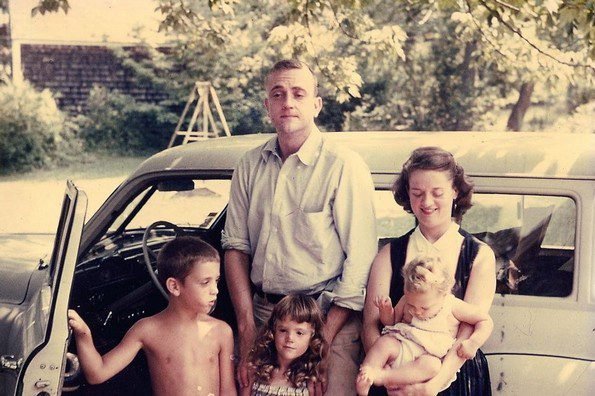
A Vonnegut family portrait c. 1955.

Like most people, Vonnegut himself may have failed some or even often as a spouse, sibling, and father, but that doesn’t diminish the power and truth behind his essential message.

I suspect I have compassion for Vonnegut’s flaws since I share them along with his ideological commitments to kindness and community—regardless of how inept I can be at both.

And my curmudgeon tendencies are strong, but as I grow older, and as I struggle with the necessary deteriorations of aging, I am more and more apt to recognize the futility of lamenting aging, of fearing and regretting old age (whatever that may be).

I remain frustrated with aging, and my vanity is triggered more than I like to admit. But I am more convinced than ever that the real fear is a lack of communiy as I continue to struggle with how to provide for my mom the sort of late life she deserves despite the consequences of her stoke (which took a significant part of her humanity) and the barriers we are encountering because, to be blunt, she has very little money to sustain her—and the typically horrible insurance that most working-class and poor people are saddled with (if they have any at all) in the godforsaken U.S.

Many times I have lamented that in the U.S. we simply do not care about children, and about that I am both deeply saddened and convinced. But that callousness and carelessness is a subset of a much larger and damning part of the so-called American character: we simply do not care about any vulnerable populations: children, disabled people, carers, and the elderly.

The great and caustic residue of being a rugged-individual culture is that we are willfully choosing to reject community in favor of Social Darwinism, consumerism, and the all-mighty dollar.

Instead of social safety nets being a foundational commitment among us, we have chosen to cast everyone to the fate of the Invisible Hand, our claims to being a Christian nature reduced to so-much hokum in practice.

The cost of growing old is in fact not the deterioration of the mind and body, but the consequences of aging being magnified by a people who refuse to provide for vulnerable populations as an unwavering commitment to human dignity.

I will continue to joke with my younger students and friends about being old; it is fun and often a way to assert my humanity into an environment that I recognize will eventually discard me because of age, although my privileges of being male, white, and well-educated will inoculate me for quite some time.

Despite my many, many flaws, my anger about the callousness of the U.S. toward vulnerable populations is not about me, and extends well beyond my sadness at how the world does not really care about my aging and disabled mother.

My anger is reflected in why Maggie Smith’s “Good Bones” has resonated so powerfully over the past several months. Smith forces us to admit “[t]he world is at least/ fifty percent terrible, and that’s a conservative/ estimate,” and she keeps us focused on the vulnerability of children.

My anger is enflamed because I do believe Smith’s closing lines: “This place could be beautiful,/ right? You could make this place beautiful.”

My anger grows because I doubt we will ever assure that comes to fruition.

To squander vulnerable populations—from children to the elderly—is to abandon our souls, to spit in the face of beauty, to declare our society morally bankrupt.

“So it goes.”

Human Frailty

You open a carton of eggs, and not quite with negligence but in the rush of routine, you lift out one egg that cracks open. Your fingers sink into the collapsing shell, sending cold and wet through your sense as you calculate the tiny disaster before you simply wanting to scramble eggs for breakfast.

You know, of course, that eggs are frail things, and you handle them with care—but this egg had been somehow slightly stuck to the carton and your reflex was to squeeze and pull a bit harder.

Half a shell and the exposed yolk still in the carton remind you, however, of the inherent frailty of eggs.

Over about three months now, I regularly spend time with my 76-year-old mother in the wake of her stroke and my 3-year-old granddaughter now freshly embarking on formal schooling by starting 3K.

Conversations with my mom and granddaughter are disorienting and similar—a garbled string of occasional words and phrases mixed with complete nonsense, not even words but mumbling.

And my mother and granddaughter both pause, eyes intent, awaiting some signal I have understood—and often I have no clue.

My mother suffers the consequences of a tiny blood clot in her brain while my granddaughter is victim to the simplicity of emerging from being a baby into early childhood.

Like an egg, they are both incredibly frail, but mostly in slightly exaggerated ways that are an essential characteristic of being human.

Humans all are frail, although we seem determined to ignore or refute that fact.

My mom has slipped into frailty, her body has failed itself after almost eight decades. While my granddaughter has begun navigating the very dangerous world in her new and tiny state.

The world is many parts angry and insensitive, like a hand hurriedly pulling an egg from a carton.

What would this world be, what could this world be if we walked through it with care, gingerly and slowly stepping along as if each step were vital?

The same week that we have been told by doctors, nurses, and social workers we can leave my mother alone during the day is when my granddaughter began 3K—equal terrors for me too much aware of the callousness of this world about human frailty.

To be aware of that frailty, I suppose, is overwhelming, and for me, possibly a great contribution to my relentless anxiety.

Callousness and carelessness, I believe, cannot be the alternative to the weight of being aware that humans are frail—that every human deserves compassion.

I have adopted a soothing tone, gentle smile, and reassuring words when my mom becomes frantic and sad, when my granddaughter fears she has done something wrong or tells us just a few days into her school life that she doesn’t want to go.

“I’m sorry,” “It’s ok,” “We’ll take care of it”—assurances offered, even though I really can’t promise they are true, because everyone must know that they are not alone, that the world doesn’t have to be so awful.

More and more often, the calm after these disturbances for my mom and my granddaughter is what I reach for to make each day worth all the other struggles and possibilities—the heaping mess of just plain nasty people who seem to outnumber the rest of us.

The calm, however, remains in the shadow of the facts of aging for my mother, life is shorter now than what she has lived, and for my granddaughter who will someday way too soon stop raising her arms for me to lift and hold her, stop crawling into my lap and guiding my hand to her feet while she eats a popsicle and watches TV.

It is a lovely and selfish thing to comfort another person, and each moment doing so should be handled with care, like taking an egg in your hand.