How to Navigate Social Media (without Being a Mansplaining Troll)

Several years ago when I was relatively new to Twitter, I had an exchange over an email list and Twitter that resulted in one person blocking me on Twitter and my virtual relationship with the other cooling significantly. Both women are black, and we share educational and social advocacy goals and ideologies.

I regret that deeply, even several years later.

Initially, I focused on my own intentions, attempting to explain away the tensions as misunderstandings. That, in fact, caused greater divides because I wasn’t listening to their concerns and had not fully embraced a key element of the situation—good intentions are never enough.

Particularly about my experiences on Facebook, I think often about this situation because I regularly delete comments on my posts. The people whose comments I delete typically claim I am censoring them or that I am too weak to engage in debate or ideas with which I disagree.

However, I view social media as an extension of my professional scholarly Self, a key element in my role as a public intellectual. Therefore, my virtual spaces are mine, and I am vigilant about keeping them free of inflammatory and baseless comments.

My social media spaces are where I offer strong and even provocative (or inflammatory) positions—what some will call “opinions”—but I take great care to offer evidence-based positions.

I include evidence and links when I post online, in part to model the sort of discourse I believe everyone should practice and in part as an extension of my role as a teacher.

Despite ridiculous claims recently after the Kavanaugh appointment, the real and virtual worlds remain mostly hostile places for women—and that hostility remains primarily driven by angry men who tend to be poorly informed or even wildly misinformed.

This culture of mansplaining and trolling exposes that far too many men think that by the mere fact that they comment, they should be regarded as equal to anyone else posting; in other words, mansplaining and trolling are the perverse logical conclusion of the marketplace of ideas, that all voices count.

Here, I want to examine how anyone (but especially men) can navigate social media in ways that avoids mansplaining and trolling. While I will often frame this in terms of men commenting in women’s virtual spaces, the concepts below are valuable in all types of social media interactions.

Do not comment on someone’s post to disagree with the original post unless you have counter-evidence. Does the post offer evidence for the claims in the post? If so, can you discredit that evidence? If you have no counter-evidence or cannot refute the evidence offered, your rebuttal is mere trolling. Does the original post offer no evidence? Then consider seeking out credible evidence yourself. Asking other people—particularly professional women—to do the work you should do on any topic is also trolling.

Do not change the topic of the original post so you can hold forth on your pet peeves. If a post on social media raises concerns about Trump’s administration, your thesis on Hillary or Obama is not relevant, or welcomed. This form of trolling is hijacking someone else’s social media space.

Resist posting memes, especially gotcha memes. Memes lend themselves to those who zip through social media frantically, but that ease of posting also feeds into lazy thinking and commenting. Those of us who try to navigate social media well and credibly tend to view all memes with skepticism. A great strategy is to thoroughly vet all memes; simply searching online for a few minutes can discredit (or confirm) all memes. One of the worst aspects of memes is the use of quotes by notable people; meme quotes tend to be fake, misattributed, or gross misrepresentations of the person being quoted. You may want to reconsider your H.L. Mencken meme quotes and those Hitler analogy quotes all together, in fact.

Respect people posting as professionals online as the professionals they are. Regularly, I witness people rushing to explain things to someone on social media who is, in fact, an expert on the topic. In the rush to correct or explain, people often fail to investigate the person to whom they are responding. This is especially disturbing when the expert is a woman—and the counter comments seem mostly driven by assumptions a woman is mistaken (or can’t be a sociologist, etc.).

Honor with extra care the social media spaces of women—especially if you are a man. The first rule of responding on social media is to check yourself about responding; it is always a good idea to pause, consider why you want to respond, and when responding to a woman, ask yourself if you would have the same urge to respond to a man. Another good idea is to avoid responding in most cases. Instead amplify the post (retweet, share, etc.) or simply offer a “like.” None the less, always avoid the “well actually” response (basic mansplaining) along with asking the woman (as noted above) to do the labor you should have done yourself to investigate the topic or claim.

Avoid the “both sides” approach to issues. Many, if not most, issues are either way more complex than two sides or have only one credible side. No social media debate is made better simply because you are the brave soul willing to launch into the “other side,” or to play devil’s advocate. These are lazy ways to discuss and typically are cover for, you guessed it, mansplaining and trolling.

Don’t fall victim to the “let’s agree to disagree” stance. A cousin to the “both sides” approach is the “let’s agree to disagree” pose that seeks to make all positions carry the same weight in terms of credibility. Once again, if you have no credible evidence for your position, there simply is not anything to agree about.

Respect other people’s virtual spaces. Since I view my social media spaces as extensions of my professional/scholarly Self, I monitor them carefully and also keep them as free as possible of offensive and false discourse and claims. It is my space. If you have something you feel compelled to express, avoid using other people’s virtual spaces, and instead, that is why you have social media.

Navigating social media spaces is fraught with problems unique to social media—anonymous bravado, a warped democratization of voices and ideas, ease of access and commenting—but those spaces are also as vulnerable (if not more so) to the problems of the real world, sexism and racism just a couple to note.

While examinations such as this are unlikely to sway those eager to mansplain and troll, I think the guidelines above can help all of us who are sincere about a market place of ideas where those ideas and their credibility are judged less by our biases and assumptions, and thus driven instead by a careful and full analysis of the available evidence.

Teaching English Is Teaching English?: Not Really

In the mid-1980s, I was offered a position teaching high school Advanced Placement English after my first year teaching English in the school where I had graduated only about 6 years earlier.

I called my principal, who had been principal there when I was a student, and explained I was tempted by the offer since I wanted to teach AP but also because my first year had been overwhelming; my load was four different preparations of English and journalism, saddling me with five different curriculums and 13 different textbooks (as well as supervising the student newspaper and literary magazine).

The principal, who always called me by my first name since I had been friends and teammates with his two sons (one a year older and the other a year younger), simply replied: “Paul, English is English.”

No effort to address my early-career struggles, no words suggesting the school wanted me to stay, or even respected my work—just a very bored statement brushing aside my concerns for asking way too much of me as an English teacher charged with teaching both British and American literature as well as writing (my student load was about 125 at that time).

I hung up discouraged, and conflicted about my career. Fortunately, I called my former high school English teacher and mentor, who worked at the district office. He talked me off the ledge, and I stayed at the school, hoping something would change about this misguided understanding of what it means to teach English, and writing.

Almost two decades later, however, I sat as a new faculty member and listened as my university changed its curriculum, including a debate and eventual decision to practice a similar misguided belief—teaching writing is teaching writing, and anyone can teach writing.

Teaching some combination of high school English, writing, and teacher education courses for over three and a half decades now, I faced with a great deal of trepidation Special Report: Literacy in the Workplace (Education Week).

While there is lots here to challenge, I think it is worthwhile to focus on a passage from Is Professional Writing the Missing Link in High School English Classes?:

“The assumption is typically that writing is a single skill, and that’s not really a correct assumption. I might be good at writing scientific articles, but God help me if I had to write a novel or poetry,” said Steve Graham, a writing education expert and an education leadership and innovation professor at Teachers College, Columbia University. “It’s pretty clear there is not a strong match between what businesses are looking for and what schools are doing. [Writing in school] really has more of an emphasis on what might happen in college than in the workplace.”

Exactly—writing itself is not a single skill, and literacy is not that simple either.

What we fail to do often, however, is to pull back and admit that teaching literacy (English) and writing, as the principal I mention above believed, is not monolithic endeavors either.

High school English is too often tasked with being both survey literature courses and writing courses. As the EdWeek article muddles, high school English must prepare all students to read and write in the discipline of literature, in preparation for the workplace (another oversimplified domain), and in preparation for college (yet another oversimplification).

We have overstuffed high school English—especially in this never-ending era of standards and high-stakes testing—and as a result we do way too much way too badly.

Let me note a few alternative reforms that may serve us better than yet more hand wringing about all the failures of teaching literacy:

  • Create robust programs and degrees in education that provide all teachers of literacy with holistic experiences as students developing their own literacy skills. My primary concern is that even today, most teachers of literacy—notably high school English teachers—have very weak grounding as students in the best practices we expect them to somehow cram into their bloated obligations as English teachers. How many teachers of English have come through courses rich in writing workshop and drafting original essays in a wide variety of genres and for a diverse range of purposes?
  • Re-imagine the curriculum so that literature and composition/writing have their own dedicated spaces that can allow us to better prepare and assign teachers. Of course, this new curriculum is not about artificially separating reading and writing since students will continue to write (and learn to write) in literature courses, and read in composition/writing courses. This new way of organizing curriculum allows composition/writing to be better addressed as a nuanced set of skills across different disciplines and for many different purposes in school and beyond.
  • Reject the culture of standards and especially high-stakes testing since both feed into simultaneously overstuffing expectations for English teachers and students as well as reducing literacy to what can be measured efficiently—a key culprit in assuring students will not be prepared for anything, much less college or careers.
  • Rethink teaching students for the Next-Thing by allowing teachers of literacy, including high school English teachers, a more clear and manageable purpose for whatever course is being taught and a more nuanced and accurate perception of exactly what the Next-Thing is. As one example, traditional high school English over-emphasizes literary (fiction, poetry) analysis and discipline-specific content such as MLA citation. As a result, students acquire a warped perception of literacy that impedes their transition into college and careers.
  • Admit and then address the very real need for any teachers tasked with teaching literacy to have reasonable student loads. Currently, best practices in literacy are often not implemented because teachers cannot manage them with so many standards and testing obligations combined with excessive student loads. As a high school English teacher, I was teaching literature and writing to 100-125 students a year for five periods a day all week; as a college professor of writing, I teach only writing to 24 students (two courses) over a semester, meeting 3 days a week. Guess which context better serves my students? Teaching conditions are learning conditions.
  • Place literacy acquisition, and especially writing, in a healthy relationship to technology. First, I offer this as a practical skeptic about technology. Next, however, in 2018, I witness daily college students who have virtually no real skills with word processing. Literacy has a symbiotic relationship with technology that too often is either blurred by a careless pursuit of technology-for-technology’s sake or failed because we make baseless assumptions that contemporary students are somehow tech savvy.

Teaching English is no simple task but there is much we can and should do to remedy that problem.

As I approach 60 and the end of my fourth decade teaching, I still cringe at my principal’s “Paul, English is English,” and shudder at the realization that little has changed for my field, my colleagues, and most students in the intervening years.

The Meek

When I read this thread on Twitter, I cried:

I read this the day after I walked across campus from my parking lot to my office. Two students approached, holding hands while laughing and smiling as they talked.

They both made eye contact with me, smiling, and spoke.

I thought about my granddaughter, who snuggles still against me. She is four now, and the first thing she does when she walks into our house is take off her shoes and socks.

When we sit together, I hold her bare feet. It is our holding hands.

How any of us treat our own children, and other children, how a people view and treat all children—this reveals a great deal about character that we tend to ignore in the U.S.

In short, we are an awful people, a disturbing antithesis of the so-called Christian values many want to wave like a tattered American flag in the face of the world.

When Barbara Kingsolver wrote about being in Spain with her daughter, she concluded: “This is not the United States.”

Kingsolver explains:

With a mother’s keen myopia, I would tell you, absolutely, my daughter is beautiful enough to stop traffic. But in Santa Cruz de Tenerife, I have to confess, so is every other person under the height of one meter. Not just those who agree to be seen and not heard. When my daughter gets cranky in a restaurant (and really, what do you expect at midnight?), the waiters flirt and bring her little presents and nearby diners look on with that sweet, wistful gleam of eye that before now I have only seen aimed at the dessert tray. Children are the meringues and eclairs of this culture. Americans, it seems to me now, sometimes regard children as a sort of toxic-waste product: a necessary evil, maybe, but if it’s not their own they don’t want to see it or hear it or, God help us, smell it.

The U.S. is a culture of rugged individualism, no sense of community, as Kingsolver adds:

In the United States, where people like to think that anyone can grow up to be President, we parents are left very much on our own when it comes to the little Presidents-in-training. Our social programs for children are the hands-down worst in the industrialized world, but apparently that is just what we want. In an Arizona newspaper, I remember seeing a letter from a reader incensed by the possibility of a school budget override. “I don’t have kids,” he declared, “so why should I have to pay to educate other people’s offspring?” The budget increase was voted down, the school district progressed from deficient to dismal and one is inclined to ask that smug nonfather just whose offspring he expects to doctor the maladies of his old age.

Our nation has a proud history of lone heroes and solo flights, so perhaps it’s no surprise that we think of child-rearing as an individual job, not a collective responsibility.

And our calloused disregard for children is not our only sin against the meek in the U.S. We are a violent and abusive people for girls and women as well.

Responding to conservative and evangelical support for Brett Kavanaugh (and Trump), Carly Gelsinger offers a disturbing analysis based on her own experiences growing up in “purity culture” driven by the evangelical church:

There exists a generation of women who were never taught consent ― and I’m not talking about Boomers. I’m talking about the hundreds of thousands of us who were raised in church and came of age at the turn of the millennium.

In our world, we were taught that our bodies didn’t belong to ourselves. God owned them, they said, but really, that meant that men owned them. Our fathers. Our pastors. Our husbands. Our politicians. Never ourselves.

Gelsinger recognizes that “[p]urity culture taught young girls to bear responsibility for men’s lust.” And then she catalogues her own experiences as a victim of men because of that culture.

Through her story we must recognize that the U.S. is a large and perverse frat culture in which the meek are initiated through the gauntlet of toxic masculinity and toxic privilege.

If the meek will inherit the earth, the cost of that initiation is far too high and a scar on a people who want to pretend, like Kavanaugh, that we are good and decent folk.

Sacrificing Women: “I came to see the damage that was done”

I came to see the damage that was done…

the thing I came for:
the wreck and not the story of the wreck
the thing itself and not the myth
the drowned face always staring
toward the sun
the evidence of damage

“Diving into the Wreck,” Adrienne Rich

Some of the most offensive elements of the Brett Kavanaugh dissembling are that his lived experiences beneath his lies are about a much wider and more insidious reality. The partisan sideshow must not be allowed to distract us from that reality—that we are a country still complicit in sacrificing women.

Toxic masculinity and rape culture are inexcusable subsets of a larger toxic privilege that spawned Kavanaugh and legions just like him. And, yes, frat culture in his past and today are microcosms of the misogynistic worlds in which mostly white men circulate while clutching the vast majority of wealth and power in the US.

But the Kavanaugh debacle is a story about toxic privilege and our willingness to sacrifice girls and women at the alter of any one powerful white man.

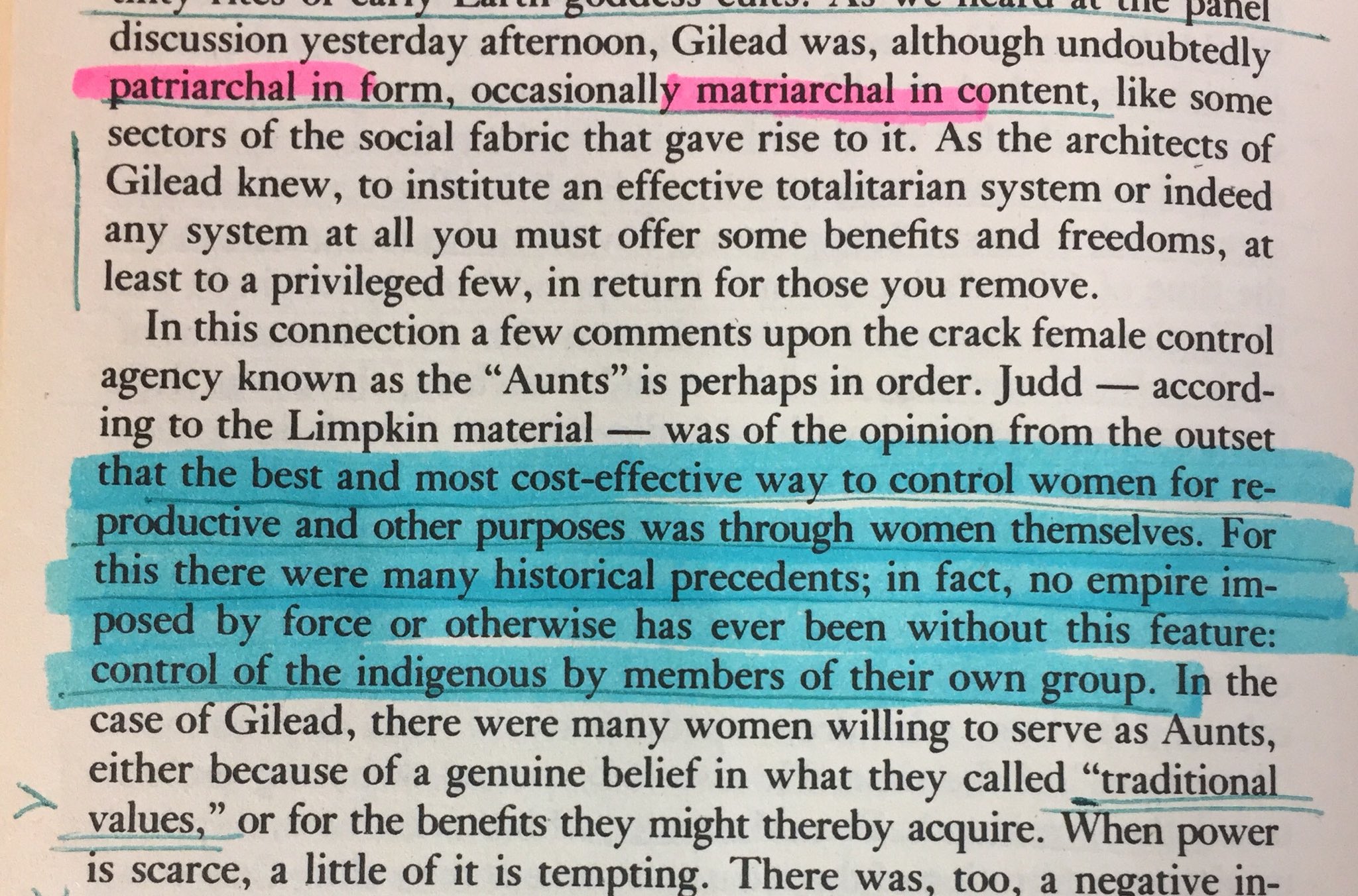
Toxic masculinity, rape culture, and toxic privilege depend as well on complicit women who have been drawn into a dark fantasy of being embraced and rewarded by these men—as reflected in Margaret Atwood’s The Handmaid’s Tale:

Toxic privilege has also driven a pop culture designed to idealize and sanitize rape culture:

Sixteen Candles isn’t a college sex romp like Revenge of the Nerds or Animal House. It’s a high school love story. It’s been celebrated for 34 years for its sweet, romantic heart. Yet it is entirely willing to feature a lengthy, supposedly hilarious subplot in which a drunk and unconscious girl is passed from one boy to another and then raped.

So Caroline gets drunk at a party and passes out in her boyfriend’s room, where presumably she believes she will be safe….

The next time we see Caroline, she’s unconscious again, and the Geek is having his friends photograph him next to her unresponsive body. “Ted, you’re a legend,” they gush.

The next morning, a newly sober Caroline and Geek conclude that they had sex the night before. The Geek asks Caroline if she enjoyed herself. “You know, I have this weird feeling I did,” Caroline says.

As this analysis unpacks, Kavanaugh lived through the same era as this film, and many popular films much worse. Alcohol and toxic masculinity in high school and especially college continue to function the same ways, ways that sacrifice women.

In the very real and ugly world, women are victims of crass political and ideological commitments to guns and lies about who exactly women should fear; it isn’t foreigners or strangers, but guns and men they know:

While this study does not focus solely on domestic violence homicide or guns, it provides a stark reminder that domestic violence and guns make a deadly combination. According to reports submitted to the Federal Bureau of Investigation (FBI), firearms are rarely used to kill criminals or stop crimes. Instead, they are all too often used to inflict harm on the very people they were intended to protect.

According to the FBI’s Uniform Crime Reports, in 2016 there were only 327 justifiable homicides committed by private citizens. Of these, only 45 involved women killing men. Of those, only 29 involved firearms, with 22 of the 29 involving handguns. While firearms are at times used by private citizens to kill criminals, the Centers for Disease Control and Prevention reports that the most common scenarios of lethal gun use in America in 2016, the most recent final data available, are suicide (22,938), homicide (14,415), or fatal unintentional injury (495). (When Men Murder Women)

Image may contain: text

And the very worst of these realities are prominent across the Bible Belt:

Image may contain: text

Emily Peck has reported a telling moment in the Kavanaugh saga: “‘Sen. McConnell, do you always turn your back on women like this?’ Khanna asked as the senator faced other questions from activists while he rode the escalator.”

Yes, the answer is yes, but also, McConnell is but one example of a much larger reality, an entire country turning its back, allowing women to be sacrificed.

Consent, Entitlement, and a History of Sexual Violence

Few things are more dangerous than a man

who is capable of dividing himself into several men,
each of them with a unique river of desire

on their tongues.

It’s Not Like Nikola Tesla Knew All of Those People Were Going to Die, Hanif Abdurraqib

In the adaptation of John Wagner and Vince Locke’s graphic novelA History of Violence, David Cronenberg’s film vividly confronts viewers with at least a couple powerful and related questions: Is human violence necessarily sexual (natural), and is human sexuality necessarily violent?

This dilemma, I think, is also facing us during the Brett Kavanaugh controversy as that narrative expands and unfolds with more and more details about his privileged past in elite prep school and college.

Let me begin with confession.

From about my junior year in public high school in rural upstate South Carolina and through my first two years in junior college, I drank quite a lot—some times legally (beer) and often illegally (liquor).

Bearded in college, in fact, I looked much older than my age so I would stroll arrogantly into liquor stores and buy bottle after bottle without a single occasion of being carded.

This adolescent and young adult stupidity and carelessness, this culture of drinking, was compounded by our drinking and driving. Often.

Much of my self-worth was built on being seen as someone who could drink to excess and not appear drunk. I was the responsible drinker among my friends, the one charged with driving.

None of this is about a life I am proud of living. But I would also suggest that my experiences and behaviors are shared by many young people—approaching what we can fairly call “normal” behavior.

However, here is where I start having some issues with the “boys will be boys” excuses offered for Kavanaugh.

Even after excessive drinking, I have never sexually assaulted or harassed women. And throughout my life, I have never been violent, mostly embracing passivism (including rejecting corporal punishment of children as a parent and grandparent).

In short, I have held the beliefs and behaviors that honor the sanctity of those weaker or more marginalized than I am.

Even while drunk. Even as I have not by any stretch been a perfect human. Even as I will never try to create a narrative of me as a choirboy just trying to live the righteous life.

Because I have sins I am ashamed to admit.

Although I do believe consent is sacred and have never breeched that line through coercive sex, I have been guilty for much of my life of the intrusion of the male gaze and my own direct and indirect participation in the wider culture of objectifying women through so-called “locker room” behavior all too common among most men.

Viewed by those men as harmless and “just joking,” this language and behavior are hard to avoid and socially awkward to confront. I have in later adulthood come to realize this normal behavior is neither harmless nor funny since it all contributes to sexism, misogyny, and even rape culture.

It is at the intersection of rape culture that my life experiences greatly diverge from the world being described surrounding Kavanaugh and his high school and college friends.

That divergence, I think, can be traced to entitlement. I grew up working class and fully aware I was not entitled to anything, even my parents’ love.

The wealth and privilege of Kavanaugh’s world, however, are paths to entitlement—men who believe they are entitled to everything, including women’s bodies and sex.

One of the grossest manifestation of that can be seen in the slut-shaming among Kavanaugh’s football teammates and printed in the yearbook (“Renate Alumnius”). But the grossest example is the frat-party culture that began for Kavanaugh in high school and continued through college.

As Jessica Valenti wrote in 2014: “numerous studies have found that men who join fraternities are three times more likely to rape, that women in sororities are 74% more likely to experience rape than other college women, and that one in five women will be sexually assaulted in four years away at school.”

Let’s now add some context to Kavanaugh being nominated for the Supreme Court and just who controls that process:

And just who has sat and now sits on the highest court:

All of this is to confront, then, it is normal for frat culture to include rape culture.

But it is not normal adolescent or young adult behavior [1], I must argue, because frat culture/rape culture is an extension of privilege and entitlement, not the consequence of human nature. Kavanaugh’s world and the world that young men and women like him now see being dismantled and re-interpreted:

Just as pathological liars believe everyone is lying, the entitled believe their entitlement—including the coerced and violently taken sex of those not giving consent, not able to consent—is simply the way the world works. I am reminded, for example, of Richard Dreyfuss’s retort to charges against him: “Dreyfuss told the New York magazine blog Vulture he flirted with and even kissed Los Angeles writer Jessica Teich over several years but thought it was a ‘consensual seduction ritual.’”

As a man continually forced to investigate my own humanity against #MeToo, my culpability both indirect and direct, I seek ways to honor consent and human dignity, continually unpacking my past, always reflecting on my present, and reaching for a better me in the future.

Like the dilemma exposed by Cronenberg’s film, Hanif Abdurraqib ends It’s Not Like Nikola Tesla Knew All of Those People Were Going to Die with

The only difference between sunsets and funerals

is whether or not a town mistakes the howls
of a crying woman for madness.

Sunsets harken the end to daylight that leads to night and the promise of tomorrow. Funerals rings more final, an ending.

We, the “town,” a community, must make a choice at some point; maybe this reckoning of Kavanaugh and his entitled class will be that transition.

To remain stuck in the mire of misogyny, reducing all women to the hysterical type that renders them less than human and thus the free bounty of the entitled.

Or to recognize the “howls/of a crying woman” as a plea for her dignity that has too often been sacrificed for the entitled, “a man/who is capable of dividing himself into several men”—one of them dressed in a suit and spinning tells of a choirboy past so that we are too distracted to see the monsters he has been, the monsters he will continue to be.


[1] See this thread that explains with citations: “The best studies estimate that as many as 10.8% of young men commit an act of rape before graduating from college.”

The Slowly Approaching Rumble of the “White Noise” of Privilege

Perchance he for whom this bell tolls may be so ill, as that he knows not it tolls for him; and perchance I may think myself so much better than I am, as that they who are about me, and see my state, may have caused it to toll for me, and I know not that.

Meditation XVII, John Donne

although you’re older—and white—
and somewhat more free.

“Theme for English B,” Langston Hughes

For my first-year writing students, Roxane Gay’s “Peculiar Benefits” serves as a powerful mentor text and an effective entry point into a difficult topic, privilege.

“Privilege is a right or immunity granted as a peculiar benefit, advantage, or favor,” Gay explains, adding:

There is racial privilege, gender (and identity) privilege, heterosexual privilege, economic privilege, able-bodied privilege, educational privilege, religious privilege and the list goes on and on. At some point, you have to surrender to the kinds of privilege you hold because everyone has something someone else doesn’t.

While her essay demonstrates the effectiveness of grounding an argument in personal narrative—her own Haitian heritage and trips to Haiti that confronted her with that country in contrast to the US—Gay also acknowledges the inherent struggle to address privilege in meaningful ways:

The problem is, we talk about privilege with such alarming frequency and in such empty ways, we have diluted the word’s meaning. When people wield the word privilege it tends to fall on deaf ears because we hear that word so damn much the word it has become white noise.

From #BlackLIvesMatter to #MeToo, I have begun to wonder if a growing rumble approaches, a rising toll that will someday no longer be only “white noise.”

Many in the US strongly resist discussions of or acknowledging privilege, as Gay notes, and part of that resistance is grounded, I think, in the cultural narrative created and perpetuated by the power elites—mostly white men: Political and economic status in the US has been earned through merit, and not privilege.

That cultural narrative is mostly a lie since the original power grabs were almost all at the expense of others (slavery and denying women equal status with men, for examples) and then those advantages—privilege—have been accumulated over many, many generations. That historical expanse has helped reduce privilege to “white noise,” it seems.

The recently stalled appointment of Brett Kavanaugh represents both the entrenched refusal of privilege and the potential eroding of the merit-cloak shrouding the truly disturbing underbelly of life-long privilege.

Kavanaugh’s interview to defend himself and proclaim both his innocence and determination to continue the appointment process has some telling features:

“I’ve always treated women with dignity and respect,” Kavanaugh insisted. “Listen to the people who’ve known me best my whole life.” Did he commit sexual assault? He “never saw any such thing.” Did he engage in lurid sexual encounters? He “never participated in any such thing.” Rather, he was focused on “trying to be No. 1 in my class” and “captain of the varsity basketball team” while working on “service projects” and “going to church.” Also, he did not have “anything close to sexual intercourse in high school or for many years thereafter.”

The denial extends beyond claiming not to have committed sexual assault to never hearing of misconduct at his school or by classmates, punctuated with his own choir-boy self-description.

This picture is the merit-veneer narrative common among the privileged who have created and maintained a network of privilege. Kavanaugh’s appointment is a blueprint for circling the wagons among the connected to protect each other regardless of who or why.

Kavanaugh’s assertions stretch credibility, however, not just for those attending elite private school but for anyone who has ever attended any high school in the US. Teens drinking and sexual misbehavior are all too common parts of adolescence, but even more damning are artifacts from Kavanaugh’s own high school experience and published accounts by his peers and friends, notably Mark Judge:

Judge, 54, has chronicled the debauchery of his 1980s high school years as a student at Georgetown Prep, where he and Kavanaugh were self-proclaimed members of the “100 Kegs or Bust” club.

In his 1997 memoir, “Wasted: Tales of a Gen X Drunk,” he wrote of high school “masturbation class,” said he “lusted after girls” at Catholic schools and referenced a passed-out “Bart O’Kavanaugh,” who drank too much and once threw up in a car.

This Kavanaugh debacle is a slightly more polished but perfectly aligned part of the larger Trump phenomenon grounded in lies and denying evidence. While Trump plays the cartoonish buffoon, Kavanaugh is sprung from the refined elites who, as this unmasking is exposing, have very ugly lives under the cover of privilege—the ruling vampire class of the US.

As the perverse and contradictory claims reveal about the cavalry forming to defend Kavanaugh—including women—somehow Kavanaugh is both innocent of sexual assault (because he was a virgin and attended church) and the poster boy for “all boys have sexual assault in their pasts” and “we cannot allow boyhood indiscretions to ruin the promising futures of some men.”

And beyond the specific Kavanaugh controversy and the subsequent defenses, even more disturbing is the rise of concerns about all men now being afraid of #MeToo consequences joined by garbled memes about mothers fretting over their sons’ futures (see this Twitter thread dismantling that narrative).

Ultimately, the US is now poised to make an important decision about continuing to ignore the white noise of privilege or hearing the rising rumble that tolls for the abusive and corrupt privileged elites.

The Kavanaugh accusations sit against the merit-veneer narrative orchestrated by Kavanaugh (and echoed by Trump and his ilk) as well as the often-ignored weight of evidence:

“Sexual assault is likely the most under-reported crime in the United States. About two-thirds of female sexual assault victims do not report to the police, and many victims do not tell anyone. Sexual assault is a terrifying and humiliating experience. Women choose not to report for a variety of reasons — fear for their safety, being in shock, fear of not being believed, feeling embarrassed or ashamed, or expecting to be blamed.

“A lack of reporting does not mean an assault or attempted assault did not happen or is exaggerated. Research demonstrates that false claims of sexual assault are very low — between 2 and 7 percent. This tells us that far more women are assaulted and don’t report than women who make false claims.” (Statement of APA President Regarding the Science Behind Why Women May Not Report Sexual Assault)

A people disgusted by the sordid underbelly of privilege must reject the merit-veneer narrative and choose the greater path to not only truth but also equity.

#MeToo is a reckoning about sexual assault and the silencing of women.

Everything about the Kavanaugh narrative rings false, and we are far past time to silence the lies of privilege.

Misreading the Reading Wars Again (and Again)

Here is some incredibly bad edujournalism: Hard Words: Why aren’t kids being taught to read?

And the summary blurb beneath the title takes that to truly awful:

Scientific research has shown how children learn to read and how they should be taught. But many educators don’t know the science and, in some cases, actively resist it. As a result, millions of kids are being set up to fail.

Now, let me offer a brief rebuttal.

First, the claim that we are not teaching reading as we should is well into its twelfth decade of crisis rhetoric. But the classic example rests at mid-twentieth century: Why Johnny Can’t Read.

That blather was a lie then and it remains a lie today.

I invite you to peruse the work of a literacy educator who taught from the 1920s into the 1970s and left behind decades of scholarship: Lou LaBrant. But the short version is the reading war claim that we are failing reading instruction is a long history of false claims grounded in selling reading programs.

Now let’s be more direct about the bad journalism.

This article cites thoroughly debunked sources—the National Reading Panel (NRP) and a report from NCTQ.

The NRP was a political sham, but it also was not an endorsement of heavy phonics. Please read this unmasking by an actual literacy expert and member of the NRP, Joanne Yatvin: I Told You So! The Misinterpretation and Misuse of The National Reading Panel Report.

NCTQ is a partisan think tank exclusively committed to discrediting teacher education. Their reports, when reviewed, are deeply flawed in methodology and typically misread or misrepresent research in order to reach the only conclusion they ever reach—teacher education is a failure! (Like reading instruction, apparently, has always been.)

I offer here one example of why no NCTQ report should be cited as credible: Review of Learning about Learning: What Every New Teacher Needs to Know. (See also GUEST POST by Peter Smagorinsky: Response to the new NCTQ Teacher Prep Review.)

NCTQ lacks credibility, but the organization has learned how to manipulate the current state of press-release journalism that simply publishes whatever aggressive organizations are willing to feed journalists desperate for click bait.

As well, the article plays the usual game of misrepresenting whole language and balanced literacy. A more accurate explanation of whole language and balanced literacy exposes a really ugly reason some are so eager to trash both and endorse phonics: the former are not tied to (lucrative) reading programs, but phonics is a veritable cash cow for textbook companies and the testing industry. (Note the NRP and NCLB directly led to a textbook scandal under the Bush administration.)

Although I tire making this point, no one in literacy recommends skipping direct phonics instruction. WL and BL both stress the need for the right amount and right time for direct phonics instruction (depending on student needs) and recognize that most students eventually need rich and authentic whole reading experiences to grow as readers (not phonics rules, not phonics worksheets, not phonics tests).

Finally, however, is the real paradox.

Formal schooling has likely never taught reading well. Little of that has to do with teacher education or teacher buy in. Again, see LaBrant’s work from the 1920s into the 1960s and 1970s; she laments the gap between good research and practice over and over.

Of course, the key point is why are we failing our students and everything we know about teaching reading?

One powerful reason is the accountability movement grounded in standards and high-stakes tests. Reading instruction (like writing instruction) has been corrupted by the all-mighty tests.

Test reading is reductive (and lends itself to direct phonics instruction, hint-hint), but it is a pale measure of deep and authentic reading, much less any student’s eagerness to read.

Because of the accountability movement, then, and because of high-pressure textbook reading programs, we have for decades ignored a simple fact of research: the strongest indicator of reading growth in students is access to books in the home (not phonics programs).

I want to end by addressing the real scapegoat in all this—teacher education.

Full disclosure: I have been working in teacher education for 17 years, after 18 years teaching high school English in public school.

But, I am the first to admit teacher education is quite bad, technocratic, bureaucratic, and mostly mind-numbing.

Teacher education, however, is not the problem because whether or not we are teaching reading research and practices correctly is irrelevant; teacher candidates overwhelmingly report that once they are in the classroom, they are told what to do and how—what they know from teacher education is tossed out the window.

The article is not a powerful call, then, for teaching students to read. It is a standard example of really bad edujournalism.

Ironically, a bit of Googling and reading could have alleviated much of that, but I guess we are asking for too much and may want to blame teacher education and teachers for those journalists’ inability to read.

Recommended

Whatever Happened to Scientifically Based Research in Education Policy?

Corporations Are Behind The Common Core State Standards — And That’s Why They’ll Never Work

A New School Year But the Same Concerns about Safety

Over the summer, a post on social media complained about President Trump not receiving credit for the sudden pause in school shootings. Of course, as one response noted, school violence tends to be absent when schools are no longer in session.

This virtual exchange exposes the dangers of both partisan sniping and uninformed public debates.

As K-12 schools and colleges begin new academic years, we are all once again concerned about the safety of students, faculty, and staff.

However, actual policies and practices that would better insure that safety face many hurdles. One problem with implementing effective strategies for safer schools is a lack of credible data.

Anya Kamenetz reports for NPR: “Our reporting highlights just how difficult it can be to track school-related shootings and how researchers, educators and policymakers are hindered by a lack of data on gun violence.”

This confusion over how often school shootings occur is made even more complicated since high-profile mass shootings at schools tend to create a false and distorted picture of schools. Despite what political, media, and public debates suggest, numerous studies reveal that students are safer in schools than in their communities.

And here is where we must face a powerful but often ignored fact about how to make our schools safer: School safety initiatives must begin by making our communities and wider society safer, including addressing access to and the sheer amount of guns in the U.S.

School safety measures have proven time and again not to be effective. More troubling, some safety measures have been shown to create less safe environments in our schools.

Metal detectors, surveillance cameras, and resource officers are all widely supported by politicians and the public, yet they do not create safer schools. And as a study released by the National Association of School Psychologists reveals,

There is no clear research evidence that the use of metal detectors, security cameras, or guards in schools is effective in preventing school violence (Addington, 2009; Borum, Cornell, Modzeleski, & Jimerson, 2010; Casella, 2006; Garcia, 2003). In fact, research has shown that their presence negatively impacts students’ perceptions of safety and even increases fear among some students (Bachman, Randolph, & Brown, 2011; Schreck & Miller, 2003). In addition, studies suggest that restrictive school security measures have the potential to harm school learning environments (Beger, 2003; Phaneuf, 2009).

After intense media coverage of shootings at schools in the 2017-2018 school year, many have been compelled to call for more people being armed, even arguing for increased armed officer presence in schools and arming teachers.

Yet, the evidence is overwhelming, as Melinda Wenner Moyer reports, “guns are associated with an increased risk for violence and homicide”—but not with greater safety.

If we can set aside partisan agendas and popular support for policies that lack credibility, we must confront that security cameras were present at Sandy Hook and Virginia Tech, that arm resource officers were present at Columbine and Parkland, and that turning schools into fortresses surrounded by barbed wire and gated with metal detectors is more likely to criminalize our students than protect them.

Ultimately, however, our choice is not between fatalism—throwing up our hands and doing nothing—and grasping at misleading and even harmful policies that give the appearance of making schools safer.

First, the U.S. is well overdue on a reckoning with our gun-lust. We have too many guns in the U.S., and we allow far too much access to those guns. Internationally, we are an obscene outlier in gun violence and access.

If school and community safety is a real concern in our country, we will find the political and public will to change our laws and our behavior. Without that will, our schools will remain ground zero for tragedies that could be avoided.

Next, of course, school policies and practices can have positive consequences for safety.

After Columbine, in fact, the Secret Service and U.S. Department of Education cautioned against safety structures (officers, metal detectors, cameras, etc.) and stressed:

Specifically, Initiative findings suggest that [school] officials may wish to consider focusing their efforts to formulate strategies for preventing these attacks in two principal areas:

  • developing the capacity to pick up on and evaluate available or knowable information that might indicate that there is a risk of a targeted school attack; and,
  • employing the results of these risk evaluations or “threat assessments” in developing strategies to prevent potential school attacks from occurring.

In other words, school safety is about paying close attention to our students, their needs and their struggles. School safety is a human issue, not something that can be barricaded or watched over closed circuit.

Ill-informed “gotcha” social media exchanges reveal the essential problems with our political and public responses to school violence: We are too often driven by our hearts and our guts while refusing to see and listen to the often hard answers for genuinely dangerous realities.