Big Time Football: “angry white man society”

While Trevor Lawrence—probably the highest profile white Division I college football player in 2020—has become the face for the #WeWantToPlay campaign calling for a start to college football amidst a pandemic, the Colorado State University football program has been forced to reckon with a racially toxic culture, implicating their former coach and current assistant coach at the University of South Carolina (Mike Bobo).

The #WeWantToPlay campaign appears to be garnering greater media and public coverage, but the CSU controversy should not be ignored, and should not be examined as a culture problem somehow centered only at CSU or in the individual coaches named in that coverage.

Charges by Black players at CSU are powerful and damning:
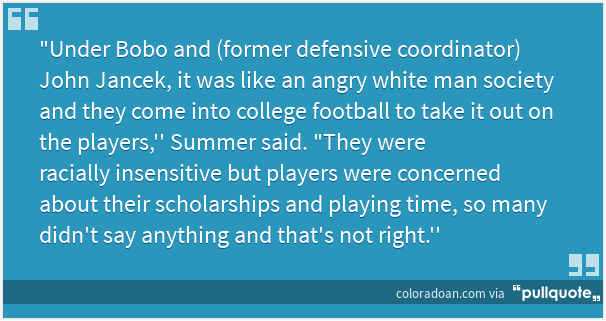
Image

However, again, this is not about CSU solely or a few high-profile coaches; this is about “closed systems” and a normalized culture of abuse “hidden in plain sight”:
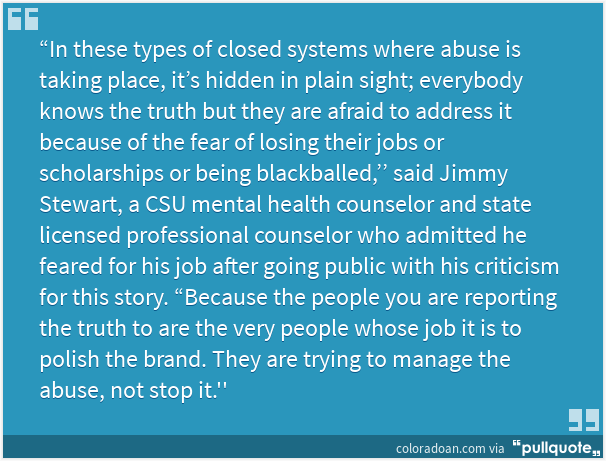
Image

Black athletes describing the culture of their football program as “an angry white man society” can and should be amplified to describe the entire system of big time football in the U.S. Start by considering the numbers:
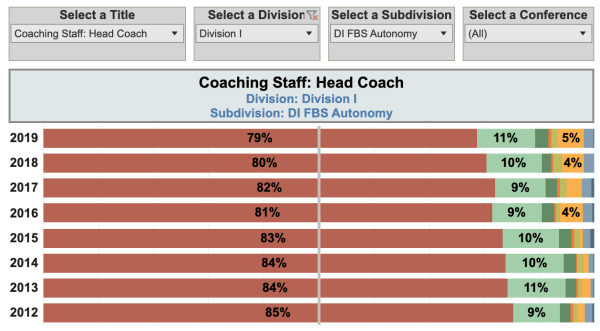
Div I head coach race football
NCAA Demographics Database

The power-base of college football is significantly skewed toward white men, disproportionate to percentage of white men in general U.S. society as well as disproportionate to the demographics of men who play the sport:

In mass media and popular culture, sport is often presented as a level playing field where the most skilled and committed athletes rise to the top. The racial composition of American football is often presented as evidence of the supposed meritocracy of sport. While 13.2 percent of the U.S. population is black, 47.1 percent of NCAA Division I football players and 68.7 percent of National Football League (NFL) players are black.

White Americans hold the vast majority of power and wealth in the U.S., skewed significantly toward white men. Yet, white Americans tend to struggle with concepts of systemic inequity (racism, sexism, etc.) that depend on understanding the invisibility of white privilege for white people and the key statistical concept exposed above, “disproportion.”

Even as the killing of George Floyd by a police officer has reignited awareness and public protests about police violence being racist, this movement has not silenced or erased the “but police shoot and kill more white people” response, echoed by the current white nationalist POTUS.

For people with power, then, grasping data about disproportion is often a paradoxical experience (Simpson’s Paradox) because of white denial and white fragility:

The people making this argument don’t dispute the fact that police kill Black people at disproportionate rates. A Black person in America is roughly three times more likely than a white person to be killed by police. But according to this argument, the disparity is rooted in crime rates and more frequent encounters with police, not racism. In 2018, the rate of arrests for violent crime was 3.6 times higher for Black people than white people. So actually, the argument goes, Black people are underrepresented as victims of police killings, after controlling for the number of encounters.

Big time college football is both a reflection and perpetuation of the larger systemic inequities (such as racism and sexism) throughout the U.S.

But the current charges against coaches and the program (culture) at CSU are not merely a condemnation of CSU or the former and current head coaches. These charges are historical and current features of sports across the U.S., starting when athletes are children and running through the very small percentage who make sports their livelihoods.

The mythology that coaches (overwhelmingly white men) are building character in their athletes and are nearly universally “God-fearing, good family men” is one of the ugliest lies in American culture.

Sports in the U.S. is never about building character and certainly isn’t in the service of God (despite the veneer of Christianity that is layered onto every aspect of scholastic sports in the U.S.), but about winning and the wealth and aggrandizement of coaches and the institutions associated with those teams at the expense of the athletes (often disproportionately Black bodies):

“After watching George Floyd being humiliated before he died, it triggered in me the times I saw or heard about certain coaches humiliate student-athletes and the fact that not going public made me complicit and compromised my integrity,” said the 65-year-old Stewart, who is white. “I also became conscious that racism is about being a bully. In that encounter with the Black student-athlete, Coach Addazio had this attitude that he’s bigger and more powerful than the student-athlete. The student was enslaved.”

The day-to-day normalized behavior of coaches—yelling, berating, swearing, threatening—would be viewed as bullying and abuse in virtually all other situations where there is the sort of power, age, and racial imbalance as there exists in sports.

The abrupt and sustained pauses created by the Covid-19 pandemic have the potential for not only the needed reckonings echoing around many of the foundational aspects of American culture but also long-overdue revolutions in those institutions, including how we educate young people as well as how young people are invited into and coached through sports (since in the U.S. formal education and sports are nearly inextricably intertwined).

White men coaches are reinforced at every turn that they are “good men” despite their behaving as bullies, despite their racist and sexist ideologies mostly veiled or closeted behind the secrecy of male bonding and locker rooms:

A member of CSU’s football staff said Addazio has downplayed the COVID-19 health threat and Black Lives Matter movement, which have dominated public discussion in recent months, calling both a “distraction from football” to be managed.

“He’s smart enough not to come right out in public and say it, but he thinks BLM (Black Lives Matter) is a crock of s—, and that has come out in meetings,” said the football staff member who wished to remain anonymous. “When we had the incident with the player (a Black CSU football player was held at gunpoint by a white man while working in Loveland), the players wanted to march with shirts that had BLM on it, make posters and say chants. He told them if you are going to do that we aren’t marching.”

CSU and the University of South Carolina likely have some hard decisions to make, and probably are hoping to sweep all this under the rug while people struggle against the avalanches of crises surrounding them—from the Covid-19 pandemic to the rumbles of a 5.1 magnitude earthquake at the North Carolina/Virginia border.

I suspect these universities will issue a few more statements, probably conduct some investigations and also create reports months down the line; there may be some very mild consequences for the coaches named (but their already earned millions will not be touched, of course).

The white coaching shuffle, in which mediocre white men fail upward while stepping on those Black bodies for leverage, will continue, however.

The messages coming from Black football players at CSU are not just about CSU, or big time college football, or the most disturbing aspects of coaching; the messages coming from Black football players at CSU are about systemic inequities pervading all aspects of the U.S.

Big time college football is an important subset of American culture, a point being fumbled by Lawrence calling for #WeWantToPlay.

The U.S does not need major college football to return to normal and resume as soon as possible in the coming weeks, the fall of 2020.

A full and complete unmasking of big time college football would be welcomed, and should precede any efforts to return to our contemporary and slightly sanitized gladiator event that was always about sacrificing some Other bodies.

UPDATE

ACC players speak out against Trevor Lawrence 

See Also

Dabo Swinney and the White-Man No-Apology Apology

The Christian Veneer: On Dabo Swinney and Donald Trump

Confronting Aaron Hernandez, Big Time Football, and Toxic Masculinity

The United States of Hypocrisy: Scholastic Sports

College Athletes’ Academic Cheating a Harbinger of a Failed System

Coach K, Sports Fandom, and More on My Redneck Past

I Swear: On “Grit,” Adult Hypocrisy, and Privilege


Neil Young v. Lynyrd Skynyrd 2020: “Southern Man” Redux

What happens to a dream deferred?

“Harlem,” Langston Hughes

My empty-headed adolescence spanned the 1970s—I turned 18 and graduated high school in 1979—in rural upstate South Carolina, only about 25 minutes away from where I live now.

Lynyrd Skynyrd’s “Sweet Home Alabama” and “Free Bird” were persistent background music on the radio and in dance clubs well into my college life. I never owned a Lynyrd Skynyrd album, but I knew every word to both songs and gleefully (and mindlessly) sang along to them in my car or holding a long-neck Budweiser on 25-cent beer night at O’Sullivan’s.

I was a very conflicted, insecure, and anxious-to-near-paralysis teenager, and my musical tastes reflected the jumble of the mindlessness (Tom Petty, Eagles) with my late-to-develop serious interest in music that I didn’t just know the lyrics, but began to think about their implications (Parliament, Pink Floyd).

My deep and careful affection for Neil Young did not develop until the 1980s. But like most people, I was always aware of the so-called feud between Young and Lynyrd Skynyrd.

The songs that are permanently intertwined are Young’s “Southern Man” and “Alabama” (which Young has distanced himself from in moments of self-criticism) that spurred Lynyrd Skynyrd’s “Sweet Home Alabama” with the infamous lines:

Well I heard Mr. Young sing about her (Southern man)
Well, I heard ol’ Neil put her down
Well, I hope Neil Young will remember
A Southern man don’t need him around, anyhow

And that band’s iconic single cover art also sent a pretty strong symbolic message:

While the band’s relationship with the Confederate Flag is complicated, Lynyrd Skynyrd as a band and MCA Records were certainly intentional about fostering a strong relationship with some of the worst realities about Southern pride.

Young’s “Southern Man” and “Alabama,” of course, took square aim at those Southern sins, prompting (as some have tried to clarify) Lynyrd Skynyrd to write “Sweet Home Alabama” as a rebuttal anthem along the lines of “Not all Southerners.”

Young has noted that his songs may have painted with too broad a brush, but Lynyrd Skynyrd’s revisionist explanations stretch credulity.

Both the tension and controversy surrounding Young and Lynyrd Skynyrd were grounded in a sort of regionalized ideological divide that remains today—Young as the liberal Canadian and Lynyrd Skynyrd as the conservative Southerners.

I was born and raised in the racist, redneck Southern culture that embraced and celebrated Lynyrd Skynyrd and the Confederate Flag. Both are steeped in a sort of jumbled logic about tradition and pride that refuses to acknowledge the harsh realities of racism that created the South but also lingers in the South and its traditions (such as the Confederate Flag and idealized mythologies about Dixie and the Lost Cause whitewashing of the Civil War).

It took a great deal of critical introspection for me to slay that past, deconstruct and then reject it, and it took too much time for that process, a transition occurring while I was an undergraduate (a racial awakening overlapping with many nights at O’Sullivan’s singing along to “Free Bird” and holding a long-neck Budweiser).

In Young, the Self I constructed out of the shell that chose to walk away from my racist upbringing found the music and lyrics that resonated with the person I wanted to become.

Recently, I saw a post on social media asking people to choose between Neil Young or Lynyrd Skynyrd. At first, it seemed out of place in 2020.

Like others who replied, my first thought was there is no choice here; it is Young because of the many problems surrounding Lynyrd Skynyrd, including “Sweet Home Alabama” and their embracing the Confederate Flag.

Over five decades, however, there really is nothing simple about that choice because it is 2020.

The Southern-apologist strategy is alive and well in 2020 even as states have taken more aggressive approaches to renaming buildings and removing statues honoring Civil War figures who unequivocally were racists and slavery enablers.

The jumbled history of Lynyrd Skynyrd and the band’s relationship with both the Old South and the New South are an aging quilt, but the threads of that quilt are being disturbingly re-spun in support for Trump by reinvigorated white nationalists in the U.S.

And while conservatives have long clung to “Sweet Home Alabama” and “Free Bird” as right-wing anthems, Republicans have also co-opted Young’s “Rockin’ in the Free World,” and Bruce Springsteen’s “Born in the U.S.A.”—seemingly (mis)understood with the same sort of empty-headedness I practiced as a redneck singing along to “Sweet Home Alabama” in the 1970s.

History has been far more kind to Young’s efforts at social consciousness through his music than to Lynyrd Skynyrd regardless of to what degree you backward (re)construct their messages about the South and its iconography (people claim, for example, the “Boo! Boo! Boo!” following “In Birmingham they love the governor” as both rejecting and endorsing infamous racist George Wallace).

There is an irony to asking people to choose between Young and Lynyrd Skynyrd—the former a flawed but earnest choice and the latter a tarnished if not irreparably stained choice.

There was never room for the Confederate Flag, and “Not all Southerners” is a coward’s plea against the historical and lingering systemic racism that plagues not just the South but the entire U.S.A.

But 2020 has proven James Baldwin’s edict: “the time is always now.”

Lynyrd Skynyrd, the original band, and the reconstructed Lynyrd Skynyrd as well as their fans are real-life examples of the great failure of the South, clinging to the old ways simply because they are the old ways.

So much of literature has warned about the folly of pride that it feels cliche, but “Proud to be a Southerner” and “Proud to be an American” both fall flat against the “rigid refusal” to acknowledge our sins past and current.

Now, Young recognizes his warning “Southern change gonna come at last” ( applies to the entire country, not just the region he targeted:

Young posted a 2019 performance of the song on his Archives Wednesday, writing: “Here’s me as an old guy singin’ his 50-year-old song that was written after countless years of racism in the USA. And look at us today! This has been going on for way too long. It’s not just ‘Southern Man’ now. It’s everywhere across the USA. It’s time for real change, new laws, new rules for policing.”

It’s 2020 and there is no credible way to justify Lynyrd Skynyrd, just as there is no credible way to justify Trump.

It’s 2020 and there really is no choice, but it certainly is time to make the choice in ways other than mere words or simply clinging to something that should have never been held dear to begin with.


Academic Freedom, Pedagogy, White Privilege, and Racism in Higher Education

“Reckoning” is an imposing word for those with power and privilege; for white people in the U.S. the threat or possibility of a reckoning is often terrifying, triggering what has now been identified as white fragility.

For those abused, assaulted, or marginalized by racism, sexism/misogyny, homophobia, transphobia, xenophobia, etc., the possibility of a reckoning is exhilarating—although tinted with at least skepticism if not cynicism about any reckoning coming to fruition.

Amidst a pandemic, however, the murder of George Floyd at the knee of a police officer seems to have reignited with a renewed stamina the #BlackLivesMatter movement.

Professional sports, including even the ultra-conservative NFL, have blinked finally against the call for police reform and racial reform across all aspect of the U.S.

Like the symbolism now being allowed and celebrated in the NBA and WNBA, the diversity and inclusion initiatives in U.S. higher education remain mostly rhetoric (and seemingly endless committee work).

While higher education is often characterized (and demonized) as some sort of insular liberal and progressive playground for college professors, the truth is that colleges and universities—like K-12 schools—are deeply conservative and mostly a reflection of society and the populations they serve.

Yes, a good portion of college faculty talk the talk of moderates and progressives, but almost all institutions are conservative by nature in order to exist; revolutionary behavior fits poorly with the economics of running a college or university.

Public universities are governed by politicians (mostly conservative and right-leaning moderate across the U.S.), and college and university boards tend to be populated by wealthy and conservative advocates for sustaining the institution (not brainwashing students with Marxism).

We of a genuine leftist persuasion, Marxists or critical scholars, are small outliers on college and university campuses; we are at best begrudgingly tolerated, often with significant consequences to our professional and personal lives.

Here’s the ugly truth—colleges and universities are systemically inequitable places. The campus, dorm, and classroom cultures are more often than not hostile to marginalized groups.

Black students, for example, are under-represented on college campuses (except at HBCUs), and even though women are the majority of students at those colleges and universities, they still must navigate sexual assault and harassment cultures with weak university support as well as significant inequities in access to majors as well as extracurricular activities such as athletics.

At my university, there have been a number of diversity and inclusion movements over the years, and we have fairly recently hired a Chief Diversity Officer.

The university has also been relatively proactive in confronting the racism in the founding of the institution, creating a report, Seeking Abraham, and establishing a series of action steps to address the racism built into the institution.

Yet, a new reckoning appears to be upon the university, best represented by an Instagram account, Black at Furman.

Alumni have been posting anonymously, detailing that the campus, dorms, and classrooms have been and remain hostile environments for students who have been marginalized by race, gender, nationality, sexuality, etc.

To their credit, administration at the university has responded positively so far to a petition by those running the IG account. Faculty seem also more motivated than in the past to acknowledge and address campus-wide inequities, especially those impacting Black students.

Along with other faculty, I have created a Equity, Anti-Racism, and Anti-Bias Statement, fore-fronting it on all course materials across my fall load:

#BlackLivesMatter

In my teaching, scholarship, public writing, and life, I am fully committed to racial, gender, and all forms of equity not yet realized throughout the U.S. and world. While academic spaces are often intellectually challenging and even uncomfortable, I will not tolerate in any aspect of this course language, ideas, or behavior/symbolism that are hostile to marginalized/oppressed groups (racism, sexism/misogyny, homophobia, transphobia, xenophobia, etc.).

Academic freedom for students and professors is tethered to consequences, and is not license. (See Free Speech and Diversity of Thought?)

Students uncertain about what language and ideas are not acceptable because they are hostile or offensive are invited to discuss those questions with me privately and are guaranteed those exchanges will be treated confidentially and respectfully. I am eager to share evidence, research, and reading to help anyone better understand goals of equity, anti-racism, and anti-bias (see materials in Box, Race and Racism).

If you witness or experience any form of bias, please report here:

Bias Incident Report

Anti-racism and anti-bias practice has been central to my teaching career for almost four decades; students are well aware of where I stand against the -isms that deform us, and my public work (such as my blogs) and my scholarship are firmly grounded in critical pedagogy, critical race theory, and critical discourse analysis.

I have also been a vocal critic of the ways in which my university falls short of critical practice and ant-racism/anti-bias commitments.

Yet, the IG account has highlighted in vivid and disturbing ways that far too often—and like many colleges and universities—inexcusable behavior is tolerated in dorms, across campus, and in classrooms because of tradition, fear of upsetting students and parents as customers, and more insidious ideologies such as academic freedom and narrow (traditional) expectations for research, scholarship, and teaching.

Central to my statement above, I think, is a confrontation of academic freedom and how it has been weaponized in the name of white privilege and racism.

Again, read the experiences of Black students in courses at my university, class sessions where language and comments that have no credibility have been allowed and have created hostile learning environments for Black students.

As I note in the statement, academic freedom is not license; it is not about “anyone can says anything in a class setting.”

For example, biology professors might acknowledge creationists and their rejecting Darwinism/evolution, but many do not, and certainly none suggest that “counter opinion” is credible in the field fo science.

How much time is spent in courses on World War II allowing Holocaust deniers equal time? Do we allow students to hold forth about the credibility of exterminating Jews?

In other words, academic freedom is about the boundaries of a discipline, and who determines the boundaries. Biology professors determine the boundaries for teaching evolution (not the university’s board of directors), and that is academic freedom.

Academia is not about knowledge bereft of moral or ethical parameters.

I will not sit in a classroom and allow students to create the sort of hostile environment former students lived and learned through because of the negligence of their professors and the university’s administration.

In the U.S., our government failure is a lack of political will, allowing and perpetuating what is ethically wrong because doing so gains political capital.

This, I fear, is an equally valid commentary on higher education.

College and university administrators and faculty too often lack the political and ethical will to simply do the right thing.

Academic freedom, how we teach (pedagogy), and what we teach are sacred and even potentially beautiful things, enormously valuable to the students who walk the grounds and sit in our classrooms.

But we have failed too, too many of those students; we have hidden behind a tarnished vision of academic freedom and proper pedagogy.

Let’s hope this reckoning is the real thing. It is long past due.

Recommended

This Ain’t Another Statement! This is a DEMAND for Black Linguistic Justice!