Please access this policy brief on the “science of reading” movement from NEPC:
Thomas, P.L. (2022). The Science of Reading movement: The never-ending debate and the need for a different approach to reading instruction. Boulder, CO: National Education Policy Center. Retrieved [date] from http://nepc.colorado.edu/publication/science-of-reading
The policy brief emphasizes the need to avoid one-size-fits-all reading policy and practice. For context, please see:
We should acknowledge that one-size-fits-all metrics do not fairly measure what matters most in many schools. Right now, what matters most is finding ways to address and improve students’ mental health so they can get back on track with learning. We should reward schools for innovation, for creating programs that will take time to evaluate.
Simple numbers promote simple solutions and can prevent promising programs with long-term positive implications from taking root. Before we head into another school year, let’s look at dismantling the ranking systems that are burdening our administrators with busywork and preventing authentic improvement.
This post is intended for people who have viewed the full series, including the final episode, of Ozark.
Many people have acknowledged that Ozark is a well-acted derivative of Breaking Bad. But an analogy just as important, if not more so, is that Ozark is a 2010s-2020s version of F. Scott Fitzgerald’s 1910s-1920s The Great Gatsby.
Marty and Wendy Byrde are essentially Tom and Daisy Buchanan, although Wendy is often more like Tom, and Marty, more like Daisy. None the less, Marty and Wendy fit well narrator Nick Carraway’s description of the Buchanans:
I couldn’t forgive [Tom] or like him, but I saw that what he had done was, to him, entirely justified. It was all very careless and confused. They were careless people, Tom and Daisy—they smashed up things and creatures and then retreated back into their money or their vast carelessness, or whatever it was that kept them together, and let other people clean up the mess they had made….
The Byrdes leave a staggering trail of carnage, larger but similar to the bodies in the wake of the Buchanans. Both couples survive mostly unscathed—at least still wealthy and alive.
If we include the Breaking Bad comparison, the two series’ creators made some important and different decisions about Marty and Walter White—the main white male center of the “vast carelessness”—and some profoundly important different decisions about the parallel characters of Jesse and Ruth—both sympathetic characters who suffer some of the greatest consequences of the carelessness.
Ozark and Breaking Bad ultimately offer some excellent aspects of contemporary series, and nearly equal elements that are problematic. Notably, the shows center whiteness against Mexicans as murders and drug lords—with the whiteness often seeking viewer empathy.
The back story of Walter White—and the annoying messaging that being reduced to a high school teacher is proof Walter has been cheated by the universe—folds into his cancer diagnosis; this feels much reduced in the scene where Marty is on his knees about to be murdered, only to start the momentum toward nothing ever really touching Marty Byrde, unlike Walter’s fate.
Bryan Cranston and Jason Bateman go a long way to help the writers skirt past the ugliest of truths beneath these men scorching the earth for the good of their family. They are, in fact, the worst sort of “careless people,” selfish and calculating.
Breaking Bad, like Better Call Saul, are far better written and filmed than Ozark, even as these series are carried by incredible acting, possibly even better in Ozark than its obvious inspiration.
On balance, Break Bad is the better series, but in its last episode, Ozark makes a case for itself because of the decisions around Ruth, in contrast to her parallel, Jesse, from Break Bad.
Like the Buchanans, the Byrdes are outsiders, and although Jesse is a local like Ruth, Ruth’s parallels in Gatsby are the Wilsons, low- to working-class characters. And like Myrtle and George Wilson, Ruth as redneck young woman, is sacrificed beside her not-yet-finished empty pool with a corpse buried beneath. The imagery of her death is intensified as we hear her telling Wyatt he doesn’t know how to be rich—paralleled by Myrtle’s pathetic efforts to play rich in Gatsby.
Ozark seems to argue that the class barrier trumps race and gender. It certainly dramatizes that class trumps character and intelligence and work ethic.
Ruth splayed on her dirt yard—reminiscent of Myrtle mutilated in the road by Daisy driving Gatsby’s gold Rolls Royce—comes after mid-final-episode the Byrde’s suffering a dramatic car accident, one shown in an earlier episode, one no one could simply walk away from.
For me, the car wreck had no emotional weight, even as Marty and his children crawl free, miraculously unharmed, even as Wendy appears unconscious (dead?) until Marty rouses her. The family soon after arrives at their house in a taxi, Wendy noting they survived only somewhat battered and bruised.
But it is Wendy’s comment to Novarro’s priest that reveals the narrative purpose of the accident—not to tease the audience with one or more Byrde deaths but to show that the entire series is an extended allegory about the Teflon promises of whiteness and wealth.
As Wendy boasts to the priest as she takes him by the shoulders, they will survive, and they do.
The series ends black screen, a gun shot, the Byrde’s winning (a more honest and cynical ending than Breaking Bad), murderously (again) after Marty softly nods to his teen son, Jonah, who fires the shot.
Like Walter White, for Marty, and now Jonah, “what he had done was, to him, entirely justified.”
Many plot lines and characters force viewers to repeatedly interrogate that very concept; Walter and Marty live by the ends justifying the means.
Yet, none confront that central question more vividly than the tensions between Wendy and Ruth about the killing of Wendy’s brother, Ben.
The last episode highlights the emptiness pervading Ozark with Ruth caving to Wendy about culpability for Ben’s murder, prompted by Wendy committing herself in yet another grand manipulation (suggesting viewers should feel empathy for Wendy since, as the scene depicts, she shares with Ruth the consequences of an abusive father).
Ozark and Breaking Bad left me wondering how I am supposed to feel about the characters.
It is there I focus on Ruth and Jesse, the characters with the most lingering sympathetic qualities in spite of their very human flaws, and frailties. I think we can (and should) find more sincerity in the struggles of Jesse and Ruth against the backdrop of the posing and ruthlessness of Walter and Marty.
Like Gatsby, Ozark is a deeply cynical work about the American Dream. This American nightmare is more like what John Gardner lamented:
That idea—humankind’s inalienable right to life, liberty, and the pursuit of happiness—coupled with a system for protecting human rights—was and is the quintessential American Dream. The rest is greed and pompous foolishness—at worst, a cruel and sentimental myth, at best, cheap streamers in the rain. (p. 96)
“Amber (Get) Waves (Your) of (Plastic) Grain (Uncle Same)” in On Writers and Writing, John Gardner (1994)
The Byrdes shit all over the Ozarks, and we are left with one final wry smile from Marty and, yes, the gun shot.
“[L]et other people clean up the mess they had made”…
In the Marvel Universe(s), including the MCU, Black Widow has endured just about every compelling and nonsensical plot line and character development that represent the larger sub-genre of superhero comic books. As I have been documenting, however, Marvel and even their best creative teams find ways to underestimate (and, of course, hypersexualize) Natasha/Black Widow.
With Marvel committing more issues and superstar teams in v.5 and v.6, readers may have held out hope that the fate of Black Widow (both inside the comic book universe and more broadly as a character Marvel would develop more substantially) had turned a corner. However, v.7 ultimately is a regression with only 5 issues, and then, the Web of Black Widow offers another brief 5-issue run after that.
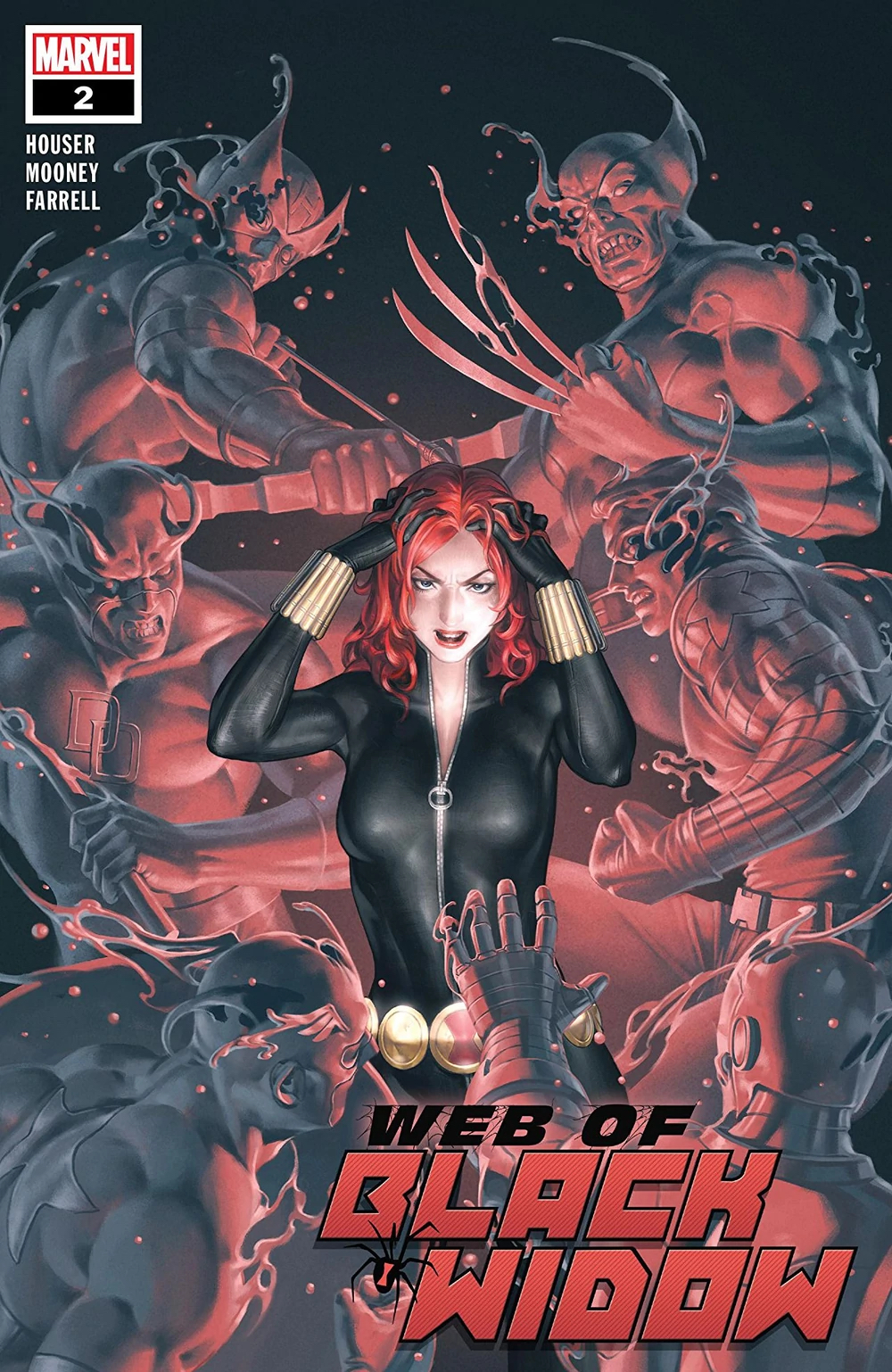
Black Widow v.7, issue 1 (cover art by Clayton Crain) and Web of Black Widow issue 3 (cover art by Jung-Geun Yoon) remind us that too often Black Widow is hypersexualized with her outfits and the relentless urge to show her bound.
Since we have the benefit of hindsight—this post sitting as it does after one of the best (if not the best) run on Black Widow, v.8 (thanks to Kelly Thompson, Elena Casagrande, and others)—many of us are now dealing with both the afterglow of a stellar 15-issue run and the recurring disappointment of Black Widow once again trapped in publishing limbo.
Here, I want to consider v.7 and Web as a stumbling journey to that excellent Thompson series, holding onto the hope that at some point Marvel will overcome underestimating and hypersexualizing Natasha/Black Widow.
Black Widow, Lost and Found
The creative team of Jen Soska and Sylvia Soska, writers, and Flaviano Armentaro, artist, are tasked with v.7 in the wake of Natasha Black Widow’s death in Secret Empire issue 7.
Cover art by Max Brooks.
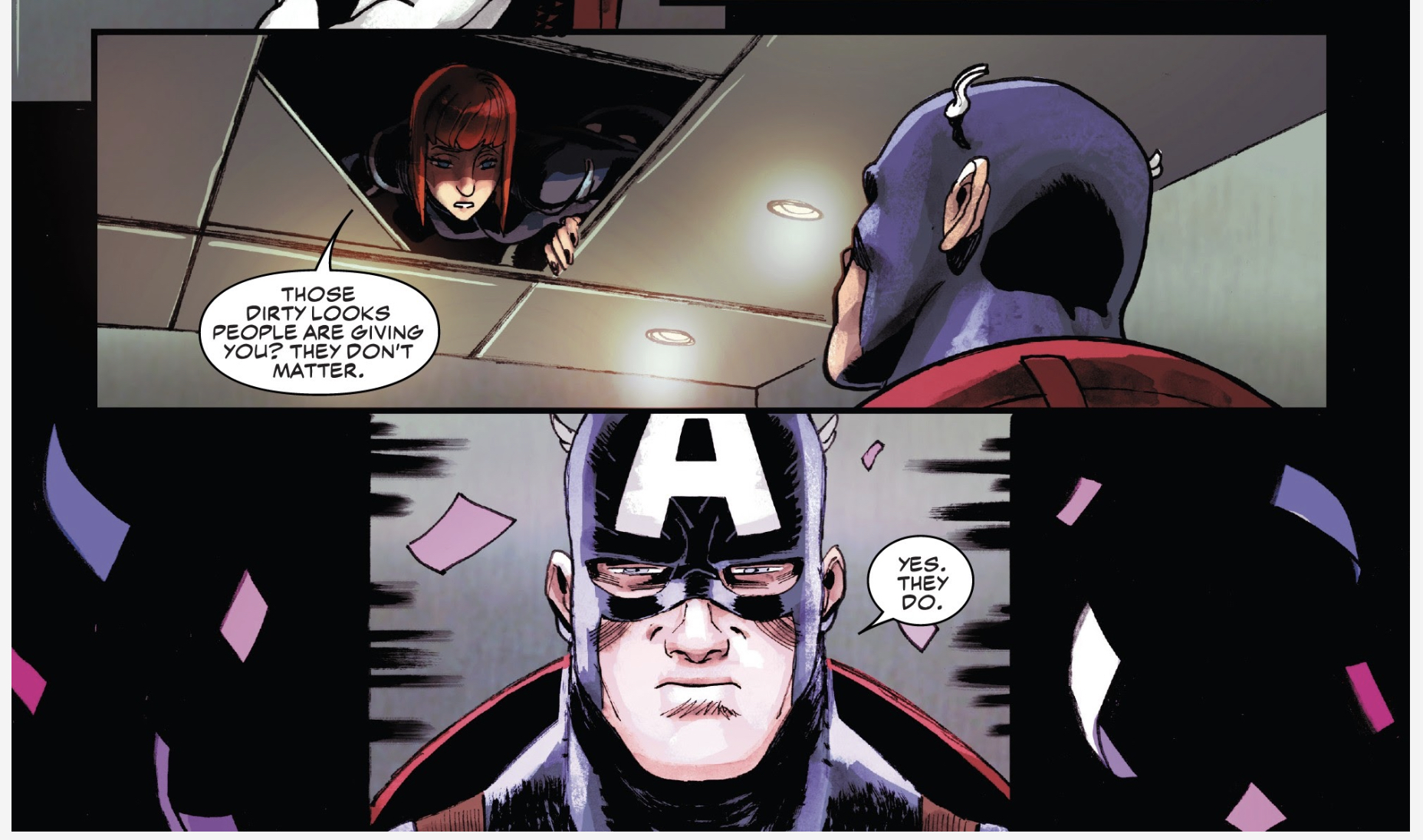
The opening of v.7 issue 1 establishes, again, the double-identity and secret identity motifs very common in superhero comics, but especially in Black Widow narratives. Here, the dual Captain Americas (one of which has killed Black Widow in Secret Empire before she is resurrected through cloning and memory implants) face off again as Natasha helps—while trying to maintain the veil of people believing she is dead.
While Black Widow and the real Captain America fight the evil Captain America, this volume returns to considerations of dual and secret identities as well as the tensions at the core of being a superhero—fighting for good while trying to honor human life.
Natasha is a perfect pairing for Captain America’s identity crisis since she has long suffered doubt and suspicious about her loyalties despite her heroism.
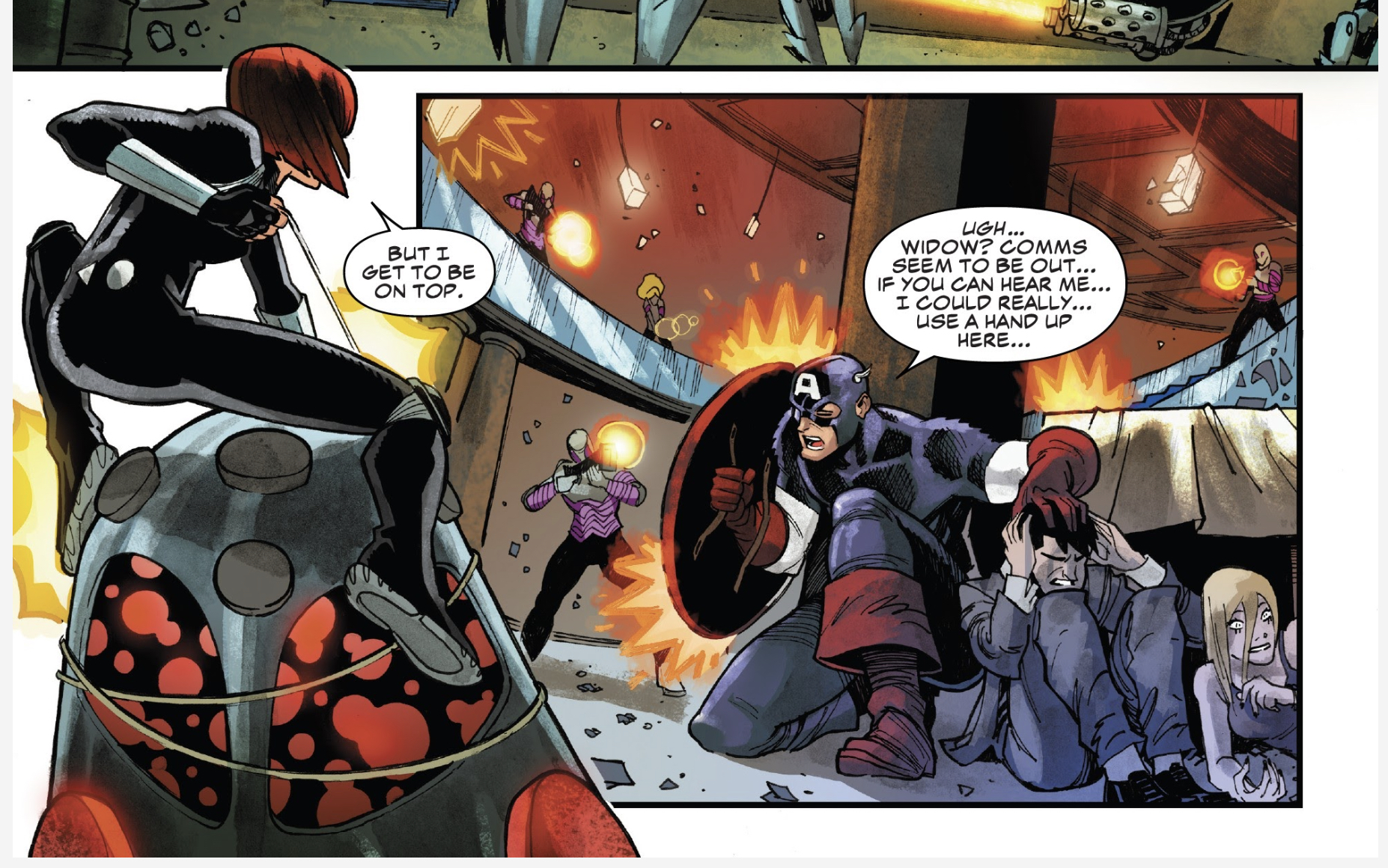
The dynamic between Black Widow and Captain America works well here, but once again, sexual banter returns in a way that feel reductive and unneeded:
Hypersexualized Black Widow would not seem as abrupt in v.7 if not for the more nuanced and fuller explorations of the character in v.5 and v.6.
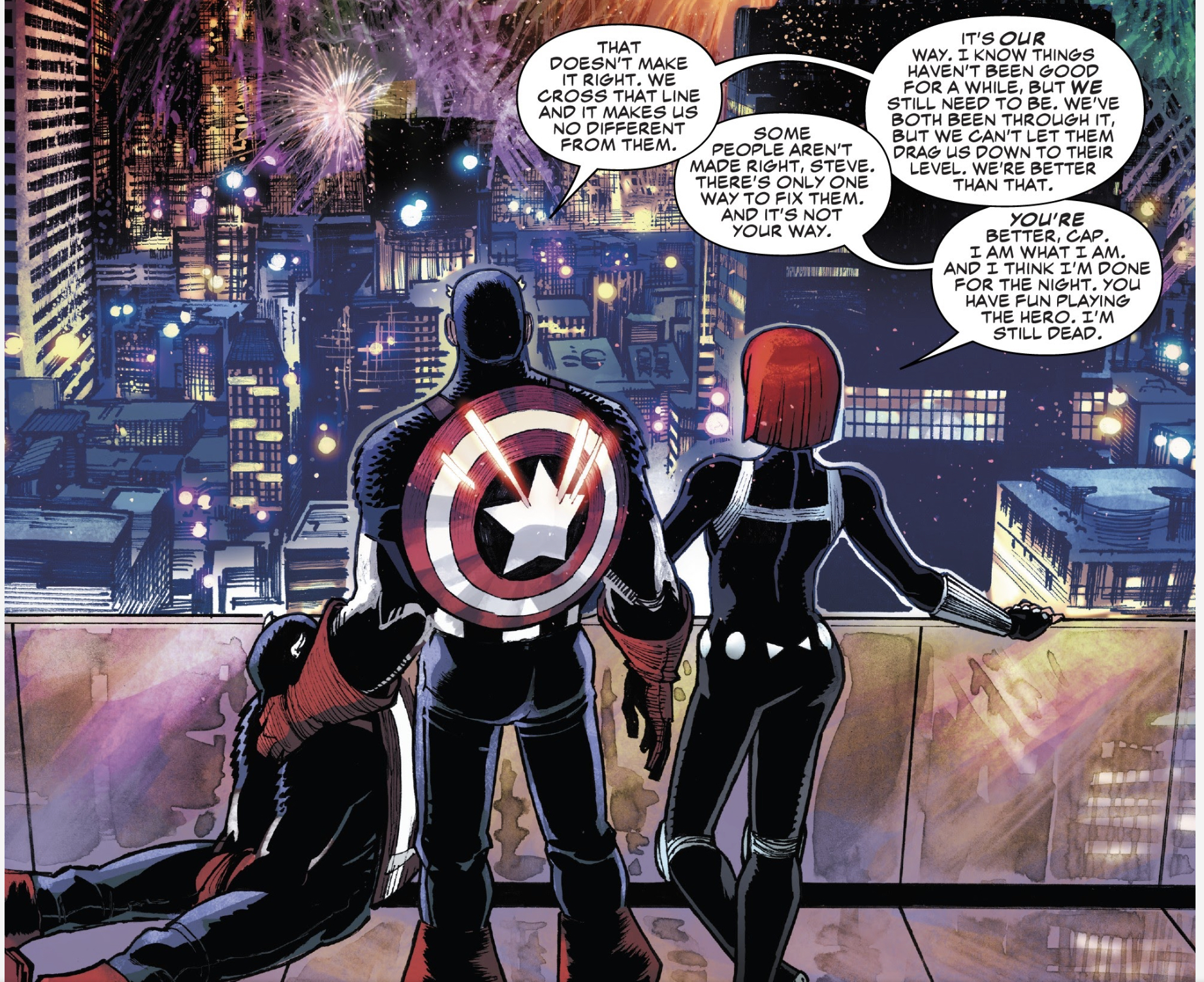
The core tension of this issue is one of the most enduring elements of the superhero subgenre, one that includes the problematic aspects of vigilanteism, embodied by Black Widow and Captain America arguing over taking a life:
Black Widow, cold and practical, resists Captain America’s idealism with “I am what I am.”
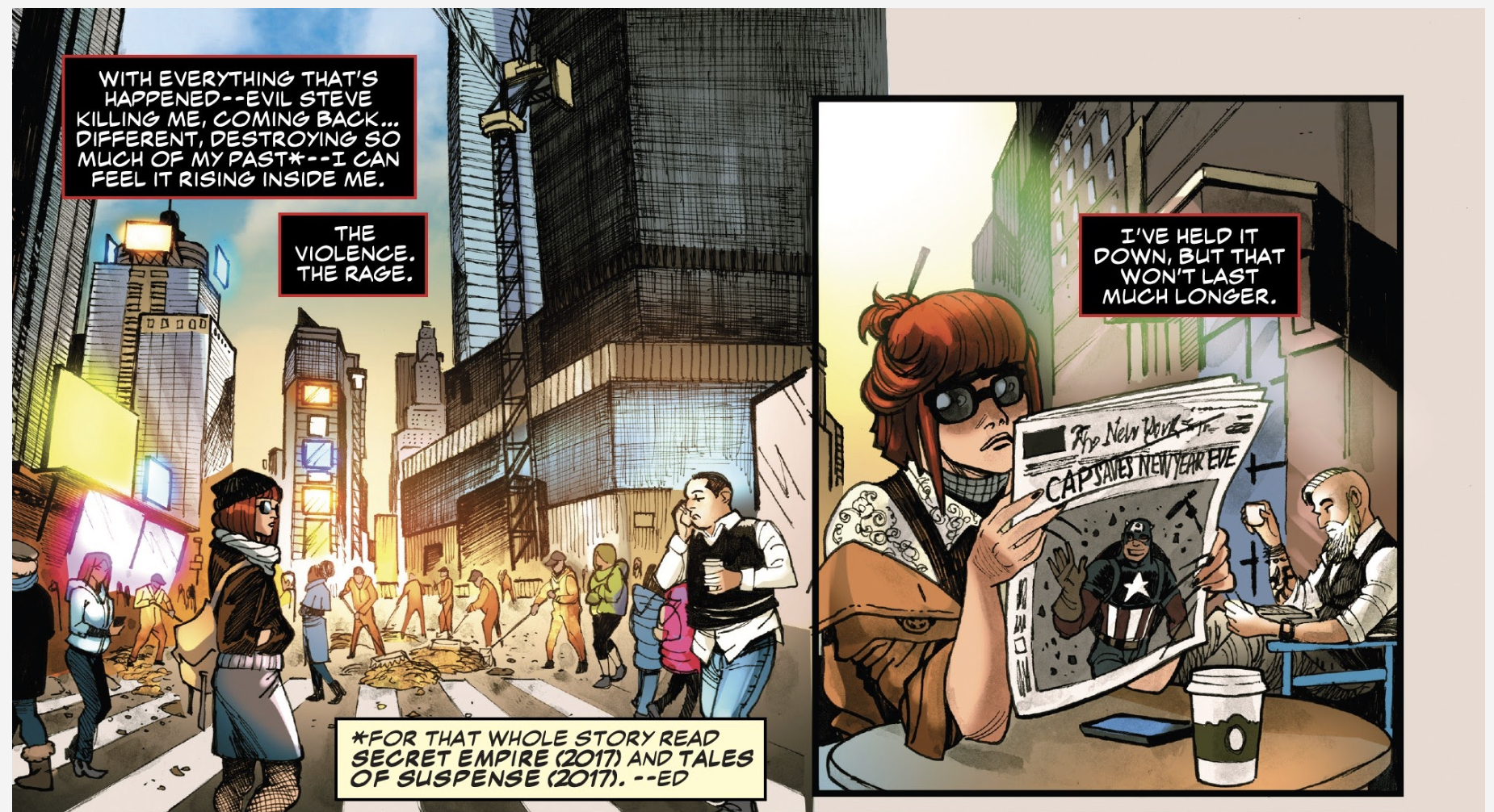
And Natasha remains vividly aware of who she is: “The violence. The rage”:
Ominous beginnings for v.7 highlight what likely are the strongest elements of the Black Widow narrative, a woman fighting herself because of the injustices she has suffered even as she seeks to fights for other people’s justice.
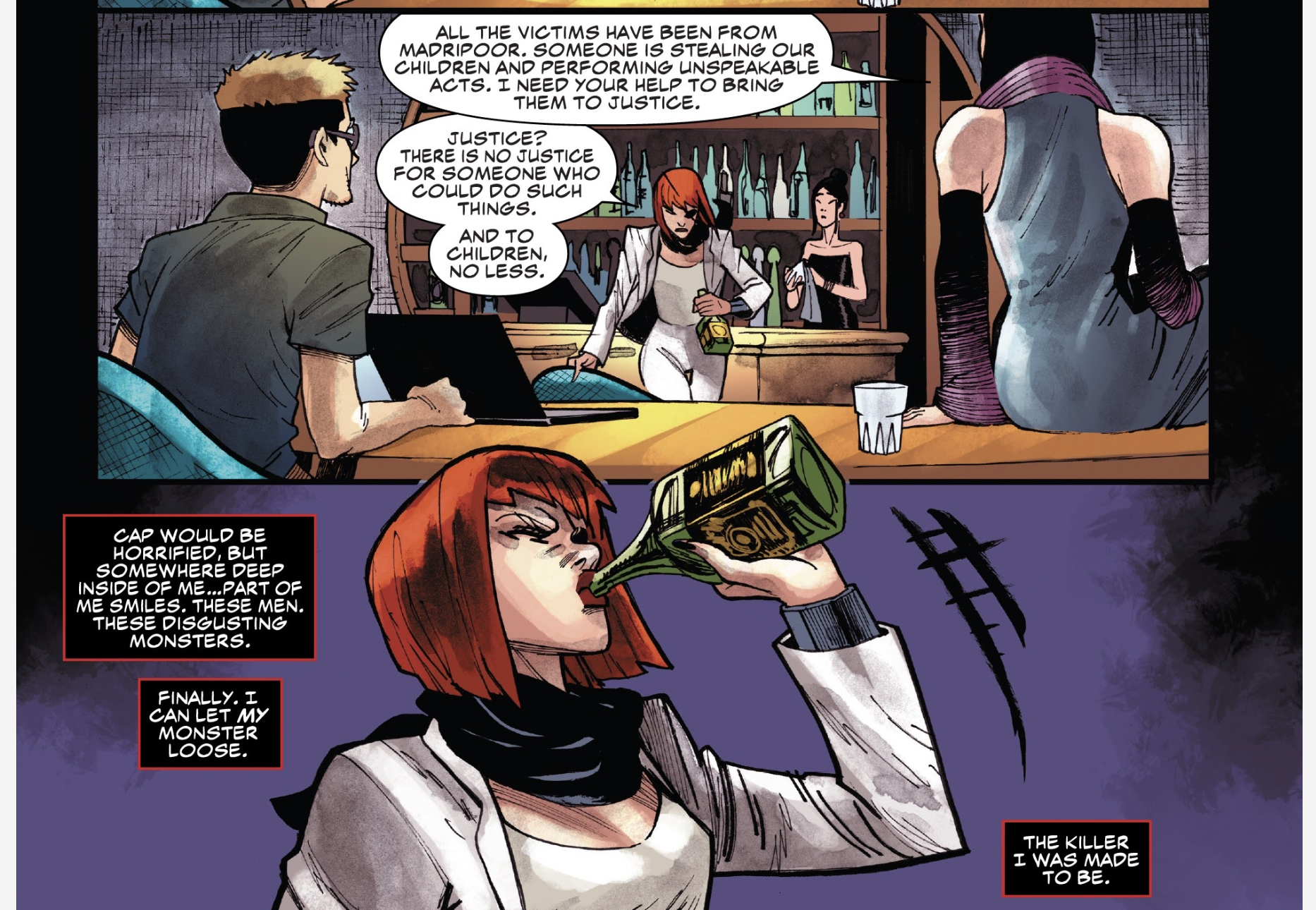
For v.7, the Soska sisters explain the are committed to “Black Widow … unleashed,” and placing Natasha motivated by avenging child sex trafficking provides fertile soil for just that—as Black Widow herself revels in the opportunity:
Natasha’s passionate resolve stand in contrast to Captain America’s naive view of the ugliest aspects of humanity.
And Black Widow unleashed shifts the reader’s gaze away from Natasha’s body (when creators underestimate the character) and highlights the violence she has embraced, and justifies. We must confront the allure along with the problems of ends-justify-the-means justice:
The focus of v.7 maintains the “unleashed” commitment of the writers, and much of the action involves several women characters—Black Widow, Tyger Tiger, Madame Masque—against the backdrop of the most horrific child sex trafficking (including a child recovered who had her hands cut off).
Throughout this series, I struggle with Flaviano’s artwork, however. Too often the style leans to the cartoon side, unlike the dynamic and even hyperrealism of previous artists such as Phil Noto and Chris Samnee. These concerns are more about my tastes than quality, I think, because Flaviano’s work suits well the “unleashed” tone throughout.
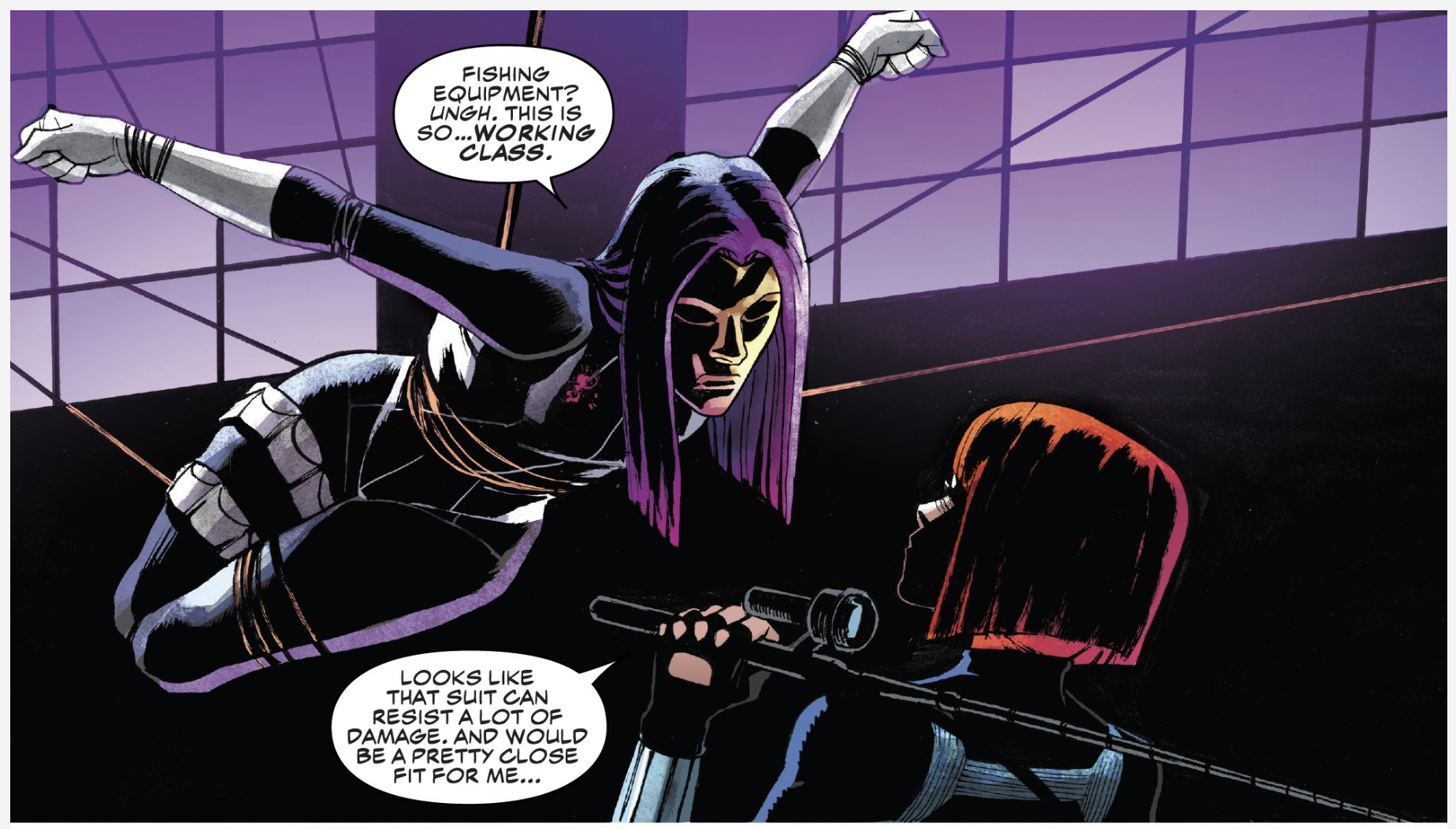
As one example, the creators of v.7 turn the tables on one of the most reductive ways Black Widow is portrayed—bound (and often nude or semi-nude):
A great deal is at work here in v.7, issue 3—a twist on the bound motif, the working-class slur, and extended scenes between two women in what is too often a misogynistic media.
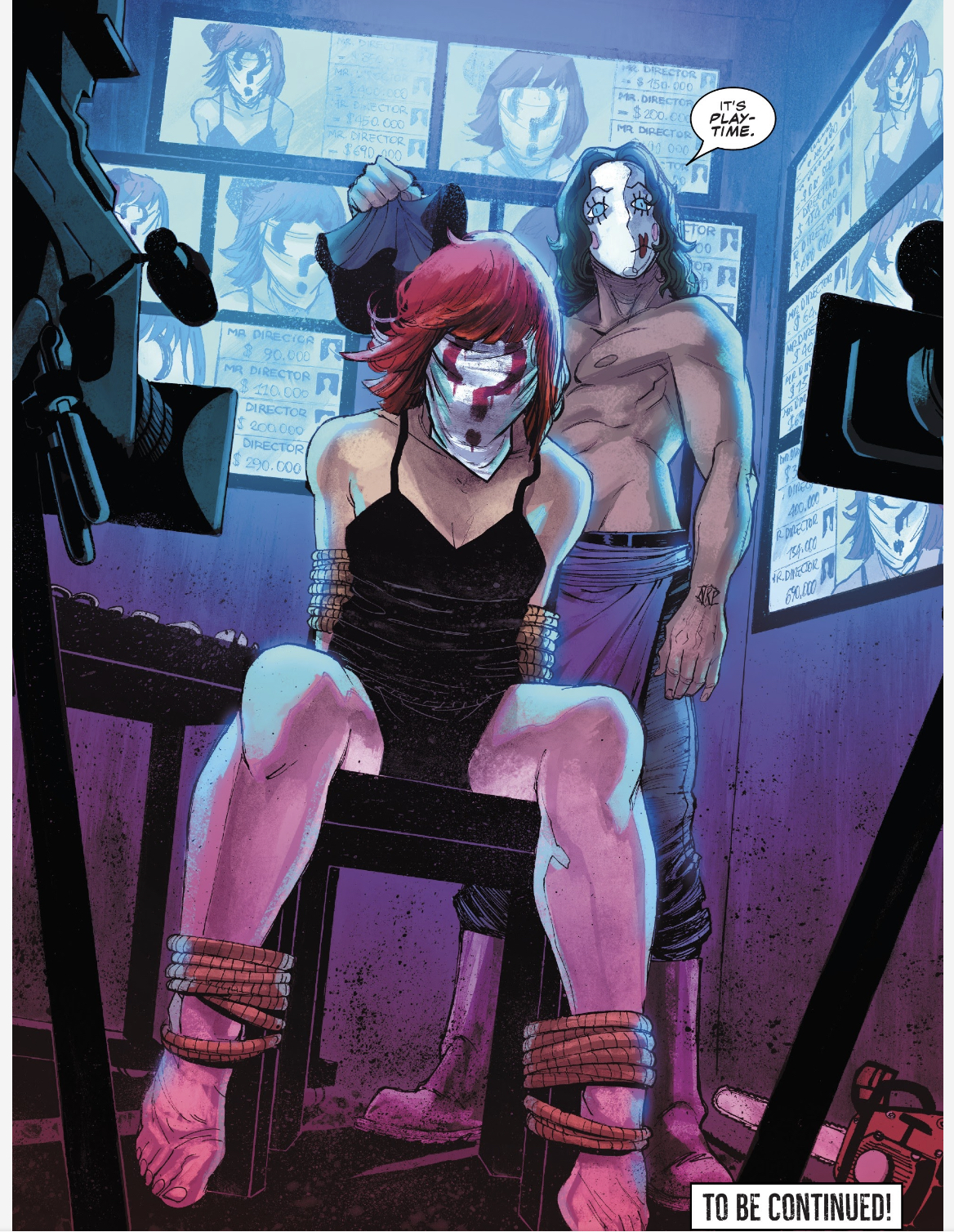
However, after Natasha takes on Madame Masque’s identity to infiltrate the child trafficking ring, issue 3 slips right back into old habits—Natasha exposed, and bound:
It is hard not to be disappointed when creative teams cannot resist Natasha returning to the role of victim and almost always finding herself bound, helpless, and exposed.
By issue 4, “unleashed” becomes hyperviolent and cathartic for Black Widow, and likely readers. Despite my concerns raised above, Flaviano’s paneling and design lend a powerfully dynamic look that reinforces the narrative.
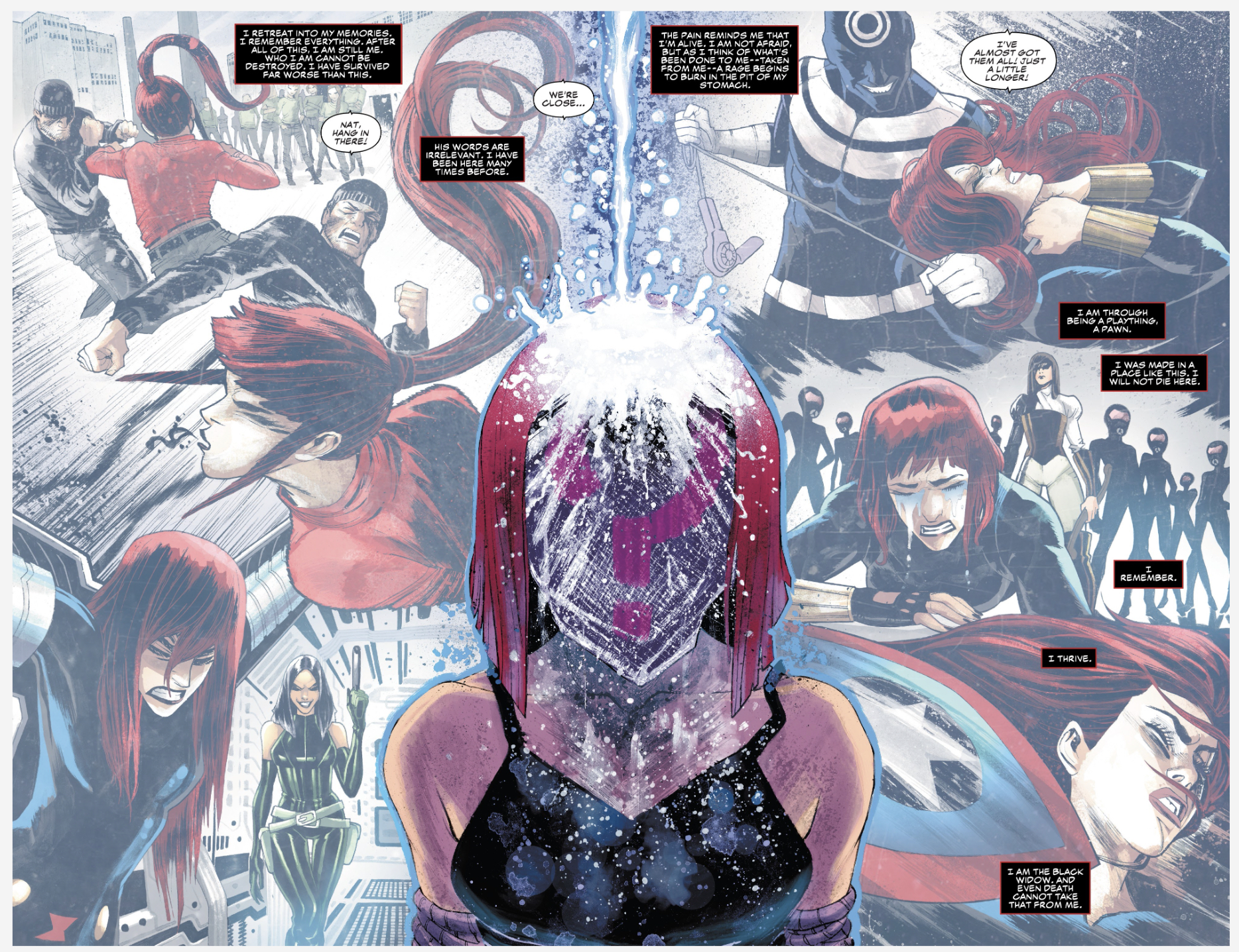
And at the center of it all, the weight of Natasha’s past remains at the heart of Black Widow, super-agent, and Natasha, deeply traumatized woman:
“I am through being a plaything, a pawn”—this refrain drives v.7, but also speaks to the essence of my series, raising concerns about underestimating and hypersexualizing this important character.
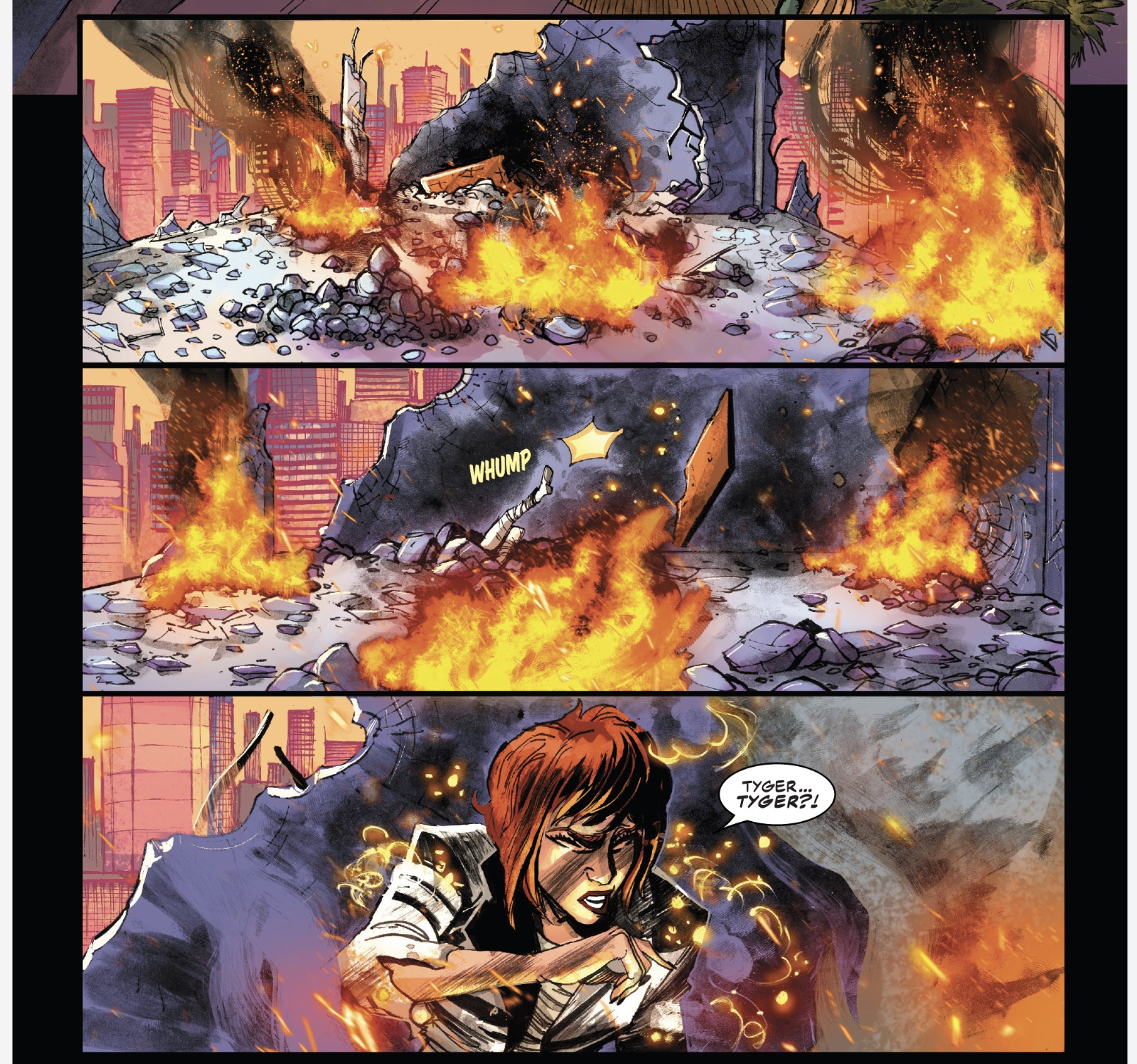
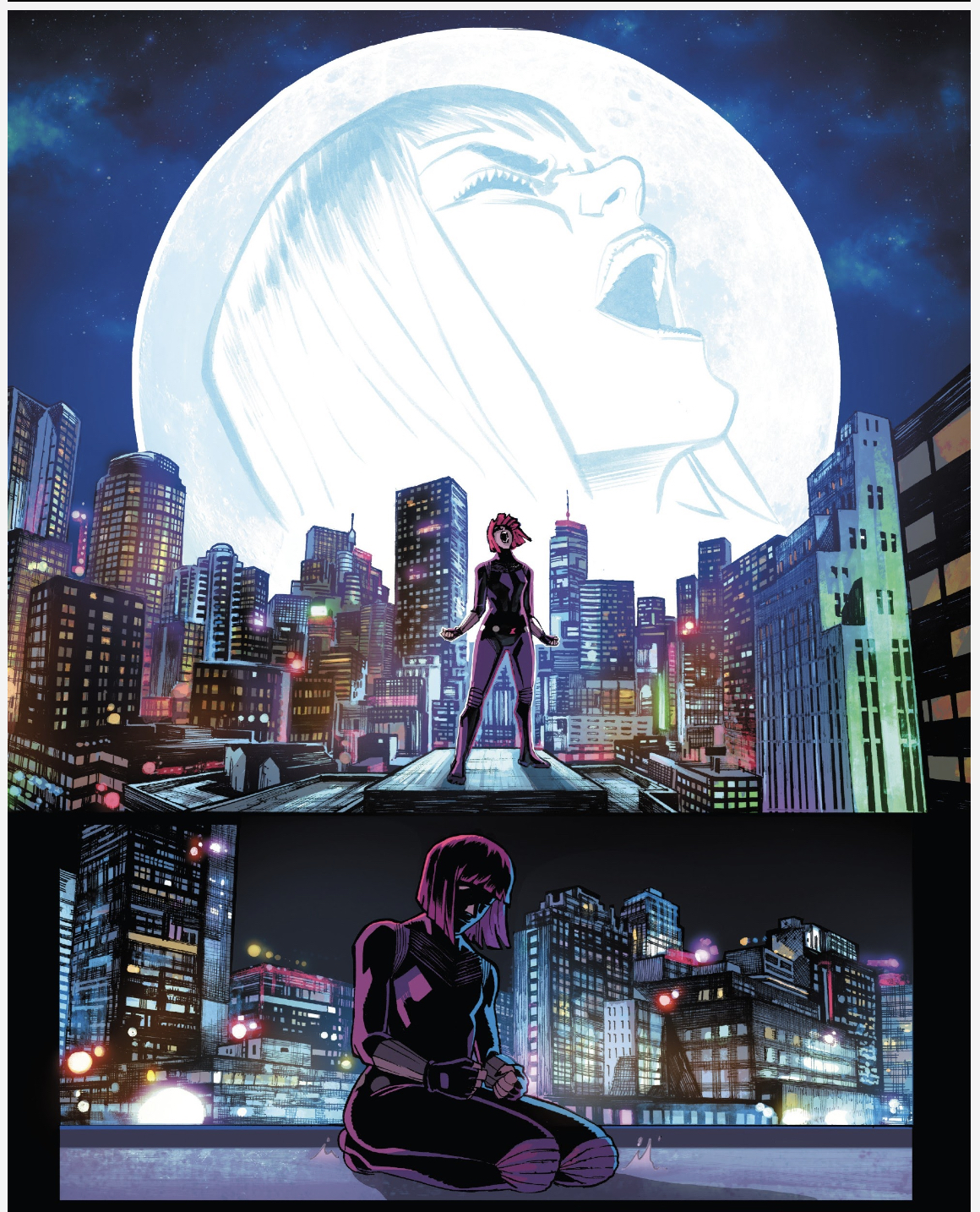
Identity and rebirth open the last issue of this series with Black Widow surviving a blast, portrayed with subtle phoenix imagery:
Survival and rebirth sits at the center of who Natasha is a woman and as a superhero.
The volume ends with some of the strongest aspects of this too-short series. Natasha/Black Widow imposes her world view—not Captain America’s—on her revenge, exposing the emptiness of the sex traffickers and fulfilling her own resolve to enact justice (even as that takes life).
The final pages reveal Natasha providing Winter Soldier-like hands to the mutilated girl and reuniting with Steve Rogers: “It doesn’t matter how our story started. It’s up to us how it’s going to end.”
This series becomes a story of power with the gender roles reversed—Natasha taking control of her world and urging Steve to let go of his fatalistic worldview.
Black Widow ends, again, yet the rage remains:
One of the best pages of v.7 occurs at the very end.
O, What a Tangled Web…
Marvel released a limited solo series, Web of Black Widow, after v.7 and before v.8, the celebrated Thompson run.
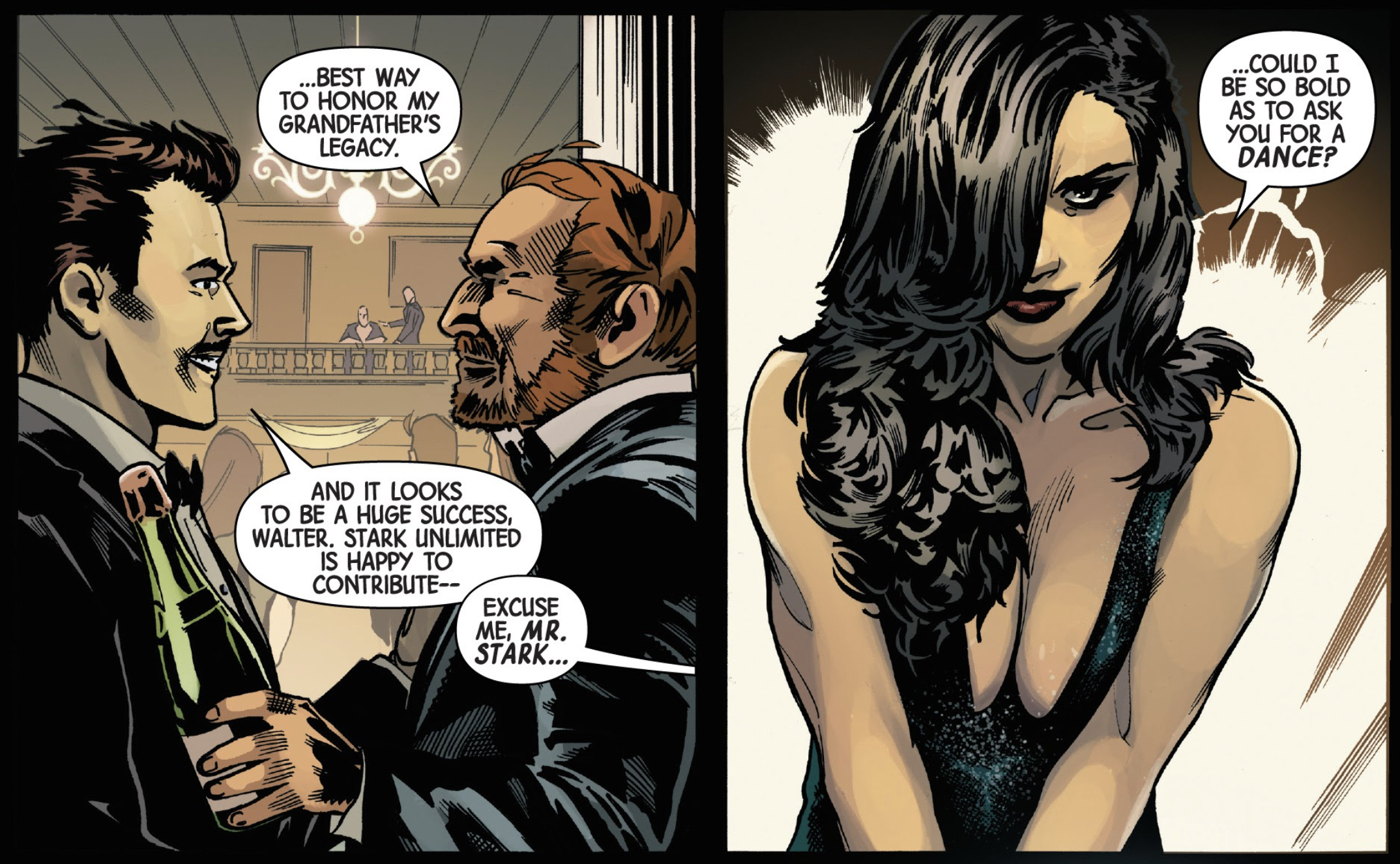
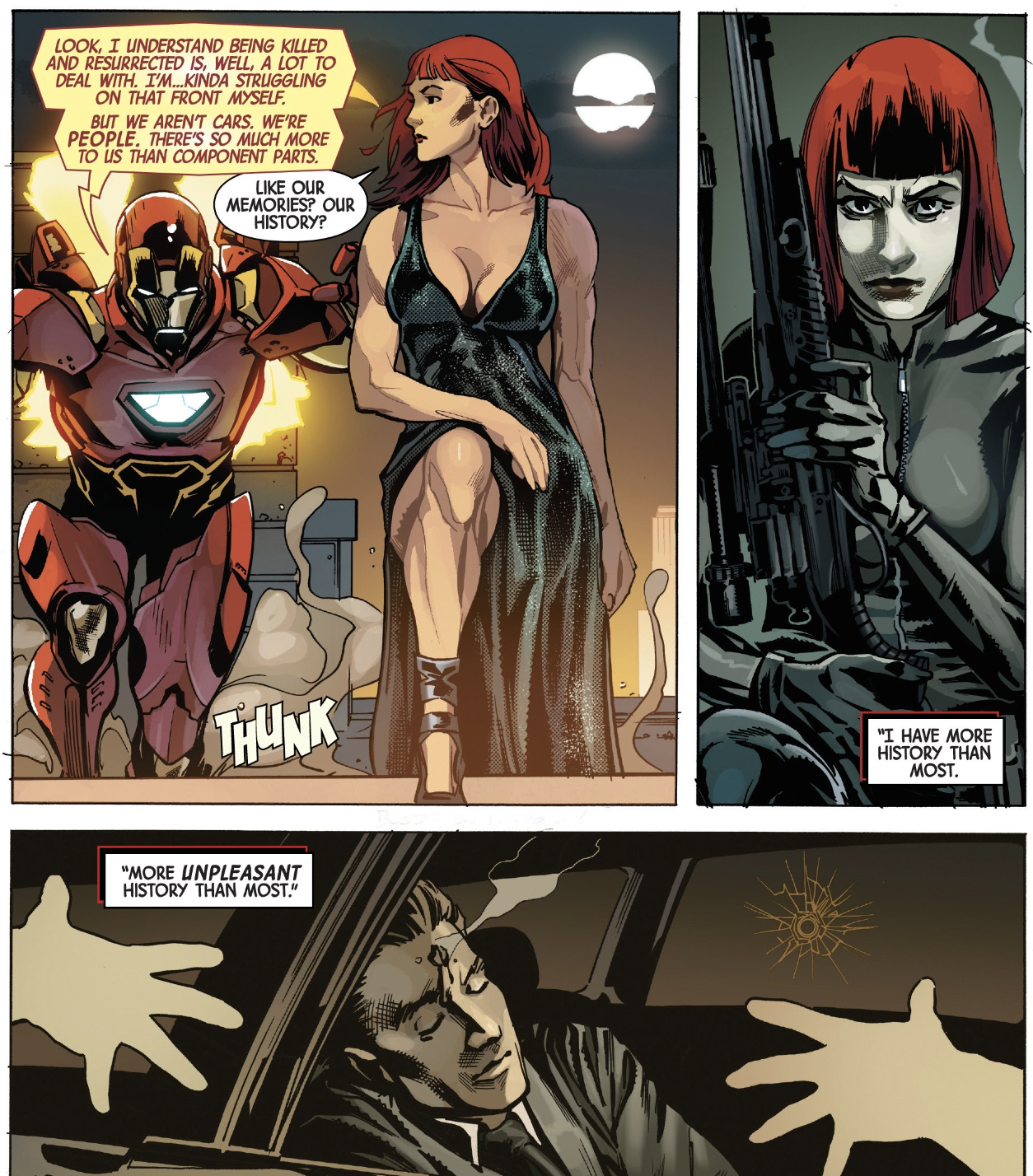
Web, regretfully, immediately introduces Tony Stark, and of course, Natasha’s cleavage:
Web is written by Jody Houser with artwork by Stephen Mooney. Issue 1 doesn’t suggest another brief series, 5 issues, will rise above well-worn ground.
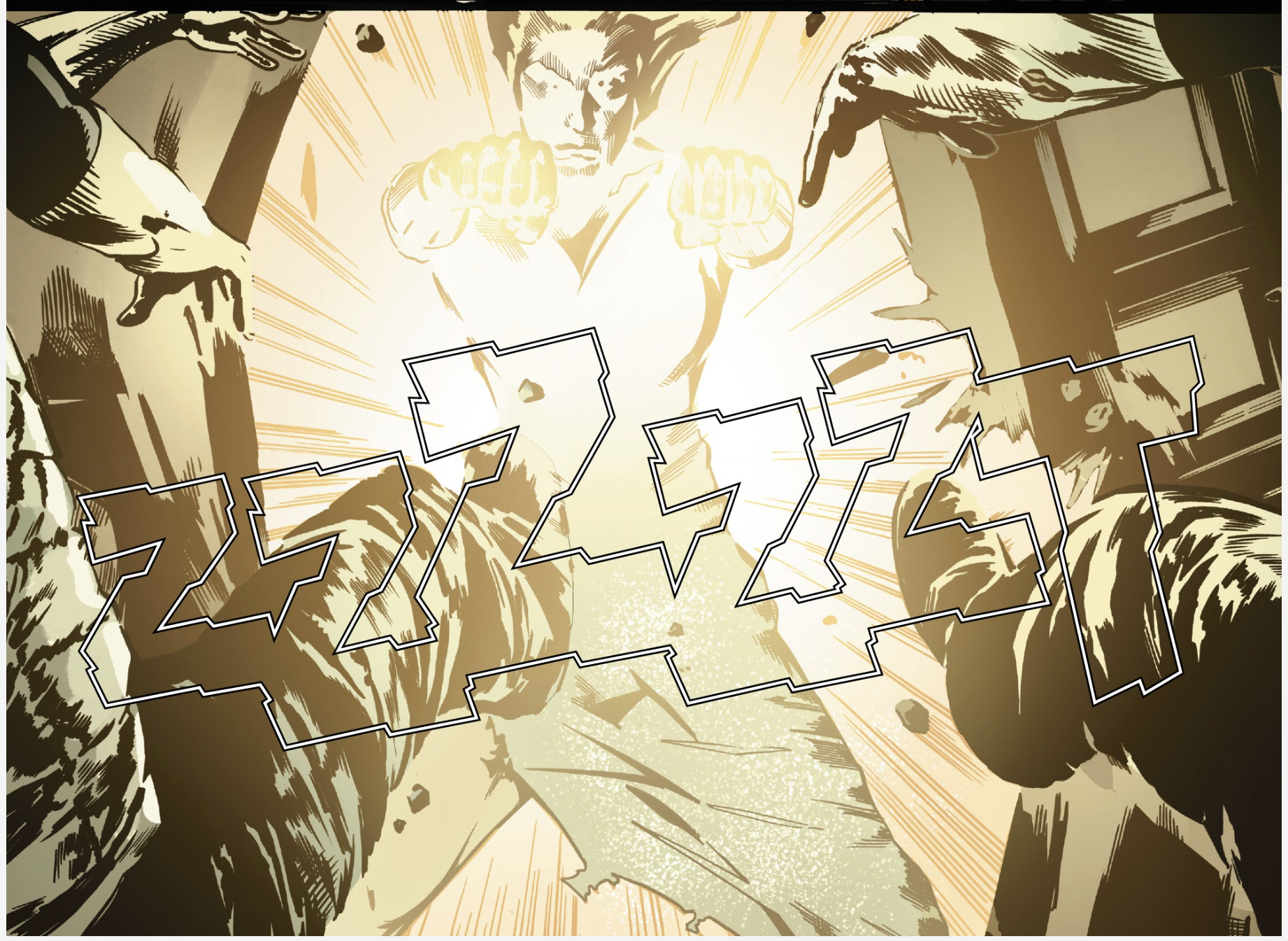
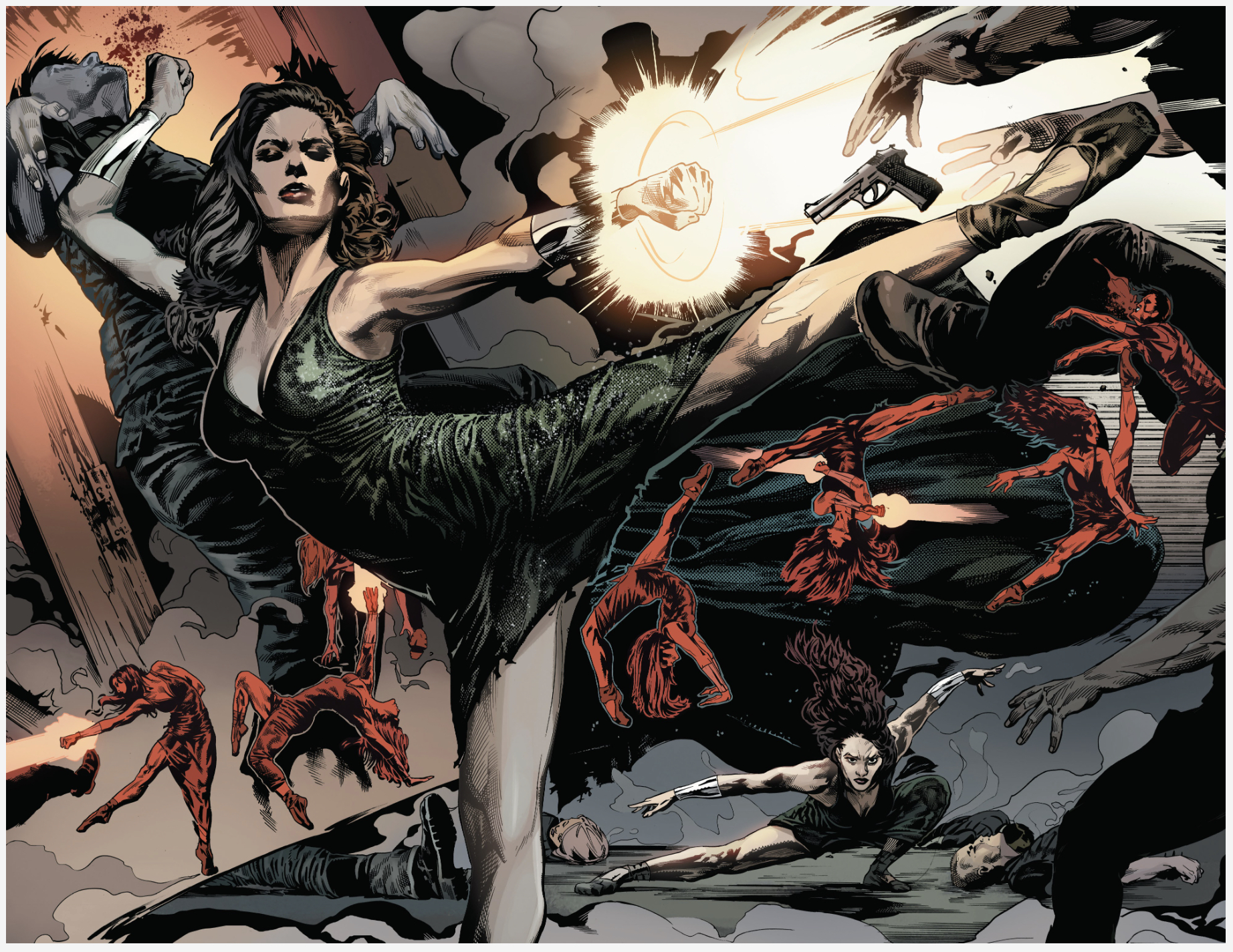
While issue 1 too often remains reductive and derivative, Mooney’s artwork soars none the less:
Mooney captures many of the best qualities found in superior runs of Black Widow.
Noted above, v.7 built to an issue of power; Web establishes the issue of history, switching the tension from between Natasha and Captain America to between Natasha and Iron Man.
Natasha continues to build who she is on who she has been, and how her history has often been what others do to her.
Web is intended as a noir take on Black Widow, and as acknowledged earlier, the artwork certainly aspires to the very best of previous Black Widow series, but too much of this solo run falls back into the underestimated and especially the hypersexualized:
Cover art by Jung-Geun Yoon
Comic books have long suffered the misleading, unnecessarily provocative covers. Throughout Web, we are confronted not with Natasha’s cleavage, but the possibility of her cleavage behind that zipper. I am reminded of a scene in The Handmaid’s Tale: “They wore blouses with buttons down the front that suggested the possibilities of the word undone. These women could be undone; or not. They seemed to be able to choose” (p. 25).
I am unable to trust what choices are allowed for Natasha in Web, genuine power and autonomy, against the objectification of her throughout. But I do sense a strong grounding of Web in all that has come before, not just Natasha’s backstory but the many series I have been covering:
Issue 2 alludes to v.6, issue 9 as the Winter Soldier is introduced to this plot line.
Ultimately, Web proves to be a mildly interesting thought experiment, Black Widow noir, and it looks good while muddling through being mostly derivative.
Worse things can be said about a comic book series, but I continue to hope for better, and with my last post coming next, I can assure you that v.8 is better—if not the best.
More often than not recently, many people have come to know Marvel superheroes through Netflix, the MCU, and now Disney+. That sets up tension between the recent fans and those of us coming from a comic book background.
I am a Marvel reader and collector from the 1970s, and fell in love with Daredevil when his comic book was co-titled with Black Widow. I also grew up a Marvel fan when shows such as The Incredible Hulk hit mainstream TV.
Once CGI allowed superhero movies to look the way we now-older fans always hoped, I have been mostly thrilled with the mainstreaming of Marvel comics—despite the many problems with that different universe compared to the too-often rebooted and jumbled universes of comic books.
I am also one of those fans who loved the Netflix Daredevil series because it captured almost everything that makes the Daredevil character and narratives nearly equally compelling and deeply problematic.
Matt Murdock becoming Daredevil incorporates the traditional silliness of superhero origins (a chemical spill doesn’t kill young Matt, but renders him superhuman) as well as some refreshing and compelling elements (Matt develops many of his superhero qualities because of his character, one grounded in a relentless righteous anger than is more than vengeance).
Although Daredevil is one of the earliest Marvel creations, debuting in 1964, and has endured almost 60 years and numerous reboots over 7 volumes, in many ways, the character is a low tier one, if not a top tier two figure in the Marvel Universes (certainly a notch down in the MCU).
Daredevil, however, is currently trending regularly on social media because, as many of us Netflix Daredevil fans have wanted, the character is being reintroduced to the Disney+ and MCU versions—although at a glacial pace. With that, we comic book fans who have been stung many times by various types of reboots have been fretting about a Disney+ series ruining the Netflix version, one that is incredibly violent (Kingpin’s car door scene, for example, is very not Disney) and one that owes a great deal to Frank Miller’s reboot of Daredevil that boosted Miller to superstardom and laid the foundation for his heralded Batman work.
Many comic book fans also fretted about Moon Knight, a much more clearly second tier Marvel superhero. However, in some ways, I think, the success of Moon Knight tempered our fretting about how Daredevil would be recreated (again).
Another element of the relevance of Moon Knight and Daredevil in the MCU is religion. Moon Knight being Jewish has been examined with the Disney+ series, in terms of how relevant his faith was portrayed in the series. Matt Murdock, and the entire ethos of Daredevil, Man without Fear, is grounded in Miller’s emphasizing Murdock’s Catholicism.
In similar ways to concerns about Moon Knight being Jewish, it seems important to interrogate whether or not Murdock’s Catholicism is being trivialized or honored in the MCU. Some fear Murdock’s faith is mere “stained-glass window dressing” (Cressler, 2022, p. 113).
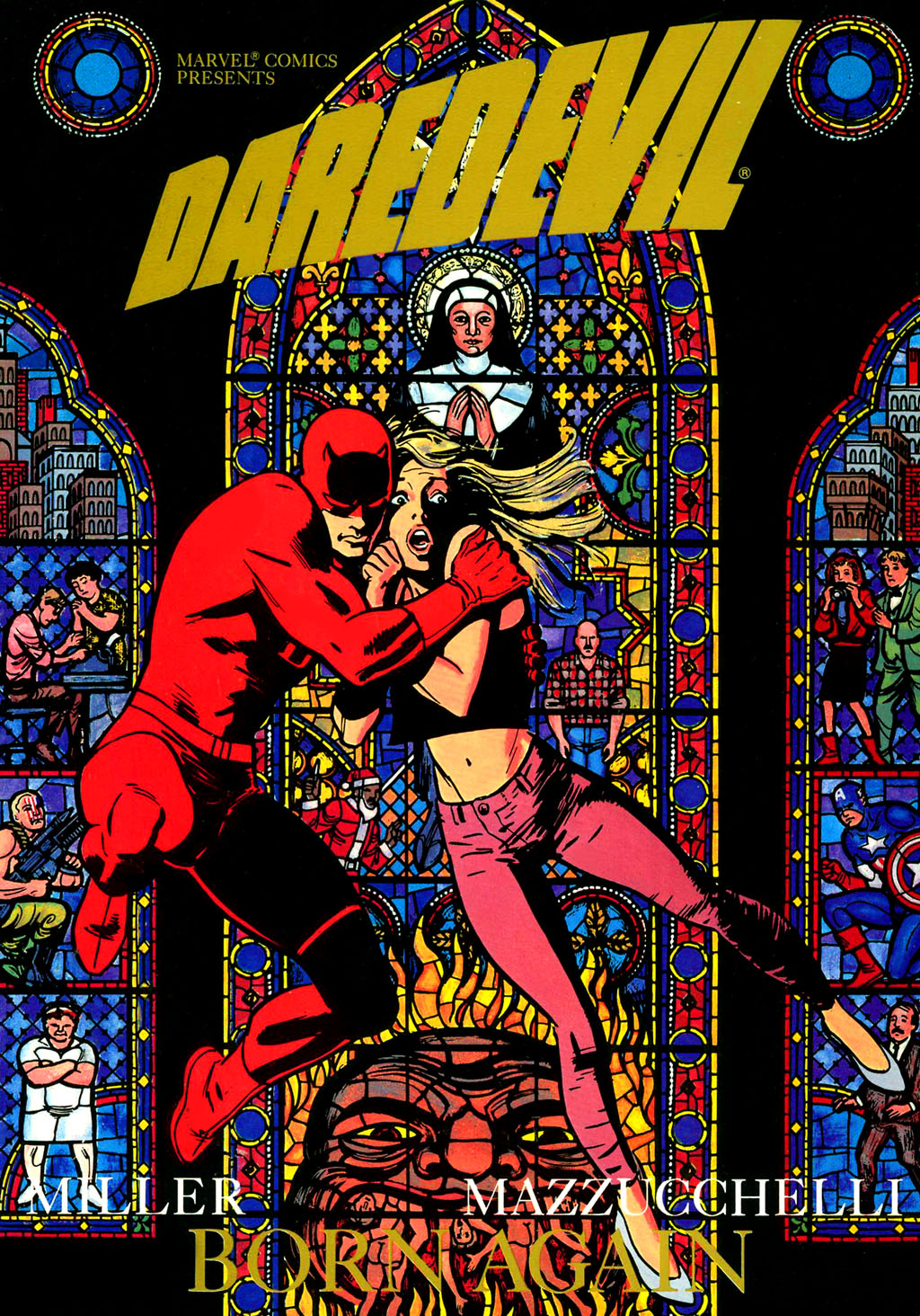
The Born Again trade paperback’s cover has reached iconic status, thanks to Miller emphasizing Catholicism and David Mazzucchelli’s run as artist.
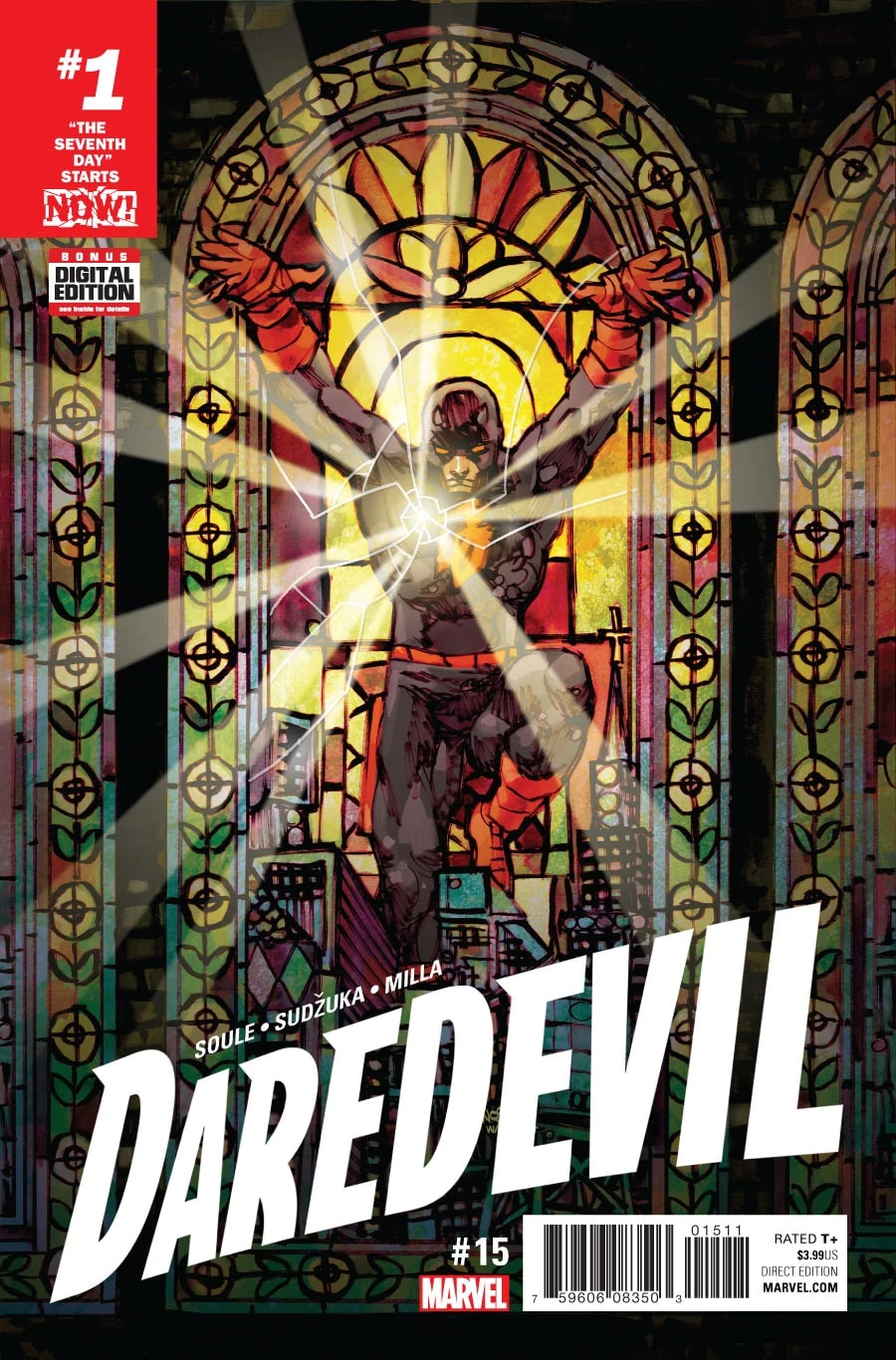
Daredevil 15 (v5) reflects Miller’s Man without Fear. (Artwork by Dan Panosian)
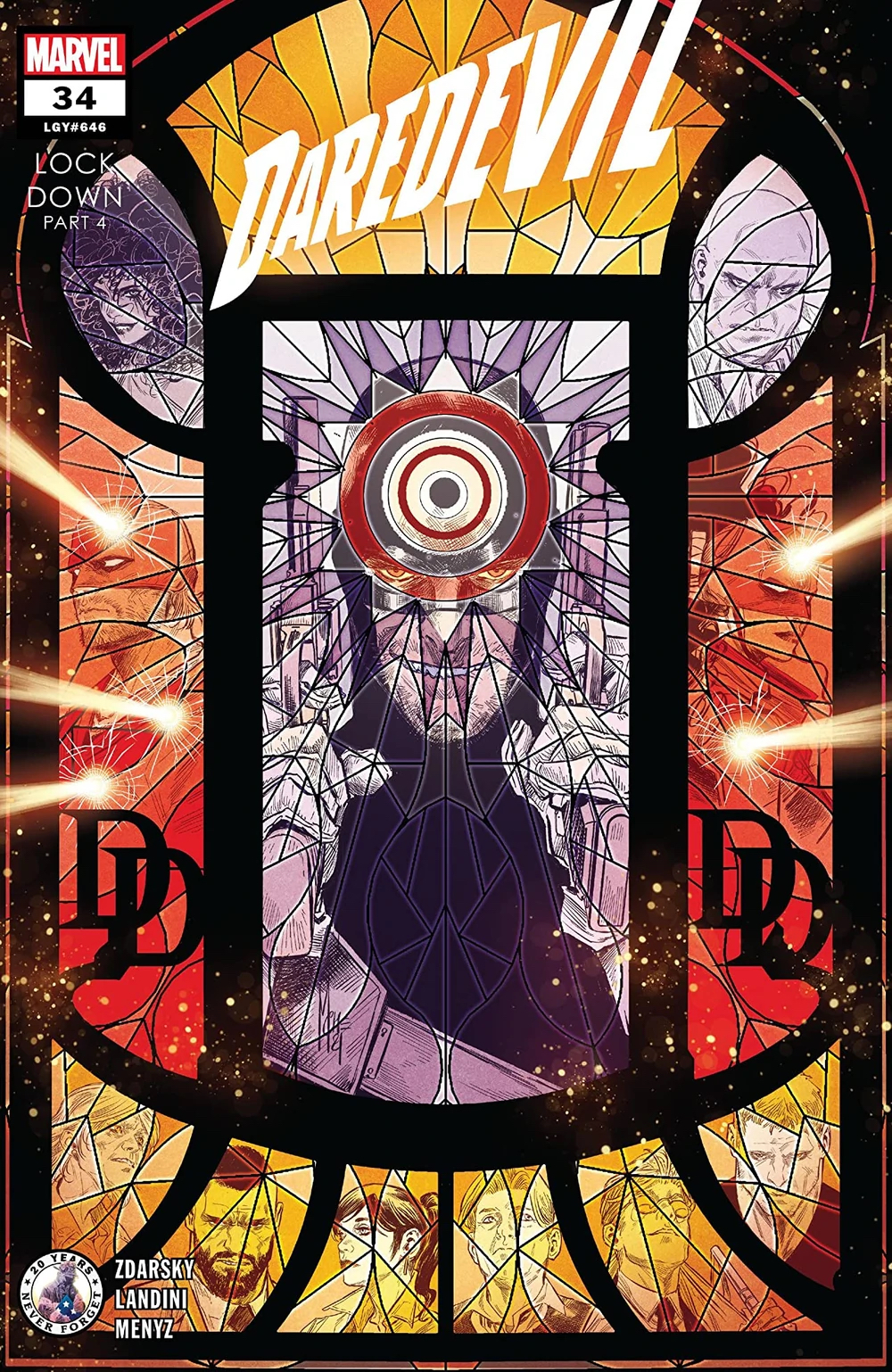
Daredevil 34 (v6) pays homage to the Miller reboot, and Chip Zdarsky’s version reads strongly grounded to Miller’s vision as well.
Ironically, Matt/Daredevil’s righteous resolve is the antithesis of glass. In many ways, people find Daredevil compelling because his superpowers are certainly skewed closer to being human, thus frail, than other superheroes such as Luke Cage, The Hulk, or Superman. Yet, Daredevil is often the most determined human in any conflict, counting on his ability to suffer and persevere—because he is certain (usually) that he is right.
That brings me to Matthew J. Cressler’s Daredevil: The Man Without Fear and White Catholic Masculinities. Like Miller, Cressler centers Murdock’s Catholicism and interrogates how that faith drives Daredevil in relationship to how well any version of Daredevil acknowledges his devoutness.
Cressler admits a concern I raised above (with the Netflix series a notable exception):
The extent to which Murdock’s religiousness features in any given story—and indeed, whether it features at all—depends of course on the artists involved. Some center other elements of the Daredevil mythos (secret ninja societies, for instance). Most of the time Catholicism seems more like stained-glass window dressing, offering a thematic or aesthetic palette without much depth: fistfights in front of altars, vaguely religious themes, jokes about Catholic guilt. (p. 113)
What makes Cressler’s analysis compelling is using Catholicism as a lens for understanding not only Matt/Daredevil but also portrayals of Daredevil as that intersects with who is drawn to the character and why. Citing Andrew Greeley and others, Cressler asserts, “Daredevil’s abilities accentuate what is often cited as the distinguishing feature of Catholic Christianity: the sensuousness of its religious culture,” including violence (p. 116).
But even more significant, I think, Cressler notes that Catholicism reinforces a central motif of most portrayals of Daredevil, suffering. In the Netflix series, for example, a motif of the show is how often people express disbelief in the amount of suffering Matt can and does endure. Nearly even more so than his blindness, Matt’s willingness—even eagerness—to suffer defines him.
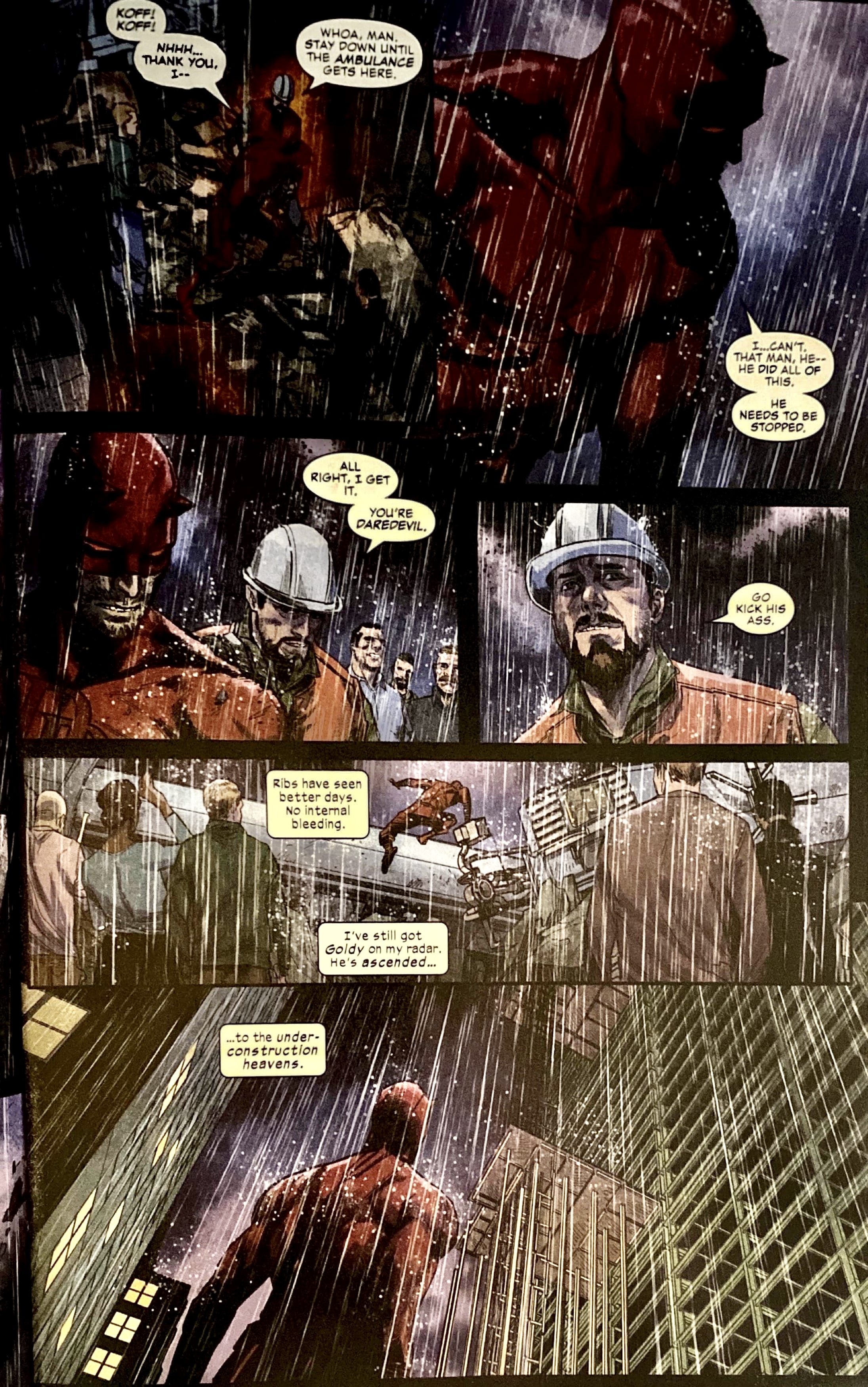
Daredevil 2 (v7), by Chip Zdarsky (writer) and Marco Checchetto (artist), embraces the ever-suffering Daredevil who always gets back up—to kick ass.
Among the most informative aspects of Cressler’s analysis is his explaining how Miller’s own working-class Catholic background builds on the origin of Daredevil: “Daredevil thus presents a working class twist on the classic comic book origin story” (p. 120).
Miller’s working-class Catholicism, I think Cressler demonstrates compellingly, contributes to both why Daredevil is an enduring character (maintaining Miller’s stamp) and a very problematic one as well.
The best analogy I have is that Miller-influenced Daredevil (Netflix and Disney+ versions) are similar to why so many people are drawn to Breaking Bad and Better Call Saul despite the deeply problematic elements. When the craft is high, the work soars, but often with any work, the flaws of the artist and the world seem to inevitably creep in:
This reluctance to call white Catholics white and have that word signify something substantive is particularly problematic when talking about the era in which Miller came of age and eventually began a career in comics. In the 1950s, white Catholics defended “their turf” against Black migrants in the urban North. In the 1960s, some fled to federally subsidized and racially segregated suburbs while others fought on the frontlines of resistance to integration. The so-called “Catholic vote”—by which pollsters meant working-class white Catholics—helped usher in a half century of conservative rule, first as part of Nixon’s “silent majority” and then as members of the “Reagan revolution.” Born Again bears this influence….
By the time Frank Miller began drawing Daredevil in the late 1970s, white Catholics had thrown bricks at civil rights activists in Chicago, firebombed school busses in Boston, and brutally quelled a prison uprising in Attica, just to name a few notorious instances of white Catholic violence. (pp. 124-125,127)
Miller’s own misogyny and bigotries grounded in his upbringing tarnish even the best aspects of his run on Daredevil. Like too much of the comic book world, stereotypes often populate Miller’s narratives in the most reductive ways.
Yet, as Cressler explains, we must acknowledge the key role of Catholicism:
When Frank Miller said Daredevil “had to be Catholic,” the Catholic he created was a white working-class Irish American Catholic man prepared to save his woman and defend his block with brute force. This is the Catholic Daredevil brought to life in Marvel’s Daredevil. And this is not merely a work of fiction. (p. 127)
Ultimately one of the most interesting tensions here is between Matt’s devoutness and his righteous anger turned violent:
Daredevil’s religiousness, reviewers seem to say, can be found in biblical quotes, religious images, and theological themes. Violence is another matter, one that has to be forgiven in the confessional and reconciled with faith. (p. 128)
However, as Cressler shows, Matt—notably in the opening scenes of Netflix’s Daredevil—has fully embraced both his faith and his violence:
If we resist [the] urge to separate the two, however, it quickly becomes clear that religion and violence are bound together for both Frank Miller and Netflix’s adaption of his work. Recall how the series opens. We meet Matt Murdock in confession, where he admits “I’m not seeking penance for what I’ve done, Father. I’m asking forgiveness for what I’m about to do.” (p. 128)
The portrayal of Matt/Daredevil, by Charlie Cox in the Netflix series, I think, is at its best when viewers can see in the acting that Matt/Daredevil has switched to “violence is the only solution”—sometimes accompanied by a slight head tilt. And we feel a little rush of adrenaline as we anticipate that despite all the odds against him, Daredevil will leave the “bad guys” regretting not only their immediate actions but also being bad guys.
I do not see Daredevil as a base vigilante bouncing from act of vengeance to act of vengeance. I am compelled by the character Daredevil because of the tensions created through Matt being a lawyer and his Catholic drive to rid the world of evil (starting, of course, with saving all of Hell’s Kitchen). Cressler referencing Birzer notes that Daredevil embodies “righteous violence meted out in defense of moral order” (p. 129).
The Disney+ era of Daredevil has been announced, Daredevil: Born Again. There is no doubt that Miller will be lurking there, but what remains to be seen is how seamlessly the Disney+ era will grow from what Netflix established.
Will we have to endure mere “stained-glass window dressing,” or will we feel the hair raise on our arms anticipating Daredevil single-handedly pummeling the bad guys down a cramped and dark hallway?
American Public Media Group announced in June “that APM Reports has been targeted for an unspecified reorganization.” Those of us in literacy, specifically the field of reading, have been highlighting since 2018 that APM Reports (specifically the work of Emily Hanford) has been misrepresenting both the problems around reading achievement and how to teach reading.
Hanford and APM Reports are ground zero for the deeply flawed “science of reading” (SoR) movement that now pervades mainstream media.
Ironically, the SoR mantra has been very valuable for mainstream media and several journalists, like Hanford, who have beat the same drum for four years, regardless of ample evidence that their messages are oversimplified, misleading, cherry picked, and lacking the very scientific evidence they demand from teachers.
Yet, it appears APM Reports is shifting its SoR propaganda cashcow to podcasts, and the next one, Sold a Story, will launch even more attacks, focusing on reading programs.
Here is the short version: Don’t buy it.
While not only APM Reports (the SoR messaging has been uniformly misleading across mainstream media), a tremendous amount of the misinformation can be attributed to the messaging there and then journalists such as Hanford getting platforms at the New York Times, for example, which is a key representation of the misinformation.
The media coverage at APM Reports (and Education Week) has been so deeply flawed, scholars have detailed the problems; I recommend this:
Hoffman, J.V., Hikida, M., & Sailors, M. (2020). Contesting science that silences: Amplifying equity, agency, and design research in literacy teacher preparation. Reading Research Quarterly, 55(S1), S255-S266. https://doi.org/10.1002/rrq.353
The passage addressing media is here:
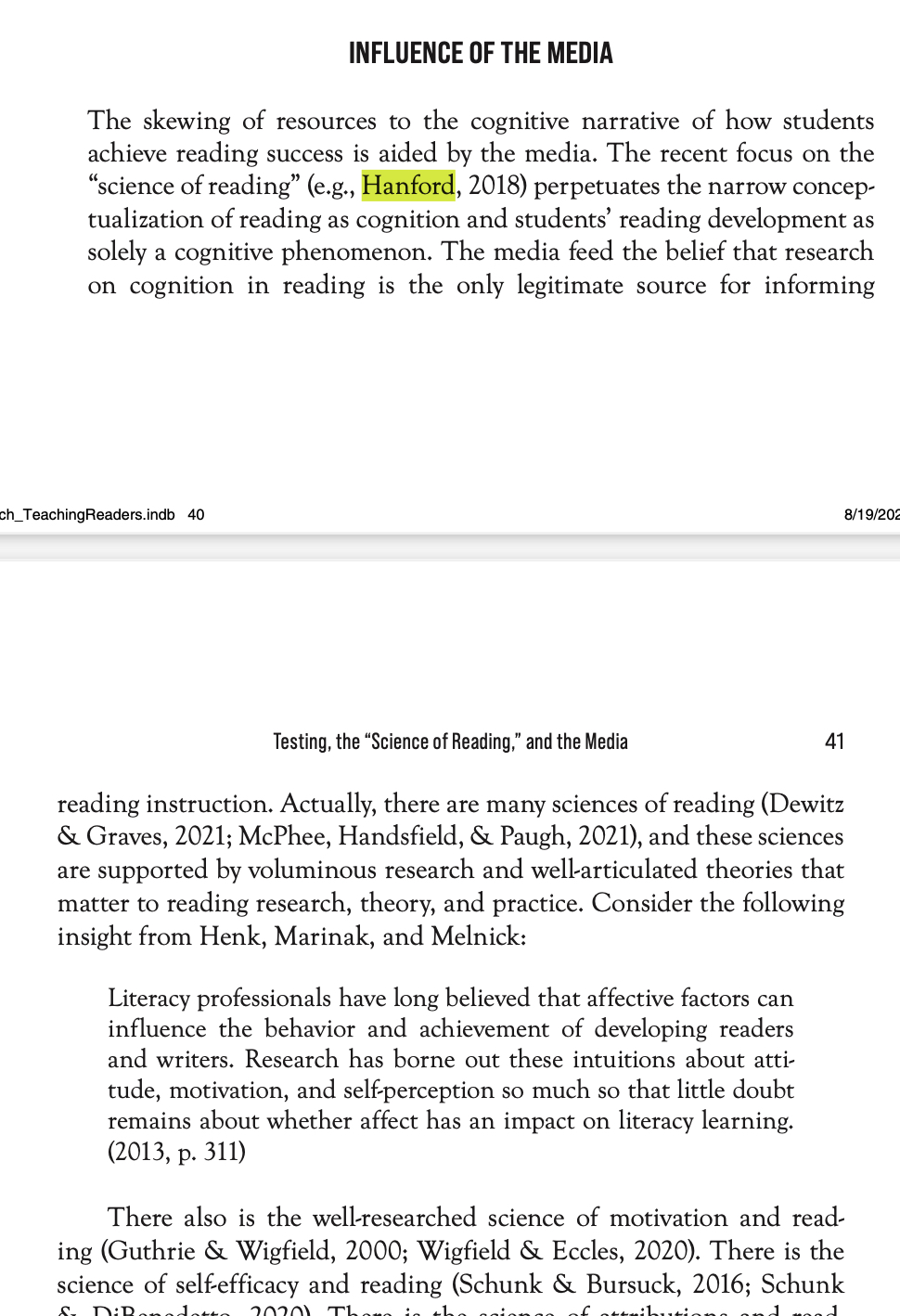
I also recommend this book:
Afflerbach, P. (2022). Teaching readers (not reading): Moving beyond skills and strategies to reader-focused instruction. The Guilford Press.
The passage addressing media is here:
While the podcasts do not drop until October, I predict they will be more of the same misinformation, a good bit of projecting (is profit really a disclaimer in the U.S.?), and another example of a key criticism offered by Hoffman, Hikida, and Sailors (2020) in Reading Research Quarterly: “the SOR community do not employ the same standards for scientific research that they claimed as the basis for their critiques.”
And thus, again, don’t buy it.
Recommended
Thomas, P.L. (2022). The Science of Reading movement: The never-ending debate and the need for a different approach to reading instruction. Boulder, CO: National Education Policy Center. Retrieved [date] from http://nepc.colorado.edu/publication/science-of-reading






 dr. p.l. (paul) thomas