

Consider the following headlines from the New York Times:
- There Is a Right Way to Teach Reading, and Mississippi Knows It
- Two-Thirds of Kids Struggle to Read, and We Know How to Fix It
- Who Runs the Best U.S. Schools? It May Be the Defense Department.
The first two are confidently assertive (lots of knowing), and the third tiptoes into a question and a “may be.”
What is fascinating, and frustrating, is that the first two are almost entirely false coverage—the first badly misrepresenting reading achievement in MS and the second inexcusably misrepresenting NAEP reading data.
The key here is that the first article feeds into the misleading “miracle” narrative popular in media and political rhetoric about schools and the second asserts the “crisis” rhetoric about public education.
Media struggles with the third article topic—the exceptional achievement found in Department of Defense schools—and possibly the most telling quote in the article hits the nail on the head:
“If the Department of Defense schools were a state, we would all be traveling there to figure out what’s going on,” said Martin West, an education professor at Harvard who serves on the national exam’s governing board.
Who Runs the Best U.S. Schools? It May Be the Defense Department.
In a rare moment of almost getting things right about education and testing, the article highlights the outstanding achievement found in DoDEA schools:

Looking at reading achievement levels of NAEP is even more revealing:
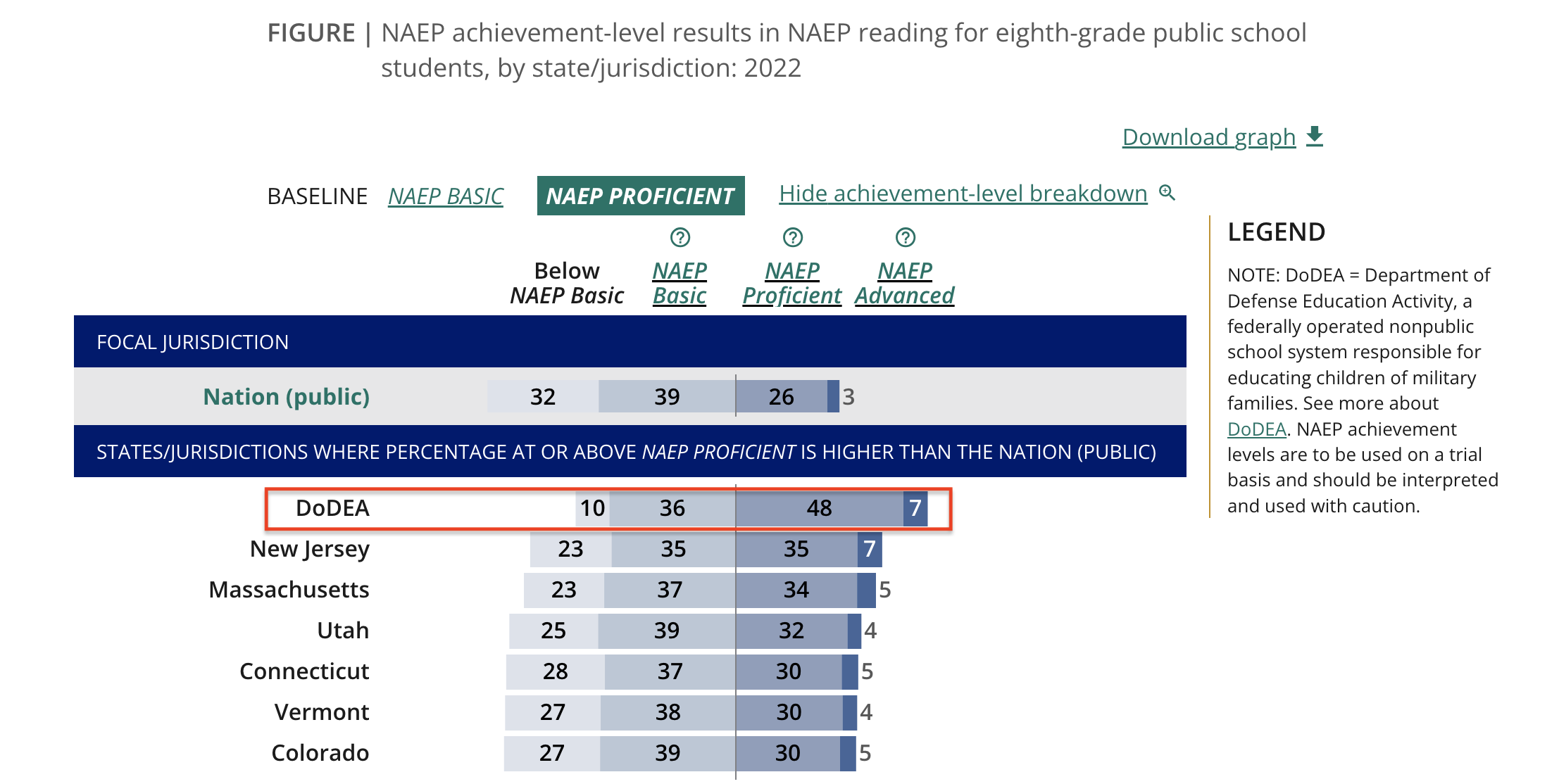

While the media has dubbed MS a “miracle,” that same media struggles to understand the DoDEA success.
Why? Well, a few clues are in the article itself:
How does the military do it? In large part by operating a school system that is insulated from many of the problems plaguing American education.
Defense Department schools are well-funded, socioeconomically and racially integrated, and have a centralized structure that is not subject to the whims of school boards or mayors….
But there are key differences.
For starters, families have access to housing and health care through the military, and at least one parent has a job.
“Having as many of those basic needs met does help set the scene for learning to occur ,” said Jessica Thorne, the principal at E.A. White Elementary, a school of about 350 students.
Her teachers are also well paid, supported by a Pentagon budget that allocates $3 billion to its schools each year, far more than comparably sized school districts. While much of the money goes toward the complicated logistics of operating schools internationally, the Defense Department estimates that it spends about $25,000 per student, on par with the highest-spending states like New York, and far more than states like Arizona, where spending per student is about $10,000 a year .
“I doubled my income,” said Heather Ryan, a White Elementary teacher . Starting her career in Florida, she said she made $31,900; after transferring to the military, she earned $65,000. With more years of experience, she now pulls in $88,000.
Competitive salaries — scaled to education and experience levels — help retain teachers at a time when many are leaving the profession. At White Elementary, teachers typically have 10 to 15 years of experience, Ms. Thorne said.
Who Runs the Best U.S. Schools? It May Be the Defense Department.
Children with access to healthcare and food security, parents with stable incomes and housing, and well-paid faculty—these are all key to educational outcomes, many of us have argued for years, but the mainstream approach in the US for decades has been entirely focusing on in-school reform only—because the education establishment, conservatives argue, have used poverty as an excuse.
The reason DoDEA success is handled with a question and “may be” is that the evidence here is a message that is politically uncomfortable in the US: Education reform needs to be both social reform and school reform.
Credible reading scores (beyond grade 4) are about more than reading instruction or reading programs, but the DoDEA forces us to reconsider the “crisis”/”miracle” rhetoric and move beyond blaming teachers, reading ideologies, and reading programs.
Media and political leaders likely will let this story pass because “Logistical planning, including a predictable budget, ‘isn’t very sexy,’ but it is one key to success, said Thomas M. Brady, the director of Defense Department schools since 2014.”
So here is something we do know, but we are mostly unwilling to admit it: Poverty and inequity are not excuses, but tremendous barriers to the sort of opportunities all children deserve.
The success at DoDEA is certainly no miracle, but that success is the sort of model we should be using instead of the manufactured “miracle”/mirage of the day.

