

[Header Photo by Jen Theodore on Unsplash]
One of the most powerful texts I use in teaching writing is the Prologue to Louise DeSalvo’s memoir, Vertigo.
We read only the first page, but it is charged with purposeful writing and engaging storytelling of a young woman fleeing the angers of her home and seeking sanctuary:
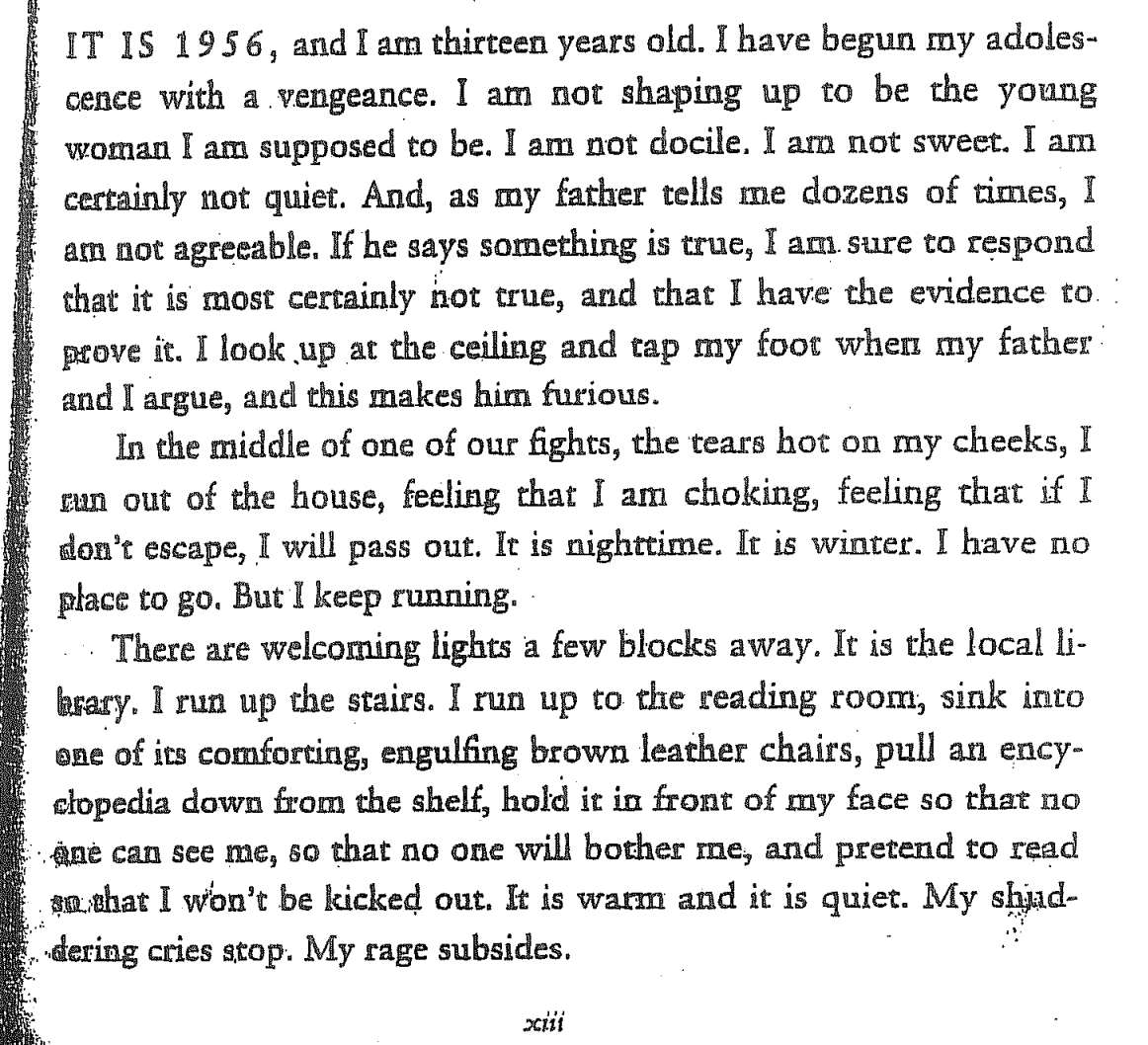
The narrative voice of DeSalvo as an adult, a Virginia Woolf scholar, echoing herself at thirteen helps establish that tension, that dichotomy—an emotionally unsafe home contrasted with the “welcoming lights a few blocks away,” the library.
This memoir is one of trauma, but DeSalvo develops a motif of the sanctuary that libraries and books offer her throughout her life.
Her life story challenges the idealizing of family and the demonizing of schools, libraries, books, and frankly, education.
Not as dramatically but similar to DeSalvo, my own life story is one of breaking free of the intellectual and ethical shackles of my home where racism and other bigotries were the norm; like DeSalvo’s experiences, my sanctuaries were school and books, and education.
I had a former friend and colleague who died relatively recently, and I will carry with me always his telling me that he had an argument with his father once about how the two of them had diverged dramatically in beliefs and ideologies. His father shouted that his greatest regret was sending his son to college.
That fills me with a tremendous sadness, and I also feel fortunate because despite the same dynamic in my family with my parents—I am dramatically unlike them in beliefs and ideology—my parents, now deceased, always encouraged my books, my thinking, my learning, and my education.
In fact, my father often stopped strangers to tell them I earned my doctorate, a thing both embarrassing and heart warming.
It is 2024. And the world is filled with monsters:
On Monday, bill sponsor Del. Brandon Steele, R-Raleigh, called for support of his legislation in a fiery speech, in which he said libraries were “the sanctuary for pedophilia” where people needed to be held accountable for exposing children to obscene content.
“I’m voting to protect children from being groomed and targeted by pedophiles and get rid of the sanctuary that was set up in our code 25 years ago,” Steele said to members of the House Committee on the Judiciary.
He continued, “If it’s a crime in the parking lot, it’s a crime in the building — period. I hope the chilling effect chills the pedophiles. We’re not going to create a safe space for them.”
West Virginia House to Vote on Bill That Could Lead to Librarians Facing Jail Time
The culture wars in the US have taken an ugly turn, and the core of those battles is that tension between the family and the child as well as the ways in which every child can and should find their true Self often masked by the expectations of that home life.
As adults, most of us have experienced that break, that necessary journey that includes disagreeing with our parents, seeing that who we are is not the same as who our parents want us to be.
Sometimes it is ideology, sometimes it is sexuality, sometimes it is gender.
These tensions, these breaks are none the less difficult and even painful.
I was talking with a colleague about the ways in which education, especially higher education, is often popularly and falsely characterized as institutions of indoctrination. The dynamic is actually very similar to DeSalvo’s opening story in her memoir.
For many college students, college is a first major opportunity to be free of home expectations, a place to not only explore who they truly are but a place to discover who they are or want to be.
If a young person seems to suddenly be a different person, parents and the public may misinterpret that as college or professors causing the change. What is more likely is that college is the place where young people have the first opportunity to express that true Self.
Exposure to new or different ideas, in fact, are not necessarily what causes anyone to change who they are, but allows people to see who they are.
Ironically, places that indoctrinate and groom children the most are their homes and their churches—the sources today of those most likely to accuse others of indoctrination and grooming.
Also ironically, universal public education was a foundational commitment (ideologically well before afforded everyone) of the US because being educated was recognized as necessary for a democracy and individual freedom.
There is a little parable by Haruki Murakami. In it, the manufactured terrors by conservatives seem to come true. A boy finds himself imprisoned in a labyrinthine library, confronting a horrifying fate:
The sheep man cocked his head to one side. “Wow, that’s a tough one.”
“Please, tell me. My mother is waiting for me back home.”
“Okay, kid. Then I’ll give it to you straight. The top of your head’ll be sawed off and all your brain’ll get slurped right up.”
I was too shocked for words.
“You mean,” I said, when I had recovered, “you mean that old man’s going to eat my brains?”
“Yes, I’m really sorry, but that’s the way it has to be,” the sheep man said, reluctantly.
The Strange Library
Murakami’s brief Kafkan nightmare, it seems, parallels what some people believe is a reality of libraries—a place where the brains of children are eaten.
The Strange Library is a sort of twisted fantasy, fitting into the tradition of children’s fears like the belief that a monster lurks under your bed or in your closet.
State representatives attacking libraries and books—that is no twisted fantasy. It is real and it is wrong.
Only monsters attack libraries and books.
And they aren’t hiding under our beds or in our closets.
They are elected officials filing bills and making outrageous pronouncements.
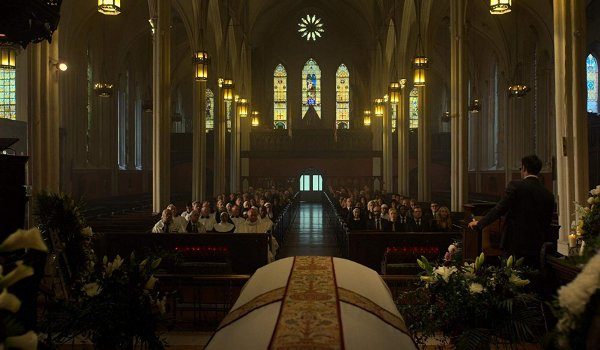
We have been rewatching the Daredevil series that ran for three seasons on Netflix. In the season 3 and series finale, Matt Murdock (Daredevil) gives a eulogy for Father Paul Lantom, Murdock’s surrogate father after his father’s death:
For me, personally, he spent many years trying to get me to face my own fears. To understand how they enslaved me, how they divided me from the people that I love. He counseled me to transcend my fears, to be brave enough to forgive and see the possibilities of being a man without fear. That was his legacy. And now it’s up to all of us to live up to it.
A New Napkin (S3 E13)
Culture wars are mostly about fear, but the worst thing about them is that they are about irrational fears, manufactured horrors.
Libraries and books are sanctuaries, not labyrinths where children have their brains eaten.
Once Murdock embraced being the man without fear, he became Daredevil, a superhero, a person who saves those in need. And by assuming this alter-ego, he found his true Self.
Fear of libraries, books, education, and knowledge is a fear of our Selves, our true Selves.
Only monsters attack libraries and books.
Update
West Virginia House passes bill allowing prosecution of librarians
 dr. p.l. (paul) thomas