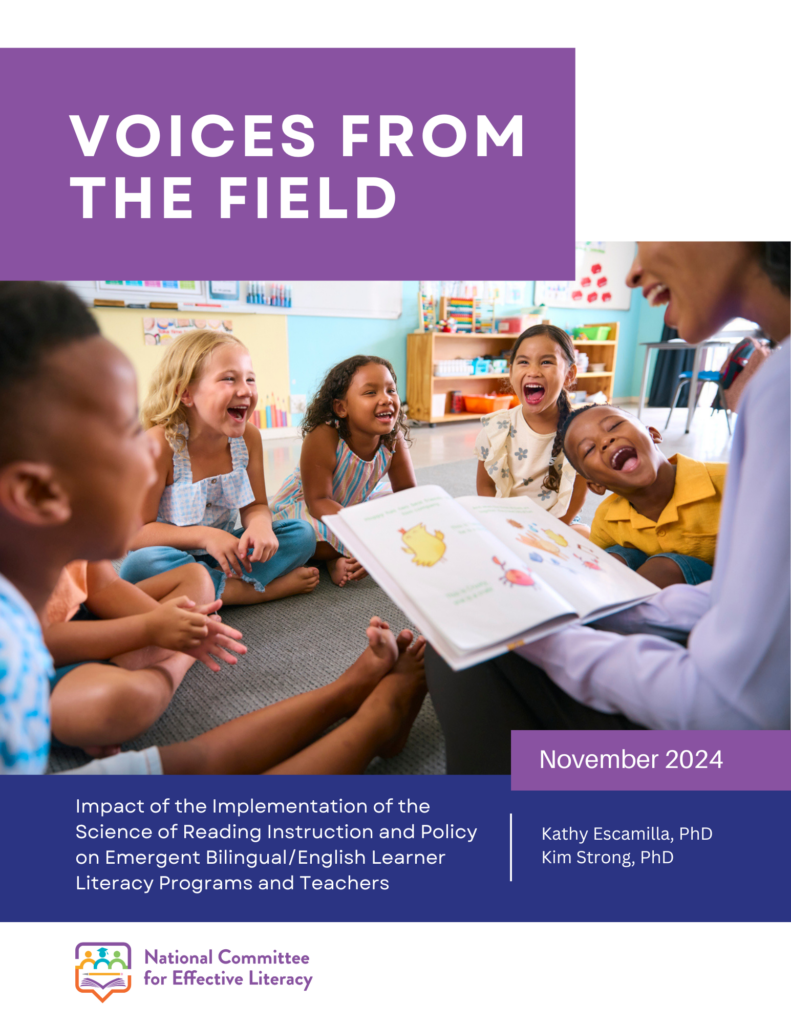
This new groundbreaking report from the National Committee for Effective Literacy (NCEL), Voices from the Field: The Impact of the Implementation of Science of Reading Instruction and Policy on Emergent Bilingual/English Learner Literacy Programs and Teachers, dives deep into the real-world implementation of Science of Reading (SoR) policies. Through interviews with nearly 80 educators who work directly with emergent bilinguals and English learners (EB/EL) in schools implementing state and district SoR policies, we uncover critical insights into the challenges and opportunities for supporting EB/ELs. This study points to the need for more comprehensive understanding of the SoR and for implementation supports that directly address the needs of EB/EL students and the contexts in which they are taught.
Some people have recognized that Elon Musk has willfully or ignorantly misread and misrepresented data on social security to create a story to support an ideological agenda—cutting social programs in the US government.
Note this thread on X/Twitter, notably Wolfer’s final post: “When everything they say is designed to mislead, you’re left to wonder why.”
And here's the number of RECIPIENTS of social security in each age bucket with the death field set to false (and recipient set to true). A mere 89,106 are aged 99+, not the tens of millions suggested by @elonmusk. https://t.co/PdCtdCIlsGpic.twitter.com/ljs3wls5Yp
Manufacturing crises to perpetuate stories for ideological agendas is very effective (and nothing new).
Why?
“A lie can travel halfway around the world while the truth is still putting on its shoes” (a quote misattributed to Mark Twain, somewhat ironically).
Certainly, the Trump/Musk era of this strategy is an extreme moment in history; however, this is exactly how education reform has been conducted since the 1980s and how the current “science of reading” (SOR) movement is being orchestrated.
The entire education reform movement was grounded in a data lie manufactured by a political report, A Nation at Risk, to create a story of public school failure in the US in order to perpetuate Reagan’s ideological agendas (school prayer, school choice, etc.).
Now, as a subset of the manufactured education crisis, the SOR movement has misread and misrepresented NAEP data to manufacture a reading crisis in order to perpetuate a story of student literacy and “bad” teachers in order to perpetuate ideological and market agendas for teaching reading.
If evidence is being ignored, then it isn’t really about evidence.
It’s about ideology.
If you see through the manufactured crises of the Trump/Elon answer, you have a template for seeing through the manufactured education and reading crises.
Returning Pencil Buster Dr. Paul Thomas joins us to help us break down the “science of reading.” This is a topic we’ve covered frequently, most recently with Dr. Nancy Carlsson-Paige this week. But Dr. Paul brings a uniquely nuanced and deep knowledge of the marketing scheme/regressive conservative political tool masquerading as a curriculum set to the show. Because Dr. Paul’s dug deep, and with his 40+ year career as a literacy educator, writer, and speaker he is one educated educator on the topic. Don’t be fooled by their talk of “science”, Dr. Paul urges us. It is a method for censorship and limiting of educators. We can do so much better. And our students deserve so much better. Yet conservative lawamakers have written laws literally banning the teaching of anything except the so-called “science of reading.” Come on, let’s not remove tools from our educators’ literacy teaching kits. That’s just foolish.
BustED Pencils: Fully Leaded Education Talk is part of Civic Media. Subscribe to the podcast to be sure not to miss out on a single episode! To learn more about the show and all of the programming across the Civic Media network, head over to https://civicmedia.us/shows. Join the conversation by calling or texting us at 608-557-8577 to leave a message!
#1 South Carolina Governor’s School for Science & Mathematics – [Poverty Index] 21.7
#2 Academic Magnet High School – 15.1
#3 Spring Hill High School – 32.7
#4 Mayo High School for Math, Science & Technology – 47.6
#5 SC Governor’s School for Arts & Humanities – 22.5
#6 HCS Early College High School – 80.2
#7 Catawba Ridge High School – 18.2
#8 Greenville Technical Charter High School – 29.5
#9 Berkeley County Middle College High School – 27.4
#10 River Bluff High School – 31.7
Now compare that list (I have added PI data) with this ranking by PI:
Eight of the ten ranked are in the least impoverished high schools in the state. I have included in orange several charter schools (12 of the least impoverished high schools out of the lowest 40 are charter schools) because charter advocates often enjoy comparing apples to oranges to promote charter schools. [Note that several of the so-called top 10 are schools allowed to select their students.]
These rankings reinforce a misconception that out-of-school factors are just an excuse when trying to educate students; however, historically and currently, reading test scores and achievement reflect a fact that has been replicated for decades:
Almost 63% of the variance in test performance was explained by social capital family income variables….The influence of family social capital variables manifests itself in standardized test results. Policy makers and education leaders should rethink the current reliance on standardized test results as the deciding factor to make decisions about student achievement, teacher quality, school effectiveness, and school leader quality. In effect, policies that use standardized test results to evaluate, reward, and sanction students and school personnel are doing nothing more than rewarding schools that serve advantaged students and punishing schools that serve disadvantaged students.
Rankings are harmful to education and perpetuate another false story about schools in the US.
Children who can’t read have been cheated by their teachers, who fail to teach reading skills such as phonics.
And our national reading crisis is a threat to our very nation, especially our international economic competitiveness.
However, there are a few problems with this story.
If you were to find a Time Machine, you could travel to any year over the past century and hear the exact same story.
As well, this crisis rhetoric has been used historically and currently with math—and every other content area tested in the US.
Here is a story about reading you probably are not familiar with: There is no reading crisis, and there is no evidence that reading test scores are driven by reading instruction or programs.
Further, again, there is nothing unique or catastrophic about reading test scores or reading achievement by US students.
Historically and currently, reading test scores and achievement reflect a fact that has been replicated for decades:
Almost 63% of the variance in test performance was explained by social capital family income variables….The influence of family social capital variables manifests itself in standardized test results. Policy makers and education leaders should rethink the current reliance on standardized test results as the deciding factor to make decisions about student achievement, teacher quality, school effectiveness, and school leader quality. In effect, policies that use standardized test results to evaluate, reward, and sanction students and school personnel are doing nothing more than rewarding schools that serve advantaged students and punishing schools that serve disadvantaged students.
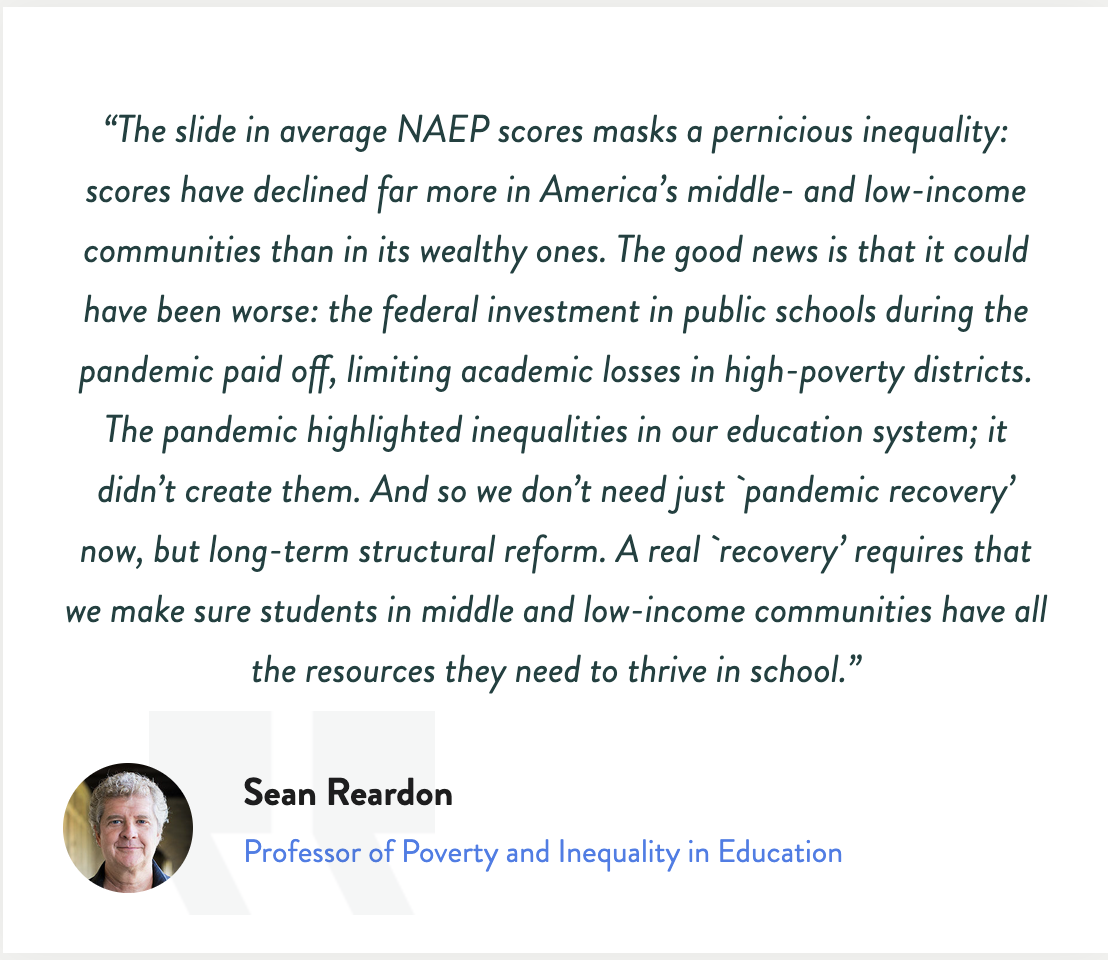
Now, consider a newer story: Post-Covid students are suffering a historic learning loss:
Reardon’s call for “long-term structural reform” must follow a new story about reading and a different approach to reading reform.
First, since the vast majority of causal factors reflected in reading standardized test scores are out-of-school conditions, the new reading story and different reform must address universal healthcare, food security and eliminating food deserts, home and housing stability, and stable well-paying job for parents.
Another out-of-school reform needed for reading is guaranteeing students have access to books and texts in their homes, communities (public libraries), and then in their schools (school and classroom libraries).
A simple program that gives every child from birth to high school graduation 20 books a year (10 chosen by the child/parents and 10 common texts) would build a library and ensure access to texts, one of the strongest research-based elements of reading acquisition.
Without social reform, reading scores will likely remain flat and inadequate.
The most important different aspects of a new story and reading reform is confronting traditional approaches to in-school reform in the US common since the 1980s. A different approach to reading reform must include the following:
De-couple reading reform and instruction from universal or prescribed reading programs and center teaching children to read (not implementing reading programs with fidelity). Admit there is no one way to teach all students to read, and provide the contexts that allow teachers to serve individual student needs.
Reform the national- and state-level testing of reading. The US needs a standard metric for “proficient” and “age level” (instead of”grade level”) shared on NAEP and state tests in grades 3 and 8; and that achievement level needs to be achievable and not “aspirational” (such as is the case with NAEP currently). National and state testing must be age-based and not grade-based to better provide stable data on achievement.
End grade retention based on standardized testing. Retention is punitive, and it harms children while also distorting test data.
Monitor and guarantee vulnerable populations of students who are below “proficient” to insure they are provided experienced and certified teachers and assigned to classes with low student/teach ratios.
Address teaching and learning conditions of schools, including teacher pay and autonomy.
Honor and serve students with special needs and multi-lingual learners.
While we have no unique or catastrophic reading crisis in the US—and even hand wringing over learning loss seems unfounded—we have allowed a century (or more) of political negligence to ignore the negative impact of children’s lives on their learning.
We have remained trapped in a manufactured story of reading crisis and that poverty is an excuse.
All the available evidence suggests otherwise.
Crisis, miracles, blame, and punishment have been at the center of the story everyone is familiar with. That story has never served the interests of students, teachers, or public education.
In an era of intense political hatred and fearmongering, this is a tenuous call, but if we really care about students learning to read, and if we truly believe literacy is the key to the economic and democratic survival of our country, reading deserves a new story, an accurate story, and a different approach to reform grounded in the evidence and not our cultural mythologies and conservative ideologies.
I teach an upper-level writing and research course for undergraduates as part of their general education requirements. The overarching project asks students to gather media coverage of an education topic in order to analyze the credibility of that coverage.
Since the course is undergraduate, I ask them to approach their analysis through critical discourse analysis, but I narrow that lens some for them. The process includes the following:
Identify the pattern of claims about the topics.
Evaluate the validity of the claims in the context of a literature review of the educational topic (limited to peer-reviewed, published recent journal articles).
Consider whose interests these claims serve (the CDA element).
I note that claims about education in the media tend to fall in a range of accurate, misleading, and false; however, for this analysis, identifying whose interest the claims serve is the key aspect of the evaluation.
False and accurate claims are typically easy to manage for students, but the misleading claims can be complicated.
For example, in public discourse about police shooting victims, two accurate data points are often cited: The majority of people shot and killed by police in the US are white and Black people are shot and killed at a higher rate than white people.
Failing to address both data points and clarifying why rates are more important than raw data contributes to media coverage being misleading, and thus, selectively emphasizing true data is often a form of manipulation and serves a particular population or ideology.
With another release of NAEP reading and math scores, we have an opportunity to address how media and political leaders tend to offer false and misleading claims based on NAEP score, but also, that NAEP itself serves to perpetuate the manufactured education crisis, which benefits the media (more clicks), political leaders, and the education market place.
Regardless of what national and state scores on NAEP are, the foundation of media and political claims is always “crisis.”
Ironically, perpetual “crisis” rhetoric and education reform since the early 1980s has had one clear outcomes—maintaining the status quo of educational and socioeconomic inequity in the US.
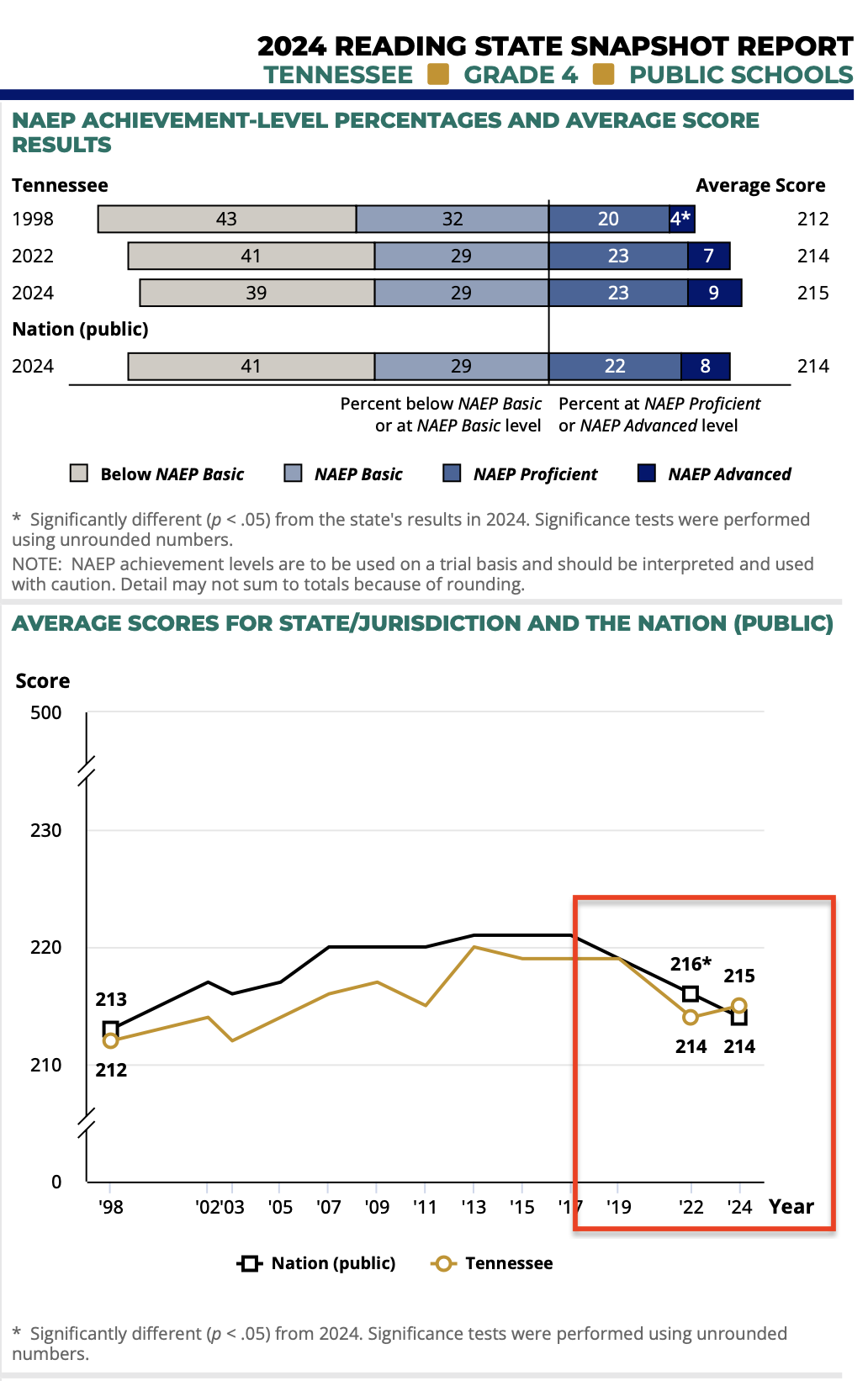
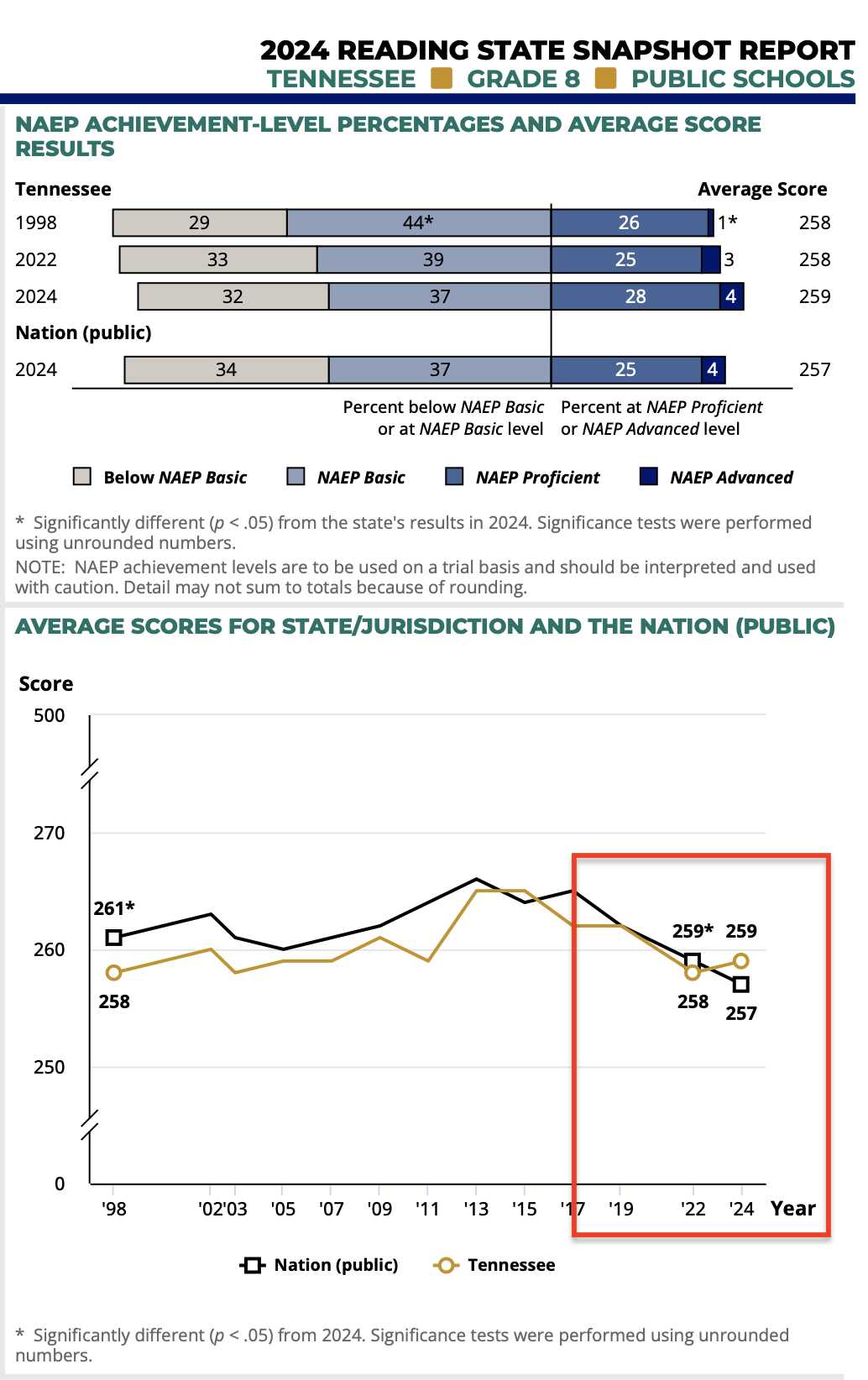
To consider this, let’s focus on Massachusetts and Tennessee.
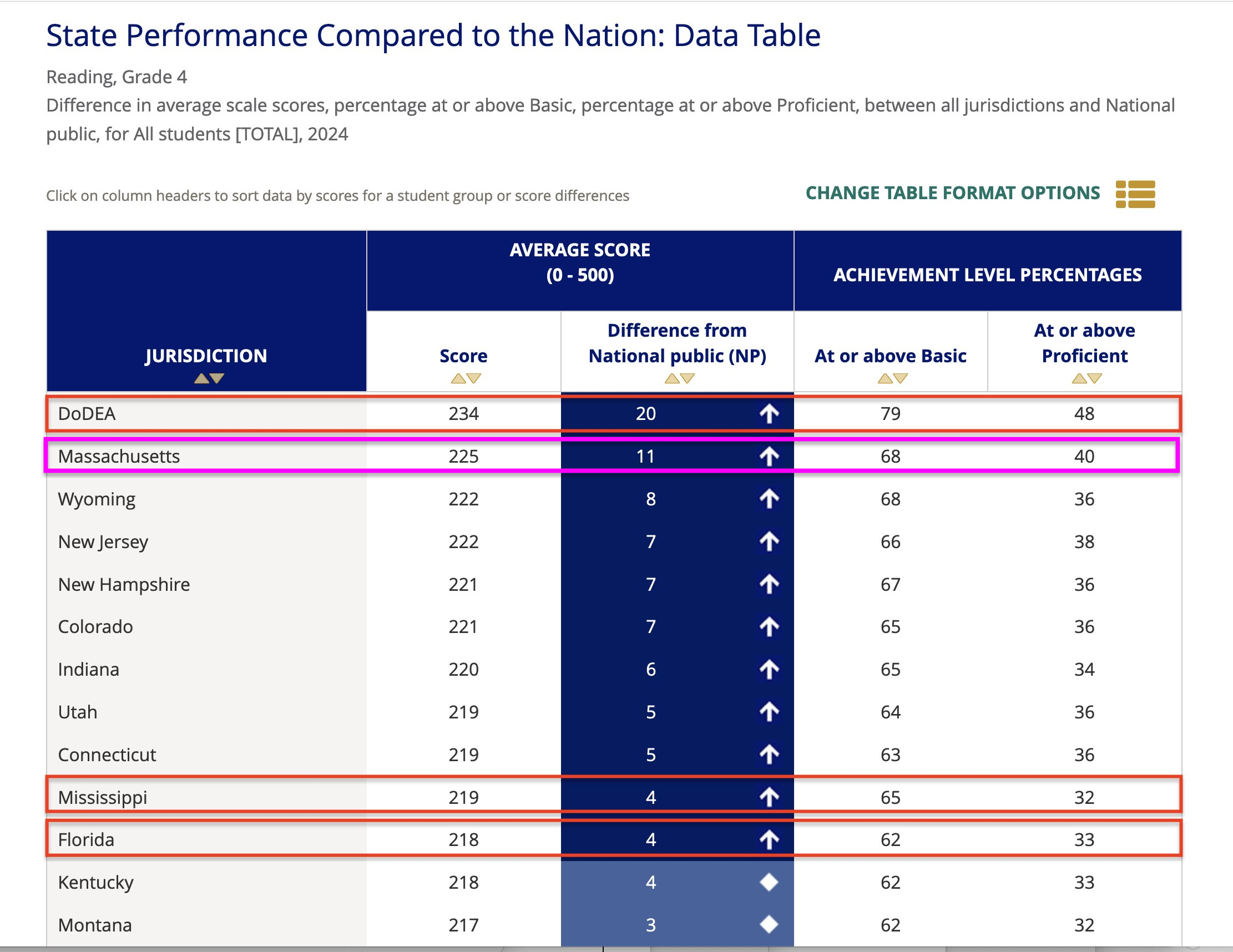
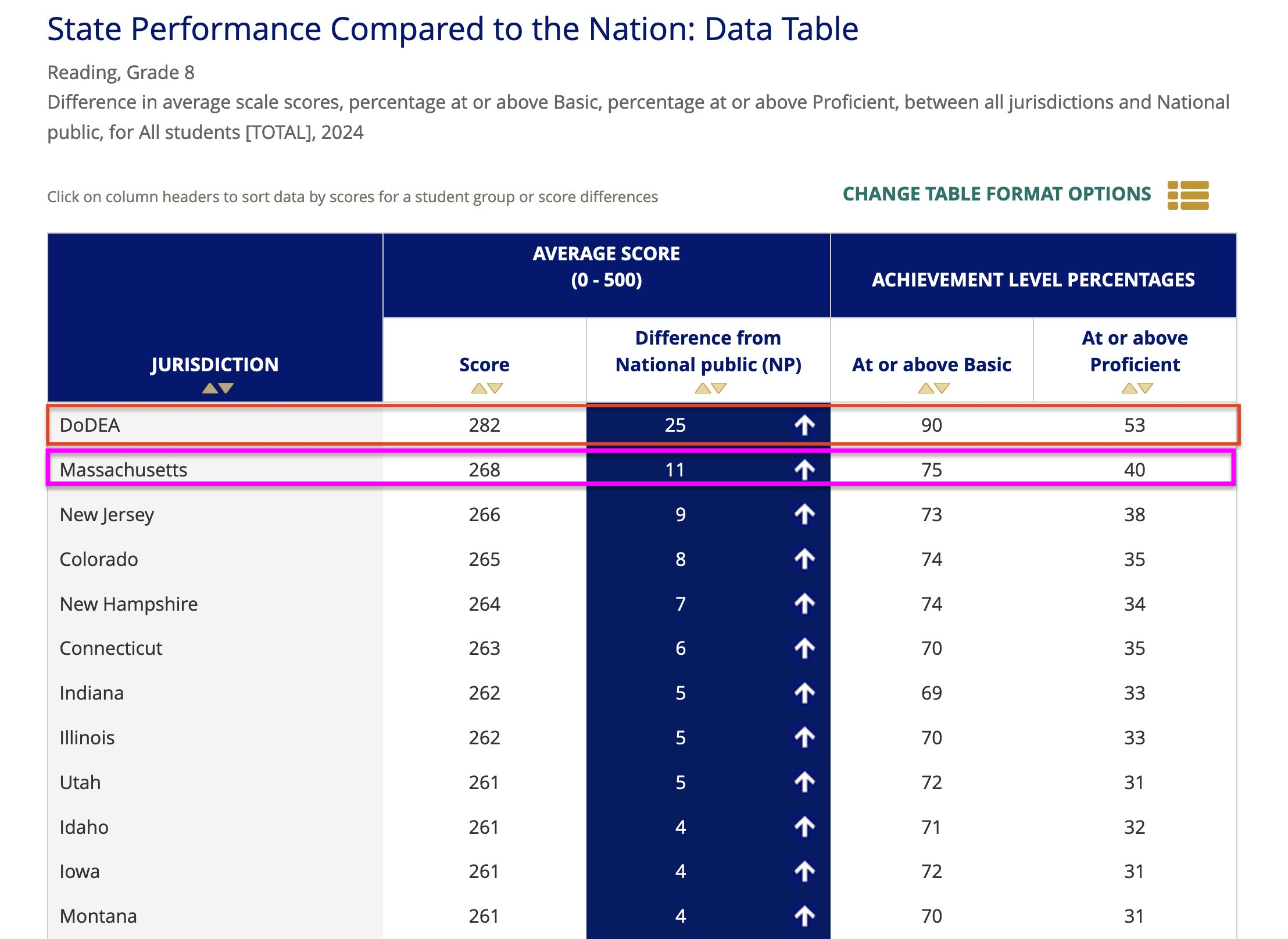
Other than top-scoring DoDEA schools, MA sits atop reading scores in the US in both grades 4 and 8:
As a relatively low-poverty state, MA should rank above states with higher poverty students. However, MA certainly serves students in pockets of poverty as well as other vulnerable populations of students who tend to have low standardized test scores.
None the less, MA has joined the standard chorus in the US about reading. The Education Trust released a report in March 2024 providing “5 Things You Need to Know about the literacy crisis in Massachusetts.”
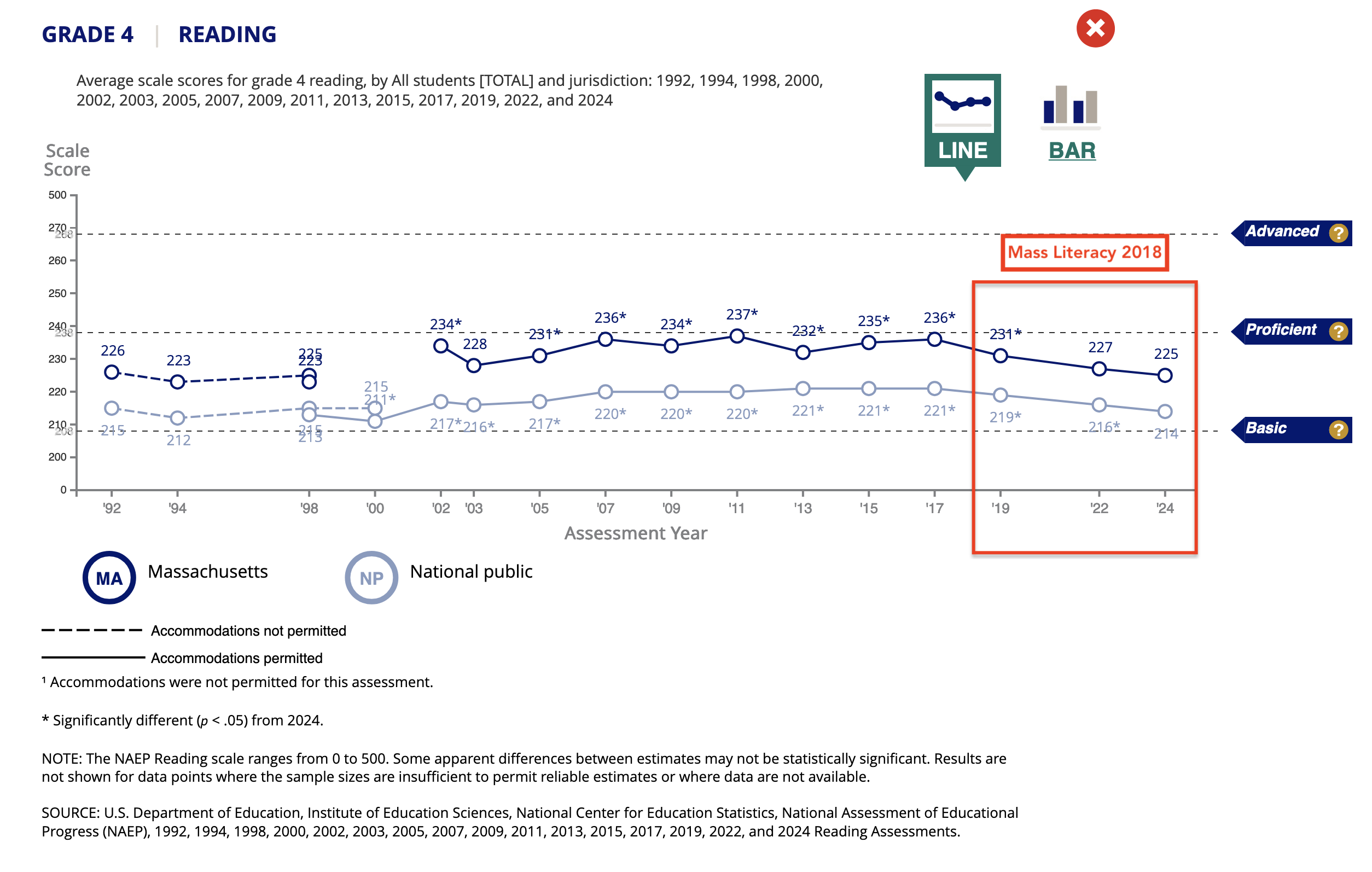
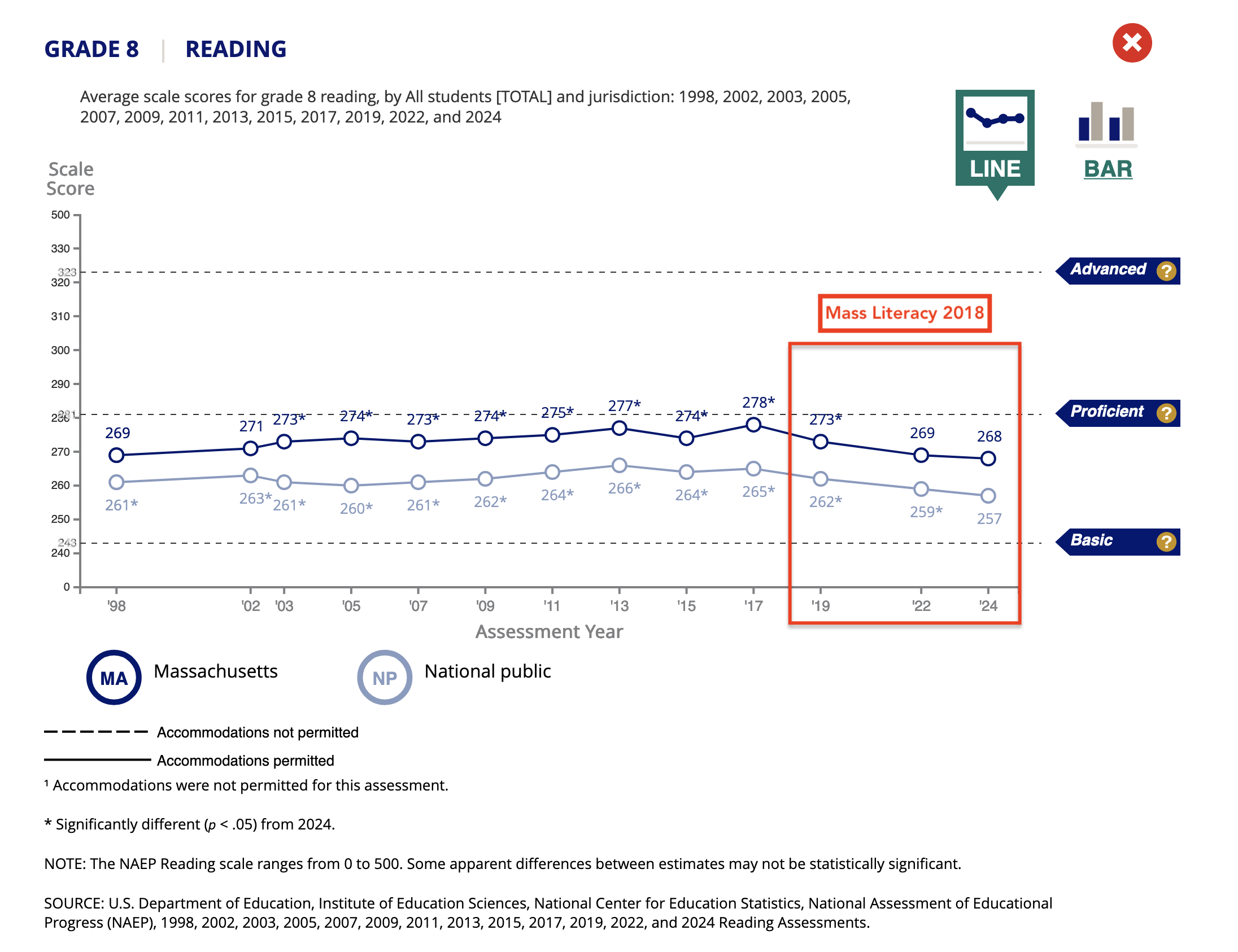
To be fair, MA is similar to most of the US where standardized tests scores have dropped post-Covid and those drops have coincided with MS’s Mass Literacy initiative from 2018:
Perpetual reform and perpetual crisis in education, regretfully, seems only to fuel more reform and more crisis.
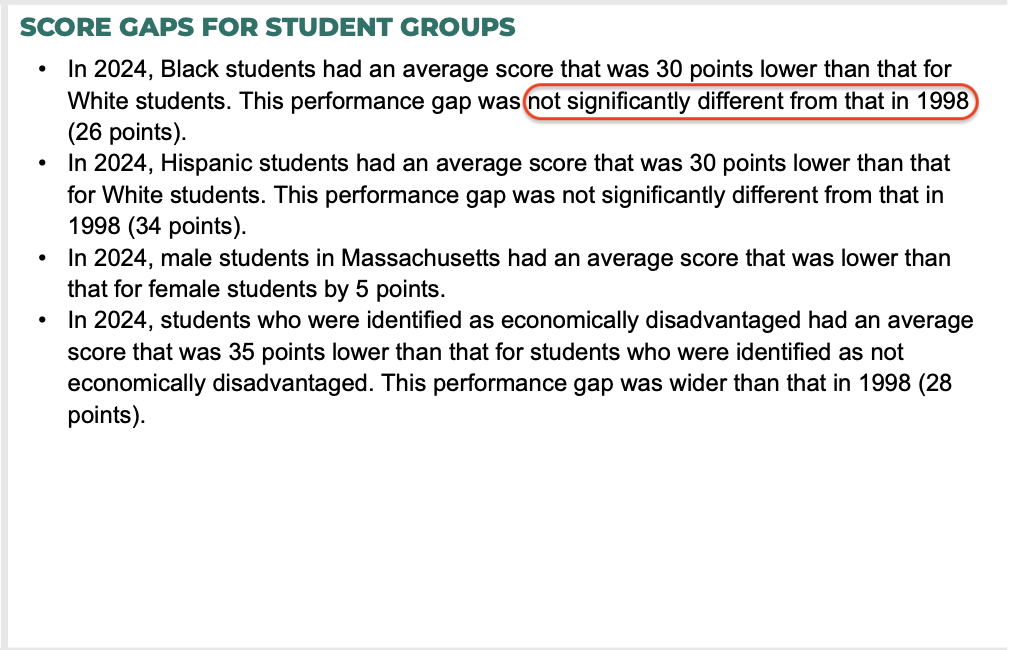
Note that MA also has something in common with almost all states regardless of whether states have high or low NAEP results. Achievement gaps by race and socioeconomic status have remained fixed for almost three decades:
While a top-scoring state like MA is shouting “crisis” primarily based on a sort of national psychosis about the “science of reading,” TN is trying to have it both ways with a reading crisis and a celebration of 2024 NAEP scores.
An October 2023 report from the TN Department of Education, “Tennessee’s Commitment to Early Literacy,” forefronts the “Literacy Crisis in Tennessee” based on (you guessed it) historically poor rankings in NAEP reading scores.
One important point here is that the media and political discourse tend to focus on “bad” statistics such as rankings and averages—which is how TN establishes their “crisis.”
For political leaders, “we have a crisis” and “I have saved us from the crisis” are not a sequential series of events, however, but a permanent rotation.
So why this positive spin for TN?
While the national average on NAEP reading has dropped, TN has experienced in 2024 a slight uptick. Because most everyone else was dropping, then, TN has seen a rise in their rankings (a key example of why ranking is a “bad” statistic).
Important again is that like MA and most states, TN scores for racial and socio-economic gaps remain fixed: “This performance gap was not significantly different from that in 1998.”
These responses to NAEP by MA and TN reveal a stark lesson that NAEP serves the interests of the media, politicians, and the education market place, but at least since 1998, NAEP hasn’t provided the data needed for any sort of genuine education reform or analysis.
Education is a political and market football, in fact.
Here are a few better takeaways from NAEP:
NAEP’s achievement levels are designed to be confusing and support the manufactured education crisis (see here).
Using NAEP to rank and sort is misleading and doesn’t support needed reform.
NAEP scores do offer some important facts related to achievement gaps and the pervasive influence of affluence and poverty on educational outcomes, but the media and political leaders choose to ignore those lessons.
Decades of NAEP reinforce this conclusion by Maroun and Tienken: “Policy makers and education leaders should rethink the current reliance on standardized test results as the deciding factor to make decisions about student achievement, teacher quality, school effectiveness, and school leader quality. In effect, policies that use standardized test results to evaluate, reward, and sanction students and school personnel are doing nothing more than rewarding schools that serve advantaged students and punishing schools that serve disadvantaged students.”
Media persist in focusing on only two stories about education: Crisis and outliers; both of which serve the interests of anyone expect students and teachers.
Like my students in my upper-level writing and research course, we would all benefit from evaluating the claims being made by media and political leaders in order to determine, first, is the claims are true (they often as misleading or false), and then to confront in whose interests these claims are being made.
Maybe this isn’t surprising given the current and historical political climate in the US, but almost never are the interests of students and teachers being served—especially when the interests of the most vulnerable students are the issue.
educator, public scholar, poet&writer – academic freedom isn't free












 dr. p.l. (paul) thomas