[Header Photo by Andy Feliciotti on Unsplash]
I teach an upper-level writing and research course for undergraduates as part of their general education requirements. The overarching project asks students to gather media coverage of an education topic in order to analyze the credibility of that coverage.
Since the course is undergraduate, I ask them to approach their analysis through critical discourse analysis, but I narrow that lens some for them. The process includes the following:
- Identify the pattern of claims about the topics.
- Evaluate the validity of the claims in the context of a literature review of the educational topic (limited to peer-reviewed, published recent journal articles).
- Consider whose interests these claims serve (the CDA element).
I note that claims about education in the media tend to fall in a range of accurate, misleading, and false; however, for this analysis, identifying whose interest the claims serve is the key aspect of the evaluation.
False and accurate claims are typically easy to manage for students, but the misleading claims can be complicated.
For example, in public discourse about police shooting victims, two accurate data points are often cited: The majority of people shot and killed by police in the US are white and Black people are shot and killed at a higher rate than white people.
Failing to address both data points and clarifying why rates are more important than raw data contributes to media coverage being misleading, and thus, selectively emphasizing true data is often a form of manipulation and serves a particular population or ideology.
With another release of NAEP reading and math scores, we have an opportunity to address how media and political leaders tend to offer false and misleading claims based on NAEP score, but also, that NAEP itself serves to perpetuate the manufactured education crisis, which benefits the media (more clicks), political leaders, and the education market place.
Regardless of what national and state scores on NAEP are, the foundation of media and political claims is always “crisis.”
Ironically, perpetual “crisis” rhetoric and education reform since the early 1980s has had one clear outcomes—maintaining the status quo of educational and socioeconomic inequity in the US.
To consider this, let’s focus on Massachusetts and Tennessee.
Other than top-scoring DoDEA schools, MA sits atop reading scores in the US in both grades 4 and 8:
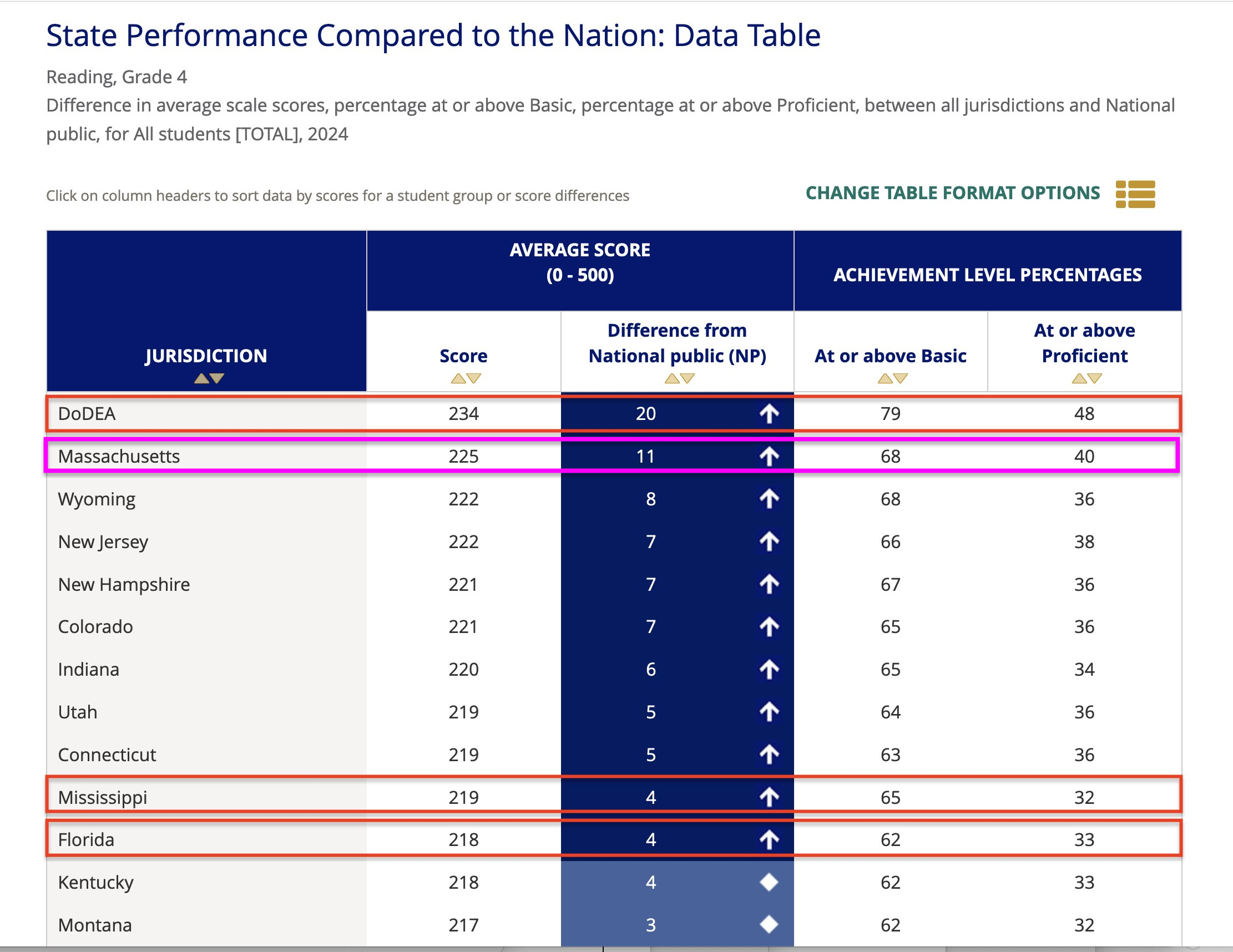
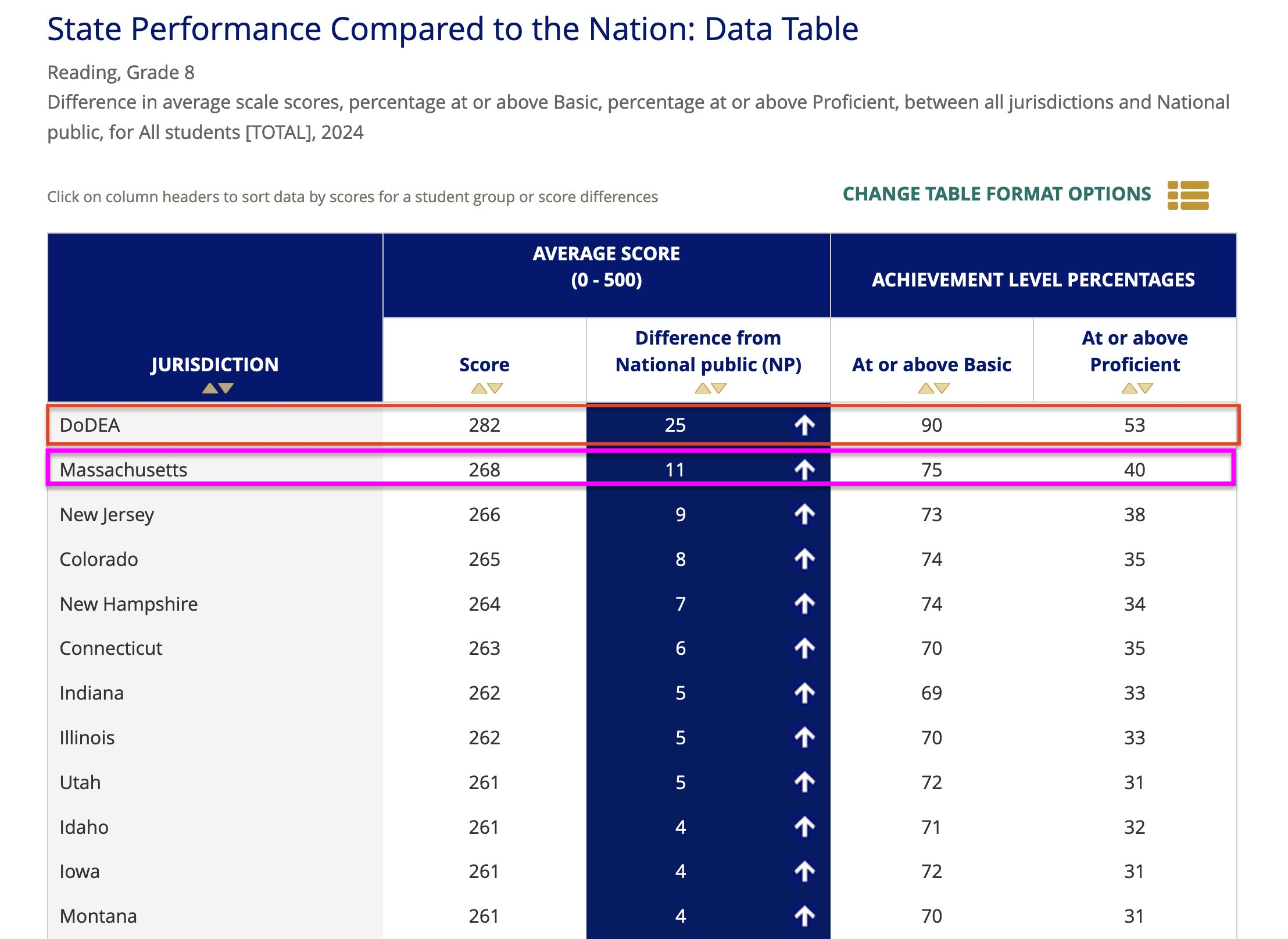
As a relatively low-poverty state, MA should rank above states with higher poverty students. However, MA certainly serves students in pockets of poverty as well as other vulnerable populations of students who tend to have low standardized test scores.
None the less, MA has joined the standard chorus in the US about reading. The Education Trust released a report in March 2024 providing “5 Things You Need to Know about the literacy crisis in Massachusetts.”
To be fair, MA is similar to most of the US where standardized tests scores have dropped post-Covid and those drops have coincided with MS’s Mass Literacy initiative from 2018:
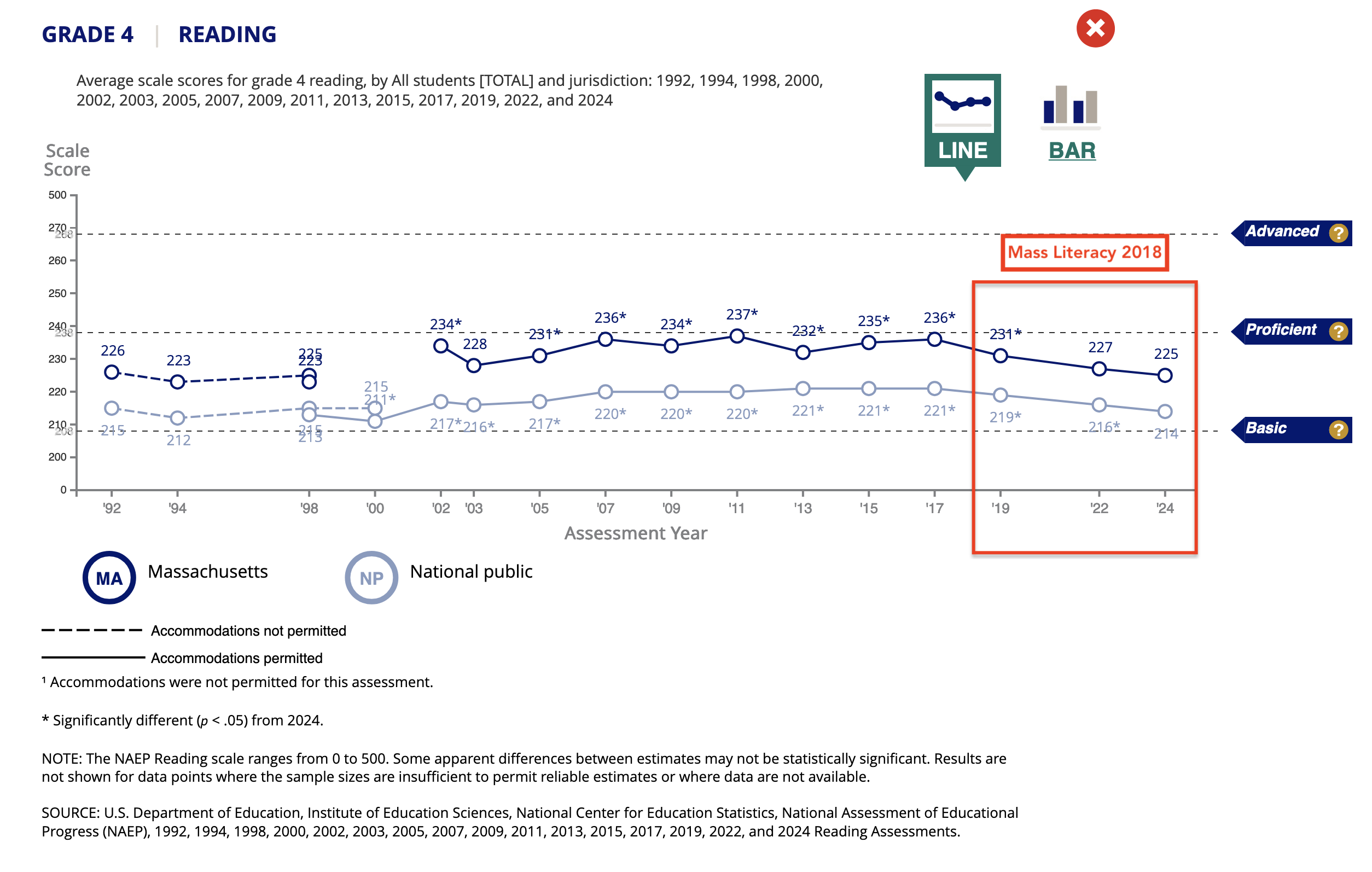
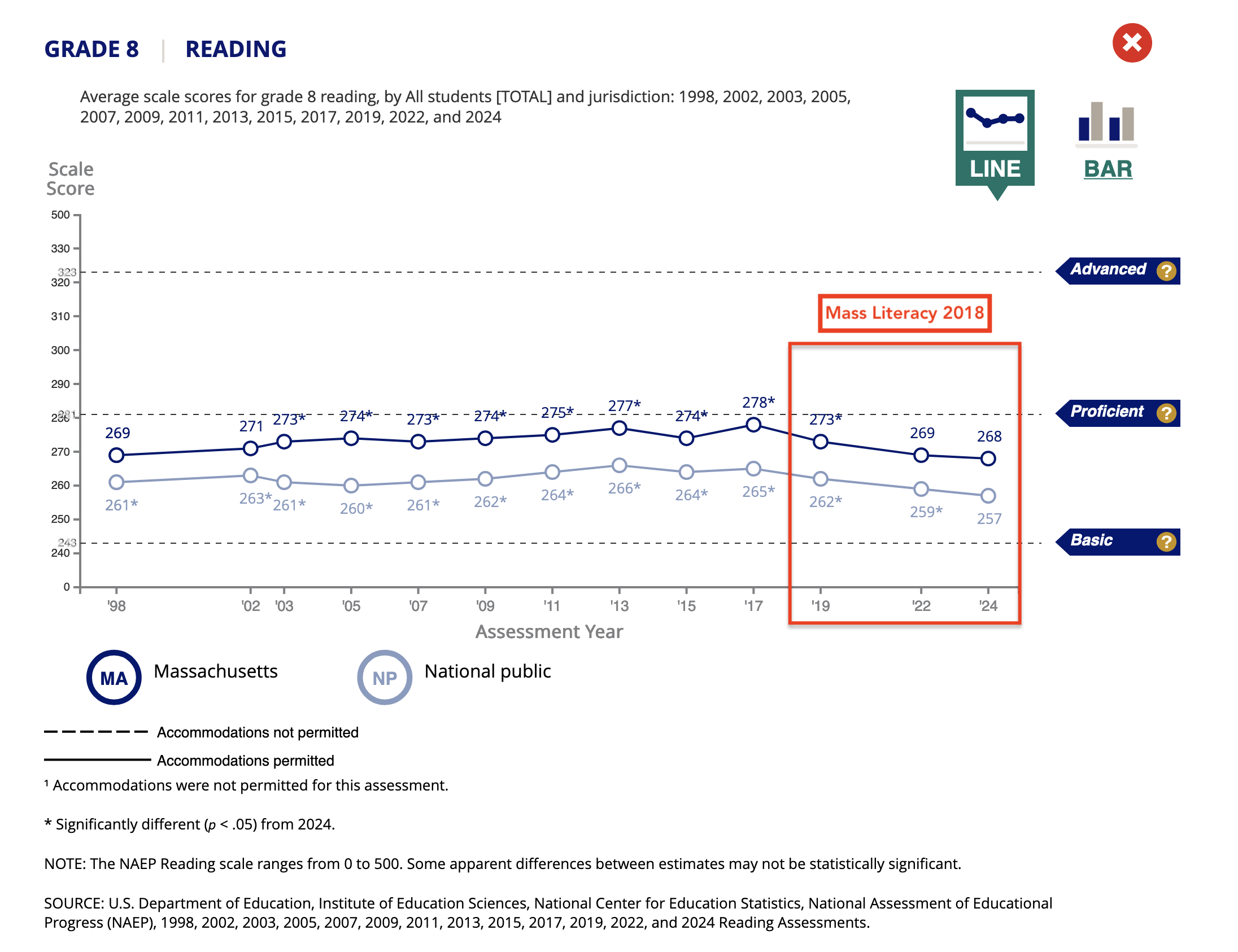
Perpetual reform and perpetual crisis in education, regretfully, seems only to fuel more reform and more crisis.
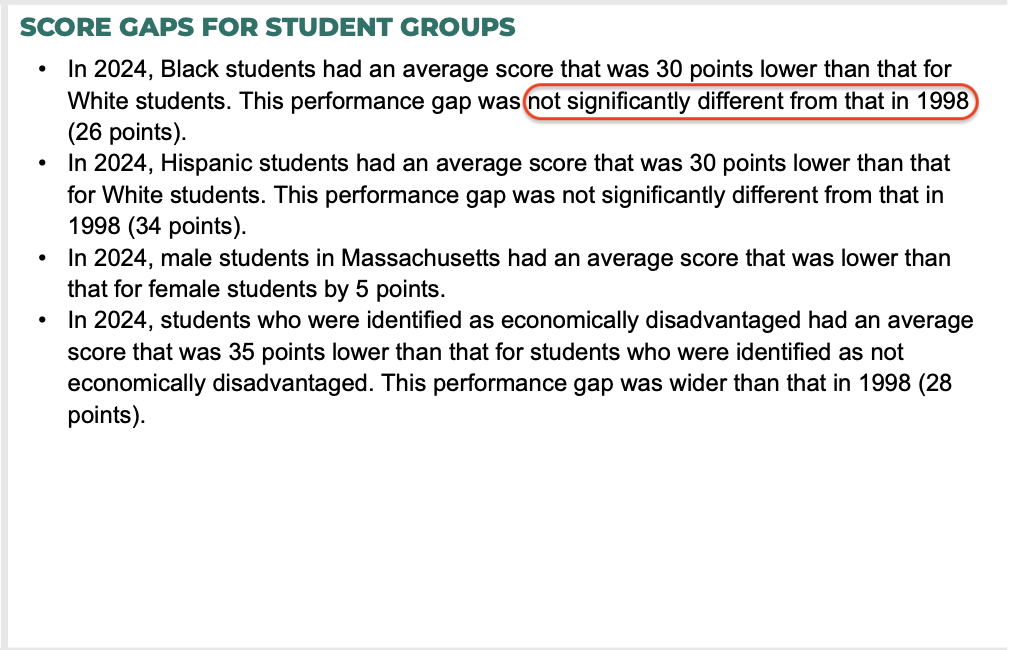
Note that MA also has something in common with almost all states regardless of whether states have high or low NAEP results. Achievement gaps by race and socioeconomic status have remained fixed for almost three decades:
While a top-scoring state like MA is shouting “crisis” primarily based on a sort of national psychosis about the “science of reading,” TN is trying to have it both ways with a reading crisis and a celebration of 2024 NAEP scores.
An October 2023 report from the TN Department of Education, “Tennessee’s Commitment to Early Literacy,” forefronts the “Literacy Crisis in Tennessee” based on (you guessed it) historically poor rankings in NAEP reading scores.
One important point here is that the media and political discourse tend to focus on “bad” statistics such as rankings and averages—which is how TN establishes their “crisis.”
Yet, while the 2024 NAEP data has spurred a great deal of misguided doom and gloom, TN is putting a positive spin on their results: Nation’s Report Card Shows Meaningful Academic Gains as a Result of Tennessee’s Commitment to Public Schools.
For political leaders, “we have a crisis” and “I have saved us from the crisis” are not a sequential series of events, however, but a permanent rotation.
So why this positive spin for TN?
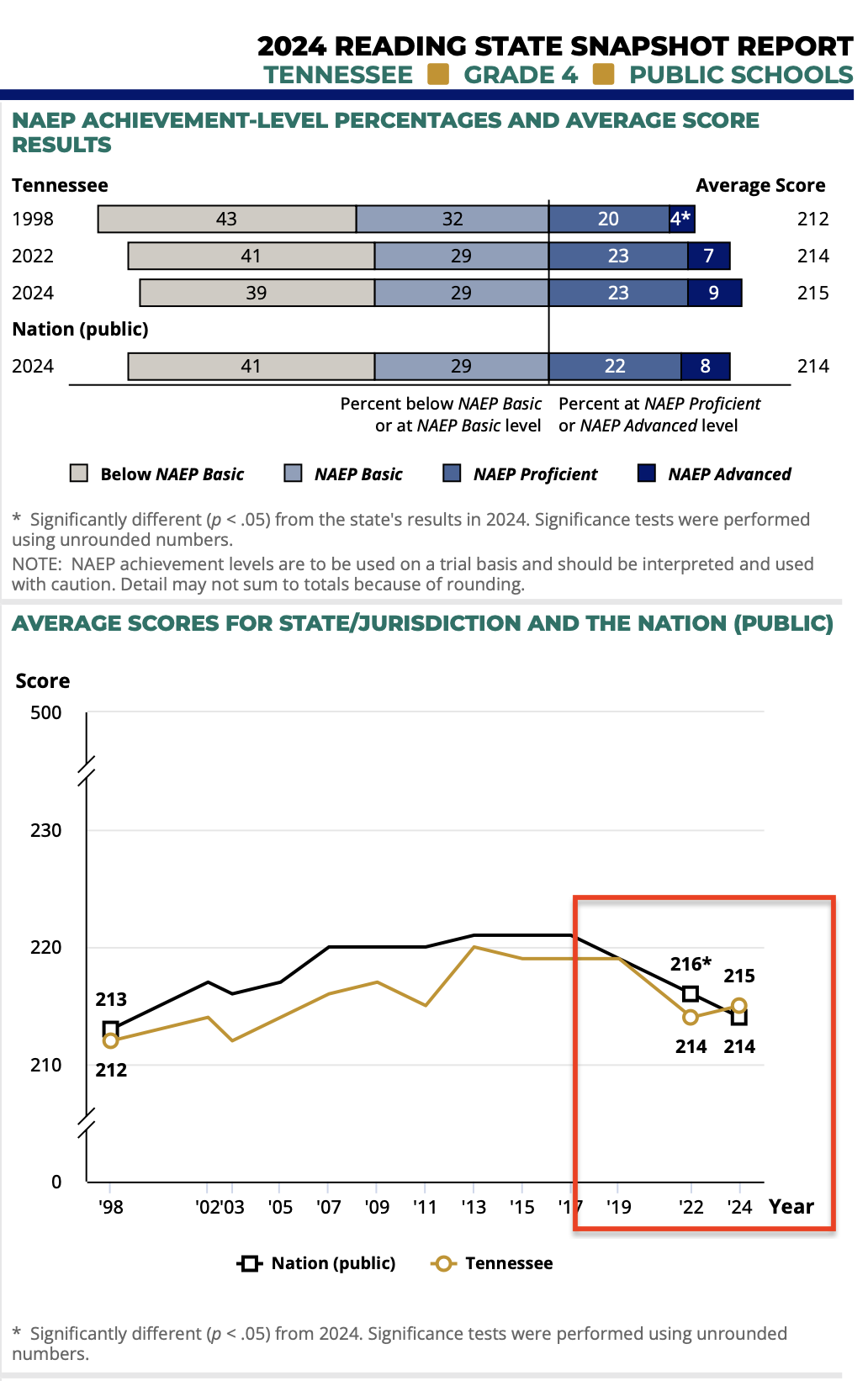
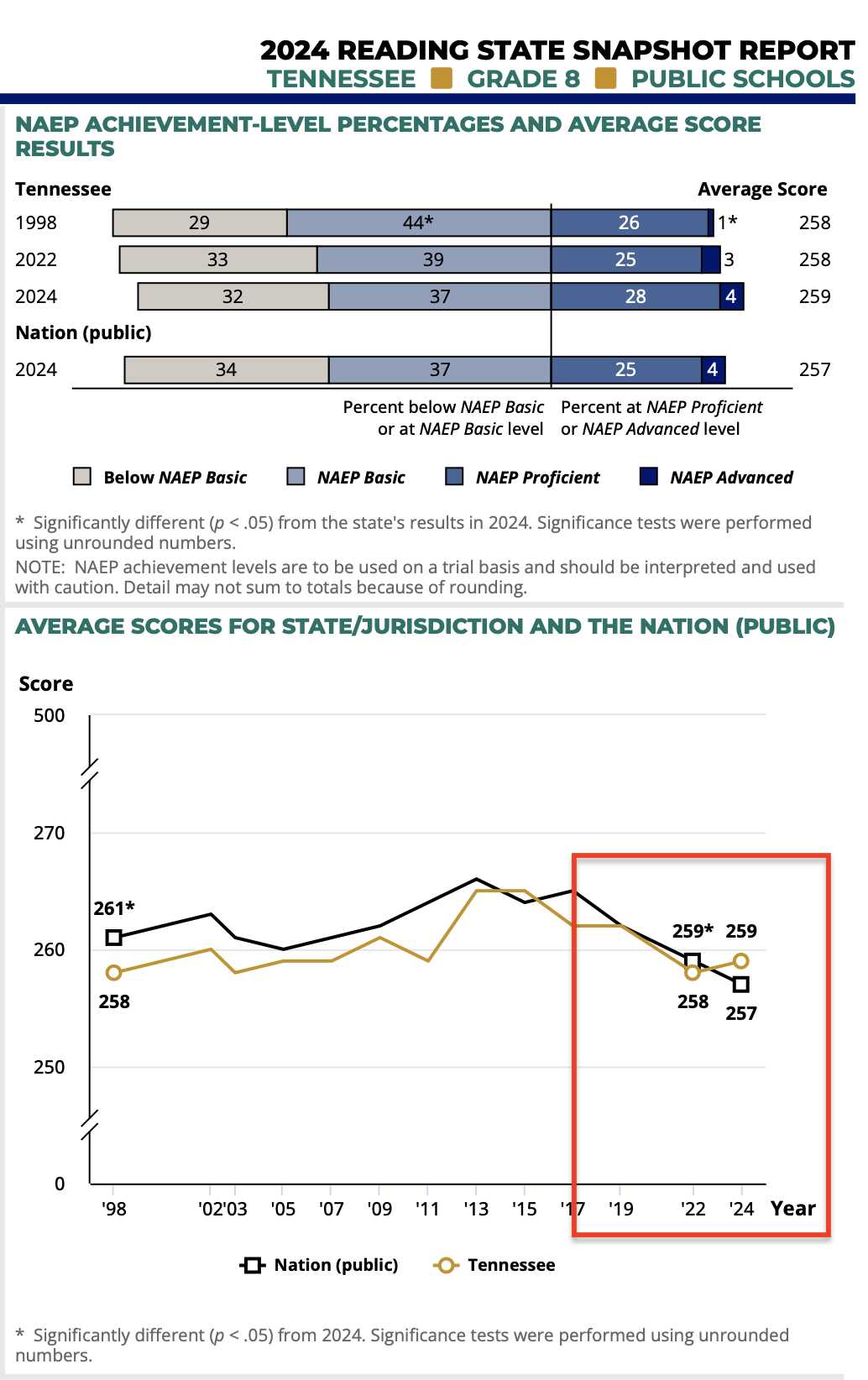
While the national average on NAEP reading has dropped, TN has experienced in 2024 a slight uptick. Because most everyone else was dropping, then, TN has seen a rise in their rankings (a key example of why ranking is a “bad” statistic).
Important again is that like MA and most states, TN scores for racial and socio-economic gaps remain fixed: “This performance gap was not significantly different from that in 1998.”
These responses to NAEP by MA and TN reveal a stark lesson that NAEP serves the interests of the media, politicians, and the education market place, but at least since 1998, NAEP hasn’t provided the data needed for any sort of genuine education reform or analysis.
Education is a political and market football, in fact.
Here are a few better takeaways from NAEP:
- NAEP’s achievement levels are designed to be confusing and support the manufactured education crisis (see here).
- Using NAEP to rank and sort is misleading and doesn’t support needed reform.
- NAEP scores do offer some important facts related to achievement gaps and the pervasive influence of affluence and poverty on educational outcomes, but the media and political leaders choose to ignore those lessons.
- Decades of NAEP reinforce this conclusion by Maroun and Tienken: “Policy makers and education leaders should rethink the current reliance on standardized test results as the deciding factor to make decisions about student achievement, teacher quality, school effectiveness, and school leader quality. In effect, policies that use standardized test results to evaluate, reward, and sanction students and school personnel are doing nothing more than rewarding schools that serve advantaged students and punishing schools that serve disadvantaged students.”
- Media persist in focusing on only two stories about education: Crisis and outliers; both of which serve the interests of anyone expect students and teachers.
Like my students in my upper-level writing and research course, we would all benefit from evaluating the claims being made by media and political leaders in order to determine, first, is the claims are true (they often as misleading or false), and then to confront in whose interests these claims are being made.
Maybe this isn’t surprising given the current and historical political climate in the US, but almost never are the interests of students and teachers being served—especially when the interests of the most vulnerable students are the issue.