
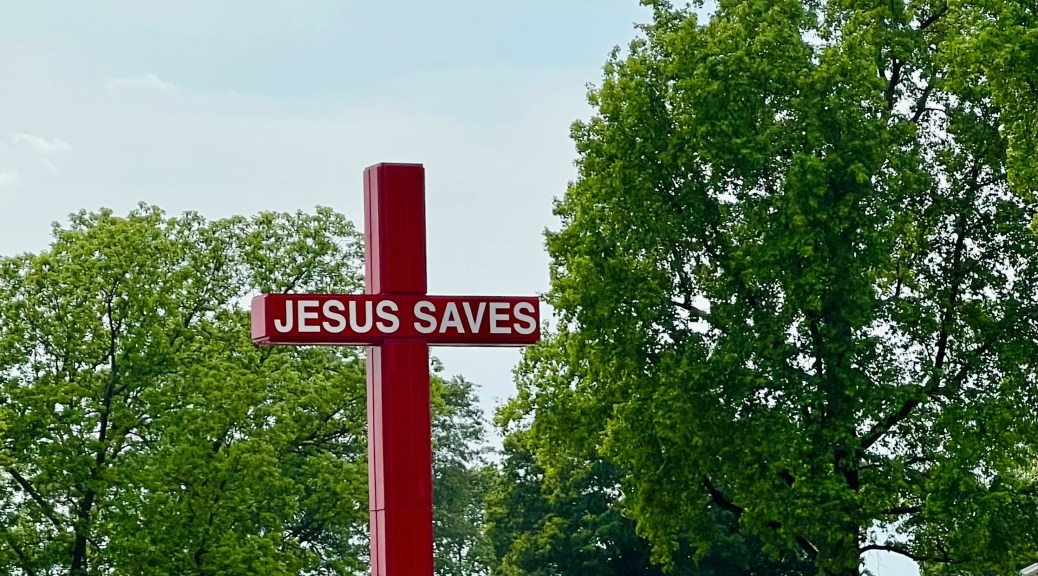
[Header Photo by Stephanie Klepacki on Unsplash]
With Easter just behind us, mainstream Christians in the US have experienced a high period of religious holidays and celebrations starting around Thanksgiving and then intensely punctuated with Christmas and Easter.
As an atheist/agnostic who seeks to live a good life as a humanist, I witness during these celebrations that much of what passes as religious is mostly pagan rituals and free market capitalism.
The irony, of course, is that these contradiction do, in fact, represent well what mainstream Christianity is in practice and reality for most people in the US.
To further that irony, the claim by the most fervent Christians in the country that the US is a Christian nation is perfectly reflected in the Bacchanalian orgy of branding and spending in the name of Jesus born, crucified, and risen as the stories go.
I was born, raised, and have always lived in the Bible Belt, specifically in the Upstate of South Carolina where many people are Southern Baptist or some other type of fundamentalist Christian.
Something in my DNA, I think, made me not just immune but resistant to authoritarian environments—in my home and family, in schooling, and most significantly in church and religion.
I don’t care much for commandments and blind faith.
My relationship with religion evolved into the sort of embarrassing sardonic nonchalance of adolescence that spilled over into being downright mean during my first two years of college.
In high school, it was a joke. I was elected president of the Fellowship of Christian Athletes as a ploy by some of my friends to have me on student council (they knew I would speak up because I was already viewed as anti-authority).
I think I was the lone person in my peer group openly admitting non-belief, and I had also exposed myself among those friends as a heavy beer drinker—something I had honed growing up on a golf course and playing golf.
That experience working at the golf course is one the most formative moments of my life. The golfers, you see, were adults I knew from my hometown, all very Christian men and most holding jobs that were well regarded with a few much wealthier than I could imagine anyone being (my own family was solidly working class, aspiring to middle class).
The golf course, however, served as an alternate universe of sorts, a perverse sanctuary where these Christian men used profanity, drank heavily, smoked marijuana, and hurled racist and sexist language at a nearly compulsive rate.
And several of these men as well used the golf course for their adultery sanctuary; a few had me monitoring their phone calls as I was tasked to distinguish between calls from their wives and their girlfriends.
The message was clear: Being a Christian was almost entirely rhetorical so that everyone could pretend to embrace the norms of what people were supposed to believe and do (even as almost no one practiced what anyone preached).
I also had to sit quietly and patiently occasionally while good Christians witnessed to me, quoting from the Bible in order to justify their racism and sexism.
Black people descended from Cain mating with apes, I was assured, for example. Something they had learned in church.
By college, I was a nasty atheist to my peers, attending a Methodist college where many were naive, even sweet, true believers.
In those first two years of college, I immersed myself in Sartre, Camus , and Kierkegaard, but that intellectualism lacked the very things I found infuriating in the Christians I was determined to discredit—kindness, human dignity, and love.
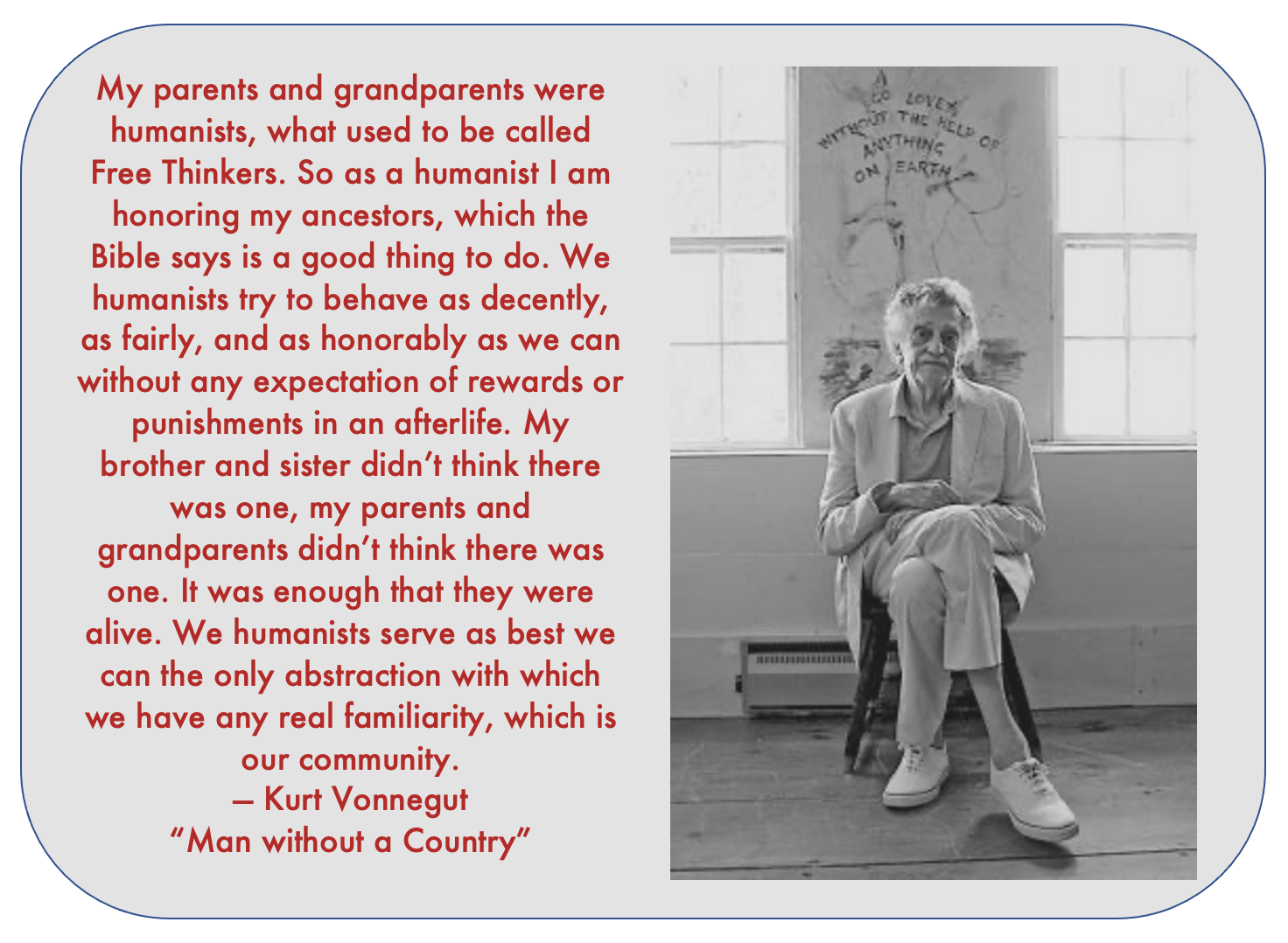
Fortunately for me, I found literature and gradually settled into a relatively harmless state of agnosticism anchored to Kurt Vonnegut’s missives on humanism:
So I sit here post-Easter 2025 when the US has fully realized the very worst warnings I have anticipated about being a Christian nation since I was a teen in the 1970s.
Almost 70% of registered voters did not vote for a second Trump term as president, but his base is mostly driven by Christians, specifically fundamentalist Christians.
And his hellscape of policy since January has been punctuated with Christian intent.
This Christianity reminds me of a larger-scale version of the golf course experiences I had—lots of hypocrisy, almost entirely rhetorical without a single ounce of Christian love or respect for human decency.
This Christianity is authoritarian and fueled by hate, fear, and judgment bereft of any logic, morals, or ethics.
US Christianity has proven that distinguishing between a cult and a religion is a distinction without a difference.
There has been an insidious long game reaching back to the Reagan era, the rise of the so-called Moral Majority, that has gradually eroded both Christianity and democracy in the US (watch Shiny Happy People to understand this).
Regardless of the historical accuracy of the stories about Jesus—and the validity of the mystical aspects of miracles and such—there simply is nothing in the cult of Trump that is remotely Jesus-like, just as his behavior as president lacks any hint of democracy.
But there is ample evidence that any optimism anyone has had for the human race is at least naive if not delusional.
I am confident that stories about crucifixion and resurrection are not literally true; I am also confident that Jesus’s simple messages of love each other, lay down your worldly possessions, and do unto others are the very least each human can do to live the good life for ourselves and for others.
Commandments otherwise are mere authoritarianism, ways for a few to control the many.
But a rabid minority in the US has rejected that Jesus nonsense and fully embraced hatred, fear, judgment, and punishment in the embodiment of one the most vile people existing in the US today.
Fools will choose fools to lead them.
And here we are.
 dr. p.l. (paul) thomas