

[Header Photo by Sasha San on Unsplash]
I am teaching for the second time a new course in my department, an introduction to educational philosophy.
At about midterm, we have covered the primary educational philosophies to prepare them for a major project over the second half of the course. When we covered Essentialism, I noted that this philosophy drives reading and education reform in several English-speaking countries, notably in the “Science of Reading” (SOR) and “Science of Learning” (SOL) movements.
Essentialism is summarized in this online, open-access text on educational philosophies (see 3.2):
Essentialism adheres to a belief that a core set of essential skills must be taught to all students. Essentialists tend to privilege traditional academic disciplines that will develop prescribed skills and objectives in different content areas as well as develop a common culture. Typically, Essentialism argues for a back-to-basics approach on teaching intellectual and moral standards. Schools should prepare all students to be productive members of society. The Essentialist curriculum focuses on reading, writing, computing clearly and logically about objective facts concerning the real world. Schools should be sites of rigor where students learn to work hard and respect authority. Because of this stance, Essentialism tends to subscribe to tenets of Realism. Essentialist classrooms tend to be teacher-centered in instructional delivery with an emphasis on lecture and teacher demonstrations.
Key beliefs of Essentialism advocate for basic skills instruction in core courses (notably reading and math), teacher-centered direct instruction, and conservative cultural norms.
Often Essentialist movements are popularly labeled “back-to-basics” movements, raising some problems for these arguments since calls for back-to-basics have existed in cycles reaching well back into the early decades of the twentieth century in the US. [1]
A cautionary tale about returning to Essentialism to form reading policy exists in the UK where phonics-centered reading reform has been implemented since 2006. [2]
Research has revealed that reform in the UK, in fact, has been implemented (including annual phonics assessments for all early literacy students), but that those reforms have not achieved the essential goal of improving student reading comprehension; and thus, researchers called for a more balanced approach to reading instruction.
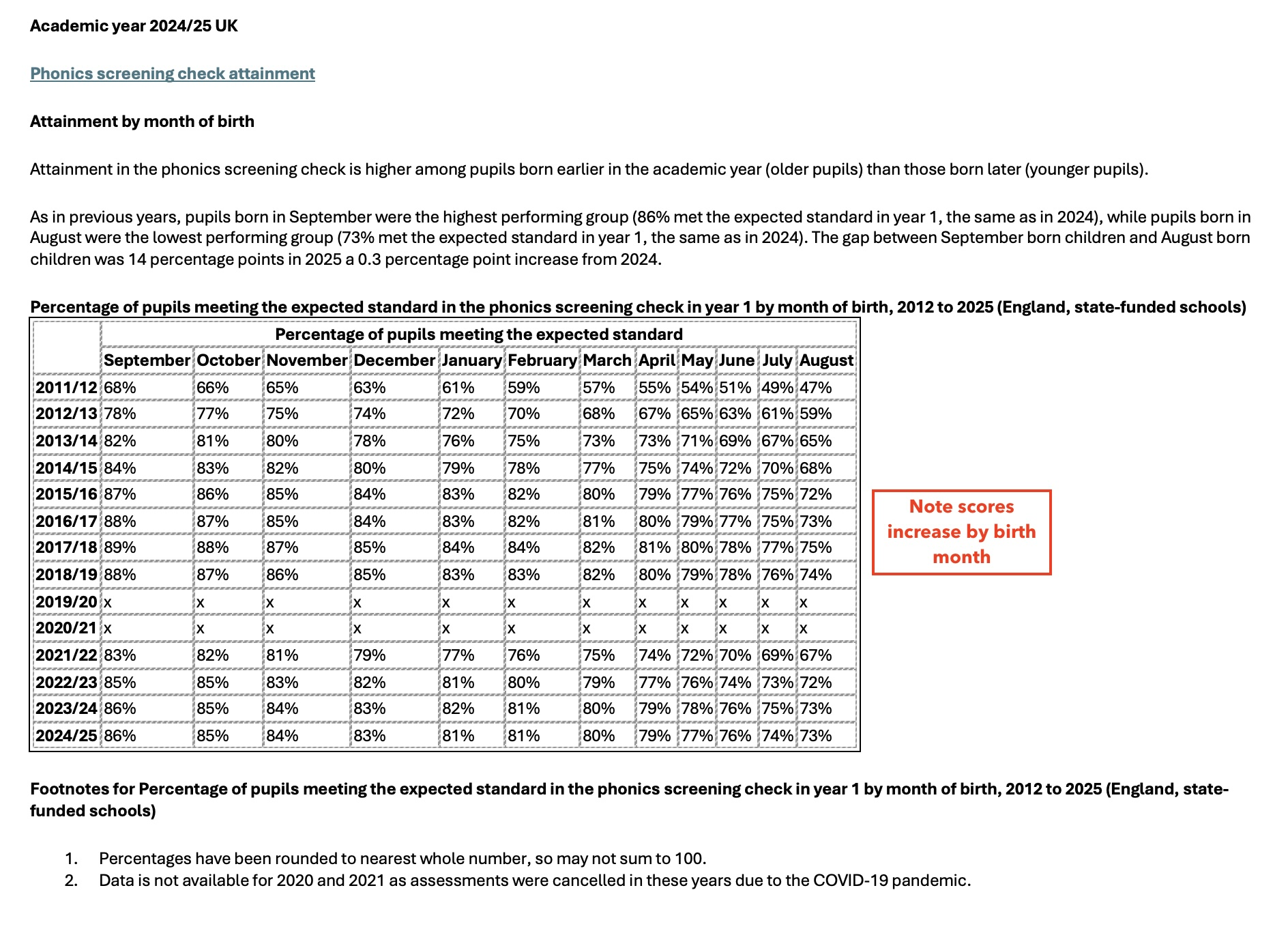
A key lesson from the UK is that skills-based assessments (phonics checks) produce student achievement strongly correlated with birth month, suggesting that child development may be a significant factor in this data (see HERE for all the data from the 2024 UK phonics check):
Another cautionary tale exists right here in the US, notably in the misunderstood and misrepresented National Reading Panel (NRP) report and the subsequent reading reform that occurred after No Child Left Behind (NCLB) mandates in 2001. Two lessons must be emphasized:
- First, the NRP report found that systematic phonics instruction for the early grades tended to increase student acquisition of phonics but did not increase comprehension. Further, when compared to students who received more holistic reading instruction, students receiving systematic phonics early were not significantly ahead of those students in later grades in terms of comprehension achievement.
- NCLB mandated in 2001 all instruction had to be “scientifically based,” including adopted reading programs. [2] Yet, by 2012 and then accelerated in 2018, the US had once again declared a reading crisis and set in motion another round of back-to-basic reforms that center systematic phonics instruction for all students and another round of mandating SOR reading programs (often called “structured literacy”).
And the disturbing irony about the newest phonics gambit is that claims of a reading crisis directly caused by balanced literacy, popular reading programs, and a lack of phonics instruction are not grounded in evidence.
Literacy scholar Elena Aydarova explains:
Now moving to the reading instruction, there’s a narrative that has been sold to the American public and policymakers. There’s a literacy crisis because teachers do not teach the science of reading because they were not taught the science of reading in colleges of education. I have tried to identify the evidence that was used to construct this claim, and I actually have not found this evidence yet.
And Reinking, Hruby, and Risko directly assert:
A perceived crisis demands attention and creates an impetus for urgently needed solutions. The Course takes that tack, arguing that there is a national crisis in reading and then promoting phonics as the cause (there is not enough of it) and the solution (more of it is needed). As we argue here, there is no indisputable evidence of a national crisis in reading, and even if there were a crisis, there is no evidence that the amount of phonics in classrooms is necessarily the cause or the solution.
None the less, copy-cat SOR reading legislation has continued to gain momentum across the US, and some states such as Florida and Mississippi have produced over a decade of data on these reforms.
Further, just as the phonics gambit claims of a reading crisis are not supported by scientific research, the outcomes of SOR reform have not produced as promised (similar to the UK).
Notably, despite MS being touted as the gold-standard of reading reform, no research exists showing why MS continues to retain about 9000 K-3 students each years, why MS grade 8 reading scores drop back into the bottom 25% of states, and why the race/class achievement gap remains the same in MS as 1998.
And comprehensive research from 2023 on SOR reading reform has shown that only states including grade retention see some short-term test score increases that disappear in later grades (similar to FL and MS).
Yet, driven by Essentialist beliefs about reading and teaching, reformers have continued to double down on the MS model.
The mainstream media has played a significant role in this phonics gambit, even anticipating in 2023 both the lack of success from SOR reform and calling for advocates of SOR not to waver in the context of that evidence of failure:
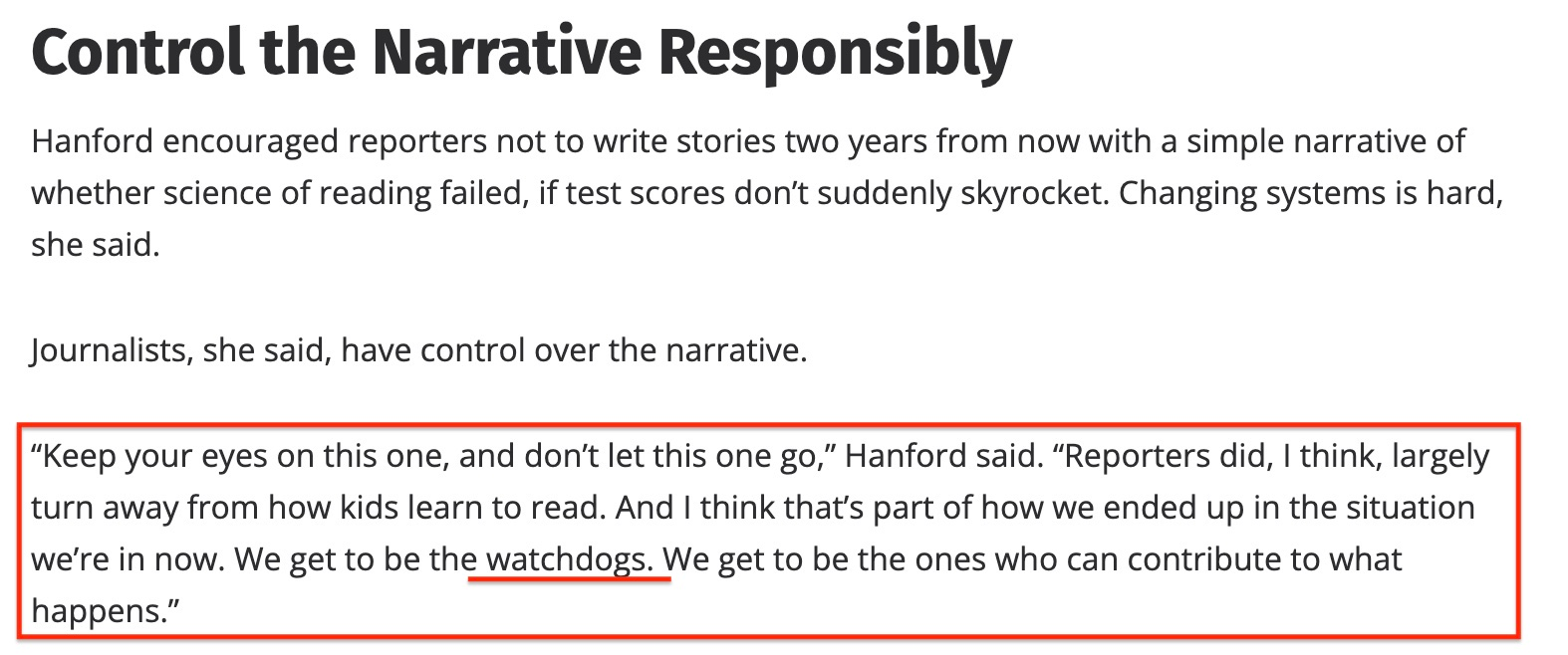
And right on cue, two years after Hanford’s plea, we have this from North Carolina [3]:
Third graders experienced a two-point drop in reading proficiency — decreasing from 49% to 47% — though third graders who achieved an alternative pathway saw a two-point increase (from 31% to 33%).
First- and second-graders’ scores are based on their performance on the DIBELS 8 assessment. Third graders can pass the beginning-of-grade test, end-of-grade test, or the retest for proficiency. However, these students can also achieve proficiency through an “alternative pathway,” which include DIBELS 8, STAR Reading — the state-approved alternative assessment — or the Read to Achieve test, according to Dan Tetreault, DPI’s assistant director of Early Learning.
“We really need to freeze something around comprehension in grade three, and spend a lot of time in that area with our students so that we begin to see growth — some change in their achievement. And I think it’s buried somewhere in comprehension,” said Board member Dr. Olivia Holmes Oxendine….
The results reflect the first drop in reading proficiency results for third-graders since science of reading implementation officially began during the 2022-23 school year. Reading proficiency among third graders at the end of that school year was 47%, rose to 49% by 2023-2024, and has now dropped back to 2020-2021 levels.
During the back-to-basics movements under the Reagan administration (which gave us the flawed A Nation at Risk report spawning endless education reform), Lou LaBrant wrote her memoir, completed in 1987 as she approached 100. LaBrant taught from 1906 to 1971, and in her memoir, she lamented having taught through and rejected multiple back-to-basics movements throughout her career and life.
And here we are again, facing another phonics gambit that isn’t working, that will never work because we always start with the wrong problems and cannot resist reform typically given the veneer of “science” while being mostly driven by ideology and beliefs about teaching and learning.
Like the Queen’s gambit in chess, the phonics gambit is old, misleading, and only works on those who don’t really understand the context of the game being played.
The major difference, of course, is that the losers in this gambit, again, are our students, especially the most vulnerable students who deserve something other than a game and a mostly petty contest of “my beliefs can beat up your beliefs.”
[1] See the following:
- What Shall We Do About Reading Today?: Looking Back to See Now More Clearly
- Reading Crisis 1961: “[N]o Further ‘Research’ into Methods of Reading Is Necessary”
- Back to the Future of Reading Instruction: 1990s Edition
- Literacy and NAEP Proficient, Tom Loveless
[2] See another cautionary tale currently in the UK: Disadvantaged pupils see drop in phonics results:
The proportion of disadvantaged pupils meeting the government’s “expected standard” in their year 1 phonics screening test has fallen this year, as overall progress since the pandemic has plateaued.
Government data published today shows 67 per cent of disadvantaged pupils taking the test for the first time met the standard this year, compared with 68 per cent last year.
Overall, 80 per cent of pupils passed the test in year 1, the same figure reported last year.
Achievement rates remain below pre-pandemic levels….
Summer-born pupils remain less likely to meet the government’s benchmark. Seventy-three per cent of pupils born in August met the standard this year, compared to 86 per cent of those born in September.
[3] See Closing the Books on Open Court Reading, Jeff McQuillan
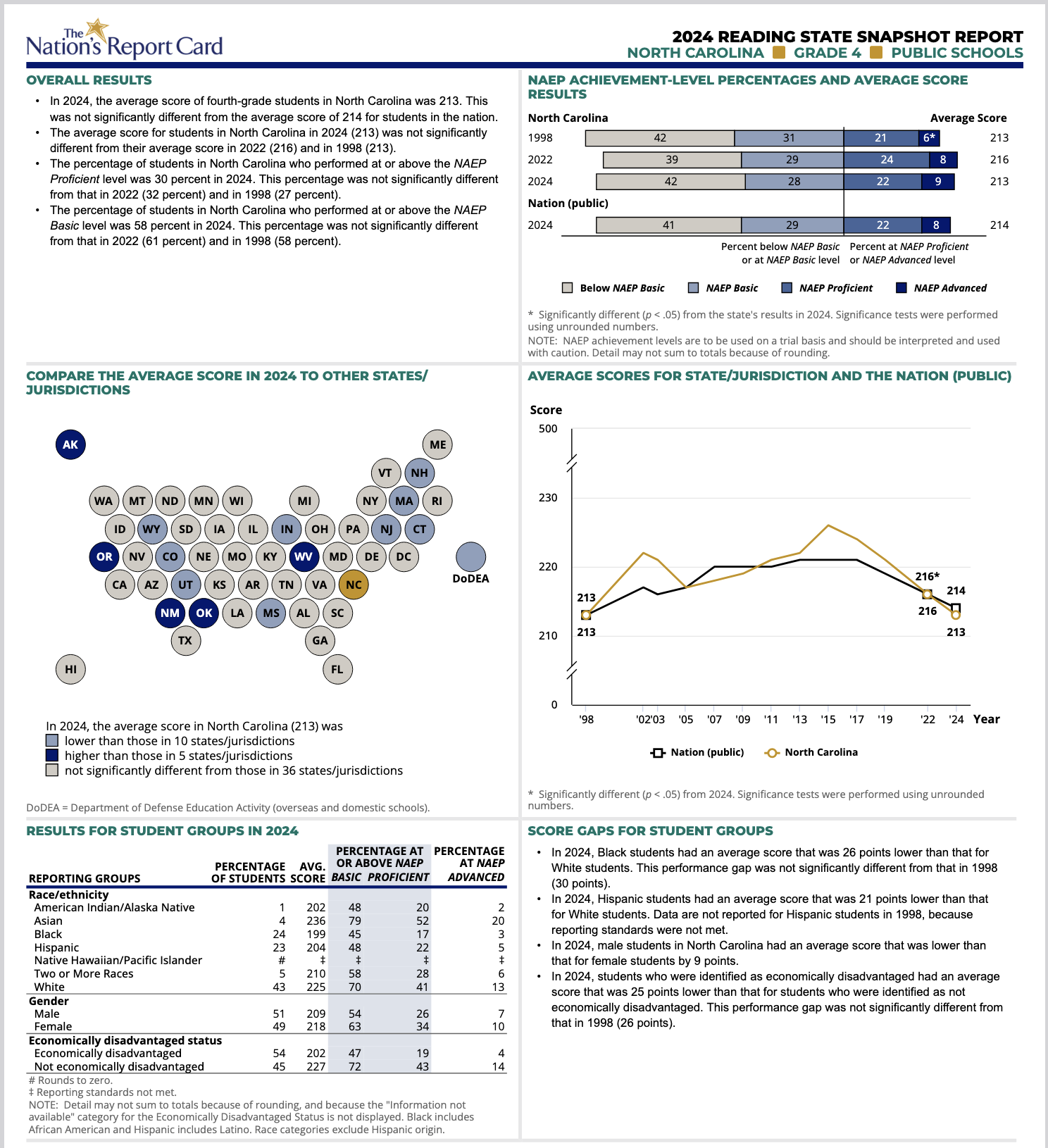
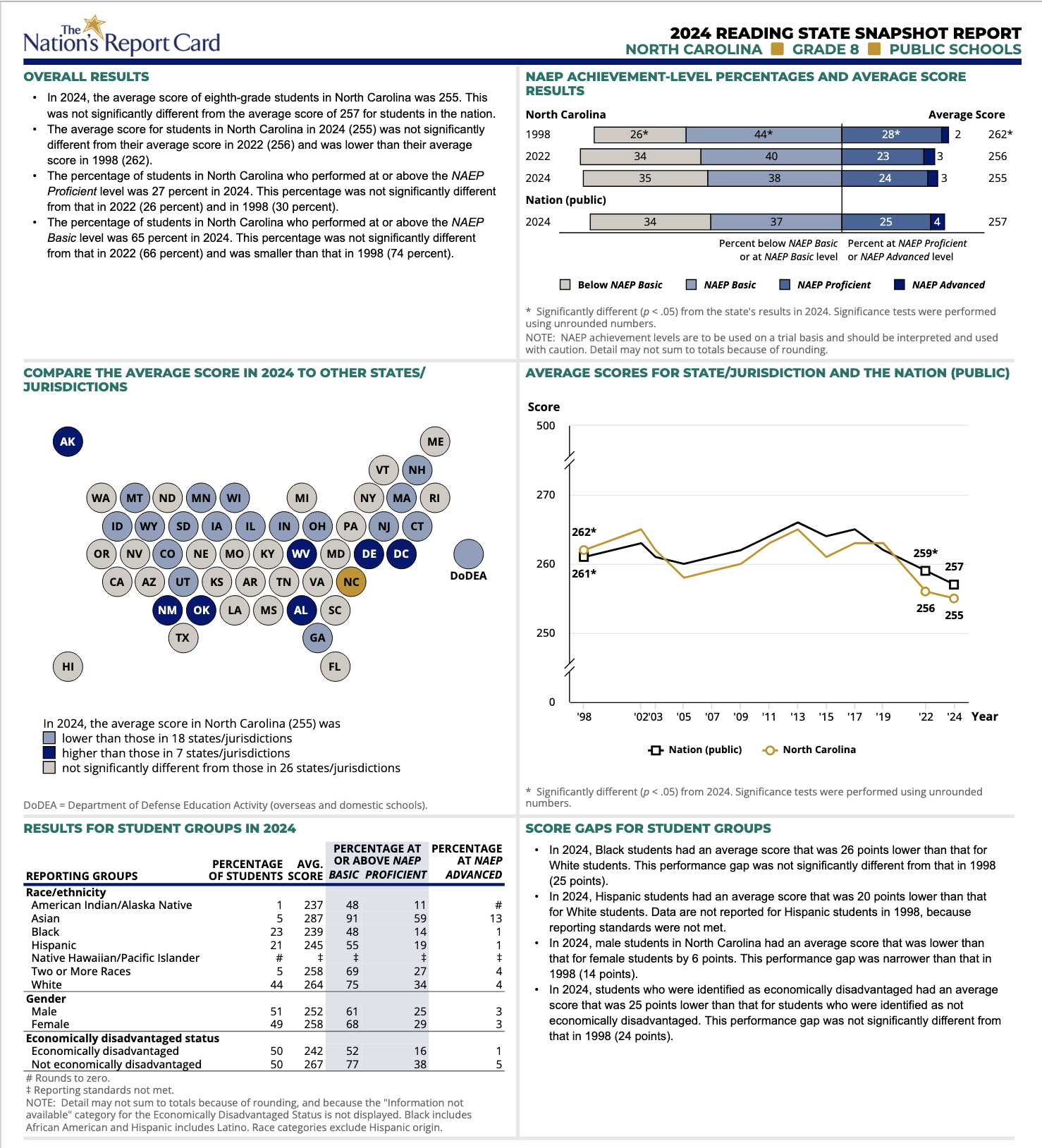
[4] Note NAEP reading data for NC:

 dr. p.l. (paul) thomas