P. L. Thomas, Professor of Education (Furman University, Greenville SC), taught high school English in rural South Carolina before moving to teacher education. He is a former column editor for English Journal (National Council of Teachers of English), current series editor for Critical Literacy Teaching Series: Challenging Authors and Genres (Brill), and author of Teaching Writing as Journey, Not Destination: Essays Exploring What ‘Teaching Writing’ Means (IAP, 2019) and How to End the Reading War and Serve the Literacy Needs of All Students: A Primer for Parents, Policy Makers, and People Who Care (IAP, in press). NCTE named Thomas the 2013 George Orwell Award winner. He co-edited the award-winning (Divergent Book Award for Excellence in 21st Century Literacies Research) volume Critical Media Literacy and Fake News in Post-Truth America (Brill, 2018). Follow his work @plthomasEdD and the becoming radical (https://radicalscholarship.wordpress.com/).
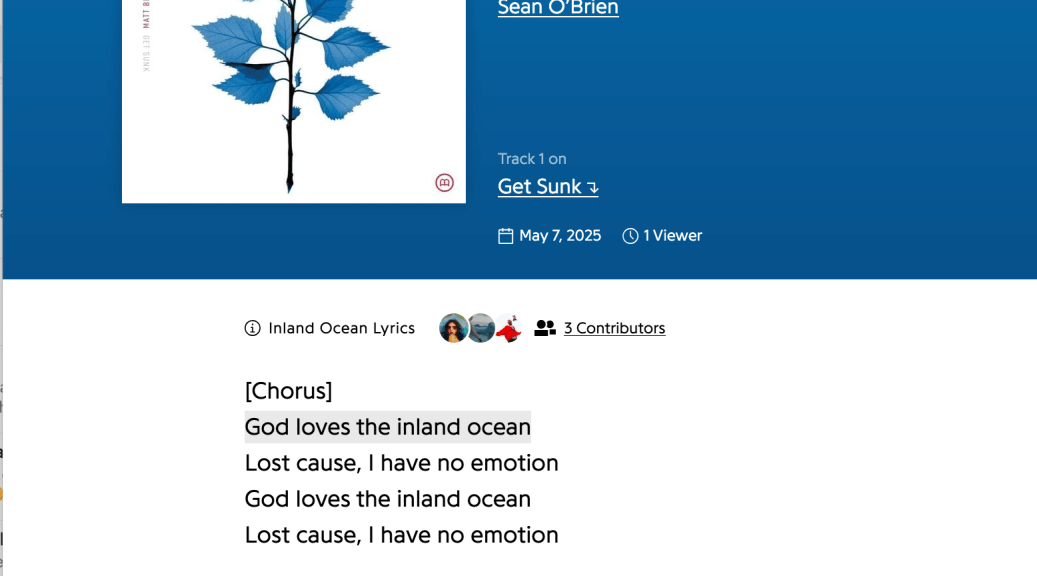
[Header image via Genuis, lyrics by Matt Berninger]
As I have noted often, over my forty-plus years teaching students to write, a few patterns remain constant, one of which is students lacking genre awareness.
On the first day of class, I often ask students what novels they read in high school English, and invariably, students include The Crucible or simply say “Shakespeare.”
They read these plays in book form, and have conflated anything in book form with “novel.”
Also, they mostly are experienced in being students who write, not writers.
So I spend a great deal of time and effort in my writing courses helping students become engaged with authentic writing practices, specifically fostering stronger writing purposes (and understanding writing forms/genres) and processes.
As a fan of The National and lead singer/lyricist Matt Berninger, I was particularly struck by this new interview [1] as Berninger begins promoting his second solo album, Get Sunk:
I think this interview is a really wonderful and brief entry point to discussing writer purpose and process (note that Berninger does use some profanity and references pot smoking).
Berninger is an endearing and quirky as his lyrics. And while he may seem flippant at first (“I’ll start fucking around with stuff”), he makes some very sophisticated and accessible observations about purposeful writing and the importance of the writing process (he has begun scribbling lyrics on baseballs instead of his standard journal, for example).
When the interviewer mentions his favorite lyric from Boxer (The National), Berninger offers a brief window into the importance of being a reader as well as the recursive nature of texts: “I stole that from Jonathan Ames.”
Berninger’s lyrics often pull from books, authors, and other song lyrics. Here is an ideal place to discuss with students the conventions of allusion and references as that creates tension with plagiarism (a great opportunity to tie in so-called canonized writers such as Marianne Moore and T.S. Eliot).
But the core comments I think students need to hear and then practice in the writing are about understanding different writing purposes/forms:
I do think songwriting is a very specific kind of thing…. It’s not—there’s poetry and there’s songwriting…. And I think they’re as different as like swimming and ice skating…. It’s like it’s still just words or just water but they’re totally different things.
This distinction and metaphor are powerful because they acknowledge the complexity of choosing and writing in different ways, for different purposes, and for different audiences.
Berninger also talks about his use of scribbling on baseballs for writing ideas. While quirky, this really captures the writing process in an authentic way (not the scripted way often taught in school).
As a teacher of writing and a writer (as well as avid reader), I want students to be fully engaged as writers—not as students performing a stilted essay for the teacher/professor.
We want for our students a sense of purpose, a demonstration of intent, an awareness of form and audience, and ultimately, a writing product of their choosing and for their purposes.
And in the era of intensified AI, I want to stress that AI has no place in these goals because students need and deserve opportunities to experience all of these aspects of brainstorming, drafting, and presenting a final product.
It may seem crude, careless, and flippant, but if we listen carefully, Berninger’s “fucking around” demonstrates the power and complexity of being a writer—and thus, being a teacher of writing.
[1] I highly recommend this blog post on Bon Iver/Justin Vernon as a companion to the Berninger interview.
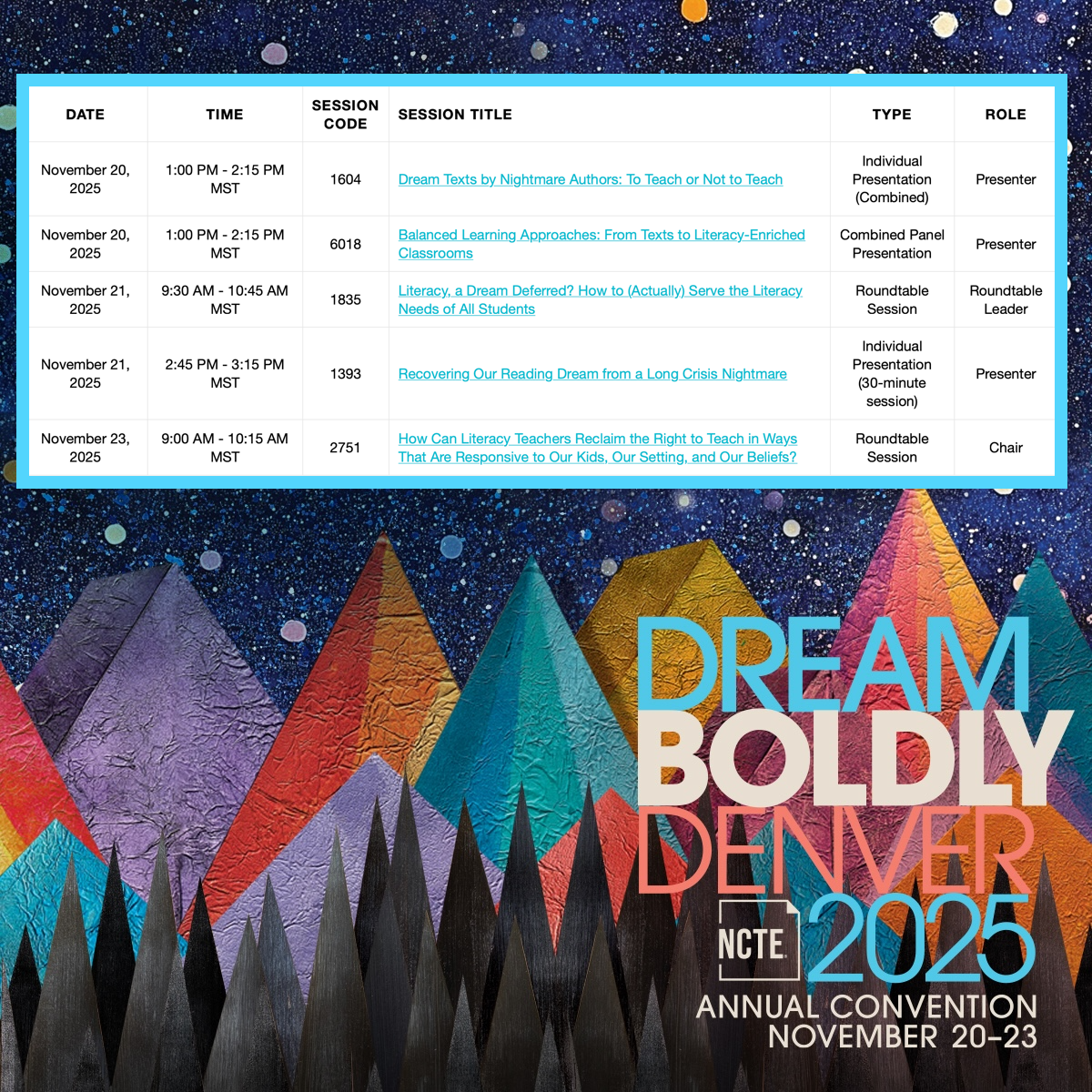
Many beloved authors have been exposed as abusive people or advocates for offensive beliefs. From the revelations about Neil Gaiman to the anti-trans stance by JK Rowling, whether to teach their works despite those failures or controversies confronts teachers throughout K-16 literacy classrooms. This session examines if and why teachers should or should not teach dream texts by nightmare authors.
Roundtable: Literacy, a Dream Deferred?: How to (Actually) Serve the Literacy Needs of All Students
11/21/2025 – 9:30 – 10:45, Room 108/110
Roundtable Presentation
Literacy and Literature as Casualties of Reading Wars
Access a PDF of the presentation HERE [Updated 11/21/25]
Reading Wars often have two overlapping components, debates about how reading should be taught and what texts students should (and should not) read. Both of these elements tend to promote ideological agendas at the expense of authentic approaches to literacy and literature.
Individual Presentation: Recovering Our Reading Dream from a Long Crisis Nightmare
11/21/2025 – 2:45 – 3:15, Mile High Ballroom 1A/1B
In 1961, Jacques Barzun in Tomorrow’s Illiterates declared “illiteracy is still with us.” Charles Child Walcutt added: “[N]o further ‘research’ into methods of reading instruction is necessary.” This session examines reading crisis/reform cycles to reconsider the stories told about reading and offer a new approach for reform that serves the needs of students and supports teacher professionalism.
Roundtable: How Can Literacy Teachers Reclaim the Right to Teach in Ways that are Responsive to Our Kids, Our Setting, and Our Beliefs?
11/23/2025 – 9:00 – 10:15, Room 107/109/111
Talk
Fact Checking “The reading wars are ending. Phonics won.” (Washington Post Editorial Board)
The Editorial Board at The Washington Post published a bold claim: The reading wars are ending. Phonics won. Here, that claim is fact checked focusing on the false claim that California adopted Mississippi-style “science of reading” legislation. A brief examination of the misleading comparison of CA and MS shows that the WaPo Editorial Board has declared a false end to the reading war as well as mischaracterizing the role of phonics.
This roundtable will share with teachers four “red flags” (Chris Ferguson) to critically engage with media coverage of educational issues and research (highlighting the “science of” coverage): RED FLAG 1: Claims that all the evidence is on one side of a controversial issue; RED FLAG 2: Reversed burden of proof. “Can you prove it’s not the smartphones?”; RED FLAG 3: Failing to inform readers that effect sizes from studies are tiny, or near zero, only mentioning they are “statistically significant.”; RED FLAG 4: Comparisons to other well-known causal effects.
Big Lies of Education: “Science of” Era Edition [Access PP PDF Here]
Education practices and policy are often directly and indirectly driven by the stories told in the media, among the public, and by political leaders. This session will explore the Big Lies in the compelling but misleading narratives, including A Nation at Risk/education “crisis,” reading proficiency/NAEP, National Reading Panel, poverty as an excuse, international test rankings and economic competitiveness, grade retention, growth mindset/grit, and the word gap.
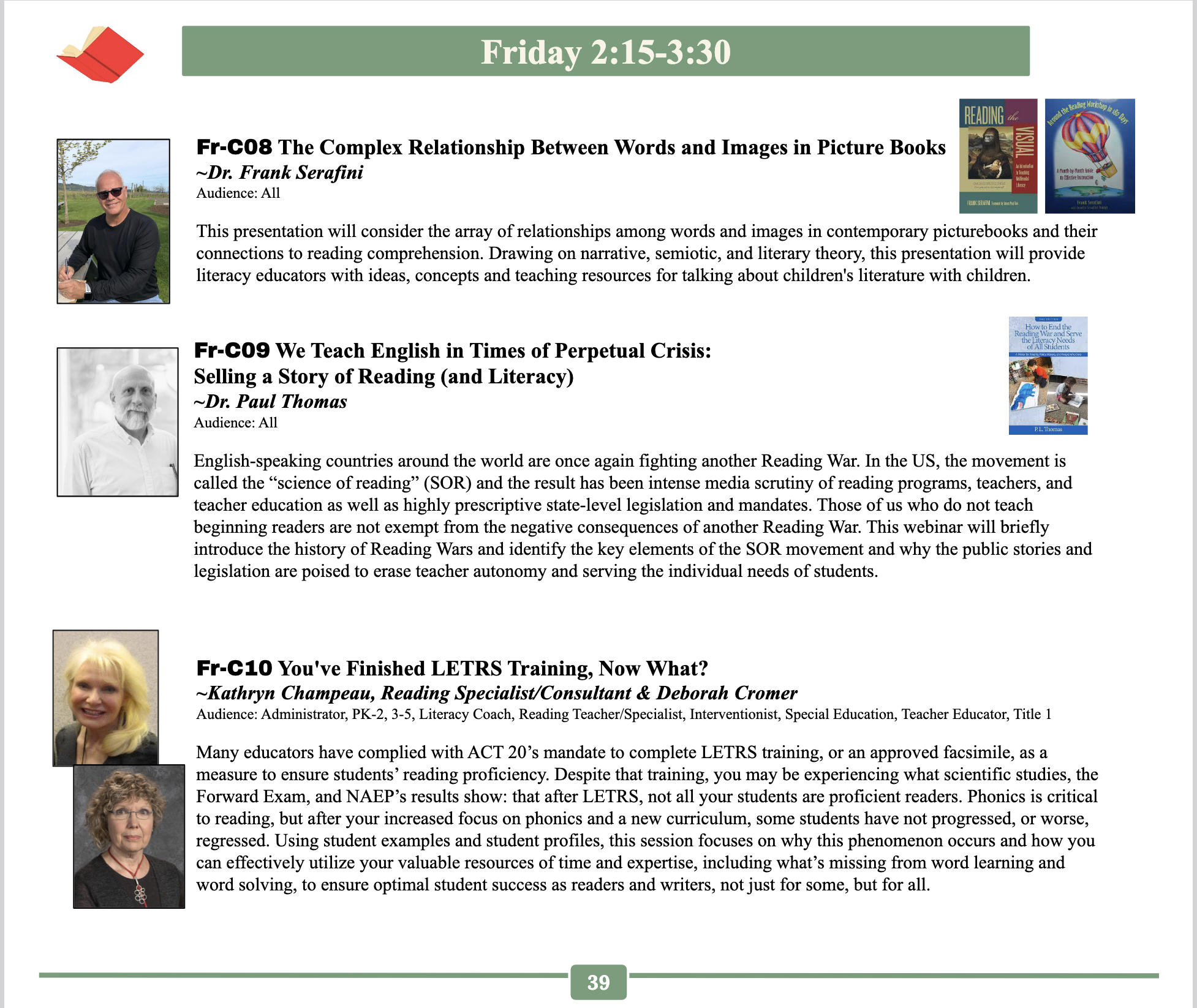
English-speaking countries around the world are once again fighting another Reading War. In the US, the movement is called the “science of reading” (SOR) and the result has been intense media scrutiny of reading programs, teachers, and teacher education as well as highly prescriptive state-level legislation and mandates. Those of us who do not teach beginning readers are not exempt from the negative consequences of another Reading War. This presentation will briefly introduce the history of Reading Wars and identify the key elements of the SOR movement and why the public stories and legislation are poised to erase teacher autonomy and serving the individual needs of students.
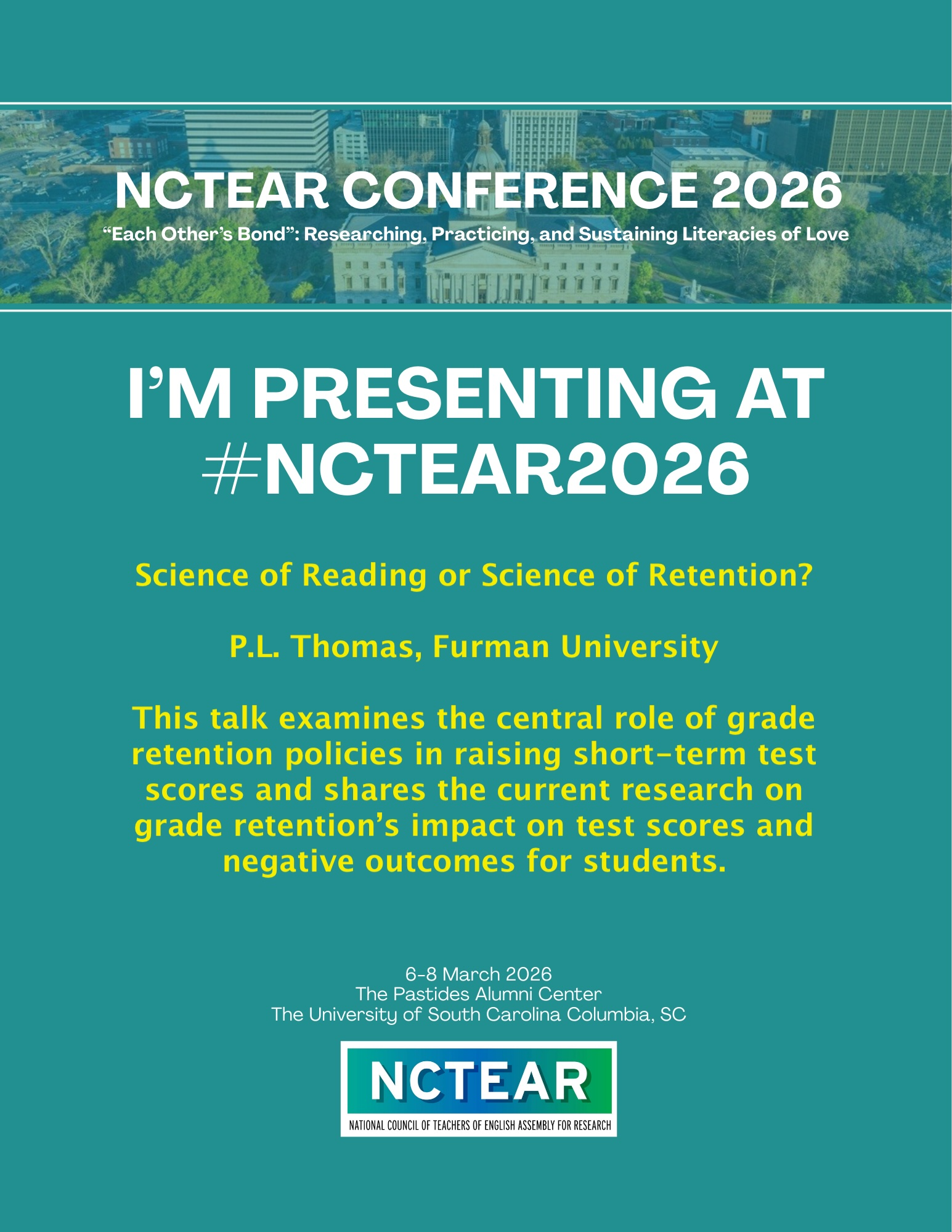
This talk examines the central role of grade retention policies in raising short-term test scores and shares the current research on grade retention’s impact on test scores and negative outcomes for students.
Alaska Task Force on the National Assessment of Education Progress (NAEP)
Likely the most influential standardized test in the US is the National Assessment of Educational Progress (NAEP), under the purview of the beleaguered US Department of Education.
Also without question, NAEP is one of the most misunderstood and misrepresented standardized tests since the mainstream media, political leaders, pundits, and the public routinely shout “Crisis!” with each release of NAEP data.
NAEP’s achievement levels are misleading at best, but at worst, those achievement levels were designed to create the appearance of perpetuate educational failure, and yes, crisis.
“Proficient” is almost always conflated with “grade level” resulting in false claims, for example, that 2/3 of fourth graders are reading below grade level. NAEP’s “basic” is approximately what most states identify as “proficient”—suggesting on grade level (see an extensive analysis here).
What most people misunderstand as well about NAEP is its purpose: NAEP was born in the fertile soil of high-stakes accountability education reform spurred by the Reagan administration’s propaganda A Nation at Risk. Reagan sought to reintroduce forced prayer in schools and wanted to close the Department of Education, labeled an “abomination.”
However, what Reagan spawned was over four decades of ever-changing standards and tests to hold schools, teachers, and students accountable. In short, NAEP was created as a test of random samples of students to hold states accountable for their educational standards and outcomes (historically, public education has been the responsibility of the states, and NCLB in 2001 was a departure toward more federal oversight).
Frankly, NAEP was designed as an accountability mechanism, not a way to provide feedback on individual student achievement. (Note that state-level accountability testing was designed to provide individual student assessment that should provide evidence for instruction.)
In 2025, on the heels of recent shouts of “Crisis!” (again) because almost everyone has misunderstood and misrepresented NAEP scores across math, reading, and even civics, Reagan’s dream may be coming true since the Trump administration has promised to end the USDOE, and that move imperils the future of NAEP.
As Peter Greene has confronted, some have taken this uncertainty about NAEP to propose turning NAEP into (you should pause here to prepare yourself for the inanity) the failed Common Core experiment that sought to replace the state-based public education accountability process with national standards and testing.
Into the nonsense that is NAEP historically and the current doubling-down on Common Core Redux, I want to make a modest proposal about the future of NAEP.
Actually I want to make two modest proposals, acknowledging that the first is never going to happen (although it is the one more strongly supported by empirical data; you know, the “science” that so many education reformers claim to worship).
I strongly reject standardized testing as well as traditional classroom testing and grades. That has been at the core of my 40-plus-year career, and again, this is informed not just by my experiences as an educator but by a very robust body of research.
Therefore, my first modest (and completely unrealistic in the US) proposal is the conclusions reached by Maron and Tienken:
Almost 63% of the variance in test performance was explained by social capital family income variables that influence the development of background knowledge. Background knowledge is a known predictor of standardized test results. Family income variables are immutable by schools. Only public policies, outside the control of school personnel, can influence family income.
The United States has one of the highest levels of childhood poverty among Organisation of Economic Co-operation and Development (OECD) countries. It is well known that the social safety net in the United States is not as strong as some nations in Europe and other parts of the world [20]. Neoliberal policies have greatly reduced government support for families in the United States. Important social policy frameworks that reduce poverty, such as monetary, labor, fiscal, and health policies, have been weakened over the last 40 years, causing increases in childhood poverty in the United States compared to other democratic countries [41].
Although some education policy makers in the United States claim that standardized test results are an important component of a comprehensive system of educational quality control, the results from decades of research on the topic suggest otherwise [42]. The influence of family social capital variables manifests itself in standardized test results. Policy makers and education leaders should rethink the current reliance on standardized test results as the deciding factor to make decisions about student achievement, teacher quality, school effectiveness, and school leader quality. In effect, policies that use standardized test results to evaluate, reward, and sanction students and school personnel are doing nothing more than rewarding schools that serve advantaged students and punishing schools that serve disadvantaged students.
Alas, the US will never follow this last point because we refuse to acknowledge systemic forces and remain a people fatally committed to rugged individualism and bootstrap mythologies.
And thus, here is my compromise, a modest proposal that can and should be explored for the future of NAEP:
Rename achievement levels in standardized testing that share a national standard metric for the levels (all states and NAEP would share the same achievement levels and metric).
Achievement levels must be age-level and not grade-level(currently, using “grade level” allows states to game scores through grade retention, for example). A clear system of “below age level,” “age level,” and “above age level” would simplify reporting and allow for more accurate political, media, and public responses to data.
This proposal would be a first step, I hope. The problem at first is that this doesn’t address the excessive testing culture the US has embraced without positive outcomes for over forty years.
This first step, I think, can create a new basis for evaluating and viewing our public schools, and then, we may be primed to begin dismantling the standardized testing machine—or at least become more acclimated to reducing it dramatically.
The great irony of the power of high-stakes testing in the education accountability era is that it has proven only one thing: Weighing a pig does not make it fatter.
Testing, testing, and testing has not improved schools, teachers, or students, but it has created a perpetuate state of educational crisis.
Perpetual educational crisis serves only political agendas and the unquenchable education marketplace.
If we can entertain for a moment of idealism that the Trump disaster doesn’t destroy both the USDOE and public education, let’s consider how to more forward in ways that better serve the promise of public education and our fragile democracy.
If not an end to NAEP, at least a better NAEP that serves the interest of students and not political or market agendas?
The story is simple and may sound obvious: Poor children suffer from a significant “word gap” (WG) when compared to middle-class and affluent children.
To re-cap, the WG Story runs as follows: Parents from lower-class backgrounds do not talk enough to their children in the early years of life, in contrast to affluent European American parents who talk a great deal. This relative deficit impedes children’s vocabulary development, which, in turn, leads them to under achieve in school. It is a small step from this narrative to a rationale for intervention: If these parents could be taught to behave more like their privileged counterparts, marginalized children would develop larger vocabularies, which would boost their success in school.
As is typical in the Big Lies of Education, compelling and enduring stories do not necessarily prove to be accurate. And the resilience of Big Lies often rests on a complex matrix of causes, detailed by Miller, Sperry, and Sperry:
In sum, nearly 20 years after its inception, the WG Story had gone from academic obscurity to celebrity status. Biases of class, race, and method paved the way for this juggernaut, which gathered force with the convergence of two events, NCLB and LENA, in its Life History. The WG Story flourished by traveling back and forth between academic, policy, and public spheres, illustrating the permeability of discourses (Bakhtin,1981), and inadvertently reproducing the educational inequality it was intended to reduce.
The WG Story and its impact are driven by deficit ideologies (what most people believe regardless of empirical evidence) despite flawed methodology in the foundational research, which, according to Miller, Sperry and Sperry, “did not arise from virgin ground but rather from soil already cultivated with the language deprivation story” that began in the 1960s.
They also acknowledge the role of the media and advocacy:
But the WG Story did not remain sealed off in the academy (Bakhtin, 1981, 1986). It was widely covered in the popular press, and high-profile foundations amplified the Story by funding initiatives to close the Gap.
Again, uncritically embracing the WG Story reflects core deficit beliefs: “The most fundamental historical through-line between the WG Story and its backstory is the fixation on the language defects of marginalized families.”
There is an enduring and false set of beliefs that link deficit ideologies about social class and language: So-called nonstandard or underdeveloped literacy reflects moral and intelligence deficits in not just individual people but entire classifications of people.
In short, any person’s functional vocabulary is not a measure of that person’s character or intelligence, particularly when framed against a norm or standard based on cultural and ideological beliefs instead of valid empirical evidence.
Dyson, A. H. (2015). Research and Policy: The Search for Inclusion: Deficit Discourse and the Erasure of Childhoods. Language Arts, 92(3), 199-207. http://www.jstor.org/stable/24575568
Currently, US education is under one of the most intense eras of criticism—although there has never been a moment over the past century and a half absent cries of education “crisis.”
Notably during the accountability era begun in the early 1980s, permanent (and manufactured) education crisis has been further eroded by the education marketplace and fads promising to end that crisis.
One enduring tension in the field of education as well is between calls for high-quality and narrowly “scientific” evidence for educational practices [1] and the pervasive embracing of education fads that promise more than research supports.
Two of the current examples of this “gap” [2] between research and practice are growth mindset and grit theories and interventions.
I am now revising a chapter on the current research on growth mindset and grit, and offer here an overview of what educators should know before embracing or continuing to embrace advocacy for both theories and interventions that promise to address student achievement.
In short, the research does not support claims by advocates for growth mindset and grit. Here is a list of what we currently do know about both:
Advocates for growth mindset and grit significantly overstate the casual relationship between these theories/interventions and student achievement.
Research published and cited by advocates is often plagued by flawed research design and/or population concerns, expectancy bias, and reporting errors (including financial conflicts) (Macnamara & Burgoyne, 2023).
Advocates tend to acknowledge that implementation of both growth mindset and grit is often suffers from oversimplification, misunderstanding, and reducing the theories and interventions to slogans and isolated lessons.
Meta-analyses and high-quality independent studies tend to have mixed results with weak effectiveness measures that may not be significant. Increasingly, research on both is negative, in fact (see chart below).
Despite the lack of evidence to support either growth mindset or grit, both continue to be implemented in many schools; some scholars raise concerns that this support is driven by ideology (deficit ideology, bootstrapping/ rugged individualism/ meritocracy) and racism/classism.
Scholars also warn that overemphasizing growth mindset and grit allows educators and policy to ignore the more significant impact of out-of-school factors [3], and as a result, often messaging and interventions manifest as “blaming the victims.”
Below, I include a chart of recent public commentary and a research overview of growth mindset and grit. I also provide the references after the chart with a few key quotes in some of the more powerful studies.
Positive Dweck, et al. Dweck & Yeager, 2019 Hecht et al., 2021
Mixed Haimovitz & Dweck, 2017 Miller, 2019 Sisk et al., 2018 Tipton et al., 2023 Yeager et al., 2022 Yeager & Dweck, 2020
Negative Brez et al., 2020 (Burnette et al., 2018; Dixson et al., 2017; Sisk et al., 2018; Schmidt et al., 2017) Burgoyne et al., 2020 Ganimian, 2020 Li & Bates, 2019 Macnamara & Burgoyne, 2023
Cushing, I. (2021), Language, discipline and ‘teaching like a champion.’ British Educational Research Journal, 47(1), 23-41. https://doi.org/10.1002/berj.3696
Dudley-Marling, C. (2007). Return of the deficit. Journal of Educational Controversy, 2(1), 1–13.
Freire, P. (2000). Pedagogy of freedom: ethics, democracy, and civic courage. Rowman & Littlefield Publishers.
Thomas, P.L. (2023). The “Science of Reading,” education faddism, and the failure to honor the intellectual lives of all children: On deficit lenses and ignoring class and race stereotyping. Voices in the Middle, 30(3), 17-21. https://publicationsncte.org/content/journals/10.58680/vm202332439
Brez, C., Hampton, E. M., Behrendt, L., Brown, L., & Powers, J. (2020). Failure to replicate: Testing a growth mindset intervention for college student success. Basic and Applied Social Psychology, 42(6), 460–468. https://doi.org/10.1080/01973533.2020.1806845
“The pattern of findings is clear that the intervention had little impact on students’ academic success even among sub-samples of students who are traditionally assumed to benefit from this type of intervention (e.g., minority, low income, and first-generation students)” (p. 464)
Burgoyne, A. P., Hambrick, D.Z., & Macnamara, B.N. (2020). How firm are the foundations of mind-set theory? The claims appear stronger than the evidence. Psychological Science, 31(3).https://doi.org/10.1177/0956797619897588.
Burnette, J. L., Russell, M. V., Hoyt, C. L., Orvidas, K., & Widman, L. (2018). An online growth mindset intervention in a sample of rural adolescent girls. British Journal of Educational Psychology, 88(3), 428–445. https://doi.org/10.1111/bjep.12192
Dixson, D. D., Roberson, C. C. B., & Worrell, F. C. (2017). Psychosocial keys to African American achievement? Examining the relationship between achievement and psychosocial variables in high achieving African Americans. Journal of Advanced Academics, 28(2), 120–140. https://doi.org/10.1177/1932202X17701734
Ganimian, A. J. (2020). Growth-mindset interventions at scale: Experimental evidence from Argentina. Educational Evaluation and Policy Analysis, 42(3), 417–438. https://doi.org/10.3102/0162373720938041
Haimovitz K., & Dweck, C.S. (2017). The origins of children’s growth and fixed mindsets: New research and a new proposal. Child Development, 88(6), 1849–1859. https://doi.org/10.1111/cdev.12955
Hecht, C. A., Yeager, D. S., Dweck, C. S., & Murphy, M. C. (2021). Beliefs, affordances, and adolescent development: Lessons from a decade of growth mindset interventions. In J. J. Lockman (Ed.), Advances in child development and behavior (Vol. 61, pp. 169–197). JAI. https://doi.org/10.1016/bs.acdb.2021.04.004
Li, Y., & Bates, T. C. (2019). You can’t change your basic ability, but you work at things, and that’s how we get hard things done: Testing the role of growth mindset on response to setbacks, educational attainment, and cognitive ability. Journal of Experimental Psychology: General, 148(9), 1640–1655. https://doi.org/10.1037/xge0000669
Macnamara, B. N., & Burgoyne, A. P. (2023). Do growth mindset interventions impact students’ academic achievement? A systematic review and meta-analysis with recommendations for best practices. Psychological Bulletin, 149(3–4), 133–173. https://doi.org/10.1037/bul0000352
“Taken together, our findings indicate that studies adhering to best practices are unlikely to demonstrate that growth mindset interventions bene t students’ academic achievement. Instead, significant meta-analytic results only occurred when quality control was lacking, and these results were no longer significant after adjusting for publication bias. This pattern suggests that apparent effects of growth mindset interventions on academic achievement are likely spurious and due to inadequate study design, awed reporting, and bias” (p. 163)
Petrik, R. L., Vega, J., & Vindas-Meléndez, A. R. (2022). A reflection on growth mindset and meritocracy. Journal of Humanistic Mathematics, 12(1), 408–421. DOI: 10.5642/jhummath.202201.3
Schmidt, J.A., Shumow, L., & Kackar-Cam, H.Z. (2017). Does mindset intervention predict students’ daily experience in classrooms? A comparison of seventh and ninth graders’ trajectories. Journal of Youth and Adolescence, 46(3), 582–602. https://doi.org/10.1007/s10964-016-0489-z
Sisk, V. F., Burgoyne, A. P., Sun, J., Butler, J. L., & Macnamara, B. N. (2018). To what extent and under which circumstances are growth mind-sets important to academic achievement? Two meta-analyses. Psychological Science, 29(4), 549-571. https://doi.org/10.1177/0956797617739704
Tipton, E., Bryan C., Murray J., McDaniel M., Schneider B., & Yeager D.S. (2023, March/April). Why meta-analyses of growth mindset and other interventions should follow best practices for examining heterogeneity: Commentary on Macnamara and Burgoyne (2023) and Burnette et al. (2023). Psychological Bulletin, 149(3-4), 229-241. doi: 10.1037/bul0000384
Yeager, D. S., Carroll, J. M., Buontempo, J., Cimpian, A., Woody, S., Crosnoe, R., Muller, C., Murray, J., Mhatre, P., Kersting, N., Hulleman, C., Kudym, M., Murphy, M., Duckworth, A. L., Walton, G. M., & Dweck, C. S. (2022). Teacher mindsets help explain where a growth-mindset intervention does and doesn’t work. Psychological Science, 33(1), 18-32. https://doi.org/10.1177/09567976211028984
Yeager D. S., & Dweck C. S. (2020). What can be learned from growth mindset controversies? American Psychologist, 75(9), 1269–1284. https://doi.org/10.1037/amp0000794
Allen, R.E., Kannangara, C., & Carson, J. (2021). True grit: How important is the concept of grit for education? A narrative literature review. International Journal of Educational Psychology, 10(1), 73-87. https://doi.org/10.17583/ijep.2021.4578
Barcza-Renner, K., Shipherd, A. M., & Basevitch, I. (2024). An examination of the relationship between burnout and grit in college athletes. Asian Journal of Sport & Exercise Psychology, 4(3), 138–143. https://doi.org/10.1016/j.ajsep.2024.10.007
“This study was one of the first to examine the relationship between burnout and grit in student-athletes. The results indicated that student-athletes who were high in grit, also self-reported symptoms of burnout and that this relationship was strongest during the first two years of college. It is plausible athletes who are grittier are also more likely to persevere through stress and challenges, including burnout symptoms. Athletes higher in grit may also be investing more effort into their sport, which could be increasing symptoms of burnout, as well.” (p. 142)
Credé, M. (2018). What shall we do about grit? A critical review of what we know and what we don’t know. Educational Researcher, 47(9), 606-611. https://doi.org/10.3102/0013189X18801322
“For all its intuitive appeal, the grit literature is currently characterized by a number of serious theoretical and empirical challenges ranging from a lack of construct validity, discriminant validity, and predictive validity. At present there is no empirical support for the idea that grit is the combination of perseverance and passion or for the claim that grit adds to our understanding of success and performance. Indeed, the best available evidence strongly suggests that grit is largely a repackaging of conscientiousness—a widely studied personality trait” (p. 610)
Credé, M., Tynan, M.C., & Harms, P.D. (2017). Much ado about grit: A meta-analytic synthesis of the grit literature. Journal of Personality and Social Psychology, 113(3), 492–511. https://doi.org/10.1037/pspp0000102
Cushing, I. (2021), Language, discipline and ‘teaching like a champion.’ British Educational Research Journal, 47(1), 23-41. https://doi.org/10.1002/berj.3696
Goodman, S. (2018). It’s not about grit: Trauma, inequity, and the power of transformative teaching. Teachers College Press.
Gorski, P.C. (2016). Poverty and the ideological imperative: A call to unhook from deficit and grit ideology and to strive for structural ideology in teacher education. Journal of Education for Teaching, 42(4), 378-386. DOI: 10.1080/02607476.2016.1215546
Kohn, A. (2014). Grit? A skeptical look at the latest educational fad. Educational Leadership, 74, 104–108.
“Make no mistake: Duckworth is selling grit, not dispassionately investigating its effects” (para. 6).
Stahl, G. (2024). “Pedagogies of the poor” to “pedagogies on the poor”: Compliance, grit, and the corporeal. In P.P. Trifonas & S. Jagger (eds) Handbook of curriculum theory, research, and practice. Springer International Handbooks of Education. Springer. https://doi.org/10.1007/978-3-031-21155-3_39
Tewell, E. (2020). The problem with grit: dismantling deficit thinking in library instruction. Libraries and the Academy20(1), 137-159. https://dx.doi.org/10.1353/pla.2020.0007.
“The ideal of meritocracy, much like grit and growth mind-set, assumes that the best and brightest rise to the top based on their hard work and determination, without regard for the historical and present-day subordination of many groups….Deficit models view students as perpetual lacking and at fault. This belief is neither healthy nor accurate. Instead, we need to remain open to broader ways of engaging students and of thinking about their lives, consider what power they really have to effect change, and where we share some responsibility. It is essential to examine how issues of access and equity shape our students’ experiences and to question how success is defined and attained” (p. 150)
[3] Maroun, J., & Tienken, C.H. (2024). The pernicious predictability of state-mandated tests of academic achievement in the United States. Education Sciences, 14(2), 129-142. https://doi.org/10.3390/educsci14020129
On April 28, 1967, Muhammad Ali publicly defied being drafted into the Vietnam War, costing him his heavy-weight title and derailing his career for three years during his prime.
Ali’s willingness to put publicly his name and his words on his beliefs reminds me of James Baldwin’s response to William Faulkner’s call for patience when confronting racism and inequity in the US: “There is never time in the future in which we will work out our salvation. The challenge is in the moment, the time is always now.”
I am also compelled by a central motif in the life and work of historian and activist Howard Zinn, who argued that we cannot be neutral on a moving train. In this era of the second Trump administration, our democracy and academic freedom train is heading off a cliff; we are all on board.
At the end of the first Trump administration, I implored academics to do more, to speak more, to use our academic and intellectual capital to advocate for the marginalized and the vulnerable as well as the core principle of what academics and education must preserve—academic freedom.
Yet, most academics and colleges/universities remained committed to the “politics of silence” approach to the threats around us.
We have chosen a sort of self-preserving silence, in fact, despite the danger that poses, one confronted by poet Adrienne Rich:
The study of silence has long engrossed me. The matrix of a poet’s work consists not only of what is there to be absorbed and worked on, but also of what is missing, desaparecido, rendered unspeakable, thus unthinkable.
The current political dismantling of K-12 and higher education is an assault on democracy; real people are suffering in inexcusable ways. The values we claim to hold sacred are being destroyed each moment we hesitate, each moment we remain silent, each moment we fail to act.
We academics may believe that the Ivory Tower allows us to protect our community as our only priority, and thus that we must protect that Ivory Tower. But I have witnessed at the highest level of my 41-year career very real and justified fear among college students, staff, and faculty.
A first-year student writing about their journey as a gay child navigating their family expectations concluded an essay with the following chilling recognition: “No one knows what the future holds for the United States now. Unfortunately, what we face is not simply a political matter, but rather, a threat on individual liberty, and I am scared for what will happen in the next four years.”
And for faculty—especially those most vulnerable due to personal status or rank—who have served the academic community as scholars and teachers, the same fear of the uncertain and hostile world beyond the Ivory Tower is directly impacting how and if we teach as we know we should. Many of us have targets on our backs simply for remaining committed to the academic freedom we hold sacred and fulfilling our moral obligation to address diversity, equity, and inclusion.
That Ivory Tower was never protecting anyone; it isn’t protecting us now in that increasingly hostile world.
Therefore, now is not the time to keep our heads down, now is not the time to retreat into the politics of silence.
As a former high school English teacher, I hear constantly in my mind Willy Lohman imploring “the woods are burning,” and I fear if we persist in a “politics of silence” approach, if we bow to cultural expectations that education and educators must appear to be politically neutral, that fire will consume us all.
We could be better than that, we should be better than that.
The world is at least fifty percent terrible, and that’s a conservative estimate, though I keep this from my children.
…This place could be beautiful, right? You could make this place beautiful.
Ultimately, we must make a decision, one reflected in William Butler Yeats’s enduring poem:
The best lack all conviction, while the worst Are full of passionate intensity.
The time is now to reject the politics of silence that brought us here, to speak and act in the name of academic freedom, in the name of our students walking our campuses now but who must enter the very real world burning around them.
Yesterday, we had our last class session in my upper-level writing and research course that is grounded in students analyzing and evaluating how media covers a chosen education topic.
In that last class, we debriefed about what students concluded about media coverage of education. While some found the coverage valid and informative, much of the discussion focused on why media perpetuates misinformation more often than not—notably about student reading proficiency in the US.
Right on cue, then, I saw this posted on social media, Teaching reading is rocket science, with these two recurring claims that are, in fact, misleading at best and false at worst (see “Recommended” links below):
Eli’s story, and the stories of all my students, are not the exception. They represent the shared reality for two-thirds of our children, here in California and across the country since the 1990s. My students are not at risk because they cannot yet read — they are at risk because not knowing how to read limits their access to opportunities, both academically and beyond.
Research shows when we teach students to read by directly guiding them to break the code of how sounds in letters work, about 95% of them can become strong readers — including multilingual learners and those with dyslexia. So why have only one-third of our fourth graders been reading at grade level for the past three decades? This gap persists because students haven’t had access to evidence-based literacy instruction drawn from decades of vast interdisciplinary research in areas such as cognitive psychology, linguistics, communication sciences and education.
The “2/3 of students are not reading a grade level” claim is one of the most powerful recurring claims in the media. Note these high-profile examples:
The stakes were high. Research shows that children who don’t learn to read by the end of third grade are likely to remain poor readers for the rest of their lives, and they’re likely to fall behind in other academic areas, too. People who struggle with reading are more likely to drop out of high school, to end up in the criminal justice system, and to live in poverty. But as a nation, we’ve come to accept a high percentage of kids not reading well. More than 60 percent of American fourth-graders are not proficient readers, according to the National Assessment of Educational Progress, and it’s been that way since testing began in the 1990s.
One of the most bearish statistics for the future of the United States is this: Two-thirds of fourth graders in the United States are not proficient in reading.
Despite ample evidence to the contrary and repeated clarifications from many educators and scholars (See “Big Lie” link in “Recommended” below), media characterizations of student reading proficiency continues to be misrepresented, primarily by misunderstanding NAEP achievement levels, because the public has always believed that “kids today can’t read”—despite there being little evidence of a reading “crisis” over the recurring claims of “crisis” reaching back into at least the 1940s.
Two points are important to clarify:
NAEP achievement levels are confusing because “basic” is approximately what most states consider “proficient” and by implication “grade level.” NAEP “proficient” is well above grade level, set at an “aspirational” [1] level that is misleading and creates a perpetual appearance of failure for students, teachers, and schools.
Most states—notably Mississippi and Louisiana—set their “proficient” level just above the mid-point of NAEP “basic” (MS) or just below (LA):
In short, if we consider NAEP and state assessments of reading valid, about 1/3 of students have over the last couple of decades performed below “basic” (NAEP) and thus seem to be below grade level in grade 4.
While the NAEP misinformation and misunderstanding is grounded in the “aspirational” use of “proficient,” the “95% of students can be on grade level” claim is just wildly overstated, and ironically, not based on scientific evidence (despite this being a refrain by the “science of” movement).
Historically and currently, many in the US have been and are concerned about student reading acquisition; this, of course, is a valid concern, notably that marginalized and vulnerable populations of students are disproportionately struggling to meet whatever standard we set for “proficient” or “grade level” (see HERE that explores how MS has not closed the race or socioeconomic achievement gaps, for example).
There is an insidious zombie politics to claims about 2/3 of students not reading at grade level, but that if we just did the right thing, 95% of students would read at grade level.
Since neither claim is empirically true, we must confront that basing education claims and reform on misunderstanding and misinformation have not yet worked and are unlikely to work moving forward.
Note
[1] Rosenberg, B. (2004, May). What’s proficient? The No Child Left Behind Act and the many meanings of proficiency. Washington, DC: American Federation of Teachers. https://files.eric.ed.gov/fulltext/ED497886.pdf





































 dr. p.l. (paul) thomas