All posts by plthomasedd

P. L. Thomas, Professor of Education (Furman University, Greenville SC), taught high school English in rural South Carolina before moving to teacher education. He is a former column editor for English Journal (National Council of Teachers of English), current series editor for Critical Literacy Teaching Series: Challenging Authors and Genres (Brill), and author of Teaching Writing as Journey, Not Destination: Essays Exploring What ‘Teaching Writing’ Means (IAP, 2019) and How to End the Reading War and Serve the Literacy Needs of All Students: A Primer for Parents, Policy Makers, and People Who Care (IAP, in press). NCTE named Thomas the 2013 George Orwell Award winner. He co-edited the award-winning (Divergent Book Award for Excellence in 21st Century Literacies Research) volume Critical Media Literacy and Fake News in Post-Truth America (Brill, 2018). Follow his work @plthomasEdD and the becoming radical (https://radicalscholarship.wordpress.com/).

The Resurrections of Adrienne Rich: “in a tunnel of silence”

Graceless
Is there a powder to erase this?

“Graceless,” The National

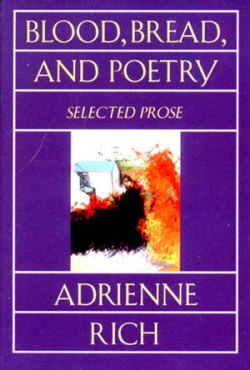
“Yes, she is a problem for me,” Adrienne Rich opens in her “The Problem of Lorraine Hansberry” (Blood, Bread, and Poetry: Selected Prose 1979-1985), “as I read and reread the published work and some of the unpublished—copies of letters, interview transcripts, essays.”
9780393311624_300

To follow is a series of parallel “As I” sentences in which Rich muses on Hansberry (“a Black woman trying to write both from ‘within the Veil,’ as she once put it, and for a public which included Black women and men, but whose dominant expectations and mythic opinions about the world were shaped by white males”), leading to:

Lorraine Hansberry is a problem to me because she is Black, female, and dead….The problem begins for me when, in reading Les Blancs, I do not know when I am reading dialogue written by Hansberry and when I am reading the end product of the process Nemiroff describes….All this may be forthright and devoted enough, and it may seem graceless to question the end result. But I do question it….But biography by a former husband and literary executor is not the same as autobiography.

This “problem” builds to Rich acknowledging “the limitations of my experience as a white woman.” Rich confronts that “within white feminist criticism itself there have been notable silences, erasures”—and “[t]he Black woman writer, as Barbara Smith has noted, suffers from double erasure.”

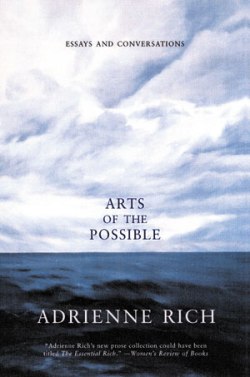
In fact, “[t]he study of silence has long engrossed me,” Rich writers in her “Arts of the Possible,” the eponymous essay of her 2001 collection of essays:

The matrix of a poet’s work consists not only of what is there to be absorbed and worked on, but also of what is missing, desaparecido, rendered unspeakable, thus unthinkable. It is through these invisible holes in reality that poetry makes it way—certainly for women and other marginalized subjects and for disempowered and colonized peoples generally, but ultimately for all who practice art at any deep levels. The impulse to create begins—often terribly and fearfully—in a tunnel of silence.
9780393323122_300

Rich as woman, as gay. Rich as poet, essayist—artist at “deep levels.”

She has presented to us in autobiography/biography that is a poet’s/artist’s work a series of resurrections, exposing who she has been and who she becomes. She has been daughter, wife, and mother; she has been lesbian lover—just as one way through association (the sorts of associations Rich exposed and confronted, “shaped by white males”) to view her metaphorical deaths and resurrections.

Rich struggling through Hansberry is Rich wrestling with her many selves—none of them perfect but all of them the richness of words crafted.

With Rich’s literal death, a new door of resurrections has opened—post mortem biographies, literary criticism, and unpublished works.

But June 2016 brings the most recent resurrection, Collected Poems: 1950-2012.

9780393285116_300

It is a simple, understated cover for a work of great physical heft, over 1100 pages in hardback—a work that resurrects Rich the poet in toto. What more could a poet want? What more could a poet dread?

If you have been on Rich’s journey for many, many years—as I have—this volume is redundant but inescapable and invaluable, a Siren’s call to those of us who love books, desire collecting.
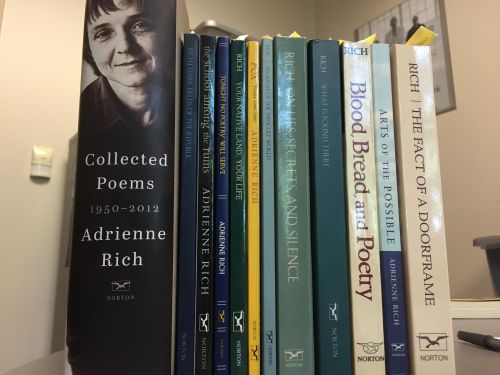
rich bookshelf

1119 pages into her body of work, Rich leaves us with words that seem haunted with James Baldwin (see her “The Baldwin Stamp”):

The signature to a life requires
the search for a method
rejection of posturing
trust in the witnesses
a vial of invisible ink
a sheet of paper held steady
after the end-stroke
above a deciphering flame

To read Rich’s entire body of published poetry draws me back to her “Diving into the Wreck,” a tour de force of personal and social commentary as poetic genius.

In death, Rich’s collected poetry presents “a book of myths” as revolt, as liberation—as a problem for everyone holding this heaviest of resurrections that is Rich and is not Rich.


See Also

Adrienne Rich: Artist of the Possible and Life among the Ruins
The Butthurt Right, Or, An Outbreak of the White-Man Vapors

…so feared by a patriarchal world…

Audre Lorde

But their remedies do not cure the disease: they merely prolong it.
Indeed, their remedies are part of the disease.

Oscar Wilde, “The Soul of Man under Socialism”

Let’s start with a fact that few are willing to acknowledge:

Despite endless debates between and about the Right and the Left in the U.S., there is no substantial Left in the U.S.—a country that is solidly right of center and distinctly so when compared to Canada or European countries with a vibrant Left.

The U.S. Left is Obama and the Clintons—neoliberals who nudge at the left edge of capitalism and a country in perpetual war.

The U.S. Left is a sort of polite progressivism of rhetoric that sees almost no fruition in action of any kind.

The U.S. Left is a compromising incrementalism that sustains the disease; it is Tyrion.

The U.S. Left meekly raises it hand and whispers: “Might we consider how we could be a tad bit less sexist, racist, and homophobic—and if that isn’t too much trouble, a little less violent?”—before shrinking away for fear of the response.

And those whispers—or God forbid a direct shout—are met with what we have now in the U.S., a newly butthurt Right, an outbreak (dare I say “epidemic”) of white-man vapors.

Nicholas Kristof—nice-guy, cardboard “progressive”—thinks the nasty Left in the U.S. has excluded the Right from academia (and we all know how powerful academia is in the U.S., right? nudge nudge), and the education reform movement (a bi-partisan assault on public education that is entirely a rightwing enterprise) is all atwitter because of the contentious Left/Right divide (Gosh, they are fuming, if those nasty BLM folk don’t settle down, all the Righties will flee the reform movement!).

All of this butthurt on the Right is very much reflected in both the rise of Trump in the wake of Black Lives Matter and the silliness of Kristof and edureform butthurt.

The white-man vapors are triggered by Michelle Alexander’s relatively moderate confrontation of the New Jim Crow, the polite left-of-center Ta-Nehisi Coates, and the Norman Rockwell Obama family just as they are accelerated by BLM, Cornel West, and Supreme Court Justice Sonia Sotomayor.

And the butthurt messages come from faux-progressives (Kristof) as much as they come from the rabid Right—political leaders, religious leaders, and law enforcement publicly stating that gays slaughtered in Orlando deserved the massacre or calling on gun owners to shoot black protesters at Trump rallies and the Republican convention.

The polite and articulate butthurt punditry on the Right, like Michael Petrilli trying to shame BLM for having the audacity to name racism “racism,” is very little different from the bully racism of Trump; in fact, they are an inseparable part of the U.S.’s conservative nature reflected in the necrophilic South.

In fact, the U.S. once chided the South for its backwardness, its illogical Bible thumping and gun toting, but we stand today in a U.S. where the essence of the entire country is just like that South.

The white-man vapors are upon us, but we must not fall prey to the same-old faux-liberal solution to yelping Rightwingers; we must not shrink against the fears of the most powerful people in the country who see their ill-gained fortunes and power slipping away.

No, the butthurt Right is a sign that women, black and brown people, the LGBT+ community, and people of all faiths and nationalities are demanding to be heard, are standing on the right side of history, which is ironically on the Left.

Higher education does not need a diversity of thought that includes traditional bigotry, misogyny, and a blind faith in disaster capitalism.

And let’s hope the neoliberals (self-identified as both Right and Left) throw up their hands and exit stage right the education reform movement—which has rained terror on the vulnerable populations of students who need our public schools the most.

James Baldwin wrote in The Nation (July 11, 1966), “The law is meant to be my servant and not my master, still less my torturer and my murderer.”

He was naming racism “racism,” both in the acts of specific police officers and as a systemic reality of the U.S. codified in the judicial system.

Baldwin was not being impolite. He was not ostracizing the Right or shaming white male patriarchy.

Baldwin was speaking necessary truth to power—and it resonates to this day because the butthurt Right slips into the vapors every time they are held accountable for the wreck of the ship they built and captained.

The barely audible Left in the U.S. has pushed the door slightly open to the House White Male Privilege built.

The owners are clutching their pearls as they lean against that door chastising the intruders to please simmer down.

We must not step back. We must push the door open, throw out the Masters, and start anew.

Ignoring Poverty in the U.S. Redux: A Reader

We were in Rye, passing the First Church, and the breeze from the ocean was already strong. A man with a great stack of roofing shingles in a wheelbarrow was having difficulty keeping the shingles from blowing away; the ladder, leaning against the vestry roof, was also in danger of being blown over. The man seemed in need of a co-worker—or, at least, of another pair of hands.

“WE SHOULD STOP AND HELP THAT MAN,” Owen observed, but my mother was pursuing a theme and, therefore, she’d noticed nothing unusual out the window….

“WE MISSED DOING A GOOD DEED,” Owen said morosely, “THAT MAN SHINGLING THE CHURCH—HE NEEDED HELP.”

A Prayer for Owen Meany, John Irving

I wrote Ignoring Poverty in the U.S. to reject the decades-long focus on education reform targeted in-school only accountability driven by ever-new standards and high-stakes testing.

But that work also reveals the incredible power of stereotypes about adults and children living in poverty in the U.S. Despite our cultural myths about rugged individualism and boot-straps success, the impoverished in the U.S. are overwhelmingly vulnerable populations.

whoispoor1

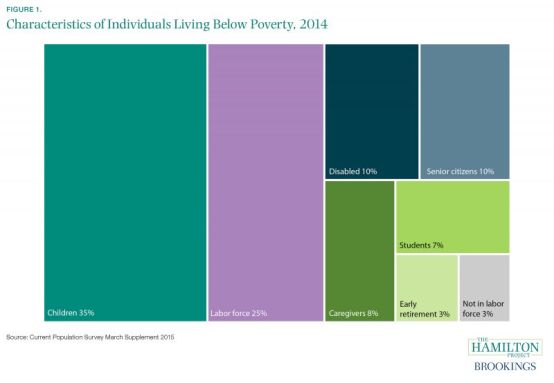
Consider the following sobering statistics, illustrated in the figure above:

  • More than a third of those who live in poverty are children. More than 15.5 million children lived in poverty in 2014.
  • About 13 percent of those living in poverty are senior citizens or retired.
  • A quarter of those who live in poverty are in the labor force—that is, working or seeking employment.
  • A tenth of those in poverty are disabled.
  • Eight percent of those living in poverty are caregivers, meaning that they report caring for children or family.
  • Students, either full- or part-time, make up another seven percent of those living in poverty.
  • Just three percent of those living in poverty are working-age adults who do not fall into one of these categories—that is, they are not in the labor force, not disabled, and not a student, caregiver, or retired.

vulnerableopm

Stereotype 2: Poor People Are Lazy

Another common stereotype about poor people, and particularly poor people of color (Cleaveland, 2008; Seccombe, 2002), is that they are lazy or have weak work ethics (Kelly, 2010). Unfortunately, despite its inaccuracy, the “laziness” image of people in poverty and the stigma attached to it has particularly devastating effects on the morale of poor communities (Cleaveland, 2008).

The truth is, there is no indication that poor people are lazier or have weaker work ethics than people from other socioeconomic groups (Iversen & Farber, 1996; Wilson, 1997). To the contrary, all indications are that poor people work just as hard as, and perhaps harder than, people from higher socioeconomic brackets (Reamer, Waldron, Hatcher, & Hayes, 2008). In fact, poor working adults work, on average, 2,500 hours per year, the rough equivalent of 1.2 full time jobs (Waldron, Roberts, & Reamer, 2004), often patching together several part-time jobs in order to support their families. People living in poverty who are working part-time are more likely than people from other socioeconomic conditions to be doing so involuntarily, despite seeking full-time work (Kim, 1999).

Father’s Day 2016: Poetry Reader [Updated 2022]

[Header Photo by Ante Hamersmit on Unsplash}

Those Winter Sundays, Robert Hayden

Daddy, Sylvia Plath

Little Father, Li-Young Lee

Eating Together, Li-Young Lee

Persimmons, Li-Young Lee

The Gift, Li-Young Lee

MY FATHER’S DIARY, Sharon Olds

my father moved through dooms of love, e.e. cummings


fragility (and then i realize)

quotidian

sleeves

past (father’s day)

sins of a father (gods and kings and men of all kinds)

that time we sat around waiting for my father to die (deathbed)

Who Do Sacred Texts Serve?

This rigid refusal to look at ourselves may well destroy us; particularly now since if we cannot understand ourselves we will not be able to understand anything.

“Lockridge: ‘The American Myth,'” James Baldwin

In my sixth decade as a son of the South, I know more than a little bit about Bible thumping.

Fundamentalist preachers, street preachers, and the faithful who hold the literal truth of Biblical texts sacred—these all embody literally and figuratively what “Bible thumping” represents: a sacred text.

The great irony of fundamentalism in the South where the King James Version of the Bible is thumped, slammed, waved, and quoted includes the problems with translation as well as the many contradictions in that text. Eye for an eye or turn the other cheek?

Not to dwell also on the cherry picking necessary for literalists: condemning homosexuality by jamming a finger on a passage from Leviticus but conveniently not pointing out the dozens of other Jewish laws those literalists trespass daily.

Throughout the U.S., however, there is also a powerful secular sacred text, The Constitution (notably the most thumped Second Amendment), that serves as a disturbing and extra layer of irony.

Yes, often, those most fervent about their Christianity are equally fervent about their guns. It seems what is important is being fervent, not making sure ones ideologies match up.

But in the wake of tragedy, we may have hope.

The Orlando massacre has spurred a powerful message about the importance of a diversity of voices in a free society.

In 2016, white males continue to have too many megaphones—we labor under, for example, the relentless drumbeat of many David Brooks who know little but pontificate endlessly simply because they can—but with the rise of social media, we hear more and more from women, people of color, and LGBT+.

After Orlando, those diverse perspectives have been willing to challenge that sacred text, the Second Amendment, noting that when the Constitution and Amendments were codified, the voices of women, people of color, and LGBTQ+ were absent.

In other words, our secular sacred text is necessarily incomplete, likely flawed.

And the problem rests in by whom, why, and how “sacred” is deemed.

There is a straight and clear line from the genesis of the South Baptist denomination—thumping the Bible to justify slavery—and the perversion of the Second Amendment—the right to bear arms to form a militia—to suit the gun fetish, gun industry, and culture of violence that all characterize the U.S., a so-called Christian nation.

Sacred texts most often serve the wants and needs—and status—of the privileged, those who have the power to thump the text and anoint it with the power of God or State.

And those powerful depend on the powerless to cling to those sacred texts, empowered by that clinging through the sheer proximity of “it’s in the Bible” or “the Second Amendment!”

So we stand in a particular part of history now, one in which some voices have been “deliberately silenced,” “preferably unheard.”

But the oppressed and suppressed are demanding that they be heard, in part by challenging, as Adrienne Rich wrote, the “book of myths/in which/our names do not appear.”

In the U.S., sacred texts are as deadly as the murderous guns we cling to—until we choose to look at ourselves, to listen, and to act in ways that hold all humans sacred.


[Grammar Note: There was a time when we made a distinction between “who” and “whom”—a sacred distinction like “they” always being plural—but “whom” has died so long live “who” as a versatile part of speech!]

More Questions for The Post and Courier: “Necessary Data” or Press-Release Journalism?

Back-to-back editorials at The Post and Courier (Charleston, SC)—Bolster efforts at rural schools (18 June 2016) and Make literacy No. 1 priority (19 June 2016)—offer important messages about the importance of addressing South Carolina’s historical negligence of high-poverty schools, especially those serving black and brown students, and the folly of cutting funding for literacy initiatives in Charleston.

However, reading these two editorials leaves one well aware that good intentions are not enough and wondering if the P&C editors even read their own editorials.

In the 18 June 2016 editorial, the editors argue: “Acting rashly without necessary data would be misguided. But taking baby steps while one class after another misses out on an adequate education is a continued waste of valuable time.”

And the very next day, we read:

Still, parents should expect their children’s reading skills to improve noticeably.

And it’s fair for parents of the youngest students to expect significant improvement in their children’s reading by the end of the school year — if the new approach works. Of course, parents also can make a difference by reading to their youngsters every day at home.

If Dr. Postlewait’s plan doesn’t succeed, the school board must find a way to pay for programs that do.

Those programs exist. At Meeting Street Academy private school, and now at Meeting Street @ Brentwood, entering students score well below average on literacy tests and quickly catch up to and surpass the average. All Charleston County students deserve the same opportunity.

This praise of “programs [that] exist” is the exact “acting rashly” the P&C rightfully warns about the day before.

So what about “necessary data”?

We have two problems.

First, we do not have a careful analysis of data by those not invested in these schools about the two praised school programs. The fact is that we do not know if successful reading programs exist at these schools.

Second, we do know that “only 1.1 percent of high-poverty schools were identified as ‘high flyers'” (Harris, 2006). In other words, we now have decades of data refuting the political, public, and media fascination with “miracle schools.”

As I have repeatedly warned: “miracle schools” are almost always unmasked as mirages, but even if a rare few are outliers, they cannot serve as models for all schools because they are not replicable or scalable.

Therefore, the P&C editors are right to warn about acting rashly and without the necessary data as we reform public schools and bolster literacy among our students.

But the P&C is wrong to continue press-release journalism that contradicts that mandate.

Arrogance: Service, Not Saviors

Beyond the obvious—that they are all joined by the field of education—what links the National Reading Panel (NRP) and No Child Left Behind, the edureform documentary propaganda Waiting for “Superman,” Teach For America, and edusavior Steve Perry?

Arrogance.

While I count myself among English language arts (ELA) teachers who are skeptical of the Great Books mindset—that we have essential books all children must read—I am moved today to endorse how many of those works remind we puny humans about the folly of pride. Not the “I am proud of you daughter/son” pride, but the arrogance pride.

The “‘My name is Ozymandias, King of Kings;/ Look on my Works, ye Mighty, and despair!'” kind of pride.

What on earth possessed politicians to form the NRP to find out what we know about teaching children to read? Did anyone point out that we have had a vibrant field of literacy in the U.S. for a good century? Isn’t it sort of obvious that we have dozens upon dozens of people across the U.S. who know exactly how to teach children to read (and have known for decades)?

But it isn’t just the teaching of reading.

Naive experts, often journalists, every week roll out yet another book in which she or he researches a field in which real experts in that field have been doing authentic work for decades—the history of teaching!, how to teach poor children!, the glory of 10,000 hours of practice!

Paternalistic, self-important, blowhard politicians daily puff up in front of the public to be that “Superman” at the center of the great lie documentary noted above that ironically serves as a perfect representation of everything that is wrong with education reform.

But one need not go back to that complete failure of film making. Try within the last week.

Educators and activists Andre Perry and Jose Vilson (see also) have assumed the mantle of speaking truth to the cult of personality that is Steve Perry.

I consider myself a student of Andre Perry and Vilson, as I work to navigate my own white male privilege in a way that serves others—specifically those marginalized by race and class.

I am a product of white privilege and colonialism, and therefore, must not serve those corrosive forces.

Here, I urge you to read Andre Perry and Vilson, but also to act upon their messages.

And I want to offer a tentative framing informed by their charges.

First, I am compelled by the new 30 for 30 series on O.J. Simpson to suggest that Simpson himself is a cautionary tale about the dangers of white privilege and the costs of whitewashing blacks in order for them to be allowed into mainstream society.

Next, I find troubling parallels in the work of Steve Perry with powerful blacks (Bill Cosby, Clarence Thomas, and Simpson) who negotiate the whitewashing in their favor at the expense of all other people of color.

The demonizing of dreadlocks, the finger-pointing at sagging pants, the judgmental finger-wagging at black English—yes, these are the tools of white privilege, but they also serve the cult of personality unmasked in Steve Perry, for example, by Andre Perry and Vilson.

Finally, although specific people have to be addressed when confronting the cult of personality, the problem is that those people are serving larger forces that are driving education reform, a movement that uses “civil rights” as a mask to implement policies that are perpetuating colonialism and whitewashing.

“No excuses” charter schools committed to “grit” are about “fixing” black, brown, and poor children.

Zero tolerance policies and grade retention policies disproportionately turn black, brown, and poor children into criminals and drop-outs.

High-stakes testing and accountability produce and perpetuate so-called achievement gaps among race and social class—as well as gate-keep in order to keep “other people’s children” in their place.

Teach For America fuels the historical inequity of access to experienced and certified teachers: White Students Get Experienced Teachers, While Black Students Get Police In School.

Whether the face of education reform is Bill Gates, Michelle Rhee, Arne Duncan, Geoffrey Canada, or Steve Perry (or the long list of celebrities who decide education is their hobby), and while we must necessarily confront each person as we confront what they represent, the ultimate challenge in rejecting edureform while also calling for building public education as a vehicle for equity and liberation is to call colonialism “colonialism,” to just say no to policies and practices designed to erase who children are so that they can be assimilated into society.

There are profound and significant differences in Andre Perry’s work, Vilson’s daily classroom teaching, and Steve Perry’s bloviating (think Donald Trump).

Andre Perry, Vilson, and Chris Emdin, for example, celebrate black students, their humanity as inseparable from their blackness—while Steve Perry celebrates Steve Perry as one who erases the black from children in the service of white privilege.

We are way past time to stop believing in and listening to these false idols, self-proclaimed “Super(wo)men.”

Ozymandias, please recall, was a fool in king’s clothing whose words mocked him:

Nothing beside remains. Round the decay
Of that colossal Wreck, boundless and bare
The lone and level sands stretch far away.

Let’s not form any more panels, let’s not crown any more edusaviors, let’s not print and/or buy any more bestselling books by educelebrities (who have never been teachers), let’s not worship at the altar of hollow Ted Talks.

Just as we didn’t need the NRP to “know how to teach children to read,” we have ample knowledge right now how to eradicate racism and classism in our society and our schools.

Edureformers, edusaviors, and educelebrities are in the service of keeping us from that vital work.

As Andre Perry asserts:

Let’s be clear: Belt wearing isn’t the reason white children are educated in wealthier schools. Haircuts and etiquette classes don’t lead to the technological innovations of Silicon Valley. Lower incarceration rates aren’t because whites use drugs less often. The wage gap isn’t caused by white men’s hard work ethic.

But social and educational inequity is the consequence of white privilege.

So I ask now that you listen to carefully and then act upon Chris Emdin‘s confrontation of edureform as colonialism and what choices lie before teachers:

What I am suggesting is that it is possible for people of all racial and ethnic backgrounds to take on approaches to teaching that hurt youth of color….

I argue that there must be a concerted effort…to challenge the “white folks’ pedagogy” that is being practiced by teachers of all ethnic and racial backgrounds….

The time will always come when teachers must ask themselves if they will follow the mold or blaze a new trail. There are serious risks that come with this decision. It essentially boils down to whether one chooses to do damage to the system or to the student [bold emphasis added]. (pp. viii-ix, 206)

Especially in our schools, and especially among our most vulnerable students, we need service, not saviors.

Call for Manuscripts: Strangers in Academia: Teaching and Scholarship at the Margins

Call for Manuscripts

Strangers in Academia: Teaching and Scholarship at the Margins

Christian Z. Goering, University of Arkansas; Angela Dye, PBS Development, LLC; and P.L. Thomas, Furman University, editors

This volume seeks to collect contributions from authors across the spectrum of academe who, for one reason or another, feel as if they are strangers at their own universities and/or in K-12 education.

In the background of this project, we are confronting the mainstream idea that formal education is somehow revolutionary, for both individuals and the larger society. Therefore, this volume is a testament to how all levels of academia are too often reflect and perpetuate the society the schools/universities serve.

Specifically, we are seeking to include the experience, thinking, and scholarly perspective of those who feel othered, ostracized, pushed out, relegated, or marginalized because of your status (race, class, gender, sexual orientation, etc.) or your professional and/or ideological stances through experiences working in higher education or K-12. While it’s the ideal of the academy to consider all warranted perspectives perhaps there are elements of your status, practice, or philosophy that is being undermined by your administrators and/or colleagues. Insidious attacks, comments in the hall, or cultural norms have left you and/or your work feeling less than welcome.

Contributions should range between 3000 and 4000 words and explore the complex nature of working in K-12 or higher education and feeling less-than-welcome. What was the experience like? How did you address it? What were the consequences? Two-page chapter proposals are due on September 30, 2016, with complete chapters due December 1, 2016.

Submit all proposals as Word attachments to paul.thomas@furman.edu

The blog post below serves as an invitation to begin considering contributing to this volume.

No, there was no way out, and no one can imagine what nights in prison are like.

Meursault, The Stranger, Albert Camus

I left public education after an 18-year career as a high school English teacher and coach. The exit had its symbolism because at that time I was wearing a wrist brace on my right hand from overuse after almost two decades of responding to about 4000 essays and 6000 journal entries per year; in other words, I left public education broken.

A former student of mine on the cusp of becoming a first-year English teacher asked me recently what my first years were like, and I had to confess that from day one, my career as an educator has always been at the margins, a stranger at all levels of formal schooling and academia.

Yes, my hand was exhausted from marking essays, but I was broken as a public school teacher by administrators and in a bit of not so hyperbolic science fiction, The System.

Every single day of my life as a public school teacher, I worked against the system—but I did so with my door open because I believed (and still believe) my defiance was for The Cause.

I was never defiant for my own benefit, but resistant to the structures, policies, and practices that I believed dehumanized teachers and students, that worked against formal education as liberation.

I didn’t punish students for being a few seconds late to class, for asking to go to the restroom. I didn’t stand guard at the doorway or in the hallways as if we were surveilling a criminal population of teens.

We laughed and moved around in my room, played music and even danced during breaks. Students ate candy, food, sneaking in drinks occasionally.

And to a fault, I was friendly with my students—a friend to my students. In the perfect sort of irony or symmetry, many of those students are today my friends on Facebook.

But toward the end, after year upon year of wrestling with administration and finding little collegiality or camaraderie among my colleagues, I found my breaking point when I took off days to present at a national conference—one I was afforded through my doctoral program, which I completed while a full-time high school teachers—and returned to work to discover I was docked pay for those days and even the substitute fee.

Public education, I learned, had no room for teachers who were also scholars.

Because the opportunity presented itself, I begrudgingly applied for, was offered, and then accepted (at a significant reduction in pay) a position in higher education as a teacher educator.

I entered the role as tenure track assistant professor very naive (even in my early 40s) and so deluded by public education that I also idealized higher education: my land of milk and honey where my full self as educator, writer, and scholar would be not only welcomed, but also encouraged.

After 14 years at the university level, making my way through tenure to full professor, let me offer the short version: more delusion.

“Don’t be so political.” “I never published an Op-Ed until I had tenure.” “Dressing awfully casually for a junior faculty member.”

Yes, my university is in many ways a very wonderful place, and my colleagues are brilliant and supportive.

But the old patterns recurred in higher education that had run me out of public education: critical pedagogy isn’t welcomed, scholarly activity creates as much friction as it receives praise, wading into public intellectual work creates even more friction, and even well-educated people can be prejudiced and petty.

Department politics and dynamics have proven to be as frustrating (for me and other professors) as my experiences with administration while I was a public school teacher.

As one example, my university has recently conducted a gender equity study because the playing field isn’t level here. Professors of color and LGBT professors will also note significant inequities as well.

Higher education has revealed itself to be in many ways as flawed as public education because even in our systems of formal education, we are apt to replicate the society we serve instead of being a working model of how things could be, how things should be.

Race, class, gender, sexual identification, and ideology—these all even in higher education create those of us who are strangers in academia; we are forced to teach, conduct scholarship, and write at the margins.

Just making this claim, I know, pushes me further to the margins, boundaries possibly well secured by the statuses I have attained despite being a stranger in academia.

Yet, I am not yet willing to throw up my hands and simply accept that we cannot be otherwise—because if the most well educated cannot set aside our biases, what hope for all of humanity?

In Albert Camus’s The Stranger, the allegory reveals the existential message that we are all prisoners. Meursault, after being literally imprisoned, confesses, “Afterwards my only thoughts were those of a prisoner.”

But readers are cautioned to note that Meursault also makes the case that his new situation in a physical prison is no different than his life as a so-called free man.

As academics, I think, it is ours to resist the same dynamic between the so-called real world and academia in which there is essentially no difference.

Academia need not be the pejorative “Ivory Tower,” suggesting we are above it all, but academia sure as hell could be, should be a model of how to honor and celebrate the human dignity of everyone.

Bigotry, George Carlin, and My Critical Journey

As I have noted many times, George Carlin and Richard Pryor were instrumental in saving me from my redneck past.

As a frail, anxious, and highly insecure teen, I sat in my room alone listening to their comedy albums over and over—memorizing, yes, but listening very carefully because I wanted to understand what these men were saying.

These were revolutionary ideas to a redneck in South Carolina in the 1970s.

With the death of Muhammad Ali, I have been drawn back to my Classic Gold collection of Carlin’s first three albums, anchored for me by his “Muhammad Ali – America the Beautiful” on Class Clown:

But as I have been listening, my recognition that Carlin and Pryor are foundational to my critical journey—especially as an educator—has been shaken by coming back to Carlin as I sit in my mid fifties.

Two routines—”White Harlem” and “Black Consciousness” on Occupation: Foole—have pushed me even further into the tension that exists in pop culture, a tension I have examined regarding Marvel Comics Captain America:

And as I have been contemplating these routines, mostly about race and the politics of race, the Orlando massacre has forced me to highlight what is possibly the most important joke from Carlin for me in terms of everything it represents about why I was drawn to his work, why it still speaks to me, and why I am deeply concerned about both of those.

Carlin was born a couple years before my father and we are separated significantly by regional and religious backgrounds; however, we still share some commonalities that distinguish us from younger generations.

During Carlin’s riff on his old neighborhood—Morningside Heights bounded by Columbia University and Harlem, and labeled as “White Harlem”—he offers his sharp observation about language, noting that in his time, the words “fag” and “queer” meant different things: A fag, Carlin explains, is someone who wouldn’t go down town with you to beat up queers.

The audience roars on the albums—and I am forced to contemplate the ugliness beneath the laughter.

Carlin as social critic and master wordsmith always laid the world before us—and in his routines, characters, and rants, I believed him to be critical of that world he portrayed.

But just as Captain America’s popularity reveals the very worst of mainstream U.S. bigotry (regardless of the creators’ and many writers’ and artists’ since intentions), I see beneath Carlin’s routine that the audience response is about laughing at marginalized people due to sex or sexual identification.

Carlin’s race riffs seem to be as problematic. White Harlem? Really?

Carlin also explains that if you put five really white guys with black dudes for a while, the white guys will start to talk, act, and walk as the black guys do.

I think Carlin genuinely valued his growing up close to and in black culture, but I am not sure he understood appropriation—and I am certain his audience did not.

When a Sport Illustrated article repeated praises a female Olympic swimmer by framing her as “like a man” (at the subtle and seemingly harmless-but-not end of the scale) and when fifty people are slaughtered for being in a gay nightclub just a year after nine people were slaughtered in a church for being black, I have to ask are these routines by Carlin funny? Were they ever funny?

And, for me this is important, how complicit is Carlin in perpetuating the horrors of homophobia, sexism, misogyny, and racism?

It seems a very privileged thing to sit in a theater and laugh at a man, self-proclaimed foole, telling jokes and using dirty words:

I memorized Carlin and Pryor—and I took their routines to school everyday as a shield against getting beat up, probably not against the threat of physical abuse but getting beat up socially and psychologically because I was skinny and insecure—I simply was not man enough, I feared.

In the late 1970s, I was entirely unaware that I was already shielded from those threats in most ways, being white, male, and heterosexual.

I was entirely unaware of how cruel and wrong this world was and is, even though Carlin and Pryor had opened the door for me to discover all that in the coming years of college.

My critical journey has been a tremendously privileged one—one in which I have been afforded the role of witness, informed by James Baldwin and many others who have been passengers.

Just as Kurt Vonnegut taught me the sacred value of kindness, Carlin and Pryor proved to me that words matter—but our critical journey must step beyond words even as we correct them.

In a year, we have placed at our feet the Charleston Massacre and the Orlando Massacre. I find little joy in listening to Carlin because I must ask: What are we going to fucking do?

U.S. Education Reform: A Snapshot

Cycle has happened often, and now poised to happen again.

Common Core

For #3 (where we are now before jumping back to #1), see Common Core isn’t preparing students very well for college or career, new report says.

HINT:

As the absence or presence of rigorous or national standards says nothing about equity, educational quality, or the provision of adequate educational services, there is no reason to expect CCSS or any other standards initiative to be an effective educational reform by itself. (Mathis, 2012)