All posts by plthomasedd

P. L. Thomas, Professor of Education (Furman University, Greenville SC), taught high school English in rural South Carolina before moving to teacher education. He is a former column editor for English Journal (National Council of Teachers of English), current series editor for Critical Literacy Teaching Series: Challenging Authors and Genres (Brill), and author of Teaching Writing as Journey, Not Destination: Essays Exploring What ‘Teaching Writing’ Means (IAP, 2019) and How to End the Reading War and Serve the Literacy Needs of All Students: A Primer for Parents, Policy Makers, and People Who Care (IAP, in press). NCTE named Thomas the 2013 George Orwell Award winner. He co-edited the award-winning (Divergent Book Award for Excellence in 21st Century Literacies Research) volume Critical Media Literacy and Fake News in Post-Truth America (Brill, 2018). Follow his work @plthomasEdD and the becoming radical (https://radicalscholarship.wordpress.com/).

Edu-Journalists Know Only Two Stories (And They Are Both Wrong)

This post is mainly a public service because it has become stunningly clear that trying to engage journalists and the media covering education in order to prompt change is falling on willfully deaf ears.

My public service is to save you, dear reader, time. If you see or view a story in the media covering education, you can expect only two frames: (1) If the coverage is about public schools, the message is CRISIS!, but (2) if the coverage is about someone (anyone) without expertise or experience in education, the message will be breathless awe at their courage to finally be dragging that miracle to life that the horrible public school system has been unable to do lo these many years.

Sal Khan? Wow:

As we’ve reported, students anywhere now can get free SAT test prep both online and in person at some Boys & Girls Clubs of America. The move may help level the playing field by improving test prep for less-affluent students to get them ready for the newly revamped SAT, which remains a pillar of college admissions despite the growth in 2015 in “test optional” schools.

It’s part of what Khan Academy calls its core duty to help provide “a free, world-class education for anyone, anywhere.”

Teach For America? No way!:

In Teach For America lingo, that would be called a hook, a compelling way to think about a concept so that it’ll stick in students’ minds….

Those concerns are reflective of the new tack toward preparation taken by TFA’s Dallas-Fort Worth region, which is trying to move away from teacher-directed instruction in favor of techniques that focus more on students drawing conclusions on their own.

And rather than giving its new corps members a crash course on lesson planning, typically the first step in the TFA’s summer training, the Dallas region supplied its recruits with 700 ready-made lessons, focusing instead on giving candidates feedback on the finer points of carrying off a lesson well.

But what about that pesky skill reading that no one has really figured out—or possibly has never even tried to figure out?

Don’t fret! Buy psychologist Daniel Willingham’s new book!

Or (thank goodness another book to buy!):

About five years ago, the chief executive officer of the Uncommon Schools charter network offered up a lofty charge during a routine staff meeting: “Figure out” reading instruction.

OK, since I said at the outset I was planning to save you time, I’ll stop here, but rest assured, I could do this for hours because the list of (wow!) edu-saviors with almost no or often no experience or expertise in education who are heralded by the media as if the field doesn’t already exist but (again, thank goodness!) these innovative types are here to save the day is almost endless itself: Bill Gates, Michelle Rhee, KIPP founders Mike Feinberg and Dave Levin [1], and those already noted above.

Search those names and the pattern is the same: Fair-and-balanced edu-journalists open with breathless amazement at brave Edu-Genuis X and then later notes the person or the program has “received some criticism” (without nary a nod toward whether or not Edu-Genius X is credible, without nary a nod toward whether or not the criticism is credible—because, hey, that’s not a journalist’s job, right?).

We are left then with two related but wrong edu-journalist approaches to education reporting: public education is (and always has been) in crisis; therefore, the only people we can count on to save us is someone (anyone) outside of education.

However, the real story is much more complicated.

Much needs to be reformed in public schooling in the U.S.—much that has been historical failures.

But those problems are more about the structural wall of bureaucracy that has always existed and is even thicker today between the rich and powerful research and expertise in education as a field and practice, and the ability of teachers to implement their profession.

“A brief consideration,” LaBrant wrote in 1947, “will indicate reasons for the considerable gap between the research currently available and the utilization of that research in school programs and methods.”

LaBrant’s claim remains today, and has been documented specifically about how middle and high school students are bing taught writing. Applebee and Langer discovered:

Overall, in comparison to the 1979–80 study, students in our study were writing more in all subjects, but that writing tended to be short and often did not provide students with opportunities to use composing as a way to think through the issues, to show the depth or breadth of their knowledge, or to make new connections or raise new issues…. The responses make it clear that relatively little writing was required even in English….[W]riting on average mattered less than multiple-choice or short-answer questions in assessing performance in English…. Some teachers and administrators, in fact, were quite explicit about aligning their own testing with the high-stakes exams their students would face. (pp. 15-17)

Applebee and Langer emphasize that the negative consequences of high-stakes testing distinguish this study from their earlier work and that accountability has essentially stymied the influence of writing research, professional organizations, and teacher professionalism.

In other words, teachers today know more about teaching writing and have a more robust research base on what works in teaching writing but are unable to implement that knowledge base because of the accountability bureaucracy that has supplanted teacher professionalism.

Also damning is that this negative dynamic is even more pronounced for our most vulnerable students:

By far the greatest difference between the high poverty and lower poverty schools we studied stemmed from the importance that teachers placed and administrators placed on high-stakes tests that students faced. In the higher poverty schools, fully 83% of teachers across subject areas reported state exams were important in shaping curriculum and instruction, compared with 64% of their colleagues in lower poverty schools. (Applebee & Langer, 2013, p. 149)

And their is a truly ugly irony to this mess: Political leadership and edu-preneurs (remember, buy the book and program!) are chanting “college and career ready” while pushing mainstream education that guarantees students lack the rich and complex behaviors that would serve them well in higher education, their careers, and (god forbid) their lives. As noted above (and writing as someone who teaches first-year writing at the university level), students are being denied writing instruction they need and deserve because of accountability (except for privileged students at private schools that are not shackled by the mandates of politicians who send their children to those private schools).

So, I know this isn’t the stuff of breathless awe and fair-and-balanced journalism, but the reality is that we are failing the profession of education, the research of the field of education, public education as a great democratic experiment, our children, and our country. But the solution to that huge set of problems is to tear down the bureaucratic wall of accountability and rebuild public schools with the leadership of educators.

[1] See this excellent examination of KIPP and the clueless media coverage of education “hot shot” experiments by know-nothing edu-preneurs:

For Russo to ignore the uneven outcomes of KIPP schools as a possible reason for their recent lack of attention is odd, but not surprising as reform cheerleaders are often blind to any objective evidence that does not support their narrative.

 

Understanding Poverty, Racism, and Privilege Again for the First Time

Once again, predictably, when my South Carolina should focus on education opportunity, not accountability was published at The State, comments included convoluted arguments demonizing people who are poor while discounting racism because “I was poor but I worked hard and succeeded” (this last claim invariably comes from a white person who is oblivious to the example proving the power of white privilege even against the weight of poverty).

Recently, as well, Teaching Tolerance confronted Ruby Payne’s poverty industry that speaks to and perpetuates stereotypes about poverty, race, and privilege (see here for research discrediting Payne’s work).

My public work addressing poverty, race, and education consistently reinforces that political leaders, the media, and much of the public in the U.S. suffer corrosive and inaccurate views of poverty, race, and privilege—stereotypes that are incredibly powerful.

When I argue about the need to address poverty directly, many respond by claiming anyone can succeed if she/he simply works hard enough. When I argue about the need to address racism, many concede poverty is burdensome, but add that racism no longer exists—again, people of color simply fail to take advantage of the opportunities all people have in the U.S.

Despite the great potential of social media and online publications with commentary (a way to democratize whose voices matter), those open forums allow anyone to respond un-vetted and perpetuate one of the great failures of public debate—arguing a single example proves or disproves a generalization: One black person excelled means there is no racism; “I was poor but” proves everyone has an equal opportunity.

Evidence appears ineffective against stereotypes—the illogical and irrational—but I invite you to step away from your assumptions and understand poverty, racism, and privilege again for the first time.

Focusing on poverty, the most enduring myths include some of the following (see the reader below for ample evidence disproving each):

  • Adults and children living in poverty somehow deserve that condition because they do not work hard enough, lacking the “grit” that successful people have.
  • The impoverished struggle because of their inferior literacy skills, often referred to as the “word gap.”
  • The culture of poverty is the result of a number of qualities among the poor, and thus, it is up to the poor themselves to break that cycle.
  • Poverty is a sham because of a number of common sense observations: the impoverished often seem to be obese and many people in poverty still own things (TVs, cars, cell phones).
  • The poor are prone to criminal behavior and substance abuse.

Research, however, refutes and discredits all of these.

One of the most powerful ways to reject false narratives about the poor is to consider that in the U.S., the cheapest foods are high in fat and processed sugar; and thus, it is a matter of practicality that the poor tend toward obesity.

Good health and safety are more expensive—shopping at Whole Foods or purchasing a car with added safety features—and thus both are accessed more easily by privilege.

Yet, we are a people stuck in false narratives about meritocracy and rugged individualism.

To understand poverty, racism, and privilege, however, systemic dynamics such as slack and scarcity must be examined. Sendhil Mullainathan and Eldar Shafir in their Scarcity: Why Having Too Little Means So Much examine the research base that shows the same person behaves differently under slack and scarcity.

Privilege begets privilege because slack allows a great deal of room for failure, and poverty begets poverty because the margins are so tight that irrational behavior seems rational.

But, again, these dynamics are the result of the conditions and not inherent qualities in individuals.

Below I offer a reader because the facts about poverty, racism, and privilege are dramatically different than the false narratives we live with in the U.S. For even good people with good intentions, the myths are hard to set aside.

A Reader: Understanding Poverty, Racism, and Privilege Again for the First Time

Scarcity: Why Having Too Little Means So Much, Sendhil Mullainathan and Eldar Shafir

George Saunders’s Allegory of Scarcity and Slack

Miseducating Teachers about the Poor: A Critical Analysis of Ruby Payne’s Claims about Poverty, Bomer, et al.

Pathologizing the Language and Culture of Poor Children, Curt Dudley-Marling and Krista Lucas

Savage Unrealities, Paul C. Gorski

The Myth of the Culture of Poverty, Paul C. Gorski

Problematizing Payne and Understanding Poverty: An Analysis with Data from the 2000 Census, Jennifer C. Ng and John L. Rury [pdf]

The Culture of Poverty Reloaded

The State: South Carolina should focus on education opportunity, not accountability

The State: South Carolina should focus on education opportunity, not accountability

[original unedited submission below]

Former Governor and Secretary of Education Richard Riley established South Carolina as one of the first states to move education reform to the top of any state’s agenda. That journey for our state is now three decades-plus old, and political leaders, the media, and the public remain unsatisfied with our public schools.

With the No Child Left Behind (NCLB) era behind us and the newly passed Every Student Succeeds Act (ESSA) now returning a great deal of power to states for school reform, The State has called for SC to recommit to accountability, warning: “[R]emoving that oversight provides a tremendous temptation for states to lower the bar. We must not let that happen in South Carolina.”

My entire 34 years as an educator in SC has been during the accountability era in which the state has changed standards and high-stakes tests five or six times each. While I agree with The State’s editorial that the transition from NCLB to ESSA is a great opportunity, I caution about doubling down on accountability.

First, SC political leaders, the media, and the public must finally confront that our public schools are a reflection of the tremendous burden of poverty on children and families in our state. The schools along the Corridor of Shame (the I-95 corridor) as well as other pockets of high poverty across the state present us with a very disturbing lesson that school reform alone has never worked, and will likely never work.

Across the U.S., in fact, accountability based on standards and high-stakes testing has failed in both fifty different experiments and the more recent national effort with Common Core. The quality or even presence of standards and high-stakes tests has never produced higher student achievement or closed the so-called achievement gap between wealthy and poor students or racial minorities and whites.

The greatest education challenge, then, facing our state is addressing poverty and racism in our society so that education reform has a chance to succeed. Without adopting policy that deals directly with stable jobs with adequate pay and benefits, healthcare, childcare, and an equitable criminal justice system, our schools are destined to continue to struggle.

Next, we need to reconsider entirely education reform—not based on accountability but on equity of opportunity.

Labeling and ranking our schools—whether we use more than test scores or not—has been harmful, and it is past time to consider another process. As Bruce Baker, Professor in the Graduate School of Education at Rutgers, and researcher Gerald Bracey have argued often, educational rankings tend to reveal more about conditions outside of the school’s control than about the quality of education. Overwhelmingly in all types of educational rankings the greatest predictor of high or low rankings is wealth or poverty.

However, The State actually hits on a better alternative: “But the focus must remain on the core function of the schools: providing all children in this state the opportunity to receive a decent education, of the sort that will allow them to become self-supporting, productive, taxpaying citizens.”

Equity of opportunity must replace accountability in SC—although this doesn’t mean lowering expectations or absolving schools or teachers from their responsibilities to students and the state.

What I propose is transparency about the opportunities to learn that all students are receiving in the context of social programs that help every student enter the doors of those schools on much more equal footing than they have historically or currently.

Those equitable opportunities must include for all students access to experienced and certified teachers, open door policies for challenging courses and programs (such as Advanced Placement and International Baccalaureate), and equitably funded schools and facilities across the state. As well, we must end inequitable disciplinary policies and outcomes, tracking, and harmful current policies such as third-grade retention based on reading scores.

But grading and ranking schools must end as well.

A hard reality of teaching is that we can never guarantee outcomes; students ultimately, if given the conditions in their lives and schools to succeed, are responsible for learning. Schools and teachers are responsible for making that learning possible.

Accountability has not worked for thirty-plus years. The hard question now is: Have the adults learned that lesson and are they prepared to try something different?

See Also

Addressing Teacher Quality Post-NCLB

Addressing Teacher Quality Post-NCLB

While the transition from NCLB (the federalization of accountability-based education reform) to ESSA (returning accountability-based education reform mostly to the states) is a microscopic change at best, it appears that teacher quality will remain a key mantra of those seeking reform—even though the use of value-added methods for evaluating teachers appear to have lost some steam.

My home state of South Carolina has been an early and dedicated home for education reform based on standards and high-stakes tests. SC is also a very high poverty state—ranking 5th in highest childhood poverty in the U.S. These pockets of poverty have been well documented by Corridor of Shame and years of court battles over equitable education funding across the state.

SC also shares with the entire U.S. a pattern of resegregation in public and charter schools as well as the historical and current reality that impoverished students, black and brown students, English language learners, and special needs students disproportionately are assigned to new and early-career teachers, and un-/under-certified teachers (notably in math). Compounding those inequities, these vulnerable populations of students also sit in high student/teacher ratio classes and are less likely to have access to challenging curriculum (such as Advanced Placement, International Baccalaureate, and gifted and talented programs), courses often taught by experienced and highly qualified teachers.

Recently, Associate Editor Cindi Ross Scoppe (The State) has argued: Key to improving poor schools: a good teacher in every classroom.

This call for a post-NCLB focus on teacher quality, I must note, does admit that teacher quality is a key part of in-school only influences on student achievement; however, we must begin to frame concerns for teacher quality in ways political leaders, the media, and the public fail to do.

First, we must note that the impact of teacher quality is dwarfed by out-of-school factors:

But in the big picture, roughly 60 percent of achievement outcomes is explained by student and family background characteristics (most are unobserved, but likely pertain to income/poverty). Observable and unobservable schooling factors explain roughly 20 percent, most of this (10-15 percent) being teacher effects. The rest of the variation (about 20 percent) is unexplained (error). In other words, though precise estimates vary, the preponderance of evidence shows that achievement differences between students are overwhelmingly attributable to factors outside of schools and classrooms (see Hanushek et al. 1998Rockoff 2003Goldhaber et al. 1999Rowan et al. 2002Nye et al. 2004).

However, that assessment is relative conservative when compared to Experiences of poverty and educational disadvantage by Donald Hirsch (JRF, 2007):

Just 14 per cent of variation in individuals’ performance is accounted for by school quality. Most variation is explained by other factors, underlining the need to look at the range of children’s experiences, inside and outside school, when seeking to raise achievement.

So the caveat for focusing on teacher quality must include that as long as we use measurable data for determining student achievement and teacher quality, failing to address out-of-school factors likely guarantees we’ll see little change in measures such as test scores.

Nonetheless, we must address teacher experience and qualifications/expertise at high-poverty, majority-minority schools; however, without social reform that alleviates the burdens of poverty on the lives of students and their families, we are unlikely to see the sorts of changes in data that would justify any in-school only reforms.

Also, the teacher quality debate often fails to make clear at the outset just how we are designating “good” or “bad” teachers (as well as “good” and “bad” schools). We must make sure that we are not using labels of quality as markers for those out-of-school factors. In other words, we tend to say schools and teachers are “good” when the student population is affluent, and both are “bad” when the student population is high poverty.

We are also apt to overreact to outliers (when so-called “bad”—high poverty—schools or teachers of poor students have higher than typical test scores) as if those outliers prove some possible standard for all teachers and schools. However, outliers are just that, outliers. And research shows that high-flying schools simply are extremely rare, and often not as high-flying as originally claimed.

Also the teacher quality discussion suffers from the false belief that “teacher quality” is a distinct and permanent quality. In fact, teacher quality is dependent on many factors and contexts. I often am a great teacher and an ineffective teacher for two different students in the same class.

Teacher quality is hard to identify and often relative to dozens of factors, including changing student populations and content being taught.

As a result, so-called low teacher quality in high-poverty schools in SC is likely a mislabel in some ways for the state being the fifth worst child poverty state in the country. But teacher quality is also a marker for our failure to address teacher experience, teacher certification, and funding at high-poverty schools.

So, yes, SC does need to insure high teacher quality for all students, addressing directly the historical and current failures associated with the most vulnerable students in the state’s high-poverty schools.

Jobs programs, comprehensive healthcare reform, food stability legislation, proving books in the homes of all children, and addressing directly the teaching and learning conditions of all schools—these reforms are likely to show greater positive outcomes than traditional approaches to the teacher quality problem.

Therefore, without addressing poverty broadly or how we determine quality teachers and schools—including moving past test-based rankings doing both—we are likely to be again disappointed with any teacher quality reforms we attempt.

See Also

Teachers at Low-Income Schools Deserve Respect, Bruce Hansen

NEW: Working in Class: Recognizing How Social Class Shapes Our Academic Work

Working in Class: Recognizing How Social Class Shapes Our Academic Work

Allison L. Hurst and Sandi Kawecka Nenga eds.

51l0ygpi3al-_sx332_bo1204203200_

From publisher:

More students today are financing college through debt, but the burdens of debt are not equally shared. The least privileged students are those most encumbered and the least able to repay. All of this has implications for those who work in academia, especially those who are themselves from less advantaged backgrounds. Warnock argues that it is difficult to reconcile the goals of facilitating upward mobility for students from similar backgrounds while being aware that the goals of many colleges and universities stand in contrast to the recruitment and support of these students. This, combined with the fact that campuses are increasingly reliant on adjunct labor, makes it difficult for the contemporary tenure-track or tenured working-class academic to reconcile his or her position in the academy.

amazon

Now What?

Additionally many educators no longer feel a sense of responsibility for engaging difficult questions because educational institutions reward them for avoiding controversy and confirming the status quo.

The Answer is Not at the Back of the Book, Seneca Vaught

19 January 2016. It is the day after the official holiday commemorating Martin Luther King Jr. and MLK’s actual birthday—a span of days blanketed with tributes as well as every conceivable way one man’s words and legacy can be twisted to suit a need.

MLK Day 2016 passed in the wake of #ReclaimMLK, #BlackLivesMatter, and #OscarsSoWhite (just to note a few), and now we walk and talk through the days before Black History Month.

Now what?

MLK Day and Black History Month are mostly so much tokenism and appropriation—or better phrased misappropriation.

As the #ReclaimMLK movement has emphasized, MLK has become a whitewashed martyr, a passive radical serving the purposes of the privileged.

I began teaching the radical MLK over thirty years ago, along side Booker T. Washington, W.E.B. Du Bois, and Malcolm X as well as Gandhi. Eventually I added Howard Zinn’s People’s History.

This was in rural upstate South Carolina in the 1980s and 1990s. This was not a popular or easy thing to do. But it taught me some valuable lessons as a privileged white male.

Race, class, and gender are irrefutable markers for privilege and oppression, but those markers are not the roots of that privilege and oppression.

Privilege is about ideas, privileged ideas.

MLK the passive radical is allowed because sanitized ideas are safe for those in power. The real MLK, radical anti-war, radical anti-capitalism—these ideas are not allowed, remain purposefully muted.

As Arundhati Roy has explained, “We know of course there’s really no such thing as the ‘voiceless’. There are only the deliberately silenced, or the preferably unheard.”

Now what? is informed by the Bill Cosby problems—and yes, I mean plural.

The Cosby sexual predator problem has taken years to rise through the Cosby problem deliberately silenced, and preferably unheard: Cosby’s sit-com fame and popularity as a public black-shamer.

Cosby thrived and survived his own demons in part because despite his surface markers of disadvantage, he was embraced for his ideas, ones that conformed to the messages of the privileged class—boot straps and all that.

And it is no stretch to note that the silenced and unheard Cosby problem has been replayed when Hillary Clinton (against her burden of gender) received applauds for her “what if white people suffered as black people do” stump speech.

Yes, there is privilege in all its blindingly white light like the myopic #AllLivesMatter.

What if a free people refused to tolerate anyone’s indignity remains silenced, unheard.

Privilege is an idea, a series of ideas—ones that can be and are voiced by a wide variety of people who look like privilege and look like oppression.

If we want to embrace MLK as a martyr for a color-blind society, we must admit that privilege feeds on seeing, but wilts under the scrutiny of listening. It is not that we should not see race, class, and gender, but that we must listen to the messages behind what we see.

Privilege twists MLK into a cartoon and builds walls around anyone willing to tell the story.

Privilege does not want to hear that equal rights do not mean equal opportunity.

Privilege is threatened by critical education, critical media, critical citizens.

“The purpose of history is not to confirm the answers,” Seneca Vaught explains, “but to challenge the assumptions and raise new questions about the past that relate to the present.”

19 January 2016. A week and a half before Black History Month 2016.

Now what?

More Thoughts on Feedback, Grades, and Late Work

My good friend and stellar colleague, Ken Lindblom, posted Should Students’ Grades Be Lowered for Lateness?, spurring a series of Tweets about grading late work.

Ken’s thoughtful post focuses on these foundational ideas:

As an educator, I try to base my decisions on a principle of authenticity. In other words, I try to make my decisions more on real-world norms than traditional school norms. I try to ensure that I am preparing students for the world beyond school, not for school. As a result, I try to make sure that the ways in which I assess students’ work is similar to the ways in which they would be assessed in a professional situation.

There are times when a professional can absolutely not be late: grant applications, proposals for conferences/speaking, . . . I’m not sure I can come up with a third example to make a series.

But adults can be late with almost anything else: publication deadlines, job evaluations, doctor’s appointments, taxes–even most bills have a grace period.

Here I want to tease out a few ideas related to feedback on student work (artifacts of learning), grades, and late work.

Like Ken’s concern for authenticity, I tend to work from a personal and professional aversion to hypocrisy based on 18 years teaching English in a rural South Carolina public high school and then 14-plus years in a selective liberal arts university, also in SC.

I have been practicing and refining de-grading and de-testing practices for over thirty years. Let me emphasize, since I have been challenged before, I have implemented—and thus currently advocate for—de-grading and de-testing in many school contexts, including public schools (not just at the university level).

So my path to rejecting grades and tests has many stages and elements. First, I had to confront that calculating grades bound only to averages often distorts grades unfairly for students. Mean, median, and mode are all credible ways to analyze data, and among them, in formal schooling, the mean (average) is both the norm and often the weakest.

I show students this simple example; a series of grades: 10, 10, 85, 85, 85, 85, 85, 85, 100, 100 = 730.

The average is 73, which most teachers would assign, but the mode is 85, and if we note these grades are sequential and cumulative (10 as the first grade in terms of time, and 100 the last grade), a legitimate grade assignment would be the 100.

In other words, using the same data, a teacher could assign 73, 85, or 100 to this student, and all can be justified statistically.

My conclusion has been this greatly challenges the value of assigning grades because those who control the rules, control reality.

Thus, I do not assign grades to any student artifacts of learning (and I do not give traditional tests). Instead I offer feedback that supports students as they revise and resubmit those artifacts.

However, I cannot refuse to assign students grades for courses. Therefore, another distinction I have come to appreciate is the difference between grading an assignment and determining a grade for a grading period or course.

Therein lies my approach to late work, but first, let’s consider adult hypocrisy.

In my 30-plus years as an educator at nearly every level possible, I witness daily teachers and professors who fail to meet deadlines (regularly); talk, do other things (grade papers), stare at their computers/smart phones, etc., during meetings; and behave in a number of ways that they do not tolerate by students in their classes, behaviors that negatively impact students grades.

I also drive daily with adult motorists who exceed the speed limit without any punishment—as most of us have come to realize a grace zone of staying less than ten mph over that limit. In other words, the real world of rules is much fuzzier than the rules of formal schooling.

These are the behaviors I see when I am confronted with student late work.

About late work, then, I have some clear policies. First, I would never change a grade assigned to an artifact of learning that distorts the actual quality of that artifact. A “B” essay is a “B” essay regardless of when it is submitted.

As an educator, my primary concern is student learning, and I suffer no delusions that when that happens is more important than if it happens. I also ascribed to Rick Wormeli’s dictum that fair isn’t always equal; thus, I do not allow very narrow expectations that I treat all students exactly the same override that I am there to serve each student as well as all students.

Next, I always record “lateness” and then consider that when I assign a grade for a grading period or course. If a student has one or two assignments late (clearly an outlier), I may ignore that when determining the grading period/course grade, but if there is a pattern of lateness, then the grading period/course grade must reflect this.

In other words, I believe we must separate artifact quality (the basis of grading period or course grades) from grading period/course grades.

Feedback and grades on artifacts of learning send students clear messages about what they produce (their learning), and then grading period/course grades send a message about the totality of their accomplishments as students.

So if we return to Ken’s context, we can imagine a manager telling a habitually late worker: “Your work here is excellent, but if you aren’t here on time, we will have to let you go.”

Especially in the recent thirty-plus years of standards, educators have fallen prey to standardization, and as a result, we have too often abdicated our professional autonomy and allowed technical norms to supplant our much more important goals and obligations, the human dignity and learning of each child assigned to our care.

And because most people have greater regard for medical doctors than teachers (sigh), I’ll end with an example my major professor offered in my doctoral program.

A patient is admitted to the hospital running a dangerously high temperature. After several days, during all of which the nurses record that patient’s temperature hourly, the doctor comes in, adds those temperatures, calculates the average, and refuses to release the patient, although the current temperature is 98.6.

Right, no medical doctor would allow the norm of averages to override her/his medical authority. And neither should educators.

See Also

Missing Assignments–and the Real World, Nancy Flanagan

The Perils of Late Work and How to Make It Count, Starr Stackstein

It’s Time to Ditch Our Deadlines, Ellen Boucher

Update

The claim about real-life norms is also dubious. There are times when deadlines must be strictly enforced, but for the most part, employers are typically forgiving of extensions and late work, recognizing that “assigned deadlines can be stressfully tight, compromising output quality,” according to a 2022 study, which also found that 53 percent of workplace deadlines were flexible. In fact, “deadline estimates are often overly optimistic,” and adhering to them too stringently can dramatically increase burnout.

Why the 100-Point Grading Scale Is a Stacked Deck

Rejecting False Claims about Education: A Primer for Journalists

One thing (but not the only thing) I have learned about doing public work as an academic is that I am often positioned as the responder, and thus criticizing someone else’s claim. The result is that many are quick to refute my criticism as just that—so much griping—and those voices often demand that I offer some alternative, a valid response. Although I must note that in the mainstream media, I am often given only about 750 words and one shot at the topic.

Here, in the confines of my blog, however, I can take more time and come back to topics as often as I see fit. My recent examination of the dysfunctional relationship between journalists covering education and the field of education (see herehere, here, and here) cannot be complete, then, without offering both the central false claims that dominate how the media characterizes public schools and credible education reform along with evidence-based alternatives to those claims.

Below, let me outline some prominent myths and the more complicated realities about the historical and current state of public education in the U.S. and the need for a different vision of education reform in the context of long-ignored social reform.

Myth: Education is the great equalizer.

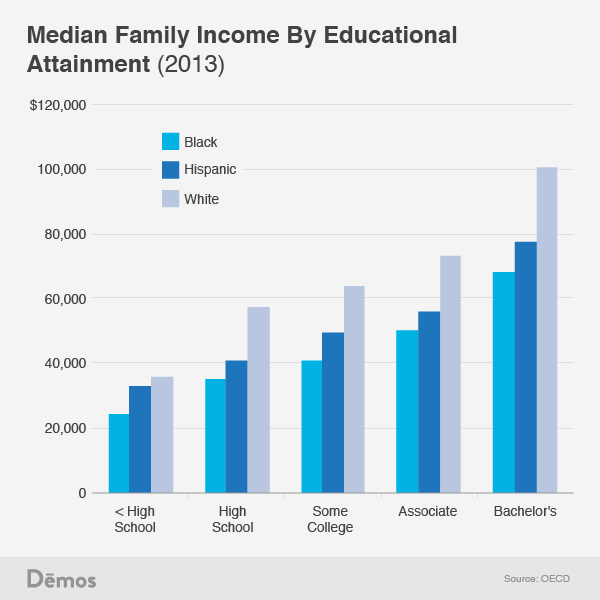
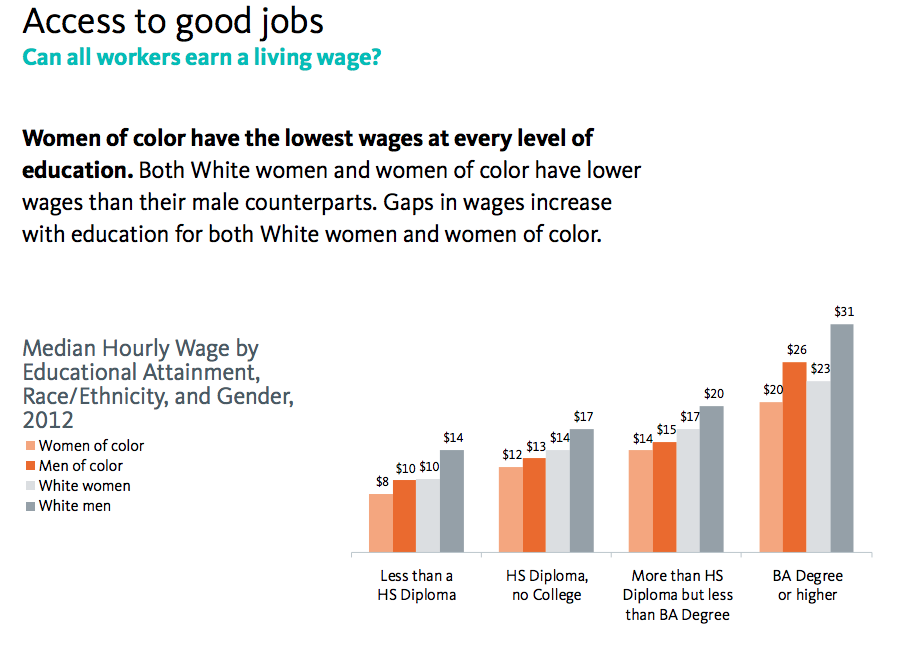
Lets start with semantics—how we make claims. As most people use “education is the great equalizer,” the claim suggests we have already accomplished this; however, in reality, educational attainment does not equalize in the context of race, social class, and gender.

A tremendous amount of evidence shows that greater educational attainment will give a person advantages within race, class, or gender, but not among race, class, and gender. As just a couple of graphic examples (see research linked above):

fig_2

access to good jobs race gender

Instead of “education is the great equalizer,” we must begin to argue “education should be the great equalizer, but we are not there yet.”

The US must, then, commit to social reform that addresses the negative influence of racism, classism, and sexism on children and adults. Concurrently, education reform must focus on equity and not accountability: access to challenging courses, access to certified and experience teachers, equitable disciplinary practices.

Myth: Teacher quality is the most important factor in student achievement.

This is also where our hopes clash with realities. Teacher quality is a small percentage, about 10-15%, of measurable student achievement, dwarfed by out-of-school, factors:

But in the big picture, roughly 60 percent of achievement outcomes is explained by student and family background characteristics (most are unobserved, but likely pertain to income/poverty). Observable and unobservable schooling factors explain roughly 20 percent, most of this (10-15 percent) being teacher effects. The rest of the variation (about 20 percent) is unexplained (error). In other words, though precise estimates vary, the preponderance of evidence shows that achievement differences between students are overwhelmingly attributable to factors outside of schools and classrooms (see Hanushek et al. 1998;Rockoff 2003; Goldhaber et al. 1999; Rowan et al. 2002; Nye et al. 2004).

Research from the UK, in fact, reveals teacher quality as only one part of school quality is even a smaller fraction of what matters in student achievement:

Just 14 per cent of variation in individuals’ performance is accounted for by school quality. Most variation is explained by other factors, underlining the need to look at the range of children’s experiences, inside and outside school, when seeking to raise achievement.

Instead of “Teacher quality is the most important factor in student achievement,” we must make a complicated case: “Teacher quality is extremely important, but nearly impossible to identify by measurable student outcomes.” And then, “social and school reform must address many influences on student achievement, most of which are outside the control of schools alone.”

As I noted above, vulnerable student populations are suffering inequitable access to certified and experienced teachers; here is an area for reform.

Myth: Private and/or charter schools outperform public schools.

These false and simplistic claims often suffer from not carefully making fair comparisons. The key here is that when raw data comparisons are used, conclusions are typically unfounded. The reality is that no type of school (public, private, charter) has proven to be superior to any other type, and all types of schools have a wide range of quality that is strongly linked to the populations of students being served. Some evidence (although this counter-claim is what the body of evidence shows):

Instead of “Private and/or charter schools outperform public schools,” we must refocus on “How do we create equitable public schools that make private and charter schools unneeded?”

This myth is difficult to separate from the next, the miracle school.

Myth: School X is a miracle school.

Possibly one of the most enduring false narratives of media coverage of education is the newest miracle school (increasingly charter or more specifically KIPP charter schools). This false narrative is compelling because on the surface, these stories in the press seem like good news; however, they fail for two reasons: first, if a miracle school existed, by its nature, that school would be an outlier, and thus not a credible model for what all or most schools should do, and second, miracle schools simply do not exist, but are the product of careful public relations and the failure of journalists to verify those PR claims.

As I noted above, schools claiming miracles or media labeling a school a miracle are likely not identifying the details that would unravel the claims: charter schools that underserve the highest poverty students, special needs students, or ELL students; private schools that are selective, and public schools that may appear highly effective when focusing on some data, but exposed as typical when the full picture is examined.

Again, the key for journalists is to be skeptical of miracle claims, and do the due diligence in confirming the claims; some evidence of the false allure of miracle schools:

Instead of “school X is a miracle school,” we need to avoid seeking outliers as models for expectations for all schools, but we must also learn to offer nuanced and complex stories about the realities of all schools, pictures that are often uncomfortable.

In short, journalists should stop writing miracle school stories.

Myth: School quality is the key to our country’s economy.

This has been refuted for decades, notably by Gerald Bracey; for example, International Comparisons: More Fizzle than Fizz:

[T]est scores, at least average test scores, don’t seem to be related to anything important to a national economy. Japan’s kids have always done well, but the economy sank into the Pacific in 1990 and has never recovered. The two Swiss-based organizations that rank nations on global competitiveness, the Institute for Management Development and the World Economic Forum, both rank the U. S. #1 and have for a number of years.

At its core, I think, this false claim about causality (better schools somehow equal a better economy) is a bigger problem than the claim.

Education journalism often fails by jumping to causal claims (using rankings as if that proves some causal link, making common-sense claims because it seems that X causes Y) when the evidence doesn’t support those arguments. Again, consider that we seem to believe private schools cause better outcomes, but in fact, private schools are able to select the sorts of students who happen to have the lives that cause those outcomes, not the school type.

Just as we must admit about teacher quality, instead of “school quality is the key to our country’s economy,” we should be arguing that improving schools by focusing on equity is important for hundreds of reasons that may or may not be directly measurable or linked to a wide variety of outcomes, such as economic stability or growth.

False narratives have endured because they are simple (simplistic), but the alternatives we need to embrace will be challenging because of their complexity.

Myth: New standards and new tests (i.e, Common Core) ask more of our students, are the key to education reform.

The blunt truth is that standards and high-stakes testing haven’t work for over three decades, and in fact, the quality or even presence of standards does not correlate with better student outcomes or greater equity in our schools.

A review of the standards-based accountability era has shown:

There is, for example, no evidence that states within the U.S. score higher or lower on the NAEP based on the rigor of their state standards. Similarly, international test data show no pronounced test score advantage on the basis of the presence or absence of national standards. Further, the wave of high-stakes testing associated with No Child Left Behind (NCLB) has resulted in the “dumbing down” and narrowing of the curriculum….

As the absence or presence of rigorous or national standards says nothing about equity, educational quality, or the provision of adequate educational services, there is no reason to expect CCSS or any other standards initiative to be an effective educational reform by itself.

Further, the evidence is plentiful that standards, testing, and accountability have been ineffective:

  • French, Guisbond, and Jehlen (2013), Twenty Years after Education Reform: High-stakes accountability in Massachusetts has not worked.
  • Loveless (2012), How Well Are American Students Learning?: “Despite all the money and effort devoted to developing the Common Core State Standards—not to mention the simmering controversy over their adoption in several states—the study foresees little to no impact on student learning” (p. 3).
  • Whitehurst (2009), Don’t Forget Curriculum: “The lack of evidence that better content standards enhance student achievement is remarkable given the level of investment in this policy and high hopes attached to it. There is a rational argument to be made for good content standards being a precondition for other desirable reforms, but it is currently just that – an argument.”
  • Kohn (2010), Debunking the Case for National Standards: CC nothing new, and has never worked before.
  • Victor Bandeira de Mello, Charles Blankenship, Don McLaughlin (2009), Mapping State Proficiency Standards Onto NAEP Scales: 2005-2007: Why does research from the USDOE not show high-quality standards result in higher NAEP scores?

Instead of “new standards and new tests (i.e, Common Core) ask more of our students, are the key to education reform,” we need to call for some different approach to reform, again one focusing on equity.

Another ugly truth behind the false narrative about standards is that the new standards/new tests churn has benefitted the education market, but not students or the public.

Myth: School choice works and parents deserve choices.

Both of these false claims speak, again, to what many in the US hope for, but not what exists. In other words, “choice” triggers for most people our faith in freedom, but in the free market and public education, “choice” is a complicated and misleading term.

First, school choice advocates have been shifting their claims and promises for several decades now—when each promise fails, a new one is offered. And second, particularly focusing on parental choice, choice advocacy fails from idealizing the mechanism.

School choice suffers a similar pattern to the myth above about private, charter and public schools: school choice advocates tend to issue PR reports that have not been peer-reviewed, journalists cover those PR accounts uncritically but do not report when the claims are refuted in reviews, and school choice must be examined by making fair comparisons (funding, populations of students, etc.).

While school choice hasn’t produced higher student outcomes, or any of the many promises advocates offer, we do have some outcomes worth considering. School choice contributes to segregation.

The wealth of research on school choice is staggering, but that is even more troubling since it overwhelmingly does not support the typical positive spin found in the media. Some evidence includes:

Instead of “school choice works and parents deserve choices,” we need to set aside our idealism about choice, and recommit to the power and importance of strong public institutions, not as a dangerous alternative to the free market but as necessary for the free market to work for everyone.

In short, market dynamics such as choice are not universally powerful or effective, especially in endeavors serving the public good such as universal public education. As well, we must admit that rejecting school choice as a mechanism for school reform is not somehow an attack on the autonomy of families or parents.

Beyond rejecting the myths noted above—and many others (such as the daft “money doesn’t matter”)—journalists need to step back from business as usual in terms of how pubic schools are examined and whose voices matter in that discussion.

Practices such as ranking need to stop, and ways to increase educators’ voices in that discussion must be explored.

As I have detailed above, the media is too often trapped in what we wish were true instead of the harsh realities we continue to face. For that reason, I remain committed to calling for a critical free press.

Recommended Reading for Education Journalists

Reading Educational Research: How to Avoid Getting Statistically SnookeredGerald W Bracey

Education and the Cult of Efficiency, Raymond Callahan

MLK Day 2016: A Reader

In the US in 2016—and specifically for educators—the need to confront racism must remain central to all efforts to overcome inequity and injustice. Among the privileged—white-, male-, heterosexual-skewed—there is no room for “yes, but,” although there remains ample room for stepping back, being silent, and then listening as first steps to offering solidarity in the action needed to confront the false narratives of “meritocracy” and “rugged individualism,” and then to overcome the irrefutable inequities linked to race, class, gender, and sexuality.

One commitment is to resist the whitewashing of Martin Luther King Jr. as a passive radical. So here, I offer some readings, varied and important, but pathways to honoring the radical MLK and to resisting the lingering dream deferred.

Final Words of Advice/ “Where do we go from here?” (1967), Martin Luther King Jr.

MLK poverty

The Trumpet of Conscience, Martin Luther King Jr.

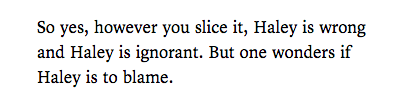
Leonard Pitts Jr.: Haley’s fairy tale ignores our history

haleyEnslaved Africans of George Washington Depicted as ‘Happy and Joyful’ in New Children’s Book

The Forgotten, Radical Martin Luther King Jr., Matt Berman

Martin Luther King, Jr.: Christian Radical—And Saint, Elizabeth Stoker Bruenig

Read This Before Co-Opting MLK Jr., Jose Vilson

The Revisionist’s Martin Luther King Jr., “I Have A Dream For Most Of Us,” Jose Vilson

Harlem, Langston Hughes

Let America Be America Again, Langston Hughes

The white man pathology: inside the fandom of Sanders and Trump, Stephen Marche

Schools, black children, and corporal punishment, Dick Startz

figure-1

“Please—a little less love, and a little more common decency.”

The Causal Effects of Cultural Relevance: Evidence from an Ethnic Studies CurriculumThomas Dee, Emily Penner

Questioning Payne | Teaching Tolerance

Toolkit for “Questioning Payne” | Teaching Tolerance

50 Years After Selma, White Lives Still Matter More, Stacey Patton

The Oscars’ Racist Refusal to Honor Modern Black Heroes, Stereo Williams

Should We Marvel at a Black Captain America?

The Martian: Allegory of Whose Lives Matter

Nicolas Sparks and the Allegory of Pretty White People Who Struggle until Everything Works Out

James Baldwin: “the time is always now”

the-time-is-always-now

More Lessons on the Journalist/ Educator Divide

During my recent round of confronting the failures of mainstream media and journalists covering US public education (see here, here, and here), I have had some of my worst fears confirmed, but have also discovered a few new lessons.

I was disappointed to read some Tweets that suggested that the reason journalists do not include more (or usually any) teacher voices is the fault of educators: teachers not willing to go on record, teachers failing to meet the journalist’s deadline.

This deflecting of professional responsibility and blame prove my central point that journalists simply do not understand education well enough to cover it adequately or fairly.

K-12 public school teachers are increasingly losing any semblance of job security—one aspect of which is the traditional charge that teachers not be political, not be advocates in the public realm. Journalists must have a greater sense of awareness and compassion for those conditions, and then seek ways to make it possible for teachers to be a major part of the public discussion about education.

An alternative, however, that I often present is that there is no absence of professors and researchers who are able to speak publicly while also having a much higher level of expertise in the many topics around education than think tank leaders, elected officials, political appointees, billionaire edu-hobbyists, and self-proclaimed edu-reformers and edu-leaders.

Another lesson involves the sheer complexity of educational problems and educational research (see here). Journalists are drawn to presenting complex issues in accessible ways for a lay audience (a legitimate concern), but what has happened in the coverage of education is that journalists overwhelmingly are using sources who start with the simplistic and oversimplified (“education is the great equalizer” [untrue], “teacher quality is the most important factor in student success” [untrue], “public education is in crisis” [untrue], “poverty is not an excuse” [baldfaced ugly assertion]) that significantly distort both the problems in education and the solutions.

As well, as I have documented often, journalists are prone to reporting uncritically on aggressively promoted reports (typically form think tanks, but increasingly from departments in universities funded by billionaire edu-reformers) that have not yet been vetted by the peer-review process; and then fail to follow up when reviews often find many flaws with the reports and their claims.

However, I have also had a couple encouraging experiences.

One journalist emailed me with a wonderfully positive and self-reflective response to my work. If there is one journalist who takes the time to consider authentically these concerns, I feel optimistic there are more.

As well, I have recently viewed a brief documentary by Lena Jackson, whose Crenshaw is an outstanding examination of education, Day in the Life – Gustavo Lopez, MA & Credential Urban Education & Social Justice:

I am left after viewing this work convinced that fore-fronting teachers’ voices is not only important, but possible—if the will to examine education is sincere and critical.

I am currently skeptical that many journalists covering education are either sincere or critical.