All posts by plthomasedd

P. L. Thomas, Professor of Education (Furman University, Greenville SC), taught high school English in rural South Carolina before moving to teacher education. He is a former column editor for English Journal (National Council of Teachers of English), current series editor for Critical Literacy Teaching Series: Challenging Authors and Genres (Brill), and author of Teaching Writing as Journey, Not Destination: Essays Exploring What ‘Teaching Writing’ Means (IAP, 2019) and How to End the Reading War and Serve the Literacy Needs of All Students: A Primer for Parents, Policy Makers, and People Who Care (IAP, in press). NCTE named Thomas the 2013 George Orwell Award winner. He co-edited the award-winning (Divergent Book Award for Excellence in 21st Century Literacies Research) volume Critical Media Literacy and Fake News in Post-Truth America (Brill, 2018). Follow his work @plthomasEdD and the becoming radical (https://radicalscholarship.wordpress.com/).

“Please—a little less love, and a little more common decency.”

I wish that people who are conventionally supposed to love each other would say to each other, when they fight, “Please—a little less love, and a little more common decency.”

Slapstick or Lonesome No More!, Kurt Vonnegut

I was a public high school English teacher for almost two decades in the rural upstate of South Carolina.

My first years were nearly overwhelming—as they are for most beginning teachers. And I would concede that much of that struggling could easily be categorized as classroom management challenges (although having five different preps, 15 different textbooks, and classes as large as 35 students certainly didn’t help).

Yet, then and now, as I approach the middle of my third decade teaching, I tend to reject the terms “discipline” and “classroom management” because they carry connotations I cannot endorse.

First, framing classroom management as something separate from pedagogy, I believe, is a mistake. In other words, effective and engaging pedagogy creates the environment that renders so-called (and generic) classroom management strategies unnecessary.

Next, most claims about “discipline” and “classroom management” remain trapped in reductive behavioristic ideology as well as authoritarian views of the teacher (in which authority is linked by default to the position).

As a critical educator, I seek to be authoritative, not authoritarian (see Paulo Freire). In other words, I forefront the human dignity and agency of my students, I seek always to model the person and learner I feel my students should emulate, and I work diligently to earn the respect of my students, in part, because of my expertise and credibility in terms of what content I am teaching.

But having taught public school, I know the real world is messy: students become confrontational with their peers and even teachers. School can be (and in some places often is) a physically and psychologically dangerous and uncomfortable place, rendering learning less important.

And I also recognize that each teacher is legally and morally the central figure of authority in any classroom. Yes, as a teacher, I must assert that authority any time the safety, health, or opportunity to learn of any students is threatened.

So when I am teaching pre-service teacher candidates, I urge them to take certain steps in their day-to-day interactions with students as well as in confrontational events.

I urge them always to speak to students with “please” and “thank you.” I stress that whenever students become loud, belligerent, or threatening, the teacher must lower her/his voice, mediate her/his language, increase her/his patience, and seek ways to give the student space and time in order to protect all innocent students and the upset student.

I say “yes, sir” and “no ma’am” to students because my father raised me that way. However, my father’s own authoritarian style (“do as I say, not as I do”) also imprinted on me my fear of hypocrisy; therefore, I seek always to have higher standards for my own behavior than for the behavior of my students.

All of that—and more—is to say that when I read A ‘No-Nonsense’ Classroom Where Teachers Don’t Say ‘Please’ I was horrified because of both the abusive treatment of children and the (not surprising) cavalier endorsement by NPR.

The problems are almost too numerous to list, but I’ll try.

First, the so-called “unique teaching method”—”no-nonsense nurturing”—is a program (from “Center for Transformative Teacher Training, an education consulting company based in San Francisco”), and thus, NPR’s reporting proves to be little more than a PR campaign for that company.

Next, these harsh and dehumanizing methods are yet more of the larger “no excuses” ideology that targets primarily children in poverty and black/brown children. In other words, there is a general willingness to endorse authoritarian methods as long as the children are “other people’s children”—code for the poor and racial minorities.

And then, related, the direct justification for that authoritarianism is that parents choose this for their children.

Here, I want to stress again what I have examined before (see here and here):

  • Be skeptical of idealizing parental choice. Parents can and do make horrible choices for their children, and children should not be condemned only to the coincidences of their births.
  • Many scholars have addressed the self-defeating choices within racial minority communities that stem from unhealthy dynamics related to being a marginalized and oppressed people; see Michelle Alexander on black neighborhoods calling for greater police presence and Stacy Patton (here and here) on blacks disproportionately embracing corporal punishment. I have applied that same dynamic to blacks choosing “no excuses” charter schools.

While the NPR article notes that these practices “[make] some education specialists uncomfortable,” I must note this is not about being “uncomfortable.”

These practices are not providing “structure,” but are dehumanizing.

As well, these practices are racist and classist, and ultimately abusive. Period.

Our vulnerable populations of students already have unfair and harsh lives outside of school. Doubling down on indignity during the school day is not the answer.

If we cannot change the world (and I suspect we can’t), we can provide all children the sorts of environments all children deserve in their school day—environments of kindness, compassion, safety, and challenges.

To paraphrase Vonnegut, then, Please—a little less “no nonsense,” and a little more common decency.

See Also

If you’re a teacher, say “please” and “thank you,” Ray Salazar

Schools, black children, and corporal punishment
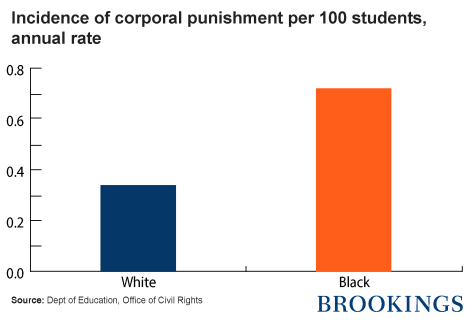
figure-1

On Professionalism and Good Intentions: More on Education and Journalism

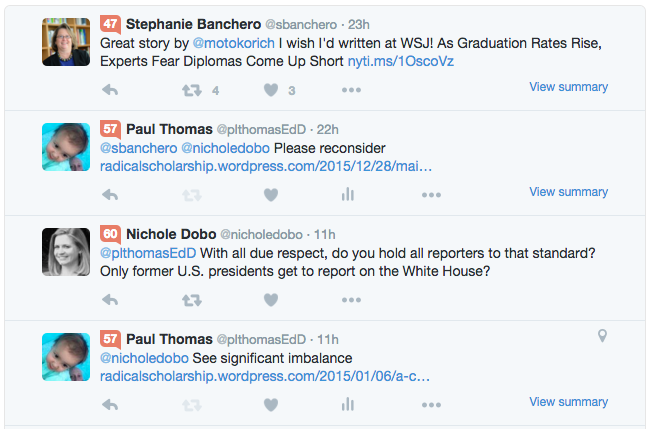
While journalist Nichole Dobo has not corresponded with me since I posted Dear Journalists Covering Education, Let Me Explain, Dobo has posted a Tweet I believe deserves additional consideration:

Dobo’s insistence that her professionalism be respected (which I support fully) raises a key aspect of my concern for how journalists tend to cover education.

Like Dobo, Stephen Sawchuk, a top education journalist for Education Week, bristled at being criticized for education coverage, characterizing the challenges as “pretty offensive.”

Here, then, I am being sincere when I ask: How is the constant and unwarranted drumbeat about “bad teachers,” “failing schools,” and “education crisis” treating educators as professionals? How is the overwhelming lack of seeking teachers and educators as sources in education journalism treating educators as professionals?

Shouldn’t teachers treat journalists as professionals and journalists treat teachers as professionals? Doesn’t our democracy need the professionalism of both journalists and educators?

I taught high school English for about two decades in a rural South Carolina public school, including several years when I also had achieved my doctorate in education while remaining a high school teacher.

During those years, the best I could manage in many efforts to reach into the media were a few letters to the editor.

Once I was in higher education, however, I was given access to Op-Eds as well as frequent interviews by TV and print journalists.

What message does that send?

For both educators and journalists, demanding our professionalism be respected and having good intentions are not enough if we are not extending that same level of respect into the areas we claim to have those good intentions.

To be perfectly honest, education journalism has significantly failed to extend respect to educators—for decades.

The entire accountability era is built on the premise that schools are not effective because teachers simply do not try hard enough, that education lacks the proper incentives (usually negative) to demand the hard work needed for schools to excel.

The “bad teacher” mantra that has risen during the Obama presidency, and the increase of calls for and uses of value-added methods (VAM) to evaluate teachers both further de-professionalize and demonize teachers—and the great majority of education journalism has embraced, not refuted, these.

And as I have already noted, the favorite meme of education journalism remains (for over 150 years) that education is in crisis.

How would journalists feel if “journalism is in crisis” was the primary and initial given about their field, for a century and a half? [1] Does that honor your professionalism? Especially if you have little or no power over your field, especially if your voice is nearly muted from the discussion?

Today, in 2016, the imbalance of treating professionals as professionals tips against journalists covering education.

What does it say to teachers when mainstream education journalists are quoting one think tank leader with no experience in education (and a degree in a field that is not education) more than all the quoting of classroom teachers combined?

You may be offended by this, but I offer it because I respect the field of journalism and agree journalists should be afforded the highest respect as professionals: Journalists covering education have not treated my profession, education, as a profession.

Of all professions, however, I believe educators and journalists need each other, need both to be honored professions.

I eagerly await journalists covering education to join educators in that solidarity.

See Also

Flunking the Test, Paul Farhi

[1] Please note how many journalists respond when a lowly blogger simply challenges them based on evidence and my own expertise in both fields.

8 January 2016: “Quite an experience to live in fear isn’t it? That’s what it is to be a slave”

Blade Runner is a film adaptation of Philip K. Dick’s Do Androids Dream of Electric Sheep?

51ehnnnppdl-_sx359_bo1204203200_

The film is my favorite film, although the adaptation is quite distinct from the novel—also a wonderful work itself.

Today, 8 January 2016, marks the birth of replicant Roy:

Roy

Roy’s final monologue is a powerful and currently relevant statement, notably— “Quite an experience to live in fear isn’t it? That’s what it is to be a slave”:

The use of androids-as-slaves as a metaphor for the human condition is also in the science fiction section of Cloud Atlas by David Mitchell.

51-ctfmpbcl-_sx316_bo1204203200_
wage slaves

(from Academia and the American Worker: Right to Work in an Era of Disaster Capitalism?)

Another brilliant, but ignored, science fiction examination of our slavery to time is Andrew Niccol’s In Time (2011), a powerful confrontation of how capitalism turns most people frantic so that a few can live in luxury.

When science fiction is set in the future relative to the publication or release of the original work, rarely is the work intended to be predictive—but often, the work is intended to tell us important things about the human condition and any now by taking us to places that seem unlike our now.

Roy as an enlightened android—more enlightened than the humans who created him to be a slave—ends his haunting monologue with “Time to die.”

I think this is intended so that we seek ways to live better, freer.


Enjoy the four-disc collector’s edition of Blade Runner.

Do Androids Dream of Electric Sheep? also is available as a graphic novel series.

What Football Reveals for Education about False Allure of Quantification

If you want to understand the inherent complexity of professional football, you may want to start with a person with a long and rich career in the sport. For example, consider “Super Bowl-winning former Ravens coach Brian Billick” responding to the rise of metrics and statistics in the NFL:

“One of the most common questions I get is, Can you do Moneyball, for lack of a better term, in the NFL? And the answer is, No, you can’t,” Billick said. “You can’t quantify the game of football the way you do baseball. It’s not a statistical game. The parameters of the game, the number of bodies and what they’re doing in conjunction with one another.”

The collaborative and human (although not humane) elements of football, it appears, render the power of statistics less predictive—and less useful—in the sport than in baseball.

One lesson, then, seems to be that statistics are not universally valid and predictive, particularly in contexts that are highly complex.

I am reminded of the post-Katrina analysis of the pre-landfall models for the massive hurricane. That image of hundreds of models was a nightmare of confusion, lending little in valuable predictive information for anyone.

The post-Katrina data on just what did occur, however, were fascinating and powerful.

Since the U.S. cares more about the NFL than public education, Billick’s skepticism and warnings are likely to be better heeded than decades of similar warnings from teachers about the rise of measurable data (mostly high-stakes test scores) in evaluating students, teachers, and schools.

In education, the tug-of-war continues, and I fear, those of us siding wth Billick in the context of education are not fairing well.

See this report advocating more metrics in teacher quality pursuits, Smart, Skilled, and Striving: Transforming and Elevating the Teaching Profession, and then a review, mostly discrediting the report as the abstract notes:

This report from the Center for American Progress offers 10 recommendations for improving the public perceptions of and experiences of classroom teachers. While elements of these recommendations would likely be beneficial, they also include policy changes that would increase surveillance of teachers, reduce teachers’ job security, evaluate teachers by students’ test scores, and create merit pay systems that would likely have the opposite effect. For evidence, the report relies too heavily on popular rhetoric, sound bites, opinion articles, and advocacy publications to advance a policy agenda that in many ways could do further harm to the teaching profession. However, many of the report’s recommendations do align with policy reforms currently being proposed for the Higher Education Act and included in the Elementary and Secondary Education Act reauthorizations and are therefore important to read critically and consider carefully. In advancing evaluation of teachers by test scores, the report goes against the cautions and guidelines recently released by the American Statistical Association and the American Educational Research Association. Other than a review of contemporary issues, the report offers little of substance to advance the teaching profession.

Let’s hold our collective breaths about which will win out. Any predictions?

Dear Journalists Covering Education, Let Me Explain

In my Twitter timeline, I saw a post praising a recent New York Times article on graduation rates and the devalued high school diploma. Since I had written a blog criticizing the many (and typical) flaws in the piece, I nudged Stephanie Banchero and Nichole Dobo to reconsider.

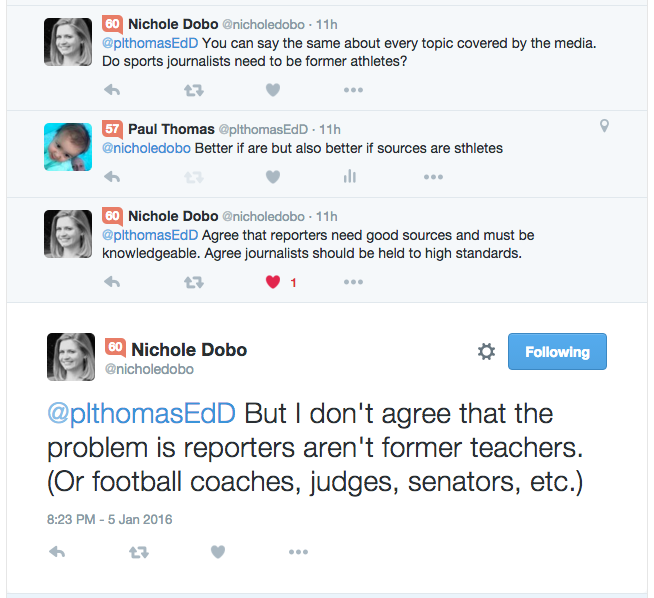
Dobo was gracious enough to respond [1], but Twitter really doesn’t afford the space to make my case as well as both the topic and Dobo deserve so I want here to lay out better just exactly why so many of us in education are routinely frustrated with how media cover education.

Let me start by reemphasizing why educators have moved from frustrated to exasperated in terms of media coverage of public education.

In the mid-1800s as public schools became a more compelling option for education in the U.S., Catholic schools initiated scathing attacks on public schools—not for educational, but for market reasons.

The history of vilifying public education in the U.S. has replicated that pattern until today—although the negative drumbeat has intensified significantly over the past three decades of high-stakes accountability (which is mostly a political, not an educational, venture).

Therefore, most political and media commentary on public education is misguided. Yes, most.

The problem for educators is not that public education is without flaws and is being unfairly demonized, but that we in the U.S. have mostly failed public education (and our students, and our country) by continuing to wallow in false narratives while ignoring the very real problems in both our education system and society that warrant reform.

My argument is that since most political leaders and political appointees governing education as well as most journalists covering education are without educational experience or expertise, these compelling but false narratives are simply recycled endlessly, digging the hole deeper and deeper.

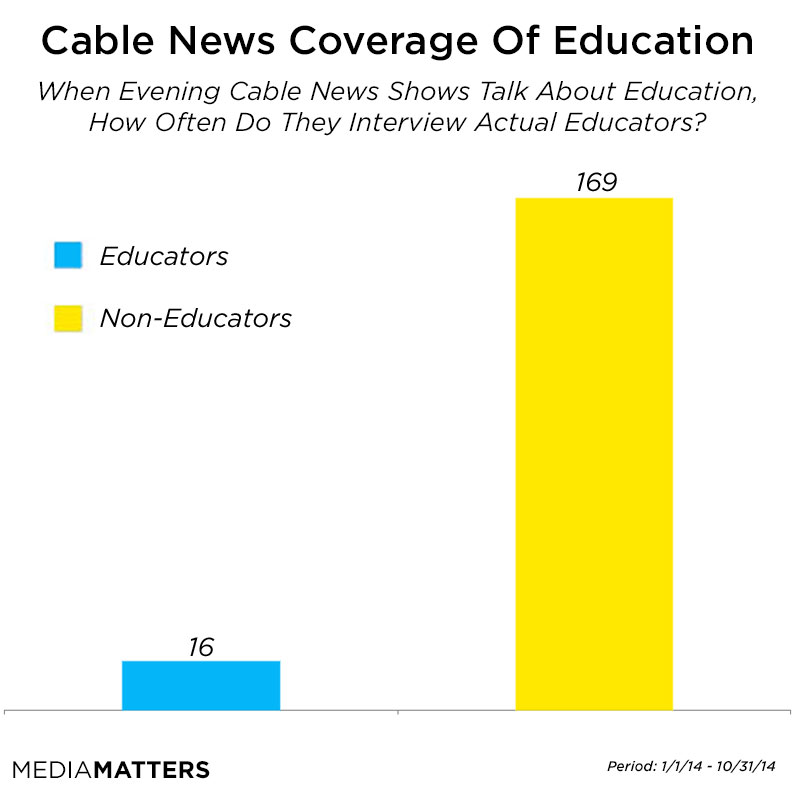
Compounding that problem is the overwhelming evidence that journalists covering education disproportionately turn to people outside the field of education as their sources [2].

Think tank advocacy masquerading as research (rarely peer-reviewed) garners sensational headlines [3] while psychologists, economists, and political scientists are quoted about every aspect of education.

And on the rare occasion that I am interviewed by a journalist, I can predict what will happen: the journalist is always stunned by what I offer, typically challenging evidence-based claims because they go against the compelling but false narratives.

No, there is no positive correlation between educational quality and any country’s economy.

No, teacher quality is actually dwarfed by out-of-school factors in terms of student achievement.

No, charter and private schools are not superior to public schools.

No, school choice has not worked, except to re-segregate schools.

No, merit pay does not work, and is something teachers do not want. Teachers are far more concerned about their autonomy and working conditions.

No, standards do not work—never have—and high-stakes testing is mostly a reflection of children’s lives, not their teachers or their schools.

This list could go on, but I think I have made my point.

Now let me offer what I think is possibly the best example of the problem—reporting of the SAT.

For decades, the College Board reported SAT scores, ranking states by their average score. The media participated then in the annual bashing of schools based on those rankings.

Eventually, the College Board conceded that such rankings are deeply flawed since among the states, the percentages of students taking the test make those comparisons/rankings invalid—and the SAT is not designed to measure the quality of schools in a state (the SAT is designed only to predict first year college success and does so slightly worse that GPA).

Thus, the College Board issued a notice [4] and began releasing state SAT scores alphabetically. However, the media persist in the bashing.

Another problem with journalists covering education is a journalism problem: seeking to address “both sides” of issues in order to appear fair and balanced.

Therefore, I have invoked the Oliver Rule because that practice too often is not being objective and mostly distorts (as John Oliver brilliantly exposes about climate change) the real balance between the credible and the baseless.

Some, possibly many, issues simply do not have two sides, and often within fields—while there remains debate—issues have such an overwhelming body of evidence supporting a stance that posing the topic as “debatable” is terribly flawed. Framing an issue with someone who is credible and someone who is not fails reporting and the public.

For example, I struggled with the media about corporal punishment recently because the topic simply has only one side (corporal punishment is overwhelmingly harmful), yet every journalist sought both sides for the reporting. This was replicated when I addressed grade retention as well.

Since the U.S. suffers under the delusion that mainstream media is liberal (it isn’t), I must stress that even the so-called liberal New York Times, NPR, and even Education Week are more apt to misrepresent education than swim against the compelling but false narratives.

As I have examined (and had reaffirmed with NPR once again covering Sal Khan as if he is a credible educator in recent days), NPR follows the patterns I have detailed above when covering “grit.”

Where education journalism thrives is in the New Media (blogging) and alternative media (AlterNet, Truthout, The Conversation). In fact, note that Valerie Strauss’s The Answer Sheet (a blog at the Washington Post) is far superior to the print education reporter Jay Mathews, who works within the false narratives about education.

So to return to Dobo’s engaging with me about my concerns.

Dobo and I share something important: we want to defend our professions because they both matter mightily. On that, I agree with Dobo and respect her integrity and her field.

To her challenges to my claims, I want to clarify that, yes, I do believe education journalism would be greatly improved if journalists covering education had expertise and experience in the field.

I have been a coach, and also believe coaches are better when they have played the game they are coaching.

But, my main contention is that currently and historically almost all the politicians governing education, pundits pontificating on education, and journalists covering education have little or no experience or expertise in the field.

My modest proposal is that most should—but certainly not all.

And then, more directly, I also must stress that the real problem with education journalism is that the sources of education coverage in the media are the same talking heads without experience or expertise—think tank leaders, edupreneurs, education hobbyists (mostly millionaires and billionaires), anyone except educators.

Few people are more critical of my field of education than I am so my real concern is that journalism is failing the real reform needed in schools because of the experience and expertise vacuum in the media covering education.

Education needs a critical media, journalists who resist the false but compelling crisis narratives being recycled by politicians.

It is well past time, I think, for everyone who wants to understand education to try asking a teacher. And then listening when what we explain goes against conventional wisdom.

See Also

Is It Journalism, or Just a Repackaged Press Release? Here’s a Tool to Help You Find Out, Rebecca J. Rosen

[1] The conversation, in part, included:

Dobo Twitter 1

Dobo Twitter 2

[2] See Educational Expertise, Advocacy, and Media Influence, Joel R. Malin and Christopher Lubienski; The Research that Reaches the Public: Who Produces the Educational Research Mentioned in the News Media?, Holly Yettick; The Media and Educational Research: What We Know vs. What the Public Hears, Alex Molnar. And REPORT: Only 9 Percent Of Guests Discussing Education On Evening Cable News Were Educators:

cable-education-overall

[3] Consider this press release from the Center for American Progress (CAP), with prompting at the end to talk with their experts, and this review, discrediting the report praised in the press release. The CAP report speaks to the false narratives, and thus, is poised to resonate with political leaders and the media—while the review is likely to garner little attention.

[4] The College Board warns: “Educators, the media and others…[s]hould not rank or rate teachers, educational institutions, districts or states solely on the basis of aggregate scores derived from tests that are intended primarily as a measure of individual students.”

A New Year’s Reader

Spanking children slows cognitive development and increases risk of criminal behavior, expert says

[See also The Stream: Should parents spare the spank]

On the Impossibility of Teaching Creative Writing, Tara Skurtu

[See also Teaching the Unteachable, Kurt Vonnegut; Writing, Unteachable or Mistaught?]

New education law: a lot of suds, William Mathis

[See also Doubling Down (Again) by Reverting, Not Changing: The Exponential Failures of Education Legislation]

A Lecture From the Lectured, John Barone, Cassandra Chaplinsky, Taylor Ehnle, John Heaney, Riley Jackson, Zoe Kaler, Rachael Kossy, Benjamin Lane, Thomas Lawrence, Jessica Lee, Sarah Lullo, Kevin McCammack, Daniel Seeder, Carly Smith, and Demetrius Wade

Is the Drive for Success Making Our Children Sick? Vicki Abeles

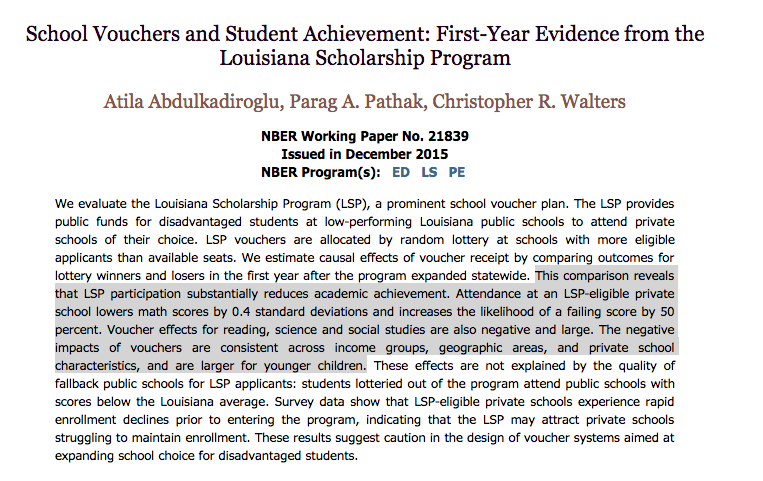
School Vouchers and Student Achievement: First-Year Evidence from the Louisiana Scholarship ProgramAtila Abdulkadiroglu, Parag A. Pathak, and Christopher R. Walters

vouchers LA

The Subtle Linguistics of Polite White Supremacy, Yawo Brown

To the White Parents of my Black Son’s Friends

The Moynihan Report ResurrectedSam Klug

Nicolas Sparks and the Allegory of Pretty White People Who Struggle until Everything Works Out

I have to admit that I am really relieved. While doing my morning Internet browsing, I discovered on the Huffington Post that it Turns Out Dressing Like Gigi Hadid Is Cheaper Than You’d Think.

And when I thought things couldn’t get any better, right there also on HuffPo, I read that the anti-pretty women-of-Hollywood (who is gorgeous!), Jennifer Lawrence, years ago before she was famous totally bombed her Abercrombie and Fitch photo shoot because she was sweating and making ugly faces.

I should add that some of my giddiness may be in the wake of watching The Longest Ride last night [1].

This is a film adaptation of a novel by Nicolas Sparks, which his web site teases in part with:

A few miles away, at a local bull-riding event, a Wake Forest College senior’s life is about to change.  Recovering from a recent break-up, Sophia Danko meets a young cowboy named Luke, who bears little resemblance to the privileged frat boys she has encountered at school.  Through Luke, Sophia is introduced to a world in which the stakes of survival and success, ruin and reward—even life and death—loom large in everyday life.

Luckily, the movie stars two very pretty people, Britt Robertson (who, I checked, is not 12) as the Art Major and Scott Eastwood (the very pretty son of Clint) as the Cowboy (did I mention he is very pretty).

Once I realized the Art Major is in fact a college student and traditional college age (and not a local middle schooler, which would have been a much different movie), I was hooked to see how NC played a part in this love story.

I nearly stopped watching because early on the movie introduces an Old Man who seems about to die, and isn’t pretty at all. Luckily, we soon get flashbacks and discover he is pretty as a young man and falls in love with a very pretty woman.

I am kind of fuzzy on some of the details, but I do recall that the flashback pretty people have bunches of sad stuff happen (he even goes to war and seems to lose the ability to father a child while retaining the ability to have sex), including the pretty flash-back woman leaving the Old Man when he is young and pretty (although she comes back).

Mixed in with the pretty flash-back couple, and I was really getting confused, the Art Major and Cowboy have very clean shower sex (because she falls in the pond!), but also lots of really sad stuff happens.

The Cowboy rides bulls for a living and keeps having accidents that really are going to kill him if he doesn’t quit. His mother (played by the used-to-be-very-pretty Lolita Davidovich) keeps warning the Cowboy but it seems he has to ride those bulls!

Some people may miss that this film adaptation has some really important literary qualities. The Art Major and the Cowboy are very pretty people, but they have real struggles nonetheless.

The Art Major has to choose between her blossoming art career and the Cowboy, symbolically represented by New York city and North Carolina, and the Cowboy just has to ride those damn bulls, symbolically represented by his riding those bulls in slow motion with cut-aways to a slow-motion timer. The Cowboy’s dilemma is masterfully reinforced by his mother constantly mentioning the folly of a sport that lasts 8 seconds and nearly kills the rider every time.

[One interesting side not, possibly coming to my mind because of my comic book background, is the Cowboy has amazing powers of recuperation. I wonder if the novel explains something like Wolverine or Daredevil’s use of meditation?]

I hate to post spoilers, but the most powerful thematic element of the film is at the end when the Art Major and the Cowboy are reunited after the Old Man dies. And, here is the real tear-jerker, the Old Man’s will has a twist that leads to making it possible for an Art Major and Cowboy to be together (and millionaires)!

So I guess, after all, my morning glee probably has far more to do with watching this movie than the wonderful Gigi Hadid and Jennifer Lawrence news on HuffPo.

In fact, the more I think about it, I may need to post a comment at HuffPo about their sexist columns: Why no article on how I can dress affordably like Bradley Cooper?

[1] By the way, I was raised in the South where we are raised to slow down and stare at accidents. I was skimming past all my U-verse channels and paused when I realized is set in North Carolina, and a couple hours later, I had watched the whole thing.

Students, Not Standards: Calling for Solidarity in 2016

Many years ago, I was sitting in the last class session of the capstone secondary ELA methods course as part of my M.Ed. The guest speaker that day was my high school English teacher, the man responsible for my primary career path, Lynn Harrill.

Lynn was friends with the professor, who was then working at the state department of education, I believe.

Toward the end of the class, the professor asked what we wanted our students to know when they left our classes. That question was followed by lingering silence.

Ever the eager student, I said, “I want them to know themselves,” and I caught a glimpse of Lynn smiling widely.

Of course, that is what Lynn had taught me, although most people probably assumed it was reading and writing Lynn had so expertly given his students (which, by the way, was also true).

This moment—one of a very idealistic and naive young teacher, me—comes back to me often, and despite my many failures as a teacher, that grounding goal has always guided me. Not to be simplistic, but I teach students—that’s why I teach.

While reading Four Stories That Homework Tells Children About School, Learning, & Life, I was struck by “STORY #3: School Is More Important Than Other Pursuits/Interests/Activities.”

And now I have to investigate that memory again.

Yes, Lynn Harrill changed my life by being my sophomore and junior English teacher in high school. He was gracious, kind, and encouraging to a deeply insecure and anxious teen (me) who had decided he was a math and science person—because that is what school had told me.

Junior high English classes had been mostly draconian English teachers, grammar book exercises, and diagramming sentences. The “English” content of those classes was easy (I made As), but I loathed it all, even the texts we were assigned to read (much of which we did not read).

Now, before I launch into whining, let me be clear that my story is about how school failed me—but that because of my tremendous privilege (white, male and—according to traditional schooling and standardized tests—high verbal and mathematical intelligence), the consequences of those failures were miniscule. I attended college and continued to make As (easily), leading to an MEd and EdD.

I share this, then, not to bemoan poor pitiful me (or to brag), but to highlight that schools often fail students in ways we do not acknowledge and that the consequences for those students who need schooling most are monumental.

While I was begrudgingly playing school and succeeding, at home I was engaged in a rich array of hobbies and interests that school not only ignored, but also indirectly refuted (even Lynn told me as a 10th grader I needed to stop reading science fiction [SF] and start reading real literature such as Fitzgerald).

I was collecting, reading, and drawing from thousands of Marvel comic books. I was voraciously listening to popular music and studying the lyrics. And I was doing the same with comedy albums, mostly George Carlin and Richard Pryor.

My reading life, as I noted above, was Larry Niven and Jerry Pournelle, Arthur C. Clarke, and whatever works were prompted by my mother’s SF film fascination. I fell in love with The Andromeda Strain because of the film, and much of my formative life was driven by the five Planet of the Apes films and TV’s Star Trek.

My response to the real literature endorsed by Lynn was tepid (but always the mama’s boy, I did as teachers told me to do), but my life was irrevocably changed when he also recommended writers I would never be assigned in the rural South of the 1970s—notably D.H. Lawrence.

Well, damn, I thought. This is literature?

My journey from student to teacher began in my sophomore year of high school as I began to untangle the false narratives school had taught me and came to embrace the authentic narratives of my real life, my real Self, outside of school.

More than a decade into my teaching career (in the position Lynn left at my high school) and in the same doctoral program Lynn had completed, I finally discovered critical pedagogy as the complete vision of student-centered teaching and learning I had been haphazardly practicing.

Regretfully, my entire career as an educator (18 years as a high school ELA teacher and then 14 more years, and counting, as an English educator and first-year writing professor) has occurred under the antithesis of student-centered critical education—the high-stakes accountability movement.

All of which, ironically, I have been prepared for by the very reading material school marginalized, science fiction and dystopian fiction.

Standards, high-stakes tests, and accountability fail students, fail teachers. They conspire to do exactly what homework accomplishes in story #3 above.

I cannot step away form this: I must teach those students placed in my care, and that duty requires me to find out who they are, what they know, and what they want so that we can work together so that they find who they are and who they want to be.

So, I wonder with the new year, and the allure of resolutions—who is with me in 2016? Can we make this about students and not standards, not tests?

See Also

Doubling Down (Again) by Reverting, Not Changing: The Exponential Failures of Education Legislation

Teacher Quality, Wiggins and Hattie: More Doing the Wrong Things the Right Ways

More on Evidence-Based Practice: The Tyranny of Technocrats

Beware the Technocrats: More on the Reading Wars

I Don’t Need Standards To Teach, I Need Students

Are Common Core and Testing Debates “Two Different Matters”?

The “Objectively Reasonable” Shooting of #TamirRice: A Reader

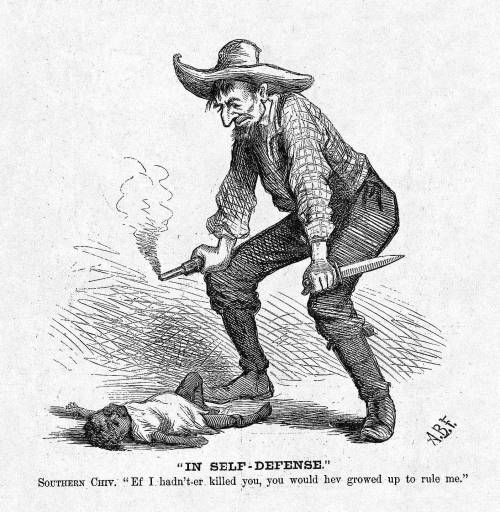
“In Self Defense,” A.B. Frost, Harper’s Weekly (October 28, 1876)

inselfdefense5w

(1934) W.E.B. Du Bois, “A Negro Nation Within a Nation”

The colored people of America are coming to face the fact quite calmly that most white Americans do not like them, and are planning neither for their survival, nor for their definite future if it involves free, self-assertive modern manhood. This does not mean all Americans. A saving few are worried about the Negro problem; a still larger group are not ill-disposed, but they fear prevailing public opinion. The great mass of Americans are, however, merely representatives of average humanity. They muddle along with their own affairs and scarcely can be expected to take seriously the affairs of strangers or people whom they partly fear and partly despise.

For many years it was the theory of most Negro leaders that this attitude was the insensibility of ignorance and inexperience, that white America did not know of or realize the continuing plight of the Negro.  Accordingly, for the lat two decades, we have striven by book and periodical, by speech and appeal, by various dramatic methods of agitation, to put the essential facts before the American people.  Today there can be no doubt that Americans know the facts; and yet they remain for the most part indifferent and unmoved.

A Report from Occupied Territory, James Baldwin, The Nation (July 11, 1966)

You will note that there is not a suggestion of any kind of appeal to justice, and no suggestion of any recompense for the grave and gratuitous damage which this man has endured. His tone is simply the tone of one who has miraculously survived—he might have died; as it is, he is merely half blind. You will also note that the patch over his eye has had the effect of making him, more than ever, the target of the police. It is a dishonorable wound, not earned in a foreign jungle but in the domestic one—not that this would make any difference at all to the nevertheless insuperably patriotic policeman—and it proves that he is a “bad nigger.” (“Bad niggers,” in America, as elsewhere, have always been watched and have usually been killed.) The police, who have certainly done their best to kill him, have also provided themselves with a pretext derisoire by filing three criminal charges against him. He is charged with beating up a schoolteacher, upsetting a fruit stand, and assaulting the (armed) police. Furthermore, he did all of these things in the space of a single city block, and simultaneously….

This is why those pious calls to “respect the law,” always to be heard from prominent citizens each time the ghetto explodes, are so obscene. The law is meant to be my servant and not my master, still less my torturer and my murderer. To respect the law, in the context in which the American Negro finds himself, is simply to surrender his self-respect.

The horrifying lesson of Tamir Rice: White America will use “objectivity” to justify the murder of black children, Brittney Cooper

Last week, a group of legal experts ruled the November 2014 police shooting of 12-year old Tamir Rice “objectively reasonable.” Rice was shot as he sat in a local park, near the recreation center where he frequently played, holding a pellet gun. When officers responded to 911 calls that a “guy was sitting in the park pointing a gun at people,” they did not know that 195-pound Tamir Rice was only 12….

It is entirely unreasonable for a young boy, someone’s child, to end up dead at the hands of law enforcement when he did not objectively pose a threat. He was a child playing with a toy. In a park. That is what children do. There was nothing unreasonable about his activities. He was playing with a gun openly in an open-carry state. He was playing with his gun in a gun-driven national culture that does not think the killings of innocent college students or little children warrant more robust gun control laws.

The plot of one of our iconic American movies, “A Christmas Story,” is about a nine-year old boy wanting nothing more for Christmas than a “Red Ryder air rifle.” In the film, the adults in his life repeatedly warn Raphie, the protagonist, that he’ll “shoot his eye out,” with the weapon. Many adults who saw Tamir Rice the day he was killed warned him to be careful with his toy gun, too. The adults in Tamir Rice’s life weren’t worried that he would harm himself, but rather that the police would “reasonably” assess the 12 year old to be a dangerous criminal.

The legal murder of Tamir Rice, Ta-Nehisi Coates

This is where my own questions begin: Is our tolerance for the lethal violence of the police rooted in the fact that lethal violence in our society is relatively common? Put differently, murder in America is much more common than in other developed countries. Is this how we have made our peace with that fact? Our world is, in some real sense, more dangerous. In recognition of this, have we basically said to the police, “Do what you will?” And in the case of Stand Your Ground, has this “Do what you will” ethic even extended to the citizenry? And if that is the case, then is there a line that can be drawn from Tamir Rice to Walter Scott to Sandy Hook to Trayvon Martin?

The Paranoid Style of American Policing, Ta-Nehisi Coates

When policing is delegitimized, when it becomes an occupying force, the community suffers. The neighbor-on-neighbor violence in Chicago, and in black communities around the country, is not an optical illusion. Policing is (one) part of the solution to that violence. But if citizens don’t trust officers, then policing can’t actually work. And in Chicago, it is very hard to muster reasons for trust.

When Bettie Jones’s brother displays zero confidence in an investigation into the killing of his sister, he is not being cynical. He is shrewdly observing a government that executed a young man and sought to hide that fact from citizens. He is intelligently assessing a local government which, for two decades,ran a torture ring. What we have made of our police departments America, what we have ordered them to do, is a direct challenge to any usable definition of democracy. A state that allows its agents to kill, to beat, to tase, without any real sanction, has ceased to govern and has commenced to simply rule.

White police are killing black kids: The cops get off, because the system protects the lives it values, Brittney Cooper

Who will fight when the cops run in guns blazing without regard or care for the lives they have been called to protect and serve?

The answer is no one. No one will fight for us. And when we fight for ourselves, they kill us for that, too. When we stand up and decry injustice, our rage becomes the pretext for even more state-sanctioned violence, repression, and disenfranchisement.

We’ve said it all before. At this point, White Americans know the racial refuse of this nation is a stinking, rotting sore. But far too many of them continue to walk around acting, as the country folks of my youth would say, as if their shit don’t stink. For those of us who view Black lives as something more than the incidentally odoriferous fertilizer for white supremacy, the stench of rotting Black flesh is almost too much bear.

Most Murders Are within Same Race

Like “thug” and “disruptive students,” a much more racially charged and racist refrain is “black on black” crime.

The phrase includes race and is factual—although fatally incomplete.

As well, many of the most credible and critical voices confronting racism are apt to concede the looming problem of blacks killing blacks—such as Ta-Nehisi Coates arguing that “[w]hen policing is delegitimized, when it becomes an occupying force, the community suffers”:

It will not do to note that 99 percent of the time the police mediate conflicts without killing people anymore than it will do for a restaurant to note that 99 percent of the time rats don’t run through the dining room. Nor will it do to point out that most black citizens are killed by other black citizens [emphasis added], not police officers, anymore than it will do to point out that most American citizens are killed by other American citizens, not terrorists. If officers cannot be expected to act any better than ordinary citizens, why call them in the first place? Why invest them with any more power?

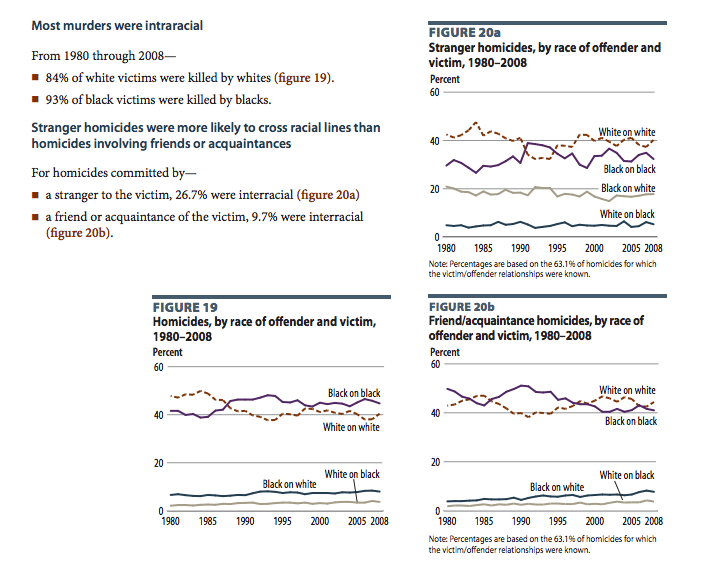
The issue is not the fact of black on black crime, but that crime and homicide are overwhelmingly within race:

murders intraracial
U.S. Department of Justice: Homicide Trends in the United States, 1980-2008 (November 2011). 

Crime and homicides are the result of familiarity and proximity. Our families, our social circles, our neighborhoods, and our communities are far more dangerous to each of us than any stranger or any unfamiliar territory. And as long as familiarity and proximity remain mostly segregated, our crimes and murders are likely to remain within the same race.

To utter “black on black” crime in order to claim a causal relationship between race and crime is dishonest. Race in crime is a marker, not a cause agent, especially not a cause agent unique to any race.