
Heinemann Online PLC: P.L. Thomas Confronts Privilege
All posts by plthomasedd
Scalia’s Racism Exposes Higher Education’s Negligence
[Reprinted in part at The Answer Sheet/Washington Post]
It is a nearly imperceptibly short stroll from Donald Trump to Supreme Court Justice Antonin Scalia.
The arrogance of power is disturbing for its privilege and bigotry, but exponentially so for the cavalier brashness and absence of self-awareness.
Regardless of the position of power, Scalia’s racist pronouncements about the proper place of black students in higher education (again, a short stroll from Supreme Court Justice Clarence Thomas’s rejecting affirmative action, which he himself used during his journey to the highest bench) are inexcusable.
However, there is another story Scalia is inadvertently exposing: the negligence of higher education to teach the students who walk the halls and sit in the classrooms after being admitted.
First, let me pull away from that specific claim to a broader pet peeve of mine: remediation.
Throughout formal education at every level from pre-K through undergraduate (and even graduate) education, students are commonly labeled as remedial (a designation that suggests the students are not at the proper level for the course they are taking) and thus need some additional services.
This is total hogwash. All students are remedial, and no students are remedial. You see, the essential role of a teacher and formal education is to identify what knowledge and skills students have as well as what knowledge and skills students lack (or need developing), and then to teach those students in that context.
So let’s return to higher education in the U.S.—where attending college is not a basic right and is often a tremendous burden on students and their families.
A significant number of students are admitted to colleges and universities for the benefit of the institution (full-pay students and athletes, as the most prominent examples). Often, these populations fall into the deficit category of “remedial,” or would be the exact type of student Scalia has now further marginalized with the damning blanket of racism.
From the most accessible (in terms of admissions) public colleges to the most selective private colleges, access to higher education in the U.S. is nonetheless selective. In other words, colleges accept students (and reject others) under the tacit contract that each belongs there and that the university will provide the education for which the student (or someone) is paying.
Again, I have taught public school in the impoverished rural South and a selective liberal arts university. Those two contrasting settings have shown me that I often taught diligently at the high school setting with little concrete evidence I was successful (many students still scored low in standardized testing), but that I could (if I chose to do so) do very little with my college students (extremely bright and motivated) and there would still be ample evidence of success.
And herein lies the issue no one is talking about beneath the embarrassment of Justice Scalia’s comments: vulnerable populations of students admitted to colleges and universities (often black, brown, poor, and English language learners)—those who need higher education the most, in fact—are being neglected by the very institutions who admit them, often after actively recruiting them (again, the athletes).
I teach two sections of writing-intensive first-year seminars each academic year. The greatest difference between my successful and struggling students is their experiences and relative privilege before attending my university.
Successful students have “done school” in ways suitable for college expectations before while struggling students rarely have.
Too often, echoing Scalia, many in higher education shake their collective heads and mutter these students shouldn’t be “at our college.”
Too often, higher education is a place that simply has no interest in teaching—opting instead for gate-keeping (masking privilege with the bigoted allure of measurable qualifications), housing students for a few years, and then taking credit for the outcomes.
Scalia’s bigotry, like Trump’s, is repulsive, but let’s not fool ourselves that it is somehow unique to a few privileged apples (who Ta-Nehisi Coates calls “oafish racist[s]”).
That bigotry is institutionalized all across the U.S., and our places of higher education too often are those institutions.
The United States of Hypocrisy: Scholastic Sports
What would Jesus do?
Jesus would not turn an essentially powerful slogan into a marketing ploy.
Jesus would not participate in capitalism or consumerism, especially around a holiday that uses his name to boost sales.
And Jesus would not play scholastic competitive sports.
The slogan—What Would Jesus Do—has been haunting me since the 2015 ACC championship football game in which head coach of Clemson, Dabo Swinney, was captured on camera twice berating the team’s punter.
There are several important reasons this incident is worth more attention.
First, scholastic coaches screaming and swearing at their players is typical, both historically and currently, in sports; therefore, Swinney’s outbursts need not be singled out as somehow unique (with the important caveat that these moments of unequal chastising are disproportionately between white coaches and black athletes, unlike the Swinney incident).
Second, these fits of rage and profanity are demonstrated by coaches (leaders) who press their players moment by moment to be in control and to display high character.
And third, as someone who has been a high school athlete and coach in the Bible Belt, I have witnessed that scholastic sports are places where no one can hide from Christianity. As Diane Roberts explains:
Christianity and football, according to former Florida State and NFL star Deion Sanders, “go together like peanut butter and jelly” — and they have for a long time. The marriage between the Prince of Peace and America’s most warlike sport predates the Reagan era, when the religious right and the Republican Party became fatally entwined. In fact, it started more than a century ago, in England.
In this twisted conflating of competitive sports and Christian zeal, again, Swinney is not unique, but simply one of the more demonstrative coaches for Christ.
Just as the warmongering and daily intolerances as well as calloused demonizing of the poor and disregard for children in the United States prove that the country is no Christian nation, scholastic sports and the hypocrisy of the leaders are further evidence that the sloganification of Christianity is all word and no deed.
As I have argued before, there is no real or credible connection between academics and athletics, and the pontificating about student-athletes is mostly smoke and mirrors so that coaches, universities, and the NCAA can profit on the backs of young people who at some point loved the game.
This sanctimonious and vapid hand-holding between competitive sports and Christianity is but another piece of the larger United States of Hypocrisy pie.
Jesus wouldn’t berate a young person publicly, humiliating another human being.
But we don’t have to go that far—no one expects anyone to be an idealized personification of perfection.
Adult leaders of young people should have higher standards for themselves than the people they lead.
And there is no way to square Christianity with capitalism without corrupting Christianity.
Just as there is no way to square Christianity with competitive scholastic sports without corrupting Christianity:

Doubling Down (Again) by Reverting, Not Changing: The Exponential Failures of Education Legislation
Political grandstanding about education and proposed as well as adopted education legislation make me feel trapped in something between a George Orwell dystopian novel (“WAR IS PEACE, FREEDOM IS SLAVERY, IGNORANCE IS STRENGTH) and a Firesign Theatre skit (“The Department of Redundancy Department”).
One of my most recent experiences with the political process exposed me to the horrors (real, not fictional or comical) of compromise while I witnessed people and organizations typically associated with being strong supporters of public education defer to what became the Read to Succeed act in South Carolina despite the addition of third-grade retention [1]; the justification was that the compromise brought more funding to reading in the state.
Political compromise for education legislation, I regret, results in more dystopian fiction: Ursula K. Le Guin’s allegory of privilege in which she illustrates how some prosper while knowingly sacrificing a child as the “other.”
Now after much sound and fury, public education is poised to be bludgeoned once again as the federal government has committed to doubling down (again) by reverting to state-based accountability and continuing its ominous tradition of Orwellian names for education legislation: the Every Student Succeeds Act [2].
A couple of decades of patchwork state-based accountability throughout the 1980s and 1990s convinced the feds that No Child Left Behind (NCLB) was the answer, and now about a decade and a half of NCLB-style federal accountability has failed just a miserably (mostly causing more harm than good); thus, as Alyson Klein reports, “The ESSA is in many ways a U-turn from the current, much-maligned version of the ESEA law, the No Child Left Behind Act.”
And just as I experienced in SC with Read to Succeed, those we would hope are on the right side of children, families, and public education are scrambling (as many of them did to embrace Common Core) to praise ESSA—although this newest iteration is “really about the same.”
At best, ESSA is a very slight shuffling of the test-mania element of the accountability era; however, this reverting to state-based accountability will guarantee another round of new standards and new tests—all of which will drain state and federal funding for processes that have never and will never achieve what they claim to achieve (Mathis, 2012).
ESSA will be another boondoggle for education-related corporations, but once again, that profit will be on the backs of children and underserved communities.
Yet, ESSA is not all U-turn since it has remnants of the nastiest elements of the snowballing accountability era; while some of the unsavory teacher-bashing is waning, ESSA nudges forward the dismantling of teacher education (a sneaky way to keep bashing teachers, by the way).
ESSA is finding oneself in a hole and continuing to dig. For those who jumped in, it is time to climb out. For those standing at the edge, back away.
Although now tarnished by Obama’s promises of “hope and change” (the Obama administration has been no friend of education), education legislation and policy need change, real substantive change that confronts what is truly wrong with teaching, learning, and teacher education—none of which has anything to do with accountability.
That change rejects accountability based on standards and testing (a “no excuses” ideology) and seeks social context reform that addresses equity in both the lives and schooling of children.
As I have detailed before, those new commitments should include:
- Food security for all children and their families.
- Universal healthcare with a priority on children.
- Stable work opportunities that offer robust wages and are divorced from insurance and other so-called “benefits.”
- Ending the accountability era based on standards and high-stakes testing.
- Developing a small-scale assessment system that captures trends but avoids student, teacher, and school labeling and punitive structures.
- Ending tracking of students.
- Ending grade retention.
- Insuring equitable teacher assignments (experience and certification levels) for all students.
- Decreasing the bureaucracy of teacher certification (standards and accreditation) and increase the academic integrity of education degrees to be comparable with other disciplines.
- Supporting teacher and school professional autonomy and implement mechanisms for transparency, not accountability.
- Addressing the inequity of schooling based on race and social class related to funding, class size, technology, facilities, and discipline.
- Resisting ranking students, teachers, schools, or states.
- Reimagining testing/assessment and grades.
- Adopting a culture of patience, and rejecting the on-going culture of crisis.
When will we tire of “finding only the same old stupid plan”?
When “[t]he lone and level sands stretch far away” where public education used to reside, it will be too late.
—
See Also
There’s a Way to Help Inner-City Schools. Obama’s New Education Law Isn’t It., Kristina Rizga interviews Pedro Noguera
[1] See the National Council of Teachers of English’s Resolution on Mandatory Grade Retention and High-Stakes Testing.
[2] Possibly the greatest flaw with NCLB was the requirement of 100% proficiency by 2014. We have to go no further that the ridiculous name of the act to see politicians (ironically) haven’t learned a thing: “every” is 100%.
What We Have Allowed to Happen to Our Profession: “We’re Terrified”
Two conversations—one in person with an early-career teacher, the other through email with a pre-service teacher—can be highlighted by a sentence from the email:
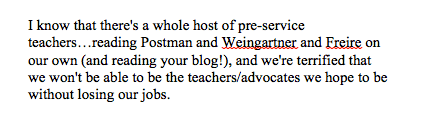
Pre-service and early career teachers (although not alone) now learn and teach under the weight of “We’re terrified.”
The early-career teacher currently attempts to teach ELA in a high-poverty, majority-minority school, where she has 3 classes with about 50 students each in a team-taught experiment and must work under the incessant requirement of giving students and their parents feedback while planning and teaching in an entirely new school focus.
Again, this is not some unusual circumstance. This is the new normal of being a public school teacher—a new normal that began about thirty years ago and continues to accelerate despite no evidence any of the so-called reforms help and ample evidence those reforms harm students (except those so-called “top students” who are white and affluent but insulated from the reforms), de-professionalize teachers, and demonize schools as well as all of public education.
The pre-service teacher who emailed anticipates the exact conditions new and veteran teachers suffer under daily—conditions that mis-serve students (mostly high-poverty and black/brown students), their parents, and their communities.
I shared with the pre-service teacher by email that being a critical educator is hard—nearly impossible?—for all educators despite status or experience.
But I also offered my regret that we veteran educators have stood by and allowed this to happen to our profession—remained passive and apolitical so that pre-service and early career teachers have been reduced to “We’re terrified” like characters on The Walking Dead.
While the early-career teacher struggles with balancing health and happiness with the relentless and misguided expectations of teaching-as-accountability, the pre-service teacher added: “I’m worried about holding true to the principles that brought me to the profession.”
Today marks the passing of James Baldwin in 1987, and as I spend time with pre-service and early-career teachers, I am haunted by “We’re terrified,” inspired by Baldwin’s “the time is always now,” and disheartened how we educators continue not to heed his call.
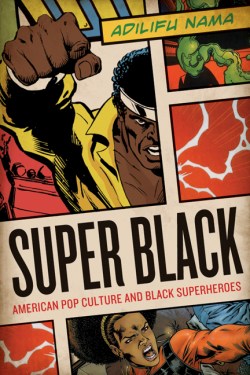
Recommended: Adilifu Nama’s Super Black
In his Introduction of Super Black: American Pop Culture and Black Superheroes, Adilifu Nama, associate professor of African American Studies at Loyola Marymount University, shares his mid-1970s trip to the toy store, where he excitedly anticipated buying superhero figures.
“[I]t was the Falcon that captured my imagination most and cemented my attachment to virtually all things superhero,” he notes. “Why? He was a black man that could fly” (p. 1).
Around the same time, although about a decade older, I was also deeply entrenched in the Marvel Universe, which in hindsight was—along with science fiction novels—one of the doors opening to my stepping beyond my working-class roots in a white community steeped in racism and conservative ideology. I too was fascinated by the Falcon, who brought me back again and again to Captain America, a superhero I found less than compelling.
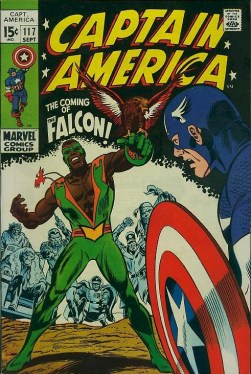
Nama asserts that Captain America losing his sidekick, Bucky, was part of “events [that] were just an interesting prelude to one of the most remarkable aspects of the Captain America comic book series: his pairing with the first African American superhero, the Falcon” (p. 69).
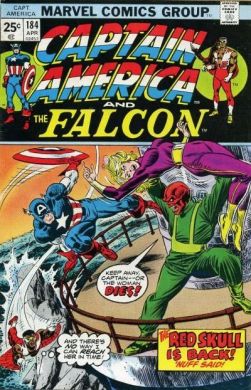
Since around 1940, superhero comic books and superheroes have held a solid and important spot in U.S. pop culture, and as pop culture, comic books as a medium (genre) have demonstrated the same sort of flaws and brilliance found in other media, such as film (which Nama addresses in Chapter 5 as well as his Black Space: Imagining Race in Science Fiction Film).
Pop culture often reflects, perpetuates, and confronts the very worst of the culture it serves—in terms of racism, sexism, classism, and the like. Comic books have been, and still are, no different.
Nama’s work is exceptional for his diligent commitment to outlining the role of black superheroes, primarily from Marvel and DC, while avoiding the failures often found in other critiques:
In short, the bulk of analysis concerning black superheroes has come to obvious conclusions, is embarrassingly reductive, and neglects to draw deeper connections across significant cultural dynamics, social trends, and historical events….Either black superheroes are critiqued as updated racial stereotypes from America’s comic-book past, or they are uncritically affixed to the blaxploitation film craze as negative representations of blackness. (p. 3)
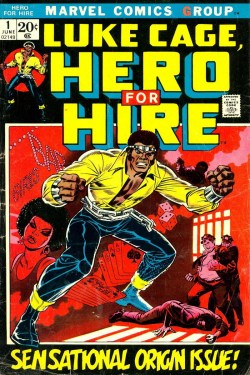
Instead, Nama “adopts a poststructural approach that is not beholden to…authorial intent and intensely surface perceptions,” but I must add that despite the scholarly focus, this is an accessible volume for a general readership interested in comic books, pop culture, and race (p. 5).
While offering a wonderful assortment of images, including a high-gloss four-page gallery about a third of the way through, Nama weaves an engaging discussion of the rise of socially conscious comic books (Dennis O’Neil and Neil Adam’s Green Lantern Co-Starring Green Arrow, DC, 1970-1972), “seminal black superheroes,” the tension of black and white superhero combinations, “white-to-black makeovers” of superheroes, and as noted about, black superheroes in TV and movies (pp. 6, 7).
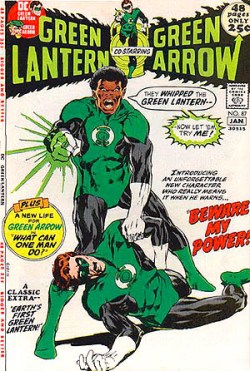
Throughout the volume, Nama offers an impressive outline of the black superhero in mainstream comic books while including a powerful examination of the relationship between comic books and the complicated history of race in the U.S.
My own evolving understanding of race in superhero comic books is increasingly informed by James Baldwin and Ta-Nehisi Coates—Baldwin’s confrontation of the specter or whiteness and Coates’s rejecting that “[t]he black freedom struggle is…about raising a race of hyper-moral super-humans.”
In the words of a comic book fan and scholar, Nama, I think, honors both Baldwin and Coates, a perspective that resists judging race in comic books through a white lens or against a distorted bar of perfection:
Where but in superhero comics did black people visit alternative worlds, travel in rocket ships, invent and command futuristic technology, or experience time travel? (p. 66)
By coming neither to glorify nor demonize black superheroes in mainstream comic books and pop culture, Nama succeeds in reaching beyond the pages of those books and showing readers how race joins everyone in the same journey:
American blacks and whites are ultimately bound to one another fused by history and circumstances, fate and fortune, dreams deferred and hopes realized, and when either party tries to destructively deny or sever the interconnected and interdependent nature of the relationship, both parties suffer. (p. 88)
However, comic books as manifestations of the culture they popularize are inevitably anchored by the white privilege of that real world. “Black superheroes should never be just a colorized version of the original,” Nama argues, adding:
because that would affirm notions that African Americans are at best a passive reflection and at worst a pathological reaction to white America. To the contrary, blacks have simultaneously retained a distinct form of black racial identity and worldview along with absorbing American folkways, mores, and taboos. Black superheroes, like the black folks they symbolize, must express that dynamic, whether they are completely original, an overt imitation of a white figure, or somewhere in between the two. (p. 125)
Ultimately, Nama’s scholarship is lifted by his childhood love for a black man who could fly—the Falcon merging in his boyhood mind with Dr. J—and readers are apt to enjoy this volume as much as the comic books it honors.
See Also
Black Goliath: “Some Black Super Dude,” Osvaldo Oyola
Black Lightning Always Strikes Twice! – Double-Consciousness as a Super-Power, Osvaldo Oyola
Black Communities of the 30th Century: Racial Assimilation and Ahistoricity in Superhero Comics, Osvaldo Oyola
The Man Who Lived Twice! (If You Can Call That Living): Marvel’s Brother Voodoo, Osvaldo Oyola
Humanity Not Included: DC’s Cyborg and the Mechanization of the Black Body, Robert Jones, Jr.
#NCTE16 DRAFT Proposal
Building on our #NCTE15: G.05 Teaching Beyond the Classroom: Social Media as Teacher Activism and Professionalism and the focus of the 2016 annual convention, Faces of Advocacy, we are forming a roundtable, Confronting Educator Advocacy with Pre-Service and Early Career Teachers.
We see a need for addressing the experiences, struggles, and strategies for supporting advocacy by pre-service and early career teachers.
Administrators, veteran teachers, teacher educators, as well as pre-service and early career teachers—our stories and how we confront the need for teachers to challenge policy, racism, sexism, and classism in our schools and society will be the focus of the presentation and roundtables.
If you are interested in joining this proposal, email me (paul.thomas@furman.edu) ASAP.
Table/topics addressing challenges for advocacy related to race/racism, gender/sexism, sexuality/homophobia, and classism are encouraged.
Some draft table ideas include:
Table: Teacher Advocacy: A Southern Dilemma
P.L. Thomas, Sean P. Connors, Nicole Amato, Kristen Marakoff
Table: Guilt as Guidance
Shekema Holmes Silveri
Table: Risk and Reward in Writing for the Public?
Peter Smagorinsky, Christina Berchini
Table: Writing for the Public – Positive Stories, Critique, or Both
Steve Zemelman
Table: Schools of education in advocacy partnerships with parents, students, communities, and k12 school personnel
Julie Gorlewski
Table: Advocating for Disability Access
Patricia Dunn
Table: What does Advocacy look like in the Rural and Small Town School
Patricia Waters
How We Arrived Here: “We, the people, must redeem”
This mixing of activism and teaching, this insistence that education cannot be neutral on the critical issues of our time, this movement back and forth from the classroom to the struggles outside by teachers who hope their students will do the same, has always frightened the guardians of traditional education. They prefer that education simply prepare the new generation to take its proper place in the old order, not to question that order.
Howard Zinn, You Can’t Be Neutral on a Moving Train: A Personal History of Our Times
There is a clear but disturbing reason that those in power in the U.S. offer and speak to the rugged individualism myth, stirring antagonism toward “government” and “unions,” for example.
The collective is always more powerful than the individual—when the individuals realize it, when the individuals commit to the collaborative power of that collective.
Competition devours while collaboration lifts.
For public education (paralleling the criminal justice system and most public institutions), there is a long and entrenched history that is indistinguishable from here, now.
How we arrived here?
Fatalism.
Neutrality.
Compromise.
Objectivity.
These are the tools of the status quo of inequity.
In education, then, students, parents, communities, and educators have been victims of all four, but have also relinquished to them.
In education, as well, the very organizations (collectives) that could have saved us—unions; professional organizations; local, state, and federal government—instead embraced fatalism, neutrality, compromise, and objectivity.
Fatalism: “We can’t change this so let’s deal with it the best we can.”
Neutrality: “We are taking no position but will provide any support we can.”
Compromise: “Both sides must have a seat at the table.”
Objectivity: “Numbers don’t lie.”
Let us recognize:
Neutrality in times of great harm perpetuates great harm.
Compromise between inequity and equity is inequity.
Langston Hughes implores: “Let America be America again,” continuing:
I am the poor white, fooled and pushed apart,
I am the Negro bearing slavery’s scars.
I am the red man driven from the land,
I am the immigrant clutching the hope I seek—
And finding only the same old stupid plan
Of dog eat dog, of mighty crush the weak.
This is from 1935, but rings all too true today, 80 years later, as Hughes confronts: “O, let America be America again—/The land that never has been yet”—building to a final plea we have yet to heed:
We, the people, must redeem
The land, the mines, the plants, the rivers.
The mountains and the endless plain—
All, all the stretch of these great green states—
And make America again!
FOR SALE: Public Education?
Poets, priests and politicians
Have words to thank for their positions
Words that scream for your submission
And no one’s jamming their transmission“De Do Do Do, De Da Da Da,” The Police
We are in a generalized crisis in relation to all the environments of enclosure—prison, hospital, factory, school, family….The administrations in charge never cease announcing supposedly necessary reforms: to reform schools….But everyone knows that these institutions are finished….These are the societies of control, which are in the process of replacing the disciplinary societies….In the disciplinary societies one was always starting again (from school to the barracks, from the barracks to the factory), while in the societies of control one is never finished with anything [emphasis added]. (Gilles Deleuze, Postscript on the Societies of Control, pp. 3, 5)
Let me break here my own guidelines to my students and open with something rather boring, a full disclosure.
I am the out-going Council Historian for the National Council of Teachers of English (NCTE), and on my second set of editors as a column editor for English Journal. Members and prominent leaders in NCTE are my colleagues, dear friends, and among the most respected people in my fields of literacy and education.
In short, I credit NCTE and the people of NCTE for a significant portion of my professional and personal accomplishments.
That said, something powerful and disturbing has remained with me after the 2015 annual conference in blustery Minneapolis, MN—something that leaves me with a spark of hope underneath a growing black cloud of doom.
This is a story about a place within a place within a place: Minneapolis, the convention center, and then the exhibitor hall.
As NCTE members converged on Minneapolis, another unfortunate but all too common police killing of a young black man occurred in Minneapolis, sparking a protest and occupation by #BlackLivesMatter.
On a much smaller scale and under considerably less urgent conditions, a select group of NCTE members organized a protest and occupation of the Pearson booth looming large over the exhibit hall (including also prominent displays by Scholastic, Heinemann, and other education-related corporations):
The spark of hope? Yes, I fully support the protest of Pearson, and hope that along with this demonstration of resistance, the renewed focus by NCTE on advocacy (a tribute to the legacy of Kent Williamson) is a sign that educators and their professional organizations have begun to recognize and even embraced the essential political nature of our profession, of being a professional.
This, I think, could be a unifying #EducatorVoicesMatter (and if so, it must be one that seeks out and includes all voices in our field, which itself has many challenges left with racism, sexism, and classism).
Now, this becomes much more complicated because I have a couple pointed (and what may appear to be accusatory) questions?
Why only Pearson? And just how did Pearson grow into this all-encompassing, all-powerful evil?
Over the past decade or so, I have witnessed the increased presence and influence of teaching/learning and testing businesses in education broadly, but at NCTE specifically. The exhibit hall is just a real-world manifestation of the inordinate advertising space consumed in NCTE publications and the enormous funding drain these companies create for public schools across the U.S.
With deference to Deleuze above, I must assert once again that Pearson et al. are the monsters, but it is we who are the Drs. Frankenstein.
And it is this: Thirty-plus years of state and federal accountability mandates have proven that there is no correlation between the presence or quality of standards and student achievement, that high-stakes testing always trumps any good intentions of standards, necessarily reduces the curriculum, and harms vulnerable student populations. And:
As the absence or presence of rigorous or national standards says nothing about equity, educational quality, or the provision of adequate educational services, there is no reason to expect CCSS or any other standards initiative to be an effective educational reform by itself. (Mathis, 2012)
Nonetheless, when the Common Core train pulled out of the station, politicians as engineers, it was with many educators and professional organizations (yes, NCTE) sprinting to hop on board, unwilling or unable to see students, public education, teacher autonomy, and the like tied up on the tracks as if in a silent movie.
I will now risk being accused of arrogance here, but I detailed carefully that the only people set to benefit from the Common Core mania were political leaders and teaching/learning/testing corporations, and then reported that in fact this is what happened, with Pearson standing at the top of the pile of cash.
We in education are always starting over, we are never finished with anything—driven into frantic states of crisis by the politics and bureaucracy of government-run education.
Pearson et al. are simply the natural manifestations of allowing our public institutions to feed our consumer/capitalist economy.
I hope there will be more and larger protests. I hope that spirit of resistance and professional autonomy—the rising of educator voices—grows.
But we must also make a real stand. No more new standards, no more new tests, no more dehumanizing accountability, no more top-down education legislation and mandates.
And that begins with educators as well as their professional organizations—not simply in word or protest, but in actions taken.
I fully accept Pearson et al. are the monsters, but literature shows us we must look at the Drs. Frankenstein for how the monsters came about.
Pointing fingers at Pearson cannot hide the blood on our hands.
Who We Were, Who We Are, Who We Will Be
A four-sport athlete in high school and an early-rising working-class adult, my father was never a literary or academic man. But he was a storyteller—weaving again and again the narratives of his life growing up and then the uniquely late 1950s, early 1960s courtship and marrying of my mother.
I am hurtling toward 55, and I can still tell you every story, in intricate detail. Some times, I find it difficult to extricate my father’s stories from my own redneck past, in fact.
Since my childhood, then, I have never drifted too far from history. I recall vividly the first test I ever failed—a pop quiz in world history my sophomore year of high school. And then throughout college, I took history courses every chance I could.
If I had understood how college worked (a flaw of a working-class upbringing), I would have orchestrated those courses into a history minor; instead, I simply returned again and again to history classes because I felt drawn.
That same gravitational pull landed me in an EdD program at the University of South Carolina, where coursework and then my dissertation—a biography of Lou LaBrant—were grounded in the history of education and English education.
November of 2015 is bittersweet for me as a consequence because this is my last annual convention of the National Council of Teachers of English (NCTE) as the Council Historian.
Soon, with irony, I become a part of the history of NCTE.
But the history of the organization and the field of teaching English—this I will never release from my intellectual and emotional grasp.
As I am prone to do, I am in constant conversation with myself about who we were, who we are, who we will be.
In a session for the newly named Outreach Network for NCTE, the discussions touched on the intersections of past, present, and future—a continuum that appears to have one damning constant—those outside the field of teaching/teaching English appear unaware of who we are as professionals, unwilling to acknowledge the wide array of disciplines that our profession comprises, and defiant to acknowledge our professional authority and autonomy.
Read LaBrant in Elementary English and English Journal (NCTE) from 1931 to 1961, and you are apt to nod your head in bewildered recognition of who we are today, feeling the weight of who we will be as inevitable as the stack of essays before us seemingly multiplying like loaves and fishes feeding the multitudes as we work in Sisyphean solitude (and for this my working-class background prepared me well).
Who we were, who we are, who we will be—our history, our present, and our future are acts of speaking (my father) and writing (me) into reality that which defined us, defines us, will define us.
Who we were, who we are, who we will be—these are the politics that shaped us, shape us, will shape us.
Who we were, who we are, who we will be—narratives retold, narratives crafted, narratives imagined.
Who we were, who we are, who we will be—as LaBrant announced abruptly in her major book-length work: “We teach English.”
This is our history to be treasured, this is our present to be defended, this is our future to be determined—and it there that we must ask, “By whom?”
 dr. p.l. (paul) thomas