
All posts by plthomasedd

P. L. Thomas, Professor of Education (Furman University, Greenville SC), taught high school English in rural South Carolina before moving to teacher education. He is a former column editor for English Journal (National Council of Teachers of English), current series editor for Critical Literacy Teaching Series: Challenging Authors and Genres (Brill), and author of Teaching Writing as Journey, Not Destination: Essays Exploring What ‘Teaching Writing’ Means (IAP, 2019) and How to End the Reading War and Serve the Literacy Needs of All Students: A Primer for Parents, Policy Makers, and People Who Care (IAP, in press). NCTE named Thomas the 2013 George Orwell Award winner. He co-edited the award-winning (Divergent Book Award for Excellence in 21st Century Literacies Research) volume Critical Media Literacy and Fake News in Post-Truth America (Brill, 2018). Follow his work @plthomasEdD and the becoming radical (https://radicalscholarship.wordpress.com/).

A Moment in #NCTE15 History-Annual Convention Minneapolis

This is my last annual NCTE convention as Council Historian, and I am pleased to offer this special Moment of History by Roxanne Henkin in honor of recent victories for marriage equity.

Please note my ongoing project related to my role as Council Historian, Lou LaBrant: An Annotated Bibliography.

A Moment in NCTE History-Annual Convention Minneapolis, 2015

Roxanne Henkin

Delivered at the Board of Directors Meeting 2015 National Council Teachers of English

Annual Convention

At this moment in U.S. history, with the historic Supreme Court decision legalizing lesbian and gay marriage last June, we look back at the efforts of our Lesbian, Gay, Bisexual and Transgender members of NCTE and the work that was accomplished beginning with the creation of the Assembly on Gay and Lesbian Academic Issues Awareness.

Although the NCTE Lesbian and Gay Caucus began in 1974, it was transformed into an assembly in 1993 to give LGBT issues a greater visibility and voice in NCTE. The new organization, the NCTE Assembly on Gay and Lesbian Academic Issues Awareness was created to “promote communication and cooperation on issues involving gay and lesbian students, teachers, and materials in academic communities and to investigate these issues, encourage research, and disseminate information…” (Karsten).

Three proposals about LGB issues were submitted, accepted and presented during the 1994 NCTE Annual Convention in Orlando, Florida. In April 1995, the NCTE SLATE newsletter was devoted to lesbian, gay, and bisexual issues. Our chair, Mary Bixby was interviewed in this issue and explained that the decision to devote a SLATE Newsletter to ‘Issues of Sexual Orientation’ was a major landmark of support (Wolfe 2). Although NCTE had passed the 1992 resolution “not to hold national council meetings in municipalities that have accepted anti-gay legislation,” Bixby felt that real progress had been slow (Wolfe 2).

In 1995, William Spurlin and I became co-chairs of the NCTE Assembly on Gay and Lesbian Academic Issues Awareness. In June 1996, we sent a letter to the NCTE Executive Committee. We wrote that we were, “Concerned about the visibility of our members and issues within NCTE.” NCTE Executive Director Miles Myers agreed to give the letter to each new convention chair and created the NCTE Advisory Committee on Lesbian, Gay, and Bisexual Issues in Academic Studies to serve as a resource to advise the Executive Committee and other groups and individuals in NCTE about LGBT issues and to make recommendations for specific actions. William Spurlin and I were appointed the first co-chairs of this new committee.

The Spring 2001 conference was slated for Birmingham, Alabama, which had sodomy laws, so the Advisory Committee asked that the convention be moved. Although the NCTE 1992 resolution decreed that NCTE would not meet in states that had anti-gay laws, the policy was not being followed in practice. NCTE still held the spring conference in Birmingham, but letters were sent to officials in Alabama, asking that the discriminatory laws in Alabama be changed. NCTE also authorized a special pin for NCTE members to wear during the conference to encourage talk about these discriminatory laws.

In 2007, NCTE passed a resolution strengthening teacher knowledge about LGBT issues. Two years later, in 2009, English Journal editor Ken Lindblom asked longtime Assembly members Paula Ressler and Becca Chase to guest edit what became an extraordinary issue of English Journal on LGBTQ issues.

At the November 2011 NCTE centennial Convention in Chicago the LBGTQ assembly celebrated 20 years of continuous work in NCTE. Now known as the NCTE Gay-Straight Educators’ Alliance, the T was added to welcome another underrepresented group, transgender teachers and students. We also welcomed our straight colleagues explicitly by including them in our name and acknowledging their critical role as allies.

This morning, at our 105th Annual Convention, we welcomed Alison Bechdel as a general session speaker. An out lesbian, Alison is a powerful and well-known writer and cartoonist. How thrilled we were to finally have one of our own as a general session speaker. Her session was well attended and well received. We need more of these in the future.

During this convention, we will have over 20 LGBT sessions presented throughout the program. On this transgender Day of Silence as we look back in history, NCTE has made great progress with LGBT issues over the past 24 years and we look forward to a future where all students and teachers, of all sexual orientations and gender identities support each other and are supported and able to thrive in both their academic and personal lives.

Works Cited

Karsten, Ernie. AGLAIA Brochure. Urbana: NCTE, 1994. Print.

Ressler, Paula, and Becca Chase, Guest eds. Theme: Sexual Identity and Gender Variance. English Journal 98.4 (2009). Print.

Spurlin, William, and Roxanne Henkin. Letter to NCTE Executive Committee. June 1996. TS.

Wolfe, D. “An Interview with Mary Bixby.” SLATE Newsletter 20 (1995): 1–4. Print.

See Also

A MOMENT IN NCTE HISTORY – NCTE ANNUAL CONVENTION BOSTON, 2013
Connecting Dots of ASD Advocacy: Don’t Buy It

Chanda Jefferson, 2015 S.C. biology teacher of the year, advocates for Achievement Schools Districts (ASD) in the state.

The commentary leads readers to SCAchievementSchoolDistrict.org (SCASD).

Jefferson has also blogged at StudentsFirstSC, the state affiliate of StudentsFirst founded by Michelle Rhee.

Please connect the dots.

And Jefferson’s claims of ASD success echoes this initial claim at SCASD:

An Achievement School District has a proven track record in other states of catapulting the bottom 5% of schools into high quality, high performing, neighborhood, public schools.

However, what is that track record in reality (not the edureformer spin-zone)?

Like charter schools in general, the ASD has not performed much different than public schools, according to a 2014 analysis:

My analysis suggests that ASD schools aren’t doing significantly better in terms of student growth than they were before state takeover. In fact, in many cases the schools’ pre-takeover growth outperformed the ASD. These findings have significant implications for the future of the ASD, how we should move forward with continued takeovers, and for future turn-around efforts in general.

From Tennessee to New Orleans to Los Angeles, claims of successful take-over strategies have been discredited, but those take-overs have resulted mostly in disenfranchised children and communities while providing political capital for advocates.

Once you connect the dots of ASD advocacy, the only conclusion you can reach is don’t buy it.

#2016SCCTE: Teaching Writing as an English Major: Who Should, Can Teach Writing?

Reading and Writing for Change

South Carolina Council of Teachers of English

Annual Conference

January 29-30, 2016

Kiawah Island Resort

Program

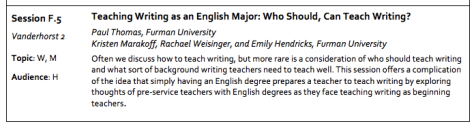
SCCTE January 29-30, 2016: Teaching Writing as an English Major: Who Should, Can Teach Writing?

Emily Hendricks, Kristen Marakoff, Rachael Weisinger, Madelyn Wojnisz, P.L. Thomas, Furman University

Session F: Saturday January 30, 10:45-11:30

SCCTE 16

Often we discuss how to teach writing, but more rare is a consideration of who should teach writing and what sort of background writing teachers need to teach well. Composition, in fact, is a field, but taking courses in literacy or having a degree in English are often seen as adequate preparation for teaching writing.

This session offers a complication of the idea that simply having an English degree prepares a teacher to teach writing by exploring thoughts of pre-service teachers with English degrees as they face teaching writing as beginning teachers.

“We need to talk…”: Conferring with High School Writers

Emily Hendricks

Students of all levels of academia have often identified conferring as the technique that most improved their writing. These meetings of criticism and commendation offer significantly more feedback than returning a bleeding, red-inked paper. However, many high school writers graduate without experiencing a single writing conference. It’s not hard to guess why this happens: too many students and not remotely enough time. So, how can we adapt to these challenges? This section will briefly review the positive impacts of conferring with writers, while also exploring the varieties of how teachers can realistically implement the technique in their classrooms.

Teaching Whiteness (and Writing)

Kristen Marakoff

As white teachers, there are innumerable ways that we assume the universality of a white perspective and impose white thinking processes on children of color. Specifically, when teaching writing, white teachers are often blind to differences between spoken dialects and written, formal English: a difference that dramatically affects a student’s ability to learn conventional grammar and sentence structure. As a student teacher who will soon be expected to teach students the fundamentals of writing, I am painfully aware that teaching them “correct” writing is imposing white culture on my students. This presentation examines culturally responsive approaches to teaching writing.

How the 5-Paragraph Essay Murders Us All—Slowly and Surely

Rachael Weisinger

From preparing students for state testing to summarizing their readings of Moby Dick, the 5-paragraph essay is drilled into students over and over again. Despite the efficiency of this standard format, students hardly experience another form of writing by the time they graduate from high school. “How the 5-Paragraph Essay Murders Us All—Slowly and Surely” will look at the need to foster love and creativity of writing, while still respecting the expectation to teach analytical essays.

To Thesis or Not To Thesis: The Question of Teaching Writing In the English Discipline

Madelyn Wojnisz [non-attending; PowerPoint available]

Many high school students struggle with varying writing expectations among different disciplines (English, history, science, etc.). Writing literary analysis requires different criteria than writing in history or science. Therefore, in this presentation, I explore and clarify, both for myself and for others, what challenges teachers and students face when writing within the discipline of English.

The Human Capacity for Good and Evil: “Violence Multiplies Violence”

Humans have tremendous capacity for good and evil.

The good is so simple, I think, that we too often fail to make it real.

“All we are saying is give peace a chance.”

Imagine there’s no countries/ It isn’t hard to do/ Nothing to kill or die for/ And no religion too.”

“‘God damn it, you’ve got to be kind.’”

The great paradox is that human evil is almost never that simply, yet we respond over and over to evil as if it is.

Addressing recent acts of terror in Beirut and Paris, Sunny Hundal writes that terrorists “want us to brush away humanity and compassion with suspicion and division,” adding: “By following that script we do exactly what Isis want us to do.”

Who we are must not be defined by those who choose evil, by that which is done to us.

Who we are must be defined by what we choose to do in the aftermath of evil.

Who we are must be defined by what we choose to recognize as terror and evil, as well. Our selective and narrow gaze of outrage is another kind of evil—one that renders some inhuman by our indifference—that lies at our feet even as we condemn large-scale brazen evil.

We must not allow the din of sword rattling to drown out the voices of the past that may, again, seem to be too simple:

“An eye for an eye leaves the whole world blind.” [1]

Let us move now from the practical how to the theoretical why: Why should we love our enemies? The first reason is fairly obvious. Returning hate for hate multiplies hate, adding deeper darkness to a night already devoid of stars. Darkness cannot drive out darkness; only light can do that. Hate cannot drive out hate; only love can do that. Hate multiplies hate, violence multiplies violence, and toughness multiplies toughness in a descending spiral of destruction. (Martin Luther King Jr., Loving Your Enemies) [2]

[1] Attributed to Gandhi, but never confirmed as an accurate attribution.

[2] See how even accurate attributions can be manipulated here.

James Baldwin’s Paris

James Baldwin in Paris in 1986. Credit Peter Turnley/Corbis

James Baldwin’s Paris, Ellery Washington

James Baldwin, The Art of Fiction No. 78, Interviewed by Jordan Elgrably

Seeing the Paris of James Baldwin, Ellery Washington

Another Country, Claudia Roth Pierpont

In Memoriam: James Baldwin’s Paris, Monique Y. Wells

James Baldwin’s Discovery of Self, Adrian Sheppe

Equal in Paris? Thomas Chatterton Williams

It Was Never Just: On Student Activism and Racism (A Reader)

It was never just Ferguson, and it is not just the University of Missouri or Yale.

Social inequity/racism and institutional racism are nearly impossible to ignore, although many still try to deflect repeated acts of violence toward blacks by police officers—in the streets and schools’ hallways—as well as the patterns of racist aggressions in the workplace and on college campuses by pointing their fingers at “bad” individuals.

White denial may be at a tipping point in the U.S. since student activism on college campuses appears to be resurfacing in ways associated with the Civil Rights era of the mid-twentieth century.

While demanding that the oppressed and wronged take the lead is problematic—it is of course the moral obligation of those with power to do the right thing—black college students and athletes taking stands against racism and inequity, stands for social justice deserve support and praise, but they deserve even more to be heard and then for all of us to act.

Here, I offer a reader related to student activism and racism spurred by the University of Missouri’s and Yale’s recent controversies:

MU students tell their stories of everyday racism

The Vilification of Student Activists at Yale, Gillian B. White

3 Lessons From University of Missouri President Tim Wolfe’s Resignation, David Zirin

The Missouri Tigers and the Hidden History of Black College Football Activists, David Zirin

READ: Two Personal Statements That Help Explain The Situation At Mizzou (NPR)

Players Strike Back: Howard’s 11 Goes on Strike, Louise Moore

The University of Missouri students who forced their president to resign

Young Black People See the News Media’s Double StandardCatherine R. Squires

A History of Racism at the University of Missouri, Brent Staples

Does Missouri president ouster offer lessons to universities grappling with a racist past?, A.D. Carson

[Clemson’s Tillman Hall and the Tragedy of Southern Tradition]

Perspective on Mizzou, David Ubben

Alleged racism at Yale, University of Missouri: Are colleges taking it seriously?

A Few Good Reads On The Missouri Protesters And Journalistic Outrage, Tasneem Raja

Student Activism Is Serious Business, Roxane Gay

I’m a black Yale grad, and its racial firestorm doesn’t surprise me: Now it’s time for the administration to act, Courtney McKinney

Our Republic Will Withstand College Students Protesting, John Warner

Three Cheers for Student Protests, John Warner

Students Share What It’s Like To Be Black At Mizzou

At Missouri, ‘right now, we are facing the backlash,’ Cristina Mislán

Missouri activists vs. the press is still a story about race: This is what happens when black students can’t trust the media, Paul Young Lee

Enter the Real Power of College Sports, Thabiti Lewis

4 Things You Might Have Wrong about the Mizzou Story, Ryan Famuliner

Fantasy Sports USA: “Road to hell paved with unbought stuffed dogs”

“Mean everything in the world to you after you bought it. Simple exchange of values. You give them money. They give you a stuffed dog.” [Bill Gorton]

“We’ll get one on the way back.” [Jake Barnes]

“All right. Have it your own way. Road to hell paved with unbought stuffed dogs. Not my fault.”

The Sun Also Rises, Ernest Hemingway

Talking with a senior English major who is certifying to teach high school ELA, I recently reached for my teaching copy of The Sun Also Rises, talking far too excitedly as I usually do when I reminisce about my wonderful high school students from 18 years of teaching in my hometown high school.

I had placed several notes and clippings in the novel, decorated with a number of highlighter colors and marginalia for teaching. One folded piece of notebook paper was a sketch by a student of the key line quoted above about the road to hell; an old Gary Larson Far Side calendar page had a stick-drawing of the novel as well.

I was a Hemingway advocate when teaching U.S. literature, but my students were overwhelmingly Fitzgerald. Yet, in the end, many of my students were just all in with whatever I asked them to do. We loved each other, and we often really just enjoyed having class. I am idealizing some, yes, but those were golden days that I treasure and often get to relive because of the magic of social media and remaining virtual friends with many of those students.

Students then likely didn’t really care as much as I did about our discussions of Hemingway’s insightful portrayal of the emptiness many from the U.S. felt post-WWI, especially the expatriated artists who called themselves the Lost Generation.

As I write this, barely past Halloween 2015, the Christmas season has ramped up as if Thanksgiving doesn’t exist (except for Black Friday), and the seasonal yammering about the war on Christmas has begun.

It is very much a U.S. thing for the majority, those with the upper-hand, to play the role of the oppressed—while simultaneously shaming those actually oppressed for daring to speak against inequity.

As I write this, the Christian horror of the moment is a coffee chain’s choice for cups during the holidays.

I cannot help noting that Christmas is the largest consumerism orgy imaginable—during the season born out of the coming of Jesus to this planet, a religious figure and religion that reject the material world. Lay down your worldly possessions and follow me, and all that.

For a people who beat a false drum about being a Christian nation, founded by Christian principles, we are a soulless lot—never raising much of a finger for the impoverished or the disadvantaged.

Suck it up, that’s our mantra.

And although I do not still teach Hemingway each academic year, I am convinced that the essential message of how our empty consumerism defines us—”‘Road to hell paved with unbought stuffed dogs'”—has now reached its logical conclusion: fantasy sports.

Our precious NFL—violent, sanctimonious, and superficially repentant—does not hold that spot, but now the cash promise of fantasy football (bannered across NFL games and ESPN) does, and does so perfectly.

We are not a people playing and watching thinly masked gladiator sport (as fake as that is, as soulless as that is); we are a people playing a game about a game in hopes of making money—a chance about as likely as the lottery.

Yes, the road to hell is paved with unbought stuffed dogs. We have walked it. We are there.

The Politics of Teaching Grammar

The pronoun/antecedent debate about “they” has continued at the NCTE Connected Community’s Teaching and Learning forum—mostly by advocates of prescriptive grammar.

That many English teachers continue to beat the drum for prescriptive rules is troubling—as I noted earlier when calling for descriptive grammar and conventional awareness. Troubling on one level since prescriptive grammar is solidly refuted by linguistics and the history of the English language [1]; troubling on another level since one staunch defense of the rules posted at the forum by an English teacher included a dangling modifier—highlighting that prescriptive grammarians often by necessity are themselves picking and choosing which “rules” to emphasize (an ironic type of descriptive grammar).

Another post called for ELA teachers to “hold the line with pronoun – antecedent agreement” because “[w]hile I think that grammar is a reflection of society, this is really about singular vs. plural.  It is not a political platform.”

And that last claim, I think, is an important place to consider further why a rules-based approach to language is failing both the language and our students.

First, critical pedagogy and critical literacy begin with the recognition that all human interaction, including language and teaching, is political. As Joe Kincheloe explains about teaching:

[P]roponents of critical pedagogy understand that every dimension of schooling and every form of educational practice are politically contested spaces. Shaped by history and challenged by a wide range of interest groups, educational practice is a fuzzy concept as it takes place in numerous settings, is shaped by a plethora of often-invisible forces, and can operate even in the name of democracy and justice to be totalitarian and oppressive. (p. 2)

And thus, making the claim that students must conform to prescriptive rules of language usage because those rules are not political is both a political act itself and a false claim that language can somehow be politically neutral. Endorsing prescriptive grammar instruction cannot be divorced from the historical fact that standard grammar has been used to perpetuate racism, sexism, and classism

As well, the literature we teachers of ELA often assign—from George Orwell’s 1984 and essays to Margaret Atwood’s The Handmaid’s Tale—illustrates that who controls language controls people; these works also highlight how that imbalance of power is unfair.

As linguists show, all identifiable types of language usage (standard English, AAVE, etc.) are simply somewhat cohesive versions, none any superior to the other except that some group in power creates that status of standard or “correct.”

Therefore, again, all language usage and the teaching of language are inevitably about power, always political.

With that context, then, the teaching of ELA should prefer an authoritative stance instead of an authoritarian one (see the writings of Paulo Freire).

Authoritative teaching of language generates teacher authority based on that teacher’s knowledge and experience with language (in terms of grammar, I would argue that includes essentially linguistics and the history of the English language). Authoritative teaching seeks to foster the student’s authority through that students’ understanding conventional usages as well as the biases associated with those usages.

Authoritarian teaching of language is the rules approach, in which teacher authority is grounded in the status of being the teacher, and the authoritarian stance necessarily asserts the authority’s (teacher’s) politics and mutes the politics of the subservient (student). Authoritarian teaching simply demands compliance—applying rules because they are rules.

As teachers of ELA, we are serving our students and the language well if we see language usage as something to be investigated and interrogated—not as a mechanism for imposing our authority on the student.

Those students can and should be guided in investigating and interrogating why we have standard English—who it benefits and why so that their own awareness about the power of language serves them and not those who use it to deny other people their political voices.

[1] Both in the false notion that some language use is inherently superior to others (as opposed to the arbitrary nature of standard forms based on who has political power), and against the reality that all language usage evolves, changes (and thus, trying to stop that change is misunderstanding the basic nature of language).

See Also

Revisiting James Baldwin’s “Black English”

A Tale of Two Teachers: The Politics of Personal Teaching, Nat Hentoff

The Very Persistent Delusions of Billionaire-Edureformers

Billionaire-Edureformer extraordinaire Bill Gates “sat in a gray easy chair” at Clemson University’s Tillman Hall (yes, that Tillman Hall) to pontificate once more on education reform.

Gates soothed the crowd by explaining “that if they get frustrated at the lack of change in American education policy, they should ‘go into a charter school’ to see quality change,” reported Nathaniel Cary.

And, on que, “Gates defended the Common Core,” and of course, “innovation,” before tossing out his old standby: “Improving the quality of teachers across the country is the only way to close the gap for all students, an initiative his foundation supports [read: ‘purchases’], he said.”

Delusion 1: Gates has financed and perpetuated the same accountability policies started in the early 1980s. If there is a “lack of change” in education (and there is), it is very much at Gates’s feet (or enormous wallet).

Delusion 2: School choice, including charter schools and public school choice, has resulted in outcomes that are indistinguishable from traditional public schools, as I detailed in 2010, and as the Center for Public Education concludes in this October 2015 analysis:

In general, we find that school choices work for some students sometimes, are worse for some students sometimes, and are usually no better or worse than traditional public schools. We hope that this report will inform the ongoing conversation about the efficacy of school choice in the nation’s efforts to assure every child is prepared for college, careers and citizenship.

Delusion 3: After thirty-plus years of education accountability driven by ever-new standards and ever-new high-stakes testing, what does the research reveal?:

There is, for example, no evidence that states within the U.S. score higher or lower on the NAEP based on the rigor of their state standards. Similarly, international test data show no pronounced test score advantage on the basis of the presence or absence of national standards. Further, the wave of high-stakes testing associated with No Child Left Behind (NCLB) has resulted in the “dumbing down” and narrowing of the curriculum….

As the absence or presence of rigorous or national standards says nothing about equity, educational quality, or the provision of adequate educational services, there is no reason to expect CCSS or any other standards initiative to be an effective educational reform by itself.

Delusion 4: What do we know about teacher quality and its impact on student achievement—or, is teacher quality the “only way” to close the gap? Teacher quality, in fact, is less significant than “unexplained”:

But in the big picture, roughly 60 percent of achievement outcomes is explained by student and family background characteristics (most are unobserved, but likely pertain to income/poverty). Observable and unobservable schooling factors explain roughly 20 percent, most of this (10-15 percent) being teacher effects. The rest of the variation (about 20 percent) is unexplained (error). In other words, though precise estimates vary, the preponderance of evidence shows that achievement differences between students are overwhelmingly attributable to factors outside of schools and classrooms (see Hanushek et al. 1998;Rockoff 2003; Goldhaber et al. 1999; Rowan et al. 2002; Nye et al. 2004).

With apologies to George Saunders, Gates lounging comfortably in a state university building named for a murderous racist while spouting what at best are misrepresentations and at worst out-and-out lies about education reform is just another example of the very persistent delusions of billionaire-edureformers.

Resisting Good/Bad Teacher/Police Frame and Confronting Systemic Flaws in Education, Law Enforcement

[Expanded and revised at Alternet: A Few Bad Actors? A Former Teacher on Classroom Cops]

The Spring Valley High controversy created by the excessive force used by a police officer on campus represents the intersection of the wider and growing public debates about so-called bad teachers and bad police.

Let me clarify first that I was a public school teacher for 18 years, and I have family members and good friends who are or were police officers. Speaking about the fields of teaching and law enforcement, I would typically be supportive of the individual people who choose these professions that are primarily about serving the public good. Of course, I have dear friends and family members I also consider to be wonderful people, good people who are also outstanding in their professions as teachers and police officers.

I have also heard these good people say and watched them do things that are detrimental to children and adults, things steeped in racism, homophobia, sexism, and classism.

As a teacher (coach and parents, also), I often made mistakes, ones that were detrimental to students and teens. I also came home from teaching on more than one instance with students’ blood splattered on my clothes after breaking up fights. Once, I stood face-to-face with a student of mine who had come on campus with a shotgun planning to shoot a female with whom he had developed an unhealthy fascination.

I am not under the delusion that teachers and police officers must be perfect, and I am well aware that both professions are sometimes (teaching) and often (law enforcement) extremely dangerous for the professionals who are not financially compensated in ways that match their responsibility or the dangers they encounter.

As well, I have almost no tolerance for the political and public demonizing of bad teachers and bad police officers—the finger-pointing at manufactured scapegoats similar to the Reagan era “welfare queen,” which we know was an ugly, racist tactic that misrepresented welfare recipients; the finger-pointing at black-on-black crime that willfully ignores that white-on-white crime is essentially at the same rate (virtually all crime is within race, that is).

Therefore, we are in a difficult position as a society, one that requires all of us to consider the black girl being slammed to the classroom floor against the shooting and killing of Tamir Rice.

To step back from “she should have just done as she was told,” to refrain from blaming the victim.

In fact, we need to refrain from pointing fingers at individuals because many teacher and police officer errors in judgment and tragic behaviors are the result of the larger systemic flaws in our society and the institutions of formal education and criminal justice.

Responding to the incident at Spring Valley High, Camika Royal, a professor of urban education at Loyola University in Maryland, explained:

“Instead of making her cell phone and/or her behavior the focus of his class, he could have told her he would deal with her after class,” Royal wrote in an email to TakePart. “Because of his choice not to let it go, to contact the administrator instead, he kept students from learning, and he disrupted the learning environment.”

In the classroom, wrote Royal, “power struggles with students rarely end well.”

It appears the student put away her phone, but didn’t want to hand it over. This was a situation escalated by the adults in authority. The infraction could easily have been addressed after class.

While far more tragic, Tamir Rice’s life also was extinguished because the officer with authority escalated the situation, over-reacted.

I want to stress that such over-reactions must not be discounted or trivialized as individual behaviors, but must be recognized as the result of normalized expectations, cultural tolerance of how some people, including children, can and should be treated.

As I have examined before, why were public discussions about domestic abuse of women prompted by NFL high-profile incidences absent support for hitting women, but the concurrent debates about hitting children all included pro-spanking arguments?

Because of a lingering normalized acceptance of hitting children that is entirely refuted by research and the medical profession.

Teachers and police officers (including black teachers and police officers) are themselves agents of pervasive systemic biases that continue to disproportionately and negatively impact people and children of color: black children are perceived as being older than their biological ages, black children are punished in school while white children are prescribed medications or provided counseling, black communities are targeted more often by law enforcement, blacks are charged and convicted at higher rates than whites for the same infractions, and blacks and whites use recreational drugs at the same rates but blacks are significantly more likely to be punished for that use.

Just as there is no safe or positive amount of corporal punishment for children—and just as the evidence shows that corporal punishment makes children aggressive and violent adults—the research is powerful that police in the hallways and zero tolerance policies in schools both disproportionately target majority-minority schools and criminalize students.

Yes, we must take care to address individual cases such as the one at Spring Valley High, but if we focus all of our energy on who to blame and if or how we should punish the police officer, we are likely to allow the larger forces to exist that will insure we will continue to face these avoidable situations again and again.

The best day in my teaching career was when I learned to de-escalate tension between me and a student. That day I began creating a classroom in which we all could avoid conflict and disruptions. Most of that change was mine to recognize and to manage—not the teens who were in my care.

The teen at Spring Valley High should never have been slammed to the floor, and Tamir Rice should be alive. Just as teachers and police officers need not be perfect, neither of these young people should have to be perfect to avoid violence and death at the hands of people charged to protect and serve them.

The first step to a solution is admitting the problem: Education and law enforcement in the U.S. are both poisoned by the facts of racism remaining in our culture. Denying that fact is embracing that racism.

Teachers and police officers need not be perfect, but teaching and law enforcement must be better, and we must make that happen immediately.

See Also

Rejecting Police in the Hallways: A Reader

All the White Responses (and the Game Is Rigged)