All posts by plthomasedd

P. L. Thomas, Professor of Education (Furman University, Greenville SC), taught high school English in rural South Carolina before moving to teacher education. He is a former column editor for English Journal (National Council of Teachers of English), current series editor for Critical Literacy Teaching Series: Challenging Authors and Genres (Brill), and author of Teaching Writing as Journey, Not Destination: Essays Exploring What ‘Teaching Writing’ Means (IAP, 2019) and How to End the Reading War and Serve the Literacy Needs of All Students: A Primer for Parents, Policy Makers, and People Who Care (IAP, in press). NCTE named Thomas the 2013 George Orwell Award winner. He co-edited the award-winning (Divergent Book Award for Excellence in 21st Century Literacies Research) volume Critical Media Literacy and Fake News in Post-Truth America (Brill, 2018). Follow his work @plthomasEdD and the becoming radical (https://radicalscholarship.wordpress.com/).

Skepticism or Cynicism for Obama Education Agenda?

One response to my Relaxing zero tolerance in schools could be Obama’s boldest civil rights reform is worth highlighting: Readers adamant that the Obama education agenda is beyond such hope.

Let me note here that I have long since slipped past healthy skepticism and resigned myself to unhealthy cynicism with respect to either major political party and their leaders, including Obama.

I have tried before to confront the possibilities and the failures associated with Obama and Secretary Duncan, a set of policies and a series of rhetorical flurries that leave me even more depressed than those dark years under George W. Bush and his Secretaries, Rod Paige and Margaret Spellings:

Paul R. Carr and Brad Porfilio are now preparing a revised edition of The Phenomenon of Obama and the Agenda for Education: Can Hope Audaciously Trump Neoliberalism?—in which I have had and will have chapters.

I must note that my revised chapter is none too rosy; in fact, it is a solid statement of cynicism that has left skepticism in the dust. The revised chapter ends:

This call for change is not being heard, blocked by the din of the crisis discourse and utopian expectations that deform our children, our schools, and our society. The great failure being masked is that bureaucratic calls for school reform are perpetuating the labeling and marginalizing of teachers and students whose conditions in mechanistic schools parallel the inequities that the political elite are willingly ignoring both in their discourse and in their policies.

So when I confront the late but important recognition by the Obama administration that current education policies and practices are indeed racist, classist, and sexist, I believe it is on us to redouble our efforts, remind everyone we have been saying that for many years.

We actually don’t need Obama’s administration to tell us these things. But unless we make an effort to shift the gaze and the discourse in the right direction, on those extremely rare moments when they do, we are losing a moment.

I am not calling for our collective patting of the backs among the Obama administration. I would say the best tactic is to say, “Shame on you all for just noticing, but let’s get to work and stop all that other nonsense that is also doing harm!”

The Obama administration has hidden behind “education reform is the civil rights issue of our time” while promoting the worst possible education policies and maintaining an inexcusable allegiance to Secretary Duncan.

Let’s not forget that, and let’s not forget the “hope and change” rhetoric that lured many of us to have hope for change.

The recent shift driven by the Office of Civil Rights reports, however, is our opportunity to turn the “no excuses” and “zero tolerance” mantras on their heads, raising our voices and our eyes toward those in charge who are failing us and the children in our schools.

If there is hope for that change, it is in our grasp to make it happen.

National Poetry Month: “What is the message when some children are not represented in those books?”

National Poetry Month 2014 comes not on “little cat feet,” like Carl Sandberg’s “Fog,” but in the wake of Walter Dean Myers and his son, Christopher, responding to reports of the whitewashing of books for children. Walter Dean Myers explains:

But there was something missing. I needed more than the characters in the Bible to identify with, or even the characters in Arthur Miller’s plays or my beloved Balzac. As I discovered who I was, a black teenager in a white-dominated world, I saw that these characters, these lives, were not mine. I didn’t want to become the “black” representative, or some shining example of diversity. What I wanted, needed really, was to become an integral and valued part of the mosaic that I saw around me.

Myers identifies James Baldwin as the moment he discovered what was missing, and then Myers asks:

Books transmit values. They explore our common humanity. What is the message when some children are not represented in those books? Where are the future white personnel managers going to get their ideas of people of color? Where are the future white loan officers and future white politicians going to get their knowledge of people of color? Where are black children going to get a sense of who they are and what they can be?

National Poetry Month 2014 also comes just as we have Baldwin’s Jimmy’s Blues and Other Poems, which includes a beautiful and inspired Introduction by Nikky Finney:

Jimmy’s Blues and Other Poems, James Baldwin

As we search for ways in which to insure that students, as Myers did, find what is missing in the texts students are often required to read, I recommend the poetry of Baldwin and Finney. Along with Finney’s full Introduction above, students can access Finney’s Playing by Ear, Praying for Rain: The Poetry of James Baldwin, and then their poetry (see Nikky Fnney at Poetry Foundation).

These entry points to poetry can then lead to multi-genre/mode/form considerations, such as The Most Powerful Piece of Film Criticism Ever Written—about Baldwin’s The Devil Finds Work. Noah Berlatsky’s essay includes two important links as well to another African American writer, Ta-Nehisi Coates, inspired by Baldwin (see Jose Vilson on Baldwin as well):

Along with seeking texts that have people who look like all our students, we must also consider language. A wonderful bi-lingual poetry unit can be developed from two beautiful and powerful books: Barbara Kingsolver’s Another America and Jorge Luis Borges’s Borges: Selected Poems (see Borges at Poetry Foundation), Kingsolver’s translated from English to Spanish and Borges’s translated from Spanish to English:

Another American
Borges: Selected Poems

Myers ends his essay by confronting how texts represent African Americans and how African American males, specifically, are impacted:

And what are the books that are being published about blacks? Joe Morton, the actor who starred in “The Brother From Another Planet,” has said that all but a few motion pictures being made about blacks are about blacks as victims. In them, we are always struggling to overcome either slavery or racism. Book publishing is little better. Black history is usually depicted as folklore about slavery, and then a fast-forward to the civil rights movement. Then I’m told that black children, and boys in particular, don’t read. Small wonder.

“There is work to be done,” Myers concludes, and National Poetry Month is an ideal time to start, or continue that work.

Additional Reading

Reading Out of Context: “But there was something missing,” Walter Dean Myers

From Baldwin to Coates: Denying Racism, Ignoring Evidence

remnant 20: “your absence will sadden other afternoons”

Assorted thoughts on poetry

James Baldwin: Challenging Authors

Reading, Learning, Teaching Barbara Kingsolver

On Children and Childhood

children guessed(but only a few
and down they forgot as up they grew

“[anyone lived in a pretty how town],” e.e. cummings

In one of those early years of becoming and being a teacher, when I was still teaching in the exact room where I had been a student (a school building that would eventually be almost entirely destroyed by a fire set by children), it was the first day of school, and I was calling that first roll—a sort of silly but important ritual of schooling for teachers and students.

Toward the back of the room and slightly to my left sat a big young man, a white male student typical of this rural upstate South Carolina high school in my home town; like me, he would accurately be considered in that context as a Redneck.

Just about everyone knows everyone in my hometown, and we are very familiar with the common names of that town. So when I came to this young man’s name—Billy Laughter (it rhymes with “slaughter”)—I said “Billy Laughter” (rhyming the last name with “after”).

Smiling, I scanned the room and then turned my eyes back to Billy; he was red-faced and on the edge of having a very bad first day, one that was likely going to result in his being punished for my having done a very stupid thing. I raised my hand, palm facing him, and said, “Billy, my mistake. I’m sorry. I was trying to be funny but it wasn’t.” And then I said his name correctly.

Billy had suffered a life of people mangling his name, and he wasn’t in any mood for my being clever on the first day of school.

Several years later, when I was teaching a U.S. history class as part of  my usual load as a member and chair of the English department, while I was having students form small groups, two young white males bumped into each other, back to back, while moving their desks. I caught the moment out of the corner of my eye and had to rush over to deter the fight that was about to occur.

I wasn’t surprised—this was typical of my small community, along with fights starting because “he/she looked at me wrong”—but some time after this, I saw a research study that explained how people in the South and North handled personal space differently. In the South, bumping into someone or looking at someone wrong is often interpreted as challenging someone’s honor, requiring a response. People in the North, conditioned by mass transit and crowded cities (I suspect the study was as much about rural and urban, as South and North), are not as apt to find acts of close proximity anything other than that.

So setting aside the urge to examine the Redneck honor code, I want to add just one more event from my coaching life in those middle years of my teaching.

While running a drill at soccer practice, I heard a comment from a player in a group behind me. My mind heard a player with whom I had been having trouble. He was difficult in class and on the team, and worst of all, he was very disruptive at practice.

I turned and, without hesitating, I announced, “You are out of here,” pointing with my finger up the hill. Throwing him out of practice? No, I kicked him off the team.

As the young man was walking up that hill, a timid player on the team said, “Coach, that was me.”

I had just kicked a young man off the team who had, in fact, not said a thing.

A day or so ago, I received an email from Alfie Kohn about his new book, The Myth of the Spoiled Child. Alfie was apologetic about self-promotion so I replied, thanked him for the book, and noted a book I am co-editing that appears to be of a similar mind about children and childhood, Pedagogies of Kindness and Respect: On the Lives and Education of Children.

I also noted that our perspectives on children—on how parents, teachers, and society treat children—appears to be a minority view.

I have been mulling, then, or more likely stewing about this for some time: What makes adults—even the ones who choose to spend their lives with children—so damned negative and hateful about those children?

That, I must admit, is the source of my palpable anger at the “grit,” “no excuses,” and “zero tolerance” narratives and policies.

I grew up and live in the South where the default attitude toward children remains that they are to be seen and not heard, that a child’s role is to do as she/he is told. If a child crosses those lines, then, we must teach her/him a lesson, show her/him who is boss—rightfully, we are told, by hitting that child: spare the rod spoil the child.

That Christ’s love comes in the form of corporal punishment has never made any sort of sense to me, but I find that same deficit view of children is not some backwoods remnant of the ignorant South; it is the dominant perspective of children throughout the U.S.

Barbara Kingsolver explains in “Everybody’s Somebody’s Baby”:

This is not the United States.

For several months I’ve been living in Spain, and while I have struggled with the customs office, jet lag, dinner at midnight and the subjunctive tense, my only genuine culture shock has reverberated from this earthquake of a fact: People here like kids. They don’t just say so, they do. Widows in black, buttoned-down c.e.o.’s, purple-sneakered teen-agers, the butcher, the baker, all have stopped on various sidewalks to have little chats with my daughter. Yesterday, a taxi driver leaned out his window to shout ” Hola, guapa !” My daughter, who must have felt my conditioned flinch, looked up at me wide-eyed and explained patiently, “I like it that people think I’m pretty.”

With a mother’s keen myopia, I would tell you, absolutely, my daughter is beautiful enough to stop traffic. But in Santa Cruz de Tenerife, I have to confess, so is every other person under the height of one meter. Not just those who agree to be seen and not heard. When my daughter gets cranky in a restaurant (and really, what do you expect at midnight?), the waiters flirt and bring her little presents and nearby diners look on with that sweet, wistful gleam of eye that before now I have only seen aimed at the dessert tray. Children are the meringues and eclairs of this culture. Americans, it seems to me now, sometimes regard children as a sort of toxic-waste product: a necessary evil, maybe, but if it’s not their own they don’t want to see it or hear it or, God help us, smell it.

I just don’t get it.

A child is not a small adult, not a blank slate to be filled with our “adult weariness,” or a broken human that must be repaired (I won’t belabor, but the whole Original Sin idea doesn’t help and justifies the drive to use the rod).

But it is also certainly true that children are not angels, not pure creatures suited to be simply set free to find the world on their own.

Seeing children through deficit or ideal lenses does not serve them—or anyone—well.

And within the U.S. culture there is a schizophrenia—we worship young adulthood in popular media, but seem to hate children—that is multiplied exponentially by a lingering racism and classism that compounds the deficit view of childhood. Consider the research showing how people view children of color:

Asked to identify the age of a young boy that committed a felony, participants in a study routinely overestimated the age of black children far more than they did white kids. Worse: Cops did it, too….

The correlation between dehumanization and use of force becomes more significant when you consider that black boys are routinely estimated to be older than they are….

The less the black kids were seen as human, the less they were granted “the assumption that children are essentially innocent.” And those officers who were more likely to dehumanize black suspects overlapped with those who used more force against them.

In the enduring finger-pointing dominant in the U.S.—blaming the poor for their poverty, blaming racial minorities for the burdens of racism, blaming women for the weight of sexism—we maintain a gaze that blinds us to ourselves, allows us to ignore that in that gaze are reflections of the worst among us.

Why do the police sweep poor African American neighborhoods and not college campuses in search of illegal drugs? Why do we place police in the hallways of urban high schools serving mostly poor African American and Latino/a students, demanding “zero tolerance”? Why are “grit” narratives and “no excuses” policies almost exclusively targeting high-poverty, majority-minority schools (often charter schools with less public oversight)?

When I raise these questions, I can rest assured I will inspire the same sort of nasty response I often encounter when cycling. A few motorists make their anger known when we are riding our bicycles, and I am convinced that while some are genuinely frustrated with our blocking temporarily the road, the real reason they are angry is that we are enjoying ourselves as children do.

And nothing angers a bitter adult as much as the pleasures of a child.

Children are not empty vessels to be filled, blank hard drives upon which we save the data we decide they should have. Children are not flawed or wild, needing us neither to repair nor break them.

And children are not to be coddled or worshipped.

They are children, and they are all our children.

Yes, there are lessons to be taught, lessons to be learned. But those driven by deficit or idealized views are corrupted and corrupting lessons.

Each and every child—as all adults—deserves to have her/his basic dignity respected, first, and as adults charged with the care of any child, our initial question before we do anything with or to a child must be about ourselves.

In 31 years of teaching, I can still see and name the handful of students I mis-served, like Billy above. Those faces and names serve as my starting point: With any child, first do no harm.

The ends can never justify the means.

Photoshop® (the shortest novel imaginable)

Photoshop® (the shortest novel imaginable)
I die fast in this city, outside I die slow
Everywhere I am is just another thing without you in it
“Fashion Coat,” The National
Prologue
i tried to Photoshop® myself
back into the picture
from which you cut me
the process was tedious and slow
because i work from dream and memory
haunting me like welcomed ghosts
Chapter 1
i have been hit twice by cars while cycling
and i cannot remember anything about them
Chapter 2
i remember every moment
from the first time we made love
every detail of your apartment
the position of your bed in the room
the Salvador Dali rose poster i gave you
hanging on your wall near the door
the flush along your neck and face
and every word shared between us
Chapter 3
i remember The National concert in Asheville
and that you were not there beside me swaying
Chapter 4
i remember reading At Night We Walk in Circles
wanting to highlight in blue this sentence:
“Nothing is more deserving of one’s respect,
he told Monica that night, as they lay in bed,
than two young people who’ve found each other.”
i remember i could find only an orange highlighter
and that i could not share about any of that with you
Epilogue
i have discovered that Photoshop®
cannot fabricate the things that matter
especially when the things that matter
are no longer possible and no longer there

CALL for Proposals: Inside Stories: Teach For America Corps Members Speak Up and Speak Out

EXTENDED to JUNE 15, 2014

CALL FOR BOOK CHAPTER PROPOSALS – (now Under Contract with Peter Lang)

Inside Stories: Teach For America Corps Members Speak Up and Speak Out

Founded in 1989, Teach For America (TFA) has grown into a massive organization with a presence in thirty states and twenty-six countries, financially supported by a host of philanthropic foundations and other organizations with considerable influence.  Additionally, TFA constitutes an integral part of the larger neoliberal goal of privatizing education and teacher training.  Though a number of narratives from corps members exist, the vast majority of them are controlled or suppressed by TFA.  Moreover, as the organization uses supportive narratives to further its rhetoric of educational reform, the large body of corps member and alumni voices that desire to express discontent, discouragement, frustration, and even anger associated with their experiences with TFA has, until now, been largely silenced.  Following the lead of a critique of TFA by academics over the last few years, slowly TFA corps members and alumni have offered narratives to challenge the official rhetoric of TFA and the supposed “prestigious” position of being a TFA teacher.

In an effort to highlight and continue this counter-narrative, this volume will provide a collection of stories from current and former TFA corps members. We would also consider narratives of parents of TFA corps members. While the most effective tool of promoting TFA as a righteous and prestigious organization are the narratives from supportive corps members who tend to parrot approved talking points, this volume will provide a necessary counter-narrative that should be heard.

Proposals could highlight overall experiences, specific experiences with recruitment/application into TFA, summer Institute experiences, placement experiences, leaving TFA, etc.  The finished narratives should be between 5 and 10 double-spaced pages in APA format. Alternative formats such as poetry or other arts-based representations are also welcome.

Audience

Given the broad audience interested in TFA, we anticipate the audience to include researchers, school board members, principals, parents, and teachers and pre-service teachers.

Schedule

1) Proposals due by JUNE 15, 2014. Include the following to Jameson Brewer at tbrewer2@illinois.edu:

a) Proposed title of chapter

b) Author(s) name, with complete addresses and 150-word biography for each author

c) 500-word abstract of proposed chapter

2) Confirmation of selected chapters by June 17, 2014;

3) Contributors will have their first drafts completed by August 15, 2014.

4) The editors will review these first drafts, and provide detailed comments and suggestions by September 17, 2014.

5) The contributors will make all of the necessary edits, and send the final chapters to the editors by October 17, 2014.

6) The editors will draft a comprehensive introductory chapter and have the foreword written by a well-known scholar in the field, which will be ready along with the index and other editorial issues by November 17, 2014.

7) Once the publisher’s Editor has approved the text, the finalized, formatted volume will be submitted to the publisher shortly after November 17, 2014 which should allow for copy-editing and other related matters to be completed for a publishing date sometime mid 2015.

For questions or queries, contact Jameson Brewer at tbrewer2@illinois.edu and/or Kathleen deMarrais at kathleen@uga.edu

Unions? We Don’t Need No Stinking Unions

I have lived and worked always in the state of South Carolina.

SC is a high-poverty state (see here and here) with a racially diverse population (ranked 12th highest). And, like many comparable states across the Deep South, SC is a right to work state.

Combined, these characteristics of my home state confirm, I think, my claim about the self-defeating South. However, when it comes to the Great American Worker, the entire U.S. shares that self-defeating nature.

Often that self-defeating quality is represented by political and public attitudes—antagonistic and aggressive—toward workers’ unions.

Current SC governor, Nikki Haley, who is now running for re-election, has taken a seemingly unnecessary stand against unions:

South Carolina Gov. Nikki Haley didn’t mince words when she spoke about unions at an automotive conference in Greenville this week. The state loves its manufacturing jobs from BMW, Michelin and Boeing and welcomes more, she explained, but not if they’re bringing a unionized workforce with them.

“It’s not something we want to see happen,” she told The Greenville News.“ We discourage any companies that have unions from wanting to come to South Carolina because we don’t want to taint the water.”…

She also warned auto industry executives at the conference to keep their guards up. “They’re coming into South Carolina. They’re trying,” Haley said. “We’re hearing it. The good news is it’s not working.”

“You’ve heard me say many times I wear heels. It’s not for a fashion statement,” she continued. “It’s because we’re kicking them every day, and we’ll continue to kick them.”

And a reader’s letter in The Greenville News represents how the public in SC feels about unions as well as Haley’s stance, arguing in part:

What would happen if unions made an inroad into the Upstate? They would start organizing like mad to try to increase their strength. As more and more employers started having to deal with union demands by raising wages and adding costly benefits, they would need to increase the costs of their products and services. The cost of living would go up for everybody.

I think Gov. Nikki Haley has the right idea.

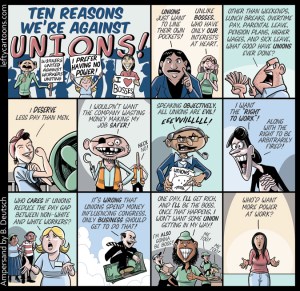
This reader’s letter as well as the apparent lack of awareness about its self-defeating perspective is perfectly satirized in this cartoon:

Ten Reasons We’re Against Unions! by Barry Deutsch
Ten Reasons We’re Against Unions! by Barry Deutsch [click to enlarge original link]
While SC political leaders and the public are drawing a line in the sand about unions intruding in the state, Northwestern college football athletes, led by quarterback Kain Colter, have taken unprecedented action to unionize, as Strauss and Eder detail:

A regional director of the National Labor Relations Board ruled Wednesday that a group of Northwestern football players were employees of the university and have the right to form a union and bargain collectively.

For decades, the major college sports have functioned on the bedrock principle of the student-athlete, with players receiving scholarships to pay for their education in exchange for their hours of practicing and competing for their university. But Peter Ohr, the regional N.L.R.B. director, tore down that familiar construct in a 24-page decision.

He ruled that Northwestern’s scholarship football players should be eligible to form a union based on a number of factors, including the time they devote to football (as many as 50 hours some weeks), the control exerted by coaches and their scholarships, which Mr. Ohr deemed a contract for compensation.

“It cannot be said that the employer’s scholarship players are ‘primarily students,’ ” the decision said.

How the public responds across the U.S. to college athletes unionizing must be framed against patterns over the last decade that include a disturbing cultural attitude toward workers, notably against teachers’ unions, tenure, and striking (see the 2012 Chicago strike for example).

Examining how workers are portrayed in the media, how workers are valued (or not) in the U.S., and the prospect of becoming a worker for graduate students, I have framed being a worker within the rise of disaster capitalism and concluded:

Finally, in the wake of disaster capitalism in New Orleans and Oregon, pop culture, specifically The Big Bang Theory, is a crucible of not only the role of workers in the U.S. but also the attitudes about the worker that series highlights. Penny, the stereotypical “girl next door,” is the object of an on-going, clichéd joke of a waitress who longs to be an actress. The larger and central jokes of the series, however, are the four academics living across the hall from Penny. It seems in this TV world, all work is funny.

What a TV sit-com never addresses, however, is that in the real world, the gap between Penny as waitress and college professors is shrinking, or better phrased, merging. The state of the American worker is beginning to share with waitressing some disturbing characteristics that cheapen all workers. As Greider (2013) details about the restaurant industry, workers of all types are becoming less often protected by unions, receiving fewer or no benefits (paid sick days, vacation days, health insurance, retirement) with their positions, being paid less than previous generations, and generally suffering under a dynamic whereby the businesses have more or all of the power in the business-worker relationship.

In the real world, Penny and one of the academics, Leonard, would not be wrestling over the education gap between them, but would be sharing the consequences of part-time work in a hostile economy toward workers regardless of those workers’ qualifications since Leonard would be an adjunct (like Professor Beth) while Penny would remain a waitress—and both would be unsatisfied as workers because their situations do not live up to their ideals.

Yet, most Americans will always be workers, and to be a worker should be an honorable thing worthy of poetic speeches and artistic black-and-white film tributes. Being an American worker doesn’t need to be a condition tolerated on the way to something better, and it shouldn’t be twenty-first century wage-slavery that is a reality echoed in the allegory of SF: “one fine day, a purely predatory world shall consume itself.” As the last paragraphs of Cloud Atlas express, however, the wage-slavery of workers in the context of assembly-line and disaster capitalism is a condition Americans have chosen (or at least been conditioned to choose), but it is also a condition workers can change—if workers believe it is wrong, “such a world will come to pass.” (Academia and the American Worker: Right to Work in an Era of Disaster Capitalism?, pp. 21-22)

A question that remained with me as I drafted the piece above is just why the majority state of people in the U.S.—being a worker—does not inform the pervasive antagonistic attitude toward workers. The public in the U.S. appears just as self-defeating as the South when we are confronted with workers’ rights and collective workers’ voices.

The opportunity before us with the possibility that college athletes may unionize and transform not only their circumstances but also all of college athletics has a less appealing parallel for me, however: The tension between the NFL players’ union and NFL owners in 2011 and how the public responded to that unionization when compared to the rising calls to end teachers’ unions and tenure.

American disdain for unions is grounded in a traditional faith in rugged individualism, but it also seems linked to a good degree of self-loathing informed by a cultural worshipping of the wealthy and famous.

Stated directly and without the political baggage of the term “union,” what are the problems with due process and academic freedom (the central elements of tenure for teachers secured by unionization)? Who prospers from workers without full benefits, strong wages, and safe working conditions? Who maintains control when workers do not have equitable voices in their work and compensation?

Writing about the term “totalitarian,” Ta-Nehisi Coates confronts the power of words (to which I would add “union”):

Words exist within the realm of politics. In politics, words are sometimes perverted by the speaker. It’s worth considering which words come under attack for perversion (“racist,” “homophobe,” “bigot”) and which do not (“democratic,” “bipartisan,” “anti-American”). I am always skeptical of people who seek to curtail their use, instead of interrogating their specific usage. Some people really are racists, and other people really are misogynists, and others still actually are homophobes. Instead of prohibiting words, I’d rather better understand their meaning.

Some people demonizing unions and unionization really are being self-serving, really are seeking ways that workers can be treated as interchangeable widgets (not unlike college athletes) while the owners reap a disproportionate profit on their backs, sweat, and labor (consider how Walmart has sought to bust unions and reduce their workforce to part-time without benefits, resulting in those workers often being on welfare).

Ultimately, Coates comes to workers in the totalitarian state:

But the central idea—that the communist party, and thus the central committee, and thus the politburo was the sole representative of workers—has a chilling moral closure. Who could be against the workers? And if the party is the true representative of the workers, why do we need other parties?

I must echo: Who could be against the workers?

That haunts me, baffles me, leaves me cynical because of all the qualities that divide people in the U.S.—race, class, religion, sexuality, gender—that almost all of us are and always will be workers—a state that should be something of honor and dignity—is the one quality that should unite us.

College athletics stand before the entire U.S. as the crucible of a few benefitting on the backs of many—many without a voice. And that crucible also reveals to us the potential power of a collective voice, an acknowledged voice among the majority who do the labor that generates the profits.

As Coates warns, “words are sometimes perverted by the speaker.”

“Union” is one such word, and when it is spoken by those in power, be certain the motivation is not in the best interests of the workers.

There would be no billionaires today without workers. In fact, powerless workers are nearly essential for maintaining the inequitable state of the U.S. in which billionaires thrive while more and more workers become trapped in multiple part-time jobs, absent benefits or job security.

The Northwestern college football players have my solidarity, but I also wonder why we all are not seeking that same solidarity among every worker in the U.S., a solidarity that could attain the American Dream that has been perverted into an American Winter:

In case it’s not clear, “American Winter” comes from a specifc, biased and unapologetic viewpoint, but it’s also the kind of argument that’s needed right now. Watching the 50 year old John, 3 years unemployed and father to a young son with Down’s Syndrome, weep on camera because he had to borrow money from his parents to pay the electric bill, it’s bracing and raw. When Paula goes to the food bank for the first time, and is overwhelmed by the fact that her situation has forced her to take such measures or when single mom Jeanette tries make a promise to her young son Gunner that they will find a place to live, it puts a new perspective on those who are traditionally associated/stereotyped as being on social services. Everyone in “American Winter” has been working, are raising families, and doing everything they can (Dierdre gives blood and goes scrapping on weekends just for extra money) to make ends meet. They are not the vultures of the system that certain political segments like to paint as living on taxpayer money. (Review: ‘American Winter’ A Devastating Portrait Of The Erosion Of The Middle Class)

That recovered American Dream could be built on workers unionized for the right to work—the right to work for wages that dignify their work and their lives, the right to work as a part of their right to live fully and freely, the right to work in a physically and psychologically safe environment, the “right to work” not perverted by a political elite bragging about using high-heeled shoes as the boot on the throat of the Great American Worker.

See Related

Remembering Howard Zinn by Meditating on Teacher Unions and Tenure?

[NOTE: The title is an allusion to a line from Blazing Saddles.]

College Athletes’ Academic Cheating a Harbinger of a Failed System

Margaret Atwood’s narrator, June/Offred, characterizes her situation in the dystopian speculative world of The Handmaid’s Tale:

Apart from the details, this could be a college guest room, for the less distinguished visitors; or a room in a rooming house, of former times, for ladies in reduced circumstances. This is what we are now. The circumstances have been reduced; for those of us who still have circumstances….

In reduced circumstances you have to believe all kinds of things. I believe in thought transference now, vibrations in the ether, that sort of junk. I never used to….

In reduced circumstances the desire to live attaches itself to strange objects. I would like a pet: a bird, say, or a cat. A familiar. Anything at all familiar. A rat would do, in a pinch, but there’s no chance of that. (pp. 8, 105, 111)

In her reduced circumstances as a handmaid—her entire existence focusing on becoming pregnant by a Commander to whom she is assigned, potentially a series of three before she is cast aside as infertile, thus useless—June/Offred’s fantasies about her Commander turn murderous:

I think about how I could take the back of the toilet apart, the toilet in my own bathroom, on a bath night, quickly and quietly, so Cora outside on the chair would not hear me. I could get the sharp lever out and hide it in my sleeve, and smuggle it into the Commander’s study, the next time, because after a request like that there’s always a next time, whether you say yes or no. I think about how I could approach the Commander, to kiss him, here alone, and take off his jacket, as if to allow or invite something further, some approach to true love, and put my arms around him and slip the lever out from the sleeve and drive the sharp end into him suddenly, between his ribs. I think about the blood coming out of him, hot as soup, sexual, over my hand. (pp. 139-140)

The novel reveals no evidence that June in her life in “former times” has been anything other than a relatively typical young woman with a family and a normal life. Atwood asks readers to consider her reduced circumstances (ones she does not create, ones she has no power to change alone) and how they shape the individuals in this disturbing Brave New World.

Atwood’s “reduced circumstances” are a narrative and fictional examination through a novelist’s perspective—a thought experiment replicated in the graphic novels and TV series The Walking Dead, as the comic book creator Robert Kirkman explains: “I want to explore how people deal with the extreme situations and how these events change [emphasis in original] them. I’m in this for the long haul.”

Research on human behavior has revealed, as well, that the same human behaves differently as the situations around change, what Sendhil Mullainathan and Eldar Shafir in Scarcity: Why Having Too Little Means So Much define as “scarcity” and “slack.” The “reduced circumstances” of The Handmaid’s Tale, then, is a state of “scarcity,” and poverty is one of the most common types of scarcity:

One cannot take a vacation from poverty [emphasis added]. Simply deciding not to be poor—even for a bit—is never an option….

Still, one prevailing view explains the strong correlation between poverty and failure by saying failure causes poverty.

Our data suggest causality runs at least as strongly in the other direction [emphasis added]: that poverty—the scarcity mindset—causes failure.(pp. 148, 155)

Given that we hold highly negative stereotypes about the poor, essentially defined by a failure (they are poor!), it is natural to attribute personal failure to them….Accidents of birth—such as what continent you are born on—have a large effect on your chance of being poor….The failures of the poor are part and parcel of the misfortune of being poor in the first place. Under these conditions, we all would have (and have!) failed. (pp. 154, 155, 161)

We are faced with a perplexing problem that sets up a clash between a powerful cultural ideal (the rugged individual and the allure of individual accountability) against a compelling research base that, as Mullainathan and Shafir offer, suggests individual behavior is at least as likely to represent systemic conditions, and not individual qualities (either those that are fixed or those can be learned, such as “grit”).

Although they may seem unrelated narrowly, two academic cheating phenomena are ideal examples of this perplexing problem—attempting to tease out individual culpability from systemic forces.

One consequence of the high-stakes era of accountability in public education has been the seemingly endless accounts of cheating on high-stakes testing; the most notorious being the DC eraser-gate under the reign of Michelle Rhee but also scandals such as the one in Georgia.

Academic cheating by college athletes has also been exposed recently, notably associated with the University of North Carolina. But college athletes cheating to remain eligible is not anything new; for example, Florida State University has received similar criticism for ignoring or covering up the academic deficiencies of athletes in the past.

It is at this point—the academic cheating and dodging of college athletes—that I want to focus on the concept of “reduced circumstances” and “scarcity” in order to consider where the source of these outcomes lie.

A few additional points inform this consideration.

First, college athletes at Northwestern University are seeking to form a union so that they can gain some degree of autonomy over their circumstances as college athletes—circumstances dictated by the NCAA. This move by athletes themselves appears to match a call by Andre Perry, his being specifically about graduation rates:

Black athletes have no choice but to play a major role in their own success. They must take full advantage of the scholarships afforded to them in spite of the climate. But some athletes have to pay a political price to force institutions to cater to black males’ academic talents. Graduation is a team effort, but black athletes must flex their political muscle to pave a way from the stadiums in January to the graduation stages in May.

Perry’s argument is one that focuses on individual agency and the athletes’ ability to rise above “the climate.”

However, David Zirin, discussing a Meet the Press examination of the NCAA and the circumstances of college athletes, seeks a systemic focus:

Yet far more glaring than the content of the discussion was what the discussion was missing. This is not surprising given the parties sitting around the table, but there was zero discussion about how institutionalized racism animates the amassed wealth of the NCAA, the top college coaches and the power conferences. It does not take Cornel West to point out that the revenue producing sports of basketball and football are overwhelmingly populated by African-American athletes. The population of the United States that is most desperate for an escape out of poverty is the population that has gotten the rawest possible deal from an NCAA, which is actively benefiting from this state of affairs….

The issue of the NCAA is a racial justice issue.

The public and the media, I believe, have already sided with blaming the athletes as well as blaming a failure of leadership and accountability among coaches and university administration, including presidents.

For example, the media has rushed to identify a student paper (a bare paragraph) as an example of the cheating at UNC, a claim now refuted by the whistleblower in the scandal, Mary Willingham. That rush and misrepresentation highlight, however, where the accusatory gaze is likely to remain—on the student athlete as culpable, on the coaches, professors, and universities.

As Zirin asks, what will be missing?

Few will consider that the academic scandal among student athletes at UNC—like the cheating scandals on high-stakes tests in public schools—is powerful evidence of a flawed system, one that places young people in “reduced circumstances” and then their behavior is changed.

As I have argued before [*see the entire post included below] (from a position of my own experiences as a teacher and scholastic coach and as someone who advocates for student athletes), school-based athletics in the U.S. corrupts both sport and academics. The entire scholastic sports dynamic is the essential problem.

There simply is no natural relationship between athletics and academics, and by creating a context in which young people are coerced into academics by linking their participation in athletics to their classroom achievement, we are devaluing both athletics and academics.

So I see a solution to the tension between Perry’s call for athlete agency and Zirin’s call for confronting systemic racism: We must address the conditions first so that we can clearly see to what extent individuals can and should be held accountable.

It seems simple enough, but if student athletes were not required to achieve certain academic outcomes (attendance, grades, graduation), then there would be no need to cheat. Hold athletes accountable for that which is athletic, and then hold students accountable for that which is academic. But don’t continue to conflate the two artificially because we want to create the appearance that we believe academics matter more than athletics (we don’t and they aren’t).

In conditions of scarcity—demanding of anyone outcomes over which that person has no control or no hope of accomplishing without a change in systemic conditions (such as academic outcomes an athlete is not prepared or able to accomplish or closing an achievement gap between populations of students)—the same person behaves differently than if that person were in a condition of abundance or privilege, “slack” as Mullainathan and Shafir call it.

Let’s turn to The Walking Dead, a world created by Kirkman, as he explains, in which “extreme situations…change” people.

In season 4 episode 14, “Look at the Flowers,” Carol, who has already demonstrated her ability to take extreme measures in “reduced circumstances” (season 4 episode 2, “Under My Skin”), offers another example paralleling June/Offred, as Dalton Ross explains:

If you thought Carol had a zero-tolerance attitude when she killed and burned two bodies back at the prison to stop the spread of a deadly virus, tonight she went truly sub-zero. The insanity began when little Lizzie stabbed and killed her sister Mika to prove that she would come back to life, leaving Carol to knife Mika’s brain to stop her from coming back as a zombie. She and Tyreese then had to decide what to do with Lizzie, with Carol saying that, “We can’t sleep with her and Judith under the same roof. She can’t be around other people.” And with that, Carol walked Lizzie outside, told her to “look at the flowers,” and then put a bullet in her brain.

Two children die, one at the hands of Carol, and that scene reminded me immediately of John Steinbeck’s Of Mice and Men, when George shoots his best friend Lenny.

After Lenny has killed Curley’s wife and run away to the hiding spot he and George have already designated, George finds Lenny:

George had been listening to the distant sounds. For a moment he was business-like. “Look acrost the river, Lennie, an’ I’ll tell you so you can almost see it.” (p. 103)

George and Lenny are hired hands, workers, pursuing their own American Dream. That pursuit has been difficult, including George trying to overcome Lenny having the mind of a child guiding the powerful and large body of a man. And it is in this final scene that George, like Carol, finds himself in “reduced circumstances.” While Lenny gazes across the river, George tells the same story he’s told hundreds of times, about the farm they will buy and the rabbits Lenny will tend as his own, and then:

And George raised the gun and steadied it, and he brought the muzzle of it close to the back of Lennie’s head. The hand shook violently, but his face set and his hand steadied. He pulled the trigger. The crash of the shot rolled up the hills and rolled down again. Lennie jarred, and then settled slowly forward to the sand, and he lay without quivering. (p. 105)

Cultural assumptions are powerful lenses for judging outcomes.

If we assume the “dumb jock” stereotype to be true, we point our fingers at the student athletes as cheaters and allow our gaze never to consider that the entire system is failing those student athletes.

If we assume people in poverty are lazy (and use that as a mask for lingering racist stereotypes of African American and Latino/a students and people), we point our fingers and say they simply aren’t trying hard enough; they need “grit.” And we fail to recognize and confront the pervasive racism, classism, and sexism that constitute the “reduced circumstances” of their lives.

Of course, college athletes should not be cheating to maintain their access to participating in sports, but it may be important to consider who is responsible for putting them in that situation to begin with—and who benefits most from maintaining that system.

***

*An Honest Proposal: End Scholastic Sport in the U.S. (originally posted at Daily Kos 14 August 2011)

While teaching the introductory education course at my university, I have taught many of our athletes, and they often immediately make an extra effort to engage with me once I explain to them that I was a high school English teacher for 18 years, including many years as the head soccer coach for the boys and girls teams. I also tell them that my wife is a P.E. teacher as well as a varsity/junior varsity volleyball coach and varsity assistant/junior varsity head soccer coach.

My daughter was an elite high school and club soccer player throughout her academic life as well.

One semester, a young man from England sat in my class as a member of the university’s soccer team. He was a popular and thoughtful young man whose British accent garnered him a good deal of attention, but I was most struck by his willingness to discuss how the U.S. and his native England approached education and sport differently.

Soccer is an interesting sport through which to view those differences since, as this young man personified, many soccer athletes come to the U.S. for their education after they have come to terms with their not attaining the professional career they had been striving to achieve.

Yes, this young man was older than his peers and viewed sport in the U.S. as a ticket to education, but he was quick to note that he thought the direct connection between education and sport in the U.S. is ridiculous; no such connection exists in many countries outside the U.S. where sport is a club, not scholastic, activity.

And when I saw a recent story at Education Week titled “NCAA Approves Higher Academic Standards for Athletes,” I immediately thought about my soccer student from England, and I have been mulling this for some time: It is time we stop not only the charade that is “higher standards for student-athletes,” but also the corrosive connection between education and team sport.

The education reform we should address and never even mention is ending scholastic sports entirely in the U.S.

First, at the philosophical level, by creating an artificial relationship between academics and athletics (consider the unique leverage we use athletics for to coerce children to engage in their academics), we are devaluing both.

If academics truly matter, then why are we spending so much energy bribing and manipulating students to take their studies seriously?

And if athletics are truly less important than academics (along with band, chorus, art, drama, etc.), then why are so many professional lives spent in fields connected to athletics?

The truth is that academics and athletics are valuable in and of themselves, and that no real relationship exists between the two. Children and adults should be allowed and encouraged to engage in either without being held hostage to artificial guidelines—such as grade and graduation requirements for student-athletes in K-12 or college athletics.

In my life and career as an educator, I have witnessed hundreds of young people with gifts and passions that are daily trivialized and dampened because the adult world has fabricated coercive and dishonest mechanisms to shape children in ways that conform to false cultural narratives (high school algebra matters more than basketball, for example).

I have taught students gifted in art, who suffered in real ways taking required math courses; I have taught gifted athletes who were banished from sport teams due to grades, withering in classes and filled with resentment instead of being inspired to turn to their books because their sport was taken away; and I could make a list like this that goes on for pages.

It is both dehumanizing and dishonest to use sport to coerce children and young adults to suffer through the academics that we have deemed essential for them.

Now, on a practical level, athletic teams associated with schools and colleges are at the heart of the culture in the U.S.—parallel to the love and affection for local soccer clubs in England, for example.

I think that cultural aspect of scholastic sport matters and can and should be preserved, but that this is also corrupted by the dishonest and manipulative political game of claiming to have high standards for student-athletes when we know that at all levels these claims are little more than wink-wink, nod-nod.

My solution, then, is to end all scholastic sport in education throughout the U.S. and replace that with a club system that includes schools and colleges fielding club teams.

At the K-12 levels, club teams could be sponsored by any school that wishes to sponsor a team, and these teams would be delineated by age groups—common in club sport—but the schools would not be required to monitor their athletes’ grades or anything related to their schooling (just as we do not require any businesses to monitor their teen employees). In fact, the club associated with the schools would not have to include only students from that school.

K-12 schools would likely focus on community athletes, many of which will be in their schools, but the removal of the false connection between any student’s ability and desire for either schooling or sport would eliminate huge and tedious bureaucracy; corrosive tension among students, coaches, and educators; and superficial and erroneous cultural messages about “what matters.”

Here is also another important and practical matter related to scholastic sport—the inordinate amount of funding and time spent on managing athletics and athletic facilities at the school level. When we alleviate schools of scholastic sport, we also shift facilities to the club level, where public and private entities who wish to preserve sport can step in and assume these responsibilities.

At the college levels, colleges and universities would also field club teams—which could continue to be monitored by the NCAA—but their players would be drawn into those clubs for athletic purposes only, likely as a stepping stone to professional teams. Colleges and universities would be free to offer scholarships to those athletes wishing to attend college, but this would be purely within the purview of the colleges/universities and the athletes who wish to gain an education.

The end of scholastic sport is an end to hypocrisy, it is an acknowledgement that sport and academics both matter, and it is an education reform we never mention but could implement immediately with positive outcomes for everyone involved.

So-called high academic standards for student-athletes are not about students, athletes, or any sort of respect for the academic life. So-called high academic standards for student-athletes are more political pontificating and, worst of all, more of the tremendous coercion practices at the heart of a misguided American culture that claims one thing—the pursuit of individual freedom and democracy—while instituting another—the codifying of indoctrinating and manipulating the country’s children through our foundational institutions.

Ending scholastic sport is the first step toward honoring sport, academics, and the humanity of the youth of our free society.

educator, public scholar, poet&writer – academic freedom isn't free