All posts by plthomasedd

P. L. Thomas, Professor of Education (Furman University, Greenville SC), taught high school English in rural South Carolina before moving to teacher education. He is a former column editor for English Journal (National Council of Teachers of English), current series editor for Critical Literacy Teaching Series: Challenging Authors and Genres (Brill), and author of Teaching Writing as Journey, Not Destination: Essays Exploring What ‘Teaching Writing’ Means (IAP, 2019) and How to End the Reading War and Serve the Literacy Needs of All Students: A Primer for Parents, Policy Makers, and People Who Care (IAP, in press). NCTE named Thomas the 2013 George Orwell Award winner. He co-edited the award-winning (Divergent Book Award for Excellence in 21st Century Literacies Research) volume Critical Media Literacy and Fake News in Post-Truth America (Brill, 2018). Follow his work @plthomasEdD and the becoming radical (https://radicalscholarship.wordpress.com/).

New Criticism, Close Reading, and Failing Critical Literacy Again

When the Common Core debates drift toward advocacy or critiques of the standards themselves, I have refused, mostly, to engage with that conversation because I believe debating the quality of CC concedes too much. I remain opposed to CC regardless of the quality of the standards because of the following reasons: (1) CC cannot and will not be decoupled from the caustic influence of high-stakes testing, (2) all bureaucratic and mandated standards de-professionalize teaching, (3) accountability/standards/testing as a reform paradigm has failed and nothing about the CC iteration offers a different approach, except that this is called “national,” and (4) there is absolutely nothing in the CC agenda that addresses social or educational inequities such as disproportionate discipline policies, course access, and teacher assignment.

So with due trepidation, I now wade into the few but needed challenges being offered about how CC encourages “close reading” of texts.

First, let me highlight that my primary field of teaching writing offers a powerful and disturbing parallel model of how the accountability/standards/testing movement supplanted and destroyed evidence-based pedagogy.

I have detailed that the rise of best practice in the teaching of writing in the 1970s and 1980s was squelched by the accountability era begun in the 1980s; see Why Are We (Still) Failing Writing Instruction?

As well, Applebee and Langer offer a chilling refrain of best practice in writing wilting under the weight of standards and testing in their Writing Instruction That Works: Proven Methods for Middle and High School Classrooms.

Reading instruction and reading experiences for children, we must acknowledge, will suffer the same negative consequences under CC and the related high-stakes tests because there are no provisions for implementing CC that change how standards and tests are implemented (often each round of standards and tests are simply infused into the current practices) and, in reality, CC approaches to reading are new names for traditional (and flawed) reading practices.

Next, I strongly recommend the following pieces that essentially confront the central problem with CC’s focus on close reading (and as I’ll expand on below, how close reading continues the traditional view of text-based analysis grounded in New Criticism—and thus excluding critical literacy and the powerful contributions of marginalized writers and critics [1]):

Reading Without Understanding — Common Core Versus Abraham Lincoln, Alan Singer

Martin Luther King Jr. and the Common Core: A critical reading of “close reading,” Daniel E. Ferguson

I want here, then, to add just a few more thoughts on why committing to CC and close reading fails against the gains we have made in understanding the complexity of responding to texts in the context of the words on the page, the intent and biography of the writer, the biography of the reader, and the multiple historical contexts that intersect when anyone reads any text.

Let me start with an example.

I began my poetry unit always with “The Red Wheelbarrow” by William Carlos Williams:

so much depends
upon

a red wheel
barrow

glazed with rain
water

beside the white
chickens.

My instructional goals with starting here are many, but in part, this poem was ideal to make a key point about how we respond to text. I would read the poem aloud and then ask students to close their eyes and envision a wheelbarrow. Then I would ask several to describe what they saw.

The exercise highlighted that many students pictured wheelbarrows in various positions. I always shared with students that I always see any wheelbarrow turned up on its front edge, leaning against a tree because my father was adamant that a wheelbarrow must not sit with the body of the wheelbarrow turned so that it can gather water, which leads to rust forming.

This activity allowed us to discuss what readers can say about the text of a piece, distinguish that from their personal responses (the text says nothing of how the wheelbarrow is sitting, but dictates that it is red, for example), and tease out how writer intent, text, and reader affect create the possibility of dozens of credible, although different, interpretations.

From there we began to confront what counts as “right,” as well as who decides what is “right” as an interpretation.

I made certain my students understood how to conduct a New Criticism analysis and stressed that school, teachers, and many testing situations (notably Advanced Placement) honor only such approaches to text.

Next, however, we challenged that dynamic and began exploring how each student’s empowerment and autonomy rested on having a broad set of lens through which to engage with text, through which to unmask power dynamics embedded in authoritative interpretations of text. [2]

This, of course, is the province of critical literacy.

Ironically, if we use a critical reading of CC and calls for close reading, we discover that “close reading” (and the move by David Coleman from writing CC to leading College Board, where AP and SAT tests are spawned) is simply a repackaging of text-only approaches to text embraced by New Criticism (see the history of New Criticism in the ELA classroom in “A Richer, Not a Narrower, Aesthetic”: The Rise of New Criticism in English Journal (English Journal, 101(3), 52-57).

Like the mechanistic and reductive ways in which New Criticism has been implemented in formal schooling in order to control and measure objectively how students respond to text, CC and the focus on close reading are poised to serve efficiency models of high-stakes testing while also failing students who need and deserve the complex and challenging tools afforded with critical literacy.

CC and close reading—if we wade into debates about the quality of the standards—are nothing new, in fact. Advocates of CC are ironically proving why instead of close reading we need critical reading.

Context matters.

[1] See, for example, Literature: The Reader’s Role, Louise M. Rosenblatt (May, 1960), The English Journal, 49(5), 304-310, 315-316.

[2] See how I use a children’s book, Click, Clack, Moo, to introduce students to Marxist and Feminist critical lenses for texts as a contract to text-based analyses: “Click, Clack, Moo”: Why the One Percent Always Wins.

A Critical Truce in the War between Traditionalists and Progressives

Harry Webb has launched A War of Words: “The war is between traditionalists and progressives and it is an old war.”

Yes, this is an old war, and what is most frustrating about this battle for me is that, once again, critical perspectives are left out entirely. So let me offer here a brief critical truce to this war between traditionalists and progressives.

First, Webb’s post highlights some of the essential problems with the war itself.

Since the mid-1900s, progressive educators and progressive pedagogy have been demonized (and usually misrepresented) as key sources of educational failures, but traditional practices have historically dominated and currently dominate what happens in real classrooms daily.

We have ample anecdotal (I have been in education for 31 years) and research-based evidence that even though, as Webb notes, colleges of education and education professors disproportionately claim to be progressive, that once teachers enter the classroom, they tend to shut the door and practice relatively traditional pedagogy—often teaching as they have been taught or defaulting to traditional practices since they are more efficient and more easily managed in the challenging environments of mixed-ability and overcrowded classrooms.

I invite everyone to read Alfie Kohn’s examination of this in Progressive Education: Why It’s Hard to Beat, But Also Hard to Find. Kohn offers not only a solid discussion of how rare progressive practices are, but also details how progressive practices are misrepresented along with what he considers to be genuine progressive pedagogy.

Another problem I have with this war, however, is that I am not a progressive and am not offering here an apology for progressivism.

I am noting that when I wear my history of education hat (I am the Council Historian for NCTE and wrote a biography for my doctoral work), I recognize a demonizing and marginalizing of progressives that is misleading. As a critical educator, I must add, I believe that progressives have failed and do fail in many ways similar to the failures I associate with traditional practices.

I will confess that it is likely we have failed progressivism, but that point is pretty academic.

Along with Kohn’s discussion of progressivism, I also invite you to examine what I believe is an accurate model of what progressivism is by exploring the work of Lou LaBrant, the focus of my educational biography. Her work disproves the stereotypes of progressives as “touchy-feely” educators who have no grounding in empirical evidence. LaBrant practiced classroom-based research and considered herself a scientific teacher throughout her career from 1906 to 1971. She also fiercely defended the progressivism of John Dewey (something, again, that almost no one represents accurately and then almost no one practices—even those education professors who claim to be progressives).

Another problem with the war is that once traditionalists have mischaracterized progressives in order to attack those mischaracterizations and progressives have mischaracterized the traditionalists in order to attack those mischaracterizations, little value comes from the war, and as is typical of wars, we have only collateral damage.

So let me pause on one comment from Webb: “Yet, their argument is weak and not supported by evidence,” he claims about progressives.

I must call a foul here. Education has a century of research, a research base that has been ignored by policymakers and often discredited by those with narrow definitions of what counts a research (action research by teachers doesn’t count, they say, effectively silencing teachers and indirectly the voices of women in their own profession). Thus when Webb proclaims, “There is an imbalance of power here,” there is an unintended irony since that imbalance is exactly what I am highlighting.

Just as one example, Zemelman, Daniels, and Hyde have offered for many years an examination of just what the body of evidence shows regarding effective pedagogy. This work calls into question two claims by Webb: first, it shows there is a robust research base, and second, the practices that are likely most effective are fairly characterized as progressive (the sorts of practices that reflect an accurate use of the term).

However, what is most important to note about Zemelman, Daniels, and Hyde’s work is that what we know about best practice includes that no pedagogy is rejected and no pedagogy is demanded; in other words, best practice is implementing the instructional practices that best meet the needs of the students and match the learning goals.

For example, the evidence on teaching writing since at least the 1930s and 1940s has shown that isolated grammar instruction does not transfer to original student compositions; in the mid-1990s, George Hillocks showed that isolated grammar instruction actually inhibits writing quality. So the most effective way to teach students to write, including the most effective way for students to learn standard grammar, is through actual writing—something most people would call a progressive perspective.

However, that same research base shows that evidence-based (the evidence being found in actual writing samples from students) direct instruction (what many would call a traditional practice) is vital, and that some students (although a minority) can benefit from targeted isolated grammar instruction.

In other words, the research base emphasizes both the effectiveness of pedagogy most would call progressive, but it certainly doesn’t discount that ultimately what works best is what each student needs. As Webb noted, lecturing can be highly effective, and it can be abysmal—but that has more to do with its delivery and appropriateness than to some default judgment on the practice itself.

When traditionalists say that all students must learn standard English, they likely have a point, but their goal often falls apart when they insist on instructional practices that the evidence has shown are ineffective. “I shall prove my pedagogy is king!” is a shallow thing against seeking ways to teach each student effectively and with  compassion and patience.

When progressives say that student must be engaged in authentic activities, they also have a point (although as Webb notes, and I agree, the jargon of education offers no proof that what is claimed is what is taking place), but that goal often falls apart when they fail to recognize that having students participating in a workshop demands a teacher who also provides a great deal of structure and manages purposeful direct instruction as student work reveals the need.

In my experience, traditionalists and progressives tend to become trapped in their pedagogy and fail to see their students or the evidence of their own ineffectiveness.

If you demand all children read The Scarlet Letter, lecture on it brilliantly for two weeks, prepare a detailed study guide, and then have a class score wonderfully on the test at the end of the unit, what have you gained if most of those students never actually read the book and the entire experience taught them to hate reading?

If you invite your students to participate in writing workshop, offer no structure, fail to provide expert feedback, have no process for students to revise and improve their essays, and then bundle a portfolio of all that work with a nice decorated folder cover, what have you gained if that workshop involved more time meandering and decorating, resulting in students writing no better at the end than the beginning? (See LaBrant’s brilliant critique of failed efforts at the project method in ELA classes, a sharp unmasking of failed progressive claims.)

So, where’s the truce? Because a reasonable person could read this so far and say that I have embedded in the discussion a sneaky endorsement of progressivism (do I associate more with progressives than traditionalists? Sure. But I find they fail just as often as traditionalists, and thus, my disappointment with progressives is much more intense).

Here’s my truce.

I bet that someone as thoughtful and purposeful as Harry Webb appears in his blogs is a stellar and effective teacher, despite our differences about pedagogy.

I have seen brilliant traditionalists teachers and lousy self-proclaimed progressives. More than anything, I have seen too many teachers bound to their practices, ignoring their students and the evidence of their ineffectiveness.

Thus, my truce is that the key (the olive branch?) to this war is whether or not a teacher has a critical lens.

Let me end with a couple invitations:

I have posted before a chart that I use to introduce students to the traditionalist v. progressive divide juxtaposed with the often ignored critical alternative; please see it here.

Also consider a longer post in which I explore this dynamic in detail, Education Done To, For, or With Students?

Maybe, as Webb suggests, there is no hope for ending this war, but I would prefer a different approach, one that requires that we all step away from our commitments (as Webb critiques well, our words, labels, and jargon), take an honest assessment of the impact our commitments have on students (because the only real things that matters are if students learn and that we never sacrifice their dignity and humanity in the process), and then begin again, determined to do better the next time.

Peace?

The “Grit” Narrative, “Grit” Research, and Codes that Blind

The answer to Grant Lichtman’s Does “Grit” Need Deeper Discussion? appears to be an unequivocal yes—based on the exchange in the blog post comments, the Twitter conversations, and comments at my blogs on “grit.”

Those conversations have been illuminating for me; therefore, I want here to address several excellent ideas that have been generated.

First, I want to make a distinction that I think I have failed to make so far: We need to distinguish between the “grit” narrative and “grit” research. My concerns and most of my writing rejecting “grit” are addressing the “grit” narrative—one that is embedded in and co-opted by the larger “no excuses” ideology.

The “grit” narrative is central to work by Paul Tough as well as a wide range of media coverage of education, education reform, and specifically “no excuses” charter schools such as KIPP. In other words, the “grit” narrative is how we talk about what qualities lead to success (in life and school), what qualities children have and need, and how schools and teachers can and should inculcate those qualities.

In order to understand my cautions about the term “grit” as a narrative, I recommend that you consider carefully the responses to Richard Sherman’s post-game interview with Erin Andrews—responses that included calling Sherman a “thug” and racial slurs.

As Sherman has confronted himself, “thug” is “the accepted way of calling somebody the N-word nowadays.”

In other words, “thug” and GPA, as I have examined, are codes that blind because they are socially acceptable words and metrics that mask racial and class biases and prejudices.

The “grit” narrative is also a code that blinds since it perpetuates and is nested in a cultural myth of the hard-working and white ideal against the lazy and African American (and Latino/a) stereotype.

We must acknowledge that the “grit” narrative is primarily directed at—and the “no excuses” ideologies and practices are almost exclusively implemented with—high-poverty African American and Latino/a populations of students. And we must also acknowledge that the popular and misguided assumption is that relatively affluent and mostly white students and schools with relatively high academic achievement data are distinguishable from relatively impoverished and mostly African American and Latino/a students because of the effort among those populations (as well as stereotypes that white/affluent parents care about education and AA/Latino/a parents do not care about education)—instead of the pervasive fact that achievement data are more strongly correlated with socioeconomic status than effort and commitment.

Whether consciously or not, “grit” narratives and “no excuses” polices are classist and racist—again demonstrably so because neither are associated with white students in middle-class and affluent communities and schools.

The “grit” narrative states and implies that schools need to inculcate in impoverished African American and Latino/a students that same “grit” at the root of affluent and white student excellence (see the same stereotyping of teaching impoverished children the middle-class code in the flawed and discredited work of Ruby Payne)—misreading the actual sources of both the achievement and the lack of achievement (see below about scarcity and slack).

In fact, part of the “grit” narrative includes the assumption that successful students and people (read “white”) are successful primarily because they work hard; they earn their success. The flip side of this “grit” narrative is that unsuccessful students and people (read “African American” and “Latino/a”) are unsuccessful because they simply do not try hard enough. At its worst, the “grit” narrative is a socially acceptable way of expressing the lazy African American stereotype, just as Sherman exposed about “thug” as a socially acceptable racial slur.

The “grit” narrative is a racialized (and racist) cousin of the rugged individual myth that remains powerful in the U.S. The factual problem with the “grit” narrative and the rugged individual myth can be found in some powerful evidence that success is more strongly connected to systemic conditions than to the content of any individual’s character. Please consider the following:

  • Using data from Pew’s Economic Mobility Project, Matt Bruenig exposes the reality that ones privilege of birth trumps educational achievement (effort and attainment):

So, you are 2.5x more likely to be a rich adult if you were born rich and never bothered to go to college than if you were born poor and, against all odds, went to college and graduated. The disparity in the outcomes of rich and poor kids persists, not only when you control for college attainment, but even when you compare non-degreed rich kids to degreed poor kids!

Therefore, the answer to the question in the title is that you are better off being born rich regardless of whether you go to college than being born poor and getting a college degree.

  • In ScarcityMullainathan and Shafir present a compelling case that the same individual behaves differently in conditions of scarcity and slack. Scarcity occurs in impoverished lives and accounts for behaviors often misread by society as lazy, careless, or self-defeating. Slack is the space afforded by privilege and wealth, providing the context within which many people thrive and, ironically, within which behaviors described a “grit” can be valuable. In the “grit” narrative as well as in “no excuses” and high-stakes environments, scarcity is both ignored and intensified, creating contexts within which demanding “grit” is harmful and likely unproductive. Then seeking and creating slack for students (in their lives and in their schooling) instead of or preceding focusing on “grit” must occur if we genuinely support the component behaviors classified as “grit” (in the “grit” research).
  • Both the “grit” narrative and the rugged individualism myth focus an accusatory and evaluative gaze on the individual, leaving systemic forces that control individual behavior unexamined. The consequences of this misplaced attention—individuals and not system—are that students will learn not to try.

The above better characterizes why I reject the term “grit” as part of the “grit” narrative, but this now leaves us with the “grit” research, about many people reading the “grit” debate Lichtman’s blog have offered impassioned defenses.

Is it possible that the “grit” research has valuable and non-biased applications in classrooms for all types of students? Yes.

However, I believe our first step in rescuing the “grit” research is dropping the term. In my view, “grit” must go.

Next, we must shift when we privilege the component behaviors called “grit” and insure that our practices do not inadvertently teach students to avoid making deep and powerful efforts that are likely to fail.

As noted above, once students are afforded slack, and the playing field is leveled, “grit” may be a suitable focus for young people. This pursuit of slack requires that social policies address directly poverty and inequity in the lives of children.

This pursuit also means that high-stakes environments must end. Increasing pressure and raising demands in learning are counter to the slack necessary for any child to perform at high levels of engagement with the necessary risk and experimentation for deep learning to occur. Children must be physically and psychologically safe, and children need expert and loving encouragement that acknowledges the inherent value in effort (not linked to prescribed outcomes) in challenging and rich experiences.

The harsh and dehumanizing environments and policies in “no excuses” schools, then, as well as the high-stakes environments occurring in almost all K-12 public schooling are self-defeating (because they create scarcity and eliminate slack) for both raising student achievement and fostering the very “grit” many claim they are seeking in children.

Let me offer a brief anecdote from my years teaching high school in the 1980s and 1990s, well before anyone uttered the word “grit” (adding that I grew up in a home with a stereotypical 1950s father who was a hardass, no-excuses parent).

One day I heard students talking about failing a pop quiz in the class before mine. One student said he had read and even studied the night before, but failed the pop quiz. He then announced what he had learned from the experience: If he was going to fail any way, he declared, he wasn’t going to waste his time reading the assignment next time.

And here is where the “grit” narrative and “grit” research collide.

As long as the “grit” narrative is perpetuated and thus effort and engagement are idealized as key to certain outcomes and then as long as the real world proves to children and young adults that achievement is not the result of their effort, but linked to conditions beyond their control, the “grit” research creates a counterproductive dynamic in the classroom, one that frustrates and dehumanizes students and their teachers.

The real world in the U.S. today is no meritocracy. Confronting the rugged individual myth, instead of perpetuating it, then, allows teachers and students to feel purpose and agency in the need to continue seeking that meritocracy.

Further, once we decouple effort and the related behaviors associated with “grit” from predetermined outcomes, we can offer in school opportunities for students to discover the inherent value in effort itself, the inherent value in taking risks and committing ones self to an activity even though the outcome may be a failure.

The great irony is that we must slay the “grit” narrative (and discontinue the term) in order to honor a pursuit of equity and slack for all children so that what we know from the “grit” research can inform positively how we teach all children every day.

Until this happens, however, “grit” as a narrative within the “no excuses” ideology remains a code that blinds—masking the racialized and racist assumptions that “grit” implies about who is successful and why.

A Child’s Story: “Because she’s older and the teacher, she’s right and I’m not”

A child’s birthday should be a ritual of joy, a celebration of living as well as of being a child.

Rachel sits in class on her eleventh birthday in Sandra Cisneros‘s “Eleven,” however, feeling many things except joy:

Only today I wish I didn’t have only eleven years rattling inside me like pennies in a tin Band-Aid box. Today I wish I was one hundred and two instead of eleven because if I was one hundred and two I’d have known what to say when Mrs. Price put the red sweater on my desk. I would’ve known how to tell her it wasn’t min instead of just sitting there with that look on my face and nothing coming out of my mouth. (p. 7)

Even before her day turns against her, Rachel has offered a glimpse of her world, the life she brings with her each day to school:

And maybe one day when you’re all grown up maybe you will need to cry like if you’re three, and that’s okay. That’s what I tell Mama when she’s sad and needs to cry. Maybe she’s feeling three. (p. 6)

On this day of her turning eleven, Mrs. Price, her math teacher, discovers a red sweater, and when the teacher asks for its owner, Sylvia Saldivar says the sweater is Rachel’s. The teacher adds she has seen it on Rachel so she “takes the sweater and puts it right on [Rachel’s] desk” (p. 7).

In a voice that almost isn’t a voice, Rachel tries to explain that the sweater isn’t hers, but to no avail “[b]ecause she’s older and the teacher, she’s right and I’m not,” Rachel recognizes (p. 7).

Rachel struggles with her rising powerlessness and anger, crying and prompting the teacher to reprimand her:

“Now, Rachel, that’s enough,” because she sees I’ve shoved the red sweater to the tippy-tip corner of my desk and it’s hanging all over the edge like a waterfall, but I don’t’ care.

“Rachel,” Mrs. Price says. She says it like she’s getting mad. “You put that sweater on right now and no more nonsense.”

“But it’s not—”

“Now!” Mrs. Price says. (p. 8)

The sweater stinks. It itches. Rachel soon crumbles for everyone to see, a nightmare in the world of childhood:

That’s when everything I’ve been holding in since this morning, since when Mrs. Price put the sweater on my desk, finally lets go, and all of a sudden I’m crying in front of everybody. I wish I was invisible but I’m not. I’m eleven and it’s my birthday today and I’m crying like I’m three in front of everybody. I put my head down on the desk and bury my face in my stupid clown-sweater arms. My face all hot and spit coming out of my mouth because I can’t stop the little animal noises from coming out of me, until there aren’t any more tears left in my eyes, and it’s just my body shaking like when you have the hiccups, and my whole head hurts like when you drink milk too fast. (p. 9)

And then, Phyllis Lopez claims the sweater—adding insult to Rachel’s embarrassment. But “Mrs. Price pretends like everything’s okay” even though, for Rachel, “it’s too late,” her birthday has been ruined (p. 9).

While it may be compelling to read “Eleven” as a powerful narrative of a child’s ruined birthday, it is important not to ignore how Cisneros offers us all important messages about how schools and teachers impact the children they are intended to serve, how teachers often become calloused and hurtful especially as they fail to recognize the frailty and humanity of each child.

Here, then, are some lessons from the story:

  • Children do not and cannot leave their lives behind when they walk through the doors of a school or a classroom. To pretend that they can is dehumanizing and hurtful.
  • How a child feels about the world and her/himself is at least as important if not more important than what a child thinks about the world. Emotions should not be ignored or marginalized as “childish.” A child’s affective and cognitive selves are dialogic and inseparable.
  • The authoritarian teacher is the failed teacher.
  • “We know of course there’s really no such thing as the ‘voiceless’. There are only the deliberately silenced, or the preferably unheard,” cautions Arundhati Roy in her 2004 Sydney Peace Prize lecture.
  • All education should begin with the child, and then always hold the dignity of each child sacred.

Rachel knows a certain sadness in her home, and on her eleventh birthday, her teacher, her peers, and her school make her want to disappear, force her deny herself and her childhood:

I’m eleven today. I’m eleven, ten, nine, eight, seven, six, five, four, three, two, and one, but I wish I was one hundred and two. I wish I was anything but eleven, because I want today to be far away already, far away like a runaway balloon, like a tiny o in the sky, so tiny-tiny you have to close your eyes to see it. (p. 9)

Every child that we teach needs our relentless love and patience because childhood is a frail becoming that leads to this thing we call adulthood, which we fail each time we allow ourselves to be callous to the laughter or tears of a child—especially when we do so in the name of education.

SOTU 2014: Orwellian Educational Change under Obama Continues

Orwellian Educational Change under Obama: Crisis Discourse, Utopian Expectations, and Accountability Failures

Paul L. Thomas

Furman University

“It is rather the same thing that is happening to the English language. . . .[T]he slovenliness of our language makes it easier for us to have foolish thoughts,” Orwell (1946) warns in “Politics and the English Language.” Few examples are better for proving Orwell right than political language addressing the education of children in the U.S. But, as Orwell adds, “If one gets rid of these habits one can think more clearly, and to think clearly is a necessary first step towards political regeneration.”

Barack Obama personifies the power of personality in politics and the value of articulating a compelling vision that resonates with many voters in the US and other global citizens. For Obama’s presidential campaign, the refrain that worked was driven by two words and concepts, “hope” and “change.” From healthcare, to war, to education reform, however, the Obama administration is proving that political discourse is more likely to mask intent—just as Orwell warned through his essays and most influential novel 1984, the source of the term “doublespeak” that characterizes well Obama’s and Secretary of Education Arne Duncan’s public comments on education reform. They mask the programs promoted and implemented by the Department of Education.

Beginning with the Reagan administration and perpetuated by Obama’s presidency are patterns of public speeches—crisis discourse and Utopian expectations—and educational policy that began with 1983’s “A Nation at Risk,” accelerated through Goals 2000, and codified without much critical concern as No Child Left Behind (NCLB) under George W. Bush and Secretary of Education Paige (Schmidt & Thomas, 2009).

Here, I will explore the neoliberal assumptions driving the language and policies related to education that came from the Obama administration and guided by Duncan. The examination will unpack Duncan’s speeches and the realities of the ideologies the administration supports through policy and public messages. The dynamic established through crisis discourse about the public education system, combined with Utopian expectations for those schools, helps mask the neoliberal assumptions embedded in what Freire (1998) calls “the bureaucratizing of the mind”: “The freedom that moves us, that makes us take risks, is being subjugated to a process of standardization of formulas, models against which we are evaluated” (p. 111).

PLEASE CONTINUE READING HERE

See also (which is being re-issued as an updated edition soon):

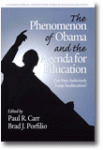
PhenomenonObama2011

Thomas, P.L. (2011). The educational hope ignored under Obama: The persistent failure of crisis discourse and utopian expectations. In P. R. Carr & B. J. Porfilio (Eds.), The phenomenon of Obama and the agenda for education: Can hope audaciously trump neoliberalism? (pp. 49-72). Charlotte, NC: Information Age Publishing.

Thomas, P.L. (2011). Orwellian educational change under Obama: Crisis discourse, Utopian expectations, and accountability failures. Journal of Inquiry & Action in Education, 4(1), 68-92. http://digitalcommons.buffalostate.edu/cgi/viewcontent.cgi?article=1034&context=jiae