
All posts by plthomasedd
In Memory: Sandy Hook Elementary, One Year After
I fear that we have become either callous or numb—either is a tragic consequence of mass shootings, even those at schools, becoming commonplace.
Here, I invite you to read from a group of pieces I wrote after and about the mass school shooting at Sandy Hook Elementary in Newtown, CT, one year ago, December 14, 2012:
“They’re All Our Children” (AlterNet)
- Alongside discussions of mental health and gun control, we must use the lessons of Sandy Hook to reframe the debate around education reform.
Remembering Sandy Hook: Protecting Guns, Sacrificing (Some) Children
Misreading the Right to Bear Arms (AlterNet)
- Confronting gun ownership is an argument about violence — not about autonomy and freedom.
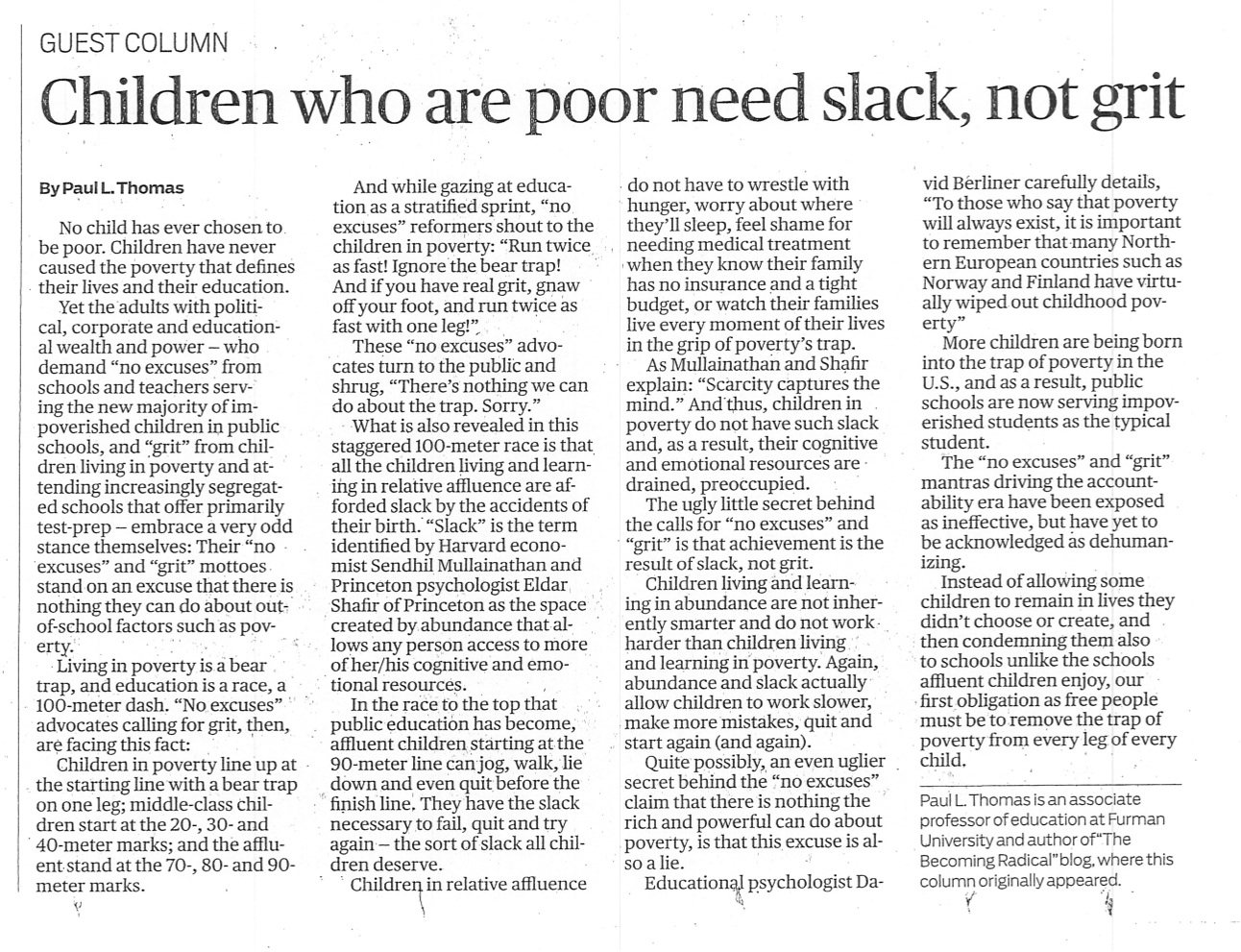
AJC Guest Column: Children who are poor need slack, not grit (December 2, 2013)
AJC Guest Column: Children who are poor need slack, not grit (December 2, 2013)
REVIEW: De-Testing and De-Grading Schools, Bower and Thomas
Reviewed by J. Spencer Clark, Utah State University, which concludes:
The purpose of this book was to offer a map of the high-stakes accountability and standardization landscape, and more importantly to provide ways to navigate this landscape in positive ways. Bower and Thomas are successful in this regard and have provided a powerful critique that equally identifies powerful alternatives to high-stakes accountability. Overall, this is a fresh look at how to meld the theories behind de-grading and de-testing schools with actual classroom practice. This book could be a useful tool for instructors of pre-service methods and assessment courses, and possibly educational foundations courses at all levels, as it provides both an analysis of key aspects of a failing system of accountability and possible alternatives to it.
Bower, J., & Thomas, P. L. (2013). De-testing and de-grading schools: Authentic alternatives to accountability and standardization. New York, NY: Peter Lang USA.

GUEST POST: Continu—what? Sara Newell
Continu—what?
Sara Newell
How do you derive meaning from a number? Should a parent or student respond differently to a 97% than to a 99%? What about a 75%? How do you know what number to assign to a student created product you’ve never seen before? As a 5th grade teacher at the Charles Townes Center for highly gifted students in grades 3-8, I felt these questions were a constant thorn in my side.
My students qualified for invitation to the center in Greenville, South Carolina based on scores in the top percentile on nationally normed tests. The current, numerical grading system has always presented quite a challenge to me as a public school classroom teacher—how do I push my students to strive for excellence without encouraging the crippling effects of perfectionism? In giving students and parents a true measure of learning, personal achievement, and goal-setting, the numerical grading system always seemed to me ineffective at best. Since I began teaching gifted students, I have been in a constant struggle to find a more effective way to provide accurate feedback about their current performance while motivating them to continue to give their best effort on whatever challenges are presented next.
The assessment issues faced in our school were exaggerated versions of the problems caused by the numerical grading system in schools across the country. The nature of our students simply intensifies the problem. For example, the vast majority of my students can ace a grade-level multiple-choice test before I even engage in the first lesson. Should they just receive “A’s”? Is that what they earned? And, if I – instead – increased the depth and complexity of my instruction to provide the appropriate intellectual challenge and a student then only mastered 92% of that material—is it “fair” to assign a less than stellar grade?
This issue becomes even more important as students begin to move into high-school level courses. How does a 92 affect their GPA when they are enrolled in high-school and honors courses beginning in 7th grade? Should they be scored less than their peers who attend mainstream schools? Teachers of gifted (and all) students face these types of problems again and again as they are asked to differentiate to meet the needs of diverse learners. How does a teacher maintain some sort of equity and still challenge students appropriately? Some schools have attempted to rectify this disparity by offering higher grade points for honors or AP classes. This does not remedy the problem—it simply magnifies the spectrum of an inaccurate ruler and introduces an additional disadvantage for college applicants whose schools do not offer this option. The issue of quality feedback and appropriate challenge remains.
For a while, I thought the solution to the problem was that I needed to design better rubrics. If I could just break assignments down into more concrete sections, the students would see what they needed to do and would be able to demonstrate mastery in a way that provided equal access to all while challenging students appropriately. (And I could still put a number on it and feel good about it.) Unfortunately, there were still roadblocks.
In a subject-integrated inquiry-based classroom, how do you quantify “delightful,” “sophisticated,” “clever” and all of the other descriptors that address the work of students who clearly went above and beyond the scope of the assignment? The scale model in gingerbread of the Metropolitan Museum of Art or the original musical composition in response to a Langston Hughes poem received a 100% that was “worth” exactly the same amount as the student who ploddingly met the minimum requirement for each element. So, the rubric was a start, but it still lacked the depth I was seeking to truly communicate effectively with my students (not-to-mention their parents) about the quality of their work. Truly authentic assessment with feedback that can guide students into becoming independent learners still seemed out of reach.
Then, our principal brought back the idea of using continua from a school visit in Seattle. These reading, writing and math continua are based on the work of Bonnie Campbell Hill and provide a system to analyze student skill and progress over many years. The lists are simple and concise. They do not include every possible state standard but instead provide an overview of the crucial skills students need to be successful.
I jumped on these tools and piloted using them with my students almost immediately. My students completed self-evaluations, rating themselves at the “beginning,” “developing,” “proficient,” or “independent” levels described on the continua. I then added my own assessment of their skills. We used these in our student-led conferences, and I could see the beginnings of evidence-based discussions in their conversations. Students were using their writing portfolios and math assessments to provide concrete support for their evaluations. This represented a terrific shift in the way students and parents thought and talked about student work.
Instead of parent comments like, “What did you miss?” or “Great job!” I was hearing, “How did you decide you were proficient in reading fluency instead of independent?” One parent asked his son, “I didn’t know you should be reading different genres. What are you reading right now? Is that the kind of book you always read?” These conversations were so much richer than the previous years’ event which basically consisted of students proudly showing their work while their parents made appreciative mumbles and nodded their heads. I was excited by the beginnings of the give and take that marks a truly thoughtful discussion, but something was still missing. There was still not a way to communicate the truly exceptional or the gifted student who was playing it safe.
After musing on this initial success and talking repeatedly with a middle school colleague struggling with many of the same frustrations, we decided that we needed to create an additional continuum. The difference between the “minimum doer” and the outstanding student in our school was based not only on the ability to demonstrate skill mastery, but on the willingness to strive to apply critical and creative thinking skills. With this in mind, I pulled together a number of resources and began to hammer out a draft of a critical and creative thinking skills continuum. (I still haven’t hammered out a shorter name, though.) Dr. Richard Paul’s mini-guides on critical and creative thinking, Torrance’s work on creativity and Van Tassel-Baska’s writing on application of these skills in the classroom were all of great benefit to me as I worked. My hope was that this document would bridge the gap between the seemingly arbitrary nature of a number grade and the lightning strike of truly outstanding work. I ended up with a scale more rooted in psychology and child development than pedagogy and standards. This was initially surprising, but it became more satisfying as I realized that perhaps with this tool we might finally get to the roots of why one student was clearly outperforming another and more importantly—what to do about it.
The purpose of this creative and critical thinking skills continuum is to provide specific feedback for students and parents about the students’ current progress as well as to communicate in a straightforward way the next steps in their educational growth. Numeric grades are loaded with judgment, both objective and subjective, as well as academic stigma. Students feel that a 100% means that you are perfect while a 67% means that you are a loser. I’ve even had students tell me that even numbers are better than odd numbers (a 99% means that I am a point away from perfect—the most frustrating thing—but a 98% means that I’m solidly in the high “A” category). The focus on the number rather than what the number represents is a bizarre, yet true manifestation of the problem with attempting to quantify something as variable as knowledge and learning. Students become so focused on the number and what it “means” that they completely lose sight of the true purpose of assessment– reflection and growth. A continuum has no numbers—hence, no judgment. There is no “right” or “wrong” way to evaluate oneself with this method.
On first executing the continua in my classroom, I did not ask my students to provide evidence to support their evaluations. (That came later…) It was absolutely fascinating to see students read through and begin their self-evaluations on the critical and creative thinking continuum. I only allowed one hour of the class period for students to complete their analysis of this one-page document. However, most of my students took much more time than that. The room was silent. My students were incredibly focused on their reading and analysis. As 5th graders are still fairly ego-centric at this concrete operational stage (thanks Piaget), they seemed to feel that an assessment all about them was well worth their time. The questions students asked about concepts like “intellectual humility” and perseverance got to the core of what I had been trying to teach for years. Why is it important to continue to try to find a solution to a difficult problem? What does it mean to demonstrate originality? How do I know if I am taking an intellectual risk? These were the questions that I wanted my students to ask—and this was finally a document that set the stage to ask them.
Another revelation occurred when I reviewed these documents individually. I began to get a much more relevant picture of how each child saw him or herself. It was striking to compare the self-assessments with the list of test-score data that my principal had just sent out. (Yes, we are still in a public school. And yes, we still have to do things like set learning goals based on the number of points students “should” improve on certain tests.) Those standardized test scores have been relatively meaningless to me in the past. However, coupled with the information from the continuum self-assessments, a fascinating phenomenon was revealed. By and large, students in the top performing test score group had consistently given themselves the lowest evaluations on the continuum while the students with the lowest (comparative) test scores had marked themselves as having mastered all or almost all of the critical and creative thinking skills. The Dunning Kruger effect in action! We had a tremendous class discussion about this effect—in which less competent people in a field tend to overestimate their abilities. We analyzed how it applied to their attitudes and approaches to learning. I began to see a shift in several students’ attitudes and performance following this one illuminating discussion.
This initial work was very inspiring. I was surprised and pleased at the effort my students put into their evaluations. The vocabulary from the continuum was popping up in our discussions again and again. Instead of “I don’t get it,” I was hearing comments like, “I need to clarify this—do you mean…?” The students were beginning to look at learning through this alternate lens. I continued to have students review the continuum and reflect on their progress as we completed units of instruction. They documented their growth and reflected on their struggles.
We also used the continuum to decide on areas of focus for the next units. I previewed with the students what I felt were the “big ideas” for learning while they made choices about skills they thought it important to develop. The quality of our communication continued to improve. Our goals were aligned—I was attempting to provide opportunities for them to improve in areas that THEY had identified as needing work. This method gave them a sense of control over their own learning.
Other teachers in my school are currently working to apply the math, reading, writing, and thinking skills continua in their classrooms. In the middle school, students are expected to provide support for their analysis as they complete their initial evaluations. In the lower grades, teachers use the continua to shift the focus from what students can’t do to what students COULD do. These continua are shared between teachers vertically to provide a long-range picture of the student’s development over time. This is something that a numeric grade based on grade-level standards fails to communicate.
At first some teachers struggled with how to make the continua relevant to their students, and all teachers recognized that the thought and effort needed to accurately utilize the continua required more time than typical “grading.” However, the value of the knowledge gained far outweighs the extra effort the analysis requires.
The next breakthrough came when I began to use the critical and creative thinking continuum in one-on-one parent conferences. For years, my conferences followed a fairly typical script. First, I would go over the previous year’s test scores. Then, I would discuss grades. The parent(s) and I would discuss any issues or “concerns,” and then I would try to end on some kind of positive note. For the parents of my highest achievers though, this was not a helpful meeting. While I’m sure they enjoyed hearing me list all of the delightful adjectives that described their child, I’m not sure that they felt that they were getting a clear picture of what their child could do to continue to grow.
The use of the continua has changed our discussions. My conferences conducted this fall focused on which elements their child was clearly demonstrating as well as areas their child could continue to develop. I was able to explain the Dunning Kruger Effect to parents who thought their child was practically perfect but who in reality was barely making an effort. I described to the parents of the perfectionists what intellectual risk-taking was and how their child could begin to do it. The conversations were so much richer than in the past, and parents did not feel that I was judging their parenting, or their children.
Instead, the focus was on attributes and evidence. Parents were surprised and fascinated when reading their child’s reflections. The conferences now were a detailed conversation about the whole child and how he or she interacted with the world. Even more importantly, parents were now able to support our classroom objectives with greater accuracy. One parent commented, “We were delighted to discuss and learn about the Creative Continuum. The Continuum is visual and the skill sets are clearly presented…Our meeting was one of the most informative conferences I have attended.”
Shifting our focus from a numerical grading system to a continuum-based evaluation has started to address many of the assessment issues I was facing. My students have stopped asking, “Is this for a grade?” as though that alone determines the value of an assignment. I continue to work to provide more opportunities for students to develop those critical and creative thinking skills. Knowing that I am going to be asking them to evaluate their growth—I am very conscious of the need to design learning experiences that require students to demonstrate those skills.
Most importantly, the students themselves feel a sense of ownership over their learning, and now they are making the effort to ask accurate, insightful questions about what they can do and what they still need to learn to do. Removing the focus from the number grade and putting it back on the evaluation of skills and attributes improves the quality of instruction, performance and communication. The end result is a focus on authentic student learning and success.
References
Davis, G.A., & Rimm, S.B. (2009). Education of the gifted and talented (6th ed.). Boston, MA: Allyn and Bacon.
Dunning, D., Johnson, K., Ehrlinger, J., & Kruger, J. (2003). Why people fail to recognize their own incompetence (PDF). Current Directions in Psychological Science, 12(3), 83–87.
Elder, L., & Paul, R. (2005). The miniature guide to critical thinking concepts & tools. (4th ed.). Dillon Beach, CA: The Foundation for Critical Thinking.
Hill, B. C. (2008). Retrieved from http://www.bonniecampbellhill.com/support.php
Van Tassel-Baska, J., & Stambaugh, T. (2006). Comprehensive curriculum for gifted learners. (3rd ed.). New York, NY: Pearson.
For Further Reading
Rubrics
Kohn, A. (2006). The trouble with rubrics. English Journal, 95(4), 12-15.
Wilson, M. (2007). Why I won’t be using rubrics to respond to students’ writing. English Journal, 96(4), 62-66.
Wilson, M. (2006). Rethinking rubrics in writing assessment. Portsmouth, NH: Heinemann.
Self-Assessment
Liberating Grades/Liberatory Assessment, sj Miller
What Are Tests Really Measuring?: When Achievement Isn’t Achievement
High-stakes standardized testing must be the most resilient phenomenon ever to exist on the planet. Joining high-stakes standardized testing in that (dis)honor would be the persistent but misleading claim that test scores are primarily achievement (and a growing future candidate for this honor is the claim that test scores by students, labeled “achievement,” are also credible metrics for “teacher quality”).
Let’s start with a couple statistical breakdowns of what test scores constitute:
- From Di Carlo:
But in the big picture, roughly 60 percent of achievement outcomes is explained by student and family background characteristics (most are unobserved, but likely pertain to income/poverty). Observable and unobservable schooling factors explain roughly 20 percent, most of this (10-15 percent) being teacher effects. The rest of the variation (about 20 percent) is unexplained (error). In other words, though precise estimates vary, the preponderance of evidence shows that achievement differences between students are overwhelmingly attributable to factors outside of schools and classrooms (see Hanushek et al. 1998; Rockoff 2003; Goldhaber et al. 1999; Rowan et al. 2002; Nye et al. 2004).
- And now from the Joseph Rowntree Foundation:
Just 14 per cent of variation in individuals’ performance is accounted for by school quality. Most variation is explained by other factors, underlining the need to look at the range of children’s experiences, inside and outside school, when seeking to raise achievement.
Next, consider this from the UK:
Differences in children’s exam results at secondary school owe more to genetics than teachers, schools or the family environment, according to a study published yesterday.
The research drew on the exam scores of more than 11,000 16-year-olds who sat GCSEs at the end of their secondary school education. In the compulsory core subjects of English, maths and science, genetics accounted for on average 58% of the differences in scores that children achieved.
While the genetics claim is potentially dangerous, and certainly controversial, the article offers some important clarifications:
The findings do not mean that children’s performance at school is determined by their genes, or that schools and the child’s environment have no influence. The overall effect of a child’s environment – including their home and school life – accounted for 36% of the variation seen in students’ exam scores across all subjects, the study found….
Writing in the journal, the authors point out that genetics emerges as such a strong influence on exam scores because the schooling system aims to give all children the same education. The more school and other factors are made equal, the more genetic differences come to the fore in children’s performance. The same situation would happen if everyone had a healthy diet: differences in bodyweight would be more down to genetic variation, instead of being dominated by lifestyle.
Plomin said one message from the study was that differences in children’s performance were not merely down to effort. “Some children find it easier to learn than others do, and I think it’s appetite as much as aptitude,” he said. “There is a motivation, maybe because you like to do what you are good at.”
Genetics, he said, caused people to create, select and modify their environment, and so nature drives nurture, which in turn reinforces nature. A child with a gift for maths seeks friends who like maths. A child who learns to read easily might join a book club, and work through books on the shelves at home.
Additional points drawn from this research present some strong cautions about continued reliance on not only standardized tests, but also uniform national standards:
“Education is still focused on a one-size-fits-all approach and if genetics tells us anything it’s that children are different in how easily they learn and what they like to learn. Forcing them into this one academic approach is going to make some children confront failure a lot and it doesn’t seem a wise approach. It ought to be more personalised,” he said.
“These things are as heritable as anything in behaviour, and yet when you look in education or in educational textbooks for teachers there is nothing on genetics. It cannot be right that there’s this complete disconnect between what we know and what we do.”
Finally, consider this research on the disconnect between test scores and student abilities:
To evaluate school quality, states require students to take standardized tests; in many cases, passing those tests is necessary to receive a high-school diploma. These high-stakes tests have also been shown to predict students’ future educational attainment and adult employment and income.
Such tests are designed to measure the knowledge and skills that students have acquired in school — what psychologists call “crystallized intelligence.” However, schools whose students have the highest gains on test scores do not produce similar gains in “fluid intelligence” — the ability to analyze abstract problems and think logically — according to a new study from MIT neuroscientists working with education researchers at Harvard University and Brown University.
In a study of nearly 1,400 eighth-graders in the Boston public school system, the researchers found that some schools have successfully raised their students’ scores on the Massachusetts Comprehensive Assessment System (MCAS). However, those schools had almost no effect on students’ performance on tests of fluid intelligence skills, such as working memory capacity, speed of information processing, and ability to solve abstract problems….
Instead, the researchers found that educational practices designed to raise knowledge and boost test scores do not improve fluid intelligence. “It doesn’t seem like you get these skills for free in the way that you might hope, just by doing a lot of studying and being a good student,” says Gabrieli, who is also a member of MIT’s McGovern Institute for Brain Research.
So should we be shocked when students passing high-stakes reading tests in Texas admit they cannot read?:
A female classmate of Tony’s says she can’t get through the stories she reads in school unless someone explains them to her. She’s passed all her state tests, too. How? She says she uses classroom-taught “strategies” on her English reading test and that if she underlines and highlights enough and narrows down her options, she has a better chance of guessing right by playing the odds. She failed her math state test because of the word problems, so she employed her English strategies there on the retry attempt and passed.
Or that the most recent analysis of the teaching of writing in middle and high schools has found that best practice in writing hasn’t occurred because of accountability and high-stakes testing?:
Overall, in comparison to the 1979–80 study, students in our study were writing more in all subjects, but that writing tended to be short and often did not provide students with opportunities to use composing as a way to think through the issues, to show the depth or breadth of their knowledge, or to make new connections or raise new issues…. The responses make it clear that relatively little writing was required even in English…. [W]riting on average mattered less than multiple-choice or short-answer questions in assessing performance in English…. Some teachers and administrators, in fact, were quite explicit about aligning their own testing with the high-stakes exams their students would face. (Applebee & Langer, 2013, pp. 15-17)
Our educational world has been turned over wholesale to testing, despite ample evidence that test scores are many things (markers of privilege, markers of genetic predispositions, markers of teaching-to-the-test), among the least of which are student achievement and teacher quality.
If we don’t have the political will to de-test our schools, the evidence is clear that the stakes associated with testing must be greatly lessened and that the amount of time spent teaching to the tests and administering the tests must also be reduced dramatically.
CALL FOR PROPOSALS: Pedagogies of Kindness and Respect: On the Lives and Education of Children
CALL FOR PROPOSALS
Pedagogies of Kindness and Respect: On the Lives and Education of Children
Edited by P. L. Thomas, Paul R. Carr, Julie Gorlewski, and Brad Porfilio
Rethinking Childhood Series, Gaile Cannella, series editor
Call and Submission Requirements
Submit a proposal of about 300 words by February 28, 2014, to paul.thomas@furman.edu.
Chapter initial drafts due July 15, 2014, should be in APA citation/style format (see citation proofing guidelines below) and 5,500-6,500 words. Authors are urged to submit clean and carefully edited drafts to enhance the editing process. Please take great care with block quotes (do not set off with returns and tabs) and hanging indents in the references list (do not create hanging indents with return/tab, but use the ruler or Menu>Format>Paragraph>Special>Hanging Indent). (Please read carefully below the background underpinning informing this volume.) Also, it is important to have complete bibliographic information with up-to-date references. (See the end of this document for more information on APA).
Topics, problems, and practices addressing the following will be included:
- How are “no excuses” ideologies dominant in child rearing and schooling in the U.S. and elsewhere? How are these practices harmful to children?
- Why are the Commons essential to a thriving democracy, and how does a cultural attitude toward children impact that culture’s commitment to the Commons (notably public schools)?
- What constitutes pedagogies of kindness and respect?
- What practices in child rearing and schooling reflect pedagogies of kindness and respect?
- How are attitudes and practices related to children connected to democratic values?
- How are current educational structures reflecting and perpetuating stratified opportunities for children, and what education reform alternatives address those structures?
- How does kindness play into the conceptualization of educational curricula, pedagogy, policy and evaluation?
Submission of Chapter Proposals
To be included in the 300 words are:
- Name(s) and affiliation(s) of author(s)
- Proposed title
- A detailed abstract on the focus of the proposed chapter, including conceptual, theoretical and methodological frameworks as well as the central research question.
- A list of 8 keywords.
- Also attach the CV(s) for the proposed author(s).
Points of Emphasis
Because we are living in times of historical amnesia, the chapters themselves should be critical, illustrate multiplicity and nuance, and demonstrate an awareness of historical and critical constructions of childhood (and the past work done related to these areas). The following are examples of expectations for the work:
- The fields of education, and especially early childhood education, have included some histories and perspectives that view/treat those who are younger with kindness and respect. Examples include the works of Nel Noddings (1992), The Challenge to Care in Schools, and Lisa Goldstein (1998), Teaching with Love (in Peter Lang’s Rethinking Series) as well as various scholarly and educational models practiced or put forward by multiple educators and scholars. Chapters in the work should demonstrate an informed awareness of this history and the ways that both old and new ideas can counter current conditions that are harmful to both those who are younger and older.
- The chapters should avoid reconstitution of the romantic, innocent child to be saved by more advanced adults; this has been addressed by many. The issue is the context in which we are all being placed (not that we should protect the “innocent” child) that is harmful to those who are younger, as well as everyone else.
- The notion of two interpretations of childhood: (a) those who are poor who are also often labeled as not knowing how to raise their children so needing help, and (b) those who are privileged and know how to raise their children, has been discussed and problematized over the past 30 years. Rather than treating this circumstance as a new revelation, the issue is “why has this circumstance continued and even worsened?” The gap between the rich and poor has certainly increased (why?); testing and standards based education has been critiqued as problematic, but the practices are more accepted than ever (why?); why has past work been ignored and what can be done to change our current circumstances?
Timeline
- Call, proposals due: February 28, 2014
- Accepted chapters: March 15, 2014
- Chapters due: July 15, 2014
- Revised/final chapters due: September 30, 2014
- Manuscript delivered: October 15, 2014
Background
Eliot Rosewater in Kurt Vonnegut’s God Bless You, Mr. Rosewater implores:
“Go over to her shack, I guess. Sprinkles some water on the babies, say, ‘Hello, babies. Welcome to Earth. It’s hot in the summer and cold in the winter. It’s round and wet and crowded. At the outside, babies, you’ve got about a hundred years here. There’s only one rule that I know of, babies—:
“‘God damn it, you’ve got to be kind.’” (p. 129)
In Sandra Cisneros’s short story “Eleven,” Rachel sits in class on her eleventh birthday, a day in which she is confronted by her teacher about a found red sweater that the teacher is certain belongs to Rachel:
“Of course it’s yours,” Mrs. Price says. “I remember you wearing it once.” Because she’s older and the teacher, she’s right and I’m not. (Cisneros, 2004, p. 42)
While these are fictional representations, children live in a state of powerlessness, silenced by the hierarchy of authority. The sweater in Cisneros’s story is, in fact, not Rachel’s, but as the narration reveals, facts are secondary to hierarchy.
In the U.S. and throughout the world, children tend to experience not only silencing but also a level of harshness not found in other cultures.
The twenty-first century remains a harsh place for children in their lives and their schools, even in the U.S. where childhood poverty is over 20% and the new majority of public schools involve children in poverty (A new majority, 2013).
But more than the conditions of children’s lives and schools in 2013 is worth addressing. As Barbara Kingsolver (1995) details in “Somebody’s Baby”:
What I discovered in Spain was a culture that held children to be meringues and éclairs. My own culture, it seemed to me in retrospect, tended to regard children as a sort of toxic-waste product: a necessary evil, maybe, but if it’s not our own we don’t want to see it or hear it or, God help us, smell it. (p. 100)
A sort of cultural antagonism and authoritarian control of children pervades the U.S., and during the current thirty-year cycle of accountability, children tend to face this formula[i]:
- Corporal punishment—persists in 19 states in the U.S.
- Medication—ADHD diagnoses and medications have risen in the U.S. during the same 30-year period as the current accountability era in education.
- Grade retention—one of the most popular forms of reading policy in the U.S. is retaining children in 3rd grade based on one high-stakes testing, despite 40 years of research about the overwhelming negative impact of grade retention.
- Testing, more testing, and even more testing—over the past thirty years, U.S. schools have increased dramatically both the time spent testing, the time spent on test-prep, the funding spent on testing, the funding spent on test-prep materials, and the consequences of high-stakes testing.
- Segregation by race and class—both public schools and charter schools can be accurately described as reflecting and perpetuating the return of segregation in the U.S.
- “No excuses” schools and demands for “grit”—especially children who live in poverty are segregated in schools where their days are characterized by “no excuses” policies that include authoritarian demands on their behavior.
- Children must prove they are deserving—childhood is Social Darwinism in the U.S.
If children in the U.S. can survive the gauntlet that is the national formula for children, as young adults they can look forward to crushing debt to attend college so that they can enter a nearly non-existent workforce.
But there is a caveat to this formula: The U.S. formula for children above is for “other people’s children,” that new majority in U.S. public schools and those children living in homes of the working poor, the working class, and the dwindling middle class.
Children of the privileged are exempt.
This volume will collect a wide variety of accessible chapters from scholars and practitioners to explore pedagogies of kindness, an alternative to the “no excuses” ideology now dominating how children are raised and educated in the U.S. The genesis of this volume cane be linked to two poems by P.L. Thomas: “the archeology of white people” and “the kindness school (beyond the archeology of white people, pt. 2),” the second of which reads in full:
it simply happened one day
when the teachers decided
enough was enoughall the boys with OCD
spent the day playing drums
or riding their bicyclesand the introverts sat quietly
smiling periodically in the corners
while the extroverts laughed and laughedand soon the pleasures became many
as varied as the children themselves
until one day a child stood to proclaimafter reading Hamlet all on her own
“I say, we will have no more tests”
to which there was thunderous cheeringyes it seemed simple and obvious enough
the founding of the kindness school
with open doors and children singing
References
Cisneros, S. (2004). Vintage Cisneros. New York, NY: Vintage Books.
Kingsolver, B. (1995). High tide in Tucson: Essays from now and never. New York, NY: Perennial.
A new majority: Low income students in the South and nation. (2013, October). Atlanta, GA: Southern Education Foundation. Retrieved from http://www.southerneducation.org/getattachment/0bc70ce1-d375-4ff6-8340-f9b3452ee088/A-New-Majority-Low-Income-Students-in-the-South-an.aspx
Vonnegut, K. (1965). God bless you, Mr. Rosewater or pearls before swine. New York, NY: Delta.
See also:
http://www.alternet.org/education/why-sending-your-child-charter-school-hurts-other-children
http://www.alternet.org/education/theyre-all-our-children
Citation Proofreading Guidelines
APA — Please copyedit submissions carefully to be sure you have cited following the APA style sheet; below are key points of emphasis that still need addressing in many chapters (also see for guidance https://owl.english.purdue.edu/owl/resource/560/01/):
Copyedit carefully references, noting APA format for titles of books and article (CAP first letter of title, first letter of subtitle and proper nouns ONLY [for example The handmaid’s tale]; journal titles use standard CAP conventions [for example: English Journal]). Essay and chapter titles do NOT require QMs, but book and journal titles remain in ITAL. Also be careful to ensure that each reference conforms to the type of work you are citing; the OWL link has a wide range of samples on the left menus, and it is crucial that you match the type of work being cited to the format. The initial information in each reference bibliography MUST match your in-text citations. For example:
in-text example
James Baldwin (1998), in “A Report from Occupied Territory” (originally published in The Nation, July 11, 1966), confronted an “arrogant autonomy, which is guaranteed the police, not only in New York, by the most powerful forces in American life” (p. 737) and the corrosive deficit view of race it is built upon.
reference
Baldwin, J. (1998). James Baldwin: Collected essays. New York, NY: The Library of America.
In-text guidelines include the following key elements:
First paraphrased reference to a source in EACH new paragraph must include either Author (year) or (Author, year). PLEASE keep Author (year) or (Author, year) in conjunction; do NOT place the year isolated from the author name. All subsequent uses in that paragraph require only either Author or (Author). Please note that parenthetical cites in the flow of your sentences require that the period come AFTER the ( ). ; for block quotes, the period comes BEFORE .( )
example
America the Beautiful created a minority class out of a race of people who are as rich, vibrant, and beautiful as any race of people. America the Beautiful has also created a criminal class out of African American men, building a new Jim Crow system (Alexander, 2012) with mass incarceration masked as a war on drugs. America the Beautiful created a dropout class and future criminal class out of African American young men, as Alexander details, building school-to-prison pipelines and schools-as-prisons as zero-tolerance schools imprisoning urban communities (Nolan, 2011).
In-text citing of print sources, required page numbers:
First quoted reference to a print source in EACH new paragraph must include either Author (year, p. #) or (Author, year, p. #). All subsequent uses require only either Author (p. #) or (Author, p. #). Note that a comma must separate Author, year, p. # and that a SPACE must be placed after the p. preceding the page number. For a quote from a single page use “p.” and for a quote spanning multiple pages, use “pp.” Please note that parenthetical cites in the flow of your sentences require that the period come AFTER the ( ). ; for block quotes, the period comes BEFORE .( )
example
In 1963, Ellison (2003) spoke to teachers:
At this point it might be useful for us to ask ourselves a few questions: what is this act, what is this scene in which the action is taking place, what is this agency and what is its purpose? The act is to discuss “these children,” the difficult thirty percent. We know this very well; it has been hammered out again and again. But the matter of scene seems to get us into trouble. (p. 546)
Ellison recognized the stigma placed on African American students, a deficit view of both an entire race and their potential intelligence (marginalized because of non-standard language skills). But Ellison rejected this deficit perspective: “Thus we must recognize that the children in question are not so much ‘culturally deprived’ as products of a different cultural complex” (p. 549). Ultimately, Ellison demanded that the human dignity of all children be honored.
Citing literary sources with APA:
APA is somewhat cumbersome for citing extended literary analysis, but you must first create an accurate bibliography of the cited works (such as novels) you will cite, and then maintain the above formatting principles when citing from and offering an extended analysis of that work. APA uses Author (year) or (Author, year) and not abbreviations of titles. If you are citing multiple works from an author published in the same year, you must alphabetize them in your bibliography by the titles, and then add sequential alphabet denotes that then MUST be used in the in-text citations.
example
Typical of contemporary education reform, CCSS began as a political process driven by business interests—not as an educational process designed by classroom teachers or educational researchers (Ohanian, 2012a, 2012b, 2012c, 2011a, 2011b, n.d). In the 1980s during the first wave of accountability, state governors became the primary voice for educational reform. Those governors often used their educational bully pulpit to pursue economic and business goals—improving the workforce or attracting new companies.
[note that proper hanging indent does not show in blog format]
Ohanian, S. (2012a, November 19). Common Core reality check: Here’s how Common Core assessments plan to certify workers for the global economy (with pix)…Let’s make sure the children read ALL of Ovid while we’re at it! Substance News. Retrieved from http://www.substancenews.net/articles.php?page=3778
Ohanian, S. (2012b, October 28). Snookered by Bill Gates and the U.S. Department of Education. The Daily Censored. Retrieved from http://www.dailycensored.com/snookered-by-bill-gates-and-the-u-s-department-of-education/
Ohanian, S. (2012c, February 4). NCTE allegiance to the Common Core is burying us. SusanOhanian.org. Retrieved from http://susanohanian.org/outrage_fetch.php?id=1183
Ohanian, S. (2011a, December 7). We’re being steamrolled into one-size-fits-all. Learning Matters. Retrieved from http://learningmatters.tv/blog/web-series/discuss-are-common-core-standards-good-or-bad-for-education/8280/
Ohanian, S. (2011b, October 19). The crocodile in the Common Core Standards. Substance News. Retrieved from http://www.substancenews.net/articles.php?page=2716
Thomas: Charter schools not a smart investment for S.C. (The State, Columbia, SC)
Our Real-World Dystopia
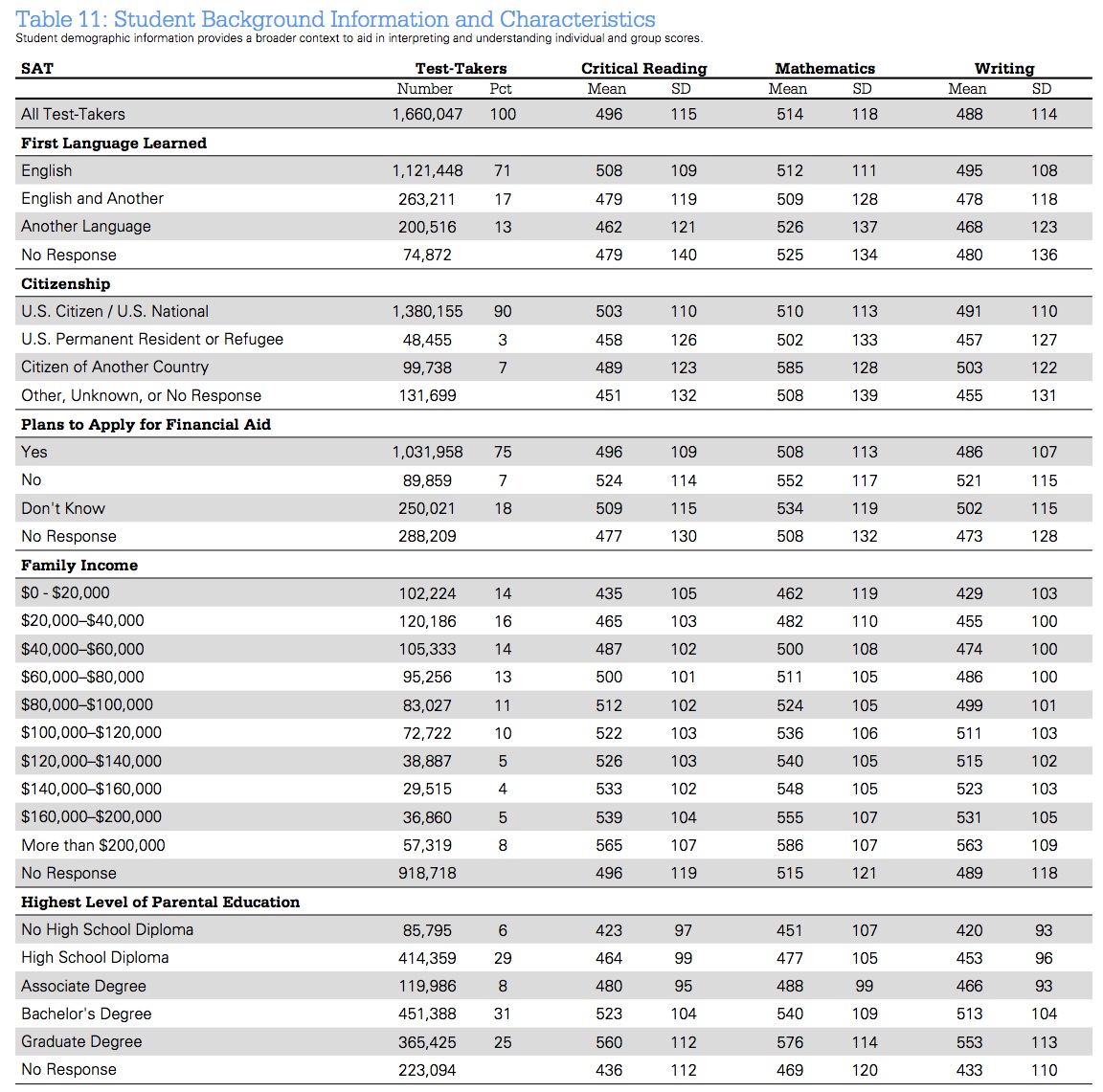
As a science fiction (SF) fan, partial to dystopian SF, and writer, I would have a great novel on my hands if this weren’t simply the way things are.
How to create a real-world dystopia:
- Identify “privilege” as “achievement” using a mechanism that you label “scientific” and “standard.”
- Use “achievement” to create the authority class.
- Repeat.
Sounds easy, but some may call this outlandish. So let me offer a visual:
And for those who enjoy the power of the word, let me offer this:
Dystopias are hard to see when you live in one—just as fish have no idea what “water” means.
 dr. p.l. (paul) thomas