All posts by plthomasedd

P. L. Thomas, Professor of Education (Furman University, Greenville SC), taught high school English in rural South Carolina before moving to teacher education. He is a former column editor for English Journal (National Council of Teachers of English), current series editor for Critical Literacy Teaching Series: Challenging Authors and Genres (Brill), and author of Teaching Writing as Journey, Not Destination: Essays Exploring What ‘Teaching Writing’ Means (IAP, 2019) and How to End the Reading War and Serve the Literacy Needs of All Students: A Primer for Parents, Policy Makers, and People Who Care (IAP, in press). NCTE named Thomas the 2013 George Orwell Award winner. He co-edited the award-winning (Divergent Book Award for Excellence in 21st Century Literacies Research) volume Critical Media Literacy and Fake News in Post-Truth America (Brill, 2018). Follow his work @plthomasEdD and the becoming radical (https://radicalscholarship.wordpress.com/).

VAM Fails Test, Again: The Bizarro World of Education Reform

The great state of South Carolina (and for full effect, you should hear that with “great” and “state” rhyming, sort of, with “pet” because that is how the good ol’ boy patriarchy says it around here) continues down a path all too familiar across the U.S.: adopt any and all education reform policies that other states are rushing to implement, even (and maybe especially) when research fails to support the practices.

I have catalogued the inexcusable political and public support in SC for retaining third graders based on high-stakes testing scores—a policy directly linked to Read, Florida.

And despite equally ample evidence to the contrary about basing teacher evaluations on value added methods (VAM), also a corrosive policy in Florida, Charleston, SC is moving forward with BRIDGE, characterized by Peter Smyth as A BRIDGE to I Have No Clue Where.

Public policy implementing grade retention, VAM, and lingering commitments to merit pay—just to name a few—continues to thrive in SC and across the U.S., seemingly as a bold-faced snub of the idealistic (and increasingly Orwellian) call in No Child Left Behind that education policy must be “scientifically based.”

Education Reform in Bizarro World

In the DC Universe, Superman has often encountered Bizarro World, Htrae. Education reform is no less bizarre with the political and public mania for policies that have been and continue to be refuted by large bodies of research.

For example, Edward H. Haertel’s Reliability and validity of inferences about teachers based on student test scores (ETS, 2013) now offers yet another analysis that details how VAM fails, again, as a credible policy initiative—with a few caveats*.

Briefly, the analysis by Haertel offers the following:

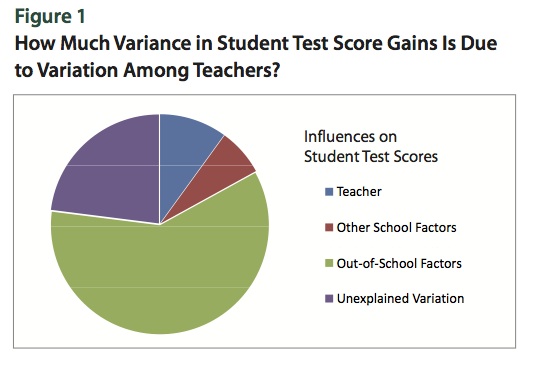
  • First, Haertel addresses the popular and misguided perception that teacher quality is a primary influence on measurable student outcomes. As many researchers have detailed, teachers account for about 10% of student test scores, as shown in this graphic (see p. 5):

graphic teach influence

  • Next, Haertel confronts the myth of the top quintile teachers (pp. 6-7*), outlining three reasons that arguments about those so-called “top” teachers’ impact are exaggerated.
  • Haertel also acknowledges the inherent problems with test scores and what VAM advocates claim they measure—specifically that standardized tests create a “bias against those teachers working with the lowest- performing or the highest performing classes” (p. 8).
  • The next two sections detail the logic behind VAM as well as the statistical assumptions in which VAM is grounded (pp. 9-13), laying the basis for Haertel’s main assertion about using VAM in high-stakes teacher evaluations.
  • The main section of the report, An Interpretive argument for value-added model (VAM)
    teacher effectiveness estimates (pp. 14-25), reaches a powerful conclusion that matches the current body of research on VAM:

These 5 conditions would be tough to meet, but regardless of the challenge, if teacher value-added scores cannot be shown to be valid for a given purpose, then they should not be used for that purpose.

So, in conclusion, VAMs may have a modest place in teacher evaluation systems, but only as an adjunct to other information, used in a context where teachers and principals have genuine autonomy in their decisions about using and interpreting teacher effectiveness estimates in local contexts. (p. 25)

  • In the last brief section, Haertel outlines a short call for teacher evaluations grounded in three evidence-based “common features”:

First, they attend to what teachers actually do — someone with training looks directly at classroom practice or at records of classroom practice such as teaching portfolios. Second, they are grounded in the substantial research literature, refined over decades of research, that specifies effective teaching practices….Third, because sound teacher evaluation systems examine what teachers actually do in the light of best practices, they provide constructive feedback to enable improvement. (p. 26)

Haertel’s concession that VAM has a “modest” place in teacher evaluation is no ringing endorsement, but it certainly refutes the primary—and expensive—role that VAM is playing in the rush to reform teacher evaluation in SC and across the U.S.

In the irony of ironies that can occur only in the Bizzaro World of education reform, each time VAM is tested, it fails, and each time it fails, more states line up to implement it.

* Haertel offers a more than generous analysis of the Chetty, Friedman, and Rockoff (2011) claim that teacher impact can be extrapolated into adult earning for students. I urge readers to examine Bruce Baker‘s and Matthew Di Carlo‘s more nuanced and cautious analyses of those claims.

“He knows, or thinks he knows”: It’s Still a Man’s (Hostile) World

During the spring of 2006 when members of the Duke lacrosse team were first accused of rape (later to be dismissed by North Carolina Attorney General Roy Cooper), I was teaching a freshman English course that focused on Kurt Vonnegut. Although my university is composed of a female majority, this class was mostly male students; since the university is a small, selective liberal arts university, the students in most ways identified with the lacrosse players.

Nonetheless, I was taken aback that the students almost unanimously (including the females) believed the lacrosse players were innocent. Class and race identification was central to these feelings, I believed, but when the case was exposed as a false accusation, I was placed in a much more complex position.

As the accusation against Florida State University quarterback Jameis Winston unfolded, then, I was once again faced with the tension that accompanies high-profile public discourse about rape and sexual abuse. Beyond the issue of innocence or guilt of Winston, however, we have been confronted with something we seem almost unwilling to acknowledge, something Emily Bazelon frames as How Did Jameis Winston Evade a Rape Charge?:

At a press conference that turned weirdly jokey—at one point, a female reporter in the room blurted “Come on” in exasperation—why did Meggs make a point of the fact that the victim “acknowledged having sex with her boyfriend”? I suppose he felt he had to say something about the presence of someone else’s DNA, in addition to Winston’s, on her clothing. But the effect was to fuel the slut shaming she’s already enduring—treatment that has led her to withdraw from her FSU classes.

Here is what’s bothering me most: I’ve been looking for a case in which a woman accuses a big-time college athlete of rape, and he is charged and then convicted.

Bazelon has found few examples, and adds:

The underlying question about Winston, his accuser, and Meggs’ decision is this: Did she lie, or did she make an accusation of rape that is credible but too difficult, in the view of this prosecutor, to prove in court? One thing is clear: It is uncommon for victims to make false accusations of sexual assault. Yes, it happens, causing terrible damage for men who are falsely accused. But the evidence suggests that the vast majority of the time, women who go to the police about rape are telling the truth.

Reading through the police narrative of this alleged victim’s account, it is hard for me to imagine that she had consensual sex with Winston and then decided to lie and say it was rape. It’s not easy to call the cops and say, as she did, after explaining she was out drinking at a bar with friends, that “next thing I know I was in the back of a taxi with a random guy that I have never met. There was another person in the taxi. We went to an apartment, I don’t know where it was. I kept telling him to stop but he took all my clothes off. He started having sex with me and then his roommate came in and told him to stop. He moved us to the bathroom ‘because the door locked’ and I’m not 100% sure how everything in there happened.” She also said, according to the warrant, that after the drinks she had at the bar, her “memory is very broken from that point forward.”

Again, beyond the specifics of the Winston case, but in the context of high-profile sexual assault accusations such as those identifying Ben Roethlisberger and Kobe Bryant (both of which were not pursued), how must all women feel when sexual assault of any kind is aired publicly with smiles, smirks, laughter, and essentially derision exhibited in the press conferences by Florida State Attorney Willie Meggs and Winston lawyer Tim Jansen?

Are we to believe that women targeting athletes, as Jansen claims, is somehow more prevalent and a greater scar on our society than women being sexually assaulted?

As Laurie Penny declares in a discussion of Miley Cyrus, the agency of women and girls remains decontextualized from their humanity: “We care about young women as symbols, not as people”:

Another week, another frenzy of concern-fapping over teenage girls. A few days ago, I was invited onto Channel 4 News to discuss a new report detailing how young people, much like not-young people, misunderstand consent and blame girls for rape. The presenter, Matt Frei, tried to orchestrate a fight between myself and the other guest, Labour MP Luciana Berger, because it’s not TV feminism unless two women shout at each other….

The tone of the reports on girls’ lack of confidence, on the persistence of myths of ignorance about rape and sexual violence, is as patronising as ever. The implication is that girls fret about their appearance, are confused about sex and consent and worried about the future because they are variously frivolous or stupid.

Penny highlights both the specific mansplaining around Cyrus and the wider mansplaining, paternalism, and objectifying that remains pervasive in public discourse of girls and women. The “slutshaming” of women—whether it be aimed at Cyrus (as simultaneous sexualizing and de-sexualizing of females) or the wink-wink-nod-nod discrediting of Winston’s accuser by Meggs and Jansen—exposes the fact that it’s still a man’s (hostile) world for women, including when women are accused of slutshaming women.

A Man’s (Hostile) World for Women

A rare safe haven for challenging paternalism and slutshaming (see Penny’s The Miley Cyrus complex – an ontology of slut-shaming) is art, where writers (mostly women) and film makers have portrayed the aftermath of sexual assault as another sexual assault.

Poet Adrienne Rich‘s “Rape” is a stark and powerful recreation of a sexually assaulted woman doubly assaulted during her police interview, beginning:

There is a cop who is both prowler and father:
he comes from your block, grew up with your brothers,
had certain ideals.

And then concluding:

You hardly know him but now he thinks he knows you:
he has taken down your worst moment
on a machine and filed it in a file.
He knows, or thinks he knows, how much you imagined;
he knows, or thinks he knows, what you secretly wanted.

He has access to machinery that could get you put away;
and if, in the sickening light of the precinct,
your details sound like a portrait of your confessor,
will you swallow, will you deny them, will you lie your way home?

With a dexterity that leaves the reader deeply uncomfortable, Margaret Atwood explores “date rape”—both as an unfolding of the reality of a woman in the context of the possibility of sexual assault by a male blind date and as a complicating of normative views of women having “Rape Fantasies.” (Atwood builds similar examinations in her The Handmaid’s Tale.)

While it raised considerable attention when released, The Accused and the real-life events it was based on, the gang rape of Cheryl Araujo, the film also anticipated discussions of slutshaming by highlighting what was then and still remains the pre-disposition to blame the victim, when the victim is a woman and when the violence is sexual.

But the attention achieved by the film and the sanctuary of poetry and fictional narrative bring us back to Penny’s charge: “We care about young women as symbols, not as people.”

For example, Lisbeth Salander is powerful and complex in the Millennium Trilogy, the fictional personification of blaming the victim:

“Our client on principle does not speak to the police or to other persons of authority, and least of all to psychiatrists. The reason is simple. From the time she was a child she tried time and again to talk to police and social workers to explain that her mother was being abused by Alexander Zalachenko. The result in every instance was that she was punished [emphasis added] because government civil servants had decided that Zalachenko was more important than she was.” (The Girl Who Kicked the Hornet’s Nest, p. 733)

Salander’s entire life is the situation in Rich’s “Rape” writ large.

But we must not ignore that even in fiction—Lisbeth as symbol—the first book in the trilogy is given the English title The Girl with the Dragon Tattoo (why “girl” not “woman”?), instead of the literal translation from Swedish, “men who hate women,” and as in the film The Accused, why do we appear more concerned about women being assaulted in books and films than in real life? And is it possible that at least in the U.S. film version, we appear more drawn to Salander as vigilante than morally enraged by the repeated violence and sexual assaults she endures?

It is without question that the human dignity of a man wrongly accused of rape is no less valuable than the human dignity of a woman raped; it is without question that I have no inside knowledge and cannot know the innocence or guilt of Winston or his accuser.

But unknowables do not excuse us from confronting the known: The smirks and grins, the innuendo and direct slutshaming aimed at Winston’s accuser were all the sort of double assault we have been warned about, the sort of double assault that affects all women, the sort of double assault that must not be tolerated:

“The victim and her family appreciate the State Attorney’s efforts in attempting to conduct a proper investigation after an inordinate delay by the Tallahassee Police Department,” Carroll [the accuser’s lawyer] said in a statement. “The victim in this case had the courage to immediately report her rape to the police and she relied upon them to seek justice. The victim has grave concerns that her experience, as it unfolded in the public eye and through social media, will discourage other victims of rape from coming forward and reporting.”

As Christine Brennan explains:

There was laughter. There were jokes. There were smiles. The news conference in which Florida state attorney Willie Meggs announced that Jameis Winston was not going to be charged with sexual battery was an extremely light-hearted affair.

Everyone seemed so incredibly happy to be talking about an alleged sexual assault.

The known has confronted us: relief that a football career and national championship would not be derailed combined with a levity not suited for public talk around the possibility of sexual violence—it’s still a man’s (hostile) world, and as Rich reminds us in “What Kind of Times Are These?”:

…this is not somewhere else but here,
our country moving closer to its own truth and dread,
its own ways of making people disappear.

MLK to Mandela: Dishonored by Passive Radical Myth

Early in February 1990, my daughter, born March 11, 1989, spent an entire night vomiting. My wife and I were new parents, and we called our pediatrician multiple times, always urged to be patient and wait it out. By the morning, we were in the emergency room, followed by our tiny child, a month shy of a year old, being admitted to the hospital.

After a few sleepless days for my wife and me, my daughter was released from the hospital on February 11, 1990, the day she was eleven months old and the day Nelson Mandela was released from prison.

I think that I will never forget the moment that remains in my memory when I stood in the hospital room holding  my frail, beautiful child, watching on the TV the news coverage of Mandela’s release. There were personal and political promises of relief and hope in that coincidence, that intersection of history and my own life that filled my heart in a way that is beyond words.

Mandela’s death now overlaps with my daughter in that she is carrying her first child and has begun to live a life that offers challenges and hope in ways than Mandela’s legacy speaks to for me, but I also must pause my hope because, as Mike Klonsky (@mikeklonsky) posted to Twitter: “They’re turning Mandela into a harmless icon.”

NBC reports, Nelson Mandela’s death: World mourns ‘hero,’ ‘icon,’ ‘father’—with a reductive paragraph near the end:

Mandela spent 27 years in prison and led his country to democracy. Though he was in power for only five years as his country’s first black president, his moral influence earned him the praise and respect of people all over the world.

And as Klonsky anticipates, an annual ritual will now follow, reducing Mandela like Martin Luther King Jr. to the passive radical myth.

Passive Radicals: The Manufactured Myth [1]

With the annual and somewhat functional recognition of certain versions of the life and work of Martin Luther King Jr. behind us in 2013, let me ask this: What do Jesus, Mohandas Karamchand Gandhi, and King have in common?

I admit the answers could be many: Significant historical voices and lives, shared messages of peace and harmony, tragic assassinations, and more.

And while these are all credible answers, I suggest the most important commonality among Jesus, Gandhi, and King is how their legacies have been manipulated by the privileged in order to create a mythology of the passive radical.

Consider Jose Vilson’s framing of how King serves other people’s purposes:

For some revisionists, MLK Jr. was either one of two things: a staunch conservative who lived patriotically, owned guns, and worked towards self-help, or he was a such a commercial pacifist whose message for peace followed every rule in the book and posed no real threat to the establishment. Then, there are those who, after having recognized MLK’s full history, still want to use his name for things he would never entertain, like breaking unions and limiting opportunity to a full education to only the “good” kids, whatever that means.

It is at Vilson’s second point—framing radicals as “commercial pacifist[s] whose message for peace followed every rule in the book and posed no real threat to the establishment”—I want to pause for a moment.

Passive Radicals?

My journey to critical consciousness may very well be anchored in my confrontation as a child and teen with the Hollywood portrayals of Jesus common at mid-twentieth century. I shared a revelation found in Alice Walker’s The Color Purple in a letter from Nettie, in Africa, to Celie:

All the Ethiopians in the bible were colored. It had never occurred to me, though when you read the bible it is perfectly plain if you pay attention only to the words. It is the pictures in the bible that fool you. The pictures that illustrate the words. All of the people are white and so you just think all the people from the bible were white too. But really white white people lived somewhere else during those times. That’s why the bible says that Jesus Christ had hair like lamb’s wool. Lamb’s wool is not straight, Celie. It isn’t even curly. (pp. 140-141)

Just as the church and Western culture created a mythology of Jesus as white, the Hollywood versions of my youth clearly established Jesus as passive, meek, exactly as Vilson characterizes one version of King—”no real threat to the establishment.”Many years later, I included the film Gandhi in a unit that explored Ralph Waldo Emerson, Henry David Thoreau, King (about whom all students know only “I Have a Dream”), and Malcolm X (a figure students had either never examined or had been taught he was a negative figure in history). That film portrayal of Gandhi perpetuated the passive radical myth in Gandhi through a British actor, able only to mask the whiteness but not abandon it entirely.

The life and work of activist and historian Howard Zinn has catalogued and confronted what Nettie learns in Africa: Those in power who control the images and the narrative use those images and narratives to feed their privilege.

The passive radical myth allows the privileged in the U.S. to wield the mask of praise to hide their self-interests.

Jesus, Gandhi, and King are reduced to cartoons, single-dimensioned, almost entirely upon a middle-class and white norm of “articulate.”

In school (including Sunday school in churches), children are led in close analysis of the rhetorical power of their words, keeping the gaze almost entirely on the mechanics and not the reasons why those words were needed, the consequences of what those words did and could incite.

As Nettie discovers, however, if anyone looks carefully, even at the words that the passive radical myth uses to honor rhetoric over action, the truth is right there before us.

Even in the reductive film, Gandhi challenges the term “passive resistance” and prefers “civil disobedience.” And many Jesus scholars note Jesus overturning the tax collectors’ tables may best reflect the radical Jesus.

For America, the mythology of King, the distorted mythology of King as passive radical, must be confronted and dismantled if any of the promises King envisioned can become reality. As Zinn notes,

Martin Luther King himself became more and more concerned about problems untouched by civil rights laws—problems coming out of poverty. In the spring of 1968, he began speaking out, against the advice of some Negro leaders who feared losing friends in Washington, against the war in Vietnam. He connected war and poverty….King was turning his attention to troublesome questions….And so, nonviolence, he said, “must be militant, massive nonviolence.” (pp. 205-206)

Like Nettie, we must look carefully at the words, and not be distracted by the fabricated images, the narratives creating the manufactured myth of the passive radical. King, especially in his last days, offered words that refute that myth:

These are revolutionary times; all over the globe men are revolting against old systems of exploitation and oppression….We in the West must support these revolutions. It is a sad fact that because of comfort, complacency, a morbid fear of Communism, and our proneness to adjust to injustice, the Western nations that initiated so much of the revolutionary spirit of the modern world have now become the arch-antirevolutionaries. This has driven many to feel that only Marxism has the revolutionary spirit. Therefore, Communism is a judgment against our failure to make democracy real and follow through on the revolutions that we initiated. We must move past indecision to action. We must find new ways to speak for peace in Vietnam and for justice throughout the developing world, a world that borders on our doors. If we do not act, we shall surely be dragged down the long, dark, and shameful corridors of time reserved for those who possess power without compassion, might without morality, and strength without sight. (“Conscience and the Vietnam War,” in The Trumpet of Conscience)

These words of a genuine radical ring true today, but are unlikely to be read in a classroom or quoted from a political stump, or echoed in the pulpits of any church. Nettie’s revelation about Jesus leads to her own blossoming self-awareness: “We are not white. We are not Europeans. We are black like the Africans themselves. And that we and the Africans will be working for a common goal: the uplift of black people everywhere” (p. 143).

Knowledge is the fuel of the liberatory impulse, and thus, it is in the interests of the privileged to manufacture characters and narratives of the passive radical in order to maintain the imbalance of equity that enslaves the promise of democracy in “proneness to adjust to injustice.”

King’s embracing unionization, direct eradication of poverty, minimum salaries, the eradication of permanent war, and the insidious racism maintaining the historical divisions between impoverished whites and blacks will not be allowed in that myth since the voice of a true radical is also the voice raised to lead to action.

[1] Originally posted January 22, 2013, at Daily Kos.

Setting Free the Books: On Stepping Aside as Teaching

While film critics have offered mostly negative reviews of This Is 40, I have watched all and then parts of the film multiple times during its run on cable TV because I am drawn to the scenes that include the children (who in real life are writer/director Judd Apatow’s children with lead actress Leslie Mann).

In one scene, the older daughter, Sadie (Maude Apatow), charges into the kitchen and unleashes a profanity-laced diatribe onto her parents. Many years ago, my daughter did the same to my wife and me, and when the two of us burst into laughter, my daughter stomped upstairs to her room, doubly infuriated at our response.

Maybe This Is 40 isn’t a good film, but I am nearly 53 and my daughter is 24 and carrying her first child. And she and I are quietly emerging from many dark years between us so I admit viewing films and reading books through a sort of middle-aged nostalgia that allows me to appreciate things I probably didn’t recognize when I should have.

The dark years and incessant tensions between my daughter and me often included yelling, first by me and then by my daughter, who enjoyed accusing me of being bi-polar. Today, I recognize that throughout my life I have fumbled almost all of my close relationships because I have struggled with nearly paralyzing anxiety combined with a proclivity toward feeling things deeply, feeling things too deeply.

As a result, my love has often manifested itself as all-consuming, overwhelming, suffocating.

My only child, then, had little choice but to rebel, to seek freedom from the tidal wave that was my love. She is now an adult—working, married, and with child. I have been forced in many ways to set aside the worst parts of how I tend to respond to loving another, and thus, we are re-building now how a father and daughter can be.

While I have struggled with personal love relationships, I have had two other loves that provide different contexts, ones that have confronted me with challenges as well—my love of books and my love for my students. Because of these three arenas of my life, my life loving, I am in the midst of a journey as a teacher that involves stepping aside as teaching.

On Stepping Aside as Teaching

The film The Words presents a multi-layered narrative about writers and their relationships with people as well as words. One story examines a writer that Clay Hammond (Dennis Quaid) creates in his eponymous novel in the film; Hammond explains to Daniella, “You have to choose between life and fiction. The two are very close but they never actually touch. They are two very, very different things.”

In Hammond’s novel, the novel published by Rory Jansen (Bradley Cooper) but actually written by The Old Man (Jeremy Irons) explores a writer who comes to love the words more than the woman who has inspired him to write the words.

I think the film speaks to what happens when anyone begins to covet the extension of what one loves even when that displaced urge corrupts the original love. And thus, this film speaks to parents, lovers, and teachers who are all bound by their passions as essential to who they are.

This brings me to books and teaching—two of my greatest loves— and a foundational question about how books matter in my teaching.

Since I have been an English and writing teacher for most of my 31 years of teaching, books are the lifeblood of my classroom. But I have always been deeply conflicted about the use of books when teaching. Traditional practices such as assigning required books and meticulously analyzing books (from the historical dominance of New Criticism in English courses to the more recent obsession with close reading in the Common Core) have always felt as if the inherent dignity of books was being violated.

I feel much the same way about how traditional teacher-centered instructional and discipline practices deny students autonomy and even their own dignity.

Because I have always sought ways in which I can remain true to my love of books and my students, then, I have struggled in formal educational settings. My only recourse has been to create classes where both my students and the books we read are honored over me and my role as an authority (or realistically as the authority) in the classroom. In other words, I have come to view stepping aside as teaching (much as I have learned to view stepping aside as parenting).

Setting Free the Books*

I have returned recently to Ray Bradbury’s Fahrenheit 451, fascinated by both the enduring power of the novel and Bradbury’s own love affair with books. In the 60th anniversary edition of the novel, Bradbury (in the text of an audio introduction) explains:

I’m a library-educated person; I’ve never made it to college. When I left high school, I began to go to the library every day of my life for five, ten, fifteen years. So the library was my nesting place, it was my birthing place, it was my growing place. And my books are full of libraries and librarians and book people, and booksellers. So my love of books is so intense that I finally have done—what? I have written a book about a man falling in love with books.

Bradbury’s love of books as a learner, a reader, and a writer creates for me even greater tension in my roles as reader, writer, and teacher—especially in the context of  Charles Bingham, Antew Dejene, Alma Krilic, and Emily Sadowski’s “Can the Taught Book Speak?” The authors address three questions:

First, what does the banning, and the unbanning of books have to do with teaching? Second, what is the nature of a book, and do we honor the nature of books when we teach them? And third, is it possible for educators to let books speak for themselves? (p. 199)

Throughout the discussion, the role of the teacher—I would add the corrupting role of the teacher—is confronted:

If a book is banned because it is dangerous as a written text, then a book could only be un banned by letting loose the dangerous potential of such a written text. A book is only unbanned when it is let loose to be read by anyone, anywhere, any time. It is unbanned when it can be read in public or  in private, aloud or  in silence, and finally, and perhaps most importantly, without “a parent to protect” the book. When one teaches a banned book, one falls short of unbanning the book on a number of counts, but primarily on the last count. When one teaches a banned book, one does something different from unbanning the book. One parents the book. One stands against Plato’s fear of writing to be sure, but one also sides with  that same fear. One lets the book be read, but one makes sure there is a parent present at the reading. (p. 201)

Teaching a book, then, is the same as parenting that book—both the teaching and parenting here characterized as intrusive in the ways I have experienced and discussed above as both teacher and parent: “What Derrida thus reminds us is that the very act of teaching is always a parasitical act.”

Teaching and parenting as necessarily “parasitical” and destructive parallels the way writers and the their love of words above people is destructive in The Words:

This figure of the teacher vis-à-vis the book might be formulated as follows: A teacher teaches a book. However, the teacher is not fully a teacher unless the book is not fully a book. That is to say, a teacher needs a book, but she needs a particular kind of book: a book in chains, a banned book, a book that does not speak for itself. If a teacher were to teach a free book, a book unfettered by place, space, or human voice, then the teacher would not be a teacher. A teacher without a book to call her own —without a book to chain in some way, shape, or form — ceases to be , as a teacher.

To put this another way, as soon as a teacher teaches a book, then the book ceases to be a book. (p. 203)

As Bradbury’s own experiences reading in libraries and not attending college show, the book is its own reason for being, as Bingham, et al., explain:

A book, after all, is meant to be free . A book is written. It is written to be read. A book is a book precisely because it is meant to be read, and to be read by anyone. It is meant to be read by anyone who chooses to read the book. If it were not to be read by anyone, then it would not be a book, but would rather be a private communiqué. This bookness of the book signifies something important for educators. Namely, it is not in the nature of a book to be taught. Why? Because a book is, itself, language. It is language that speaks. If the book was not language, if it did not speak, then it would not be a book. A book is not intended to be interpreted into speech. A book does not require that people come to consensus about what it says. A book is itself  consensus. It already says something before any consensus. There is no book that requires or expects a teacher, just as there is no speaking person who requires or expects a teacher. A book speaks in and of itself. It speaks without the need of parasites, chains, or megaphones. (p. 203)

So what are we to do, we who are lovers of books and teachers?

Simply stated, the problem is this: the taught book cannot speak. Indeed, the solution to this problem would seem simple now that the problem has been identified. The problem would be solved if teachers were to leave books alone. (p. 206)

At the intersection of love, books, students, and teaching, I have come to recognize the importance of setting free the books by seeking ways in which I can practice stepping aside as teaching. Just as I had to understand that loving my daughter required me to leave her alone, I must leave books and my students alone—and thus the highest form of respect, the highest form of trust, the highest form of love.

The risks are high in this practice because so few adults trust children, so few adults trust books. And in our paternalistic culture, parenting is viewed as necessary and good—not intrusive and corrupting (in fact, we see books as potentially corrupting and childhood freedom as corrupting).

Ultimately, stepping aside as teaching is a paradox likely to be perceived as not teaching at all—by students, parents, colleagues, and the public.

But risk we must, in the name of those things we love.

* I had a long and wonderful love affair with the novels of John Irving, mostly in my 20s and 30s. Irving’s first novel, Setting Free the Bears, is intentionally alluded to in this subhead.

GUEST POST: Let’s Nurture Inner-Directed Students and Ignore the “No Excuses” Crowd, John Thompson

Let’s Nurture Inner-Directed Students and Ignore the “No Excuses” Crowd

John Thompson

Early in my career, Latifa taught me an important lesson about the teaching of noncognitve skills.  Latifa’s dress-for-success style and leadership made it easy to forget her unhappy childhood in foster homes.  When she got up, shut both doors, and walked to the front of the classroom, it was my time to take a seat in a desk.  Latifa often did this when she and her classmates were angry about something at school that offended their senses of fairness.  Once they had their say and articulated solutions, Latifa would reopen the doors so I could get back to teaching Government standards.

When participating in our discussions, I drew upon my decade living in a neighborhood in the middle of the “Hoova” set of the Crips street gang turf, as well as lessons learned from students, counselors, therapists, and fellow teachers at an alternative school for juvenile felons. I also drew on techniques for getting along with people gained from extensive hitch-hiking, roughnecking in the oil fields, and lobbying Oklahoma legislators. Yes, I drew on eclectic real-world experiences to help mentor students.  No, I did not impose some primitive KIPP-style cognitive behavioral model.

Yes, my inner city students drew on diverse experiences and, yes, they wrestled with many issues that were no different than suburban kids raised in two-parent families.  No, I don’t believe that many affluent classrooms had as many survivors of extreme trauma.

Yes, I used my generation’s vocabulary, as I coached students on making sense of the world from their generation’s perspective.  I recounted the theme of “the Lonely Crowd” and instructed them on the distinction between “other-directed” versus “inner-directed” persons.  I presented my belief that adults needed to help young people develop an internal locus of control. I offered my opinion that a key purpose of schooling is helping to nurture creative insubordination.

No, I did not push “grit,” “true grit,” or a John Wayne value system. Back then, the term of art was “character education.”  That name bothered me more than today’s word, “grit.” I had bigger concerns, however, than the label that we attached to the qualities which we now call “the socio-emotional.”

By the way, often it was a dispute over our school’s periodic enforcement of the dress code that sparked our confabs. During these spasms of “No Excuses” for their outer appearances, my students and I discussed the best ways to respond.  We knew that the “this too shall pass” nature of these crackdowns would soon reinsert itself. I would volunteer that the dress code isn’t my priority, but supporting my colleagues is.  I would spell out my desire for a balance between supporting my students, while fulfilling my job’s responsibility.  We’d discuss how to deal with the rules as a team until the enforcement frenzy burned out.

Students voiced their anger about the system’s priorities. Untucked shirt tails wasn’t seen as the key to overcoming the effects of generational poverty and the legacies of Jim Crow. They also articulated their pain, being treated as objects to be ordered around.  And, as David said, “I don’t feel whole without my hat …”

Yes, David’s expression of his divided consciousness prompted a serious discussion.  Yes, some themes we had learned from studying Ralph Ellison and James Baldwin were recalled. No, we didn’t tell him to just conform and grit it out.

So, I thank Paul Thomas and Lelac Almegor for reminding me about those wonderful experiences. Thomas has long criticized the work of Angela Duckworth, Paul Tough, and James Heckman and their support of KIPP’s pedagogy.  He now adds a link to Almegor’s “The Inherent Flaws in Character Education.” Almegor astutely writes in opposition to the current emphasis on character education that sounds “like a magic wand. Working kid by kid and school by school, we can fix what is wrong with our historically struggling student populations while implicitly laying the blame on the students or their parents or their communities.”

If I read them correctly, there are two issues.  The first is rooted in the conversation which grew heated in the 1960s when Patrick Moynihan used the phrase “a culture of poverty.” Sometimes that debate was a nuanced academic dispute; other times it was an avoidable conflict dividing liberals from ourselves. Conservatives got a kick out the fights between the various wings progressives, but there were important scholarly points to be made. I also agree with Paul Tough that these disputes were a part of “liberal posttraumatic shock” for supposedly losing the War on Poverty.

The second issue involves recent research on the socio-emotional, and the unfortunate term “grit,” which are being coopted by reformers “No Excuses” schools, it seems to me, are teaching an other-directed value system and doing so in the name of inner-directedness. To paraphrase Karen Lewis, accountability hawks are claiming that their schools liberate poor children so they can become Masters of the Universe, when they are actually training students to become Walmart greeters. Only in our Orwellian education reform era, could behaviorist indoctrination to pass bubble-in tests be branded as the cultivation of qualities such as adaptability and empathy.

On this issue, again, Almegor provides a wise explanation. At his school, “we do character education not because our children are disadvantaged but because they are children. It belongs within our school building not because nobody else is doing it, but because everyone does it. Our school is a part of our community and so we share in its responsibilities.”

He notes that teaching character should be about “being more independent, assertive, and persistent, but often it is not.” He observes:

We are not trying to fix them so they are more like middle-class kids. We are trying to get them ready to compete from behind. But some of it isn’t about character at all, only the appearance of it. When we teach a kid to give a firm formal handshake, we are not strengthening his character. We are teaching him how to translate his strength into a language that people in power will understand.  

It seems to me, however, that most non-reformers will read the research of Duckworth, Heckman, and Tough as incompatible with accountability-driven reform. Their criticism of achievement tests, and their inability to predict success in school and in life, applies equally to standardized testing. Even those who believe that school choice is a key to improving schools, I suspect, would prefer Almegor’s approach to character education to KIPP’s structure. Or, they would at least choose Almegor’s nurturing over a competitive, top down approach to produce higher “outcomes,” i.e. test scores. I have to believe that parents prefer the already huge and growing social science on the need for high-quality early education over the drill and kill school of reform.

So, I have to wonder why Thomas, Almegor, and others are so upset that some scholars and reformers overuse the word grit.  Are they afraid that reformers will do something crazy like impose bubble-in testing and test prep on young children?  Seriously, Gary Rubenstein’s “My Daughter’s Kindergarten Common Core Workbook” shows the extremes to which reformers will go.

As during the battles over the “culture of poverty,” we in the progressive tradition have no choice but to live by our values and debate ideas in public.  It is tricky to do so in an era when reformers are likely to take any concept or word and turn it into a weapon to advance their agenda. But, it is the price we play for being committed to democratic education for all. Our job is preparing kids for an Open Society.

More on Failing Writing, and Students

Throughout the 1980s and 1990s, I taught English in the rural South Carolina high school I attended as a student. Many of those years, I taught Advanced Placement courses as part of my load (I taught all levels of English and usually sophomores and seniors) and was department chair.

Over the years, I worked hard to create an English department that served our students well. We made bold moves to provide all students in each grade the same literature textbooks (not different texts for different levels, as was the tradition, thus labeling students publicly) and to stop issuing to students grammar texts and vocabulary books (teachers retained classroom sets to use as they chose).

And a significant part of our English classes was the teaching of writing—having students write often and to produce multiple-draft essays. I stressed the need to end isolated grammar instruction (worksheets and textbook exercises) and urged that grammar, mechanics, and usage be addressed directly in the writing process.

Even though the principal was supportive and a former English teacher, at one faculty meeting while the administrators were discussing recent standardized test scores for the school (yes, this test-mania was in full force during the 80s and 90s in SC), the principal prefaced his comments about the English test scores with, “Keep in mind that the English scores may not reflect what we are doing here since we don’t teach grammar.”*

In a nut shell, that sort of mischaracterization and misunderstanding about best practice is at the foundation of my previous post exploring Joan Brunetta’s writing about how standards- and test-based schooling had failed her.

A few comments on the post and a follow up discussion in the comments with Robert Pondiscio—as well as a subsequent post by Pondiscio at Bridging Differences—have prompted me to continue to address not only how we still fail the teaching of writing but also how that failure is a subset of the larger failure of students by traditional approaches to teaching that are teacher-centered and committed to core knowledge.

Revisiting “The Good Student Trap” in the Accountability Era

Adele Scheele has coined the term “the good student trap,” which perfectly captures how schools create a template for what counts as being a good student and then how that template for success fails students once they attend college and step into the real world beyond school. My one caveat to Scheele’s ideas is that especially during the accountability era—a ramping up of traditional practices and norms for education—this trap affects all students, not just the good ones.

And the trap goes something like this, according to Scheele:

Most of us learned as early as junior high that we would pass, even excel if we did the work assigned to us by our teachers. We learned to ask whether the test covered all of chapter five or only a part of it, whether the assigned paper should be ten pages long or thirty, whether “extra credit” was two book reports on two books by the same author or two books written in the same period. Remember?

We were learning the Formula.

• Find out what’s expected.
• Do it.
• Wait for a response.

And it worked. We always made the grade. Here’s what that process means: You took tests and wrote papers, got passing grades, and then were automatically promoted from one year to the next. That is not only in elementary, junior, and senior high school, but even in undergraduate and graduate school. You never had to compete for promotions, write résumés, or rehearse yourself or even know anyone for this promotion. It happened automatically. And we got used to it….

What we were really learning is System Dependency! If you did your work, you’d be taken care of. We experienced it over and over; it’s now written in our mind’s eye. But nothing like this happens outside of school. Still, we remain the same passive good students that we were at ten or fourteen or twenty or even at forty-four. The truth is, once learned, system dependency stays with most of us throughout our careers, hurting us badly. We keep reinforcing the same teacher-student dichotomy until it is ingrained. Then we transfer it to the employers and organizations for whom we’ll work.

This model of traditional schooling includes a teacher who makes almost all the decisions and students who are rewarded for being compliant—and that compliance is identified as “achievement.”

In English classes, a subset of this process is reflected in how we teach, and fail, writing. As I noted in my earlier post, Hillocks and others have noted that traditional commitments to the five-paragraph essay (and cousin template-models of essays) and a return to isolated grammar exercises have resulted from the rise of high-stakes testing of writing. As well, the accountability era has included the central place of rubrics driving what students write, how teachers respond to student writing, and how students revise their essays.

So what is wrong with five-paragraph essays, grammar exercises, and rubrics?

Let’s focus on rubrics to examine why all of these are ways in which we fail writing and students. Alfie Kohn explains:

Mindy Nathan, a Michigan teacher and former school board member told me that she began “resisting the rubric temptation” the day “one particularly uninterested student raised his hand and asked if I was going to give the class a rubric for this assignment.”  She realized that her students, presumably grown accustomed to rubrics in other classrooms, now seemed “unable to function [emphasis added] unless every required item is spelled out for them in a grid and assigned a point value.  Worse than that,” she added, “they do not have confidence in their thinking or writing skills and seem unwilling to really take risks.”

Rubric-based writing and assessment, then, reflect the exact problem I highlighted earlier, one noted by Applebee and Langer: teachers know more today than ever about how to teach writing, but commitments to accountability and testing prevent that awareness from being applied in class; as Kohn explains:

What all this means is that improving the design of rubrics, or inventing our own, won’t solve the problem because the problem is inherent to the very idea of rubrics and the goals they serve.   This is a theme sounded by Maja Wilson in her extraordinary new book, Rethinking Rubrics in Writing Assessment. In boiling “a messy process down to 4-6 rows of nice, neat, organized little boxes,” she argues, assessment is “stripped of the complexity that breathes life into good writing.”  High scores on a list of criteria for excellence in essay writing do not mean that the essay is any good because quality is more than the sum of its rubricized parts.  To think about quality, Wilson argues, “we need to look to the piece of writing itself to suggest its own evaluative criteria” – a truly radical and provocative suggestion.

Wilson also makes the devastating observation that a relatively recent “shift in writing pedagogy has not translated into a shift in writing assessment.”  Teachers are given much more sophisticated and progressive guidance nowadays about how to teach writing but are still told to pigeonhole the results, to quantify what can’t really be quantified.  Thus, the dilemma:  Either our instruction and our assessment remain “out of synch” or the instruction gets worse in order that students’ writing can be easily judged with the help of rubrics.

Once fulfilling the expectations of the rubric becomes the primary if not exclusive goal for the student, we have the SAT writing section and the unintended consequences, as Newkirk explains (English Journal, November 2005) about students writing to prompts and rubrics for high-stakes testing:

George Hillocks Jr. has shown that another persistent problem with these types of prompts concerns evidence—the writer must instantly develop instances or examples to be used for support. In a sample of the released papers from the Texas state assessment, some of this evidence looks, well, manufactured….When I first read this essay, I imagined some free spirit, some rebel, flaunting the ethics of composition and inventing evidence to the point of parody. But when I shared this letter with a teacher from Texas, she assured me that students were coached to invent evidence if they were stuck [emphasis added]. In my most cynical moment, I hadn’t expected that cause. And what is to stop these coached students from doing the same on the SAT writing prompt? Who would know?

As but one example above, “the good student trap” is replicated day after day in the ways in which students are prompted to write and then how teachers respond to and grade that writing. The failure lies in who makes almost all of the decisions, the teacher, and who is rewarded for being mostly compliant, students.

While core knowledge advocates and proponents of rubric-driven assessment tend to misrepresent critical and progressive educators who seek authentic learning experiences for students with charges of “not teaching X” or “So what shall we teach?” (with the implication that core knowledge educators want demanding content but critical and progressive educators don’t), the real question we must confront is not what content we teach and students learn, but who decides and why.

If we return to rubrics, well designed rubrics do everything for students (see Education Done To, For, or With Students? for a full discussion of this failure), everything writers need to do in both college and the real world beyond school.

Rubric-driven writing is asking less of students than authentic writing in a writing workshop.

Traditional core knowledge classrooms are also deciding for students what knowledge matters, and again, asking less of students than challenging students to identify what knowledge matters in order to critique that knowledge as valuable (or not) for each student as well as the larger society. The tension of this debate is about mere knowledge acquisition versus confronting the norms of knowledge in the pursuit of individual autonomy and social justice—making students aware of the power implications of knowledge so that they live their lives with purpose and dignity instead of having life happen to them.

My call is not for ignoring the teaching of grammar, but for confronting the norms of conventional language so that students gain power over language instead of language having power over them. Why do we feel compelled not to end a sentence with a preposition? Where did that claim come from and who benefits from such a convention?

Why does academic writing tend to erase the writer from the writing (“No ‘I’!”) and who benefits from that convention?

You see, critical approaches to teaching go beyond the mere acquisition of knowledge that some authority has deemed worthy (what Freire labels the “banking concept” of teaching). Yes, knowledge matters, but not in the fixed ways core knowledge advocates claim and pursue. Critical approaches to knowledge honor the dignity of human autonomy in children, something that many adults seem at least leery if not fearful of allowing in their classrooms.

Core knowledge, rubrics, templates, prescriptions, and prompts are all tools of control, ways to trap students in the pursuit of compliance. They aren’t challenging (or “rigorous” as advocates like to say), and they aren’t learning.

As Scheele explains:

System dependency is not the only damaging thing we learned in the context of school: We learned our place….

Yet most of us were falsely lulled into a false self labeled “good” by fulfilling the expected curriculum. The alternative was being “bad” by feeling alienated and losing interest or dropping out….

So what’s the problem? The problem is the danger. The danger lies in thinking about life as a test that we’ll pass or fail, one or the other, tested and branded by an Authority. So, we slide into feeling afraid we’ll fail even before we do-if we do. Mostly we don’t even fail; we’re just mortally afraid that we’re going to. We get used to labeling ourselves failures even when we’re not failing. If we don’t do as well as we wish, we don’t get a second chance to improve ourselves, or raise our grades. If we do perform well, we think that we got away with something this time. But wait until next time, we think; then they’ll find out what frauds we are. We let this fear ruin our lives. And it does. When we’re afraid, we lose our curiosity and originality, our spirit and our talent-our life.

Beyond Rigor, Templates, and Compliance

In my position at a small and selective liberal arts university, I now teach mostly good students in my writing-intensive first year seminars. Students are asked to read and discuss Style, a descriptive look at grammar, mechanics, and usage that raises students’ awareness and skepticism about conventional uses of language, but rejects seeing conventions as fixed rules. (We ask why teachers in high school tend to teach students that fragments are incorrect when many published works contain fragments, leading to a discussion of purposeful language use.)

Throughout the course, students are asked to plan and then write four original essays that must be drafted several times with peer and my feedback. The focus, topic, and type of essay must be chosen by the student. To help them in those choices, we discuss what they have been required to do in high school for essays, we explore what different fields expect in college writing, and we read and analyze real-world essays in order to establish the context for the choices, and consequences of those choices, that writers make—specifically when those writers are students.

I offer this here in case you think somehow I am advocating “fluffy thinking” or a “do-your-own-thing philosophy” of teaching, as some have charged. And I invite you to ask my students which they prefer, which is easier—the template, prompt-based writing of high school that created their good student trap or my class. [HINT: Students recognize that five-paragraph essays and rubrics are easier, and they often directly ask me to just tell them what to write and how. As Mindy Nathan noted above, good students are “unable to function [emphasis added] unless every required item is spelled out for them in a grid and assigned a point value.”]

My students reinforce for me every class session that we have failed the teaching of writing and those students by doing everything for them in school. They are nearly intellectually paralyzed with fear about the consequences of their own decisions.

When challenged and supported to be agents of their own learning, their own coming to understand the world, and their own decisions about what knowledge matters and why, however, they are more than capable of the tasks.

And with them in mind, I must ask, who benefits from compliant, fearful students as intellectual zombies, always doing as they are told?

—–

* Although he phrased his comment poorly, my principal was, in fact, making a valid point that a multiple-choice English (grammar) test was unlikely to fairly represent what our students had learned about composing original essays. He intended to make a swipe at the quality of the test, although he did so gracelessly.

Why Are We (Still) Failing Writing Instruction?

We have two recent commentaries that detail how schools and teachers fail students in the teaching of writing—one comes from a college student and the other, from a former teacher. While both reach the same conclusion about the teaching of writing, the reasons for those failures are in conflict, suggesting that we must consider whether schools and teachers are fumbling the teaching of writing, and then why.

Posted at Anthony Cody’s Living in Dialogue, a former Massachusetts student and current college student, Joan Brunetta, confronts the negative consequences of high-stakes accountability driven by standards and testing:

I am currently a student at Williams College, but I grew up in the public school system in Cambridge, MA and was among the first cohort of kids to have every single MCAS test administered, 3rd grade through 10th. Over the course of my years in the Cambridge public school system, I saw the scope of my education narrowed with increased testing, from a curriculum that valued student growth, experiences, and emotions, to one that was often cold and hard and moved on whether or not we were ready.

Brunetta’s experience should not be discounted as anecdotal since an analysis of twenty years of reform in her home state tends to reinforce her claim. As well, her message about how writing instruction distorted by standards and testing failed her is equally compelling:

In the years I attended high school, in which more focus was centered on testing, much more of our learning was directed toward tests. I wrote hardly anything but five-paragraph essays in high school English and history classes before 11th grade….

Some students said that they actually remember more of what they learned in elementary school than of the material they had learned just the last semester in high school, because those pieces of history or literature were taught in a context and were talked about, not glossed over and memorized quickly. Others noted that they had actually read and written more in elementary school than high school….

Here’s a rubric that my 7th and 8th grade teachers used for evaluating our essays. This is what real rigor looks like to me. Our papers were looked at as true pieces of writing, with respect to our ideas, our structure, and our use of language. If you compare this to the rubric for an MCAS essay or an AP essay (both of which apparently test for a “higher” level of critical thinking), the juxtaposition is truly laughable. I would particularly like to point out the 7/8th grade criteria for good organization: “The paper has a thoughtful structure that surfaces from the ideas, more than the ideas feeling constrained by the structure. Paragraphs and examples connect with fluid transitions when necessary to make the relationships between ideas clear. The organization is not predictable but artful and interesting in the way it supports the ideas.” (emphasis my own)

To do this in writing is hard. It is a challenge. It is what real writers do when they write engaging essays, books, and articles. In MCAS essays and all the essays we wrote to prepare for MCAS essays, using an unpredictable structure was wrong. To do anything but constrain your ideas by the structure was very wrong. When we learned essay writing in high school, we were often handed a worksheet, already set up in five paragraphs, telling you exactly where to put the thesis, the topic sentences, and the “hook.” In my freshman history class, I was told that each paragraph should have 5-9 sentences, regardless of the ideas presented in the paragraph. The ideas didn’t matter–structure reigned supreme. There is nothing wrong with learning how to write in a structured and clear way–for many students, having certain structures to rely on or start with is very helpful. But when testing was involved, all of our writing was reduced to a single, simple, and restrictive structure–simply because that structure is simpler (and therefore cheaper) to grade. It is important to note here that I have heard multiple college professors specifically tell all their well-trained, test-ready students never to use this structure in their writing.

Furthermore, in elementary school, we were taught to edit our writing (a skill totally missing from any MCAS standards and tests and generally lacking from high school); we wrote at least 2 or 3 drafts each time. At the end of the year, we created a portfolio presentation, which we gave to parents, teachers, and community members about how we had grown over the year, what we still needed to work on, and what our goals were for next year. Almost all of my writing practices and skills that I use each day in college –and even more so, the ability to evaluate my own work and see what I need to do in the next draft or on the next paper–come from my middle school years in a school that was not following the guidelines and was refusing to prep us for tests.

Again, Brunetta’s experience is one student’s story that is typical of how high school instruction in the U.S. has been decimated by accountability, standards, and testing. Applebee and Langer, in fact, have compiled a powerful examination of the exact experiences Brunetta details: Despite teachers being aware of a growing body of research on how best to teach writing (in ways Brunetta experienced in elementary and middle school), there remains a “considerable gap between the research currently available and the utilization of that research in school programs and methods” (LaBrant, 1947, p. 87), notably in writing instruction in schools today.

However compelling Brunetta’s story is, Robert Pondiscio shares Brunetta’s conclusion while offering a much different source of failing students in the teaching of writing:

Like so many of our earnest and most deeply humane ideas about educating children in general, and poor, urban children in particular, this impulse toward authenticity is profoundly idealistic, seductive, and wrong. I should know. I used to damage children for a living with that idealism.

I taught 5th grade at PS 277 in the South Bronx from several years. It was the lowest-performing school in New York City’s lowest-performing school district. We didn’t believe in the kind of literacy instruction practiced by New Dorp High School, as described by Peg Tyre in her piece, “The Writing Revolution.” It is not an overstatement to say that our failure to help students become good readers and writers is why I became a curriculum reform advocate.

Pondiscio has continued to blame authentic writing instruction as a failure, linking it to the same narrowing effect as accountability:

More recently the muscular brand of test-driven education reform that has come to dominate schooling has ill-served those purposes by hollowing out the curriculum further still.  If a child reads on grade level and graduates by age 18 our schools will eagerly pronounce him or her educated and send them off into the world, with diminished agency, fewer options, and less opportunity than their affluent and better-educated brethren.  We have conspired—all of us—to make them less than fully free.

This fundamental injustice upset me and upsets me still.  I sometimes note that my progressive credentials were in good order until I became a teacher.  The education I was trained to give to my students left them less than prepared for self-sufficiency and upward mobility.  My complicity in allowing the scope of their education to be narrowed, whether by progressive ideals or test-driven accountability, robbed them of some measure of their liberty.  Not just economic liberty, but freedom of thought and expression.

What, then, should we conclude from Brunetta and Pondiscio in the context of what we know about best practice in teaching writing and how writing is being taught in K-12 schools?

First, we are clearly failing the teaching of writing, and as Hillocks warned (see Hillocks, 2003, and Hillocks, 2002), that failure is primarily driven by high-stakes accountability’s influence on the classroom.

As well, the increased high-stakes testing of writing, notably the SAT and ACT along with high-stakes state assessments linked to standards, has eroded effective writing instruction, as NCTE cautioned. A similar warning about machine-scored writing is a harbinger for even more damage to be done to the teaching of writing.

The tension between Brunetta and Pondiscio about authentic writing instruction remains both troubling and important. In order to understand how Brunetta and Pondiscio could reach the same conclusion with such contradictions, we must examine Brunetta’s and Pondiscio’s characterizations of authentic writing instruction, specifically workshop approaches to teaching writing. Brunetta’s description quoted above should be measured against this from Pondiscio:

Every day, for two hours a day, I led my young students through Reader’s and Writer’s Workshop. I was trained not to address my kids as “students” or “class” but as “authors” and “readers.” We gathered “seed ideas” in our Writer’s Notebooks. We crafted “small moment” stories, personal narratives, and memoirs. We peer edited. We “shared out.” Gathered with them on the rug, I explained to my 10-year-olds that “good writers find ideas from things that happened in their lives.” That stories have “big ideas.” That good writers “add detail,” “stretch their words,” and “spell the best they can.”

Teach grammar, sentence structure, and mechanics? I barely even taught. I “modeled” the habits of good readers and “coached” my students. What I called “teaching,” my staff developer from Teacher’s College dismissed as merely “giving directions.” My job was to demonstrate what good readers and writers do and encourage my students to imitate and adopt those behaviors.

Two brief points from Brunetta and Pondiscio offer a window into clarifying why Brunetta’s characterization of writing workshop is more accurate than Pondiscio’s: Brunetta notes, “in elementary school, we were taught to edit our writing…; we wrote at least 2 or 3 drafts each time,” while Poniscio laments, “Teach grammar, sentence structure, and mechanics? I barely even taught.”

Pondiscio has fallen victim to a common mischaracterization of authentic writing instruction, one that suggests no direct instruction occurs, particularly direct instruction addressing grammar, mechanics, and usage.

If Pondiscio was doing no direct instruction, then, in fact, he did fail his students. But that failure cannot be laid at the feet of workshop or authentic writing instruction.

Workshop approaches to teaching writing authentically include direct and purposeful instruction addressing all aspects of writing, including grammar, mechanics, and usage; the issue has never been if we teach grammar, for example, but when and how.

Pondiscio’s characterization of writing workshop is cartoonish, a simplistic distortion of a vibrant field that portrays the teaching of writing as complex and multi-faceted.

For example, Writing Next (2007) highlights “Eleven Elements of Effective Adolescent Writing Instruction”:

1. Writing Strategies, which involves teaching students strategies for planning, revising, and editing their compositions

2. Summarization, which involves explicitly and systematically teaching students how to summarize texts

3. Collaborative Writing, which uses instructional arrangements in which adolescents work together to plan, draft, revise, and edit their compositions

4. Specific Product Goals, which assigns students specific, reachable goals for the writing they are to complete

5. Word Processing, which uses computers and word processors as instructional supports for writing assignments

6. Sentence Combining, which involves teaching students to construct more complex, sophisticated sentences

7. Prewriting, which engages students in activities designed to help them generate or organize ideas for their composition

8. Inquiry Activities, which engages students in analyzing immediate, concrete data to help them develop ideas and content for a particular writing task

9. Process Writing Approach, which interweaves a number of writing instructional activities in a workshop environment that stresses extended writing opportunities, writing for authentic audiences, personalized instruction, and cycles of writing

10. Study of Models, which provides students with opportunities to read, analyze, and emulate models of good writing

11. Writing for Content Learning, which uses writing as a tool for learning content material (pp. 4-5)

These eleven elements in no way discredit direct instruction or addressing grammar, mechanics, and usage; again, teaching writing is about couching direct instruction within students being provided structured, authentic and whole experiences with multi-draft, original writing.

Pondiscio’s misrepresentation of workshop isn’t unusual among educators who embrace teacher-centered and knowledge-based approaches to learning. Part of Pondiscio’s position lies within his embracing grammar, for example, as a body of knowledge worth acquiring as an end to learning, not as a means to better writing.

In writing instruction, grammar and other surface features (mechanics and usage) are important elements of a larger writing context, and research has shown (see Weaver, 1996, and Hillocks, 1995) that isolated direct grammar instruction neither helps students acquire grammatical knowledge nor improves students as writers. In fact, isolated direct grammar instruction tends to impact negatively student writing:

chart

(click to enlarge)

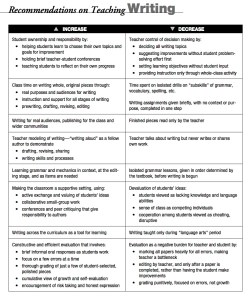
Pondiscio’s knowledge-based view of acquiring grammar and his mischaracterization of writing workshop are powerfully refuted by what we know is best practice in writing instruction:
BP writing

(click to enlarge)

As the chart above shows, best practice in writing instruction is not a template, but a range of practices that must be navigated by teachers and students dedicated to students becoming writers. If Pondiscio failed his students when teaching writing, he can point to many things I am sure, but writing workshop properly implemented is not one of them.

Ultimately, we must admit that Brunetta and Pondiscio are right about the lingering failure of teaching students to write. To answer why, both Brunetta and Pondiscio offer valuable insight, but for different reasons.

Over the past thirty years, high-stakes accountability and testing have ruined the promise of best practice begun in the first days of the National Writing Project in the late 1970s and early 1980s. Standards-and-test mania have supplanted a rich field of teaching writing, one that is still evolving and one that remains characterized by tensions.

But a second reason we continue to fail the teaching of writing is that English teaching has a long history, as I quoted LaBrant above, of allowing a “considerable gap between the research currently available and the utilization of that research in school programs and methods.” This professional failure has occurred even when the stakes were not high or linked to standardized tests.

Writing remains a powerful and important tool for learning, thinking, and expression. The teaching of writing, although often marginalized and ignored, should be foundational to all education—although it remains a distant cousin to reading and math.

Continuing to seek new standards and better tests will only erode further the failure to teach writing Brunetta and Poniscio identify. Instead of trying to close the achievement gap measured by test scores we have manufactured during the accountability era, we are way past time in our need to address the gap between what we know about teaching writing and what we do with students in our classrooms.

For Further Reading

Writing Instruction That Works: Proven Methods for Middle and High School Classrooms, Arthur N. Applebee and Judith A. Langer

The Testing Trap: How State Writing Assessments Control Learning, George Hillocks

Teaching Grammar in Context, Constance Weaver

Teaching Writing As Reflective Practice: Integrating Theories, George Hillocks

Best Practice (4th ed.), Zemelman, Daniels, and Hyde

Research on Composition: Multiple Perspectives on Two Decades of Change, Peter Smagorinsky, Editor

End Zero-Tolerance Policies: A Reader

What do zero-tolerance policies, “no excuses” practices, and grade retention have in common?

They all negatively and disproportionately impact children from poverty, minority children, English language learners, and boys; and nearly as disturbing, all are discredited by large bodies of research.

Is the tide turning against at least zero-tolerance policies? Lizette Alvarez reports:

Faced with mounting evidence that get-tough policies in schools are leading to arrest records, low academic achievement and high dropout rates that especially affect minority students, cities and school districts around the country are rethinking their approach to minor offenses.

Zero-tolerance policies, “no excuses” practices, and grade retention have something else in common: they should all be eradicated from our schools. And thus, here is a reader to help support calls for ending these practices and policies:

Police in the Hallways: Discipline in an Urban High School, Kathleen Nolan

Review: Police in the Hallways: Confronting the “Culture of Control,” P. L. Thomas

The School-to-Prison Pipeline, Journal of Educational Controversy (vol. 7, issue 1, Fall/2012-Winter 2013)

Hope Against Hope: Three Schools, One City, and the Struggle to Educate America’s Children, Sarah Carr

New Schools, Old Problems [Review: Hope Against Hope], P. L. Thomas

Education Reform in the New Jim Crow Era

Truthout TV Interviews P.L. Thomas About the New “Jim Crow” Era of Education Reform

Just Say No to Just Read, Florida, South Carolina [includes retention research]

Implementing Policies to Reduce the Likelihood of Preschool Expulsion, Walter S. Gilliam, PhD

Prekindergarteners Left Behind: Expulsion Rates  in State  Prekindergarten Programs, Walter S. Gilliam, PhD

Henry Giroux on the “School to Prison Pipeline”

The Mis-education of the Negro, Carter Godwin Woodson

Arresting Development • Zero Tolerance and the Criminalization of Children, Annette Fuentes