P. L. Thomas, Professor of Education (Furman University, Greenville SC), taught high school English in rural South Carolina before moving to teacher education. He is a former column editor for English Journal (National Council of Teachers of English), current series editor for Critical Literacy Teaching Series: Challenging Authors and Genres (Brill), and author of Teaching Writing as Journey, Not Destination: Essays Exploring What ‘Teaching Writing’ Means (IAP, 2019) and How to End the Reading War and Serve the Literacy Needs of All Students: A Primer for Parents, Policy Makers, and People Who Care (IAP, in press). NCTE named Thomas the 2013 George Orwell Award winner. He co-edited the award-winning (Divergent Book Award for Excellence in 21st Century Literacies Research) volume Critical Media Literacy and Fake News in Post-Truth America (Brill, 2018). Follow his work @plthomasEdD and the becoming radical (https://radicalscholarship.wordpress.com/).
Rob Tierney and P David Pearson explore the validity of claims associated with the Science of Reading as they have appeared in social media, the popular press, and academic works.
The book offers a comprehensive review of these claims—analyzing the evidence, reasoning, assumptions, and consequences associated with each claim—and closes with ideas for moving beyond the debates to greater consensus or accommodation of differences. The book is a must read for educators involved in teaching reading, as well as parents, policy makers, and other stakeholders.
EVALUATING THE SETTLED CHARACTER OF KEY SOR CLAIMS
CLAIM 1
Explicit systematic phonics instruction is the key curricular component in teaching beginning reading
CLAIM 2
The Simple View of Reading provides an adequate theoretical account of skilled reading and its development over time
CLAIM 3
Reading is the ability to identify and understand words that are part of one’s oral language repertoire
CLAIM 4
Phonics facilitates the increasingly automatic identification of unfamiliar word
CLAIM 5
The Three-Cueing System (Orthography, Semantics, and Syntax) has been soundly discredited
CLAIM 6
Learning to read is an unnatural act
CLAIM 7
Balanced Literacy and/or Whole Language is responsible for the low or falling NAEP scores we have witnessed in the U.S. in the past decade
CLAIM 8
Evidence from neuroscience research substantiates the efficacy of focus on phonics-first instruction
CLAIM 9
Sociocultural dimensions of reading and literacy are not crucial to explain either reading expertise or its development
CLAIM 10
Teacher education programs are not preparing teachers in the Science of Reading
“Human development is an important component of determining a nation’s productivity and is measured in employee skills identified by employers as critical for success in the modern global economy,” claims Thomas A. Hemphill, adding:
The United States is obviously not getting a sufficient return on investment in elementary and secondary education, as it has mediocre scores in mathematics literacy and declining scores for science literacy for 15-year-old students surveyed in 2022. The only significant improvement for 15-year-olds is in reading, where the United States finally entered the top 10 in 2022.
If these educational trends continue, the United States will not have an adequate indigenous workforce of scientists, engineers and technologists equipped to maintain scientific and technological leadership and instead will become perpetually reliant on scientifically and technologically skilled immigrants. We must demand that elementary and secondary education systems reorient efforts to significantly improve mathematical and scientific teaching expectations in the classroom.
However, for decades, evidence has shown that there is no causal link between international rankings of student test scores and national economic competitiveness.
This Big Lie is purely rhetorical and relies on throwing statistical comparisons at the public while drawing hasty and unsupported causal claims from those numbers.
Bracey offers this from researchers on the relationship between international education rankings and economic competitiveness:
Such countries [highest achieving] “do not experience substantially greater economic growth than countries that are merely average in terms of achievement.”
The researchers then lay out an interpretation of their findings that differs from the causal interpretation one usually hears:
“We venture, here, the interpretation that much of the achievement ‘effect’ is not really causal in character. It may be, rather, that nation-states with strong prodevelopment policies, and with regimes powerful enough to enforce these, produce both more economic growth and more disciplined student-achievement levels in fields (e.g., science and mathematics) perceived to be especially development related. This idea would explain the status of the Asian Tigers whose regimes have been much focused on producing both economic growth and achievement-oriented students in math and science.”
“From our study, the main conclusion is that the relationship between achievement in science and mathematics in schoolchildren and national economic growth is both time and case sensitive. Moreover, the relationship largely reflects the gap between the bottom third of the nations and the rest; the middle of the pack does not much differ from the rest. . . . Much of the obsession with the achievement ‘horse race’ proceeds as if beating the Asian Tigers in mathematics and science education is necessary for the economic well-being of other developed countries. Our analysis offers little support for this obsession. . . .
“Achievement indicators do not capture the extent to which schooling promotes initiative, creativity, entrepreneurship, and other strengths not sufficiently curricularized to warrant cross-national data collection and analysis. Unfortunately, the policy discourse that often follows from international achievement races involves exaggerated causal claims frequently stress- ing educational ‘silver bullets’ for economic woes. Our analyses do not offer defini- tive answers, but they raise important ques- tions about the validity of these claims. In an era that celebrates evidence-based policy formation, it behooves us to carefully weigh the evidence, rather than use it simply as a rhetorical weapon.”
A key point to note here is Bracey is writing in 2007, and the OpEd above is March 2024. The Big Lie about international education rankings and economic competitiveness is both a lie and a lie that will not die.
I strongly recommend Tom Loveless exposing a similar problem with misrepresenting and overstating the consequences of NAEP data: Literacy and NAEP Proficient.
Bracey offers a brief but better way to understand test data and economic competitiveness: “education is critical, but among the developed nations differences in test scores are trivial.”
Instead of another Big Lie, the US would be better served if we tried new and evidence-based (not ideological) ways to reform our schools and our social/economic structures.
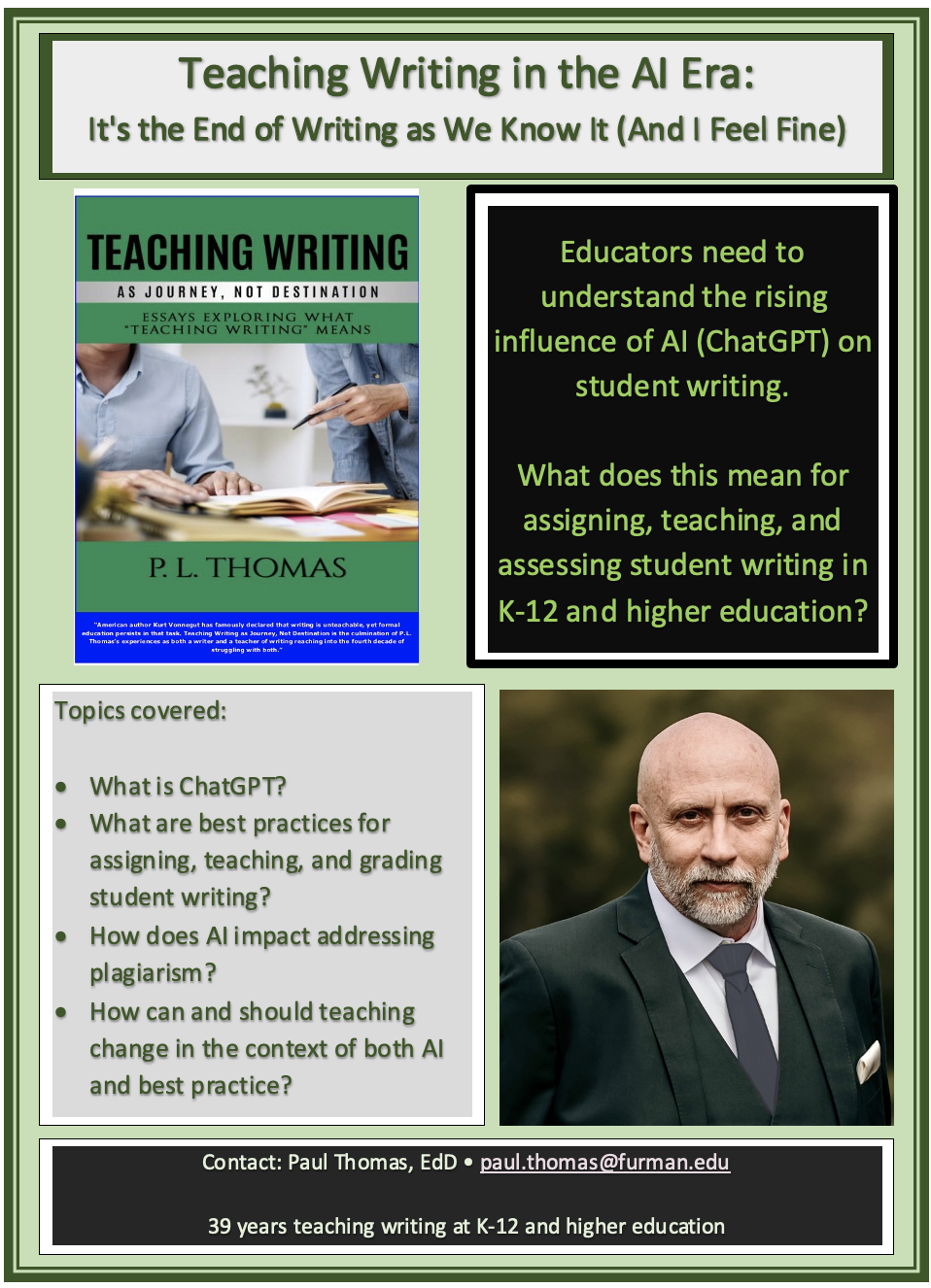
Over my 40-year (so far) career as a teacher, I have spent the bulk of that time teaching adolescents and adults to write.
An inordinate amount of that effort focuses on a great deal of unlearning since many writing assignments for students are exclusively student behaviors, not authentic practices or producing authentic artifacts.
This semester I am teaching two first-year writing seminars and an upper-level writing/research course. All of these students are in the midst of submitting cited essays.
This is the time of unlearning the “research paper.”
For the upper-level course, students work through an authentic process of choosing a topic, searching for their primary and secondary sources, submitting an annotated bibliography, and then submitting a cited essay (an analysis of media coverage of an educational topic).
Throughout that process, I note that, for example, the annotated bibliography is for them, a sort of prewriting of the cited essay (not an assignment to submit for a grade). This is an effort to lay the foundation for an authentic process of writing an original analysis grounded in evidence.
Despite my repeated warnings, students in this course still often turn in a first submission that is not a media analysis but a “research paper” on the educational topic. For example, instead of submitting their original analysis of how the media covers dyslexia, they submit a “research paper” on dyslexia.
Concurrent with that assignment, my first-year students are preparing their first formally cited essay (using APA). The essay before this assignment requires them to cite using hyperlinks, again emphasizing an authentic and more common approach to evidence in the world outside of formal schooling.
For both first-year and upper-level students, however, the urge to write a reductive and stilted “research paper” is deeply engrained from their K-12 schooling.
One consequence of that artificial experience and template is extremely cumbersome style that includes students writing about their “sources” instead of using their sources as either the focus of their analysis or evidence for their claims.
For example, these sorts of sentences are common:
Extensive scientific research has been conducted to determine if ADHD is the result of genetics or environmental factors. While this research has shown some correlation between certain genes or environmental factors and the onset of ADHD, the results remain inconclusive (Thapar et al., 2012).
Various studies and scholarly research conducted surrounding the pipeline expose the oppressive and discriminatory systems and beliefs involving law enforcement and unforgiving disciplinary policies within schools that are continually pushing students, especially students of color out of schools.
One article I read pushed for dialogue in their congregational community surrounding the mental health of black parishioners.
Journalists for mainstream media sources have argued that standardized testing adds a lot of stress and without many benefits.
Published scholarly work has concluded that testing is necessary, and journalists Donnelly (2015) and Silva (2013) back up these views.
This sort of meta-writing—identifying that scholars do research, treating the sources for an assignment as “my sources,” acknowledging that the student has done the research or reading—is a failure of the students to understand both the nature of cited writing and their own obligation as a writer of scholarship.
The upper-level course has a very challenging assignment that requires students to understand different types of sources and to write in different styles within the cited essay.
For these students, they have to gather evidence of media coverage of an education topic (the primary evidence of their analysis) while also having a body of scholarly sources that serve as the foundation of that analysis.
The brief literature reviews forces them to focus on the patterns in those scholarly articles, which provides the lens for analyzing the media coverage.
In the media analysis and evaluation sections, then, students must incorporate textual analysis, which requires a much greater sophistication than the examples above.
Here is the expanded guide I have created for those students to navigate the stylistic shifts and the use of evidence in cited essays:
Media Analysis Guidelines (EDU 250)
For 8-10 pages, a proposed structure:
Opening – about 1 page (2-4 paragraphs); be sure to include essay focus on media
[ ] Open with a specific narrative that focuses reader on your educational topic (and possibly use a media example).
[ ] Prefer shorter paragraphs (throughout essay).
[ ] Thesis must focus on media analysis. Prefer identifying questions you will answer about media portrayal of educational topic. [Do not refer to “the literature” or “research.”]
Literature Review – 2 pages; focus on *patterns* in the sources (write about your topics, not the sources); must be fully cited (prefer synthesis and avoid presenting one source at a time) and address all scholarly sources included in references
[ ] Discuss the patterns found in the scholarly evidence. [Do not refer to “the literature” or “research.”]
[ ] Do not write about your “sources”; write about what the evidence shows concerning your educational topic.
[ ] Primarily focus on a synthesis of your scholarly sources; do not walk through one source at a time.
[ ] All scholarly sources must be included, and you must fully cite using APA.
Media Analysis– 2 pages; focus on *patterns* in the media and include several examples; directly identify media outlets and journalists
[ ] Discuss the patterns found in media coverage of your educational topic.
[ ] Identify journalists and media sources specifically; choose some key quotes to show readers evidence of media coverage patterns.
[ ] Must cite fully in APA.
Media Evaluation(identify if media claims are valid or not) – 2 pages; this is the most important goal of the essay so evaluate the media coverage by implementing your knowledge of the scholarship (do not refer to “research” or “sources”); must be fully cited
[ ] This is the key section where you show whether or not the media coverage is valid (supported by research) or not. You must connect media patterns with the scholarly research.
[ ] Do not refer to “my sources,” the “research,” or the “literature.” Use your scholarly sources to evaluate media coverage.
[ ] Must fully cite throughout in APA.
Closing/Conclusion – about 1 page (2-4 paragraphs); must emphasize essay focus, media analysis
[ ] Return to a concrete or specific example from media.
[ ] Maintain focus on media analysis and give your reader something to do with your analysis/evaluation.
This assignment seeks to offer students an experience with what is common in academic and scholarly writing (graduate-level work and published scholarship). The assignment guidelines are too much of a template for my liking, but I am aware that many real-world scholarly works conform to such template or narrow guidelines (see this work of mine written to a strict template).
For both my first-year and my upper-level students, however, what I am seeking is how to foster in them greater autonomy and authority as writers and scholars.
My students’ cited essays are never called “research papers,” students always have choice about topics for their essays and must generate their own thesis/focus for the assignment, and my feedback supports these students incorporating evidence (sources) as ways to build their authority as writer and scholars.
For example, we work on fairly simple stylistic shifts that create authority and move cited essays beyond the research paper:
From this:
Research has shown that standardized testing interferes with both teaching and learning, increases student frustration, and leads to a classroom mindset focused more on grades than on actual learning of material (Wilson, 2022).
To this:
Standardized testing interferes with both teaching and learning, increases student frustration, and leads to a classroom mindset focused more on grades than on actual learning of material (Wilson, 2022).
Students have far too many experiences at the K-12 level that use inauthentic writing assignments (such as the “research paper”) as a mechanism for assessing if students have acquired skills—finding and analyzing sources, implementing academic citation, etc.
Those approaches have the goals reversed.
Students as developing writers and scholars need to acquire those skills in the service of their writing and expression; the cited essay is the thing we are seeking, and their authority as writers/scholars is the most important aspect of our feedback and (if necessary) assessment.
Can a student organize and focus an examination of a topic or idea in ways that are compelling and grounded in valid claims?
To do that well, academic and scholarly writing demands citation that serves to support the authority of the writer.
Ultimately, the urge in students to write about their sources is a reflection of their not yet understanding their autonomy as humans, writers, or scholars.
Students as writers must be allowed the full experiences of being a writer and thinker, guided of course by teachers of writing. But we as teachers of writing often do far too much for the student and ask far too little of those students.
Few students will move on from formal schooling and be academic or scholarly writers. What we must provide them with, then, is writing experiences that support their coming to embrace their autonomy and authority as thinkers along with the ability to express themselves in ways that are credible and compelling.
Regardless of your level of optimism, there simply is no other conclusion to draw from over forty years of educational crisis and reform: Education reform has almost nothing to do with improving education for students, but education reform has become an industry.
And one of the most powerful engines driving the crisis/reform industry in education is education journalism.
Interesting is that both are provable false narratives.
Yet, these stories endure because “[v]iewing education as being in more or less permanent crisis” (Edling, 2015) creates market and political profit for media, private education corporations, and politicians.
As a simple fact of logic, consider that for at least the last century, on every standardized test in every content area, students in poverty as a group have scored significantly lower than more affluent students.
Over that century, the teachers, instructional practices, programs, and curriculums/standards have changed dozens of times and have never been coherent at any one point across the US.
The only constant, of course, has been the economic inequity of the populations of students being taught and tested.
Yet, what have the media and political leaders focused on almost exclusively in the forty-plus-years of intense accountability reform (over what can be called at least half a dozen cycles in those decades)?
Instruction, curriculum/standards, and programs.
Why?
Teacher training churn, standardized test churn, and program churn are industries, and there is profit in constant churn.
Never has it been more clear that education reform is industry: “The administrations in charge,” writes Gilles Deleuze in Postscript on the Societies of Control, “never cease announcing supposedly necessary reforms: to reform schools, to reform industries, hospitals, the armed forces, prisons” (p. 4).
And never has it been more clear that education journalism is deeply invested in that churn, in manufacturing perpetual crisis:
Just within the past twenty years, Gates+ money has incubated several new education-only media outlets, such as Chalkbeat, EdReports, EdSurge, Education Next, Ed Post, FutureEd, and The 74. Gates+ money has also substantially boosted the efforts of preexisting education-only media organizations, such as EdSource, Education Week, the Education Writers Association, the Thomas B. Fordham Institute, and the Hechinger Report. All told, this accounts for almost all large-audience, US, K–12-education-only print media outlets, other than those tied to the traditional public education establishment.
I suspect no one embodies education reform as industry as well as Bill Gates, education reform hobbyist.
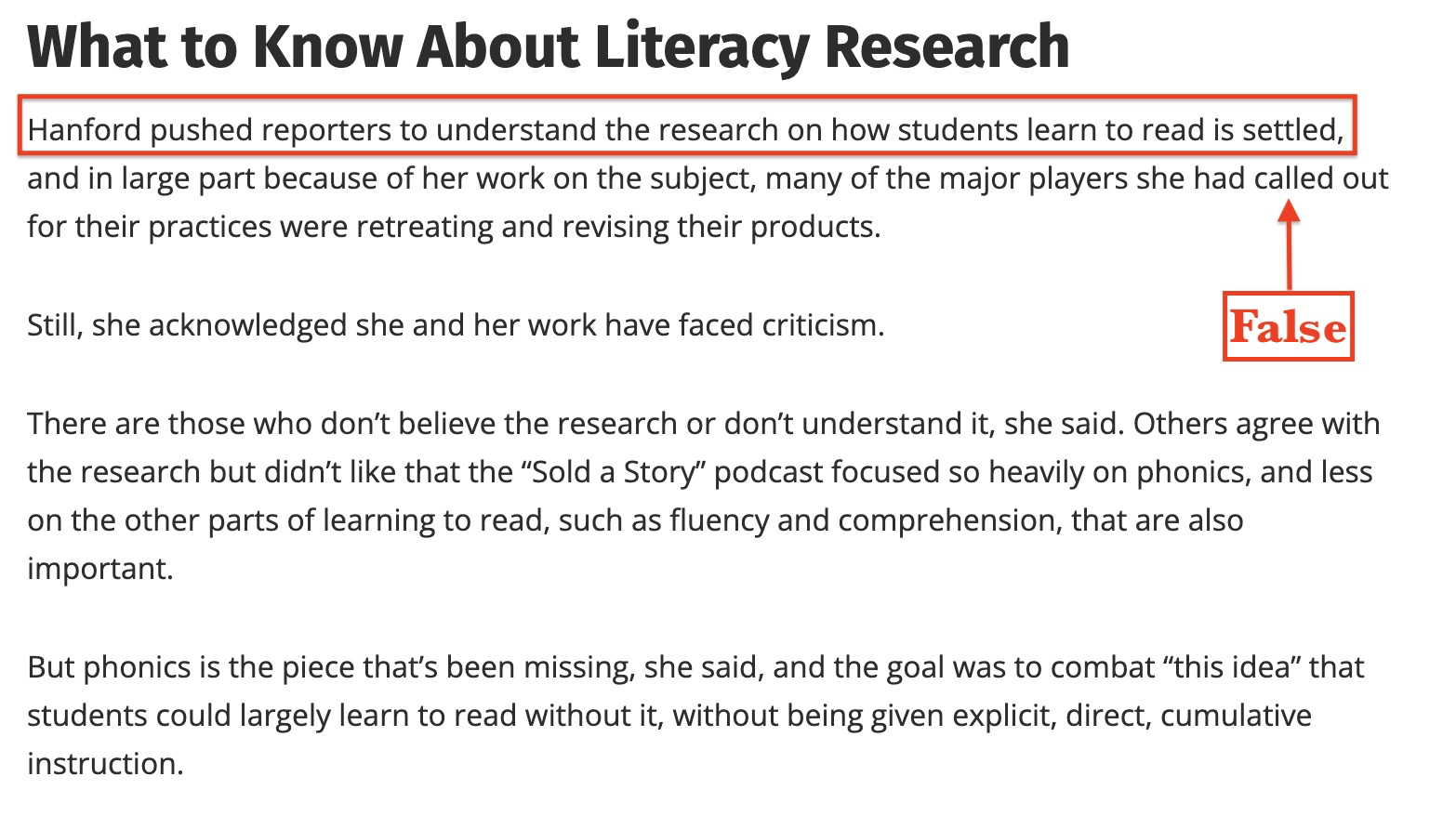
And, for example, nothing better exemplify what the true commitment in education journalism is better than the Education Writers Association and the current darling of education misinformation, Emily Hanford:
Manufacture a crisis with a melodramatic story, and then steel the troops for the inevitable outcome so that everyone can circle back to yet another crisis and more reform.
There is the sound of profit in the background as journalists as “watchdogs” announce more and more failure and crisis among school, teachers, and students.
The real literacy crisis is that too many people cannot read the writing on the wall. Or more likely, too many people are blinded by the profit of education reform as industry to even see the writing on the wall.
Thought Experiment 1
If you wonder if or how money matters, consider that the Department of Education Reform at the University of Arkansas is funded by Walton money. The Walton’s are significant school choice and charter school proponents. The “research” coming out of the DER is overwhelming positive about school choice and charter schools.
Coincidence?
Thought Experiment 2
England passed reading reform mandating systematic phonics for all students in 2006 (although their media and political leaders persist in crying “reading crisis”).
These are critical times for the children and youth of our nation. Thank Heaven that we have a squad of sharp-eyed citizens who are on the lookout for corrupting influences. Among their greatest contributions to society has been their scrubbing of pornography from our libraries and schools. The delicate sensibilities of children and youth are increasingly free from the threats to their souls that words present.
As is always the case, Florida has led the charge in restoring our purity of mind and manner. They have begun by eradicating from our libraries and classrooms our greatest and most present danger: books about gay people and people with dangerously dark skin.
With these most execrable of books removed, it’s time to zero in on what only the most discerning of eyes can detect. To this point, our hard-working vigilantes have wisely removed such offensive and disgusting texts as the Merriam-Webster Dictionary from libraries to prevent the spread of filth that follows from defining words that refer to body parts and their functions. This movement has now broadened to banish additional dictionaries with their obscene terms, and a slew of encyclopedias that have corrupted our children with their erotic propaganda.
We are on our way to making America great again. But have we gone far enough?
I would like to propose some additional materials that should comprise the next wave of book bans. The first to go should be gardening magazines and books, the most subtly menacing of volumes to be found anywhere.
Let’s start with their seemingly harmless pronunciation guides. To some, these innocuous listings simply tell people how to pronounce biological names of plants. According to my careful analysis, however, these guides instead provide an insidious way of implanting corrupt thoughts and encouraging immoral behavior in our children.
Here, for instance, are some of the terms and their pronunciations that I have found in materials somehow overlooked by our guardians of decency:
Diascia (dy-ASS-see-ah)
Mahonia (ma-HO-nee-ah)
Ajuga (ah-JEW-gah)
What would happen if a child were to come across these sinister guides, lured in by the enticing prospect of pronouncing words correctly? To what degree are our libraries grooming an uncouth generation of degenerates and predators by including gardening books and magazines?
Might children begin to refer to an unmentionable human body part through such a vile vulgarity? Might they be enticed into a life of sluttiness by speaking the name of a shrub whose name is bad enough, but whose cultivar, the Leatherleaf Mahonia, might promote sadomasochism? Might our innocent children join the forces of World Domination by speaking the name of a dark and devious groundcover, a plot we’ve known about since the publication of the Protocols of the Learned Elderberries of Zion? And is it just a coincidence that the flower known as ‘Zion Plum’ is an Osteospermum? I’m just asking.
Any fool can see the horrors wrought upon our nation by gardening books and magazines. Once the abominations appearing on their pages have been read, they can’t be unread.
And it’s not just plant pronunciation guides. Perverts have been naming plants for years. Imagine that your child innocently takes a gardening book off the shelf, and reads these names:
Botryotinia fuckeliana
Family Jewels Milkweed
Narcissus assoanus
Nipplewort
Penis passion fruit (Passiflora quadrangularis ‘Erotica’)
Pinus Rigida
Shagbark
Shaggy soldier
Sticky willie
Stiffcock
Stinking willie (Trillium erectum)
Well, at least there’s a Virgin Thistle. But some of these books also include some pretty filthy animal names:
Arses insularis
Bluefooted booby
Bugeranus
Cock-of-the-Rock
Dicksissle
Fartulum
Hellbender
Robin redbreast
Rough-faced shag
Satanic goatsucker
Tufted titmouse
Turdus maximus
Woodcock
Wunderpus
If impressionable children come across these names, next thing you know they’ll be asking for a litter box for their school bathroom in which to deposit their Turdus maximus. I can hear the sky falling just thinking about it.
Many of these volumes have extensive sections on sexual and asexual plant propagation. It’s only a short hop from there to obscene human sexuality, which our children must never learn about. And what is this “asexual” propagation? Why isn’t it called abstinence propagation? How treacherous can these gardening magazine editors possibly be?
One gardening book I inspected actually recommended that we install a bust for people to stare at. And then, to put it next to a bush. That sounds like a Trojan Horse to me. Some even refer to snakes, and we know what that’s really all about. And what’s with all this about birds and bees? Sounds pretty salacious to me.
It’s time to get our collective head out of the depths of our Arses insularis. The best place to start is in the school and public libraries, and in classrooms where radicalized Marxist teachers are turning our students gay. I’m reminded of the sly British thinker Horace Walpole, who said that he understands “diversity to proceed partly from our climate, partly from our government: the first is changeable, and makes us queer; the latter permits our queerness to operate as they please.”
Here we get the whole liberal plot to promote reading: DEI, climate change, and the gay lifestyle agenda. All because of books and their infernal words, supported by the Deep State. Gardening books and magazines are now the greatest threat to our nation’s security. We must remove them from all public spaces immediately, lest we slip ever more fatefully toward societal extinction.
Along with Decoding Dyslexia, The Reading League is likely the largest advocacy group for the “science of reading” (SOR). As I have detailed, however, there is a serious problem with the “science” in their advocacy.
Let me remind you of the standards for “science” that The Reading League has proposed:
Now, consider the following:
The problem lies in promoting decodable texts under the guise of SOR when here is the evidence on decodable texts [1]:
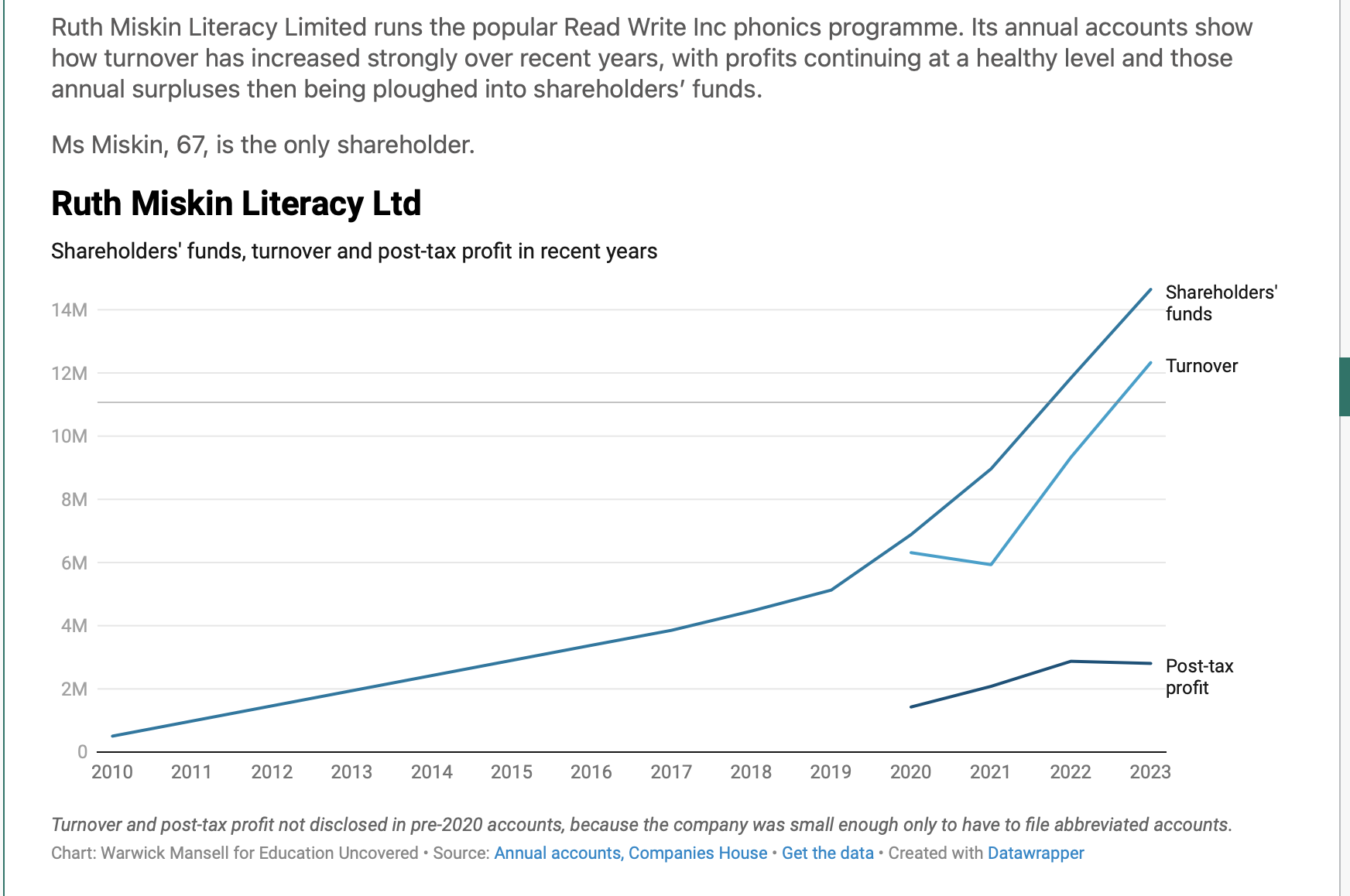
Here are the sponsors that promoted The Reading League’s recent conference. Some simply sell decoding books. If aware of peer-reviewed studies that I may have overlooked for any of these programs or assessments, please share.
For those of us of a certain age, well before the era of trending on social media, a simple ad for Wendy’s prompted the catch phrase “Where’s the beef?”
The ad made Clara Peller a star in her 80s, and it certainly helped create a national distinction among fast-food hamburger restaurants in the US.
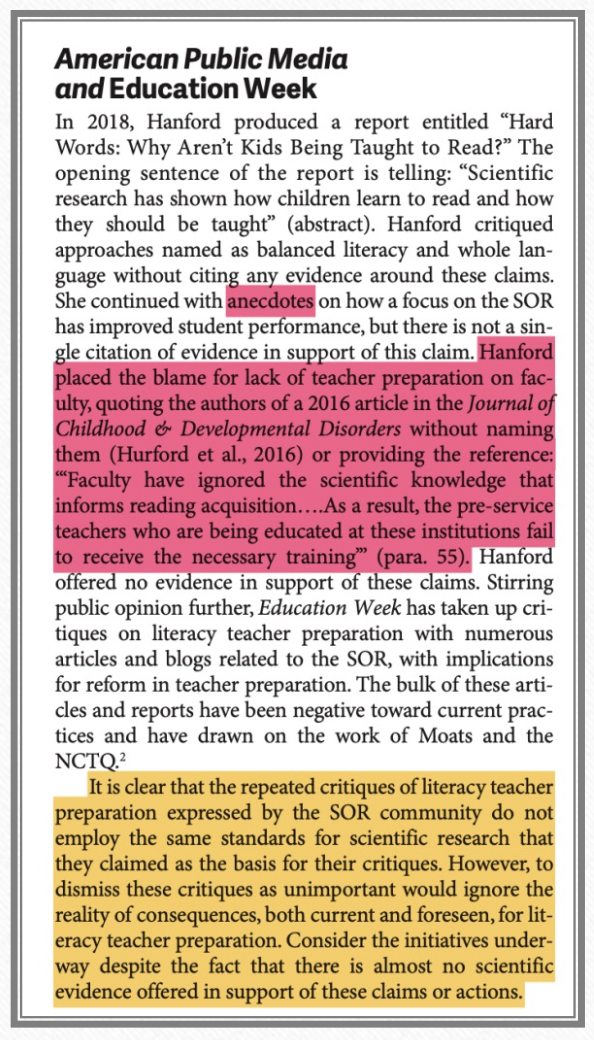
As early as 2020, literacy scholars identified the bait-and-switch approach being used in the “science of reading” (SOR) movement—demanding science while relying on anecdotes:
Hoffman, J.V., Hikida, M., & Sailors, M. (2020). Contesting science that silences: Amplifying equity, agency, and design research in literacy teacher preparation. Reading Research Quarterly, 55(S1), S255–S266. https://doi.org/10.1002/rrq.353
Here are two recent posts on Twitter/X that provide an entry point into that bait-and-switch coming true:
Listen, I have yet to see any evidence that Balanced Literacy as theory or actual practice is the reason for reading struggles in kids. Maybe if there was research that proved it I would be more receptive. Unlike folks who use LETRS I do like research to justify my decisions. 😘
There is no point in this article where I discuss reading proficiency for children in Kindergarten. Yet, my work is cited in this way. Please check your claims. SMH…
— Tiffany A. Flowers (Author & Literacy Advocate) (@Prof_Flowers) March 18, 2024
Gilson asks a key and foundational question about the basis of the SOR movement—the unsupported claims of a reading crisis caused by balanced literacy and a few identified reading programs (primarily by Lucy Calkins and Fountas and Pinnell).
To be blunt, there is no scientific research showing a causal relationship between any reading theory or specific programs and a reading crisis. Notably, there simply isn’t any evidence that reading achievement is coherent enough or that reading programs are consistently used across the entire nation in ways that even make that claim possibly true.
And then, more insidious perhaps, SOR advocates not only bait-and-switch with science/anecdotes, the claims of “science” or “research” are often linked to journalism, not cited at all, cherry-picked evidence, or as Flowers calls out, misrepresentations of evidence.
The resulting legislation, then, is forcing successful schools to change programs and practices by sheer fiat, such as in Connecticut, or imposing bans and mandates that are wildly arbitrary.
Note the practices from a literature review of the science of reading below; please note that “not scientific” can mean either that scientific research has shown the practice to be ineffective or that no scientific research yet exists:
Not only must we ask “Where’s the science?” we must also ask why is three-cueing being banned in the same states mandating O-G phonics (multi sensory approaches), decodable texts, and LETRS training although all of there are technically not scientific?
The answer, of course, is that the SOR movement is mostly rhetorical ideological, and commercial.
Bans and mandates are about serving a narrow set of reading ideologies and lining the pockets of certain education markets.
Teachers, parents, and even students are starting to acknowledge that the SOR tsunami is causing great harm to teaching and learning reading.
This is late, but we simply all must start demanding that SOR advocates practice what they preach. When they make their condescending claims about teachers of reading, teacher educators, student reading achievement, and reading programs, we absolutely must ask, Where’s the science?
educator, public scholar, poet&writer – academic freedom isn't free












 dr. p.l. (paul) thomas