
All posts by plthomasedd
What Would James Baldwin Do (Say, Write)?
Columbia, SC: Thomas: Kids Count data remind us SC’s chief education problem isn’t in the schools | Opinion Columns | The State
COMING SOON: Critical Foundations in Young Adult Literature (Sense)
COMING SOON
Series Editor: P. L. Thomas, EdD, Furman University
Publisher: Sense
Critical Foundations in Young Adult Literature: Challenging Genres, Antero Garcia

“Disillusioned with Teach For America”
What Would James Baldwin Do (Say, Write)?
My future son-in-law is black. My daughter is white. And we live in the South where, despite their (possibly naive) idealism, interracial relationships still matter, often in negative ways.
I have been deeply concerned about race, class, and literacy for my 30-year career as a teacher, writer, and scholar, but I must confess that their relationship increases the poignancy of those issues for me because on the day the Trayvon Martin murder became the focus of the media, my future son-in-law left my house in a hoodie covering his dreadlocks. It was nighttime, and I wrestled with telling him to be careful in a way that had nothing to do with the perfunctory “be careful” people often use to say good-bye.
Their relationship has also colored my watching the documentary The Loving Story, and purchasing Loving v. Virginia in a Post-Racial World: Rethinking Race, Sex, and Marriage.
Over the past couple of years, as well, I have been exploring the work of James Baldwin, notably his non-fiction, leading to my co-editing a new volume on Baldwin.
As a white child of the redneck South, I am, then, wrestling with the not guilty verdict in the shooting of Trayvon Martin on many levels—personal, scholarly, existentially. And I find myself at a loss.
One enduring rock I continue to seek—a place to stand or even hold on to—is the work of James Baldwin. In fact, What would James Baldwin do (say, write)? echoes in my mind.
I imagine Baldwin, not on the Dick Cavett Show, but on Oprah, righteous and angry:
I imagine Baldwin responding to the smug inhumanity of Rush Limbaugh:
And I envision his words, 57 years later, still titled “A Report from Occupied Territory“:
On April 17, 1964, in Harlem, New York City, a young salesman, father of two, left a customer’s apartment and went into the streets. There was a great commotion in the streets, which, especially since it was a spring day, involved many people, including running, frightened, little boys. They were running from the police. Other people, in windows, left their windows, in terror of the police because the police had their guns out, and were aiming the guns at the roofs. Then the salesman noticed that two of the policemen were beating up a kid: “So I spoke up and asked them, ‘why are you beating him like that?’ Police jump up and start swinging on me. He put the gun on me and said, ‘get over there.’ I said, ‘what for?’”
An unwise question. Three of the policemen beat up the salesman in the streets. Then they took the young salesman, whose hands had been handcuffed behind his back, along with four others, much younger than the salesman, who were handcuffed in the same way, to the police station.
Nearly two decades before Ronald Reagan initiated the mass incarceration of African American males and almost six decades before Michelle Alexander declared this The New Jim Crow (asking, for example, why drug sweeps target poor and mostly black neighborhoods but not college dorms), Baldwin declared black neighborhoods “occupied territory”:
As a result of the events of April 17, and of the police performance that day, and because Harlem is policed like occupied territory, six young Negro men, the oldest of whom is 20, are now in prison, facing life sentences for murder. Their names are Wallace Baker, Daniel Hamm, Walter Thomas, Willie Craig, Ronald Felder and Robert Rice. Perhaps their names don’t matter. They might be my brothers, they might also be yours.
Haunting this passage from Baldwin is the ugly underbelly of who we identify with, and how we create some groups of people (black males) as “others.” George Zimmerman’s jurors, all white females, appear to have identified with Zimmerman, and seem not to have viewed Trayvon Martin as someone’s son, and thus everyone’s child.
Do race and racial stereotypes over-ride our human dignity? Can we not listen to our possibilities as parents and the fact that all humans are at their core children?
Where is our empathy, the appeal to basic human dignity in Baldwin’s words?
Today, I seek Baldwin’s words, as well, because he spoke from his own life:
This means that I also know, in my own flesh, and know, which is worse, in the scars borne by many of those dearest to me, the thunder and fire of the billy club, the paralyzing shock of spittle in the face, and I know what it is to find oneself blinded, on one’s hands and knees, at the bottom of the flight of steps down which one has just been hurled. I know something else: these young men have been in jail for two years now. Even if the attempts being put forth to free them should succeed, what has happened to them in these two years? People are destroyed very easily. Where is the civilization and where, indeed, is the morality which can afford to destroy so many?
In the wake of the Civil Rights movement, blacks in the US learned lessons we continue to witness today:
Furthermore, the Negro’s education, North and South, remains, almost totally, a segregated education, which is but another way of saying that he is taught the habits of inferiority every hour of every day that he lives. He will find it very difficult to overcome these habits. Furthermore, every attempt he makes to overcome them will be painfully complicated by the fact that the ways of being, the ways of life of the despised and rejected, nevertheless, contain an incontestable vitality and authority. This is far more than can be said of the middle class which, in any case, and whether it be black or white, does not dare to cease despising him….
The children, having seen the spectacular defeat of their fathers—having seen what happens to any bad nigger and, still more, what happens to the good ones—cannot listen to their fathers and certainly will not listen to the society which is responsible for their orphaned condition.
What must children be learning now—Trayvon Martin dead, drug tested, vilified, reduced to an iconic hoodie; Zimmerman freed, exonerated, justified?
Baldwin speaks to those lessons:
This is why those pious calls to “respect the law,” always to be heard from prominent citizens each time the ghetto explodes, are so obscene. The law is meant to be my servant and not my master, still less my torturer and my murderer. To respect the law, in the context in which the American Negro finds himself, is simply to surrender his self-respect….
These things happen, in all our Harlems, every single day. If we ignore this fact, and our common responsibility to change this fact, we are sealing our doom. Here is the boy, Daniel Hamm, speaking—speaking of his country, which has sworn to bung peace and freedom to so many millions. “They don’t want us here. They don’t want us—period! All they want us to do is work on these penny-ante jobs for them—and that’s it. And beat our heads in whenever they feel like it. They don’t want us on the street ’cause the World’s Fair is coming. And they figure that all black people are hoodlums anyway, or bums, with no character of our own. So they put us off the streets, so their friends from Europe, Paris or Vietnam—wherever they come from—can come and see this supposed-to-be great city.”
There is a very bitter prescience in what this boy—this “bad nigger”—is saying, and he was not born knowing it. We taught it to him in seventeen years. He is draft age now, and if he were not in jail, would very probably be on his way to Southeast Asia. Many of his contemporaries are there, and the American Government and the American press are extremely proud of them. They are dying there like flies; they are dying in the streets of all our Harlems far more hideously than flies. A member of my family said to me when we learned of the bombing of the four little girls in the Birmingham Sunday school, “Well, they don’t need us for work no more. Where are they building the gas ovens?” Many Negroes feel this; there is no way not to feel it.
Baldwin’s last comment—”Many Negroes feel this; there is no way not to feel it”—likely remains true, but shouldn’t we by now be able to say about the death of Trayvon Martin, “Everyone recognizes the injustice; there is no way not to feel it”?
The ‘educational’ value of being born rich
Racism Built into the System to Mask Racism
Social Justice?
Kids Count on Public Education, Not Grit or “No Excuses”
Secretary of Education Arne Duncan has often stated that “education [is] the one true path out of poverty—the great equalizer that overcomes differences in background, culture and privilege. It’s the only way to secure our common future in a competitive global economy.” While this claim appears obvious, when Matt Bruenig asked “What’s more important: a college degree or being born rich?” and examined the data, he concluded:
So, you are 2.5x more likely to be a rich adult if you were born rich and never bothered to go to college than if you were born poor and, against all odds, went to college and graduated. The disparity in the outcomes of rich and poor kids persists, not only when you control for college attainment, but even when you compare non-degreed rich kids to degreed poor kids!
Therefore, the answer to the question in the title is that you are better off being born rich regardless of whether you go to college than being born poor and getting a college degree.
In South Carolina, for example, this sobering reality is made more troubling by the 2013 Kids Count report from the Annie E. Casey Foundation, which examines child well-being in the nation and each state.
Nationally, SC ranks 45th, down from 43rd in the foundation’s previous report. Only Louisiana, Arizona, Nevada, Mississippi, and New Mexico sit lower than SC in child well-being. The ranking consists of four broad categories that reflect significant social and educational challenges for SC:
- Economic Well-Being (2011 data): SC children in poverty, 28% (worse than 2005, 23%); children whose parents lack secure employment, 35% (worse than 2008, 30%); children living in households with a high housing cost burden, 36% (worse than 2005, 32%); teens not in school and not working, 11% (worse than 2008, 8%).
- Education: SC children not attending preschool (2009-11), 55% (better than 2005-2007, 59%); 4th graders not proficient in reading (2011), 72% (better than 2005, 74%); 8th graders not proficient in math (2011), 68% (better than 2005, 70%); high school students not graduating on time (2009/2010), 32%.
- Health: SC low-birthweight babies (2010), 9.9% (better than 2005, 10.2%); children without health insurance (2011), 8% (better than 2008, 13%); child and teen deaths per 100,000 (2010), 32% (better than 2005, 41%); teens who abuse alcohol and drugs (2012-11), 7% (better than 2005-2006, 8%).
- Family and Community: SC children in single-parent families (2011), 42% (worse than 2005, 38%); children in families where the household head lacks a high school diploma (2011), 13% (better than 2005, 15%); children living in high-poverty areas (2007-2011), 13% (worse than 2000, 6%); teen births per 1000 (2010), 43 (better than 2005, 51).
SC represents states that remain heavily burdened by the negative consequences of poverty and social inequity, complicated factors often reflected in the measurable outcomes of public schools. This report offers SC, the nation, and political leaders an opportunity to change the discourse about school reform and take bold action that addresses the wide range of social and economic challenges facing our state.
While the report data show that social and education reform should remain priorities for SC, that same data also suggest that social reform is far more pressing than expensive and historically ineffective commitments to new standards and tests being promoted for education reform.
Children in SC deserve better schools, and children in poverty remain the exact students most underserved in those schools. No one is suggesting that education reform be set aside or ignored. But many current school reform policies are simply wastes of taxpayers’ money and educators’ time that would be better spent on education reform that addresses the conditions of teaching and learning, and not just more of the same standards-and-testing mandates tried for thirty years now.
More pressing is social reform because without addressing childhood poverty, workforce stability and quality, the costs of living, single-parent homes, and concentrated high-poverty communities, most education reform measures are doomed to be fruitless.
As The Economic Mobility Project reveals, children in SC and across the US are likely to have bright futures if they are born into relative affluence, and those children, even without attending college, are apt to succeed over impoverished children who rise above the challenges of their homes and communities by graduating college. “Grit” and “no excuses” are simply slogans, hollow and cruel in the bright light of the evidence.
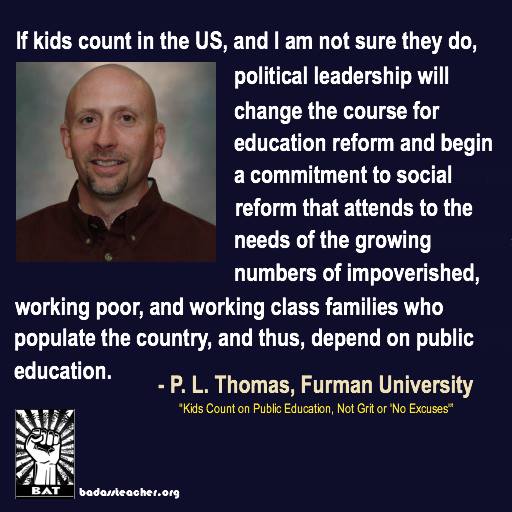
If kids count in the US, and I am not sure they do, political leadership will change the course for education reform and begin a commitment to social reform that attends to the needs of the growing numbers of impoverished, working poor, and working class families who populate the country, and thus, depend on public education.
 dr. p.l. (paul) thomas