
All posts by plthomasedd
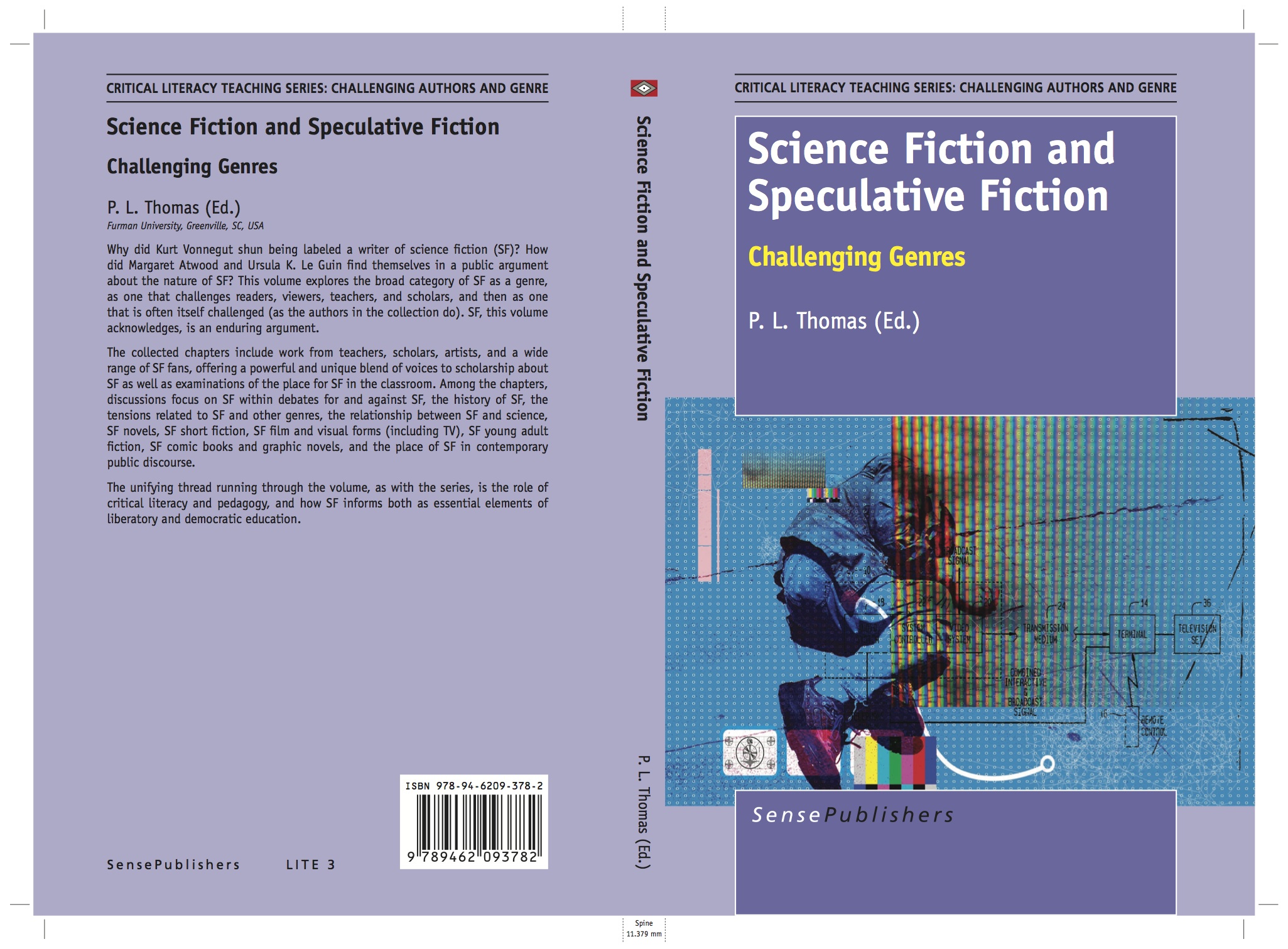
AVAILABLE SOON: Science Fiction and Speculative Fiction
In the next few weeks, a new title in the series Critical Literacy Teaching Series: Challenging Authors and Genres will be available from Sense:
Science Fiction and Speculative Fiction: Challenging Genres
Blinded by the Stereotype Spotlight
Why are drug sweeps routinely conducted by police in high-poverty minority neighborhoods and not dorms on college campuses?
Why was shooting victim Trayvon Martin drug tested, and his shooter, George Zimmerman, not tested?
Why are Teach for America recruits, with no formal training as teachers, allowed to teach high-poverty minority students, often in “no excuses” charter schools such as Knowledge Is Power Program (KIPP), but affluent and white students tend to have certified and experienced teachers?
Why are charter schools, which often segregate students by race and class, expanding, while public schools also grow increasingly segregated—and why are both conditions essentially ignored?
The answers lie somewhere in the blinding power of the stereotype spotlight focused on people and children living and learning in poverty.
Consider Esther J. Cepeda’s “Overcoming generational poverty”:
Teachers in low-income school districts often get specialized training about the culture of poverty in order to better understand their students’ lives and take those challenges into account in the classroom. As a high school teacher, I was trained in Ruby K. Payne’s “A Framework for Understanding Poverty.”
Payne has a 20-item list of the characteristics of generational poverty, which includes constant high levels of background noise, the overvaluation of entertainment as a respite from the exertions of survival, a strong belief in destiny or fate because choices are in low supply, and polarized thinking in which options are hardly ever examined (again, because so few tend to be available).
Also pervasive in the culture of poverty is the sense that time isn’t for measuring, that it occurs only in the present, and that the future exists only as a word.
Cepeda, first, carelessly* honors the Payne “framework,” despite a significant and growing body of scholarship that has rejected Payne’s worksheets and workshops as the worst possible examples of deficit perspectives built on stereotypes, and not credible and nuanced evidence about class or race.
Payne, having no formal expertise in poverty, class, or race has admitted she based her work initially on her husband having grown up poor. In its genesis, Payne’s work is at best anecdotal.
But the “framework” also perpetuates and speaks to corrosive stereotypes about class and race. For example, Payne presents her clients (generating a tremendous amount of revenue for her through the self-published workbooks and workshops offered across the US) with what she claims are foundational conditions about people in poverty that explain why children living in poverty struggle in schools: According to Payne, people in poverty know how to bail someone out of jail, how to acquire handguns, and how to gather resources from trash and recycling bins.
Let’s imagine for a moment a similar “framework” for affluence**. You may be from wealth if:
- You know how to hire an escort without being arrested.
- You know people who can have charges dropped if you are arrested.
- You know how to hide your income to avoid, legally, paying taxes.
Framed within the cultural fetish in the US for wealth and the wealthy, that “framework” likely seems unfair, but are those conditions and the implications in them any more unfair that Payne’s claims about people in poverty?
The blinding power of the stereotype spotlight fails even among advocates seeking, in earnest, to help people and children living in poverty. The failures include the following:
- Stereotyping is gross overgeneralizing. The worst stereotyping is recognized as racism, sexism, or homophobia. Any category of humans (such as class, race, gender, or sexuality) is likely far more nuanced than monolithic. Payne’s stereotyping is classism, tinted by racism.
- Focusing on claimed flaws inherent in people in poverty (and poverty itself) keeps the focus on personal failure, personal responsibility, but it ignores systemic inequity. As long as we continue to act as if people in poverty are deficient, and all we need to do is “fix” them, we continue to absolve ourselves of any social responsibility for inequity and injustice.
- Creating stereotypes as deficits against social norms entrenches those norms as “right” and thus above being confronted or changed. The idealized middle class of the US has historically and currently constitutes, however, beliefs and practices that need to be challenged. Consider that separate but equal was a norm of the US, as was slavery. Social norms remain that speak to groups about “knowing their place” (women), as well.
As long as the stereotype spotlight remains focused on children in poverty, highlighting them as academic failures who need a culture of “no excuses” to force them to conform to the idealized middle-class norm (Payne’s “hidden rules”), the historical and current race and class biases remaining in standardized testing, the inequity of opportunity existing in US consumerism and capitalism, the inequity of opportunity expanding in access to high-quality schools and high-quality courses in schools, and the inequity of access to high-quality teachers all remain unacknowledged and thus never addressed.
The blinding power of the stereotype spotlight needs to be switched off and replaced by a mirror for middle-class and affluent America.
* Payne often expresses her “common sense” claims about people in poverty to large auditoriums filled with, disproportionately, middle-class, white, and female teachers. Those teachers often sit shaking their heads in agreement. Payne’s claims are compelling because they seem accurate within a cultural stereotyping. The result is many good people with wonderful intentions also find themselves trapped within stereotypes.
** Paul Gorski uses this method to discredit Payne’s simplistic claims.
remnant 26: nerd intuition, soulmates, & the Fountain of Youth
Clarifying Common Core Compromise (part 2)
My initial Common Core compromise was intentionally brief—in part to make it accessible and, ultimately, as a concession that it details elements unlikely to be embraced by the political and corporate leaders driving CC-mania.
While I remain north of skeptical, able to see clearly cynicism, about the possibility that my compromise will be embraced, I did receive enough response—and many important concerns—to justify a follow up, clarifying a few key concepts behind my compromise.
First, the foundational motivation for the compromise is to highlight that both CC (and the entire accountability movement) and the USDOE are, as currently functioning, deeply flawed structures, each working to ruin universal public education. The flaws at the root of CC and the USDOE are related to bureaucracy, political/partisan corruption (a redundancy, I realize), and predatory corporations (the private feeding on public funds).
Next, the elements in my compromise are designed to re-imagine CC as a genuine mechanism of change—to end the current accountability era and spur a new era of authentic commitments to social and educational equity and opportunity and to end the USDOE as a political/partisan bureaucratic nightmare and re-invision the USDOE as a centralized and professional ministry of education that serves the public good and the people.
So here are a few clarifications directed at the concerns raised so far:
- Ending high-stakes testing accomplishes a few key reforms: (a) ending the disaster capitalism of Pearson and other corporations that benefit from crisis discourse about schooling, feeding on precious public funds, (b) ending a historically bankrupt tradition of linking test scores to individual students, teachers, and schools (using NAEP, random sampling, and broad data sets), and thus, addressing privacy concerns (NAEP data not linked to individual students but creating longitudinal data bases by states), ending high-stakes accountability, and stemming the tide of value-added methods designed to de-professionalize teachers.
- Transforming the USDOE to a centralized, professional, and responsive ministry of education does not mean I am calling for standardization or “government control of schools.” In fact, I am calling for the exact opposite of those concerns. Centralized does not mean standardized. Currently, the US has a public workforce composed of public school teachers and publicly funded university professors that includes all the expertise and knowledge needed to create the resources every public school in the US needs. As I detailed, the USDOE centralizes all materials, resources, and assessments (NAEP), but centralized must not mandate for any schools. Instead, each school will base needs on the populations of students being served, and then the USDOE becomes a centralized (thus creating an equity of opportunity) resource to serve the needs expressed by each school. Education must begin with each student and work outward.
- Although I didn’t directly note this before, I also envision once we end high-stakes testing and move to NAEP-like data sets (similar to what Finland does), we must then expand dramatically the evidence used to monitor and reform further our schools.
Is it possible for educators, scholars, researchers, and community members who believe in public education and the essential nature of the Commons for a free people to take the tool of oppression (Common Core) and turn it against the very people who created it?
I wonder, yes, I wonder.
And when I wonder, I think about—despite all its flaws—the film Gandhi, and the spirit found in key scenes of a people coming to embrace their own freedom:
Brigadier: You don’t think we’re just going to walk out of India!
Gandhi: Yes. In the end, you will walk out. Because 100,000 Englishmen simply cannot control 350 million Indians, if those Indians refuse to cooperate.
Can a spirit of non-cooperation grow from a solidarity around CC as a true mechanism of reform?
Nehru: Bapuji, the whole country is moving.
Gandhi: Yes. but in what direction?
My Common Core Compromise
While nearly all states in the US implement Common Core standards as well as brace for the so-called “next generation” high-stakes tests guaranteed in their wake, the debate around CC has increased. Most people fall into one of three camps—CC advocates, Tea Party/libertarian CC detractors who see the standards as liberal “big” government intrusion, and educators, academics, and researchers who reject CC as more of the same failed accountability paradigm.
Early and often, I have stood firmly in the third camp, entirely rejecting CC. I remain troubled by the number of educators who say they support CC, but reject the high-stakes testing and accountability linked to the new standards. I also remain troubled that the tremendous investment of public funds and time benefitting directly private corporations feeding off new standards and tests appears to concern few people.
However, I am now prepared to compromise and support CC implementation under the following conditions:
- Adopting CC in all states is part of a complete repealing of No Child Left Behind.
- New federal education legislation fully funds CC implementation and bans any public funds being spent on private corporation materials or tests.
- All CC materials and resources will be produced, distributed, and monitored by the USDOE, and funded by federal and state resources allocated for education.
- The USDOE will create a centralized web-based clearing house for educators to upload lesson plans and other resources for all teachers to implement CC.
- States accepting federal funds and implementing CC must end immediately all high-stakes testing and linking teacher evaluations and pay to test scores.
- NAEP assessments will be aligned with CC and then administered in 3rd, 8th, and 11th grades to random samples of students in all 50 states to create a data base for examining the effectiveness of CC.
Under these conditions, adopting CC would represent real reform and would be a needed mechanism for ending the worst aspects of the accountability era over the past 30 years.
As long as CC remains central to maintaining the status quo—notably as a cash cow for private corporations to feed off public funds—I cannot support them in any way.
The Foolish Bureaucracy of Education Reform
Le Guin’s “The Ones Who Walk Away from Omelas”: Allegory of Privilege
“With a clamor of bells that set the swallows soaring, the Festival of Summer came to the city Omelas, bright-towered by the sea,” opens Ursula K. Le Guin ’s “The Ones Who Walk Away from Omelas.”*
The reader soon learns about a people and a land that leave the narrator filled with both a passion for telling a story and tension over the weight of that task:
How can I tell you about the people of Omelas? They were not naive and happy children—though their children were, in fact, happy. They were mature, intelligent, passionate adults whose lives were not wretched. O miracle! but I wish I could describe it better. I wish I could convince you. (p. 278)
The narrator offers an assortment of glimpses into these joyous people and their Festival of Summer, and then adds:
Do you believe? Do you accept the festival, the city, the joy? No? Then let me describe one more thing. (p. 280)
The “one more thing” is a child, imprisoned in a closet and its own filth—a fact of the people of Omelas “explained to children when they are between eight and twelve, whenever they seem capable of understanding”:
They all know it is there, all the people of Omelas. Some of them have come to see it, others are content merely to know it is there. They all know that it has to be there. Some of them understand why, and some do not, but they all understand that their happiness, the beauty of their city, the tenderness of their friendships, the health of their children, the wisdom of their scholars, the skill of their makers, even the abundance of their harvest and the kindly weathers of their skies, depend wholly on this child’s abominable misery. (p. 282)
And how do the people of Omelas respond to this fact of their privilege at the expense of the sacrificed child? Most come to live with it: “Their tears at the bitter injustice dry when they begin to perceive the terrible justice of reality, and to accept it” (p. 283)
But a few, a few:
They leave Omelas, they walk ahead into the darkness, and they do not come back. The place they go towards is a place even less imaginable to most of us than the city of happiness. I cannot describe it at all. It is possible that it does not exist. But they seem to know where they are going, the ones who walk away from Omelas. (p. 284)
Le Guin’s sparse and disturbing allegory has everything that science fiction/ speculative fiction/ dystopian fiction can offer in such a short space—a shocking other-world, a promise of Utopia tinted by Dystopia, the stab of brutality and callousness, and ultimately the penetrating mirror turned on all of us, now.
At its core, Le Guin’s story is about the narcotic privilege as well as the reality that privilege always exists at someone else’s expense. The horror of this allegory is that the sacrifice is a child, highlighting for the reader that privilege comes to some at the expense of others through no fault of the closeted lamb.
In the U.S., we cloak the reality of privilege with a meritocracy myth, and unlike the people of Omelas, we embrace both the myth and the cloaking—never even taking that painful step of opening the closet door to face ourselves.
What’s behind our door in the U.S.? Over 22% of our children living lives in poverty through no fault of their own.
While Le Guin’s story ends with some hope that a few have a soul and mind strong enough to walk away from happiness built on the oppression of the innocent, I feel compelled to long for a different ending, one where a few, a few rise up against the monstrosity of oppression and inequity, to speak and act against, not merely acquiesce or walk away.
Le Guin, U. (1975). The wind’s twelve quarters. New York, NY: Harper Perennial.
*Previously posted at The Daily Kos October 30, 2011, slightly revised here.
 dr. p.l. (paul) thomas