
All posts by plthomasedd
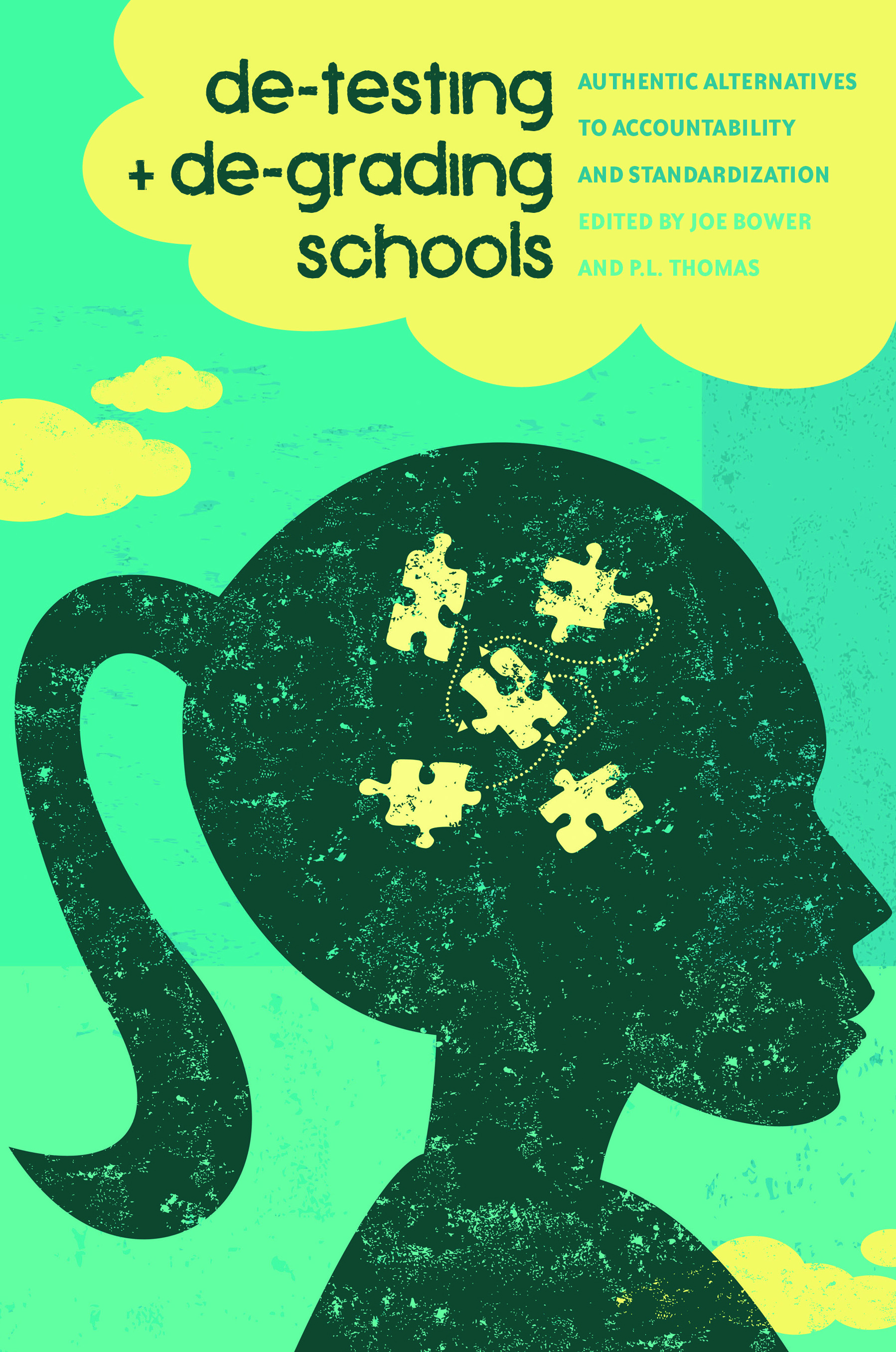
IN PRESS: De-Testing and De-Grading Schools (Peter Lang)
De-Testing and De-Grading Schools: Authentic Alternatives to Accountability and Standardization
Joe Bower and P. L. Thomas, editors
Introduction by Alfie Kohn
Peter Lang USA
Counterpoints Series
|
Author(s) |
Title |
| Alfie Kohn | Introduction: “The Roots of Grades-and-Tests” |
|
Part I: Degrading Learning, Detesting Education: The Failure of High-Stake Accountability in Education |
|
| Lisa Guisbond, Monty Neill, and Bob Schaeffer (FairTest.org) | Chapter One “NCLB’s Lost Decade for Educational Progress: What Can We Learn from this Policy Failure?” |
| Fernando F. Padró | Chapter Two “High-stakes Testing Assessment: The Deus Ex Machina of Quality in Education” |
| Anthony Cody | Chapter Three “Technocratic Groupthink Inflates the Testing Bubble” |
| Lawrence Baines and Rhonda Goolsby | Chapter Four “Mean Scores in a Mean World” |
| Julie Gorlewski and David Gorlewski | Chapter Five “Degrading Literacy: How New York State Tests Knowledge, Culture, and Critical Thinking” |
| Morna McDermott | Chapter Six “The aesthetics of social engineering: How high stakes testing dehumanizes/desensitizes education” |
| Richard Mora | Chapter Seven “Standardized Testing and Boredom at an Urban Middle School” |
| Brian Beabout and Andre Perry | Chapter Eight “Reconciling Student Outcomes and Community Self-Reliance in Modern School Reform Contexts” |
| David Bolton and John Elmore | Chapter Nine “The Role of Assessment in Empowering/ Disempowering Students in the Critical Pedagogy Classroom” |
| Part II: De-Grading and De-Testing in a Time of High-Stakes Education Reform | |
| Alfie Kohn | Chapter Ten “The Case Against Grade” |
| Joe Bower | Chapter Eleven “Reduced to Numbers: From Concealing to Revealing Learning” |
| John Hoben | Chapter Twelve “Assessment Technologies as Wounding Machines: Abjection, the Imagination and Grading” |
| Peter DeWitt | Chapter Thirteen “No Testing Week: Focusing on Creativity in the Classroom” |
| Hadley Ferguson | Chapter Fourteen “Creating an Ungraded Classroom” |
| James Webber and Maja Wilson | Chapter Fifteen “’Parents Just Want to Know the Grade’: Or Do They?” |
| P. L. Thomas | Chapter Sixteen “De-grading Writing Instruction in a Time of High-stakes Testing: The Power of Feedback in Workshop” |
| Brian Rhode | Chapter Seventeen “Demoralizing, Disengaging, Non-Actualizing Education” |
| Lisa William-White | Conclusion “Striving Towards Authentic Teaching for Social Justice” |
Current Education Reform Perpetuating, Not Curbing, Inequity
A half century seems to be a significant amount of time for change, but Minnijean Brown Trickey’s visit to Little Rock Central High School fifty years after the federal government had to monitor her and eight other African American students entering public school shows that much more time is needed. Felicia Lee captured Trickey’s experience, documented in the HBO film Little Rock Central: Fifty Years Later:
On a recent visit to Central High, Ms. Trickey spoke to a self-segregated classroom: whites on one side, blacks on the other. An African-American student apparently dozed as she spoke. Students and teachers alike spoke blithely or painfully of the low educational aspirations and achievements of too many black students. Central, many said, is now two schools in one: a poor, demoralized black majority and a high achieving, affluent white minority.
Public schools in the U.S., like Little Rock Central, are a snapshot of racial and economic inequity. While the landmark Brown v. the Board of Educationin 1954 ended de jure segregation, the South struggled with school integration well into the 1970s.
Yet, Little Rock Central is not unique to the lingering racial and economic inequities found in schools—including children of color, children from poverty, ELL, and special needs students being assigned un-/under-certified and inexperienced teachers, receiving highly scripted test-prep instruction, and enduring authoritarian “zero tolerance” discipline policies. Children of color and children from poverty also experience the within-school segregation highlighted by Little Rock Central: Fifty Years Later: White and affluent students dominate selective tracks of classes (such as Advanced Placement), and white and African American students self-segregate in class, the lunchroom, and social settings.
Many of these issues of social and educational inequity receive some political and public consideration, but one aspect of inequity remains ignored: The rise of de facto educational segregation, notably in the South.
The Re-segregated South
Race has historically been central to both how the South is defined as well as the social tensions of the region. In a 2012 report for The Civil Rights Project, Genevieve Siegel-Hawley and Erica Frankenberg note that the twenty-first century has revealed a South in which “black and Latino students account for about half of the region’s students, while whites constitute a minority.”
According to data drawn from a larger report, E Pluribus…Separation: Deepening Double Segregation for More Students, the racial dynamics of the South include two powerful elements, as Siegel-Hawley and Frankenberg, focusing on the South, detail:
• The South is a majority-minority region in terms of its school enrollment, second only to the West as the most diverse in the country. At more than 15 million students, the South has, by far, the largest enrollment of any region. Southern students make up almost a third of the national enrollment (32% of all students).
• Latino students account for nearly the same share (23.4%) of the region’s enrollment as black students (25.9%). At 46.9%, whites now constitute a minority of students in the South.
While the South has historically been an impoverished region of the U.S., the racial shifts experienced by the region amplify the problems already faced by public schools disproportionately burdened by the impact of poverty on student outcomes as well as fully funding education. Racial and economic factors are difficult to separate in the South, but the rise in populations of Latino students adds challenges associated with language acquisition to the systemic struggles fueled by racial tensions in the South.
During the most recent era of school accountability, begun in the early 1980s and intensified in 2001 with the implementation of No Child Behind (which specifically charged public schools with documenting and addressing racial gaps in achievement), however, achievement gaps and drop-out rates, for example, remain seemingly entrenched in public education. One other reality of the last three to four decades is that schools are re-segregating:
• Since 1991, black students in the South have become increasingly concentrated in intensely segregated minority schools (defined as 90-100% minority students). This represents a significant setback. Though for decades Southern black students were more integrated than their peers in other parts of the country, by 2009-10 the share of Southern black students enrolled in intensely segregated minority schools (33.4%) was fast closing in on the national figure (38.1%). By comparison, in 1980, just 23% of black students in the South attended intensely segregated schools.
• For the last four decades, contact between black and white students has declined in virtually all Southern states. In schools across the region, white students make up 30% or less of the enrollment in the school of the typical black student for the first time since racial statistics pertaining to schools were collected by the federal government.
• Most of the largest Southern metro areas also report declining black-white exposure. The Raleigh, NC metro had the highest black-white contact although this too has fallen in recent years. In 2009, the typical black student in the metro went to a school where whites accounted for about 45% of their peers, compared to about 54% in 2002).
• In 2009, black-white exposure in the metropolitan area of Raleigh was relatively similar to the overall white percentage in the metro (54%)–indicating fairly stable levels of desegregation. Future enrollment data for the Raleigh metro should be closely monitored to ascertain the impact of recent policy changes to the district’s voluntary integration policy.
• Two metros, Memphis, TN and Miami, FL, had the lowest exposure of black students to white students in 2009, under 15%.
The South is no longer a racial dichotomy between black and white; Latino students now share the inequities found among African Americans:
• The share of Latino students attending intensely segregated minority schools has increased steadily over the past four decades from 33.7% in 1968 to 43.1% in 2009; presently more than two out of five Latino students in the South attend intensely segregated settings.
•At the metropolitan level, Latino-white exposure is higher than black-white exposure across many major Southern metro areas. This is particularly true in Southern metros outside of Texas (where, in general, the lowest exposure between Latino and white students occurred).
• For example, Atlanta has a growing Latino student population, now comprising 13% of all students. As their share of enrollment has grown, Latino exposure to whites has fallen substantially—by nearly ten percentage points since 2002. Yet, Latino students in the Atlanta area still have higher exposure to white students (29.8%) than their black peers (20.3%).
• In ten Southern metros, the typical Latino attends a school where at least 40% of students are white. By comparison, only in the Raleigh metro did black students experience similarly high levels of exposure to white students.
Among black, white, and Latino students, social and educational inequity defines access to education (schools remain reflections of racially and economically stratified communities):
• Black students experience the highest levels of exposure to poverty in nearly every Southern state. (This is different from the rest of the U.S., where Latino students experience higher average exposure to poverty.)
• Virginia, with the lowest share of student poverty in the South, also reports the lowest black exposure to poor students. Even then, almost 50% of students in the school of the typical black student in Virginia are low-income, considerably higher than the state’s share of low-income students (36.8%).
• Stark differences in exposure to poverty for white students, as compared to black and Latino students, exist in virtually every Southern and Border metropolitan area.
• In three Border metros, the typical white student attended a school with less than 30% poor students, and the typical black student attended a school with more than 60% of students from households at or near the poverty line.
The re-segregation of the South should raise essential questions about education reform: How are current reform policies addressing racial and economic inequity? And how are those reforms impacting re-segregation?
Current Education Reform Perpetuating, Not Curbing, Inequity
The current education reform era remains committed to seeking new standards (currently a push for national standards, the Common Core), aligning tests to those standards and then linking those test scores to teacher evaluations, expanding commitments to charter schools, and infusing the teaching core with inexperienced and uncertified Teach for America recruits.
While the education reform movement has ignored that test-based accountability has failed to raise student outcomes, close achievement gaps, increase graduation rates, or boost international comparisons of U.S. schools, the test-based and “no excuses” reform paradigm proves to be even a greater failure when measured against goals committed to equity, as the reports from The Civil Rights Project highlight.
Changing standards ignores that children in poverty and children of color tend to experience test-prep courses regardless of the standards, and thus receive a reduced educational experience when compared to middle-class and affluent (and disproportionately white) students. If education reform were committed to equity, public schools would insure that all students, regardless of race or socio-economic status, would receive rich and engaging educations.
Increasing the amount of testing and the stakes associated with that testing (for both students and teachers) ignores that standardized testing remains more closely linked with the child’s home status than with the child’s learning or their teachers’ effectiveness. If education reform were committed to equity, high-stakes standardized testing and using test scores to label and rank students and teachers would be completely eliminated. Test-driven education stratifies students by race and socio-economic status, discourages teachers from seeking opportunities to work with high-needs students, and misrepresents school quality (see the historical failure of relying on the SAT, for example.)
Charter schools are not producing outcomes superior to public (or private) schools, but charter schools (such as KIPP) are stratifying (re-segregating) schools and focusing education for children of color and children from poverty more on authoritarian discipline policies and test-prep than rich experiences being experienced by their more affluent (and white) peers. If education reform were committed to equity, children of color and children from poverty would be provided public education that mirrors the education being experienced by affluent whites; instead, charter schools are segregated and “no excuses” environments designed for “other people’s children.”
Funding and expanding TFA candidates in high-poverty and high-minority schools ignores that the single greatest inequity experienced by children of color and children from poverty is being assigned un-/under-certified and inexperienced teachers. If education reform were committed to equity, education reform would abandon test-based teacher evaluations as well as supporting TFA, and instead would insure equity of teacher assignment for all students while also acknowledging the importance of experience and expertise for teachers.
Focusing on school-only reform (the tenet of “no excuses” school reform) ignores the corrosive power of poverty. If education reform were committed to equity, education reform would be supported by social reform that acknowledges recent findings on the stress of poverty and child cognition: “These results suggest that prenatal stress may play a role in the intergenerational persistence of poverty.” Poverty is the result of inequity, and schools too often reflect that inequity and thus cannot then raise students out of that poverty.
The bi-partisan test-based accountability movement, driven by a “no excuses” ideology, is deaf and blind to the social and educational inequity of their policies.
Little Rock Central, half a century after segregation was declared over, remains a haunting legacy of how much further society and U.S. schools need to go:
“Central is still pretty segregated,” Brandon Love, the affluent student body president who is the only black person in his Advanced Placement classes, says in the film. “It is just that we do not have to have the National Guard here to get in the school and to go to school.”
The South is currently a bitter pill to swallow in the war on inequity. The South, again, is also a stark message for the entire country: Inequity stains the lives and learning of American children.
The commitments of education reform are perpetuating those inequities, not overcoming them. The segregated South has risen again, and education reform deserves a significant part of the blame.
“No Excuses” and the Culture of Shame: Why Metrics Don’t Matter – @ the chalk face
More Challenges to Kirp’s “Miracle” Narrative – @ the chalk face
Lessons from the Zombie Apocalypse
At the intersection of horror and science fiction (SF) lies a haunting lesson in the allegory rising from narratives such as The Invasion of the Body Snatchers (1956): By the time the apocalypse happens, it won’t look like we expect, and political and public recognition of the event will come way too late.
As a life-long SF fan and educator for three decades, then, I have found that Max Brooks, in his World War Z, has inadvertently written a series of lessons for the education reform apocalypse that is already happening, and almost no one is willing to admit it.
I think we must not ignore that the zombie genre is a mythology about the brain: The infection attacks the brain and the only way to kill a zombie is to destroy the brain. For an educator, these are not trivial matters.
Brooks crafts an oral history that looks back on the human race barely surviving a zombie apocalypse. As the snippets of interviews reveal, the political and military elites around the world failed to act with clarity and often hid the rising zombie plague from the public in calculated and horrifying ways: Decisions were made, for example, about who should survive and who was expendable.
In one section we learn that to identify infected zombies, air planes killed hundreds of people so that the infected could rise from the carnage and be easily identified.
Another response to the zombie outbreak involves the government and Big Pharma. Initially, the zombie infection is identified as rabies so a rabies vaccine is mass-produced, primarily to allay fear although the government and pharmaceutical companies knew the vaccine to be ineffective. Money was to be made and the ends justified the means.
But one of the most powerful lessons to me is in the Great Panic section, an interview with Maria Zhuganova. This oral history focuses on the actions of the military in conjunction with civilian oversite, a man call “Rat Face.”
In Zhuganova’s explanation, we discover that the soldiers are forced to enact decimation, as she explains:
“To ‘decimate’…I used to think it meant just to wipe out, cause horrible damage, destroy…it actually means to kill by a percentage of ten, one out of every ten must die…and that’s exactly what they did to us….
“We would be the ones to decide who would be punished. Broken up into groups of ten, we would have to vote on which one of us was going to be executed. And then we…the soldiers, we would be the ones to personally murder our friends….
“Brilliance….Conventional executions might have reinforced discipline, might have restored order from the top down, but by making us all accomplices, they held us together not just by fear, but by guilt as well. We could have said no, could have refused and been shot ourselves, but we didn’t. We went right along with it….We relinquished our freedom that day, and we were more than happy to see it go. From that moment on we lived in true freedom, the freedom to point to someone else and say ‘They told me to do it! It’s their fault, not mine.’ The freedom, God help us, to say ‘I was only following orders.'” (pp. 81-83)
And here we sit in the second decade of the twenty-first century, with a film version of World War Z and pretending that a horror/SF tale has no value beyond our entertainment.
While our government conspires with Big Testing to implement scorched-earth policies with our children because the public is afraid of our international competitiveness and does not question the effectiveness of testing, despite the evidence to the contrary.
And like the soldiers, teachers are compelled to be accomplices in Common Core State Standards implementation and preparing our students for the tests to follow.
The decimation of public education has infected us all.
The only real antidote, unlike the zombie apocalypse, is that educators, students, and parents must all choose not to follow orders, not to become the accomplices that allow the decimation.
Sorry, Kirp’s Fix Another Flawed Discourse on Ed Reform – @ the chalk face
Recommended Reading for Educators Trapped in the Machine
“From that moment on we lived in true freedom, the freedom to point to someone else and say, ‘They told me to do it! It’s their fault, not mine.’ The freedom, God help us, to say ‘I was just following orders.'” (p. 83)
from Engel, M. (2000). The struggle for control of public education: Market ideology vs. democratic values. Philadelphia, PA: Temple University Press.
“[I]t is nothing short of disastrous that more than ever before, one antidemocratic system of ideas—market ideology—almost exclusively defines the terms of educational politics and charts the path of education reform
“…[I]deology is important in understanding educational change….Ideology is nonetheless often overlooked or at best misapplied by mainstream social scientists as a factor in politics. This is due in part to the dominance of quantitative methodologies in political science, which leads to the trivialization of the concept into conveniently measurable but irrelevant labels….Market ideology has triumphed over democratic values not because of its superiority as a theory of society but in part because in a capitalist system it has an inherent advantage.” (pp. 3, 8-9)
from Callahan, R. E. (1962). Education and the cult of efficiency: A study of the social forces that have shaped the administration of the public schools. Chicago: The University of Chicago Press.
“For while schools everywhere reflect to some extent the culture of which they are a part and respond to forces within that culture, the American public schools, because of the nature of their pattern of organization, support, and control, were especially vulnerable and responded quickly to the strongest social forces. . . .The business influence was exerted upon education in several ways: through newspapers, journals, and books; through speeches at educational meetings; and, more directly, through actions of school boards. It was exerted by laymen, by professional journalists, by businessmen or industrialists either individually or in groups. . ., and finally by educators themselves. Whatever its source, the influence was exerted in the form of suggestions or demands that the schools be organized and operated in a more businesslike way and that more emphasis by placed upon a practical and immediately useful education….
“The tragedy itself was fourfold: that educational questions were subordinated to business considerations; that administrators were produced who were not, in any true sense, educators; that a scientific label was put on some very unscientific and dubious methods and practices; and that an anti-intellectual climate, already prevalent, was strengthened.” (pp. 1, 5-6, 246)
The Ignored Commons: Our Children – @ the chalk face
Educators: “[N]ot the Time. . .to Follow the Line of Least Resistance”
In a major journal from the National Council of Teachers of English (NCTE), a teacher and scholar laments the current state of implementing the research in language: “A brief consideration will indicate reasons for the considerable gap between the research currently available and the utilization of that research in school programs and methods” (p. 87). [1]
And the discussion of that gap between research and classroom practices leads to this conclusion:
“Most thinking persons agree that the existence of civilized man is threatened today. While language is not food or drink, and will not satisfy the hungry and thirsty, it is the medium by which we must do much of our learning and panning, and by which we must think out solutions to our problems if we are not to solve them by the direct method of force. No sensible person believes that language will cure all difficulties; but the thoughtful person will certainly agree that language is a highly important factor in promoting understanding, and a most dangerous factor in promoting understanding between individuals and between the countries individuals represent. Moreover, language is a significant factor in the psychological adjustment of the individual. This is not the time for the teacher of any language to follow the line of least resistance, to teach without the fullest possible knowledge of the implications of his medium [emphasis added]. Before we, either as individuals or as a Council, experiment with methods of doing specific things or block out a curriculum, let us spend some time with the best scholars in the various fields of language study to discover what they know, what they believe uncertain and in need of study. Let us go to the best sources and study the answers thoughtfully. The game of Gossip is not for us.” (p. 94)
While those of us living our lives as teachers, especially teachers of literacy in K-12 settings or in teacher education, may recognize many points above in our current debates about education reform—including some of the debates that simmer below the surface of the workings of NCTE—this piece is by Lou LaBrant and was published in the January 1947 issue of Elementary English (now Language Arts).
More than six decades after LaBrant wrote about the gap between research and practice, More than six decades after she implores us that “[t]his is not the time for the teacher of any language to follow the line of least resistance,” educators across the U.S. are faced with the failure of leaders, the public, and professional organizations in the face of the promise of universal public education and its potential to drive the great hope we call democracy.
The Locus of Authority: Our Time for Resistance
At the 100th anniversary annual convention for NCTE in Chicago (November 2011), I presented during a panel on the Council’s century of leadership in the field of literacy—reading from the essay above by LaBrant and suggesting how she would have responded to the current calls for Common Core State Standards (CCSS), increased testing, intensified value-added methods (VAM) for teacher accountability linked to those tests, and accelerating mandates driving teacher preparation and accreditation of colleges and departments of education.
I know from my work as the biographer of LaBrant that she was a powerful voice for the professionalism, scholarship, and teacher autonomy—including herself and every teacher with whom she interacted. LaBrant, in fact, during the early 1930s when enrolled in her doctoral program at Northwestern University, faced pressure while teaching English to implement required reading lists, textbooks, and benchmark testing, all of which she knew to be flawed practices.
What did LaBrant do?
She fabricated lesson plans with her roommate, the foreign language teacher, and submitted them each week while practicing the pedagogy she embraced—student choice in what they read and wrote, holistic instruction and assessment of literacy. At the end of the year, LaBrant and her students (yes, in the early 1930s) faced end-of-course testing, and LaBrant’s students received top scores. Consequently, she was praised by the principal in front of the entire faculty for her dedication to the prescribed policies.
This tension between bureaucratic mandates that seek to shift the locus of authority (consider Freire’s distinction between “authoritarian” and “authoritative”) away from the teacher and within the standards and tests designed and prescribed by the state is not entirely new (except for the intensity), but neither is the need for teachers to own their autonomy, their professionalism—to be that resistance.
Also at the 2011 NCTE annual convention, a convention of celebration, Susan Ohanian, Stephen Krashen, Carol Mikoda, Bess Altwerger, Joanne Yatvin, and Richard J. Meyer proposed a resolution: NCTE will oppose common core standards and national tests. [2] This act of resistance, this act of teacher autonomy and professionalism resulted in what Catherine Gewertz in the Curriculum Matters blog at Education Week describes as: “The National Council of Teachers of English was asked by a group of its members to take a strong stand against the common standards, but it declined to do so.”
This is a time when political leaders, the public, and national organizations have abdicated their moral obligation to create and maintain universal public education for all children as a sacred trust between a free people and the promise of democracy.
As the faculty of Garfield High School (Seattle, WA) take a principled stand against MAP testing as a beacon of hope in the fog of corporate education reform, this is also a time for all educators to shine every light of our autonomy on what is right and what is wrong in the day-to-day pursuit of teaching children.
“This is not the time for the teacher of any [student] to follow the line of least resistance, to teach without the fullest possible knowledge of the implications of his medium.”
References
Freire, P. (2005). Teachers as cultural workers: Letters to those who dare to teach. Trans. D. Macedo, D. Koike, & A. Oliveira. Boulder, CO: Westview Press.
Freire, P. (1993). Pedagogy of the oppressed. New York: Continuum.
Freire, P. (1998). Pedagogy of freedom: Ethics, democracy, and civic courage. Trans. P. Clarke. Lanham, MD: Rowman and Littlefield Publishers, Inc.
LaBrant, L. (1947, January). Research in language. Elementary English, 24(1), 86-94.
[1] Originally posted at Daily Kos (November 21, 2011) and cross-posted at Truthout (November 28, 2011). Reposting here as a call for solidarity among educators inspired by the resistance of Garfield High School faculty (Seattle, WA) to the corrosive impact of MAP and other elements of high-stakes testing in U.S. education. The original piece has been revised.
[2] Revised resolution passed: Resolution Proposal to Support: No Confidence in United States Department of Education Secretary Arne Duncan

